


Erhalten Sie Zugang zu diesem und mehr als 300000 Büchern ab EUR 5,99 monatlich.
- Herausgeber: Spellmount
- Kategorie: Lebensstil
- Sprache: Englisch
SHORTLISTED FOR THE 2016 CROSS SPORTS BOOK OF THE YEAR AWARD When Britain's empire went to war in August 1914, rugby players were the first to volunteer: they led from the front and paid a disproportionate price. When the Armistice came after four long years, their war game was over; even as the last echo of the guns of November faded, it was time to play rugby again. As Allied troops of all nations waited to return home, sport occupied their minds and bodies. In 1919, a grateful Mother Country hosted a rugby tournament for the King's Cup, to be presented by King George V at Twickenham Stadium. It was a moment of triumph, a celebration of military victory, of Allied unity and of rugby values, moral and physical. Never before had teams from Australia, Canada, New Zealand, South Africa, Britain and France been assembled in one place. Rugby held the first ever 'World Cup' – football would not play its own version until 1930. In 2019 the modern Rugby World Cup moves to Japan in the Centenary of the King's Cup. With a foreword by Jason Leonard, this is the story of rugby's journey through the First World War to its first World Cup, and how those values endure today.
Sie lesen das E-Book in den Legimi-Apps auf:
Seitenzahl: 509
Veröffentlichungsjahr: 2015
Das E-Book (TTS) können Sie hören im Abo „Legimi Premium” in Legimi-Apps auf:
Ähnliche


















Praise for:
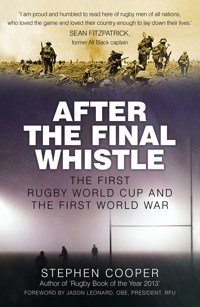
After the Final Whistle: The First Rugby World Cup and the First World War
‘In his award-winning The Final Whistle, Stephen Cooper concentrated on the extraordinary contribution his club Rosslyn Park made to the Great War by telling the story of 15 players who didn’t come back. Now in After the Final Whistle Cooper broadens the scope massively and looks at the “rugby soldiers” of every Allied nation involved. It’s an extraordinary and inspiring tale and concludes, after the Armistice, with teams from those military forces celebrating peace by going head to head in what many would describe as the first World Cup.’
Brendan Gallagher, The Rugby Paper
‘A timely reminder of that fierce spirit which makes us all proud to be a part of rugby.’
David Sole, former Scotland rugby union captain
‘As a rugby player and singer, it is impossible not to be moved by these powerful stories of rugby men in harm’s way. It is comforting to know that they did not die in vain and their nations’ anthems live on. There is silence in the stadium before I perform and then the eruption of sound in the thousands. Team-mates and supporters sing together, it is an incredibly powerful thing. Reading these stories now, gives each anthem a deeper meaning, it gives us our own identity.’
Laura Wright, internationally renowned soprano,rugby player and official RFU anthem singer
‘A triumph: a proper accompaniment to the Rugby World Cup … further proof of the glorious civilising influence of Rugby Union.’
Justin Webb, journalist and BBC Radio presenter
More praise for:
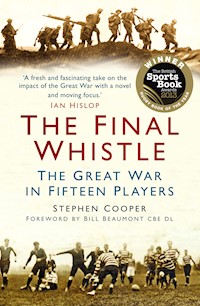
The Final Whistle: The Great War in Fifteen Players, Times Rugby Book of the Year 2013
‘This haunting and beautiful book … tells the story of men from one rugby club but it is a universal narrative of heroism and loss. He writes superbly and has produced a book of commendable scholarship. I cannot recommend it enough.’
Fergal Keane
‘A fresh and fascinating take on the impact of the Great War, with a novel and moving focus.’
Ian Hislop
‘Sensitive, original and profoundly moving’
Sir Anthony Seldon
‘An inspired idea to link rugby and the Great War in this way – it brings home the pathos of these ardently lived lives … an original and illuminating approach to this endlessly fascinating subject.’
Edward Stourton
‘Stephen Cooper has written a book of beauty and sadness … People use the word hero to describe sportsmen but the guys in this book are true heroes. A fantastic and inspiring read from the first page to the last.’
Jason Leonard, Lions & England
‘… a book of stunning quality … a team-full of heartbreaking stories, each going in different and fascinating directions; poignant and powerful.’
Alan Pearey, Rugby World Magazine
‘A fitting tribute not simply to 15 individuals cut down in their prime, but a paean to all those who died in the First World War.’
Mark Souster, The Times
For Clark and Ken Miller:Men of rugby and flowers of Scotland, cut down early.
In Acknowledgement
Like my first, this is a work of personal passion, not of historical erudition. It does not aim to be comprehensive and readers may regret the exclusion of many worthy players and stories; if so, you have my apologies. There are more detailed books in the bibliography if you wish to delve deeper. My thanks go to Jo De Vries and Donald Sommerville for their patience and expertise in improving this one.
In researching this book, I found that national identity mattered less than being part of a worldwide rugby family, then as now. Welshmen coached French teams and played for South Africa, South Africans played for England, Englishmen for Australia and Australians for Britain and the USA. It’s a circle of life where mud is thicker than blood.
I am therefore grateful to an international rugby family who have adopted, tolerated and helped me. If I have overlooked anyone, I am mortified. From England: Michael Rowe, Mike Hagger, Richard Steele and Deborah Mason at the World Rugby Museum, Twickenham. Ian Minto, James Corsan, Nigel Gooding, Colin Veitch, Paul Brennan, David Bohl, Kate Wills, Allan Fidler, Kath Middleditch, Sam Cooper, Ian Metcalfe, Graham McKechnie, Jon Cooksey, John Lewis-Stempel, Gordon Brown, Ian Watmore, Jason Leonard, Bill Beaumont, Richard Daglish, Ron Hall, John Robertson, Jonathan Bunn, Shane Record, Ben Cooper, Roy Barton, Simon McNeill-Ritchie and Patrick Casey.
From Scotland and the exiled diaspora: Hugh Barrow, Paul McFarland, Sandy Fitzpatrick, Mark Taylor, Simon Wood, Ross Cameron, Andy Mitchell, Hugh Pym, Alan Weir, Richard McBrearty. From Canada: Cameron Tompkins, Keith Jolly, Allan Willox, Doug Sturrock. From Wales: Gareth Thomas, Gwyn Prescott and Brynmôr Evans.
From New Zealand: Stephen Berg at the NZ Rugby Museum, Bettina Anderson, Clive Akers, Owen Eastwood, Alan Sciascia, Windsor Jones and Nicola Barrett at National Army Museum Te Mata Toa, Chris Clews and Susan Thomas of Ponsonby. From Australia: Gareth Morgan.
From Italy: Angela Teja, Elvis Lucchese, Luciano Ravagnani, Alberto Cellotto. From Ireland: Sharon Heffernan for her cover picture of son Fionn at Cill Dara training, Ciaran O’Mara. From South Africa: Paul Dobson, Nicky Bicket, Lady Maggie Robinson, Sir Peter Robinson, Floris van der Merwe, Tanya Whitehead.
From France: my guru, Frédéric Humbert, and from Afghanistan: Asad Ziar.
Lines from A.P. Herbert’s ‘Beaucourt Revisited are quoted by kind permission of the Executors of the Estate of Jocelyn Herbert, M.T. Perkins and Polly M.V.R. Perkins. The extract from ‘Mametz Wood’ from Skirrid Hill by Owen Sheers (Seren, 2005) is reproduced by permission of the author, c/o Rogers, Coleridge & White Ltd, London W11. Extracts from Greg Growden, Wallaby Warrior: The World War I diaries of Australia’s only British Lion, Allen & Unwin, 2013, are used by permission. The extract from Mick Imlah’s London Scottish (1914) from The Lost Leader (2008) is copyright the estate of the author and reprinted by permission of Faber and Faber Ltd.
In 2015 we will celebrate rugby’s values with an event that has its origins in war. We also commemorate the men whose sacrifice in that war a century ago, and others since, allows us the freedom to celebrate our game. In a detail buried in the bibliography, Australian captain ‘Paddy’ Moran’s Viewless Winds was published in 1939 by Peter Davies Ltd. This was Peter Llewellyn Davies, who was awarded the Military Cross in the Great War. J.M. Barrie publicly identified him as the source for the name of Peter Pan, although his brother George, killed with the Rifle Brigade in 1915, was perhaps more the model for The Boy Who Wouldn’t Grow Up.
This label of ‘the original Peter Pan’ haunted Davies throughout his life, which ended under a train at Sloane Square. In 2013 Charles Spencer, reviewing John Logan’s play Peter and Alice, observed that Ben Whishaw’s performance suggested ‘a man irretrievably damaged by his experience of war, and who has painfully and repeatedly learned that the only reason boys don’t grow up is because they die’.
Indeed.
Contents
Praise
Title
Dedication
In Acknowledgement
Foreword
1 On Rugby Fields the Whistles Blow
2 The Last of Peace
3 Scotland
4 Australia
5 New Zealand
6 Canada
7 South Africa
8 United States of America
9 England
10 Ireland
11 Wales
12 France
13 No Side
14 The Return of the King
15 Endgame
16 Aftermath and Recovery
17 Rugby Remembers
Bibliography
Plates
Copyright
Foreword
by
Jason Leonard, OBE
This year we welcome the nations of the world to our country for the world’s greatest celebration of rugby. England again hosts the Rugby World Cup for the first time since 1991, an occasion I remember well. Much has changed in our sport since then, not least the advent of professionalism; an event that started in the amateur era of 1987 is now the third largest sporting festival in the world.
But some things have not changed: I am pleased to say that rugby’s values are as strong now as they were then. Those values of teamwork, respect, discipline, sportsmanship and enjoyment have always been there; they have made our game stand out, which is why we now talk about them openly and proudly.
For me, it was a revelation to find that those values were hardened in the most testing of times during the First World War, the great global conflict one hundred years ago that we commemorate today. It was a time of tragedy – and there are many tragic stories here – and it was a time of profound heroism and brave endurance. Rugby played its part at home, at the front and even in prison camps; it is no coincidence that once the horror was over, the instinct was to celebrate with a rugby tournament – the first ever team world cup.
This book demonstrates what all rugby lovers have known for many years, that there is more to rugby than what happens on the field. There is a way of life that comes with it; and a way of thinking that believes in honour, sacrifice, pain and love of team mates and country. We can never compare sport with war, but we can perhaps discover here the well-spring of those beliefs.
I am honoured to have won 22 of my England caps at four Rugby World Cups, including a memorable November day in 2003. I am privileged to welcome the rugby world to contest another great battle in 2015; but I also ask you to remember the players from a century ago who made the ultimate sacrifice in that most brutal of wars. And remember too that, in the worst of times, they found enjoyment in our great game.
Jason Leonard, OBE
President, Rugby Football Union
1
On Rugby Fields theWhistles Blow
Twickenham: Friday 18 September 2015
A whistle sounds at 20.00 GMT at Twickenham to start England’s first game of the 2015 Rugby World Cup against Fiji. It is heard around the world.
Let us go back 110 years.
Crystal Palace: Saturday 2 December 1905
Welsh referee, Mr Gil Evans begins the first meeting between white-shirted England and the All Blacks. He also officiates when Cardiff RFC successively play the All Blacks, the South Africans in 1907 and Australia in 1908; to celebrate this treble, Cardiff present Evans with an engraved sterling silver ‘Acme Thunderer No. 58’. This passes on to countryman Albert Freethy, who uses it to referee the 1924 Olympic Games rugby final in Paris.
Twickenham: Saturday 3 January 1925
At the second encounter of All Black and all-white, Albert has the whistle again. When neither captain can produce a coin for the toss, he flips a florin lent by supporter Hector Gray, who later engraves it with a rose and fern; Freethy blows the Thunderer to dismiss New Zealand’s Cyril Brownlie, the first player sent off in an international Test.
Eden Park: 22 May 1987
By now the sterling silver is nicked and worn with age; every surface is engraved with its history, like battle honours or a trophy. Australian referee Bob Fordham whistles for the start of the first modern Rugby World Cup. The florin has been tossed, and the trusty Acme has blown to kick off every one since.
RC Compiègne, France: Sunday 25 October 2009
On the edge of the Compiègne forest, where the Armistice was signed in 1918, is a rugby field. Two teams of 14-year-old boys surround a memorial bearing fifty-eight French names, all killed in the Great War; the visiting side from England remembers 109 from its own club. On this Sunday morning, before their game, a whistle signals a minute’s silence.
These young tourists from Rosslyn Park, immortal in their teenage rugby swagger, know little of the fate of Australia’s Jim Martin at Gallipoli, Horace Iles from Leeds or John Condon from Waterford, Ireland, at Ypres: all died at their tender age of 14 in that war. But they listen solemnly to a French Army officer who tells them that ‘rugby and warfare share a common language, but – il nous faut souvenir, enfin – they are very different’.
Rosslyn Park, London: Saturday 29 March 2014
A trench whistle starts a match of centenary remembrance, played in baggy cotton jerseys, some splendid facial grooming and under pre-war Laws. This whistle was taken in 1916 from the body of an officer in the Yorkshire Regiment by a German soldier; it was later returned to the regimental museum by his descendants and still bears the scar of a shrapnel splinter.
The shared language of rugby and warfare still prevails today, a century after the war which first connected them, as rugby’s latter-day scribes conjure the stark imagery of conflict. An untried England team under new coach Stuart Lancaster opened their 2013 campaign away to an experienced Irish side; unfancied, they came away from atrocious Dublin weather with an unexpected 12–6 win. One journalist wrote: ‘These are no mere kids who need the roar of a Twickenham crowd to encourage them to puff out chests. These are guys for the trenches, steely and trustworthy.’1 One hundred years later, the rugby field shares a common lexicon with the battlefield.
My generation can still hear in its mind’s ear the sonorous burr of Bill McLaren, ‘voice of rugby’ and former artillery gunner, describing the boot of Gavin Hastings as ‘mighty like a howitzer’.2The Times reported ‘aerial bombardment’ when Wales played New Zealand in 1935; passes are ‘fired’, stand-offs launch ‘torpedo’ kicks, and scrum-halves ‘snipe’ round the blind side. Where did it come from, this language bond between rugby and warfare? And how is it that a century later the imagery born of the Great War is still deployed (see what I did there?) to add colour and drama to sports reports? It is not, heaven forbid, lazy journalism but something deeper, more intuitive, and an echo of shared values.
My conclusion is this. There are many sports that carry danger and physical risk for individual competitors, notably anything to do with horses and cars. Boxers, of course, willingly climb into the ring for a beating, and sadly even cricketers now face untimely death at the crease. Uniquely, however, in team sports rugby players deliberately and consistently, and without the protection of helmets or padding, put themselves in harm’s way on behalf of others – on behalf of the team and in its common cause. This is what soldiers also do, and their comradeship sustains them far more than patriotic ideals or mission statements, or even Kevlar. Perhaps this explains the unconscious bond between rugby and soldiering and, in consequence, an almost symbiotic vocabulary.3
In a far better-qualified view, Australian Army chief General Sir Peter Cosgrove put it more explicitly:
There are similarities between the harsh and lethal demands of warfare and the thrill we get from a full-bodied contact sport like rugby. The thing about rugby is that it does prepare people to keep going under severe stress when things they have to do are extraordinarily hard.4
Cosgrove was not the first military commander to draw the parallel. Admiral Lord Jellicoe, commander of the Grand Fleet in 1914, concurred:
Rugby football, to my mind, above all games is one which develops the qualities which go to make good fighting men. It teaches unselfishness, esprit de corps, quickness of decision, and keeps fit those engaged in it.5
After the war, Field Marshal Sir Douglas Haig declared that team sport required ‘decisions and character on the part of the leaders, discipline and unselfishness among the led, and initiative and self sacrifice on the part of all’. It was his belief that ‘the inspiration of games has brought us through this war, as it has carried us through the battles of the past’.6The Scotsman reported the views expressed at the Scottish Football Union’s AGM in October 1914:
The quick decision necessary to take an opportunity, the dash, the self-restraint, and the consideration for the opponent were most valuable training for both soldiers and sailors, and … was demonstrated by the fact that whenever this country has been at war Rugby men in large numbers went to the front.7
Paddy Moran, Australian captain in 1908, recalling the ‘higher plane of organised roughness’ of university rugby, noted:
When I read of [First Sea Lord] ‘Jacky’ Fisher’s remarks while head of the British Navy, ‘the essence of war is violence; moderation in war is imbecility’, I thought his saying could well have been adapted to the Rugby Football of my own time. It was however largely a good-natured violence. Two commandments on which you were judged and condemned: Thou shalt not squib and Thou shalt not squeal.8
Rugby roughness gave them an appetite for the fight. The rugby writer, Edward (universally known as E.H.D.) Sewell recounts that one New Zealand officer ‘lying smashed by Turkish bullets in hospital assured me that one of his chief troubles on Gallipoli was to keep back the Rugby players. Out of every twenty “first into” the Turkish trench, eighteen were Rugby men.’ Even allowing for the popularity of rugby in New Zealand, this seems statistically unlikely, but we get the point.
In 1916, the Arrow in Australia paid tribute to rugby’s wholehearted response to war:
The only bright spot in all this, apart from the fact that the Allies have the Germans hard on the defence, is that the response by rugby footballers has shown that their game is as fine a preparation for war as anything in the line of sport the world has invented. The response has come from all grades of players, from the juniors to the first graders of ordinary powers to the representative men, and to the men who have retired from play for many years. It is a great thing to dwell upon in this hour of the world’s carnage.
Rugby and the military were already linked before the First World War. The Calcutta Cup, the oldest trophy in international rugby, originated from the army: stationed in India, the 3rd East Kent Regiment (The Buffs) and 62nd (Wiltshire) Regiment established rugby at the Calcutta Club. However, when The Buffs were posted out of India in 1876, enthusiasm for rugby waned and reduced membership forced the club to disband. From the 270 silver Indian rupees left in the kitty, a cup was made with its distinctive design, three cobras as handles and an elephant atop the lid. In 1879, the Calcutta Cup was presented to the RFU to be competed for annually by teams from England and Scotland. The first match, in 1879, was a 3–all draw; it was on 28 February 1880 that England became the cup’s first winners in Manchester.
Rugby, however, had to fight for its place in the British Army: in 1906, there were 578 army soccer teams, with 180 in the Royal Navy. The inauguration that year of the Army–Navy Cup, albeit for officers only, increased participation and rugby grew from its handful of military teams. Successive national tours by colonial teams, starting with the All Blacks in 1905, further developed interest and a steady influx of public school-educated rugby-playing officers into the Regular and Territorial armies meant that rugby was firmly established in the military by 1914.
Sport served a deeper psychological purpose at the front. Volunteer civilians who had dreamed of bloodless glory at the drill halls before August 1914 found the reality of warfare so hideous that they had to seek escape in order to survive. Humankind cannot indeed bear so much reality. Behind the lines, they took refuge from their trench terrors in games which offered a comforting return to a world before war, and an ordered ‘other life’ where war did not threaten to drive them mad. According to historian J.G. Fuller, the soldier ‘sought intervals of pleasure to relieve the suffering, and exercised ingenuity to create islands of sanity in the midst of the horror’.9
Rugby was one such island. With its precise formations, set-piece confrontations, and disciplined rules, rugby restored a sense of order while its physicality and speed took men out of their troubled selves. Even ‘Code Wars’ served a purpose, as one Australian subaltern recalled:
The relative merits of Rugby, Australian Rules and Association were debated as keenly on the battlefields and back areas of France and Belgium as they ever were under the sunny skies of Australia … the argument with the Kaiser was more easily settled than that one. The patronising manner in which a supporter of one particular game would ask another to ‘come and see a real football match’ was most amusing.10
As the French say more elegantly, the more things change, the more they are the same thing. In the 1916 diary of another Australian, Tom Richards, one can hear the yearning for yesteryear mixed with the joy of release. When his 1st Field Ambulance played the 3rd they journeyed eight kilometres by wagon and crossed the River Lys on a raft to a pitch with football posts,
… but no other marks, neither goal lines nor sidelines as the grass was two feet long in patches … the ball could not be seen and the men kicked yards away from the ball … a fellow was laid out and none of our players noticed it … A jolly good experience second only to the first match I saw in England when a hailstorm stopped the play and a ball went into the scrum alright and burst therein; the players could not make anything out of it.11
Where indeed ‘les neiges d’antan’of the rugby field? On the October eve of their transfer to the Somme, he watched ‘the 12th Battalion A Company versus the Bombers’ in an elegiac setting that reminded him of home:
The surroundings were almost Australian in their appearance. The playing field was roomy and the grass delightful both in its softness and colour. A rough hedge of hawthorn and fruit-bearing blackberry bushes protected one side and end, a row of tall majestic trees towered close to the other side and watercress banks of the river framed off the end.
The scene inspired in the soldier-players ‘an unconscious undercurrent to urge on these valiant athletes to fight relentlessly for the honour, the prestige of each particular section’. And although reality will soon bite with the sharpest of teeth, there is a carpe diem. Inevitably in rugby – and without the need for Latin – there is also a whole load of banter:
Tomorrow they will be en route for the Somme and the greatest Hell ever thought of, greater even than man’s imagination is capable of conceiving. But what care they for the morrow, let’s first find out who are the best footballers while there is still time in hand … No player dared make a mistake: in his mess he would obtain no peace for weeks should he fail to keep up his end.
Sport was a great equaliser between officers and other ranks, allowing both to forget themselves and their status for a brief while, yet maintain order and discipline through the rules and behaviour code of the game.
Even as prisoners of war, when they were no longer free to play in green fields, they improvised games in captivity on pitches far less attractive than Richards’s water meadow. Douglas Lyall Grant, of London Scottish, two years a PoW, broke a rib playing rugger on the cinder surface at Gütersloh Offizierslager, and moaned like a schoolboy: ‘It’s rotten, I’m off games for a bit.’ At Schwarmstedt, the pitch was even more hazardous:
The ground can hardly be called suitable, being only 50 yards long and 25 yards wide, while a pump and an electric light pole are obstacles to be avoided. However we had a good enough game with eleven a side and got hot dirty and scraped.12
Improvisation occasionally brought retribution. At Magdeburg, playing in a cobbled courtyard with no leather ball available, officers used a bread loaf; the German guards resented this insult to their Brot and gave them all eight days in the cells. Further proof, if needed, that Fritz was not a sportsman and did not understand the importance of games or fair play. Such shortcomings, in the eyes of soldiers and press barons alike, were directly responsible for the current hostilities. Rugby was played on neutral grounds too: in April 1916, ‘Engeland’ and ‘Schotland’ played ‘het beroemde Engelsche spel, Rugby Football’13 at Leeuwarden, Netherlands. Teams came from 1,500 Royal Naval Division (RND) internees at Groningen, after the disaster at Antwerp had marooned them ashore for four years.
International players were celebrities at the front as at home. Lieutenant Chater writes in some astonishment at witnessing a spontaneous Christmas truce in his sector of the line; he is more impressed at sharing a dugout with David McLaren Bain, ‘the Scotch Rugger international, an excellent fellow’, who would shortly be killed at Festubert. Even generals were caught under the spell of rugby’s stardust, as Henry Grierson14 recounted of one corps commander who ‘came to inspect our Battalion in the front line trenches’ and found Edgar Mobbs, former captain of Northampton Saints and England:
When the GOC saw Edgar, he corpsed the meeting by ejaculating, ‘By Gad, it’s Mobbs. The last time I saw you, my dear chap, was when you and Tarr scored that remarkable try for England against the Australians – let’s go into your dugout and talk over old times.’ And so they did, and the Lt Gen never went near the frontline at all, but talked Rugger instead, to the total amazement of the Divisional Staff. But they didn’t know that General Fanshawe15 was an old Blackheath player.
Just as Jonny is ‘loved by the English, adored by the French’, so too was Mobbs a century before, as rugby crossed the lines of language. Lieutenant Gurney, one of his Saints acolytes now serving under him, recounts a starstruck Frenchman exclaiming: ‘C’est Monsieur Mobbs!’ Gurney indignantly retorted, ‘C’est Colonel Mobbs’. Back came the reply: ‘Je le connais – rugby football – Bordeaux – I play against him.’
The cold statistics of war do not show a ‘lost generation’, a phrase coined by Gertrude Stein, not for those who died, but to describe the war-interrupted survivors drifting through the Twenties – the beautiful and damned of F. Scott Fitzgerald’s novels. Over 8 million men served in the British forces and roughly 10 per cent of them died; this equates to between 1 per cent and 2 per cent of the population as a whole. Comparing census returns of 1911 and 1921 reveals a decline in the male population of military age of some 14 per cent. The influenza pandemic that raged globally through 1918 and beyond also took its own deadly toll of that generation,16 unusually striking the young far more than its customary victims of infants and the elderly. Death in war does not spread itself evenly; like life, death is not fair, but indiscriminate.
Disproportionate blows fell on tight-knit communities who joined up together and fought in the same murderous battles: ‘Pals’ battalions from Accrington and Barnsley or the Tyneside Irish and Scottish were more than decimated in 1916. But other sections of the population not so easily tagged with local labels suffered as much. If 10 per cent of all combatant men died, the death rate for line officers was double at 20 per cent. A gruesome feature of Rosslyn Park’s death roll of 109 names17 is the number shot in the head. This is more than an occupational hazard of trench warfare, or the absence of top cover before the ‘Brodie Bowler’ helmet became standard issue in January 1916: it is because these were junior officers who led their men over the top and on patrol, peered over parapets, helped drag wounded soldiers to safety, only to be shot for their pains, or were picked off by snipers while checking on fright-weary sentries on their nightly rounds.
There is no statistical analysis of rugby players who died. Nor would it be possible to define the sporting allegiance of the 888,246 British and Commonwealth soldiers represented by a blood-red sea of ceramic poppies in the moat of the Tower of London. Those who both played and died for their country are the most celebrated. By my count, 137 capped players died in this war from Britain and its Empire, France, USA and even Argentina:18 its side that played the British in 1910 lost forward Frederick Sawyer at the Aisne in 1917.19 But time and again, when photographs are shown, or stories are told of fifteen men together, or a game of thirty, there is a consistent fraction: ONE THIRD. Rugby players suffered a death rate between 30 per cent and 35 per cent.
Let us inspect the anecdotal evidence at school, club, or international level: Rosslyn Park lost 109 of some 350 who served, six from its 1910 XV photo; six of the XV of teenage Battersea schoolboys at Emanuel School in the 1914–15 season and six of their counterparts at Edinburgh Academy, or eight from its 1905 championship-winning side. Five Blues from Oxford’s 1910 Varsity team perished, six of the French side at Swansea that year, and eleven from Scotland’s clash with South Africa in 1912 (nine being Scots). Always a third or more.
The sorrowful roll call continues. Eight from Glasgow Academicals Football Club XV in its final pre-war season; six from that season’s Liverpool FC, one of the greatest rugby club sides ever, with three national captains, two of them destined to fall in action; seven from 1913 French champions Aviron Bayonnais and from their Perpignan successors, five of the Barbarians side against the Royal Army Medical Corps (RAMC) at Richmond in 1915, including three international threequarters. And so on. Statistics are not everything in life – proverbially, they come a poor third to lies and damned lies. But in death, the ‘killer stat’ – ONE THIRD – will shake his bloody locks and haunt the many rugby teams of this book.
The Five Nations finale of April 1914 was poignant: it was the last peacetime international in Europe before the conflagration, with death’s shadow hovering over eleven doomed English and Frenchmen. The March Calcutta Cup game in Edinburgh was even harder hit, with twelve gladiators about to die, a misfortune of 40 per cent: Scotland would lose seven of its flowers; five Englishmen would wither in the earth, including the tallest poppy, Ronald Poulton-Palmer. Most tragic is an unlucky thirteen scholars destined to die from a 1912 Varsity Match that featured nine internationalists and twenty-eight who fought.
Despite this litany of death and injury, rugby emerged reinvigorated; it got up off the floor after a multitude of crushing tackles and went at it again. After the fighting was finished, soldiers once more played rugby in 1919; they celebrated their victory and survival – and the memory of team-mates – with a unique festival: the first ever rugby world cup. This book tells that story.
During the war, the No. 58 Thunderer was the standard issue whistle for artillery crews, warning them to keep clear of the recoil, before it returned to its peacetime role on the sports field. For the record, when the whistle blew in 1905, the All Blacks won 15–0. Twenty years later, down to fourteen men after Cyril Brownlie’s dismissal, they still beat England 17–11 to the silvery sound of Freethy’s blast. In 1987, when the same whistle first blew for the modern Rugby World Cup, hosts New Zealand went on to beat Italy 70–6 in Auckland. This black pattern with a silver accent will be broken when England kick off against Fiji at Twickenham on Friday 18 September 2015. But the century-old whistle will add to the mystique of a sporting celebration that was first born out of a terrible war
In 2009, Rosslyn Park’s U14 lads went on tour and played lesgars from RC Compiègne; the result and score will forever stay on tour, as it must. And in 2014 at Roehampton, as we remembered 109 men who made the ultimate sacrifice, no one was counting the score – not even the actuary who ran touch.
Rugby won the day.
Notes
1Daily Telegraph, 11 February 2013.
2 McLaren served in Italy in the Second World War, and was at Monte Cassino.
3 I am grateful here for a conversation with my friend Roy Barton; if you don’t agree, it’s his fault.
4 MC in Vietnam, Chief of Defence Staff 2002–05; Governor-General from 2014.
5 E.H.D. Sewell, The Log of a Sportsman (Unwin, 1923).
6 Gary Sheffield, Leadership in the Trenches (Macmillan, 2000).
79 October 1914.
8 Moran, Herbert, Viewless Winds – being the recollections and digressions of an Australian surgeon (P. Davies 1939).
9 Fuller, J.G., Troop Morale and Popular Culture in the British and Dominion Armies (OUP, 1991).
10 Ibid.
11 Growden, Greg, Wallaby Warrior: The World War 1 Diaries of Australia’s only British Lion (Allen & Unwin, 2013).
12 John Lewis-Stempel, The War Behind the Wire (Weidenfeld & Nicolson, 2014).
13 The famous English game.
14 Henry Grierson, The Ramblings of a Rabbit (Chapman & Hall, 1924).
15 Lt Gen. Edward Fanshawe, who took over V Corps from his brother Hew, sacked by Haig for daring to defend a scapegoat.
16 Some 3–6 per cent of the world population died in the epidemic: 17 million in India, 400,000 in France and 250,000 in Britain.
17The Final Whistle, listed eighty-seven names in 2012; twenty-two more have been discovered since; history may be in the past, but it is not fixed.
18 Gwyn Prescott’s list is the best, but I have added George Pugh, Australia and Paul Fauré, France.
19 Lt F.W.C. Sawyer, Royal Engineers, killed 4 April 1917.
2
The Last of Peace
Oh, we don’t want to lose you but we think you ought to go, For your King and Country both need you so.1
It was an August Bank Holiday weekend.2 As cricket-lovers at the Oval watched a young Jack Hobbs stroke his way to 226 against Nottinghamshire, the cries of the newsboys around the ground were ominous: ‘MOBILISATION OF THE FLEET’, ‘GERMANY IN THE NORTH SEA’ and – in Cockney tones – ‘SPRECHEN SIE DEUTSCH’. On Saturday morning, Ronald Poulton-Palmer had reported for duty with his 4th Royal Berkshire Territorials as they prepared to leave for their annual fortnight’s camp near Marlow. But there was an expectation of more news: France, Germany and Russia were already at war.
Just fourteen weeks earlier ‘R.P.P.’ had been at the Stade Olympique at Colombes near Paris, captaining England to a successive Grand Slam, and scoring four tries in the process. This was a flourish to the nominal Home Nations ‘championship’ of those amateur days, as the French were still finding their feet in international rugby. Indeed, France and Scotland did not meet that year: their previous match in Paris had degenerated into a riot, and the scandalised Scots declined to host the French in genteel Edinburgh.
There had been little to choose between England, Wales and Ireland, although the real thriller was the Calcutta Cup in Edinburgh when the unfancied Scots ran England close, forcing them to hang on for a narrow win by a single point, 15–16. England claimed the Triple Crown and went to Colombes for the coup de grâce. Ireland and Wales contested second place, each having beaten Scotland. The game in Belfast was brutal, as the Welsh pack justified its reputation as ‘The Terrible Eight’. Several stoppages delayed play as bleeding men were treated for injuries. A torrid private battle took place between Welshman Percy Jones and Irish pack-leader William Tyrrell, which went way beyond Moran’s ‘good-natured violence’; in later years, after bloodier slaughter put rugby brawls in perspective, Tyrrell – by now Air Vice-Marshal Sir William Tyrrell, a grandee of the Irish Rugby Union – specifically asked to sit with his erstwhile adversary Jones at a post-match dinner. They did not talk about Fight Club.
France, like Scotland, had lost all their games. But they scored first and were in the contest till the break when England led 13–8; in the second half the white shirts ran away to win 39–13. On top of R.P.P.’s four, Cyril Lowe, a wing considered too small by some at 5ft 6in, scored a hat-trick; he played twenty-five consecutive matches and was for long years England’s record try-scorer. Of the thirty players who took the field, eleven were killed in the war. For England, surgeon James ‘Bungy’ Watson died when a torpedo sank HMS Hawke; Francis Oakeley drowned as a submariner; Jimmy Dingle fell at Gallipoli; Arthur Harrison earned a posthumous Victoria Cross for his action at Zeebrugge in 1918; Robert Pillman and Poulton-Palmer died in Flanders. On the French side the fallen were Marcel Burgun, who was shot down, Jean Larribau, Emmanuel Iguiñiz, Paul Fauré, and Jean-Jacques Conilh de Beyssac. Of the six Englishmen, four have no known graves, the bodies of three naval officers Watson, Oakeley and Harrison lost in the North Sea, and Dingle in Turkey. The pair with the dignity of a headstone, Poulton-Palmer and Pillman, are six kilometres apart at Ploegsteert, Belgium.
At 11 p.m. on 4 August, Britain’s ultimatum expired and a state of war was declared with Germany. The next day dawned in Sydney twelve hours before it did on the Greenwich Meridian. The touring All Blacks played a Metropolitan XV at the Sydney Sports Ground. A message in stark capitals was placed on the scoreboard: WAR DECLARED. Ironically, the match proceeds were designated for sending an Australasian team to the Olympics planned for Berlin in 1916; many athletes, by then known as Anzacs, were still making strenuous efforts to get to Berlin in the summer of 1916, but were unavoidably, often permanently, detained by events at Pozières. Instead of funding an unlikely Olympic challenge, the New South Wales Rugby Union duly noted that ‘much activity was devoted to the recruitment of members for the Expeditionary Force’. Ten days later, the kick-off for the last Test between the Wallabies and All Blacks was moved to 2 p.m. so the New Zealanders could board their ship home, which under new wartime regulations had to be out of Sydney Harbour by sunset, or be made to wait at the dock until next sunrise.
British rugby’s first act of war on 5 August, within twelve hours of its declaration, came from Birkenhead Park: it was the first club to offer its ground and pavilion to the military. That morning the decision was steered through committee by former England captain Percy Kendall, who then promptly rejoined his former local Liverpool regiment in the afternoon. Another England cap at Birkenhead, RFU selector James ‘Bim’ Baxter, ‘went afloat in the RNVR and served afloat to the end.’ E.H.D. Sewell wrote: ‘For instant patriotism, Birkenhead Park RUFC stands out as the most brilliant example of record.’
Across the Pennines, in Yorkshire’s Wharfedale, Jack King was haymaking on his farm at Ben Rhydding with fellow Headingley forward, Thomas Lumb, an agricultural student whose ‘boundless energy and high spirit’ at Leeds Grammar School had earned him the nickname ‘Busty’ (no, me neither). Out in the field, Tommy, an ‘enthusiastic Territorial in the Yorkshire Hussars of some years standing’,3 was handed his mobilisation papers: ‘Sorry, Jack’, said he, ‘but I’ll have to chuck now, pack up and make a bee line for headquarters – we are called up.’ His friend enquired about the procedure for joining the Hussars, ‘for I intend to come with you’. It was a Boy’s Own adventure.
Jack left his home on Thursday 6 August, ‘without fuss or show or noise, and with a few instructions to his sisters as to the management of the farm’ (so far so Yorkshire), never dreaming that he would do anything but walk straight into the Yeomanry. But Jack King was rejected by King’s Regulations: he was an inch short of the 5ft 6in required for military service. He grew remarkably quickly and three days later became a trooper in His Majesty’s Army: it was 9 August, the same date he would die two years later at the Somme. His friend Corporal Busty Lumb died in May 1915 at Ypres, aged 22; his body could not be found, but his name can – on the Menin Gate Memorial. Major Lane-Fox of A Squadron wrote of him: ‘I had only recently promoted him to Corporal, and no promotion ever gave greater satisfaction throughout the Squadron, for there was no more rightly popular man.’
Frank Mellish, still at South African College School in Cape Town, was summoned to the headmaster’s study. Although he could not recall committing any heinous crime, the 18-year-old took the precaution,
to slip my atlas inside the seat of my pants and unwittingly adopting the gait of a stiff-legged cowboy, did as I was bid. In the tense, curt Scots manner of our Headmaster we were told that Germany had declared war on Britain and that automatically meant on South Africa as well. We, being members of the Union Defence Force, were to report immediately to the Drill Hall, collect our uniform and be sent wherever we were required.4
Once Bank Holiday Monday was over, a total of 8,193 men enlisted between Tuesday 4 and Saturday 8 August. Many of the most eager were rugby players: one who signed his attestation papers on Wednesday at the Artists’ Rifles’ HQ was Rosslyn Park’s Eric Fairbairn, an Australian-born oarsman and Olympic medallist; another was clubmate, Robert Dale.5 Charles Alvarez Vaughan, a Middlesex and Barbarian winger of rare pace, working in Colombia on his family tobacco estates, received a cable requiring him to take up his post in the Reserve. On 17 August, poet Nowell Oxland took his army medical in Oxford, where he was studying. The number of volunteers climbed exponentially: by the third week of August, it was 49,000, by the fourth 63,000, and in the first week of September, it reached almost 175,000.
In Scotland, on 10 August, the SFU donated £500 to the National Relief Fund, offered the Inverleith ground to the military, and asked club members ‘to do something for which the training in discipline and self-control given by our Game has fitted them’. By the time of its 8 October AGM, many attendees were in khaki. President Dr James Greenlees, a Lorettonian and four-time Cambridge Blue with seven Scots caps, sent apologies – he was with the RAMC in an army field hospital in France. Twenty-four clubs provided figures – out of 817 players, 638 had enlisted. In Ireland, the Irish Rugby Union Volunteer Corps was established before the British Expeditionary Force (BEF) had landed in France. England’s RFU, wrong-footed at holiday time by the threat posed to the forthcoming season by this national emergency and by players’ headlong rush to join up, did not immediately cancel fixtures but issued a circular to clubs on 13 August:
The Rugby Union are glad to know that a large number of their players have already volunteered for service. They express a hope that all Rugby players will join some Force in their own town or county.
Nine days later scrum half Gordon Bayly of Rosslyn Park and his pilot Vincent Waterfall, another ‘keen sportsman’, were the first British airmen to be shot down by enemy fire on 22 August, as they reconnoitred German columns moving on Mons. The unimaginable scale of the mechanised slaughter to come was measured by the death of 27,000 French soldiers on that single August day.
Gloucester Football Club reservists like Boer War veteran and hooker Fred Goulding, ‘A’ team full back William Hancock and centre Bernard Roach had been immediately recalled to the Colours; Hancock and Roach were dead by Christmas. It was clear within days that a New Army was needed and Kitchener’s famous finger was pointed; on 28 August, at a recruitment drive at Gloucester’s Shire Hall, Major Collett called for twenty-five enlistees to join the territorial 5th Gloucestershires, to bring the battalion up to strength. Between 300 and 400 men rushed the platform, led by a rugby player:
… a tremendous cheer went up when Sid Smart, the Gloucester footballer and English International took his place on the platform and similar demonstrations were accorded to the Captain of the Gloucester football team, [Lionel] Hamblin and his colleagues, Albert Cook and [William] Washbourn.6
Most Gloucester FC players joined the 5th; faced with its players marching to war, the club had little choice. On 2 September, it issued a statement:
… practically the whole of the playing members have enlisted but in any case the Committee would not have felt justified in fulfilling the fixtures even if the players were available owing to the rapid change of the situation in connection with the war.7
Local newspaper The Citizen announced that its sporting edition would no longer be published; any games played would be considered unpatriotic and would not be reported in its pages. Yorkshire’s Committee met on 31 August for the first time since the declaration and passed a resolution that ‘all football in the county be suspended during the continuance of the war, and we strongly appeal to our players to join some unit for the defence of the country’.
On Saturday 5 September, with most players and clubs already ahead of them, the RFU cancelled all matches for the 1914–15 season. In Glasgow that Saturday, instead of preparing for an afternoon match, the Honorary Secretary of the Academicals, John Macgill, was typing a flurry of urgent correspondence. In his haste, secretarial accuracy deserted him. He replied to Dr James Nicoll, who had offered funding in the current crisis:
As I expected, the Meeting on Thursday decided to cancel all Football fixtures. The Meeting thereafter considered what could be done in the club to further recruiting. It was resolved to try to raise an Academical Company to form part of the battalion of commercial men which is being got up by the Chamber of Commerce. So far I have got about 35 names. With regard to your very kind offer to contribute to any expense which might be incurred in connection with the formation and equipment of an Acamedical [sic] Corps, of course with our present scheme we do not anticipate any outlays, but at some future stage there may be some scheme of training Acamedicals for which funds will be required.
He wrote next to A.D. Lawson, his ‘oppo’ at Gala Football Club to cancel their forthcoming fixture. He then confirmed to one of those ‘35 names’, William Mercer Alexander, that:
I have your wire and confirm in reply that I have entered your name in the Academical contingent being formed for services in Kitchener’s Army. The idea is that our contingent, the members of which will be kept together, forms a unit of the Battalion of Commercial men.8
As Second Lieutenant Alexander, 17th Highland Light Infantry, William would lose his life on the first day of the Somme; he rests in name only on the Thiepval Memorial.
In Ireland, Harry Magrath, of Cork Constitution, younger brother of Irish cap Dickie, was elected captain for the 1914–15 season. When war was declared, it was agreed to play charity matches only: the last played was the Charity Cup final against University College Cork on 19 December, which Constitution won 5–3. Thus Harry had the pleasure of captaining his team to its last success before all rugby activity was suspended for the duration. Serjeant Magrath, 24th Royal Fusiliers, met his death at Beaumont-Hamel on the Somme in November 1916.
Football, meanwhile, attracted nationwide derision and critical column inches in equal measure for its ‘unpatriotic’ stance. Professional clubs saw no good commercial reason to cancel players’ annual contracts for a war that would assuredly be over by Christmas, and kept the turnstiles clicking; the players just wanted to earn a crust – the first Lamborghini was not built until 1963 so what else was there? Not only players but spectators too were accused of shirking:
Every club which employs a professional player is bribing a needed recruit to refrain from enlistment, and every spectator who pays his gate money is contributing so much towards a German victory.9
Recruiters were frustrated in their September efforts outside football grounds where ‘the results were grievously disappointing’:
There is apparently something about the professional football match spectator which makes a recruiting appeal a failure. At the Chelsea ground … not a man was induced to join. At other football grounds appeals were made, and with equal ill-success. This failure contrasts strongly with the wholesale volunteering which has distinguished the performers and the devotees of other forms of sport. Rugby Union clubs, cricket elevens, and rowing clubs throughout the kingdom have poured men into the ranks. The dismal story of Saturday’s recruiting is relieved by one man who volunteered at the Woolwich Arsenal ground.10
You can almost hear them chanting, ‘One-Nil to the Arsenal’. When Saturday came, women with white feathers were the only ones who did a roaring trade, often mistakenly picking on soldiers in mufti simply hoping for some afternoon entertainment while in training, recuperating from wounds or (less likely) on leave.
Bolts of fury were hurled at football from press and pulpit alike. On 30 August, the Reverend Youard, clearly a Christian of the muscular persuasion, addressed his flock at St Swithun’s. He considered the balls of the battlefield, how they roll not, neither do they spin, except in oval shape, and urged:
… every able-bodied young man in East Grinstead to offer yourself without delay in the service of your country. The Welsh Rugby Union Committee has passed a resolution declaring it the duty of all football players to join immediately. Blackheath Rugby Football Club has cancelled all its matches for the same reason. That is the right spirit. I hope it will be imitated by our own clubs. Go straight to the recruiting officer and offer yourself. That is the plain duty of every able-bodied young man today.
A letter from ‘A Soldier in France’ complained that ‘hundreds of thousands of able-bodied young roughs are watching hirelings play football while others are serving their country’. On 6 September, Sir Arthur Conan Doyle, in a recruiting speech, borrowed liberally from Ecclesiastes when he addressed footballers:
There was a time for all things in the world. There was a time for games, there was a time for business, and there was a time for domestic life. There was a time for everything, but there is only time for one thing now, and that thing is war. If the cricketer had a straight eye let him look along the barrel of a rifle. If a footballer had strength of limb let them serve and march in the field of battle.
They did not turn: a propaganda poster lamented ‘When will they ever come?’ Another man of God, the Bishop of Chelmsford, preaching a pointed sermon:
… in an address on Duty, spoke of the magnificent response that had been made to the call to duty from the King. All must play their part. They must not let their brothers go to the front and themselves remain indifferent. He felt that the cry against professional football at the present time was right. He could not understand men who had any feeling, any respect for their country, men in the prime of life, taking large salaries at a time like this for kicking a ball about. It seemed to him something incongruous and unworthy.11
You might very well think that, my Lord Bishop; I couldn’t possibly comment.
Frederick Charrington, scion of the brewing family, accused West Ham United players of being effeminate and cowardly, getting paid to play while others fought. Celebrated all-round sportsman, C.B. Fry, Corinthian legend and FA Cup finalist with Southampton, called for football to be abolished: all professional contracts should be annulled and no one below forty should be allowed to attend matches.
In December, William Joynson Hicks12 established the 17th Battalion, Middlesex Regiment, which quickly became known as the ‘Football Battalion’. Within weeks he had a full complement of 600 men; few were footballers, most being fans who wanted to slope arms with their idols. Mr E. Cunliffe Owen wrote to the Daily Telegraph from the Hotel Cecil, under the heading ‘The Footballers’ Chance’:
Sir – Without entering into the controversy as to whether football should cease or not, may I point out that there is an honourable alternative for the man who ought to serve his country and yet must play and talk football – namely, to join the 2nd Sportsman’s Battalion Royal Fusiliers, the battalion which is now recruiting at this hotel. The corps already contains well-known footballers, and friends joining at the same time, who have interests in common, can be kept together, live in the same hut, and so on. They need not altogether sacrifice their love of sport while training for the great international now being played in northern France.
But as late as March 1915, only 122 of 1,800 registered professional footballers were reported to have joined the Colours. The public voted with their feet and gates fell by more than half; the Football Association finally bowed to popular pressure and suspended the game on 23 April, the suitably patriotic St George’s Day.
Amateur rugby by contrast rushed to war: 90 per cent of players were in uniform by the end of 1914. Mr Edward Roper of Liverpool FC proudly told the Daily Post on 1 September that ‘between 50 & 60 of the club’s players had joined and there was not a player left’. By December, recruiting posters hailed the ‘Rugby Union Footballers Doing Their Duty’ as a ‘Glorious Example to British Athletes’. The Times thundered: ‘Every player who represented England in Rugby International matches last year has joined the Colours.’ Indeed they had, and twenty-six England men would die over the next four years, with a twenty-seventh a week after the Armistice. Leonard Tosswill, of Bart’s and Middlesex, ever-present in England’s 1903 side, an RAMC medic and later eye-surgeon, declared that a man ‘who had learned to “play the game” on football grounds might be trusted to do no less in the greater game of war [and] answered the call of his country as he would to the whistle without questions’.13
The approbation of rugby’s patriotic leadership by War Office propagandists and opinion formers in the national press was even extended to the enemy. Or at least to one representative of the otherwise ‘vile Hun’ who showed himself to be ‘a jolly good sport’ of the right sort. The German cruiser SMS Emden had sunk 74,000 tons of shipping in the Far East; one night HMS Yarmouth, escorting a merchantman out of Singapore, reportedly received an unexpected signal:
‘Captain von Müller of the Emden and the ward-room mess send their compliments, and would be obliged if the Yarmouth would let them have the result of the inter-regimental Rugby Football match.’ The result of the match, which had taken place that afternoon, was duly given together with the intimation that it would not be long before British Sportsmen in the East had the pleasure of the Captain’s company at all field and track events.14
When Emden was finally sunk by HMAS Sydney, her captain was mourned: ‘It is almost in our heart to regret that the Emden has been captured and destroyed; we certainly hope that Commodore Karl von Muller, her commander, has not been killed, for, as the phrase goes, he has shown himself an officer and a gentleman.’15
There never was a Rugby Battalion, as there was a Footballers’ or Sportsman’s (17th and 23rd Middlesex). The reason was simple: all the rugby players had already joined up and were dispersed among the Regular and Territorial regiments. Nonetheless representations were made, and on 9 September, RFU Secretary C.J.B. Marriott issued another letter:
RUGBY FOOTBALL UNION AND LORD KITCHENER’S ARMY
On reference to the authorities, the Rugby Football Union find it is not feasible to form a separate battalion of Rugby men. They have received, however, answers from various Commanding Officers saying that they will gladly accept for their Regiments a company about (120) of Rugby men, who could be enlisted together.
A very large number of our players have already responded to the previous letter of my Committee and joined some Corps, but it is probable there may be some others ready to enlist. I will therefore enter names sent in to me, and as soon as I have enrolled sufficient to form a company, will send them on to a Commanding Officer for enlistment as a Football Company in Lord Kitchener’s Army.
Marriott’s company was never incorporated; the workings of committees may be tolerated as a necessary evil in peacetime, but rugby players preferred to follow charismatic leaders to war. One such leader was Edgar Mobbs.
If one man epitomised rugby’s contribution to the war effort, it was Edgar Roberts Mobbs. This tall, powerful winger with seven England caps had captained his country once (‘the Ultima Thule of any Rugby player’s ambitions’, he told the Boy’s Own Paper) but held his home town crowd at Northampton Saints in thrall for seven years and 177 tries as its leader; Saints were not the power they are now, and many viewed Mobbs as ‘carrying the team on his shoulders’. His East Midlands Counties was the only provincial side to beat the touring Australians and he had the personal satisfaction of England’s first try against Australia.
Too old at 32 for a commission when Kitchener made his first call for 100,000 men in August 1914, Mobbs enlisted immediately as a private soldier. Like some energetic feudal squire, he set about raising a company of 264 like-minded local sportsmen, which became D Company, 7th Northants, known as ‘Mobbs’ Own’ – readers may remark the thread of rugby-playing D companies woven through these pages. ‘On 14 September, he marched away from the Northampton barracks at the head of the company he had raised, to entrain for a military camp’, wrote Sewell. Despite the private taking a presumptuous lead, he was not formally commissioned until the end of training.
George Percival, fourteen years a diminutive Saints scrum half with ‘attitude’ (goes with the job), played under Mobbs and followed his call. The recruiting sergeant thanked him politely, but pointed out he was too short. Percival protested: ‘My captain said to come and join up, so here I am.’ The language became more Anglo-Saxon, and when the sergeant threatened to kick him out the door; George turned on him: With ____ like you running this war, you’ll soon kill off all the tall men, and then you’ll have to come for me, ’cos I won’t come willing.’ Two years later they had killed off the tall men, lowered the height restrictions, and sent George his call-up papers, which he ignored. Eventually two redcaps came to his house, only to find him packed and ready to go: ‘I told you ____ in 1914 you’d have to come and fetch me, and now you have. Let’s go to war.’
Mobbs was a one-man recruiting machine; when he wasn’t recruiting, he played rugby and often combined both. He sat on the wartime committee of the Barbarian Football Club (along with England’s Bruno Brown, Cherry Pillman and Harold ‘Dreadnought’ Harrison). In training at Shoreham Camp, he captained a team against his own Baa-Baas in a December match ‘in aid of Lady Jellicoe’s North Sea Fleet Comforts Fund’. As 1915




