


2,99 €
Mehr erfahren.
- Herausgeber: Patrizio Corda
- Kategorie: Geisteswissenschaft
- Sprache: Englisch
12 BC. - Marcus Vipsanius Agrippa Postumus is born in the most prosperous period of the Roman Empire, in which in power is its founder Augustus himself.
The son of the famous Agrippa, he can also claim membership to the Julio-Claudian dynasty on his mother's side.
With Augustus struggling with a scarcity of direct heirs, everything would suggest a bright future for Agrippa within the dynasty.
But his very existence will prove to be a problem not only for the Caesar's plans, but also and especially for those who aspire to alter them. Determined to assert his independence and freedom in a court plagued by conspiracies and subterfuges, Agrippa will endure countless trials and suffer as many abuses.
Until when, with Rome now seemingly unattainable, he will have a new opportunity to choose between eternal glory and oblivion.
Das E-Book können Sie in Legimi-Apps oder einer beliebigen App lesen, die das folgende Format unterstützen:
Veröffentlichungsjahr: 2024
Ähnliche










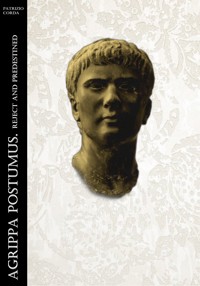
Agrippa Postumus. Reject And Predestined
Indice dei contenuti
AGRIPPA POSTUMUS. REJECT AND PREDESTINED
Patrizio Corda
I
ii
III
IV
V
VI
VII
VIII
IX
X
XI
XII
XIII
XIV
XV
XVI
XVII
XVIII
XIX
XX
XXI
XXII
XXIII
XXIV
XXV
XXVI
XXVII
XXVIII
XXIX
XXX
XXXI
XXXII
XXXIII
XXXIV
XXXV
XXXVI
XXXVII
XXXVIII
XXXIX
XL
XLI
XLII
XLIII
XLIV
XLV
XLVI
XLVII
XLVIII
XLIX
L
LI
LII
LIII
LIV
LV
LVI
LVII
LVIII
LIX
LX
LXI
LXII
LXIII
LXIV
LXV
LXVI
LXVII
LXVIII
LXIX
LXX
LXXI
LXXII
LXXIII
LXXIV
LXXV
LXXVI
LXXVII
LXXVIII
LXXIX
AUTHOR'S NOTE
THANKS
Literary property reserved ©2024 Patrizio Corda
AGRIPPA POSTUMUS. REJECT AND PREDESTINED
Patrizio Corda
To my readers
I
Never anyone
Rome, May 12 B.C.
He entered the immense mausoleum quietly, away from the eyes of the guards who would normally have watched him night and day. He did so slowly, with hesitant little steps and without any of the vestments with which the empire was now used to seeing him.
Wearing, Octavian had nothing but a long, creased white tunic and simple leather shoes. Only his ring, certifying his role as princeps, had escaped that undressing that smacked of spontaneously inflicted humiliation.
Reflecting the light from the flashlight he was weakly holding, this helped him make his way through the large circular room, then pointed him to where he was headed. The air, burdened more by its tension than by the night humidity, wrenched a sob from him.
But Octavian, who at that moment had nothing of Augustus, did not stop. He cleaved through the darkness, a slender, undefined silhouette that well knew he was under the observation of elusive but undoubtedly there presences.
So he arrived at the cell he had promised himself to visit every single night since his life had changed beyond repair.
Rummaging through the folds of his tunic, he pulled out the set of keys that only he possessed and opened the lock. The wonderfully historiated wrought-iron gate opened meekly and unopposed, barely emitting a squeak that the emptiness all around reverberated, giving it a sinister note.
Then, after shaking a tuft of his once-blond hair from his forehead but which in recent years had taken to greying, Octavian leaned over the urn. So he sighed.
With all the pain that until then he had not allowed himself to externalize, repressing it in the innermost recesses of his soul.
"My friend..." he murmured, as his eyes ran swiftly over the carving that adorned the white marble base that supported the urn. He felt a pang in his chest as he remembered the name.
Marcus Vipsanius Agrippa.
Distraught, Octavian shook his head in desolation.
How could this have happened? Why, just when every enemy had been vanquished and the empire was entering a new golden age, had his right arm had to be shut down?
What cruel mockery had the gods reserved for him?
He had always thought that the first to die would be him.
Throughout his life, Octavian had been in poor health and several times had been close to leaving the earthly world.
Agrippa, on the other hand, had always been a colossus, in body and mind. Tireless, courageous, and above all loyal, he had repeatedly been decisive and providential in situations that had seemed irreparable even to him. And when power had come, he had never shown the slightest resentment in stepping back, granting him all the glory by virtue of his noble birth. What a man he had been!
An irreproachable general, he was also an able politician and a righteous administrator, whose public works had added luster to the empire they had founded together.
But above all, Agrippa had been a sincere friend to him.
An often silent but always present companion, the kind capable of understanding the thoughts of others without the need for vocal confrontation. To each of Octavian's insights, he had responded by making himself available, whether it was to suppress a rebellion or to bring order to distant and unknown lands.
If only he had not had humble origins, he would undoubtedly have been worthy of receiving his own honors.
But by now those were but futile fantasies, conjectures pleasant in the immediate term but painful in the long run, complicit in the impossibility of turning them into reality.
Although he was first among the first, the prince of the Senate, the emperor of the Romans, Octavian reminded himself that he was, before anything else, a man. And as such, he could not have changed what he had been. Agrippa had died suddenly, while returning from Syria with the intention of initiating the conquest of Illyricum. But above all, he had died doing what he had always loved. Serving him.
And he, on the other hand, would have to face reality in a new way, bearing alone that immense burden they had always shared. Though ashamed, Octavian wondered if he would ever succeed in that difficult task.
Of course, by his side was still his wife Livia, a woman of formidable political intellect. But Livia was not Agrippa, nor could she ever have been for any number of reasons.
Nor would those around him, from family members to close associates, have been able to wear his shoes worthily. Not because they were incapable - some were - , but simply because he would never be able to trust them to the extent that he had blindly relied on his friend's instincts.
Stifling the instinct to indulge in tears, Octavian barely stroked the urn, almost fearfully, as Agrippa's face came back to life in his mind. So he pulled himself up, groaning.
He remained standing, alone in the midst of the darkness that seemed capable of extending to the far reaches of the world.
And for the first time in his life, he felt lonely.
Completely alone and abandoned.
He realized then that building the empire from scratch had been an arduous task, and that finding someone to entrust it to in the future would be even more difficult.
Overwhelmed by doubt, sadness and the knowledge that that wound would never heal, Octavian preferred to shirk the darkness. So he closed the gate and made to take the exit. Then, however, he could not resist the impulse to turn one last time toward the urn.
Letting go, in a puff of breath, of what he had always known from the beginning and was now a devastating reality.
"Never anyone, my friend. Never will anyone be worthy of you."
ii
A name, a memory, an order
Rome, June 27, 12 B.C.
As the creature slept unknowingly in her arms, Julia could do nothing but think of the words her mother Scribonia had told her so long ago.
The more children you have with a man, my dear, the more they will end up looking like him. Until on their faces you will not find a single trace of you.
Exactly the scenario in which Julia had found herself.
Already in the children she had previously had, Gaius, Lucius, Agrippina, and Julia, she could see similarities with their father, more than there were with her. But that child was something else entirely.
There was no reason why he looked so much like Agrippa, having just come into the light. Looking at him more closely, Julia almost went so far as to twist her muzzle in disdain.
Bringing him into the world had been more painful than the other times, and this was more than justifiable given the baby's exaggerated size.
But the most striking thing was how he already, unquestionably, manifested all the somatic traits of Agrippa.
That infant looked like an exact copy of the giant, perpetually scowling man she had been forced to marry years earlier at her father's behest after the unfortunate death of her first spouse, her beloved cousin Marcellus.
The already prominent forehead, the small, deep, dark brown eyes, and especially the hard, square shape of the face and the disproportionate nose already hinted that, once he grew up, these would be hailed as a revived Agrippa.
There was no trace in him of what Julia loved most about him, namely his big green eyes and shiny black hair.
In contrast, the little one already sported several blond wisps.
The exact shade of Agrippa's hair.
By dint of staring at him, Julia felt a growing annoyance mount within her.
But just as she was about to entrust it to the handmaids so as to put it out of her mind, a figure burst into the room enveloped in the fumes of the still-warm water. Though weakened by the pains of childbirth and scant rest, Julia instinctively sat more composedly, her body's reflex dictated by tension.
A tension that only her father Augustus could instill in her.
The emperor, with a single glance, succeeded in the feat of making the handmaids realize that it was time to get out of the way. Once he had made a vacuum around him, the latter did not abandon his cold and indifferent expression, maintaining it until he arrived next to the bed where Julia rested.
Neither of them said anything.
As if he did not even have his daughter in front of him, Augustus focused solely on the sleeping infant oblivious to everything.
His fingers brushed her hair, small golden strands still twisted and sticking to the soft leather, and for an instant the princeps' lips puckered in an awkward simulation of a smile.
Julia continued to stare defiantly and contemptuously at him until Augustus, made uncomfortable by it, reciprocated.
It was then that Julia lost all boldness, crushed by a contempt infinitely greater than she felt for her father. A hatred that had previously been shameful because of her conduct, and which the emperor now no longer even tried to hide. He had put the best man in the empire next to her after him, and she had still been able to besmirch the good name of their family with her utter lack of modesty.
Sensing such bitterness and disgust, cumulated over the years, Julia relented and lowered her gaze.
Just then, Augustus spoke.
"His face..." he said more to himself than to her.
Yes, thought Julia. He looks exactly like him.
For a moment she was softened by that display of her father's vulnerability. It was immediately apparent to her how Augustus, in looking at the little one, had seen Agrippa's peculiarities in him again, gently regretting them. But then she remembered their relationship, their disagreements and the humiliations they had suffered. And all compassion vanished.
"What is your name?" asked Augustus in one breath, without even seeking his gaze.
"He doesn't have any," she replied, dryly. "He was born only a day ago."
In remembering this, the emperor nodded thoughtfully. Then he seemed to reflect deeply, even taking a step back.
Only after a while did he lift his head, looking Julia in the eyes.
But when he spoke, his words had the flavor of a sentence.
"Marcus Vipsanius Agrippa. Posthumously," Augustus said, in a tone not at all reassuring. "That will be his name."
Julia arched an eyebrow, barely parting her full, rosy lips in puzzlement. She immediately branded that choice as distasteful, as well as an outright prevarication.
Of course, the child was an exact replica of the father.
But why call him the same, moreover specifying the fact that he was born after the latter's death?
Besides, did she really matter so little that she did not even have the right to decide on her own child's name?
Driven by annoyance, she made to open her mouth. But then Augustus stared at her, his eyes the same color as ice, and Julia felt helpless. Like every time she had tried to challenge a decision of her father's, only to end up suffering it in silence.
Turning around, the Caesar took the exit. So he paused in the doorway, as if remembering something he had omitted earlier.
But Julia knew it. The man did not forget anything. Never.
If anything, he could reiterate. And that is precisely what Augustus did.
"He will be called Agrippa Postumus. It is decided," he said between his teeth, in a manner so icy that it seemed fierce to her. So he closed behind the door, leaving Julia alone with the child.
Devoid of any energy, she let herself sink into the bed.
Once again, the emperor her father had decided for her.
Imposing his will on her, as he had always done.
III
Free
Rome, April 11 B.C.
Hidden under the transparent veil, Julia cried.
She was crying with pure hatred, frustration, shame, and resignation. Yet, barely averting his gaze, she noticed that beside her Tiberius was also on the verge of tears.
Only pride, anger, and the obligation to appear manly and in control of himself were preventing Livia Drusilla's son from giving full vent to his emotions, shouting his despondency to the world.
Below her, Julia saw an indistinct human tide, recognizable more by their hands waving olive branches than by their unseen faces. In the eyes of the Roman people, that was a marriage that promised to fortify the Julio-Claudian dynasty even more. But in reality, it was nothing more than yet another aberration birthed by the twisted minds of Augustus and Livia, who knew no logic but that of power.
Everything, for them, had to be subordinated to the survival of that much more fragile family than the people believed.
Every ploy was reasonable and therefore permissible in order to ensure that power did not slip away from the inner circle that had made it its own after the Civil War so many years earlier.
And it mattered little if it made all of them mere pawns, although they shared the same blood. Their personal happinesses counted for nothing before the purposes of the imperial couple.
Realizing that she did not even know what part of Rome she was in, Julia was seized by a sudden and salacious irony.
He sketched a smile more like a grin as he kept his eyes on Tiberius. At only thirty-one years old, the latter already looked like an old man, with a pale, hollowed-out face, big sad eyes and a huge hooked nose. Until then, they had not even spoken to each other.
Yet they would soon have a lot in common.
Suddenly, Julia realized that for Tiberius that experience must have been even more traumatic. The son of Livia Drusilla, but born of the marriage that preceded his marriage to Augustus, that wretch had been forced to marry her so that she, the emperor's daughter, would not remain a widow. More importantly, he had been forced to publicly repudiate Vipsania Agrippina, daughter of the same Agrippa whom she had had to marry years earlier.
In recalling those intricate dynamics, Julia was tempted to spit on the ground in disgust. At the same time, she felt enormous pity for Tiberius. The latter, though drab and detestable, had always distinguished himself as an excellent general under Augustus, although the emperor had little regard for him.
Yet, despite his merits, he had had to give up the woman he sincerely loved, thus destroying his own family in the name of reason of state. Ironically, in their attempt to strengthen the dynasty, Augustus and Livia had ended up dealing a severe blow to an heir of that Agrippa whom they so incensed at every opportunity.
All his bitterness went right to the august one.
What mother could be so cold, calculating and power-hungry that she had no regard for her own child?
As people sang below them, Julia stopped staring at Tiberius and any other member of the imperial family.
That marriage, which everyone hoped would be long-lived, was doomed to fail. And even if she and her new husband had any compatibility, she would have done everything in her power to shipwreck it. Not so much for Tiberius, who was certainly to be pitied, but to repay Augustus and Livia for all the hatred and contempt they had spewed at her over the years.
He would, Julia, have had, if possible, even shabbier conduct than the one already held, making them bitterly regret having convinced themselves that they could maneuver anyone without facing the slightest consequences.
For a moment Julia was cheered by that thought, and even found herself searching the crowd for the first lover in what promised to be a very long series.
Then, however, all his resolve faltered.
He realized that in truth, doing so would only hurt himself and Tiberius, further worsening their reputation.
In fact, there was no person who could consider himself exempt from being part of the plots of the Caesar and his consort.
This was evidenced by her previous marriage, that to Agrippa, a man who was indeed praiseworthy but significantly older than she was.
Despondency prevailed, and Julia bowed her head almost without realizing it. It was then that she noticed that at her feet were seated, side by side, the lesser Julio-Claudians.
He saw his children, and felt sorry for them as well.
They, too, however young, had already been seized by the two old men, and soon they would have to begin to obey their directives. The sight of those shining, hopeful faces, unaware of what awaited them, prostrated her.
But then he realized that among them was also Octavia, the seraphic-to the point of doubting their kinship-sister of Augustus.
This one, always a lover of little ones, had volunteered to hold little Agrippa Postumus for her, a decidedly burdensome bundle for her tired, drooping arms.
It was the sudden appearance of her son, a child only one year old but incredibly burly, that restored Julia's hope.
Wiping away her tears and smiling, she stared at him as he cried, shaking her small fists, and drew courage from it.
Perhaps there was still some hope.
All of them had to succumb to the logic of power.
But Agrippa Postumus does not. Not yet.
Taking advantage of the surrounding clamor, Julia spoke to him, barely moving her lips and whispering a sincere wish to him.
"Please, my son. Don't ever let us maneuver you. It is late for us now, but you are still in time. Don't end up like your mother, who has now become the imperial whore. Live, my little one. Live free. As every Roman should be."
IV
Cursed blood
Bay, July 10 B.C.
The waves, laden with white foam, came roaring down on the black, porous stone walls. Yet no matter how they tried, these could never erase that wonderful coastline where he had built his summer residence.
An analogy, Augustus thought as he reclined at the parapet of his terrace, that could also be applied to his union with Livia. How many times had they tried, or rather he had tried, only to find that yet another attempt had been unsuccessful?
Did it make sense at that point to push further?
Pensively, Augustus looked at his hands. Even the sun-browned skin had failed to conceal the first grooves and spots.
He was aging, inexorably. He was now fifty-three years old, an age at which anyone, if he said he wanted to have children, would be taken for a fool.
Yet that was what he wanted, more than anything else.
A real son who was his own. One who would have his blood, and who would finally free him from having to look elsewhere for an heir. Stymied, Augustus pounded his fist on the parapet.
He had loved Agrippa immensely, and would always love him. But the first two boys born of his union with Julia, Gaius Caesar and Lucius Caesar, had been adopted by him only out of desperation. He would never have considered them his sons.
Initially, Augustus would have liked to make Marcellus his heir.
But the beloved nephew, who had everything to pursue a brilliant political career, had died suddenly, of a fulminating illness that took him away at a young age.
Only that uncalculated grief, plus his inability to impregnate Livia-or was it she who was infertile? - had convinced him to take alternative paths so that the Julio-Claudian dynasty would not find itself without candidates for the throne in the event of his departure.
And although he had found that solution, Augustus did not feel that he was satisfied. His political reputation had been saved by those adoptions, but his pride as a man had suffered.
Laying his gaze on the stormy sea, the emperor thought of the wife he had decided to marry long ago.
He had never understood how he felt about Livia. Was it love he felt, or a sincere and deep appreciation for her many talents?
Surely, Augustus told himself, it was never her body but rather her sharp mind that had struck him. Not that Livia was bad-looking, with her clear oval, piercing brown eyes and black curls framing her face. But of her he had always appreciated more her intelligence, her cunning, her ability to interpret the thoughts of others and anticipate their actions so that she could overpower them.
At that point, since they could no longer procreate, it would have been more legitimate to call themselves sodalists instead of consorts.
After all, their every thought and gesture was aimed at increasing the prestige of the dynasty of which they were the undisputed leaders, as well as further extending the influence of the Roman Empire.
Yet, Augustus thought, their relationship was no longer as solid as it once was. The autonomy he had granted Livia, in the name of her advisory skills, had ended up convincing his wife that she could actually influence the fate of the empire.
Compounded also by her vulnerability given the difficulties in finding an heir, the august one had been meddling more and more in matters of state, going so far as to make even the servants murmur.
Of this Augustus was aware. But he was also powerless.
At such a delicate moment, the worst thing would have been to deprive himself of Livia, the only one capable of reasoning as he did.
The woman was smart. Maybe too smart.
Most importantly, she was ambitious beyond all logic.
That is why lately, knowing that he could not aspire to anything for himself, he had ended up slyly and repeatedly advocating the candidacy of Tiberius as a possible Caesar of the future.
At the very thought, Augustus found himself turning up his nose.
He did not know what he hated about the young man. Yet, something told him he was not worthy to succeed him. More an uncontrolled regurgitation than the result of rational reflection.
Curved in on himself, Augustus shook his head.
No. Everyone, but not Tiberius.
Mentally, the emperor reviewed the faces of all those related to him. Setting aside the distant relatives he moved on to Julia's recently adopted children. All that remained was to rely on them, and hope that they would grow up immune to their mother's lasciviousness. Then, however, his mind lingered on the silhouette of a baby still in swaddling clothes, whom he had only seen sporadically as he crawled along followed by his nurses. Agrippa Postumus.
"Too small," murmured Augustus between his teeth. "Besides, his blood...damn it, Livia!"
Clenching his fists, the emperor tried to contain his anger.
His inner turmoil immediately ceased, however, as soon as he sensed a presence behind him. Then, turning slowly, he noticed that the very august one had suddenly emerged, her no longer so curvaceous silhouette lying at the access to the terrace.
Furrowing his brow, Augustus scrutinized her as if he had been confronted with a completely unfamiliar animal.
Livia, on the other hand, stared at him with her usual austere gaze, behind which lay an incredibly quick and analytical mind.
Neither dared to say anything to the other.
Augustus, however, felt as if he had suddenly solved a riddle that had gripped him for so long.
In the blink of an eye the reason for his tension was clear to him, and with it the reason for the moment the imperial couple was going through. It was enough for him to immerse himself in Livia's eyes.
For the first time since they had joined together, their plans differed.
He wanted an heir of pure Julio-Claudian blood.
She, on the other hand, dreamed of her own Tiberius as emperor.
With all the indirect legitimations of the case for her.
But it was not Livia's plan that frightened Augustus.
What appalled him that day was to realize that for the first time in his life, someone else's plan was more feasible than his own.
V
Supreme rejection
Rome, September 9 B.C.
It was not supposed to end like this.
Augustus, livid with rage, kept repeating those words to himself as below him the people gathered in the Forum moved frantically like an immense herd of ants.
The emperor's instinct at that moment was to look again at the open sarcophagus that had shown all the Romans the body of poor Drusus, younger brother of Tiberius and son of Livia, who had died a few days earlier in Germany after suffering a bad fracture falling from a horse.
He did not feel the urge to cry, yet Augustus clearly felt that a tear had opened in his heart.
That boy of only twenty-nine had done admirable things in his short life, and in a very short time had managed to greatly extend the boundaries of the empire into the dark and dangerous land of Germania, fighting strenuously against the hordes of barbarians who crowded its forests. He would have accepted its death if it had seized him while preserving his dignity as a warrior.
Had Drusus perished in battle, he would have had no reason to recriminate. But to expire like that, in fevers and convulsions from the infections of that wound, seemed tremendously unfair to him.
Toward the empire and especially toward himself.
He had thought in recent times of adopting Drusus because of his military merits. Strong, courageous and resourceful but also endowed with a lively intelligence, the latter had seemed to him to possess all the right qualities to become a good emperor.
But then the deities had wanted to inflict that heartbreaking and totally unexpected blow on him.
Nor did he notice, Augustus, the voice that had risen in the meantime permeating the Forum with its, for once undeniable, vehemence. When that brief speech had concluded, the crowd began to invoke the name of poor Drusus, as well as that of the Julio-Claudian dynasty.
Then the Caesar roused himself, shaking his head imperceptibly, and realized who had taken possession of the stage towering over the thousands of people below them. Before him, Augustus found the tall, slender figure of Tiberius, who had been entrusted with the funeral oration in the Forum. The emperor was to do the same later at the Circus Flaminius.
But at that moment he did not think about it at all.
As Tiberius retreated with bowed head, sincerely saddened by his brother's departure, Augustus felt himself burning with rage.
In recent weeks he had repeatedly contemplated adopting Drusus even to counter the aims of Livia, who had become increasingly assiduous in supporting Tiberius's candidacy. But now that his favorite was gone, there seemed to be no way out.
Unconsciously, Augustus began to clench his fists.
Damn!
Already misfortune had taken away his ideal successor, that Marcellus on whom he had staked everything at the time. Now yet another misfortune was befalling him, disrupting his plans and depriving the dynasty of another perfect candidate.
It really seemed that the gods had been willing to listen to Livia's prayers, causing a series of inauspicious coincidences to pave Tiberius' path to the throne.
Driven by a surge of disgust, Augustus turned around and looked for his own detested stepson. He saw him beside his mother, in that usual resigned attitude he so hated.
Could he, that insipid and melancholy man, who loved to live on the edge of asceticism, ever have been a worthy emperor of the Romans with such a submissive posture?
And what about his poor if any speech, his perpetually sad appearance, and his total inability to act except at his mother's suggestion?
What emperor could have come out of such a character? All Tiberius knew how to do was command troops; there was no question about that.
He himself had been crucial in the many campaigns in Germany.
Yet even though he had had less time on his hands, Drusus had given him the impression that he was more ready, naturally inclined to the pursuit of glory. Under him, the legions had exalted themselves, raising him as an idol. Under Tiberius, they had limited themselves to performing their tasks with precision but without too much transport.
Yet fate seemed to have chosen as the future Caesar the very person most indigestible to him. That thought alone set Augustus ablaze, who strove to restrain himself by stiffening and thus controlling the slight tremors in his slender neck.
To calm himself, he tried to look at all he had left in the way of heirs. He laid eyes on Gaius and Lucius Caesar, Julia's two first sons. The young boys, though spoiled and restless, could have turned out to be good statesmen if properly educated. Besides, in their veins was the blood of Agrippa.
Although he acknowledged that he had some doubts about them, Augustus preferred to delude himself about their potential rather than listen to those instinctive feelings he had always chased away.
He knew that this was an irrational decision, based on anything but concrete grounds, yet he was stronger than him.
He would much rather have given the empire to one between Gaius and Lucius than lose the contest with Livia by surrendering to her insistence. That, for him, would have been an even more bitter defeat than those he had already suffered.
He would never adopt Tiberius as his legitimate son, nor would he elect him as his immediate successor.
Rather he would have made Caesars the two young boys, or some remote relative. Even Agrippa Postumus, who had barely begun to speak, would have come before him.
Anyone, but not Tiberius.
VI
Several
Rome, September 9 B.C.
It was hot. Very hot. Yet it took little for Agrippa Postumus to realize that people's faces were not shiny from sweat but rather from tears. Tucking back his hair, a mane of wavy golden strands that framed his square face like a lion's mane, the child looked around again as he held his mother Julia's hand tightly.
Straining his ears, he heard the people under the stage they occupied calling the name of his grandfather, Emperor Augustus.
Everyone, in one way or another, was trying to encourage him and exhort him not to break down. He also heard many people calling for Drusus, the man whose funeral they were conducting.
A shiver ran down Little Agrippa's spine as he recalled the moment he had seen him inside the sarcophagus.
Of him he had appreciated the magnificent armor and the shining sword. But his pallor had literally terrified him.
Someone in the front rows then said something that stimulated his ever-vigilant curiosity as a child.
"Poor Augustus!" exclaimed a clearly male voice. "First Marcellus, and now Drusus! Death seems to have wanted to leave him alone, despite his ailments, but on the other hand seems to revel in tormenting his loved ones and his legions!"
Puzzlingly pursing his lips, Agrippa tried to make out the face of the speaker. Then he pondered the meaning of those complex words for a child of only three years old.
Finally, he was drawn to a sound he knew well. A voice he heard every day: warm, soft, somewhat endearing.
But also a voice that, when animated by the wrong feelings, could be as icy and sharp as a razor blade.
And just at that Julia laughed, sneering in agreement with what that commoner had said.
Agrippa ignored for a moment the uncomfortable feeling his sweaty palm gave him, and lifted his head in search of his mother.
It did not take him long to find her. Although small, the baby seemed to grow day by day, and although Julia was all but short he already reached her femur.
In Agrippa's mind, a number of questions wormed their way into his mind.
Why had the man spoken like that?
And why had his words aroused the mother's hilarity?
Someone below him repeated that phrase, and Agrippa noticed that at the mere hearing of it people shook their heads, raised their eyes to the sky and shook their fists or clasped hands in supplication.
Too many things, there and then, seemed meaningless to him.
At first, his inability to connect all those elements by giving them a single meaning frustrated Agrippa, who kicked the wooden floor stymied.
Then, however, he ended up, as always, being distracted by his senses.
His ears, capable even then of perceiving sounds of all kinds even at great distances, were invaded by a high-pitched, shuddering sob, steeped in sincere despair.
Though he did not let go of Julia's hand, Agrippa instinctively turned to his left, moving a step away. A few steps away he saw a child a little taller than himself, with shiny brown hair and milky skin. The latter, standing next to the august Livia Drusilla, seemed unable to hold back tears, and systematically switched from wiping his eyes to pulling up with his nose. He looked simply inconsolable.
And rightly so, Agrippa reminded himself.
For that child, whom he had met some time before, was none other than Germanicus, the son of the unfortunate Drusus.
What happened was as sudden as it was spontaneous.
As if maneuvered by a force that was new to him but, above all, more rational and mature than his three-year-old self, Agrippa violently shook his mother's hand, inevitably capturing her attention.
So he gently asked her with his eyes to release him.
Finally he pointed his right index finger, stubby and rosy, toward Germanicus.
"May I, mother?" he asked awkwardly.




