


2,99 €
Mehr erfahren.
- Herausgeber: Patrizio Corda
- Kategorie: Geisteswissenschaft
- Sprache: Englisch
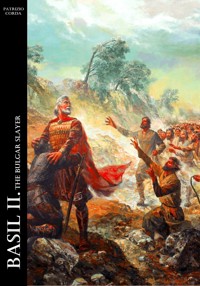
969 AD. - Despite being the rightful heir to the throne, the prospects for Basil are not the best. Complicit in the maneuvers of his mother Teophano, wife, mother and creator of emperors, his childhood years are spent in the shadows.
The situation will not change even after his ascension, due to the intrusions of his great-uncle and grand chamberlain Basil Lecapenus.
Only after ridding himself of these encroaching influences will Basil succeed in fulfilling his destiny, becoming one of the best Byzantine emperors ever as well as the longest-ruling among all.
In his forty-nine-year reign he will will change the face of the Eastern Empire, thanks to far-sighted laws and countless wars won.
It will be only one of these, however, that will make his life a legend to be handed down to posterity.
The legend of the basileus Basil II, known as the Bulgar Slayer. The exterminator of Bulgarians.
Das E-Book können Sie in Legimi-Apps oder einer beliebigen App lesen, die das folgende Format unterstützen:
Veröffentlichungsjahr: 2024
Ähnliche






Basil II. The Bulgar Slayer
Indice dei contenuti
BASIL II. THE BULGAR SLAYER
Patrizio Corda
I
II
III
IV
V
VI
VII
VIII
IX
X
XI
XII
XIII
XIV
XV
XVI
XVII
XVIII
XIX
XX
XXI
XXII
XXIII
XXIV
XXV
XXVI
XXVII
XXVIII
XXIX
XXX
XXXI
XXXII
XXXIII
XXXIV
XXXV
XXXVI
XXXVII
XXXVIII
XXXIX
XL
XLI
XLII
XLIII
XLIV
XLV
XLVI
XLVII
XLVIII
XLIX
L
LI
LII
LIII
LIV
LV
LVI
LVII
LVIII
LIX
LX
LXI
LXII
LXIII
LXIV
LXV
LXVI
LXVII
LXVIII
LXIX
LXX
LXXI
LXXII
LXXIII
LXXIV
LXXV
LXXVI
LXXVII
LXXVIII
LXXIX
LXXX
LXXXI
LXXXII
LXXXIII
LXXXIV
LXXXV
LXXXVI
LXXXVII
LXXXVIII
LXXXIX
XC
XCI
XCII
XCIII
XCIV
XCV
XCVI
XCVII
XCVIII
XCIX
C
CI
CII
CIII
CIV
CV
CVI
CVII
CVIII
CIX
CX
CXI
CXII
CXIII
AUTHOR'S NOTE
THANKS
Literary property reserved ©2024 Patrizio Corda
BASIL II. THE BULGAR SLAYER
Patrizio Corda
To my father
Major cities and fortifications in Britain in 410 AD.
I
A dawn without light
Constantinople, December 10, 969 AD.
"My beloved ones, it is with immense pleasure that I present to you the man who from now on will be not only your guardian but also our holy emperor. He answers to the name of John Zimisce."
As he spoke those words, Teophano laid his large iridescent eyes, made up to perfection in a multitude of colors, on the two children who were gazing inebriatedly at their beautiful mother.
All the while, the basilissa had been shaking the hand of the man she had dragged into her chambers, and about whom the imperial court knew little or nothing. When, however, he met the gaze of the eldest of his sons, 11-year-old Basil, Teophano applied more force in that hitherto as bland as it was sure grip.
As a consummate conspirator, used to hatching plots and plans in great secrecy, she knew how to recognize that fleeting shadow that could veil human eyes. And what she saw in her eldest son immediately convinced her that he had already realized that something was wrong. It might have taken him time to explain it all, small as he was, but undoubtedly Basil seemed to have noticed that this sudden change was abnormal, to say the least.
As proof of the empress's wit and perceptiveness, Basil barely frowned his rosy smooth forehead.
He then shifted his gaze away from his mother, focusing on the not-so-tall but incredibly muscular man who had presented himself to them decked out like a warrior deity.
By his side, his brother Constantine, two years younger, had been captivated by his shining armor and his long, raven hair, which was lost in the equally dark beard forming a mane that framed a hard, square, pale face surmounted by an imposing nose and small, piercing eyes. But in peering circumspectly at Zimisce, the silent Basil saw superimposed on his face the face of another person. Not surprisingly, that of the man whom until the day before his mother had called both husband and and basileus.
What had become of Nicephorus Phocas II, lord of the Romei?
A coughing fit roused the two children, forcing them to take note of the presence in the corner to their right. Huddled in that cone of shadow, their great-uncle Basil Lecapenus nodded gravely, tightening his lips hidden by his thick whitish beard.
Nudging Constantine to hurry, Basil sketched a not-so-convinced bow toward his mother and John Zimisce, who nodded in return with the usual demeanor of men-at-arms.
A characteristic that had also distinguished Nicephorus.
Recovering his upright position, Basil thought of the man so different from the newcomer. Terribly thin and slender, with exaggeratedly long arms and a gaunt face that seemed trapped in a tangle of brown curls, Nicephorus had until then been the figure most like a parent to him.
Because of his known military merits, Teophano had married him after the death of their natural father, Basileus Roman II.
Despite his innumerable commitments, Nicephorus had been both a good emperor and a good foster father, present within his means. But then, if this was such a praiseworthy man, why had he been replaced? And how, then?
For a brief moment, Basil planted his heavenly eyes in Zimisce's and felt a strange sensation.
But he did not impute it so much to his presence as to what might have caused his sudden introduction to the palace.
Again, the mysterious question arose.
What had become of Nicephorus? Why had his mother presented them with a new emperor if there was already one in Constantinople?
Spaced out, as he always was when he could not find answers, Basil awkwardly restarted his brown hair that reached his shoulders and turned back to Constantine.
He felt a natural motion of disdain. The younger brother, shorter and stockier than him, seemed almost bewitched by Zimisce's austere posture. He did not doubt that the latter, vain as he was, had not even questioned the reason for that meeting.
As Teophano listed the countless accomplishments of the one who would don the purple, contextually patting his shoulder, Basil cast a fleeting glance at his great-uncle's namesake.
She saw him becoming more and more bent and shadowy, his gaze lost in emptiness.
Why, he wondered, did these not claim his right to rule instead of watching helplessly as such individuals undeservedly undermined him?
Moreover, in his veins ran the blood of the Macedonian dynasty, of which he and Constantine were also part.
Why give way to strangers, although sometimes these were admirable men like Nicephorus?
Committed to finding a meaning to that matter so strange and full of contradictions, Basil quickly ended up estranged and paid no more attention to anything but the strange and unpleasant feeling that was making its way through him.
Only finally, called to order by the silence that had fallen, did he find the ardor to mirror himself in his mother's wonderful but indecipherable eyes. Closing his lips in a radiant smile, Teophano looked at his own children and bent over them in all his irrepressible and warm sensuality.
So he embraced them, as if to remind them that regardless of who sat on the throne of Constantinople, one day this would be their thing.
But in that embrace, for the first time, Basil felt himself shudder. Without the slightest warning, the empire had discovered it had a new basileus who had emerged from nowhere.
And nothing in all this could ever have made him feel safe.
No guarantees from there on would serve to appease him.
Something unprecedented and unnatural had happened.
And he and his brother Constantine, in all likelihood, would have been the ones most harmed by the situation.
II
The third puppet
Constantinople, December 10, 969 AD.
As he watched Teophano approach the thin silk curtain, completely naked and shiny from sweat, John Zimisce felt a chill. How had he conquered such a woman?
The empress was dazzlingly beautiful, with the perfect oval of her face, her Oriental-cut eyes and full lips. Her body, shapely and toned at the same time, moved with a slow, languid grace, and her complexion reminded him of the color of the sand of certain deserts in which he had been lost in his youth.
Most importantly, Teophano was the reigning empress.
For a brief moment, Zimisce considered the possibility that the basilissa was trying to use him for other purposes. But when he was already going adumbrate, chasing that suspicion through the meanders of her mind, Teophano re-emerged from the dimness and lay against him, slipping between the damp blankets and pressing her breasts against his chest. That such enveloping and primal contact compelled Zimisce to have no eyes or attention but for her.
"So," Teophano said in his ear as he stroked his shaggy beard, then down to his chest, "are you ready to become basileus, my beloved?"
"To the same extent that I am ready to become your consort," he joked, as he tried to grab her by the buttocks. "At least promise me that you won't make me suffer too much. The waiting already wears me out."
Amused, Teophano emitted a crystalline laugh and encircled him with her legs at hip level. Zimisce felt his loins on fire and realized that, like him, the basilissa seemed to have little intention of going to sleep.
"One day of patience. Not one more," she replied, planting her right index finger in his face. "One day only, and Nicephorus Phocas will be the past, nothing more than yet another name in the very long list of emperors that have followed each other through the centuries. I assure you that it will take but a short time to take his place in the hearts and memories of the people. The poor fellow was so drab...but he should still be thanked for his services."
"And in your heart?" urged Zimisce, clawing her by the shoulders. "Have I already taken her place?"
From amused, Teophano suddenly became serious.
So she kissed him ardently before uttering a word.
"Isn't what I'm showing you enough?"
"I would say yes," he replied, kissing her neck. "But I'd be lying if I didn't say I crave further confirmation."
Finally free from eye contact with her lover, Teophano could give free rein to her thoughts, throwing off the mask she had held until then. Allowing Zimisce to make her way inside her for the second time, the basilissa sighed and looked up at the very high ceiling of her bedroom.
In the half-light, it was impossible to discern the frescoes that graced it. Yet she, with her imagination alone, was already able to glimpse the future.
A future in which she would reign, alone and unchallenged, albeit through that man who was, yes, charming and intelligent, but politically a neophyte to say the least.
Already rehearsed from the previous intercourse, Zimisce took a short time to finish and a few minutes later lay beside her, snoring deeply. Looking at him, Teophano sneered.
Looking back it was nothing short of amazing how she, a girl daughter of a simple innkeeper, had managed to make her way through the very dangerous and treacherous court of Constantinople.
Yet as time passed, that same loveliness that had made her famous enabled her to seduce, maneuver, and then eliminate a host of slaves, courtiers, and ministers, coming to acquire almost as much influence as her husbands.
No one had ever been able to resist his charm.
Neither Roman II, nor Nicephorus, nor even Zimisce, who most of all seemed to be literally at his feet.
Her first husband had died before she could really make him her instrument, although for the most part he had influenced her decisions. The second, whose minutes were now numbered, had finally convinced her to take the plunge, weaving the great plot that would give her access to supreme power.
And now the third, the most foolish and malleable of the puppets she had made use of through her graces, would allow her to finally act in the light of day, but without taking any risks.
The history of the empire had already seen women in power.
But these, as in the case of Irene the Athenian, had quickly become consumed by what they had laboriously achieved, causing their own downfall.
She, Teophano thought as he wiped his sweaty brow, would not have made the same mistake. She would have gladly kept men by her side if they had not thwarted her plans.
Thus, no one could ever have hit her directly.
Exalted at the very thought, the basilissa turned toward Zimisce in search of more pleasure. But when she saw him lying on his side, increasingly drowsy, she gave up joining him.
May he have his well-deserved rest.
A lifetime of hard, unknowing work awaited him.
Obviously, at your service.
Good Lord, how easy it was to beguile men!
III
Blood and purple
Constantinople, December 13, 969 AD.
As he left the small and unadorned room where the funeral of Nicephorus II Phocas had been held, Basil was pervaded by a feeling that paralyzed him. Suddenly he felt dirty and corrupt, as if complicit in some unspeakable crime.
But also extremely cowardly and ungrateful.
Throughout the ceremony, he had not dared to lay eyes on the body of what until the day before had been both the basileus and his adoptive father. Everything in that gathered funeral confined to the dynasty alone had seemed bleak and elusive to him.
The elderly patriarch of Constantinople, Polieucte, had listed the merits of the deceased and invoked divine clemency on his soul with such haste that he seemed almost eager to get to safety.
The new basileus, John Zimisce, had watched in such a collected manner that he even seemed indifferent to the whole thing, as if his own military career had not been affected in the least by Nicephorus' benevolence.
Who had not even shown up-and this Basil had noticed immediately- was his mother Teophano, who had also been his wife for six years. An unwarranted and unjustifiable absence, given the gravity of the event. What consort would ever have deserted her late husband's funeral? What could have been so important as to make her non-attendance reasonable?
Only at the end of the ceremony had Basil been able to observe Nicephorus' body, wrapped in a purple cloth and ready to be laid in the coffin. But just when he had found the courage to approach, feeling the desire to at least brush his hand, this had been denied him.
Together with his brother Constantine, mostly distracted by those around them, Basil had only been allowed to get a few steps closer and peer at the body. And there he had noticed that something did not coincide with the version reported to him.
They had been told that Nicephorus, after a long and exhausting ride, had returned to the city from Chalcedon to escape a snowstorm. The effort had been too much for his physique, however, and he had expired in his rooms from exhaustion.
When he had taken a good look at the body of the ex-basileus, however, Basil had noticed that the purple cloth covered him in full, leaving only the head, already swollen and yellowish, exposed.
So far, nothing unusual. But Basil, who at only eleven years old was already a fine observer, had not missed the excoriations and especially the purplish halo at the base of Nicephorus' neck. Nor had he been able to ignore the abrasions on his hands, which not even the court handmaids had been able to conceal with their cosmetics.
As he entered the corridor leading to his rooms escorted by two rows of Varangian guards, Basil became convinced that poor Nicephorus, the conqueror of Crete and the terror of the Arabs, had not died of a sudden illness.
If anything, his life had been cut short by a violent act, the only scenario that could justify those wounds and bruises.
Even Nicephorus' expression, rigid and almost dismayed, betrayed the occurrence of something that had taken him by surprise and to which he could not object.
Suddenly, a gruesome scene came to life in little Basil's mind, in which the emperor instead of being found lifeless in his rooms was literally flushed out and then brutally murdered. All, probably, to further the rise of that John Zimisce who was already going to boast of the purple.
Sighing, Basil went back to thinking about that purplish bruise, barely concealed by the fine fabric covering Nicephorus' long body.
What if these were not only viciously beaten, but even beheaded?
Was that perhaps why he was harnessed like that, without anyone being able to get close to touch or kiss him?
Before he could even give credence to that chilling idea, which also seemed plausible to him, Basil felt something seize his left hand. Shaking himself up suddenly, he saw that Constantine was fidgeting to get his attention. His younger brother, looking at him feverishly, pointed to the sequence of busts that adorned the corridor on either side.
In particular, Constantine had focused on one of them, watching them with vacant but also judicious eyes.
Recognizing who it was, Basil agreed to accompany his little brother into the presence of that presence.
He remained impassive as he focused on his round face, his thin, slanted eyes, and that high forehead that suggested a certain depth of thought.
He had always failed to find the right words to say to him.
After all, although he was attached to him, he had no memory of him.
"Today a new basileus has ascended the throne, father!" said Constantine instead with a naive smile. "The wish is that he may reign with impartiality and benevolence, as you did!"
Basil looked at him dejectedly, pitying him.
As far as he knew, their father Roman II had been anything but an admirable emperor. It was said that he loved only to hunt, and that his few and fluctuating fortunes were attributable solely to the generals with whom he surrounded himself. Among them had been, not surprisingly, Nicephorus himself. Who, before long, would end up joining him in that narrow corridor, consecrated to the most revered emperors of recent centuries.
Again, Basil laid his clear, icy eyes on his father's torso. He tried hard to feel affection and pity for him, but he could not.
Digging up his most distant memories, he resigned himself to agree that he had no memory of the man who had generated them.
For as long as he had knowledge of himself and the world, Nicephorus had always been emperor. His departure, violent or otherwise, represented for him and his brother an abrupt and unexpected change, an entirely new beginning full of unknowns.
Would he have been, the dark and cold Zimisce, a reference point as the good Nicephorus had been?
They had been lucky, Basil thought, to have as their guardian a man like him, yes devoted to war but also incredibly pious and benevolent. To his war merits, he had been able to add other no less important ones, often standing up as their guide far more than their vain mother.
Who guaranteed him and Constantine that John Zimisce, yet another general who came to the purple almost by accident, would care for them in the same way?
And what would become of the empire from then on?
Gently brushed by one of the guards, Basil gave Constantine a shake inviting him to leave the indifferent bust of the father they had never really known.
The younger brother pouted and clenched his fists, but enticed-or perhaps fascinated? - by the lusty figures around them he was not slow to obey. Then the two of them resumed their march down that hallway, which grew bleaker and more oppressive with every step, especially because of what they had left behind.
Returning with bowed head, Basil reflected on the misfortunes that had befallen their dynasty in just a few years.
His father Roman had died when he was only 25 years old, also suddenly and without clarity on the matter.
Unconsciously, he and Constantine had taken refuge in Nicephorus, seeing in the proud and upright man an example to follow.
But now, he, too, had died under mysterious circumstances.
Who would take care of them in the future?
Basil, distraught, could not answer himself. However, subject to his suspicious nature, he could not help but consider the possibility that all those deaths were linked by a common factor.
A factor to whom Basil, marveling himself at his own audacity, managed to give both a name and a face.
That night, shaken more by his thoughts than by his first contact with death, he preferred to pray rather than sleep.
He needed to be forgiven by the Lord for what he had imagined. A son, he said to himself bitterly, should never doubt the one who brought him into the world.
IV
Consolation
Constantinople, December 13, 969 AD.
The sky was an immense grayish dome, dull and grave, which seemed to extend seamlessly to the Sea of Marmara and beyond. Looking out the window of his own room, Basil Lecapenus sighed as he admired the dense pine forests below him, in his view what was most beautiful the gardens of the Boukoleon Palace could offer.
If nothing else, he could have consoled himself with the little verdict that those tough, twisted trees would not resign themselves to losing. That thought brought a bitter smile to his face.
Unlike them, he had resigned himself, all right.
Unfastening the silver shawl that protected his drooping neck, Basil thought back to all that had happened in those last hectic days, but also to his guilty inaction.
He had become aware of this when Teophano had introduced John Zimisce to his two sons. The eldest of them, the taciturn Basil, had shot him a look that made him cringe and feel ashamed at the same time.
Even that little boy, who knew nothing about the world, had come to wonder what he had always wondered.
Why had he never tried to claim the throne?
Thinking back, Basil Lecapenus shook his head.
What could they, all of them, know about what he had experienced that had prompted him to hole up in the shadows despite having pure Macedonian blood, content with his mere presence at court?
In an attempt to find justification for his renunciation, thus showing compassion for himself, the old man traced his turbulent existence in thought.
He was indeed the son of the basileus Roman I, but the woman who had given birth to him was of such low birth that it had not been possible for his father to recognize him officially. Because of this, in order not to oust him from the palace, the only viable course had been to make him a eunuch. Thus, Basil Lecapenus had been stripped not only of his right to the Eastern throne but also of his manhood.
Over the years, each rotation on the throne had brought some attention to him, given his position that made him in fact the most prestigious figure at court after the emperor himself.
But each time, Basil had preferred to defile himself. And this was not because he could not give way to a moreover justifiable usurpation, but because over time he had ended up convincing himself that he himself did not qualify to be basileus.
In the end, it was useless to lie to oneself.
The facts spoke for themselves. As influential and respected as he was, he had resigned himself to simply being the richest and most influential eunuch in the palace.
The proof of how low perhaps his ambition was in the way he had behaved at the death of Nicephorus II Phocas. He knew full well that that murder was the work of Teophano, determined to rule through her new husband. And although he knew about it, he had done nothing to enable Nicephorus to save himself, nor had he done anything to protect his family members, who themselves disappeared within hours of the funeral.
Although he detested Teophano, whose ambition was inversely proportional to his own, Basil Lecapenus had done nothing.
And his great-grandson, noticing this, had tried to ask him why through his crystalline eyes.
Again, Basil was invested with shame.
But then, in a rare burst of optimism, he told himself that in the end not all ills had come to harm. To his rescue, albeit unwittingly, had come the patriarch of Constantinople, old Polieucte. Having learned of Nicephorus' assassination, the holy man had confronted the new imperial couple head-on. And during a private conversation with Zimisce, he had forced him to choose between love and glory.
The latter, in fact, would receive investiture as basileus only if he renounced his marriage to Teophano, undoubted instigator of the murder and already suspected of also having played a role in the death of her previous husband. Backed into a corner, Zimisce had eventually preferred the purple to the graces of that perverse and perturbing woman.
Here is the reason for Teophano' absence at Nicephorus' funeral.
Soon the basilissa would be exiled, and her betrothed would reign alone, choosing another bride.
But would he really be able to govern in solitude?
Suddenly, Basil Lecapenus was seized by an unexpected and completely unprecedented surge of ambition.
He had seen Zimisce climb the army ranks: the latter was an excellent general, but he knew nothing about law and economics. Playfully, he would need to be assisted and advised in the years to come.
And who, better than the grand chamberlain of the court of the East, could have performed those functions?
Wouldn't it have been possible, at that point, to redeem his past failures and exploit his indispensable presence by making him the tool to reign incognito, expertly maneuvering the new and unsuspecting emperor?
This, moreover, would allow him to protect his two very young great-grandsons Basil and Constantine, ensuring that no one from then on would interfere with the natural succession within the Macedonian dynasty. Neither Roman II nor Nicephorus had been able to protect the two children, assuring them that they would one day sit on the throne. Deprived even of their mother, they were left with only him.
And it was that very noble intent, which partly justified his never confessed ambitions, that helped Basil Lecapenus feel a little more at peace with himself. With newfound lightness, he ran his gaze over the pine forests that surrounded the pavilions of the Boukoleon and smiled.
Fate had prevented him from having his rightful place in the Macedonian dynasty. Therefore, he would ensure that those two unfortunate children would not suffer the same fate as he did.
V
Basilissa's word
Constantinople, December 969 AD.
Upon reaching the bridge, Teophano' first impulse was to scan the dock of the nameless marina from which she had to embark in the middle of the night. The basilissa's lips, which had always been full and plump, thinned until they became two hard, clenched lines as she realized that at last her plea had fallen on deaf ears. Despite her plea, which came via a secret missive, John Zimisce had not shown up.
Furious, Teophano clenched his fists.
The man she had created with her own hands, turning him from a general into a basileus, had deceived her. Or perhaps he had simply preferred to keep all the glory for himself, disowning those feelings he had spoken to her about until she was sick of them.
Evidently, there was an antidote in the world that could free men from the influence she knew how to wield.
And this antidote was none other than purple, exactly what she had been craving for all that time.
As he continued to look around, Teophano had the feeling that the whole of Constantinople was quite happy to part with her. Indeed, although she was in a port area, there were very few lights on, and the capital of the East seemed to have sought refuge in the darkness in order to escape her vengeful gaze.
But not even darkness prevented the basilissa, close to exile in a monastery on the island of Prinkipo, from catching a glimpse of the unmistakable bulk of the basilica of St. Sophia.
The sight of that wonderful monument caused her to tremble uncontrollably. She thought of Patriarch Polieucte, the one truly responsible for the separation between her and Zimisce, and in her heart she prayed to the Lord to crush that decrepit old man, with the glabrous head and white beard of a filthy country monk, for what he had caused her by his meddling.
Had it not been for the patriarch, her and Zimisce would never have parted. They would have reigned together, sitting in the audience hall of the Boukoleon. More importantly, she would have reigned through him.
Almost intimidated by her presence, the sailors assigned to carry her began to silently untie the ropes.
With a brief jolt, the ship began to move and imperceptibly began to move away from the dock.
But Teophano did not notice. Or he did not want to.
In his mind, there was only room for hatred and lust for revenge. Revenge toward the patriarch, who had claimed to decide earthly matters that were none of his business.
But also revenge on Zimisce, who after disowning her had denied himself as a coward, effectively breaking the oath with which they had bound themselves by mutual convenience.
As for old Basil Lecapenus and his two sons, she found no reason to feel resentment. The elderly eunuch had always been an idiot, a homunculus in body and spirit, utterly incapable of influencing the fortunes of the empire as he could and should have by virtue of his lineage.
He had let her act undisturbed when he had hatched the murder of Nicephorus. Why expect him to suddenly help her in her hour of greatest need?
Basil and Constantine, on the other hand, could rest easy.
Their parting had been cold and fleeting, like the relationship they had always had. But before they left, Teophano had promised them that one day she would return, and justice would be done. The dynasty would soon be reunited, and then they would reign together over the empire that was theirs.
Or rather, his thing.
For of this, as she disappeared over the horizon, Teophano remained convinced. One day she would indeed return.
Then she would reign as she had always promised herself.
Whether through a new lover or the fruits of her loins, it mattered little. His end would justify any means.
VI
Nostalgias and certainties
Constantinople, April 971 AD.
Indifferent to the horse's reluctance, which waved its mighty neck snorting, Basil pulled the reins to him and forced the animal to stop its course, making a sharp turn to the left.
As soon as the maneuver was completed, the young man heard what he had expected all along: a succession of hissing sounds in rapid succession, accompanied by a sharp jolt of air.
Then, releasing his left hand and slinging his shield, he raised his arm, protecting his head. The javelins used in the drills, devoid of the metal tips, came down hard on the shield and then fell to the ground. Only after a few moments, certain that he would not face any more threats, Basil lowered his arm.
And then he was greeted by a long and sincere applause, the vigor of which carried to his ears like the roar of a waterfall.
"Excellent, my young lord!" complimented him in a cumbersome Greek, Olaf, the Varangian who had taken charge of his military training. "It has taken many of us months to tame that wayward beast. Yet you are already able to lead it to obedience like a consummate knight!"
Getting out of the saddle, sweaty and covered with dust, Basil slipped off his helmet and smiled. That giant from the ice, with his golden hair gathered in long braids and the skin of his face perpetually burned by the sun he was not used to, inspired natural sympathy in him. It was not a common thing to receive such praise from the best soldiers in the empire, charged with watching over the life of the basileus. Yet, just as quick as he had been to rejoice at those compliments, Basil managed to seethe.
As he took his leave with still the echoes of the Varangians’ hoarse felicitations in his ears, the now 13-year-old boy took to stripping listlessly of the padding he had had to wear during the exercise. Then he took note, reentering the Boukoleon dark in the face, that unlike that turbulent, black-as-night steed he had not yet learned to tame his sudden melancholies.
The praise of Olaf and the Varangians had sincerely pleased him. However, Basil could not deny to himself that he would have preferred to hear those same compliments from a father figure. Feeling that emotional chasm he well knew open beneath his feet, the boy thought of a time when he had been able to consider himself provided with a guide, an example to look up to.
In his childhood years, the noble Nicephorus II Phocas had been to him what his father Roman II could not be: a mentor, a valiant, wise, and devoted man, endowed with every quality a member of the imperial dynasty should possess.
But then the conqueror of Syria, the basileus who had instilled terror in the Arabs who had threatened the empire had disappeared. And since then Basil had felt as if lost, forced to raise himself in spite of all the people who surrounded him daily and boasted that they had contributed to his education.
John Zimisce, the new emperor for almost two years, had never expressed any intention of fulfilling duties outside the regency. Never had he privately talked with him and his brother Constantine, making sure of their condition.
And this had only exacerbated his sense of loneliness.
His young life, barely 13 years long, had already been turned upside down twice, as many as the deaths of those who should have made him a man and perhaps a basileus.
Ignoring the greetings of grooms, groomsmen and various courtiers, Basil walked ever more curtly toward the steep staircase leading to his apartments.
With each step, however, his spirit grew heavier, and the unresolved questions that had been nagging at him for the past two years came back to haunt him without his being able to resist them.
Why had it had to go that way?
Why did their glorious dynasty seem doomed to vainly escape the icy embrace of death?
His father Roman II and Nicephorus had been different men, just as different had been their short reigns.
Yet in their own ways they had both been appreciable emperors and appreciated by the people for a variety of reasons.
Why had they had to die, forcing him and Constantine to come to terms with life in total solitude?
But most of all, why couldn't he get rid of the feeling that their fates had basically been mirrored?
Had they really both been crushed by a venomous presence in their lives that had used and then destroyed them to gain power? Where did that conviction of his come from?
By now exhausted by all those questions, Basil staggered into his rooms. Then he let himself go on the bed, falling on it with all his weight.
Even closing his eyes, however, he could not escape the echoes of what his mind kept suggesting to him uninterruptedly.
He sighed, convinced that he could never taste the sweet lightness of adolescence.
If he really believed that someone had caused the deaths of his birth father and adoptive father, then he would do well to remain alert. For what he had heard, on a cold day two years earlier, was likely to happen.
Sooner or later, that dark presence whose hands were stained with imperial blood would return.
Sensing the fatigue of the day crushing him and numbing his limbs, young Basil meekly surrendered himself to darkness.
But before doing so, he promised himself that he would confide all his doubts to his younger brother, Constantine.
That is, if these remained listening.
By now he knew better: his erratic and frivolous brother cared little about such things.
VII
An ill-fated triumph
Constantinople, October 971 AD.
The long procession, led in a chariot through the entire Mese Street and which had also touched the Forum of Constantine and St. Sophia, had tested young Basil's albeit strong legs. However, when Basileus John Zimisce moved toward them as they crossed the audience hall of the Boukoleon, the boy forgot all fatigue and suddenly stiffened. Flanked by two rows of mighty Varangian and surrounded by hundreds of festive courtiers, the emperor climbed the steps leading up to the throne, beside which Basil himself and his brother Constantine awaited him.
As the choruses of those present rose up to touch the high ceilings of the pavilion, Basil focused on the unimposing but nonetheless intimidating figure of Zimisce. In his eyes, he noticed a glow far stronger than that emanating from the gems on the purple ribbon that encircled his forehead.
And while he did not think much of him, Basil recognized that the basileus had every reason to feel proud.
For months these had been divided between Bulgaria and the Balkans, fighting Prince Svyatoslav of Kiev who had claimed power over those territories crucial to the empire. Proving himself once again to be an excellent general and strategist, Zimisce had faced the enemy head-on despite the harshness of those territories, and at the end of a wearisome campaign had won a great victory by which he had restored order in those areas that had always been turbulent.
There was no doubt: while there might be reservations about his gifts as a regent and politician, there could be no question at all about his ability to conduct a military campaign.
Now in their late teens, Basil and Constantine had grown up quite a bit, although the latter, though the taller, had retained the chubby, innocent face of boyhood.
However, when Zimisce stood before them, his body made even bulkier by the armor worn under the purple, Basil had the impression that these towered over him.
Covered in turn by a purple robe edged in silver, the two boys performed a deep bow as etiquette dictated.
Tense and uncomfortable, Basil heard the pearls that graced the ribbon on his forehead jingle. Then he heard sharply the firm, deep voice of the basileus as he addressed them.
"Get up, my children."
Exactly, thought Basil. Children, not sons.
Compared to the days of Nicephorus, that boundary in their relationship had remained sadly untouched. Obeying, they both raised their heads again and tried to maintain eye contact with Zimisce.
Suddenly, and contravening his usual demeanor, the emperor smiled almost awkwardly.
"Thanks to this victory, our empire has gained further prestige and glory. We do not doubt," he continued, laying his hands on their leaders, "that in the future you too will be able to make us proud with your achievements."
Having said this, Zimisce rotated on himself with his back to them.
He then spread his arms wide, muffling the room, and occupied the throne.
Only then did the court resume singing with religious devotion, hailing their basileus. But young Basil, by then, had eclipsed as he was wont to do.
Seated at Zimisce's right as the oldest dynast, the latter looked at his brother Constantine. He saw him restless in a way he thought was sleazy and childish, almost unable to contain himself because of his proximity to the emperor. His face radiant with admiration seemed to him even more childlike than usual.
Of this, Basil regretted immensely.
It seemed that Constantine, at the age of eleven, just did not want to become aware of his position and what Zimisce's reign meant for their family. At times it seemed to him more as if he were in the presence of an ordinary courtier, happy even to be there, than next to a dynast who should have aspired to a future as a legitimate regent.
Tired of focusing on his naive and vain brother, Basil looked around from the corner of his eye. He then spotted his great-uncle, Grand Chamberlain Basil Lecapenus, huddled in a corner with his arms folded and a mournful expression to say the least.
Again, the young man wondered why such a wise and powerful man had remained helpless in the face of Zimisce's usurpation.
Could these really have been satisfied with his role, knowing that he held all the cards to be the rightful basileus?
Annoyed by the hundreds of voices extolling the emperor, Basil imperceptibly shook his head and tried to isolate himself, planting his cold eyes on the large gate in the distance, presided over by a score of Varangian with pikes in their hands.
However, he found himself unable to distract himself, almost naturally inclined to examine the situation closely.
It was only fair to give Zimisce credit. By his intervention, he had prevented the empire from coming to terms with the invasion of Prince Svyatoslav's Rus'.
Still, it could not be denied that the new basileus had installed himself by deception, participating in the murder of a pious man like poor Nicephorus. Even more serious was the fact that Zimisce was officially considered a member of the Macedonian dynasty, when he did not possess a single drop of their blood.
Instinctively, Basil turned and observed the emperor.
He felt a sudden rush of anger as he scrutinized his determined, bearded face and mirrored himself in those eyes that were so serene and suggested great self-confidence.
Redolent with annoyance and even a certain envy, Basil told himself that even if the empire celebrated a triumph that day, his dynasty would have to beat its chest. For Zimisce's success, probably the first of a long series, represented for them Macedonians the bitterest of defeats.
A nefarious circumstance that was the result of an event long gone in time, but of whose responsibility Basil was now virtually certain.
VIII
Caesars and invisibles
Constantinople, June 974 AD.
Suddenly lifting his head and wiping his sweat-soaked forehead from the great heat, Basil stopped reading and remained listening. By now, he had become so accustomed to his brother's intemperance that he could tell his brother was returning from one of his nocturnal raids if only by the remote and inconstant sound of footsteps echoing in the nearby corridors.
Stifling the urge to pound his fist on the desk, he turned toward the wide-open window. Above Constantinople was a gloomy, starless firmament, and the green foliage surrounding the palace was motionless due to the total absence of wind.
Damn it. Was it possible that he and his brother were so different?
Could it be that Constantine did not understand that the privileges he enjoyed should not be a justification for behaving like a thug? Did he have any idea of the damage he was doing to their good name?
Before he could recriminate further, the door to the apartment they shared burst open, and Constantine stormed in, staggering conspicuously.
Turning to look at him, Basil was dumbfounded.
His brother was literally unrecognizable.
With his robe of the finest Oriental silk shredded and smeared with wine and vomit, the latter looked at him bewildered, his round face emaciated like that of a dying man and his large brown eyes circled with violet. Smiling like an idiot, Constantine ungainly passed the back of his hand over his moist lips.
And at the sight of the vermilion halo that appeared on his left cheek, Basil realized that his brother was not just soiled with wine.
His face, neck and even the knuckles of his fingers were covered with congealed blood.
He stood up abruptly, indignant.
Not only had that idiot run away from the palace to party with his friends in the middle of the night, but he had even gotten involved in some brawl with who knows what layabouts!
"Ah, that face of a penitent nun!" blurted out Constantine, letting his legs spread open on an armchair and showing the abrasions on his legs. "How many more times do I have to suffer it, every time I return to the palace?"
Dazed by his total disinterest, Basil looked at him grimly and spoke to him in a grave tone, more like a tutor than a brother.
"You still ignore the rules of conduct we are called upon to observe, Constantine," he said contritely. "In doing so, you show that you do not cherish the title we have been given."
In response, the younger brother let out a resounding belch and laughed, holding up his gurgling stomach.
"And here you are wrong, my brother!" he replied in an amused tone. "Because I, more than you, am well aware of what we are. Let me remind you: we are the Caesars, the most important figures in the whole empire after the basileus himself. Everything is granted to us, but nothing is really required of us, let alone demanded of us. And because of that, I don't see why I should remain here locked up studying as you do. But I guess every man is entitled to do what he wants with his life. I certainly am not going to give up that much freedom by throwing away my best years."
"You do not understand, Constantine," insisted Basil, shaking his head. "Our title requires us to prepare for the day when we must shoulder great responsibility for the good of the empire. Tell me, what are you doing to make yourself ready? Do you have any idea of the consequences your attitude might have?"
In his heart, Basil had hoped that those words and that subtle admonition might instill in his brother a modicum of guilt, if not even a glimmer of awareness.
But Constantine, completely indifferent to his calls, dismissed him with a tired gesture of his right hand, throwing his head back.
"And tell me, who should make sure of our preparation?" he asked him with his eyes closed and an inebriated, dreamy expression. "Who should redress us? The basileus, perhaps? You know very well that these, on the contrary, will protect us no matter what we do! So why not take advantage of it? Not to mention that he is now busy preparing for war in the East against the Fatimids. What do you think he is most interested in? My innocent nocturnal outings or the reconquest of the Holy Land?"
Impressed by that examination, which was moreover sadly true, Basil lost any desire to continue the discussion.
Nor was he encouraged by the fact that, after speaking to him with disarming lucidity for a drunk, Constantine had suddenly dozed off in the armchair, breathing with his mouth open. Watching him as a trickle of saliva trickled down his chin, Basil found himself without any more arguments.
However foolish, arrogant and indifferent to his duties, his brother had spoken the truth. Their title of Caesar was a purely formal honor, and one about which no one cared. Least of all the basileus, who would instead have to make sure he had heirs ready to succeed him in the future.
No one had ever really checked them out.
And that meant that just as no one cared about Constantine's nocturnal adventures, no one would ever compliment him on his skill on horseback and with the sword or the countless hours he devoted to studying classical works, treatises on agronomy or compendia of law.
Dejected, Basil retrieved a sheet and laid it on his brother in a last and genuine motion of brotherly love, then turned off the oil lamp and retired to his own bedroom.
All his life he had thought he was more balanced, foresighted, and wise than his younger brother. But in the end, despite his innumerable tares, Constantine had been able to become aware of the reality of the facts long before he did.
With a sigh, Basil took note of his defeat.
His brother was completely right.
No matter how hard they tried, the basileus would never care about them.
IX
Compulsory waiver
Surroundings of Jerusalem, November 975 AD.
Inhaling a puff of hot air that scraped his throat, John Zimisce strained his eyesight to see better.
Bringing him out of the cordon of Varangian that followed him everywhere, even mingling with the troops, had been that signal that had alarmed him several times in his life. And as far as he could see, even on that occasion he had been right to worry.
When beyond the thin horizon line, made shaky by the heat that cramped those desolate desert areas, he saw an immense wall of dust rising, the basileus tightened his grip on the reins of his steed in resignation. The ground vibrated again, more intensely than when he first noticed it, and the sultry air was filled with howl-like calls, almost inhuman shrieks that took to reverberating on the soft stony slopes that surrounded them.
It was not long before the first hundreds of mounted Fatimids emerged from the cloud. The sight of them immediately alerted the vanguard, which, knowing of his presence, almost unanimously turned in his direction in anticipation of an order.
Many of them had already taken up their swords and pikes, and some spontaneously formed more compact deployments.
But just when the men thought they had interpreted his thoughts, John Zimisce wearily raised his right arm.
"We're retreating," he announced in a firm but unforced voice. "Let's make sure we retreat in order before their arrows reach us."
Without his realizing it, the basileus had been joined by his staff and a handful of Varangians. As soon as he uttered those words, Zimisce suddenly found himself hit by a chorus of incredulous remonstrances.
"But...basileus!" protested one of the older generals. "We don't even have any idea how many enemies there are. Why even give up assaying their strength?"
"That's exactly the point," Zimisce objected, almost ashamed. "There may be many more of them than us. We have already relied too much on good fortune."
"Perhaps it is because the Lord wants us to triumph!" insisted another of them. "Please, basileus, think again: we have taken Damascus, Nazareth, Acre and even Caesarea! All that remains is Jerusalem to complete the feat. Didn't you want to recover the Holy Land? So far we have always won. Why stop short of a victory that God Himself seems to want?"
Numerous other appeals followed, gradually becoming more and more hysterical.
Zimisce struggled not to give in to his wrath, but finally, with nerves on edge, he turned sharply and incensed those present with his gaze.
"You dare question my judgment?" he growled through gritted teeth, tightening his grip on the hilt.
That fierce threat, imbued with the authority gained from a life spent fighting, extinguished even the most daring spirits.
"Good," Zimisce then nodded. "I see that your loyalty has remained intact, and for that I am pleased. Now make sure the men retreat in an orderly fashion, and quickly. The infidels will not give us much more time."
So it was that, literally a few miles from Jerusalem, the Roman army that had recaptured much of the East from the Fatimids retreated in a silence filled with disbelief.
Ignoring the pleas of his servants and even the Varangians, Zimisce wanted to ride ahead of the troops as the howls of the enemies faded into the distance.
Finally alone, the basileus swept his gaze over the landscape that would have mortified even the most optimistic man.
All around them were nothing but scorching expanses devoid of vegetation, barren and inhospitable plains that left no room for any form of life except insects, scorpions and bramble stumps.
That campaign, although victorious up to that point, had been a living hell for all of them. It was true what the generals had said: many cities had been returned to Christendom.
But this had cost them countless lives.
By now exhausted, the men probably would not have withstood yet another charge from those Fatimids who had been harassing them for weeks with their raids, and who seemed to be multiplying at night. But that alone was not the reason that had made him opt for retreat, the first of his decorated career.
Concerned, Zimisce lifted a sleeve of the purple that covered his armor and examined his exposed forearm.
What he saw, although not new, caused him to feel dizzy and took his breath away. Those pinkish spots, which threatened to cover him from head to toe, had not disappeared even with the rarest ointments his doctors could administer.
Adding to that troubling symptom was the terrible week the basileus had spent, between long moments when his breathing became labored and sudden slowdowns in his heartbeat. Used to facing reality at the cost of being disappointed, Zimisce told himself what he had already known for days.
Something in his body was wrong.
Too many ominous signs, not to consider the possibility that he had fallen ill with a possibly unknown disease.
That is why he and his army would return to the Bosphorus.
The Fatimids were certainly a formidable opponent, but they could not be sufficient justification for that retreat.
The truth was that, for the first time in his life, the emperor seriously feared for his own safety.
Spurring the horse wearily, Zimisce recognized that there was not much left for him to do but quicken his pace and hope to return to Constantinople still intact.
As well as praying to the Lord that that decision of his would not prove to be too late.




