


2,99 €
Mehr erfahren.
- Herausgeber: Patrizio Corda
- Kategorie: Gesellschafts- und Liebesromane
- Sprache: Englisch
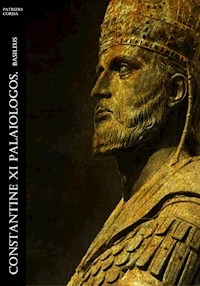
1453 A.D. - Constantinople is under siege, about to fall under the terrible
attacks by the Ottoman armies of Sultan Muhammad, in what will be one of the bloodier and more memorable war events in the medieval age and history as a whole.
Constantine Palaiologos, the last emperor of the East, desperately tries to oppose with all his might to what is the foretold end of a thousand-year-old empire.
But soon, isolated and without help, he realizes that all is lost and decides to disappear along with his world, throwing himself as a martyr among the enemies that have entered the city.
But fate seems to have other plans for him.
His time has yet to come. There may still be a way for him, and for his empire, to come back into existence. Whether it's in Constantinople, or at the extreme ends of the world.
Das E-Book können Sie in Legimi-Apps oder einer beliebigen App lesen, die das folgende Format unterstützen:
Veröffentlichungsjahr: 2020
Ähnliche






Patrizio Corda
Constantine XI Palaiologos. Basileus
Indice dei contenuti
CONSTANTINE
PALAIOLOGOS
Patrizio Corda
I
II
III
IV
V
VI
VII
VIII
IX
X
XI
XII
XIII
XIV
XV
XVI
XVII
XVIII
XIX
XX
XXI
XXII
XXIII
XXIV
XXV
XXVI
XXVII
XXVIII
XXIX
XXX
XXXI
XXXII
XXXIII
XXXIV
XXXV
XXXVI
XXXVII
XXXVIII
XXXIX
XL
XLI
XLII
XLIII
XLIV
XLV
XLVI
XLVII
XLVIII
XLIX
L
LI
LII
LIII
LIV
LV
LVI
LVII
LVIII
LIX
LX
LXI
LXII
LXIII
LXIV
LXV
LXVI
LXVII
LXVIII
LXIX
LXX
LXXI
LXXII
LXXIII
LXXIV
LXXV
LXXVI
LXXVII
LXXVIII
LXXIX
LXXX
LXXXI
LXXXII
LXXXIII
LXXXIV
LXXXV
LXXXVI
LXXXVII
LXXXVIII
LXXXIX
XC
XCI
XCII
XCIII
XCIV
Notes
THANKS
Proprietà letteraria riservata ©2019 Patrizio Corda
CONSTANTINE
XI
PALAIOLOGOS
BASILEUS
Patrizio Corda
To Giulia
I
The blame
Varna, 10 November 1444 A.D.
The smoke began to dissolve after hours spent covering the sky, which only then began to dye with the redness of the impending sunset.
The plain had lost its original features. It was now an expanse of uncertain reliefs, disfigured by odd hills suddenly rising after a day that had seemed to last forever.
But there was nothing natural in those silhouettes that blurred into the evening's dimness.
They were bodies.
Thousands of bodies scattered, piled on top of each other to form heaps as high as and more than one man. Their armors were dented, their garments torn and their iron links crushed into pieces.
The blood had blackened the ground, making it moist and fetid.
Even the horses could not escape the massacre. Some of them were lying on the ground lifeless, dying with broken legs, waiting for someone to put an end to their suffering.
And beneath their mighty bodies contracting from spasms, other men, already surrendered to the Lord's mercy, deadly crushed by their own companions rather than by their enemies.
Enemies of humanity and faith.
They had suddenly filled the horizon, showing the true dimension of their exterminated and invincible army.
And they had overwhelmed the army of Christ, sweeping it away with a force never seen before on a battlefield.
The silence that permeated the air still seemed to carry the cries, the calls, the prayers and the screams of pain of the Crusaders, while the forces of the Antichrist fell upon them.
Only a slight crackling, barely audible, whispered in the silence.
A banner with a red cross on a white background, as if by magic still planted on the ground, was burning. It seemed to watch over the thousands of dead, over all those souls who had ascended to heaven in a desperate attempt to prevent the inevitable, to stem a dark power that the madness of one man had decided to unleash.
And that man, incredibly, was the leader of the Christian Church.
Despite the initial victories of the Crusaders over the Ottoman army, Pope Eugene IV had felt that it was not enough. It was necessary to crush the threat of the infidels once and for all.
Christianity had to prevail.
And not only religiously, but also politically and militarily. In fact, he had decided to embark on that expedition, offering his support and his men, only in exchange for the union of the Churches of East and West. With obvious benefits on his part. But when he saw the possibility of extending his influence to the Balkans, he could not resist.
The Crusaders really seemed capable of rejecting the Ottomans.
At that point, Eugene had been seized with an unworthy yet irresistible urge, even for a man of faith.
The urge to have more and more. To dominate everything and everyone.
And so he had united in the name of Christ an incredible succession of peoples, among Hungarians, Poles, Bohemians, Serbs and Byzantines, who were the first to be threatened by the enemies. It was precisely the Eastern Empire that had asked him for help and men, involving him in that expedition that had become the last Crusade. That league had marched united against the Ottomans, albeit in obvious numerical inferiority.
And he had won.
At least in the beginning.
When the supreme commander of that heterogeneous army, the Hungarian John Hunyadi, had informed him of his intention to arrest himself in order not to do anything reckless, Eugenio felt himself burning. Just when he was so close to touching that earthly power never really reached he was ordered to stop, to give up lands, possessions and honors for the shyness in war of men less noble than him.
The Sultan of the Ottomans, Murad, discouraged by the defeats he suffered, had even signed a treaty in which he pledged to desist from any offensive for ten years.
But it was not enough for Eugenio.
He had peremptorily commanded that it be proceeded with, to free the Balkans all from the heretical threat, which was undoubtedly planning a new assault behind that signed treaty just to buy time.
Astonished, Hunyadi had been forced to obey in order to avoid losing all the forces provided to him by the Papal State and their allies, without which he would have had very few troops left.
That discouragement had spread like wildfire among the soldiers, who had thus lost cohesion and confidence.
Giving way to the prelude to an unprecedented catastrophe.
The Ottoman forces, faced with the Pope's refusal to continue the truce, had reconstituted and reinforced themselves. When they showed themselves to the Crusaders, they appeared like a human tide.
Sixty thousand men, against only twenty thousand left to Hunyadi.
It was a carnage.
The defeat of the Hungarians commanded by King Sladislaus, who had died in the clash, started a massacre in which the Janissaries, Murad's ferocious chosen soldiers, had claimed thousands of victims. And now the forces of Christ, the men whom Eugene had sent to die in the name of God, were lying on a plain, condemned to be forgotten by all, their remains nothing but a feast for vultures and wild animals passing by.
Pious souls who had abandoned their already rotting bodies.
The crusader banner stopped burning, now reduced to an incinerated rag. It fell to the ground without a sound.
A long, sinister gust of wind blew across the plain.
There was not a single Christian soldier left alive.
Murad's fury had been uncontrollable, and soon his sights would shift to other, greater goals.
This, while the only culprit of that disaster that would go down in history was officiating the Holy Mass in Rome.
II
The chosen one
Mistra, March 1445 A.D.
To my beloved son Constantine,
greetings.
My dear, I write you this letter while my tears wet this ink. I cry, Constantine, because I am forced to give you sad news that I never wanted to bring you.
Your brother John, our beloved basileus, our emperor, has fallen victim to an unknown illness that not even the most eminent doctors we have been able to recruit at court could understand. He is weaker and weaker, and what is worse his very soul seems to weaken and lose energy every moment that passes. Undoubtedly, his still young spirit bears the frustration of not having been able to raise the fortunes of this world of ours, as he had hoped at the dawn of his reign.
I wish you could have prepared yourself, my son.
But the circumstances are calamitous, and I feel compelled to try to warn you in time, knowing well that there is no time.
I have always believed that you, of all my sons, were the most inclined for good governance after my dear John.
He has done a good job, and is loved and respected for his authority even outside Constantinople.
But it seems that the Lord has decided that the time has come to have him back. I look into his grieving eyes, which have lost strength and vitality, and I cannot hold them for more than a few moments.
My eyesight is veiled by tears knowing that soon, I will have to say goodbye to another of my beloved sons. And you know well, Constantine, how many of your father's and my offspring have left prematurely, as if our noble house had fallen victim to an irrevocable curse.
I know that in Greece, where you now reside as despot of Morea, you are well liked and revered by virtue of your clemency and your character, which I remember as affable, moderate, and devoted to justice.
This is precisely why I am announcing to you that I, the Empress of the Byzantines, Helena Dragases your mother, intend to have John designating you as his successor. Basileus knows that his demise is imminent, and as he has no heir, he will be forced to elect one of your brothers as his successor.
I don't want what I'm about to tell you to sound evil and improper of a mother, my son, but I can't hide it from you.
Beware of those who share your blood.
Your older brother, Theodore, though he has long retired to private life, never approved the fact that the Morea, one of the last possessions of this dying empire of ours, has gone into the hands of the youngest in the family.
Do not exclude the possibility that, the day John ascends to heaven, Theodorus may return from his self-inflicted exile claiming what he is entitled to by dynastic right, but not by ability.
I know that your heart is filled with goodness and innocence, but there can be no room for these when the dynamics of power come into play. Take my advice, which comes from decades of experience at court.
Your other brother Thomas, with whom you share the government of the Morea, which you have laboriously regained by giving Constantinople renewed power over Greece, may also prove to be an enemy once John has passed away.
The closer a person is to us, Constantine, the more he comes to know our merits and our faults, our virtues and our weaknesses. Be skillful in hiding the latter, and in making yourself invulnerable to any plot and any slander.
The modesty that dwells in you will undoubtedly make you believe that you are not worthy enough to ascend the throne of Constantinople, thus reigning over the East. Do not doubt yourself.
I would have wished for you a government in better times.
But as you well know, we live in years of misfortune.
After the catastrophic Crusade in which almost all Christian forces were destroyed, we are surrounded by hordes of Ottomans.
We hoped to rise again, thanks to the coalition of armies we had gathered in exchange for the unification of the Churches.
But we did not.
I do not deny you that often, at night, I wonder if this is not punishment for some attitude of pride we have held in the past. And yet, I cannot answer.
I only know that this world in which we live, my son, is a continuous becoming, an unstoppable flow of events that follow one another, and in which we, no matter how many honors we may obtain on earth, are but insignificant figures of passage.
Everything moves, and everything changes.
Even what seems immutable and eternal.
The peoples who once roamed the most remote lands of the world now overwhelm us, who once ruled wherever the sun shone.
Everything can be, and everything can change.
Both on a large scale, and on a small scale, in our private lives.
That is why I ask you, my beloved son, to prepare yourself for what will be decided for you. And to forget the meaning of the blood bond.
That is why I ask you, my beloved son, to prepare yourself for what will be decided for you. And to forget the meaning of the blood bond.
Once you put on the royal purple, you'll have nothing but enemies.
And all the honor in the world.
I hope to receive a letter from you soon, and to read those words under the illusion that I can hear your voice, which I remember always sweet and kind. Know that I always keep you in my thoughts.
May the Lord keep you in good health,
Helena Dragases, Basilissa of the Romei
III
The legacy of Theodosius
Isthmus of Corinth, December 11, 1446 A.D.
"Sfranze..”.
Giorgio Sfranze observed Constantine, the scion of the Palaiologoi dynasty, while he was sitting on the ground, his empty gaze fixed on what remained of the imposing walls of Hexamilion.
He shook his head, hiding the sorrow behind his thick yellowed beard and the grid of wrinkles that crisscrossed his waxy and stretched face, giving him the appearance of an old man and not of a forty-five year old.
Constantine XI, son of Manuel and Helena Dragases and brother of the basileus John, seemed to him a child struggling with the first, real disappointment of his existence.
So kind and gentle in his soul was that man a little younger than him that he seemed almost incapable of understanding the situation itself, which seemed truly tragic.
The despot of Morea, the last real possession of the Eastern Empire, seemed unable to understand how those monumental walls, which stretched for six miles along the isthmus of Corinth, could have collapsed.
They had been erected over a thousand years earlier by Augustus Theodosius II, at a time when barbaric threats had made it necessary to build a barrier to protect the entire Peloponnese. They had always been a unique sight to behold, so strong, rich in history and impenetrable.
Apparently, immortal.
But then, the Ottomans had arrived. Like divine punishment.
Sfranze passed one hand over his beard without saying anything, resting the other on Constantine's shoulder. He would have had everything to be a great emperor in the future: a handsome physique, a beautiful face with fine features framed by a well-groomed brown beard and flowing hair pulled back, a natural elegance and a brilliant mind, assisted by a pure spirit with an innate tendency towards justice and good feelings.
Perhaps too much.
That was poor Constantine's flaw. He was too good, too honest, almost blind and incapable of rationalizing human wickedness and the misfortunes that were the bitter fruit of it.
That is why he lay like that, forgetting his kingship and his role, without energy, capable only of staring at the smoking rubble, those blocks once insuperable and now destroyed, reduced to thousands of pieces, and the bodies charred by the terrible cannon fire of the Ottomans.
Already at the time of his father Manuel the Turks had violated those protective walls, forcing the regent of Constantinople to empty the imperial treasuries already exhausted to rebuild them. Constantine had decided to devote himself body and soul in continuing his father's enterprise, managing to find, thanks to his good government, the funds to once again repair the screen that would protect the Morea from any external threat.
But it was worth nothing.
It had to be that too, thought Sfranze, to heartbreak Constantine's soul. The growing conviction that, no matter how hard he tried, his entire lineage was destined to succumb, to see its hopes constantly reduced to shreds, always at the hands of Sultan Murad's armies.
He had no doubt that Constantine had something in his character that made him still too fragile to rule with full power.
But neither could he deny that the string of disasters and disappointments he had had to endure up to then would have broken any man's confidence and optimism.
"My friend” he said at that point, paternally embracing him.
Constantine bowed his head. On his face he had an indefinite yet disturbing expression of one who is in the midst of a vortex of thoughts tending toward self-harm and the desire to surrender.
Sfranze's heart tightened.
He owed so much to the Palaiologoi and to the affection of Constantine, who had greatly favored his ascent by coming to call him to himself in Morea, making him governor. And by virtue of the noble sentiment that bound them, he would not have allowed the oblivion, the depression and the apparent inescapability of the debacle their world was facing to get the better of him.
He could not resign himself to the idea that his friend and benefactor was a weakling, a man incapable of standing up and fighting.
There had been too many occasions when he had shown himself to be a man of striking intelligence, capable even of arduous decisions and great sacrifices for the good of the community.
He could not have been wrong about himself. And this had nothing to do with his personal pride.
It was about keeping alive the last, true ruler who could have raised the fortunes of a once vast and flourishing empire, which had been reduced over the centuries to a few lands, one of which was the Morea, illuminated by the light of Constantine.
"We will overcome this one too” he whispered in his ears, lifting him by weight.
Constantine kept his eyes on the ground, nodding unconvinced.
"This ruins don't mean anything. The matter vanishes. But history remains. An august has erected this barrier. And it is up to you, whether it still exists or not, to carry on his work. For the good of us all”.
Constantine's splendid green eyes shone for an instant, making Sfranze understand that those few words of his had had the slightest effect he would have hoped for.
He almost seemed to perceive the energy and warmth that he was able to give off in moments of full enthusiasm. Yes, he had managed to get his inner fire burning again.
"Once again, I can only surrender to your words, Sfranze” he smiled sadly. "Let's go”.
And embraced in an almost camaraderie-like manner, they continued to walk as the sunset spread across the sky, mercifully concealing that spectacle of death and devastation.
IV
Virtue
Mistra, March 1447 A.D.
Although spring was just around the corner, it was still bitterly cold on the slopes of Mount Taigethus. You could admire its peaks still white, the snow on the branches of the trees that surrounded its sides. Constantine stayed for a while looking at its heights and then turned around, walking softly under the porticoes of his residence. From these, it was possible to lose oneself in the immensity of the horizon, with the Mediterranean Sea that looked like an endless flat, deep blue table.
He reached the end of the walkway, and remained silent contemplating the sea, lying against a column.
Sfranze approached him, holding on to his cloak.
"You know what, Sfranze?" said Constantine breaking the silence. "That all this is part of a bigger plan than us”.
"I don't understand you" he said, frowning his eyebrows.
Constantine smiled without malice, but with a hint of satisfaction for having realized something that his witty friend and counselor missed .
"Think about it. Since the Ottomans have become a real threat, much has changed around us. Not only politically, but spiritually as well. Don't you realize that even the Pope has been corrupted by a hunger for power?"
Then he turned around, seeing that Sfranze didn't answer.
"There's no need to be diplomatic even now, let's go. It's just the two of us. I know you think so. We offered the Papal States years ago the chance to rule over the two united Churches, eliminating all religious disputes in exchange for military support. And yet, while peace was at hand, it was the Pope's greed, his desire to conquer new lands that compromised the Crusade. And if even the head of the Church has a corrupt spirit, it means that ultimately the human race in its entirety is irrecoverable".
Sfranze scratched his head on which few, sparse and long straw-colored hair remained, and flanked him. They remained silent for a little while, admiring the calm and placid sea, indifferent to their plight.
"This must be it. The Ottomans must be the messengers of the end of time. There's no other explanation. Look how they razed the walls of Hexamilion, taking back all the Morea we had conquered at the price of human lives and huge sacrifices!"
"All is not lost..”.
Constantine turned around, but without the strength to strike Sfranze with a reprimanding look. It was more as if she was imploring him tacitly to argue such an empty phrase of his.
"If you think so, why then am I, Constantine Palaiologos, son and brother of emperors, now forced to pay tribute to these uncivilized barbarians?" he asked him, stifling his anger.
"It was the best thing to do at the time”.
"I'm tired of living moment by moment, Sfranze! I cannot endure such humiliation, which shames even my brother's basileus. I am now convinced that reigning is not for me. Look at it, my kingdom!" he exclaimed, inviting him to observe the small towns that were scattered beneath that natural terrace of theirs.
"Only on paper do I reign over these places! And the people know it! The Palaiologoi, the lords of Constantinople, reduced to miserable tributaries of Sultan Murad! Forced to pay, to pay in order to prolong this farce of a kingdom, and not to be banished!"
Sfranze sighed. Like all the talented and enlightened, Constantine was the victim of an atavistic fickleness. He swung sudden and engaging exaltations to long, weary periods of frustration, dangerously close to self-harm.
Peace in Morea had only momentarily calmed his wandering nature, a symptom of an inner fragility which, as history taught, had often marked the young members of the greatest dynasties holding absolute power.
And at that moment, poor Constantine was fully a victim of the worst side of himself. Unable to do anything but blame himself for something far greater, without rationalizing events. Almost happy to bask in self-hatred for his inexperience and his inadequacy.
As if on his own he had been able to oppose the invincible Murad, who had brought the entire Christian world to its knees, as well as having torn the Morea, over which he had reigned.
"I know you, Constantine. And you know it. Were it not true, you would never have given me the honor to serve under you. So I tell you, my friend, you must grant yourself not so much forgiveness as rest. I mean rest from these thoughts that are not true, and they are certainly not good for you. For you speak the facts, and the life that the citizens of Morea have led to this day”.
"You are flattering me” smiled Constantine bitterly.
"Don't you ever dare say such a thing again” he reproached him without malice Sfranze. "I stand by you on my own merits, and certainly not by your pity. Let me finish now. The love that your subjects have honored you with is the same love that has honored other great men of the past, who have gone down in history for their good heart before their authority. No need to name names. Well, this innate goodness that you possess will never make you lose the support of the people, whatever your condition. And if you are unable to have faith in the Word because of the ignominy of God's ministers, at least have confidence in yourself. For only in this way, believing in your work and in the affection and loyalty that your subjects have given you can you find the strength to rise up.
Constantine looked at him refreshed, a smile barely sketched to shine within the contours of his thick beard.
"I would like to see in me the virtues you boast so much”.
"To everything its time” answered Sfranze calmly, sitting down.
They remained again in silence, each one immersed in his own reflections, busy peering beyond the sea as if beyond it there might be traces of that future that they could not see.
An icy wind began to blow, howling through the porticoes.
And to Constantine it seemed to him that the sea that was beginning to swell and boil, threatening storm, was in every way identical to the torment that did not seem to want to stop agitating his fragile soul.
V
Immortal fate
Constantinople, October 1447 A.D.
Helena stood motionless on the doorway, her aquamarine eyes shining with happiness and surprise. John, her son and basileus of the people of the East, was standing on his own legs.
He had his back to her, lying with difficulty on the window sill from which one could admire the royal gardens and the inner courtyards.
Dressed only in a light tunic, the emperor appeared resigned, pale, far removed from the royal figure who had enchanted, by intelligence and taste, all the peoples who had known him.
The morning light enveloped him with a whitish, milky yet dazzling aura, while he continued to linger with his gaze upon his capital, unaware of his mother's presence.
Only the light touch of her diaphanous fingers redeemed him.
"Mother" smiled at her. His ever-tended beard was now very long, a tangle of thick brown hair. His hair was just as long, dirty and wild.
Helena welcomed him in her arms, hiding behind the wall of her silence the dismay of having heard his ribs protruding.
She gently helped him to sit on the edge of the bed.
"What a joy to see you in strength again, my son”.
John smiled, nodding almost ironically.
"I haven't felt this good in a long time. Above all, I am lucid and conscious. Who knows how much you must have suffered for me”.
Without giving him time to continue, Helena kissed him on the forehead, hugging him again and sitting next to him, caressing his hands. Frosty, bony, sometimes trembling.
"You must eat. It's essential for you to recover”.
"In all honesty, I don't know how long this happy moment will last” John surprised her with a melancholy smile. "I am objectively the shadow of the man I used to be. Look” he told her, pointing at his bare feet, "the basileus of the Romei who walks barefoot like a wretch. He said this in a hilarious tone, but also bitter.
"Though I seemed to be dying for a long time” he continued, barely getting up, and returning to the window, "I thought a lot. I looked for answers that unfortunately I could not find. I cannot, no matter how hard I try, understand where I have done wrong. And the more time I have left is running out, the more regret grows".
Helena shook her head, disconsolate.
It was true what they told her. The pain of life was killing her son even before the illness did.
"And yet, in my heart I know I did right. I dismissed all the mercenaries from our army, I gave the imperial coffers to build fortifications and even agreed to kneel before the Pope like a beggar, bartering the union of the Churches with armies that could defend us. But none of this served any purpose. And to know that all of you are being dragged towards the end with me tears me apart".
He remained silent, his gaze lost in emptiness. Against the light, his silhouette appeared even more slender and exhausted by fasting.
His once mighty legs, turned back bundles of muscles were now more like those of a destitute old man. His skin already sagging.
"I have never allowed myself to contradict you since you ascended the throne” Helena said, hugging him from behind, "but now I must do so. You must return to reality, John. And however high the honor you have been given, you must understand that you too are a human being. You have given all of yourself, but like all other men you can only be a spectator before what has already been written in the firmament. We can only slightly change the Lord's plans. And you have done everything possible. If it ends, nothing will be able to avoid it".
John turned slowly, looking at her terrified and lost.
"So what else can I do?"
Helena kissed him on the cheek, as if in his eyes he no longer appeared as an adult, among the most powerful in the world, but as a helpless child.
"All you can do is pray for you and for us, and hope that we are given the opportunity to see the change that hasn't come so far. It pains me to be realistic, John, but know that it is difficult for that to happen. And yet, all that remains is for us to hope, to keep hope alive that something will change, no matter who may be the proponent of such an undertaking.
John felt his legs tremble, and he struggled until he collapsed pitifully on the bed.
The vigor of which he had been so astonished that morning was already beginning to fade. He looked at his mother almost ashamed of himself.
Helena came towards him again, staring him in the eyes.
"One must prepare oneself, John”.
"What do you mean, mother?"
A flash passed in the eyes of the old but still charming Empress Mother.
At times, it was as if her inexhaustible determination was able to bring her back in time, making her shine like when, young and beautiful Serbian princess, she had sat on the throne of Constantinople for the first time.
"Whatever your destiny, it is your responsibility to make sure that your family and your people are not left alone. I pray that you live, because too many of my children have already returned to God. But if this is not so, it will be necessary that our dynasty continues to be the symbol of hope, of the future.
John already knew what his mother meant.
Heavily exhaling from his nostrils, he planted his palms in the soft bed. He closed his eyes for a moment, then opened them again.
"So who do you think is worthy to inherit my kingdom?"
Helena took his hand, caressing it gently.
"Your heart will tell you this, my son”.
At that moment, John rediscovered the temperament of the best times, suddenly returning the imperious ruler who had been. Though seated and exhausted, he emanated an immediate authority.
"And I demand to know what the basilissa thinks”.
A smiling smile was drawn on Helena's unclothed face.
"I think what everyone thinks. That there's only one person who can rule worthily as your successor”.
The outer light flooded in, showing both of them the clarity of each other's thoughts.
John looked deep into his mother's beautiful eyes.
"Constantine”.
Helena held both of his hands, and nodded severely.
"Constantine”.
VI
Exiled
Mesembria, July 1448 A.D.
Protected from the darkness, Demetrius continued to walk quickly through the ruins. He suddenly crossed a beggar who was languishing against a collapsed wall and pulled his hood down even further, fearing to be discovered.
Once he was protected from prying eyes, he freed himself from that oppressive cover, releasing his red curly hair under the moonlight. He looked around and could not hold back a curse.
Those damn Ottomans were destroying everything in their path. Even those once flourishing and colorful lands, a stone's throw from the sea, were now a pile of rubble. And the blame would fall on him.
How long had he been confined there?
That title of counselor in Bulgaria that his family had given him was no longer enough for him. It was all an excuse to keep him away from the very heart of the empire. Constantinople.
That was where the real power was. And it was all in the hands of that moribund John and his mother Helena.
Damn it, he was her son too!
Why did she send him to those wastelands?
What was wrong with him?
All his brothers had enjoyed more important jobs than he had. Theodore, though now retired, had been despot to Morea in Greece. The same fate that now fell to Thomas and Constantine, who, as far as he knew, seemed to be his mother's favorite. John then continued to sit on the imperial throne despite spending his days in bed, languishing like a worm. Anything but a basileus.
Him, on the other hand, who shared the same blood as them, and was struggling with a lesser government but was cut down by the Ottoman raids, seemed destined never to see the light.
Forced to spend the rest of his days in the shadows, he was a second-class member of a dynasty that had always been linked to power.
He sat on a boulder, and contemplated the surroundings.
Destroyed buildings, wrecked debris, corpses. Not far from his residence, the picture became truly tragic. He, too, was a hostage of the Ottomans and their raids, however deluded he was about the opposite.
His white skin seemed even brighter in the darkness.
He bent over himself to reflect.
In fact, what had the Palaiologoi done that was so important that they felt they still had to maintain power?
It seemed crazy to them to even think that, being part of that glorious lineage. But frustration, he knew well, was capable of bringing human thought into new, dark and sinister territories.
Since he had had his wits, his father, his mother and his brothers had seemed powerless in the face of Murad's growing power.
The empire had become more and more risky, distressed by the poverty of resources and ideas as the Turks multiplied, conquered lands to their detriment and humiliated them in battle at every opportunity. His brother John had even had to prostrate himself before the Pope, save finding himself with his hands and feet tied, forced to submit to his will in exchange for troops to be deployed against the enemy.
And even that shameful humiliation was worthless.
The Ottomans seemed on the verge of conquering Morea too, which was in the hands of those brothers, Thomas and Constantine, considered better than him but equally incapable of offering any resistance.
He lifted his head, losing himself in the darkness.
But at that point, who was really right?
Who really deserved to dominate unchallenged over what had once been of the Romans, and then of their descendants Romei?
Who was more suitable, more powerful, blessed by God?
He wondered if at that point, after all those failures, they were not the ones who were wrong. It was clear that they no longer seemed able to hold that dying empire.
Murad was powerful, very rich, and militarily he could not be defeated. The last crusade was proof of that.
The very destruction that surrounded him was an example.
The Palaiologoi, who had mixed their blood with his mother's Slavic blood to stay in power, were a dying dynasty.
It was so. Time cyclically caused new people to take turns, rising to the highest glory for their merits.
And the time of the Ottomans seemed to have come.
Unless...
Unless it was the last of the Palaiologi, the only one who had not yet reigned in the true sense of the word, to stand as a bulwark of Christianity and the empire, chasing away the prospect of a future made of darkness and slavery.
Perhaps he was the last hope of their world.
He laughed quietly, basking in that fantastic and fascinating hypothesis. He, Demetrius, at last awarded the highest power, winner of the Ottoman threat.
Yes, he liked that idea.
It was worthy of him.
Of him alone, certainly not of his brothers, who had only collected discards by besmirching the name of their lineage.
But before he could get what he felt he was born to, he had to find a way to untie those chains, to free himself, to escape from that golden prison to which they had deliberately sent him. He had to find a way.
He started walking again, without bothering to hide his princely, refined, almost feminine face that everyone knew.
He had no doubt. He would have found a solution.
He had an unshakeable confidence in his means. Another hallmark of those destined for great enterprises.
He would have climbed his family hierarchy, and then resolved the war with Murad and his Ottomans, going down in history.
And this, he thought with a grin on his face, not necessarily defeating them in battle and erasing them forever.
VII
The certainty of a future
Constantinople, October 25, 1448 A.D.
Helena watched the doctor lean over John in agitation.
He lingered for moments that seemed endless, then slowly crossed his eyes. He shook his head.
There was nothing left to do.
The basileus was destined to die out soon after, his breath about to disperse into the wind. He lay on the bed unconscious, emaciated, his mouth wide open and his eyes closed. Anyone who had not placed his ear on his now bony chest would undoubtedly have believed he was already dead.
The Empress Mother bit her lower lip. She, in her turn, was reeling from the endless vigils, and could no longer remember the last time she had eaten or looked in the mirror.
With a lightning nod of her hand she dismissed the doctor, and was left alone with her dying son. She approached him and placed her hand on his forehead. She felt it cold, dry.
She wondered if John could even hear her voice.
She couldn't give in to the pain, a mother who had already lost several children to illness. Those tragedies had had an almost dehumanizing effect on her. Perhaps that was why she was able to maintain rationality and conviction of what was a priority.
The election of Constantinople's new regent.
As if he had read her mind, John slowly moved his right hand, looking for her fingers.
"Mother..”.
Helena came upon him, kissing and caressing him.
"My mother...there's no more time...it's the end of me, the end of everything” John gasped, before saying a series of uneven words with his mouth full of saliva.
She walked away from him imperceptibly.
Her son had lost his mind. She cursed herself for waiting too long, believing the illness would give him respite.
She would not have been able to make him sign up for Constantine's election, the only one worthy of succeeding him. She'd been a fool.
Now she couldn't really walk away from him.
Anyone, taking advantage of his insanity, could have extorted any concession from him, condemning the dynasty and perhaps even ousting it.
He wouldn't have allowed it. The Palaiologi were supposed to rule.
"I know what you're thinking..”. whispered John, chest shaken with spasms.
"I don't think of anything, my son, except your health”.
"I... I am finished. I will die. But I've had time to think about what we said to each other some time ago. I couldn't leave knowing I'd leave my family surrounded by greedy people, ready for anything to take the power. I... I couldn't”.
Maybe there was a chance. One last, unmissable chance.
"What happened that I don't know, my son?"
An almost mocking smile appeared on John's ragged face.
"I know how much you care about Constantine and his election. I also... agree”. He stopped to catch his breath. "Among my brothers, he is the most balanced and wise. Thomas is loyal to the crown, but he still lacks personality. "Theodore now, he wants no more of power. And Demetrius..”.
"...Demetrius is different” Helena said.
John barely opened his eyes, reduced to two slits.
"Demetrius is evil. He is...willing to do anything”.
Helena could do nothing but agree with him. It was true. That's why he was sent to Bulgaria by mutual agreement. And now, he would return to office and claim the highest title.
"That's why I... I've decided to elect Constantine. The nomination is guarded by men loyal to me, in my private chambers. No one... no one has access to it. I have given orders to send it to Constantine, when... when I will be gone”.
Having said that, he clutched his mother's hands with unsuspected strength because of his condition, before falling into an unconscious state again, with his head reclining on one shoulder.
Was what your son had just told her true?
Did her pressure finally have the desired effect?
Helena covered John with the sheet, and watched him while he lay inert, but still alive. Who knows for how long.
What if those words were nothing more than the fruit of a man's hallucinations?




