


9,49 €
Mehr erfahren.
- Herausgeber: Sonicbond Publishing
- Kategorie: Geisteswissenschaft
- Serie: On Track
- Sprache: Englisch
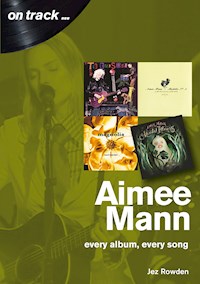
Any consideration of the songwriting craft would be incomplete without the inclusion of American singer/songwriter Aimee Mann. From her first steps as singer and bass player with 1980s synth pop band ‘Til Tuesday, who scored a massive MTV hit with ‘Voices Carry’ in 1985, she has continually produced starkly autobiographical songs, with a sense of melody that cuts through the emotional detail.
With a career now spanning almost forty years, she has built a catalogue of nine studio albums, from debut Whatever to 2017’s Mental Illness, since going solo in the early 1990s. Via a series of record label frustrations, Aimee has developed into a fiercely independent recording artist, flying outside the mainstream. Her critical acclaim has never wavered, however, and while happy to continue working in a niche market, her soundtrack for the film Magnolia and the accompanying Oscar nomination raised her profile considerably, adding to her stalwart army of fans.
This book gives an overview of Aimee Mann’s career from her earliest days when she ‘made it big’ with ‘Til Tuesday, through her solo career, investigating every recorded track. It is a comprehensive guide for fans and new listeners keen to investigate a double Grammy winner who is also a true original and whose work deserves to be much more widely recognised.
A music fan for as long as he can remember, Jez Rowden worked in record shops for many years, absorbing music of all kinds. He enjoys many genres and has been involved in writing album and concert reviews, mostly within the progressive rock field, for nearly 15 years, also acting as editor for the ‘Dutch Progressive Rock Pages’ (DPRP) website and currently ‘The Progressive Aspect’ (TPA) which he helped found in 2013. His previous book for Sonicbond covered the music of Steely Dan’s Walter Becker and Donald Fagen. An avid gig goer, he lives in Swansea.
Das E-Book können Sie in Legimi-Apps oder einer beliebigen App lesen, die das folgende Format unterstützen:
Seitenzahl: 337
Veröffentlichungsjahr: 2022
Ähnliche




















Sonicbond Publishing Limited
www.sonicbondpublishing.co.uk
Email: [email protected]
First Published in the United Kingdom2021
First Published in the United States 2021
This digital edition 2022
British Library Cataloguing in Publication Data:
A Catalogue record for this book is available from the British Library
Copyright Jez Rowden 2021
ISBN 978-1-78952-036-1
The right of Jez Rowden to be identified
as the author of this work has been asserted by him
in accordance with the Copyright, Designs and Patents Act 1988.
All rights reserved. No part of this publication may be reproduced, stored in a retrieval system or transmitted in any form or by any means, electronic, mechanical, photocopying, recording or otherwise, without prior permission in writing from Sonicbond Publishing Limited
Printed and bound in England
Graphic design and typesetting: Full Moon Media www.fullmoonmedia.co.uk
Thanks to ...
A huge thank you is again due to Stephen Lambe and all at Sonicbond for allowing me to put this book together and dig deeper into the career of an artist I have admired for many years.
Aimee Mann has produced a string of idiosyncratic and highly engaging releases, each different to the last, exploring new sounds and textures to colour her songs, and what songs they are: always dripping with melody and filled with her wonderful words. She is truly a master of her craft and my deepest appreciation goes out to her.
I am also indebted to my wonderful wife Paula for her unstinting support and patience, allowing me to chip away at doing this when there were loads of other things that I should have been doing! Thank you so much Sweetheart, all my love. X
Contents
Foreword
Beginnings
’Til Tuesday
Voices Carry (1985)
Welcome Home (1986)
Everything’s Different Now (1988)
Aimee On Songwriting
Whatever (1993)
I’m With Stupid (1995)
Magnolia – Original Soundtrack (1999)
Bachelor No.2 (Or, the Last Remains Of The Dodo) (2000)
Lost in Space (2002)
Live at St. Ann’s Warehouse (2004)
The Forgotten Arm (2005)
One More Drifter In The Snow (2006)
@#%&*! Smilers (2008)
Charmer (2012)
The Both (2014)
Mental Illness (2017)
Coda
The Young Snakes
Bark Along with the Young Snakes (1982)
Compilations and Collections
Coming Up Close: A Retrospective (1996)
Ultimate Collection (2000)
Aimee Mann (2003)
Other Appearances
Bibliography and References
Also available from Sonicbond Publishing
Would you like to write for Sonicbond Publishing?
Foreword
Let’s face facts: Aimee Mann should be a damn sight more famous than she is, although I suspect that she quite likes things the way they are. For those familiar with her wonderful body of work, the two Grammy Awards, Oscar nomination and regular inclusion in lists of greatest living songwriters come as no surprise.
From her earliest days, with post-punk outfit The Young Snakes, through the 1980s chart hits and pop fame with ’Til Tuesday, right through a solo career of now nearly thirty years that has seen her fully embrace the singer-songwriter path, Aimee has crafted a song catalogue that is beyond reproach. Taking influence from Leonard Cohen, Stephen Sondheim and Jimmy Webb, among others, she has developed a style of her own, taking personal experience and the foibles of the human condition as a starting point for her vividly crafted songs.
What initially drew me to Aimee was her uncanny way with a melody, forging uncompromisingly upbeat hooks to cloak her dark tales of losers and misery. From her strikingly unexpected operatic falsetto with The Young Snakes and the epic pop of ’Til Tuesday, she made a deliberate move to a more comfortable style that works well in the intimate and personal spaces that her songs inhabit. Her warm and individualistic tones possess a charm and personality that cut through to speak to her listeners directly. It’s understated, delicate, haunting and sweet in equal measure. She is also a particularly melodic and highly underrated bass player, an element she has largely moved away from over the years, acoustic guitar now being her instrument of choice.
Her songs possess a well-defined understanding of what makes great pop, finessing thoughts and tricky circumstances into beautifully arranged musical settings, always delivered in an effortlessly cool way. The message is often bleakly ironic, the brightness of the melodies delivering poignant vignettes as almost clandestine, hiding the true extent of the heartbreak and darkness, to be discovered, as in my case, much later. Her observational, slightly detached style looks at the underbelly of the relationships we form, showing her deep fascination with what makes us tick as an emotional species. She plays with language in intriguing ways, twisting scenarios and perspectives, often singing from the viewpoint of another and frequently directing her ire at her own choices: As she told the LA Times in 1993: ‘I’ve certainly given other people the short end of the stick more times than I can count, and those are the times that I’m least proud of’.
Aimee has explained the origins and meanings of many of her songs, but some remain elusive. I have tried to interpret them in the way they come across to me – only Aimee knows for sure. My reasoning may not always work for you, or it may seem well off the mark, and that’s fine. They’re a personal perspective and not set in stone, best used as a starting point to discover how the songs work best for you. Her albums are a treasure trove of beautiful yet fierce words with the grit to keep listeners coming back for more, the process of writing this book opening them up still further for me. My hope is that both new listeners and existing fans can use it as a companion to the music, to listen that little bit closer to her beautiful songs. You won’t be disappointed..
Beginnings
Aimee Elizabeth Mann was born on 8 September 1960 in Richmond, Virginia, growing up with an older brother, in the suburb of Bon Air. Her father was a painter and her mother a psychiatrist. They divorced when Aimee was three, her mother spiriting her away to London for nine months before her father managed to bring her back. She remained devoted to her father but did not see her mother again until she was an adult.
‘I was always a tomboy who was pretty solitary, interested in reading and painting,’ she told the LA Times in 1996. ‘I was into all the stuff my father was interested in. We’re very much alike. We like watching football games and eating asparagus.’ Her childhood was not especially musical, although her father played piano. She took lessons from the age of six, but ‘hated it because I just didn’t get it’.
The first music that grabbed her attention was Peter, Paul & Mary. Her stepmother enjoyed Glen Campbell, which introduced her to the songs of Jimmy Webb, but as she confirmed to Pennyblack Music in 2017, the first album she bought was Elton John’s Madman Across the Water because she liked the cover. ‘I had no idea who he was. And then I took it home and I was like “Whaaaat?” … it had a real melancholy, kind of spooky sound almost, that wasn’t like other stuff that was out there. And I really liked it.’
Developing an interest in the performing arts, she joined her high school drama club, a teacher remembering her in an article in Richmond’s Style Weekly in 2000, as ‘a kid who had her own mind… She was a kind of an insecure kid, very quiet, very introspective … I liked her a lot. When she did start talking, she was worth listening to’.
She discovered David Bowie and Bruce Springsteen, moving on to John Lydon and the Sex Pistols when punk broke. Her tastes took in arch outsiders like Devo and Talking Heads, but also the easier sounds of Frank Sinatra, Burt Bacharach and The Carpenters. However, she hated hard rock. She picked up a few guitar chords and learned to play Bob Dylan and Neil Young covers, but soon became intrigued by the bass guitar. Her family initially ridiculed her aspirations: ‘They thought it was hilarious …,’ she said in an interview with the LA Times in 1985, ‘I started saving money to buy a bass. My family laughed at me, so I gave up the idea for a long time. If I had started playing bass when I was 12 like I wanted to, I’d be an incredible bass player now’. Eventually, while working as a waitress in Richmond’s Holiday Inn, she hung out with touring bands and learned rudimentary bass from a musician she got to know. He told her about Berklee College in Boston, and she discovered that you didn’t have to audition for the seven-week summer schools they ran. She hadn’t tried songwriting and knew no musical theory, but with an ‘overwhelming urge to get out of town’, she decided to follow her interest in music. Persuading her father to fund the course, she moved to Boston in 1978: ‘The best thing that anyone can ever do – and that I certainly did – is make a choice not to be afraid anymore. I was a very fearful person,’ she told Billboard in a 1993 article, ‘and leaving Richmond to go to the big city of Boston by myself for music school when I knew nothing but four Neil Young chords on an acoustic guitar – that completely changed my life’.
Of her integration into musical education, in her 1995 artist biography for the Geffen label, she said, ‘Once I got the underlying structure down, music stopped being this huge mystery. I became more interested and much better at it’. She was accepted on a vocals course at Berklee for the following academic year, but she ‘quickly realised that no-one could teach me how to sing’ and lessons didn’t improve her vocals. Rather, she found that the repetition of songs was the key. She switched to bass: ‘I didn’t want to become a bass player necessarily – I wanted to learn how to read music’.
She worked hard and learnt bass and theory from the basics. Not knowing if she had any talent, learning was the key to finding out. She later noted that understanding theory was a key moment, changing music into something she could develop skills in. She connected with music but wasn’t sure what her part in it might be. Fame didn’t come into the equation; she just wanted to be a musician.
At this point, she knew little about technique but her desire to play drew her to the burgeoning punk scene, later commenting that she owed much to punk, as without the inclusiveness of the scene and the support from those involved, where you could do what you liked without having to be a great player, she would never have become a musician.
In a 2017 interview with The Observer she spoke of attending Berklee ‘for four semesters and then I was concerned about wasting my father’s money. So I dropped out. I had also started a band and I wanted to see what being a working band and playing shows was like’. It was 1981 and that band was The Young Snakes, ‘a little punk, noise-art outfit’, comprising Aimee on bass and vocals, with drummer Dave Brown and guitarist Doug Vargas. Dave came up with the name. They didn’t like it, but it ended up sticking as they had bookings. Vargas was an angular player, heavily influenced by King Crimson’s Robert Fripp. Aimee tried to sound like Nina Hagen and sang in a faux-operatic style: ‘The idea of mixing punk with operatic singing, I thought, was amazing’, she told the Boston Globe in 1993. There was an experimental edge – ‘no matter how ridiculous’, Aimee describing The Young Snakes as ‘a bunch of noise’, their music having ‘weirdness upon weirdness’. They released Bark Along with the Young Snakes in 1982 (discussed in the Appendices of this book). ‘We were deluding ourselves’, she said in another interview with The Globe in 1985.
Whilst working at Newbury Comics in Boston, she concluded that being less experimental and more restrictive in the writing would be a better way forward in terms of value and interest. This more structured approach was tried with the Snakes towards the end of their run, but new wave and Roxy Music were becoming an influence and Aimee’s dalliance with art-punk soon ended. Talking to the LA Times in 1985, she said: ‘I realised I wanted to write about things that were important to me, that were happening in my life. I’m a romantic. I think a lot about love. I like to write haunting love songs with pretty melodies. If people think I’m one-dimensional and plastic because of that, I don’t care. I could write love songs forever.’
In 2017, Aimee considered her decision to become a musician in an interview with Guitar World:
I didn’t really have an innate ability to play by ear the way other people could, but I knew I wanted to learn about it. So I set a goal for myself. I’d go to school and learn about music until I hit a wall. I was always encouraged by getting better, writing songs and learning how to play. I started a band and when that one collapsed, I started another band. I never did hit that wall. But I also never thought about being a big star. I just said I’m going to go until I can’t go anymore. It’s the way I still feel about my career. I’m just going to keep going forward until I can’t go forward anymore.
’Til Tuesday
After the Young Snakes collapsed, Aimee spent a short period as a member of an early iteration of Ministry (during their synth-pop period), while briefly dating band leader Al Jourgensen. Aimee and drummer Michael Hausman, a classmate from Berklee, became a couple, and after meeting English guitarist, Robert Holmes at a party, they were later introduced to Bronx-born keyboard player Joey Pesce, another Berklee alumnus. The quartet quickly hit it off and started playing regular gigs.
It has been suggested that the band’s name (originally styled as ’til Tuesday) was taken from David Bowie’s ‘Love You ’til Tuesday’ from 1967, or that as they rehearsed on that day each week, sessions would end with a cheery “Til Tuesday!’. But in 1984, Aimee revealed to the Boston Globe that ‘It was just something that finally sounded alright after hours and hours of stupid suggestions. We liked using a day of the week. We wanted a little phrase; we considered Sunday Best, that kind of thing’.
Taking it seriously from the start, they worked ‘disposable’ jobs whilst trying to make it as a band. Holmes was a few years older, and after a decade in bands, had more experience. His family had emigrated when he was seven, settling in Boston. The rest of the band were also from out of town and only in Boston to study. While the others came from punk and new wave backgrounds, Holmes was steeped in classic rock, developing a lovely echo-laden guitar technique, textural and quite minimalistic, that suited ’Til Tuesday, effectively filling spaces in the arrangements.
Aimee saw ’Til Tuesday as a rebellion against the ‘no melody, no chord progression, no sweetness’ of The Young Snakes, realising (as noted in her Geffen biography) that ‘Not following the rules was a rule in itself and more limiting than anything else’. There was great confidence, as she stated to The Boston Globe in 1984, ‘I know this band is going to be successful. It’s not like I’m fooling myself – there’s a definite place for us. There’s a need for us. It may be a small one, but we’re different enough, and we’re the same enough. We thought it all out. We know what we’re doing’. Of their sound, Aimee told The Globe in 1983 ‘I think it has enough of an edge, but I’m really a sucker for lush melodies and minor chords – melodies that are beautiful without being sappy’.
With Aimee the striking focal point, the others played their part in delivering a group image. Holmes’ interesting androgynous look complemented the clean-cut Hausman, Pesce cutting a fine figure with his contemporary haircuts and dance moves. Holmes wryly observed to The Boston Globe in 1985, ‘I think we’re pretty much a democracy. We’re four parts, but with Aimee as a tiebreaker’.
They recorded a demo, ‘Love in a Vacuum’, which got local airplay. The Boston Globe noted that they ‘made an impressive mark with their cool, airy brand of white funk … equally oriented toward rhythmic grooves and melodic hooks’ with lyrics ‘often about tense, difficult relationships’. With their audience increasing, they won WBCN’s Rock & Roll Rumble in 1983 with its $2,000 prize.
The daughter of an executive at Epic Records heard ’Til Tuesday on the radio and convinced him to check them out. Seven months after forming, they were signed to Epic by A&R man, Dick Wingate, Joey Pesce telling Spin in 1986 that Epic ‘seemed the most down-to-earth and didn’t want Aimee in leather and have her swallow the microphone’. Aimee was quick to credit the vibrant Boston music scene and the support of local radio in the band’s success.
They had proven themselves a great live act and successfully developed a collection of songs that set them apart. Early material from before the debut album shows more funk and a punk edge to their new wave sound, successfully smoothed off for mass-market appeal once a major label became involved. The band seemed to be having more fun at this stage, doing their own thing before it became a business in the public eye. A concert at The Spit in Boston on 1 March 1984, broadcast at the time on WFNX, was unofficially released as Voices Carry – Live in 2015. Not all the fifteen tracks were ever officially released, the quality is very poor (with vocals crazily low in the mix for the first half), but it gives an idea of what a sharp live band they were at that time.
The recording of the debut album was a new experience for them and something of a blur. Released in 1985, the title song from Voices Carry became a big US hit, helped by the powerful video which received much airtime on the fledgeling MTV, already an important factor in breaking new chart music. ’Til Tuesday went on to win that year’s MTV Video Music Award for Best New Artist. The video’s success and its iconic image statement turned out to be difficult to escape.
Hall & Oates’ guitarist, G. E. Smith, showed the video to Daryl Hall, whose representative called ’Til Tuesday – during the album release party – to offer them a tour support slot. Within days they found themselves playing nationwide arena shows to audiences of 20,000.
With her appealing image, helped by a great song getting heavy rotation, Aimee proved to be a huge draw, and she got her ‘brush-up with fame, when ’Til Tuesday was popular for a minute’. The initial success seemed to please her. She told the LA Times in 1985: ‘You can now be in the music business and not get into that ridiculous, sleazy lifestyle where you’re always drunk or stoned or coked-out or you’re sleeping your way to the top. You can be popular without being a degenerate’. However, she found people following her home very strange and not at all to her liking, noting that ‘Your recognisability exceeds your success’. Travelling in a van, staying in cheap motels and earning $150 a week, they were ‘kind of famous’ but completely broke: ‘I judged that I’d made it when I could afford to buy contact lens solution whenever I needed it!’. The assumption was that she had made it big, but forging a career has always been fraught with difficulty, and she continues to stress the realities, telling The Observer in 2017: ‘I don’t think people understand how hard it is to even make a living’.
Her drive to make a success of a singing and writing career led Aimee – in spite of timid beginnings – to throw herself fully into band performance and promotion. But after the initial rush, the realisation dawned that her life was no longer her own. Although things died down after a couple of years, she became wary of the media spotlight: ‘It was very difficult to deal with that’ she told Style Weekly in 2000, ‘it takes a certain kind of person to enjoy being stared at 24 hours a day. I find it more intrusive than enjoyable’. In 2017 she told Billboard, ‘Only a real narcissist enjoys constant attention. To me, constant attention feels vaguely threatening. People expect things out of you you’re not going to be able to deliver … if we’re going into the hotel and somebody offers to carry my suitcase or something, it’s like “Oh, they’re being really nice because they’re my friend”. You can’t pretend to yourself that you as a person are so wonderful that people just want to carry your bags all the time! It’s not like people carry my bags, but still…’.
The second ’Til Tuesday album, 1986’s Welcome Home, was softer and more acoustic, leading to arguments with Epic about direction. Nothing really took off and Joey Pesce quit, replaced by Michael Montes.
Throughout their recording career, the band evolved significantly as Aimee’s songwriting developed. ’Til Tuesday ‘were sort of doing, like, post-new-wave dance-pop stuff’ she told Stereogum in 2018, ‘I started to feel like it was not really my thing. Acoustic guitar music was what I was more influenced by and what came naturally to me’. This direction became more apparent by the band’s third and final album, 1988’s Everything’s Different Now. Holmes and Montes left after the recording but before the album appeared. Now effectively a duo, Aimee and Michael Hausman toured in support with session musicians, but with no record company promotion, it did nothing sales-wise. The band’s recording career effectively came to an end a month after the album’s release when Epic stated that no further band recordings would be sanctioned, although they wanted to keep Aimee under contract to work with outside writers like Dianne Warren and Desmond Child. This arrangement did not appeal to Aimee, as she told The Independent in 1995: ‘Their songs say nothing, they have no real personal viewpoint, there’s no cleverness, no truthfulness’. Of the label’s quest for fame, she said ‘I nearly had a heart attack. I thought: “I can’t do it. I’m not capable of being a big star”. I said, “Look, don’t put me in an arena and expect me to make my gestures large, where everything has to be amazing, perfect and fabulous. I’m tired of fabulous. I can be a really good songwriter, but I can’t be fabulous. It’s not going to happen. My gestures are small!”. She is not a fan of ‘that grand-gesture-type songwriting, those glorious topics with huge references, where you say how you feel about something instead of showing the reality of the situation and thus describing your feelings... well, they’re a model for me of how not to write songs … You can only write a completely universal song by making it truly personal’.
The bitter dispute between artist and label damaged an already sour relationship. Aimee told Epic that as they didn’t like what she did, they should go their separate ways, describing their response to the BBC in 1995 as ‘No, we love what you’re doing, as long as it’s completely different from what you’re doing, we will love it’ … and the message was really clear, the label commented ‘We’re going to kill your records until you do this, and we’re not going to release you because we know you’d like to go’. She had seven more records to make for them, so she was potentially in forever.
Mann and Hausman continued to tour under the ’Til Tuesday banner until 1990. Aimee then embarked on her solo career which, after legal hassles to extricate herself from her contract, officially began in 1992.
Voices Carry (1985)
Personnel: Aimee Mann: Vocals, Bass GuitarRobert Holmes: Guitars, Background VocalsJoey Pesce: Piano, Synthesisers, Background VocalsMichael Hausman: Drums and PercussionProducer: Mike ThorneReleased: 20 April 1985Record Label: EpicRecorded: R.P.M. Sound StudiosRunning Time: 41:52Highest chart place: US:19, UK: -
Martin Rushent, who had made his name with post-punk, new wave and synth-pop artists, was initially considered as producer, before Mike Thorne – another Englishman with a similar background – was eventually hired. Thorne had produced Soft Cell’s ‘Tainted Love’ and Bronski Beat’s ‘Smalltown Boy’ singles and had a good ear for a hit.
By Thorne’s account in Stereo Society in 1999, the sessions in New York were ‘pleasant and relatively uneventful’. The band were not only competent musicians with distinctive instrumental voices, they were also flexible and able to spot interesting musical directions when they appeared. Thorne noted Aimee to be an ‘articulate, tough-minded extrovert; the other three were slower to confrontation but just as sharp’. They had come together at the right time and forged a sound that fit well with current trends. Coupled with a batch of quality songs, this led to immediate success, Mann’s lyrics framed in music co-written by the whole band.
Voices Carry was released in April 1985, preceded by the title track in March, ’Til Tuesday’s emergence catching the record-buying public unaware. Thorne saw the band as ‘passionate, entertaining, intelligent and stylish’, fronted by Aimee, her peroxide hair with thin braid becoming an important visual cue that factored well with the fashions of the time, accentuated in band images and on record sleeve. The advent of MTV had made video a key factor in a song’s success, and in ‘Voices Carry’ they had a striking example to help spread the word.
The Los Angeles Times called Aimee ‘a star in the making – her vocals have a girl’s innocence and a woman’s sophistication, with a tangible ache lurking just beneath [her] tense yet cool surface’, also noting that ‘she’s got the best cheekbones since Sting’. Spin reported the album as ‘a pleasure, but not a revelation’, noting Aimee’s look and ‘a voice that’s evocative, though not yet distinctive enough to stake out its own turf in the crowded field of female vocalists’. Robert Christgau likened the synth-pop hooks to A Flock of Seagulls, Mann providing a more human face. However, the ‘recognisable romantic cliché’ of the ‘aggressively banal lyrics’ pointed towards product rather than artistic expression. In a recent retrospective, AllMusic praised Mann’s lyrics as setting ’Til Tuesday apart from the raft of similar bands plying their trade in the mid-1980s, noting that they should have achieved greater success with subsequent albums.
Listening to Voices Carry today, it’s a fine collection, certainly flavoured with sound choices that place it squarely in the 1980s, but (with a couple of exceptions) not overly dated and the songs speak for themselves. It’s bright and upbeat, forged from quality pop sensibilities. The playing is good with a keen ensemble feel, Michael’s drums keeping things steady, nothing flashy, while Joey’s keyboards are generally more interesting than the standard fare. Aimee’s bass is a key focus, playing lead on some songs with a defined groove in her slap technique, but the star of the show is often Robert’s understated and echo-laden guitar, giving the songs depth as he steps forward with vital contributions. Vocally, the album is far removed from the career that Aimee would eventually carve out for herself. She sings well, if a little thin at times, such widescreen pop crying out for a more powerful voice to get the hairs on the neck standing to attention. Nevertheless, it’s a confident performance that successfully delivers the songs. And what songs they are, at least four classics with a fine supporting cast.
The album went gold in the US and Canada but there was a sting in the tail for Thorne when a friend commented on how bad it sounded. This surprised him. He had enjoyed the experience and was happy with the results. His friend’s copy sounded ‘screechy, low in level, completely lacking the power of the original’. An investigation by Epic revealed that the album had been ‘re-cut at the pressing plant’ by ‘the night shift’ in response to the high demand. Despite this revelation, sub-standard copies continued to appear in later pressings, much to Thorne’s chagrin.
‘Love In A Vacuum’(’Til Tuesday, Lyrics: Mann) (3:34)
From the slap bass intro, this is a 1980s classic. Mike Thorne confirmed that the arrangement changed from ‘a fairly laid back piece launched by Joey’s synthesiser bass line to an aggressive, catchy song when, following my suggestion and much practice of the resulting difficult part by her, Aimee’s bass had appropriated his figure for the recording’. A wise move – the demo version (and Voices Carry – Live performance) with synth intro sounds very dated now.
The harmonies and staccato guitar immediately provide drive and energy, Aimee’s voice having a ballsy edge. The sound expands into the chorus, sweeping synths, a picked-out keyboard line and twangy bass keeping things moving. With a synth counter-melody carrying into the bridge, Aimee sings almost alone before soaring again. Her voice carries some interesting phrasing and tonality if maybe a little shrill at times – a very different instrument from what it would become.
Lyrically, it describes the bubble of a relationship where initial feelings can decay, selfishness and possessive thoughts creeping in to replace the carefree early days. Ultimately, the loneliness of obsession leads to an almost inevitable split: ‘I look in your eyes, I realise what you’ve sold me, You say it’s me, But I know that it isn’t’.
Relegated from its initial first choice position to become the third single, released in November 1985, it failed to chart. The video begins in black and white, Aimee play-fighting with a boyfriend. Things seem good; he hangs her picture on the wall, but he soon becomes distant and controlling, the picture a metaphor for the prison she now finds herself in. The band appear to play the chorus in colour before the scene resumes. It deviates from the lyric as the couple appear reunited by the end, no doubt a marketing ploy to keep things positive. Aimee had to fight the directors to prevent them slavishly copying scenes from Jean-Luc Godard’s Breathless.
The remix agreement in Mike Thorne’s contract was overridden for the first two singles, which were handled by Bob Clearmountain. Here, Thorne and Harvey Goldberg made 7” and extended 12” versions that ‘we felt were among our personal best work. The 7” was powerful, and the 12” had an extraordinary combination of dance power and rock and roll sheen. Using early samplers, I added short sections from the previous two singles over the top of the new rhythm track, forming a novel piece verging on being a latter-day ’Til Tuesday medley’. After delivery to Epic, nothing more was heard. Upon release, the 7” had been remixed and, in Mike’s words, was ‘an unmitigated disaster. Aimee’s heroic opening bass lick was edited to the point of butchery, and the sound was badly defined and muddy… one of the brightest and most spectacular new group starts of the year had been shattered by incompetence and arrogance’.
‘Looking Over My Shoulder’ (’Til Tuesday, Lyrics: Mann) (4:15)
Remixed by Bob Clearmountain as the second single in August 1985, it reached only 61 in the Billboard Hot 100. The bass is still front and centre with a funky slapping edge; the melody carried on guitar. Aimee sings low, showing the range at her disposal, picking up into the gorgeous rising chorus. Keyboards float around the main melodies, coming to the fore at the end, working with the vocal over the steady rhythm. It is already apparent how adept ’Til Tuesday were at integrating melodic hooks into fully realised pop songs.
Lyrically, it’s about unrequited infatuation, almost to the point of obsession, with the underlying awareness that it will end in disappointment ‘because I know I haven’t a prayer’. The video shows the band members watching the ‘Voices Carry’ promo on TV. An argument ensues about Aimee’s role as the focal point, Robert pointing out ‘We’re supposed to be a band!’. Aimee imagines herself in a white ballgown, descending a circular staircase, the centre of attention, but the guys lurk in the shadows, lunging out to startle her. She pushes them away, but they are always nearby and she becomes more distraught. In the classic tradition, she wakes to find it was just a dream and they’re all still friends, but on the screen in her white dress, Aimee sits weeping. It certainly plays with the band’s image but is probably a bit too close for comfort.
‘I Could Get Used To This’ (’Til Tuesday, Lyrics: Mann) (3:02)
Unlike the first two songs, this one has not aged as well, its sound dating it as squarely in the early 1980s, particularly the guitar and funky bass intro. Unsurprising, but the true classics from Voices Carry still stand out. That said, AllMusic highlighted the haunting lyric that helped to distance them from similar bands of the time.
The words are sophisticated in structure and delivery. It seems positive – ‘So far … So good, I could get used to feeling the way that I do’. She doesn’t want to keep the relationship a secret, but there’s the usual sting as ‘Love is just too difficult … I’m only talking to myself about it, So sad, I guess I’m going to have to live without … I know how it goes’. However, there’s questioning hope near the end with ‘Baby, will I get the chance?’.
The pace is steadier, Mann strutting through the vocal with confidence and, ultimately, it’s very engaging, popping bass bouncing along with various synth tones, guitar doubled in a supporting role.
‘No More Crying’ (’Til Tuesday, Lyrics: Mann) (4:18)
The words here are particularly damning:
There is no love hereOnly some sort of blackmailFound myself thinkingHe was almost sincereBut you know rumoursYou believe what you hearI saw it comingIt’s the same old storyYou ignore his lyingBelieve him when he says that he’s sorryNo more crying over you…
Ouch! But who caused all this anger? In his 2013 autobiography, Al Jourgensen spoke of his brief romance with Aimee. Jourgensen claimed that he was the inspiration for ‘Voices Carry’. However, speaking to MTV, he could not remember the name of the song and admitted that he had never heard it or seen the video. Mann stated to Rolling Stone in 1985 that ‘No More Crying’ was about Al and ‘nothing else’. Jourgensen spoke of their ‘dysfunctional relationship’, saying that he had seen Aimee recently and they still got along. He took it as a good sign, saying to himself, ‘OK, you were an asshole at times, but you weren’t a complete asshole all the time’.
Bass leading the way, it kicks off when the repeated four-note guitar figure comes in for the simple but effective chorus. There’s a sparseness that allows room for Mann to work the melody, selling the song and hitting some particularly high notes. Synth details shine after the breakdown, the textures fitting the sophisticated feel, suitably dark in the verses but lighter for the chorus.
‘Voices Carry’ (’Til Tuesday, Lyrics: Mann) (4:19)
The first ’Til Tuesday release and a major success, reaching number eight on Billboard, and also the Top 20 in Australia and Canada. Originally passed over for first single, it was A&R man Dick Wingate’s shrewd choice to release it in a reworded form that seemed to precisely define the band and its style. The 7” featured a 3:59 Bob Clearmountain edited remix. Speaking to Musician in 1993, Aimee said, ‘We never thought of it as a real pop song’.
AllMusic stated, ‘One of the most distinctive radio singles of its era’, also noting how Mann’s breathy voice and the chorus brilliantly release the tension that builds throughout its ‘stark, paranoid verses’. Said to have been inspired by an argument between her and Hausman after they broke off their relationship before the album’s release, it was actually one of Aimee’s earliest songs, the original lyric sung from the male perspective, the words based on a skittish girlfriend. Early recordings are available of the band playing it in its original form. Given perceptions at the time, Epic was concerned that the powerful mainstream commerciality of the song might be damaged by the perceived ‘gay vibe’, so they insisted that the lyric be altered to change the gender of the love interest. Thus the premise of a relationship deemed controversial moved to one of domestic abuse and control, although you can still hear the alternative meaning in the words.
Cyndi Lauper wanted to record ‘Voices Carry’ with the original lyric as the follow-up to her huge hit ‘Girls Just Want to Have Fun’, but only if the band left it off their release. Sensing the wide appeal, ’Til Tuesday kept it for themselves.
There’s a swagger to the guitar and synths, Mann’s voice at first edgy, gaining confidence into the chorus as she’s warned that raised voices could be heard by the neighbours. Aimee’s delivery brings the fear and control into focus, rising towards the conclusion, giving it all she’s got. There’s a natural fragility to her voice that works well here, backed up with real power and conviction.
The video was pivotal to the song’s success, Mann’s no-nonsense image making her something of a feminist icon. It became an MTV favourite, a well-realised and memorable piece which resonated with audiences. The oppressive and well-to-do boyfriend (played by Cully Holland) tries to get musician Aimee to quit her band and change her look by coercive means to fit in with his upper-class lifestyle. He wants her to be someone she isn’t, but she eventually fights back whilst attending the opera with him at New York’s Carnegie Hall.
Except for a short establishing shot of Carnegie Hall’s exterior, the video was filmed entirely in Boston, at an apartment on Brookline Street, and at the Strand Theater for the final interiors where Mann rises from her seat to belt out ‘He said, shut up, He said, shut up, Oh God, can’t you keep it down’ while removing her cap to reveal her signature spiky hair. Her mortified boyfriend cringes in the next seat as other concert-goers look on aghast. According to Mann, it was director DJ Webster’s idea to add this scene, inspired by Alfred Hitchcock‘s The Man Who Knew Too Much, Doris Day screaming during a symphony to thwart a murder. As for the acting, Aimee based her performance on real-life experiences: ‘Yeah, I remember this, Grrr… and it’s there’. A snowstorm had deterred potential extras from attending for the dramatic final scene, so to avoid showing empty seats, the camera couldn’t pull back as far as was planned.
‘Winning The War’ (’Til Tuesday, Lyrics: Mann) (4:03)
Coming in like Duran Duran, it soon settles into a popping bassline, akin to ‘Love in a Vacuum’, with excellent guitar from Holmes. The keys are effective, tastefully filling the space and adding new lines. A minute in, Aimee begins to sing, possibly lacking the power at the top of her range to carry it off, but the song itself works well, conjuring images of crowded 1980s dancefloors.
Despite the long instrumental intro, it’s musically light. Lyrically, it’s another troubled relationship, a couple at each other’s throats, the protagonist noting that ‘You fight just for the sake of it, You know what hurts the most’. The constant battles threaten to ‘close the door on happy ever after’ and there’s irony in ‘We should have stopped it long ago, When there was love still’. It’s a bleak representation of a romance that is past its sell-by date. The words are quite repetitive, but it’s a toe-tapper that successfully keeps the momentum.
‘You Know The Rest’ (’Til Tuesday, Lyrics: Mann) (4:26)
This sedate ballad comes in beautifully on a keyboard line with chorded support. Stripped back, Aimee’s voice is the melodic highpoint, rising majestically into the chorus, supported by Joey. She puts in a great performance here, particularly the wordless phrases before the second chorus. Piano is used to good effect and it’s a fine song, one of the best on Voices Carry, culminating in an expansive finish to the fade.
This one might have been inspired by Mann’s failing relationship with Hausman; there’s clearly a lot of affection left. It’s a gentle song, with sadness in lines like ‘When you trusted me that was just a guess’, acknowledging failings on both sides, and there’s an almost apologetic air in places with regret for something now lost:
Well, I warned you onceBut without successAnd I just escapeWith my heart a mess
‘Maybe Monday’ (’Til Tuesday, Lyrics: Mann) (3:40)
The punchy full-band intro is a nice change of pace, Holmes adding lovely phrases as it pulls back before launching into the chorus, which is a winner, getting stronger as the song develops. Aimee is light and airy, heading towards the top of her range. Again, a more powerful voice may have served this quirky number better, but she does a fine job. Guitar and keyboards combine at the end with a nice new wave vibe.
The words suggest repeated promises that he never delivers, leaving her hanging on. There’s an element of control here too, and if there’s one thing Aimee isn’t keen on, that’s it. The verses are her side of a conversation, talking to herself in the chorus, and she appears to be coming to the conclusion that she’s being taken for a mug:
It makes me laughI’m spending all my timeStaring at his photographAnd that’s the catchOh, I feel foolishBut I know it’s really all I have
The opening track on Voices Carry – Live




