


Erhalten Sie Zugang zu diesem und mehr als 300000 Büchern ab EUR 5,99 monatlich.
- Herausgeber: The History Press
- Kategorie: Geisteswissenschaft
- Sprache: Englisch
This gripping account of the impact of the Blitz upon an Upminster couple was recently unearthed by the diarist's son. The harrowing events described so poignantly had an immediate effect on the author, who set out to compile this tribute both to his family and the countless people who have experienced or died from air raids. The Blitz diary began less than a year after Mary Hoodless had married, just three days before the Declaration of War in 1939. Such a personal record running through the Blitz period is unique. The entries throw light on the minutiae of trying to continue everyday life with a sense of normality against the backdrop of fear and uncertainty. As well as the diary itself, the place of the Blitz in the wider war is contemplated. Life was hard for most before the war; it became much worse for six years and it then became possible for the survivors to rebuild in a time of relative prosperity. All three phases are described in the family story. The moving narrative of the diary together with the explanation of the bigger picture demonstrate the courage, humour and great determination of ordinary Essex people in the face of war.
Sie lesen das E-Book in den Legimi-Apps auf:
Seitenzahl: 160
Veröffentlichungsjahr: 2008
Das E-Book (TTS) können Sie hören im Abo „Legimi Premium” in Legimi-Apps auf:
Ähnliche




















AIR RAID
AIR RAID
A Diary and Storiesfrom the Essex Blitz
W.A. HOODLESS
WITHA FOREWORDFROM LORD TEBBIT
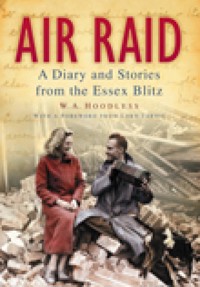
Front Cover: After the raid – music amidst the rubble.This heartening print from early October 1940 came from somewhere in what is now Havering. The press caption was ‘Home Sweet Home!’The couple had seen their house destroyed by an air raid, but thanks to their Anderson Shelter were completely unharmed as were their children of two years and eleven weeks. Once salvage began in the daylight, the concertina was retrieved and spirits were raised. The Blitz Spirit really did exist.
First published 2008
The History Press
The Mill, Brimscombe Port
Stroud, Gloucestershire, GL5 2QG
www.thehistorypress.co.uk
Reprinted 2010
This ebook edition first published in 2013
All rights reserved
© W. A. Hoodless, 2008, 2013
The right of W. A. Hoodless to be identified as the Author of this work has been asserted in accordance with the Copyright, Designs and Patents Act 1988.
This ebook is copyright material and must not be copied, reproduced, transferred, distributed, leased, licensed or publicly performed or used in any way except as specifically permitted in writing by the publishers, as allowed under the terms and conditions under which it was purchased or as strictly permitted by applicable copyright law. Any unauthorised distribution or use of this text may be a direct infringement of the author’s and publisher’s rights, and those responsible may be liable in law accordingly.
EPUBISBN 978 0 7509 5256 9
Original typesetting by The History Press
Contents
Preface
Foreword
one
Family and Upminster Before the War
two
Diary of Air Raids and Connected Stories
three
After the Onslaught: Picking up the Pieces
four
Assessing the Blitz
Bibliography
I dedicate this book to my familyand to everyone else that has ever suffered,directly or otherwise,from the bombing of civilians.
Preface
On 30 August 1940, my mother, Mary Hoodless, made up her mind to keep a diary of air-raid experiences, in a small blue notebook. I rediscovered it shortly after Christmas 2005, when looking through some old family papers and photographs. Reading it again after many years, the story was so gripping that I suddenly felt I should write this book.
Unlike most Second World War publications, this is a personal record running right through the Blitz period and written at the time. Placed as it is in historical context with the war, the locality and my family, I want the book to be a tribute both to them and to the countless people who have experienced or died from air raids at all times and places. Certainly in Britain, the Blitz was endured with great courage and sometimes even humour. In no particular order, my thanks are due to local authors Tony Benton and Peter Watt, the Imperial War Museum, the RAF Manston Spitfire and Hurricane Memorial Trust, Essex Record Office, Havering Local Studies Library at Romford, Swan Books, Upminster, the Romford Recorder, the National Archives at Kew, the Upminster Tithe Barn Museum and Colin Wingrave. Brian Evans kindly agreed to the use of the cover photograph amongst others.
Certain text extracts from the Mass Observation Archives refer to this preface. They are reproduced with permission of the Curtis Brown Group Ltd, London, on behalf of the trustees of the Mass Observation Archives; copyright © Mass Observation Archives. Regarding the story of firefighting in the East End of London (Chapter Four), every effort has been made to trace copyright holders and the author and the Imperial War Museum would be grateful for any information which might help to trace those whose identities or addresses are not currently known.
Owing to the vast amount of background material, much more has had to be omitted than included. Where it is still in copyright and it has been possible to establish that, I have the permission of the owners to reproduce it. Where appropriate with illustrations, sources and consents are acknowledged in the accompanying captions. The same applies to quotes used in the main text. I would, however, be glad to be advised if I have unwittingly infringed any person’s rights.
For many years now, virtually all of the physical scars from air raids have disappeared from sight as a result of redevelopment. But the mental scars remain in the minds of those who survived. In a familiar street, they cannot help recalling what it was like to run for the shelters and to wonder if they were going to be killed or injured by bombs or fires. For them, rebuilding erases very little. For most of us today, however, the Second World War is very much a matter of history and I think it best, if possible, to look at it all now without feelings of hatred or resentment. We simply need to learn the sober lessons.
The war was indeed more justified than most and can fairly be described as a successful struggle against evil. Nonetheless, one cost of the success was the large number of 60,595 British civilian deaths and 86,182 serious injuries from air raids. The great majority of these occurred during the months of the night Blitz from September 1940 to May 1941. Considering the alternative of Britain becoming a Nazi slave state, most would agree that these and other war-related deaths were the lesser of two evils. Years ago, I saw the opinion forcefully expressed that all the local and national leaders, who wished to go to war, should be given weapons and placed in a large field. That way, the issues could be settled and millions of ordinary people could have their wish of living in peace. Sadly, despite the idea sounding attractive, I fear that it is not feasible.
Ambitious and often evil regimes have arisen regularly throughout history, so placing other countries in a no-win situation. Either they surrender at great cost or fight at great cost. In 1939, it was remembered by many that the Germans had pioneered air raids in the First World War. From the 1920s onwards, it was felt that bombing could be decisive and, accordingly, British defence spending then favoured the bomber over the fighter. One common military view held that civilian targets were justified because entire nations were fully involved in modern wars. If bombing could break a country’s morale, its government would have to make peace. Many were most uncomfortable with that approach and a boost was thereby given to the disarmers and pacifists. But had Germany been able to deploy heavy bombers like the Lancaster, the highly destructive self-sustaining firestorms such as those in Hamburg and Dresden would certainly have occurred on a large scale in the UK in 1940. A key difference with the Western democracies is that, unlike them, Hitler would have had no compunction in creating such firestorms.
When the clash of these enormous international forces have their malign impact at ground level, the common man always seems to suffer, regardless of where he lives in the world and for which side he fights. For instance, in 1940/41, I think that there was a direct connection between Hitler’s mad ambitions and the civilian bombing casualties of Essex and elsewhere. The six years of war affected everybody to a greater or lesser extent. Shortages, fears of invasion and survival, bombing, valour, misery, real community spirit etc. all came together to change lives and outlooks forever. In one way perhaps, the hardships were more bearable than would apply today because of the greater mental toughness of the times. Full honour is due to the wartime generation.
Edmund Burke, the eighteenth-century philosopher, is quoted as saying: ‘All that is necessary for evil to triumph is that good men do nothing.’ If this means that the human condition extracts a price for peace and freedom, it was certainly paid on the Home Front during the Blitz.
Foreword
By Rt Hon. Lord Tebbit CH
History is not just about dates and events, but the lives of people – both the extraordinary people who drive history and the ordinary people who live through events.
I took care to ensure that my mother told my children of her childhood and remember particularly well her description of seeing a Zeppelin shot down and falling in flames at Cuffley on the Middlesex-Hertfordshire border in 1916.
The story of history as seen by the ordinary men and women who lived through the Blitz has been a neglected study. This book by Bill Hoodless is based on his mother’s 1940 diary records, of what life was like for many families during the Battle of Britain and the Blitz of 1940-41, not many miles from Cuffley.
The events described are also vividly recorded on Paul Day’s magnificent bronze panels on the Battle of Britain London Monument on Victoria Embankment near Westminster Pier.
It was both the skill and courage of the RAF aircrews of many nationalities, and their supporting servicemen and women on the ground, buttressed by the stoic resistance of the civilians under attack by the Luftwaffe, which decided the outcome of the Battle of Britain. Defeat would have opened the way to Hitler’s final victory in Western Europe. Victory held open the way to build the Anglo-American-Russian alliance, which finally defeated him.
Nearly seventy years on we survivors must ensure younger generations know how their great grandparents saw the battle which changed history.
ONE
Family and UpminsterBefore the War
The whole story begins with the family and the town before 1939. After all, horrific though it was physically, the Blitz affected only a part of people’s lives. Whether considered personally, or from the viewpoint of a town’s development, it was a ghastly episode that comprehensively left its mark. I want to start, therefore, with a picture of life before the storm.
Family Biography
My grandfather on my mother’s side, William Brown, was a skilled carpenter, who had made ends meet in hard times by calling on residential premises doing any jobbing work going. Coming from Lancaster, he met my grandmother from Fleetwood and they had five children, my mother being the eldest, born in 1906. As a strict Methodist, my grandmother sat in the same pew at the church in Fleetwood for some sixty years. When grandfather started a building company with a bricklayer, Mr Jackson, the firm was known as Brown & Jackson, a company listed until recently on the London Stock Exchange. In 2005, the name was changed to Instore, but by then the business had long since changed from building to retailing. It seems that it was not necessarily expected for the children to marry, but after my parents married first in 1939, so did my mother’s brothers and sisters. I well remember my grandparents as a kindly old couple, who looked forward to our summer holidays and always got in a crate of Peardrax, a fizzy pear-flavoured drink. Grandad’s knowledge of timber was total, whilst Grandma could still recite long poems from memory at the age of ninety.
Fig.1. Edwardian photograph of my father’s family. This photograph depicts a totally different world from that of today. Husbands were working family men, wives were housewives and duty was all important. It was a time of hardship, rigid morality and church attendance. Values were consistent across schools, parents and state. My father, the youngest of six, is shown on the right.
My father’s father, a master fishmonger, ran a greengrocer’s and fishmonger’s shop in Leeds, where my father was born. Fig. 1 is a family photograph, showing Dad as the smallest and youngest of six children. It was a traditional, God-fearing and self-reliant family with my grandmother keeping a good table and an endless supply of that general elixir of the time, goose fat. Times were hard and days were long, without the opportunity to pay too much attention to the children, who explored the countryside and made their own entertainment. My grandfather made regular trips to market in the horse and cart with my Aunt Lucy, when she was still only three. At a later time, the family lived in Horncastle, Lincolnshire. My grandfather having died before my parents’ marriage, they rather lost touch with his side of the family for many years.
My mother, Mary, succeeded in getting the only scholarship from Fleetwood to study science at Reading University where she was captain of hockey, obtained a degree in chemistry and later became a teacher. My father, Henry, was a keen motorcyclist as a young man, competing in the Isle of Man TT races. As an electrical engineer, he worked on installations and machinery maintenance, in various parts of the country right up to the post-war house move. They had met on a train where he was particularly impressed with her dress, which she had made. After a quick engagement, they were married in Romford Registry Office on 31 August 1939. Fig. 2 shows them on a day trip to France during the engagement. There had barely been time to get the engagement ring from the Jewish diamond trading market (in a secure railway arch in Amsterdam), to get married and to occupy the newly built house at Highfield Crescent, Upminster, before the start of war on 3 September 1939. He was then working as maintenance supervisor at a Tilbury steel drum works (Fig. 22) being responsible for the heavy machinery and the output. As the war continued, he was overseeing about 100 men, mainly on the twelve-hour night shift.
My parents soon became part of the Home Front in the war against Hitler. There was no honeymoon. A year later, my mother cooked a chicken to celebrate their first wedding anniversary, but it was far from a normal occasion: that night, when she was in the Anderson Shelter with a neighbour, a bomb threw earth over their legs. Like many, she spent the war years as a housewife, and from 1943, when my brother Peter was born, as a mother. Due to its importance to the war effort, my father’s job was a reserved occupation, so excluding him from call-up. At least they had nearly a year of the Phoney War together before the horror of the Blitz.
In summary, like countless others, my parents came from typical backgrounds. Hard work, duty and self-reliance were the norm. They both worked as single people, living in digs, until it became possible to buy a house, marry and settle down whilst in their thirties. At that stage, the war began.
Story of Upminster
Upminster has progressed from being a small rural parish in the middle of the nineteenth century to the attractive London suburb of today. The large pre-war demand for housing was met by both council and private medium density schemes allowing reasonable front and rear gardens. A lot of new residents were delighted by their new three-bedroom semi-detached houses having first-floor bathrooms, remembering as they did the ‘bad old days.’ Certainly this comment applied to my parents, who could well recall the Edwardian era of 1901-1910. Apart from the rich and a fairly small middle class, the great majority were then working families living poor lives in cramped conditions. Local transport was mainly on foot or by horse, whilst Marconi’s first radio signal was not sent until 1901. Fig. 3, which shows the family home in Highfield Crescent as part of a typical 1930s scheme, represented gracious living indeed.
Fig. 2. Day trip to France, believed to be just before start of war. Despite the clouds of war gathering, it was possible to enjoy a day excursion which must have been during my parents’ engagement. No doubt this café was soon to be patronised by German servicemen. My mother was badly seasick on the ferry but was cured by my father’s insistence on her eating thick fat pork sandwiches, an experience she never forgot!
But if, in 1939, places like Upminster were a bright modern world of improved living standards, any ‘feel-good factor’ was badly damaged by the clouds of war. On the one hand, about half of the town lived in good housing built in the previous ten years; crime was low; alcoholism was limited; drug addiction and racial problems did not exist and traditional family life was strong. On the other hand, there were big worries about German rearmament and to a lesser extent the rise of Russian communism. For many, such concerns thwart any attempt to paint the late thirties as a golden era.
Early Times
The whole region was agricultural before the Roman invasion, with families, even then, living in Upminster. St Mary’s Lane perhaps dates back 2,500 years as a major east-west route. During Roman times, this part of Essex exported corn to Gaul. The first church, St Laurence’s, was Saxon, erected in a woodland clearing and only rebuilt in stone at the start of the thirteenth century. This was the village centre. The Domesday Book records the manor of Upminster. In Norman times, it appears that a church hostel or inn also existed at these central crossroads of the village and, together with the original church, served as a resting place for many pilgrims travelling to Becket’s shrine at Canterbury. The site of that inn is believed to be close to the site of the Bell Inn, itself a rebuilt inn constructed in 1770 and demolished in 1962. Even now, many mourn the loss of the Bell Inn, replaced as it is with an example of 1960s brutalism. The central crossroads remain to this day.
Fig. 3. Highfield Crescent today: 1930s housing with no hint remaining of the Blitz or the 1941 parachute mine. The family home occupied from 1939 to 1948 is on the right of the picture. The mine landed behind the houses opposite, close to the railway line, which runs parallel to the road.
Agricultural use has continued, subject to the constraints of building, right up to the present time. The feudal system eventually evolved into a much greater number of smaller ownerships. Proximity to the capital and its rich merchants has been a major factor in the development of large residences and country estates from the seventeenth to the nineteenth centuries. For example, Sir James Esdaile, a cooper and a Lord Mayor of London, was responsible for a number of important eighteenth-century buildings such as Gaynes Manor House, New Place and the Bell Inn. For certain wealthy people, the parish was serving a dual purpose: country retreat from the bustle of London and agricultural investment. Upminster Mill was built in response to demand for flour during the Napoleonic Wars.
Arrival of the Railway
In 1885, Upminster Main Line Station opened giving a thirty-minute direct rail link to Fenchurch Street, London. Although it paved the way for expansion, not much happened for many years. Fig. 4 is a still tranquil scene from around 1910. The vacant land on the right became the site of Upminster Bridge Station, opened on the Romford link line in December 1934. It is shown on the 1921 Ordnance Survey map extract (Fig. 5) as part of a large empty field, with no sign yet of Highfield Crescent, where my parents lived. The sheer modernity of the town in 1938 is clear from the other map of that date in the same illustration: at least half of it had been constructed in those seventeen years.




