


8,99 €
Mehr erfahren.
- Herausgeber: Binnacle Books
- Kategorie: Geisteswissenschaft
- Sprache: Englisch
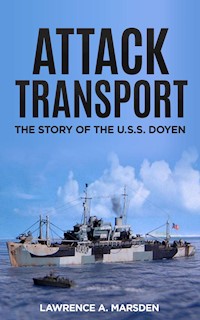
Attack Transport: The Story of the U.S.S. Doyen is a fast-paced action-adventure story from World War 2 detailing the birth of modern amphibious warfare. The book follows the US Navy attack transport ship the Doyen (AP-1), the first of its kind, from its exciting launch on the California coast to its deadly assaults on the shores of Saipan, Leyte, Luzon, and Iwo Jima.
Das E-Book können Sie in Legimi-Apps oder einer beliebigen App lesen, die das folgende Format unterstützen:
Veröffentlichungsjahr: 2020
Ähnliche




















Attack Transport
Lawrence A. Marsden
Published by Binnacle Books, 2020.
Copyright
––––––––
Attack Transport: The Story of the U.S.S. Doyen by Lawrence A. Marsden. First published in 1946.
Revised edition published 2020 by Binnacle Books. All rights reserved.
ISBN: 978-1-67816-018-0.
Table of Contents
Title Page
Copyright Page
1 | A Fighting Ship is Born
2 | The Adolescent
3 | Invasion in Dress Blues
4 | Pollywog versus Shellback
5 | Those New Zealand Women
6 | Tarawa
7 | Pigeon Mates
8 | Time Out
9 | Saipan
10 | Akimoto and Shiba
11 | Change of Plans
12 | Leyte
13 | The Goat and Cabbage Circuit
14 | Christmas 1944 Style
15 | Up the Slot
16 | Stopover at Guam
17 | Iwo Jima: The Goal
18 | Iwo Jima: The Price
19 | A Letter Home
20 | Underway Again
Further Reading: General Leemy’s Circus
1
A Fighting Ship is Born
––––––––
IT WAS ON A MONDAY morning that I received my orders to report for sea duty. The regular routine of the week was just beginning when the telephone on my desk rang. The voice of the skipper boomed over the wire. “Larry, start packing your bags—you’re going to sea!” The skipper quoted: “...upon detachment you will proceed and report to the Commanding Officer of the U.S.S. Doyen (APA-1).”
Whatever kind of ship APA-1 was, it certainly had a low number. No one in the office had ever heard of APA’s, but the war was still young, and ignorance of new fleet units wasn’t at all unusual. Finally we unearthed an antiquated ship classification list. I opened it to the A’s. Down the list ... “AP—Troop Transport” ... and almost at the bottom ... “APA—Animal Transport.”
Animal transport! I could see myself as jockey on a seagoing freight car, or perhaps “stable boy” would be a more accurate term. I closed the pamphlet and stuffed it into my lowest desk drawer. Bad enough to suffer ignominy alone ... no reason to share it with an unsympathetic office force.
That afternoon I took the bus to naval headquarters. Perhaps they would have additional information, or possibly something could be done to change the orders. I approached the chief clerk in the personnel office. He was a dour old chap, his heavy jowls giving him the appearance of a dyspeptic bulldog. I had barely told him what my orders were when he shoved back his chair, rose ponderously to his feet, and extended a ham-shaped hand. Without expression in his voice he said, “Good luck, sir ... and goodbye, sir.”
“What do you mean?”
“Well, sir, you’ve been ordered to an attack transport. That’s the newest thing out. They’re going to use those ships to carry the troops right up to the beaches! You can give me a battleship any old day—but not one of those babies.”
And so, two weeks later, I left for the West Coast to report for duty aboard Attack Transport Number One.
Reporting for duty aboard a ship is like a lodge ritual; it must be done in a certain way. As I walked down the dock toward the berth of the Doyen, I tried to recall all the things I was supposed to do. “Let’s see ... I walk up the gangway and just as I get to the top I salute the quarterdeck. Quarterdeck ...where is the quarterdeck? Or is it the flag I salute? ... I guess I’ll play it safe; I can see the flag from here. Then I salute the officer of the deck and say, ‘Your permission to come aboard, sir?’ After that I add, ‘Lieutenant Marsden reporting aboard for duty.’ Then he’s supposed to say, ‘Permission granted; glad to have you aboard, sir.’ From there on, I guess I’m on my own.”
It was easier than I had expected. Either the officer of the deck was equally inexperienced, or else he chose to ignore my feeble salute and mumbled words. At any rate, he was really friendly. Putting out his hand, he greeted me.
“Glad to have you aboard, Marsden. The ship’s a mess, but I guess you’ll get used to it. Chow’s about ready, and if you don’t mind waiting a minute till my relief gets here, I’ll take you up and show you around.”
While I waited for him, I looked over the exterior of the ship. She was a big girl, about five hundred feet in length, with a high superstructure forward and decks built in stair fashion toward the stern. Her two stacks gave her the rakish appearance of a light cruiser. At the moment she did look a mess. My new friend explained why.
“We’re not in commission yet. She was due for it a week ago, but something fouled us up, as usual, and we’re still waiting. But the Old Man said the big day has been set for May 22, and that’s only about a week away.”
As the relief O.O.D. approached, my friend unbuckled his gun belt and motioned for me to follow him. It was like walking through a fun house at a carnival. I had no way of knowing where the narrow passageways were leading, and the decks were covered with fire hoses, cables, hissing air hoses, acetylene lines, and helmeted yard workers. After winding through this maze for at least three hundred feet, we took a sharp left turn up a ladder (stairway, I would have called it then). At the top was a small room about twenty feet in length and eleven feet wide. The little sign above the entry labeled it: “Ship’s Officers Wardroom.”
The ship’s officers were already eating when we entered. My friend took me to the head of the table and introduced me to the executive officer. “Commander McClaughry, this is Lieutenant Marsden. He just reported aboard ship for duty with the supply department.” Commander McClaughry, a tall, slender, friendly appearing chap, stood up and shook my hand. “Glad to have you with us, Mr. Marsden. We have a good ship here, and I know you’ll like it.” Other introductions followed. There were so many men to meet that the best I could manage was a grin and a “Glad to meet you.”
A few personalities, though, did make a lasting impression. There was Ralph Lane, the chief engineer. He was a huge, heavy-set man with a great booming voice, a man who would say what he liked when he liked. Then there was the senior medical officer, handsome, dapper Jim Oliver, fresh from a society practice in swanky Palm Springs. These two made a place for me at the table, and as the meal continued did their best to acquaint me with the background of the ship and what she was supposed to do.
Although the date was May 17, 1943, the Doyen had been conceived many years before. At the close of World War I, it was anticipated that a new type of transport would be needed. Visions of world peace were bright, but the War Department was still skeptical about the security of the small islands in the West Indies group. What was required, the planners reasoned, was a small and speedy transport—a ship just large enough to carry a Marine landing team. Tentative plans were drafted (the rough design was submitted by the youthful Assistant Secretary of the Navy, Franklin Delano Roosevelt) and an estimate was submitted to the Naval Affairs Committee. As the Congress of the early twenties was more interested in scrapping the fleet than in making any additions, the project ended there. A ship of the proposed type was approved, but funds were not made available.
Then came signs of trouble in the East and in the West. From the start of activities in the Pacific, it was evident that a new type of joint land-and-sea warfare had to be developed. “Amphibious” was the only accurate term, and “amphibious warfare” it became. Classical notions and textbook tactics were subjected to a vigorous revaluation in which many were scrapped. Naval and civilian architects spent long hours together over their drafting boards. Plans were turned out only to be discarded as new demands showed them to be inadequate. Ships and boats of weird design slid down the ways. Ponderous floating boxcars, smaller boats with clanking ramps, sleek torpedo boats—all crowded the shipyards and the transportation facilities of the nation. It was then that the original plans for the transport were resurrected.
A fast and maneuverable troopship was required. The Navy Department selected a New York architectural firm, masters in the field of yacht design, to blueprint the working plans. The specifications were rigid; it was to be a vessel more than four hundred feet in length, capable of carrying thirteen hundred men, with storage space for supplies and munitions sufficient for sixty days, and possessing a speed of at least eighteen knots. In addition, provision had to be made for complete antiaircraft armament and for the bulky radio and radar units that are a part of every Navy fighting ship. The keel was laid at the yards of the Consolidated Steel Corporation in Los Angeles, just four months after the blueprints were submitted for approval.
On July 9, 1942, the ship was launched. Named after Brigadier General Charles A. Doyen, United States Marine Corps—who once commanded the Fourth Marine Brigade, which later fought so valiantly at Chateau-Thierry and Belleau Woods—she was christened by his granddaughter, Miss Faye Doyen Johnson.
Although the ship was then in the water, much of the work remained to be done. The finishing of the superstructure, the installation of guns, radio, radar, and the intricate intercommunications system—all typically Navy jobs—had yet to be completed. For this work, the hull was towed into the navy yard at Terminal Island, California, where she now lay.
Almost a week later, on May 22, 1943, the Doyen was accepted for the Navy by Captain S. F. Heim, U.S.N. The commissioning of a naval vessel marks the acceptance of that craft by the Navy Department. It also means that from that day on she is an independent unit of the fleet, entitled to her own commanding officer and to her own commission pennant.
The day was a beautiful one, the kind that Southern California advertises. The warm sun shone down on a ship which was hardly recognizable as the one I had originally boarded. The litter of building had been cleared away. Equipment was neatly stowed, and the whole ship glowed from a fresh coat of deep-blue paint. I was just one of the 475 officers and men who stood smartly at attention on the afterdeck. All of us, I believe, stood just a little straighter, held our heads just a little higher than we ever had before. This was our ship, and we were proud of her.
The actual ceremony was brief. Captain Heim formally signed a few papers and then addressed us: “I need not tell you that your ship is fast and powerful. She has been designed for her mission and is fitted with every modern device to meet and beat the enemy at his own game. I am sure the designers and builders have produced a sturdy body, and that you, the crew, will give that body a living soul and spirit.”
As he concluded, the Navy Band assembled on the dock commenced playing “The Star-Spangled Banner.” The colors rose slowly toward the top of the mainmast. Just as the ruffle of drums reached its full tempo, a line snarled and the flag momentarily paused. From behind me I heard an indrawn breath and a muttered, “Christ . . . that’s bad luck.” It was answered by a sharp “Shut up! Look! It’s breaking loose.” For, almost as if it had been planned as an emphasis to commissioning, the colors snapped up full and free. The U.S.S. Doyen, Attack Transport Number One, had come into being.
Captain Heim then turned the ship over to her first skipper, Commander Paul F. Dugan. Chaplain James J. Doyle concluded the ceremony with the invocation that has been given at the launching of each ship of the United States Navy since 1776, an invocation to which all of us added a silent “Amen.”
O Almighty and Eternal God, we invoke Thy Name in blessing upon this Ship, her Captain and Crew, and all those who take passage thereon. Stretch forth The right hand over her course, as Thou didst in the tempest on the Sea of Galilee, that she may have safe and tranquil sailings. Guided by the Star of the Sea, may this vessel always reach its haven secure, according to Thy holy will. May the blessing of Almighty God, Father, Son, and Holy Ghost descend upon this ship and all those thereon, and abide there always. Amen.
2
The Adolescent
––––––––
THE Doyen was officially born on May 22, 1943, but like all youngsters, she had to go through a stage of growth and adjustment. Most of her crew were just as inexperienced. Captain Dugan and Commander McClaughry were Naval Academy graduates, but the remainder of us had been recruited largely from civilian life and from the Merchant Marines. It was a case of the rider learning to ride on a horse that had never been ridden.
We were all eager to be underway, to get into the battle, but there was much work to be done first. My own duties began immediately. The boss of the supply department was Lieutenant Commander George E. Schindler. Mr. Schindler—he was a stickler for military etiquette and wouldn’t think of allowing us to call him George—was a severe and exacting person. Things had to be just so. He was right, of course, but the rest of us chose to be a little more easygoing. The only times he would relax were during the intervals when we managed to slip away to the officers’ club. After a few drinks the boss would get really human, sit down at the piano, and bat out some well-executed jazz. Months later, after I had taken over his job, I realized why he had been so careful. Our assignment was to stock the ship with all its equipment, and it was Schindler’s responsibility to make certain that nothing was missing. We really sweated through the first loadings. As all hands were turned out to handle stores, the decks were piled high with food, rain gear, nuts and bolts, and just about every other item ever listed in a mail-order catalogue.
This work, though, served to unify the ship’s personnel. After one week, I remember writing home that this ship was the friendliest place I had ever known. Everyone was willing to cooperate, for we all realized that someday our own lives might hang in the balance if real teamwork wasn’t achieved.
All the troubles weren’t concerned with the ordinary work routines of the Doyen. A ship in port within the continental limits of the United States is always faced with some disciplinary problems. In wartime that factor is increased. Members of the crew who had been at sea fell into two classes: those who respected the rules governing liberty in order to protect their rights to further freedom, and those who preferred to disappear from the ship to return just before sailing time. The influence of both groups was felt by our newly assigned recruits.
One mess attendant, a double for Step-in Fechit, hit the beach and the bottle to such an extent that he became involved in what he termed “a little affair with straight-edge razors.” Another youngster, Red O’Neil from Oklahoma, went on a weekend party with only a twenty-four-hour pass. He was brought back to the ship by the shore patrol and was restricted as prisoner-at-large. Apparently he had made further plans, for one night he slipped over the side, down a cargo net, and on into town. The next morning he appeared before the officer of the deck, saluted smartly, and reported: “Seaman O’Neil, PAL, AWOL, sir.”
We had one setback in our work. Shortly before the Doyen was commissioned, we had heard rumors that she was top-heavy. Her hull lines were those of a yacht, yet she possessed a huge superstructure. The grapevine scuttlebutt reported the yard was laying bets two to one that the ship would turn over when she hit the heavy swells off San Francisco. The story was given added impact when, during our second week as an accepted ship of the Navy, we were ordered into dry dock for an inclination test. All of us, from the men in the bilges to the commanding officer, were keeping our collective fingers crossed.
We were bitterly disappointed to learn that in order to make an inclination test the ship had to be stripped of all her supplies, the same supplies we had just so laboriously loaded. But the job had to be done. Then the ship was put in dry dock, and a small flat-car loaded with weights was placed on a railroad track affair which had been laid across the deck amidships. A plumb bob was suspended from a girder of the drydock. As the flatcar was shifted from one side to the other, a trained technician measured the degree of inclination as shown by the vertical bob. From these figures the ship’s seaworthiness in rough weather could be accurately determined.
While the Doyen was being tested, only one representative of the ship was allowed to stay aboard. The rest of us lined the sides of the dry dock and anxiously waited. Commander McClaughry remained on the ship, stationed at a point in its exact center. Ralph Lane chided him, “Commander, you must have a helluva lot of pull around here. What’s the story, do you know a congressman?”
“No, sir!” came the quick reply. “They chose me because I part my hair in the middle.”
Rumors to the contrary, the ship came through with an excellent record. We were told that she could withstand any sea, and with that report came orders to get underway within forty-eight hours for a brief training cruise. Back came the supplies. But this time we didn’t have a week in which to load them. Boxes and crates were piled everywhere. Schindler paced the deck like a madman. “God,” he muttered again and again, “how’ll we ever know where anything’s stowed? There’ll be ramifications; I know there’ll be ramifications.”
On schedule, two days later, we slid through the breakwater and headed for the open sea. It was after dark when we reached deep water. Though the report had told us that the ship could take anything, most of us were more than dubious. Swaddled in lifejackets, a half dozen of us congregated in the officers’ wardroom to spend the night. Ensign Dan Minnich, a tall good-natured chap, veteran of the Murmansk run, did his best to increase our uneasiness. Over and over again he declared that the “metacentric center was too high” and “When she tips, you fellows’ll see.” Bosun Trippler, an old-time Navy man, was inclined to agree with him. After four hours of uneventful cruising, without so much as a 10-degree roll, three of us trooped off to bed. But Dan and Trippler remained where they were sitting. The last thing I heard as I left was Dan saying, “Tripp, I’ll bet I beat you to the weather deck when she tips.”
The Doyen’s initiation was not without real excitement. During our trial run just outside San Diego, all of us were at our battle stations for gunfire practice. Firing was fast, noisy, and continuous, but not too accurate. Almost at the close of the drill, two of the three-inch-fifties got overheated and jammed with live shells still in their partially opened breeches. The condition was immediately reported to the bridge, and the order to cease firing was given.
I watched what happened next. Chief Gunner’s Mate Capo and Gunner’s Mate “Ace” Parker gingerly approached the guns. While one pulled back on the breech mechanism, the other tugged at the shell. The first came out easily and Capo tossed it overboard. The second, however, was firmly lodged. Grabbing up a small crowbar, Capo slid the point behind the rim of the shell and began to pry it out. This was really dangerous; should the shell be exploded by the heat of the gun; the two men wouldn’t have a chance. But the shell finally worked loose into the hands of Ace Parker. We were standing so silently that we could all hear the plop as the shell dropped into the sea. That afternoon at Captain’s Mast both men were awarded Letters of Commendation. This was Capo’s second decoration; he already held the Silver Star for heroism on the cruiser Northampton.
During that same run the damage control officer conducted a test of the firefighting apparatus of the ship. Because of a mechanical defect in the control system, a carbon dioxide extinguisher was mistakenly set off in the after engine room. The engineers on boiler watch in the lower level of the room, unaware of the accumulation of the gas, continued working until they were overcome.
When the engine room failed to respond to a signal from the bridge, the trouble was detected. There wasn’t time to outfit a rescue party with oxygen masks. Three engineers on the upper level of the engine room volunteered to attempt to bring out their unconscious shipmates. They crawled down the ladder, fighting for breath at each step, and managed to locate the victims. With the men hung limply over their shoulders, the three engineers worked their way back up to the top of the ladder. Oden V. Hayes, C. L. Greenwood, and J. T. Strauss were later given the Navy and Marine Corps Medal.
By the middle of July the ship was beginning to possess a definite “soul and spirit.” Like the intricate engine-room parts, we, her crew, were at last becoming broken in to smooth teamwork. Morale was high and all of us were waiting for the day when we would at last see real action. We felt that time was not very far distant. Even the bootblack boys in San Diego knew that the complete retaking of the Aleutians was about to commence. It was no surprise, then, when the official announcement came: “All departments make ready for sea.”
Charles Augustus Doyen (1859–1918)




