


33,99 €
Mehr erfahren.
- Herausgeber: John Wiley & Sons
- Kategorie: Fachliteratur
- Serie: Basic Guide Dentistry Series
- Sprache: Englisch
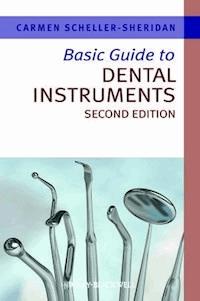
Basic Guide to Dental Instruments provides a working inventory of dental instrumentation in common use in dental surgeries. A clear photograph of each instrument is included, and described according to name, usage, any relevant features and varieties. Each section is dedicated to a specific discipline or division of dentistry. Complete set-ups have been included at the end of most sections for various procedures. The coverage reflects instrumentation and accessory items used in general dental practice, routine hospital dental procedures and selected specialist settings.
The author adopts a flexible approach which recognises that some instruments are multi-functional, and their names and usage can vary across dental surgeries. This approach, coupled with the range of instruments covered, makes the book an ideal 'portable' resource across general practice, hospital and a range of specialist settings. The book also highlights instruments which can be easily confused. In addition to detailing the classic sets of dental instruments, the importance of instrument care and sterilisation regimes is acknowledged.
This second edition contains an expanded chapter on instruments used in conjunction with dental implants, and illustrations have been updated throughout.
FEATURES
- Best-selling title
- Brand new chapter on instruments used in dental implantology
- Expanded chapter on dental burs
- Illustrations revised throughout
Sie lesen das E-Book in den Legimi-Apps auf:
Seitenzahl: 115
Veröffentlichungsjahr: 2013
Ähnliche


















CONTENTS
Dedication
Acknowledgements
How to Use This Book
SECTION 1 INFECTION CONTROL IN THE DENTAL SURGERY
PROTECTIVE WEAR
WORK SURFACES
ITEMS USED FOR IDENTIFICATION AND ORGANISATION DURING STERILISATION
STERILISATION EQUIPMENT
MANUAL CLEANING AIDS
SECTION 2 DENTAL RADIOGRAPHY
CONVENTIONAL INTRA-ORAL RADIOGRAPH FILM
INDIRECT DIGITAL RADIOGRAPH FILM – PHOSPHOR PLATES
RADIOGRAPHIC ACCESSORIES AND EQUIPMENT
EXTRA-ORAL RADIOGRAPHS
SECTION 3 BASIC INSTRUMENTS
GENERAL FEATURES OF DENTAL INSTRUMENTS
THE BASIC DENTAL INSTRUMENTS
SECTION 4 INSTRUMENTS AND SUNDRIES USED IN MOISTURE CONTROL
SECTION 5 LOCAL ANAESTHESIA
SYRINGES, NEEDLES AND CARTRIDGES
SHARPS’ WASTE MANAGEMENT
SECTION 6 INSTRUMENTS USED FOR RUBBER DAM PLACEMENT
SECTION 7 HANDPIECES, BURS AND ROTARY ATTACHMENTS
HANDPIECES
BURS AND ROTARY ATTACHMENTS
SECTION 8 INSTRUMENTS USED IN BASIC RESTORATIVE PROCEDURES
FOR ALL RESTORATIONS
FOR AMALGAM RESTORATIONS
AMALGAM WASTE MANAGEMENT
FOR COMPOSITE RESTORATIONS
FOR ALL RESTORATIONS AGAIN
SECTION 9 MATRIX BANDS AND MATRIX RETAINERS
TOFFLEMIRE MATRIX RETAINER AND STAINLESS STEEL MATRIX BAND SET-UP
SECTIONAL MATRIX AND BITINE RING SET-UP
HAWE SUPERMAT MATRIX SET-UP
SECTION 10 INSTRUMENTS USED IN ENDODONTIC TREATMENT
ENDODONTIC INSTRUMENTS
ENDODONTIC ACCESSORIES
SECTION 11 ELEVATORS
PARTS OF AN ELEVATOR
TYPES OF ELEVATOR
SECTION 12 EXTRACTION FORCEPS
PARTS OF EXTRACTION FORCEPS
TYPES OF EXTRACTION FORCEPS
SECTION 13 SURGICAL INSTRUMENTS
GENERAL SURGICAL INSTRUMENTS
INSTRUMENTS FOR PERIODONTAL SURGERY
IMPLANTS
EMERGENCY EQUIPMENT
SECTION 14 MEASURING DEVICES
SECTION 15 IMPRESSION TRAYS
FUNCTIONS AND FEATURES OF IMPRESSION TRAYS
TYPES OF IMPRESSION TRAYS
SECTION 16 ORTHODONTIC INSTRUMENTS
ORTHODONTIC APPLIANCES
ORTHODONTIC MATERIALS
ORTHODONTIC INSTRUMENTS
MISCELLANEOUS ITEMS
SECTION 17 INSTRUMENTS USED IN PERIODONTAL PROCEDURES
VARIOUS PERIODONTAL PROBES
SCALERS AND CURETTES
MISCELLANEOUS EQUIPMENT
SECTION 18 INSTRUMENTS USED IN REMOVABLE AND FIXED PROSTHODONTICS
Index
This edition first published 2011
© 2006 by Blackwell Publishing Ltd
© 2011 by Carmen Scheller-Sheridan
Wiley-Blackwell is an imprint of John Wiley & Sons, formed by the merger of Wiley’s global Scientific, Technical and Medical business with Blackwell Publishing.
Registered office:
John Wiley & Sons, Ltd, The Atrium, Southern Gate, Chichester, West Sussex, PO19 8SQ, UK
Editorial offices:
9600 Garsington Road, Oxford, OX4 2DQ, UKThe Atrium, Southern Gate, Chichester, West Sussex, PO19 8SQ, UK2121 State Avenue, Ames, Iowa 50014-8300, USA
For details of our global editorial offices, for customer services and for information about how to apply for permission to reuse the copyright material in this book please see our website at www.wiley.com/wiley-blackwell.
The right of the author to be identified as the author of this work has been asserted in accordance with the UK Copyright, Designs and Patents Act 1988.
All rights reserved. No part of this publication may be reproduced, stored in a retrieval system, or transmitted, in any form or by any means, electronic, mechanical, photocopying, recording or otherwise, except as permitted by the UK Copyright, Designs and Patents Act 1988, without the prior permission of the publisher.
Designations used by companies to distinguish their products are often claimed as trademarks. All brand names and product names used in this book are trade names, service marks, trademarks or registered trademarks of their respective owners. The publisher is not associated with any product or vendor mentioned in this book. This publication is designed to provide accurate and authoritative information in regard to the subject matter covered. It is sold on the understanding that the publisher is not engaged in rendering professional services. If professional advice or other expert assistance is required, the services of a competent professional should be sought.
Library of Congress Cataloging-in-Publication Data
Scheller-Sheridan, Carmen.Basic guide to dental instruments / Carmen Scheller-Sheridan. – 2nd ed. p. ; cm.Includes bibliographical references and index.ISBN-13: 978-1-4443-3532-3 (pbk.)ISBN-10: 1-4443-3532-4 (pbk.)1. Dental instruments and apparatus–Handbooks, manuals, etc. I. Title.[DNLM: 1. Dental Instruments–Handbooks. WU 49]RK681.S33 2011617.6′0028–dc23
2011021940
A catalogue record for this book is available from the British Library.
1 2011
To my dear husband, Padraig, and sweet daughter, Abigail, for all of their love and support.
ACKNOWLEDGEMENTS
I would like to thank the many people who supported me with this publication: Professor Noel Claffey, Professor June Nunn, Tina Gorman, Joan Brennan, Madonna Bell, Pascaline Fresneau, Una Lannon and Helen Phipps. Thank you to Dr Declan Furlong who provided me with some images and to Mr Mark Thompson for photographing many of the dental instruments.
Thank you to the following companies and people who supplied photographs:
American Eagle Instruments Inc.
Biomet 3i
DENTSPLY Ash® Instruments
Dr Declan Furlong
Dynaflex
Garrison Dental Solutions
Henry Schein Ireland
Hu-Friedy
J. Morita Europe GMBH
Kerr
Kodak
Laerdal Medical Ltd
Learning and Teaching Scotland
LM – Instruments Oy
L&R Manufacturing
Dr Anthony Maganzini
Integra LifeSciences Corporation, Plainsboro, NJ
Ormco Europe
Owandy Dental Imaging
Premier Dental Products Company
Dr Frank Quinn
Roydent Dental Products
SDI
Septodont
Sirona Dental Systems
Sybron Endo
Total Care
Ultrasonics
W&H (UK) LTD
Young Dental
HOW TO USE THIS BOOK
As the dental profession evolves, there is an increasing demand for supplementary material that can keep up with advancing trends. ‘Hands on’ practical experience is essential for anyone in the dental profession, and this needs to be supplemented with written information to reinforce our practical experiences.
This illustrated manual has been prepared for students working and studying in the dental profession. It may be used as a study aid or kept in the dental surgery as a reference guide. This manual is intended to complement other methods of learning, i.e. textbooks, lecture notes, etc., and is not meant to be a comprehensive resource.
Because many dental instruments look similar, and can be confusing to a student, the ‘false friends’ sub-sections identify instruments that may resemble the particular instrument. This manual is not intended to be a complete representation of all dental instruments, but it does include examples from each dental discipline. As many dental instruments are multi-functional and are referred to by more than one name, where possible, these are given beside the name of the instrument. Complete set-ups have been included at the end of most sections for various procedures. The dental professional may have to modify these lists depending on the operator’s preference.
Each section is dedicated to a specific discipline or division of dentistry. Some instruments feature in many sections, and these have been included in the set-up sub-sections of the relevant sections. Infection control is a fundamental requirement in the dental surgery, and as such the first section is dedicated to this area. This section aims to introduce the principles of health and safety, which must always be at the forefront of a dental professional’s mind. Contact the legislative bodies for appropriate regulations and legislation relevant to your workplace.
SECTION 1
INFECTION CONTROL IN THE DENTAL SURGERY
It is the responsibility of the dental team to ensure that the appropriate and correct procedures are carried out in relation to infection control to protect the patients, the public and themselves.
Figure 1.1
PROTECTIVE WEAR
FIGURE 1.1a, b, c
Name
(a) Mask (b) Safety glasses (c) Face shields
Function, precautions and directions for use
To protect the dental team from micro-organisms, debris, splatter and chemicals
A mask is worn to protect the mucous membranes of the nose and mouth. It filters out small particles
Should always be changed between each patient or before if it is visibly soiled
Should be worn during patient care, sterilisation, disinfection, cleaning procedures and during laboratory work
Safety glasses and/or face shields are worn to protect the mucous membranes of the eyes
Should be disinfected between patients
A face shield can be used instead of safety glasses, but a mask must still be worn
Should be large enough to cover the eye area completely and provide protection from the top and side. With some safety glasses additional top and side shields have to be added to be used for this purpose
Safety glasses are available to fit over prescription eye wear
Must be shatterproof
Varieties
Different types of masks and glasses available
Figure 1.2
Figure 1.3
FIGURE 1.2
Name
Protective gloves
Function and directions for use
To protect the dental team from direct contact with micro-organisms, debris, splatter and chemicals
Worn during patient care when coming in contact with contaminated objects and chemicals, and when working intra-orally
Always change between patients
Do not wash gloves
Replace damaged and ripped gloves immediately
Always wash and dry hands thoroughly prior to donning gloves
It is important to make sure gloves fit properly
Varieties
Made from many different materials, i.e. latex, vinyl and nitrile
Available packaged as sterile surgical gloves
Rubber utility gloves/heavy duty gloves are used during sterilisation procedures
WORK SURFACES
FIGURE 1.3a, b
Name
Non-permeable barriers
Function and features
Used to cover surfaces to prevent contamination
Must be impermeable
Single use; to be disposed of in the contaminated waste
Varieties
Many different types and sizes available
Figure 1.4
Figure 1.5
ITEMS USED FOR IDENTIFICATION AND ORGANISATION DURING STERILISATION
FIGURE 1.4
Name
Coloured identification rings
Function and feature
Used to organise and identify instruments
Autoclavable
Varieties
Many different types and sizes available
Coloured autoclavable tape can also be used
FIGURE 1.5a, b, c
Name
Instrument cassettes
Function(s)
Used to organise and identify instruments during sterilisation and disinfection
Can double as an instrument tray during procedures
Varieties
Many different types and sizes available, including plastic and metal types
Figure 1.6
Figure 1.7
Figure 1.8
FIGURE 1.6
Name
Autoclave tape
Function and features
Used to secure instrument wrap or pouches prior to sterilisation
Will change colour once exposed to a certain temperature, but this does not indicate whether sterilisation has occurred
Can be written on to indicate the contents of the package
Varieties
Many different types and sizes available
FIGURE 1.7a, b
Name
Sterilisation pouch
Functions and features
Used to wrap instruments prior to sterilisation
Aids in organisation of instruments
One side may be transparent to allow for viewing of the pouch contents (
Figure 1.7a
,
b
)
Coloured markings indicate that a certain temperature has been reached during the sterilisation cycle
Instruments will remain sterile in pouch until it is punctured or opened
Varieties
Many different types and sizes available
STERILISATION EQUIPMENT
FIGURE 1.8
Name
Autoclave
Function and directions for use
Uses steam under high pressure to achieve sterilisation
Follow manufacturer’s directions for use
Consult local legislation and guidelines in regard to appropriate sterilisation procedures
Varieties
Many different types and sizes available
Figure 1.9
Figure 1.10
MANUAL CLEANING AIDS
FIGURE 1.9
Name
Bottle brushes
Functions, features and precautions
Manual cleaning is never recommended except when ultrasonic cleaning is not effective in removing debris
Used along with a soapy cleaner to remove debris prior to sterilisation
Allows cleaning inside suction tubes
Long handle allows a greater distance between the operator and the contaminated object
Should always be used submersed in water to reduce splatter
Always wear heavy duty utility gloves while using bottle brushes
Varieties
Many different types and sizes available
FIGURE 1.10a, b
Name
Bur brushes
Function and precautions
Manual cleaning is only recommended when ultrasonic cleaning is not effective in removing debris
Used along with cleaner to remove debris prior to sterilisation
Allows for the cleaning of burs with small, hard-to-clean flutes
Always wear rubber utility gloves/heavy duty gloves while using bur brushes
Varieties
Many different types and sizes available
Figure 1.11
Figure 1.12
FIGURE 1.11
Name
Ultrasonic cleaner
Function(s) and directions for use
Used along with a soapy cleaner
Uses sound waves to reduce bioburden and debris from instruments prior to sterilisation
Follow manufacturer’s instructions for solution types and length of time needed for cleaning
Varieties
Many different types and sizes available
FIGURE 1.12
Name
Assistina
Function(s) and directions for use
Uses air to run cleaning fluid solution and oil through handpieces
Used to expel debris from handpieces
Plastic cover over handpiece attachment is used to reduce aerosol
Follow manufacturer’s instructions for use
Varieties
Many different types available
SECTION 2
DENTAL RADIOGRAPHY
Radiographs are important tools in the diagnosing of dental disease. There are many types of radiographs available, all of which are used for different purposes. There are two main types of dental radiographic films: intra-oral and extra-oral.
Figure 2.1
Figure 2.2
FIGURE 2.1a, b
Name
(a) Intra-oral X-ray machine (b) Extra-oral X-ray machine
Functions
Intra-oral X-ray machines are used for exposing occlusal, peri-apical and bite-wing radiographs
Extra-oral X-ray machines are used for exposing panoramic/OPG (orthopantomograph) radiographs and cephalometric radiographs
Varieties
Machines from different manufacturers may vary in design
FIGURE 2.2
Name
Lead apron and thyroid collar
Function and precautions
A lead apron and thyroid collar must be used to protect the patient from radiation during X-ray procedures
The lead apron is used with a thyroid collar that must cover the radio-sensitive tissues (from the thyroid downwards and including the lap area)
The lead apron must be hung up, not folded because folding the apron will cause the lead inside to crack, causing radiation to pass through
Varieties
Different styles available from various manufacturers
Figure 2.3
Figure 2.4
CONVENTIONAL INTRA-ORAL RADIOGRAPH FILM
FIGURES 2.3; 2.4
A detailed radiograph film, which is exposed while in the patient’s mouth
Used in conjunction with a film holder for accurate placement
Some films may be covered in a clear plastic sleeve for infection control and prevention purposes (see
Figure 2.4
)
Every film has a bump to assist in film orientation
The bump always faces towards the X-ray tube
Inside the film packet:




