


6,00 €
Mehr erfahren.
- Herausgeber: The Lilliput Press
- Kategorie: Geisteswissenschaft
- Sprache: Englisch
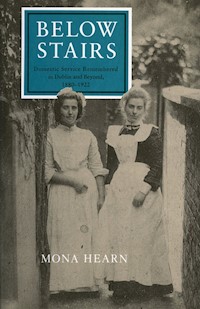
A hundred years ago sevants underpinned middle- and upper-class life in Ireland, and domestic service was the major source of employment for women before social conditions changed utterly after the First World War and labour-saving appliances took their place. Two generations on, the domestic servant is an almost extinct species. This book examines an area of life which has never been adequately reflected in Irish literature, labour or social history. The author of this pioneering study bases her work upon interview sources, government reports, royal commissions and census returns, as well as household accounts, inventories, family papers, contemporary newspapers, diaries and reminiscences. She discloses and interprets the little-known world of life below, and occasionally above, stairs: the conditions and lifestyles of its inhabitants; their recruitment, training and duties; the wages paid, clothes worn and food eaten; the freedoms conceded, the privations endured. Below Stairs, Domestic Service Remembered in Dublin and Beyond, 1880-1922, affords unique views of the lives of the ordinary and extraordinary, of rulers and the ruled. It prepares the ground for interpretations of a forgotten age.
Das E-Book können Sie in Legimi-Apps oder einer beliebigen App lesen, die das folgende Format unterstützen:
Veröffentlichungsjahr: 1993
Ähnliche




















BELOW STAIRS
DOMESTIC SERVICE REMEMBERED IN DUBLIN AND BEYOND 1880–1922
MONA HEARN
TO MY MOTHER
— Contents —
Title Page
Dedication
Introduction
One Masters and Servants
Two Entering Service
Three Conditions of Service
Four Life in Irish Country Houses
Five A Career in Service
Six Decline in Service
Appendix
Index
Plates
Copyright
— Introduction —
One hundred years ago domestic servants were a familiar part of everyday life in Ireland; today they have virtually disappeared. The prospect of ‘managing’ without a servant was unthinkable to middle-class householders in the early 1900s. Yet, within a couple of generations, that change occurred, and had a profound effect on the social life of the country. Now the domestic servant is but a fading memory to the older generations.
In the last century and the early years of this century most young girls, and some boys, from the lower social classes went straight from school to service, sometimes the very next day. They joined the ranks of what was by far the single largest occupational group for women; in 1881 48 per cent of employed women in Ireland were in the domestic class. There was a steady decrease in the number of domestic servants from then on, but domestic service was only surpassed by manufacturing industry in 1911. It was still the second largest employer of women with 125,783 female indoor servants.1 Indeed any account of the employment of women in the nineteenth or early twentieth centuries must afford a prominent place to domestic service.
The importance of domestic service as an occupation which not only affected the whole life of those engaged in it but also impinged, in an intimate and special way, on the lives of those employing servants, has never been adequately reflected in literature, legislation, labour or social history in this country. The main reason for this neglect was probably lack of knowledge about domestic service and certainly an absence of a comprehensive view of the industry. The work place of the servant was the middle or upper-class home, and the home in Ireland and Great Britain was a private haven into which no outside interference was tolerated or indeed contemplated. Significantly, a bill: ‘to regulate the hours of work, meal times and accommodation of domestic servants and to provide for the periodical inspection of their kitchen and sleeping quarters’ which was presented to parliament in 1911, never became law.2 In 1918, when there was widespread disquiet about the scarcity of domestic servants, the Ministry of Reconstruction in England set up a Women’s Advisory Committee on the Domestic Service Problem. The committee made certain recommendations on the organization of domestic service which were unacceptable to the Marchioness of Londonderry, who found herself unable to sign the report. She said: ‘I regard any possibility of the introduction into the conditions of domestic service of the type of relations now obtaining between employers and workers in industrial life as extremely undesirable and liable to react in a disastrous manner on the whole foundation of home life.’3
The vast majority of Irish servants were children of small farmers, estate workers, the semi-skilled and the unskilled. The girls, unlike the daughters of the middle and upper-classes, were expected to earn their living until they got married. The lack of alternative employment in Ireland meant that they had a very limited choice; in fact the choice facing them was usually service or emigration. Those who emigrated very often entered service in their adoptive country. Because service was usually the only choice available it became the traditional haven for women from rural Ireland and from many towns and cities. This in turn added its own momentum, so that positions as servants were sought automatically without consideration of alternatives which might, in some cases, particularly at the end of the period, have in fact existed, in factories, shops or offices. Mothers and fathers anxiously looked for ‘situations’ for their daughters, and to a lesser extent for their sons, as the time for leaving school approached. Help was sought from neighbours, shopkeepers, teachers, clergy and roundsmen, someone was bound to know someone who was looking for ‘a little girl to help with the housework’. These first places were often poorly paid but were regarded as an opportunity to learn and perhaps save a little money for the uniform needed for ‘gentlemen’s places’. One former servant who left school at eleven years of age, went to work for a farmer to mind a child who had a cleft palate. She was treated as one of the family, called the farmer and his wife ‘daddy and mammy’, but got no pay. She then went to another farm near home where she had board and lodging and ‘they dressed her’, but she had no regular wage; she got ‘a couple of pounds now and again’. It was only after these two experiences that she got a ‘proper job’ as a scullery maid in a ‘big’ house in County Meath.4
Domestic service appealed to parents, especially as a career for daughters, as it offered board and lodging as well as wages, and was an easy way to make the transition from father’s house to the world of work. It was also acceptable to the ideology of the time which considered the home – albeit someone else’s home – the natural place for a girl or woman: the work was what any woman would do in her own home. It was also the obvious destiny for those without families of their own – those from orphanages, industrial schools and reformatories. Finally, a fate, approved by parents and endorsed by society, was accepted by girls, over much of the period, as their natural role in life. Having accepted service, most girls were prepared to be happy and contented with their lot.
Taking up a ‘situation’ as it was called for an indoor servant was a more traumatic step than taking up a position in most other industries. It involved a complete break with home, friends and a familiar way of life; it entailed living in a dependent and subordinate position in the home of people who were not only strangers, but who were also of a different social class with different habits, values and lifestyle. Many humorous stories are told to illustrate the difficulties experienced by mistresses when untrained girls were exposed to a way of life of which they were totally ignorant. There are few accounts which highlight how harrowing and bewildering an experience this must have been for young girls. Former servants said that they were very lonely; one, from the country, said that in her first place in Dublin she ‘cried for a week’.5 The Women’s Advisory Committee reported that young girls under sixteen years of age should not enter service because ‘it is unsuitable for a girl to live in other people’s houses, as she has not reached the age at which she is capable of readily adapting herself to new conditions’.6
The employer’s household embraced the servants’ whole life. Absolute loyalty to master and mistress was expected. Apart from some limited free time, the servant was always available to see to the wants and comfort of his employer. The total control of servant by master, which was in fact reinforced by legislation, meant that the domestic servant had little discretion over the day-to-day conduct of his life. To what extent domestic servants may have adopted the outlook and values of their employers and may have become estranged from those of their own social class is a fascinating question but one which is extremely difficult to answer. It is one of the reasons sometimes advanced to explain why trade unionism failed in its efforts to attract domestic servants. Samuel and Sarah Adams, who had worked as servants for fifty years, in their book TheCompleteServant, advised young servants that:
as their mode of living will be greatly altered, if not wholly changed, so must be their minds and manners. They should endeavour to discard every low habit and way of thinking, if such they have; and as there will be set before them, by those of superior rank, and cultivated understanding, the best modes of conduct and the most approved behaviour, they will wisely take advantage of the opportunity which Providence fortunately presents to them to cultivate their minds and improve their principles.7
The usefulness of the experience gained by domestic servants in helping them afterwards to run their own homes is often given as an advantage of domestic service. The contrary view is also expressed, namely that the style and standard of living in the employer’s house made it difficult for the domestic servant to adjust to the harsh reality of a working-class home and, perhaps, a subsistence wage.
Only a minority of servants in Ireland worked in country houses, yet this world has shaped our image of life below stairs. The reality for the vast majority of servants was very different. Country houses, however, provided the model for the staffing of much more humble homes. The dress, duties, conditions of service and treatment of servants in these houses were adapted by the middle classes to suit their own more modest households, and elements were clearly discernible even in the one-servant home.
Notes
1 Census of Ireland, 1881, 1891, 1901, 1911.
2 Pamela Horn, The Rise and Fall of the Victorian Servant (London & New York 1975), p.159.
3 Ministry of reconstruction. Report of the Women’s Advisory Committee on the domestic service problem, together with reports by sub-committees on training, machinery of distribution, organization and conditions, p.31 [Cmd 67], HC1919, XXIX, 37.
4 Former servant at Tara to author, 12 April 1980.
5 Former servant, Farrell Street, Kells, to author, 12 March 1980.
6 Report of domestic service sub-committee on training, p.11–17.
7 Samuel and Sarah Adams, TheCompleteServant (Lewes 1989), p.20.
— One —
MASTERS AND SERVANTS
Employers ranged from the nobility and gentry employing up to nineteen or twenty servants, to members of the lower middle classes who had that ‘little girl’ to help with the housework. By far the largest number of employers had one general servant. A typical example was C.L. Doyle who was a sorting clerk in the GPO in 1911. He lived with his wife and two sons in a small house, 157 St Helen’s Terrace, Clonliffe Road. He was forty-eight years of age and was earning approximately £146 a year. He and his wife kept a boarder which gave him a higher income and he was able to employ a young girl aged eighteen from County Meath.1 Most of Mr Doyle’s neighbours could not afford a servant and in fact a colleague of his, James Blake, also a sorting clerk, living ten doors away at number 167, had no servant.2 He had a family of eight children and could obviously not afford to rear a large family and keep a servant. A government report in 1899 on the wages of domestic servants drew attention to this: ‘the larger the family, the less can the head afford to pay until some of the younger members become self-supporting’.3 Charles Booth, a sociologist who investigated the life of the poor about the turn of the century, also found that less affluent homes with few members were more likely to have servants than larger households.4
A minimum salary of about £150 a year was required to afford a servant.5 In 1912 a select committee of the commons investigated the wages and conditions of employment of post-office clerks in Ireland; the clerks earned between £104 and £114 a year and were described by the committee as having ‘a moderate standard of living’. The annual cost of rent, food and fuel for a clerk’s family in an Irish provincial town was reckoned to be £103.10.0–£108.10.0. Those advocating higher wages pointed out that this did not allow for the education of children. Neither they nor the committee mentioned the employment of a servant;6 it was taken for granted that this was not an expense occurred by those earning£110–£120 a year. When it is considered that keeping a servant cost at least £25 a year, it is evident that an income of £150 was necessary before a family could afford one. This meant that a skilled man who earned about a £100 a year could not employ a servant; national teachers could not afford a servant, neither could a policeman. Of course some people with very low incomes hired a young girl at a small wage and made savings by reducing the quantity and quality of the food supplied.
Many people, especially from the lower classes, earning much more than £150 a year, and some with earnings from boarders and financial help available from other working family members did not have servants. While a certain income was necessary before a servant could be employed, if this was available, the middle class was much more likely to have a servant than the lower middle class. Social class, which was determined mainly by the position and salary of the head of household, was the single most important factor affecting the employment of servants. Upper-class and most middle-class families had servants; at this period the style of living of these classes required the employment of servants. An article in TheIrishHomestead in 1915 discussed the responsibilities of a middle-class man earning £400 a year. These were seen as:
obligation to live in a better house, provide domestic help, clothe wife and children, as well as the wage earner himself according to the standard of his social status: educate (sometimes prolonged and expensively) his children, pay higher rates and taxes, and altogether incur a greater lease of life responsibilities than may fairly be said to be incurred by the average manual workers.7
Wives and daughters of the better off members of society were not expected to do their own housekeeping; daughters were usually not taught housekeeping skills but they were expected – it is not clear how – to acquire the ability to ‘manage’ servants. A former mistress said that when she got married in 1913, at the age of twenty-eight, she was totally unable to train a maid as she knew nothing about housekeeping. When she went to a registry office to interview a maid she was so ignorant about the procedure that the servant, probably taking pity on her, told her the questions she should be asking.8
In Dublin in 1911 98 per cent of the upper-class, most of the middle class (71 per cent) and 23 per cent of the lower middle class had servants. The two lowest classes, the semi-skilled and the unskilled, did not generally keep servants.9
TABLE 1
Percentageofdifferentsocialclassesemployingoneandmoreservantsin1911(numberofemployersinbrackets)
As might be expected, the higher the social class the more servants employed. Some of the higher professional class, living for example in Merrion and Fitzwilliam Squares, had large staffs of six or seven servants. Mr Justice John Ross, then a high court judge, who lived with his wife and grown-up daughter at 66 Fitzwilliam Square in 1911, had six servants: a butler, footman, cook, two housemaids and a chauffeur.10 Sir Charles Cameron, who in 1911 was medical superintendent officer of health and held other public health positions for which he was paid £1000 a year, lived at 51 Pembroke Road, and employed four servant.11
The middle and upper-classes lived in large houses and this increased their need for servants. Houses in 1911 were often poorly planned and were usually devoid of labour-saving appliances. The style of living of the upper-classes was elaborate and friends were entertained lavishly: this standard of living was absolutely dependent on the availability of servants. Thus these people usually employed servants as a matter of course, they may have debated about the number of servants they should have, but that was the only consideration: servants were a requirement of their station in life. If they had children, they employed more servants, generally specialist servants such as nursery maids, nurses and governesses.
On the other hand, the employment of a servant by the lower middle class and indeed some of the middle class was in response to a need – such as help with children. Members of the lower middle class were more likely to have a servant if they had a young family – the number having a servant at all was, of course, low. A young girl was employed to mind the children or do the housework and help with the children. If the family was large, they did not have a servant, the older children looked after the younger ones. In the nineteenth and early twentieth centuries many families had adult female relations living with them; women rarely had a home of their own until they married or perhaps inherited their parents’ home. In lower middle-class homes these women, if they did not work outside the home, obviously helped with the housework and made the employment of servants unnecessary. The middle and upper-classes tended to have more dependent female relatives, they were, after all, better able to support and house them, but these women were not expected to help in the home: their presence did not affect the employment of servants at all, except perhaps, to add to the work.
On the whole, the keeping of servants was linked to customary practice and need rather than show. As with any other possession however, servants were sometimes used for the ostentatious display of wealth and standing: more servants than were needed were employed, men were engaged rather than women, foreign servants were hired as personal servants. Elizabeth Smith, who lived in Wicklow in the middle of the nineteenth century, when deciding which luxuries she could do without, said: ‘upper servants, fancied wants, indolent habits, can all be dispensed with and no great happiness sacrificed’.12 Most employers, however, regarded servants not as a luxury or a status symbol, but as essential for their comfort and the proper organization of their homes. Even when servants posed problems for employers, or when they became difficult to obtain, the possibility of doing without servants was rarely entertained.
The majority of the servant-keeping class in Dublin in 1911 was Protestant (Protestants represented only a quarter of the general population at that time).13 The reason for this was that positions in the public service, the professions, banking, and business were held by Protestants to a far greater extent than their number warranted.14 These were the people who lived in the fashionable squares in the city and in the newly developed suburbs and who could afford to employ servants. C.S. Andrews, describing the development of Terenure in 1910 when he went to live there, said that the rows and squares of new semi-detached houses were occupied mainly by Protestants, employees of the big city firms; people who played bowls and tennis in Eaton Square and hockey or rugby in the local sports centre.15 Louie Bennett, who worked for nearly forty years for the Irish Women Workers’ Union, described a family who lived beside them in Temple Road in her youth as misfits. ‘The Murphys were not only in business [by this she meant retailing, not ‘big’ business which was considered respectable], they were Roman Catholics … and were not accepted without question within the fold of Temple Road.’16
Servants reflected the needs and preferences of their employers. The majority of them were young single women working in houses where only one servant was employed. They were usually called general servants, and during the 1880s the name ‘thorough servant’ was used in Ireland.17 These young women were responsible, with the help of the housewife, for all the work of the house. Probably about 80 per cent of the 12,322 indoor servants in Dublin in 1911 were working in one-servant households.18 The general servant was the only one for whom Mrs Beeton had any sympathy, describing her life as ‘solitary’ and her work as ‘never done’. She had to do all the work which in larger establishments was undertaken by a number of servants. ‘Her mistress’s commands are the measure of the maid-of-all-work’s duties.’19
Kate Ivory and Ellen Quillan were typical general servants working in Grosvenor Square, Rathmines, in 1911. Kate was employed by Mr Henry Kelly and his wife. Kelly was a commercial clerk working in a brass foundry, he had one six-year-old child; he and his wife kept a boarder. Kate was twenty-nine, single, born in Co. Wexford, a Catholic working in a Protestant household. Number 89 was a two-storey red-brick house, with the usual hall, sitting-room, dining-room and, extending away to the back, a gloomy kitchen, scullery and pantry where Kate spent most of her working life and indeed all her evenings. Across the square, Ellen, a twenty-five-year-old single Catholic from Co. Fermanagh, worked for an older couple, Mr and Mrs Robert Daly, who lived with their three teenage children at number 54.20 Robert Daly, a member of the Church of Ireland, was a civil servant in the telegraph department of the GPO. Number 54 was larger than 89, with twelve granite steps leading to the front door. There was a door under these steps into the kitchen premises. This was the entrance used by Ellen, and the one to which the delivery men came. Ellen had to climb the stairs each time the front door bell rang, and she had to carry all the meals up the stairs to the dining room on the first floor. These two young women had to clean the houses including scrubbing the twelve steps, flagged or tiled kitchen floors and back passages. They had to light ranges and fires, carry hot water upstairs, empty slops, mind children, cook and serve meals. Kate had to attend to the needs of a boarder as well as the family.
There were many other young women like Kate and Ellen who worked alone in similar houses in the quiet roads and squares of the city. In 1911 these exclusive residential areas were indeed peaceful, with very little traffic, most of which was horse drawn. In the morning maids might be seen cleaning door brasses or, with their striped cotton dresses protected by sacking, scrubbing the stone steps leading to the front doors. Later, hard-hatted and dark-suited masters descended these steps on their way to offices and businesses in the city. During the day the quiet was occasionally broken by children going or coming from school, uniformed nurses pushing commodious prams as they took their young charges for their daily outing, and delivery boys on bicycles with laden baskets of goods from the main city shops. Indeed these boys and van men probably provided the only break in the dull daily routine for the Kates and Ellens ‘below stairs’ in fashionable Dublin.
When two servants were employed in these houses, one was usually a cook, the other, whose job it was to clean the house and to serve meals, was usually called general servant, housemaid or house/parlourmaid, or given no specific title. A cook was not always employed as many mistresses preferred to do the cooking themselves – at least for the main meal – and leave the rest of the housework to the servants. A number of houses had a general servant and a nurse for the children. In this type of household the employment of a second servant was only temporary and as soon as the children became older, only one servant was kept.
‘With three servants – cook, parlourmaid and housemaid – a household is complete in all its functions. All else is only a development of this theme.’ In larger households, the cook had an assistant, a kitchen-maid or perhaps a second assistant, a scullery maid; the parlourmaid’s duties were taken over by the butler, and the housemaid had the assistance of other housemaids who might be called upper and lower housemaids. A nurse for the children might have got help from an under-nurse and nursemaids. Valets and ladies’ maids were only found in wealthy households.21 The staff structure in houses with three or more servants in Dublin seemed to have followed this pattern. The usual three servants employed were a cook, parlourmaid and housemaid. In almost one third of three-servant houses one servant was a children’s nurse. What C.S. Andrews called the ‘Catholic middle middle class’ – general medical practitioners, shopkeepers ‘who did not live over their shop’, civil servants, journalists and bank managers – usually had three servants ‘referred to as the cook, the maid and the nurse’.22
There were very few male indoor servants in Ireland in 1911. Out of a total of 1040 servants in Dublin houses only 66 were male. This was close to the percentage for the whole country in the census of that year, 93 per cent of servants were women and only 7 per cent men.23 Even though there was a 28 per cent drop in indoor male servants between 1891 and 1911, men servants were comparatively rare even twenty years previously.24 Men were more likely to be employed in households with a comparatively large staff of six or more servants. It was more expensive to employ men, their wages were generally higher and they ate more. When Elizabeth Smith decided to economize she declared: ‘we have resolved to do without a man servant’.25 The cost of male servants was further increased by a tax on them which was introduced by Lord North in 1777 to help to pay for the American War. It was one guinea a year for each servant at the beginning but it was gradually increased, and a sliding scale used whereby a higher tax was paid on a second or subsequent male servant. In 1799 the tax on twenty-one male servants in Castletown House was £23.17.9.26 In 1786 a duty on hair powder affected those whose servants wore powdered wigs. An attempt was made to tax female servants but this caused such an outcry that it was abolished. The tax on male servants was reduced substantially during the nineteenth century but it was still a disincentive to the employment of men. It was finally abolished in Great Britain in 1937.27
Men servants were not as adaptable as women. As they were usually employed in houses where a number of staff was kept, they tended to have specialized functions. They may also have been less amenable than women to standing in for fellow servants or doing chores which they considered not part of their normal duties. Charles Booth certainly thought so; he maintained that it was want of adaptability on the part of men rather than high wages which led to the gradual disappearance of male servants from all but the most wealthy households.28
Of course the reduction in male servants was not due only to employers’ decisions to hire women rather than men. When domestic service began to lose its attraction men were the first to move into other employment. The specialized functions that male servants usually performed prepared them for other occupations; a groom could become a public coachman, a butler or footman could become a barman, or run his own public house. The fact that they were used to taking responsibility made the transition from one occupation to another easier. Many men took jobs as non-residential outdoor servants – gardeners, grooms and coachmen, while women tended to remain as indoor servants.29
Domestic servants had a higher level of literacy than the general population. In 1911 92 per cent of indoor servants were literate as against 88 per cent of the latter.30 It is clear that employers took great care when choosing a servant, therefore it is reasonable to expect that they looked for literate people. Households where a large number of staff was employed, and more specialized staff, had more literate servants. Of course the literacy rate of servants improved greatly over the thirty years from 1881 to 1911, it was only 61 per cent in 1881.31 Many servants in the more lowly positions were not able to read and write. For this reason some kitchen ranges had the alphabet incorporated in the design on the roasting tin rest which was under the oven door, so that kitchen and scullery maids could learn their letters in their idle moments.32
Servants’ religion was important to most employers.33 Catholics tended to have Catholic servants and one third of servants employed by Protestants were members of their own Church.34 It must be remembered that it was far easier to recruit Catholic than Protestant staff, 80 per cent of the general population in Dublin city being Catholic.35 In the selection of nurses, nursemaids and companions, employers showed a definite preference for their co-religionists. As a Protestant employer said, she was happy to employ Catholic servants, but liked a Protestant nurse who could tell Bible stories to the children when putting them to bed.36 The larger houses in Dublin tended to have more Protestant servants: a high proportion of the owners were themselves Protestants, they had more British servants, and they had more male servants, many of whom were Protestants.37 While the religious affiliation of their servants was important to many employers, former servants did not appear to have suffered from religious discrimination. They did not feel that they had been excluded from situations on account of their religion, and they had not experienced any difficulty in practising their religion. Roman Catholicism was considered the religion of the servant class. George Tyrrell, who was later to attain fame as a leader of the Modernist heresy in the Roman Catholic Church, was brought up in Dublin in a Church of Ireland family. He mentioned childhood holidays in Skerries where:
There was the tawdry little Roman chapel in the village … and I wondered to see gentle folk belonging to such a vulgar religion, suited only for servants. That Romanism was the religion of the Helots and of vulgar and uneducated classes in Ireland was one of the strongest, if the least rational, prejudices of my childhood.38
The Catholic Church of the Three Patrons in Rathgar was known as the ‘servants’ church’; it is reputed to have been built by the pennies of the servants who attended the church and who worked in the mainly Protestant households in that upper-class area of the city.
Domestic service was an occupation for young people and the old family retainer was probably a rarer phenomenon than her appearance in literature suggests. In 1911 47 per cent of indoor female servants in Ireland were under 25.39
TABLE 2
Percentageoffemaleindoorservantsindifferentagegroupsin1911comparedwiththegeneralfemalepopulationinbrackets
The age structure of servants in the three censuses from 1881 to 1901 also show that servants were predominantly young. The large proportion of young servants was, no doubt, due to the fact that virtually all female servants – and possibly some male servants – left service on marriage. Employers preferred to engage young servants. This can be seen in newspaper advertisements, for example in TheFreeman’sJournal on 22 January 1889 mistresses sought: ‘Respectable girl, general servant, £1 per quarter’, ‘Girl about 16 mind children and housework £4’, ‘Smart girl as general servant £6’, ‘Smart tidy little girl about 13 to mind children 13/- a quarter’. While employers were offering higher wages in TheIrishTimes on 1 July 1909, they still looked for young servants: ‘Young General Foxrock, good plain cook, small washing, small family, £14’, ‘Smart Young General – plain cook, no washing, early riser, £12–£14, 80 Leinster Rd’. Young servants could be paid less, were presumed to be more amenable to new routines and surroundings, to be stronger and have more energy and be far removed from the problems that an ageing servant could create for an employer.
The majority of servants were single, they either married comparatively late and left service, or they did not marry at all. That employers preferred unmarried servants is clear from newspaper advertisements which often either stipulated that an applicant must be single or asked for a declaration of marital status. It is also clear from the apologetic tone of advertisements from married applicants who hastened to assure employers of the usefulness of their spouses to look after the garden or help with the housekeeping; childlessness was seen as an advantage.40 In Dublin in 1911 only 2 per cent of female servants were married and 6 per cent were widowed.41 When the marital status of female servants is compared to that of women in the general population it is clear that at any age female servants were less likely to be married than their peers. Approximately half of the female population between the ages of twenty-five and thirty-four were married, compared with only 3 per cent of servants.42 The percentage of married male servants in Dublin (22 per cent) was comparatively high. However, most male servants worked in large houses where there was more likely to be accommodation for married servants. They usually held positions of authority or ones for which employers would prefer mature men; the majority were butlers, coachmen or chauffeurs.43 Many would not take jobs unless married quarters were available and the type of accommodation, gate lodges and living quarters over stables and garages was more suitable for men than women.
Conditions of service and the attitude of employers did not facilitate the meeting of the sexes in circumstances conducive to courtship and marriage. Servants worked long hours with very little freedom, they had limited opportunities to meet each other.44 This was especially true of those working in one-or two-servant households, which included the majority of servants. These girls tended to marry milkmen, breadmen, butchers, roundsmen, or small shopkeepers, probably the only men they met regularly. Marriage was looked on by many servants as a way of escaping from service.45
The process of acquiring a spouse was actively discouraged by many masters and mistresses. The disparaging term ‘follower’ was used to describe a servant’s boyfriend; it was the subject of jokes and cartoons, and a ‘no followers’ rule pertained in many households.46 It was even mentioned by some employers when advertising for servants.47 Servants were thus further isolated from their own social class. The low status of their occupation also made it harder for them to acquire an eligible young man. A number of former servants said that they pretended to boyfriends that they worked in factories.48
Servants may also have postponed marrying until they had accumulated a nest egg which gave them greater independence and security when setting up home.49 Certainly many Irish servants were in a position to save and they may have acquired some of their employers’ middle-class values of thrift and prudence. The tendency of Irish servants to delay marriage extended to Irish women immigrants who became servants in the United States. Many of them never married. ‘To work a lifetime in an employer’s family without marrying was an accepted custom on the Emerald Isle.’50
The question might be asked whether single women found a livelihood in domestic service or whether servants tended not to marry. The latter seems more likely. Pressure, which might have been exerted on single girls living at home on farms or indeed in towns to marry and start a home of their own was, of course, lacking. At a time when match-making was common, there was no evidence that marriages were arranged for servants by their families. Some women may have entered service when they were older and not likely to marry, but the number was probably small. The difficulties of older women entering service are obvious; apart from the preference of employers for young servants, older women would have found it harder to accept training and the lack of freedom and subservient role that service imposed. There was an influx of older women into service but they were widows. They were probably domestic servants before marriage and merely returned to the job for which they were trained.




