


25,99 €
Mehr erfahren.
- Herausgeber: John Wiley & Sons
- Kategorie: Geisteswissenschaft
- Sprache: Englisch
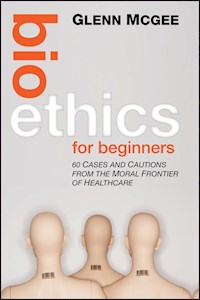
How far is too far? 60 cases illustrating modern bioethical dilemmas
Bioethics for Beginners maps the giant dilemmas posed by new technologies and medical choices, using 60 cases taken from our headlines, and from the worlds of medicine and science. This eminently readable book takes it one case at a time, shedding light on the social, economic and legal side of 21st century medicine while giving the reader an informed basis on which to answer personal, practical questions. Unlocking the debate behind the headlines, this book combines clear thinking with the very latest in science and medicine, enabling readers to decide for themselves exactly what the scientific future should hold.
Sie lesen das E-Book in den Legimi-Apps auf:
Seitenzahl: 319
Veröffentlichungsjahr: 2012
Ähnliche




















Contents
Cover
Title Page
Copyright
Dedication
Preface
The Chief of Bioethics
Acknowledgements
Caution 1: Tip-Toe When Walking on the Bleeding Edge
Case 1 The Dangers of Creating Life in the Lab
Case 2 Design: More Intelligent Every Day
Case 3 “Shroom” Science: Safe and Effective?
Case 4 A Robot Code of Ethics
Case 5 No More Periods, Period
Case 6 Search Me, Shape Me, Any Way You Want Me
Case 7 A Bloody Mess
Case 8 Stem Cells: The Goo of Life and the Debate of the Century
Caution 2: Everybody Lies
Case 9 Lies, Damn Lies . . . and Scientific Misconduct
Case 10 Conflict of Interest Means Business at NIH
Case 11 While You're Here, How about a Spinal Tap?
Case 12 Study Subject or Human Guinea Pig?
Case 13 The New Tuskegee: Exploiting the Poor in Clinical Trials
Case 14 Salt in the Wound: Will India Rise up Against the Oppression of Foreign Clinical Trials?
Case 15 Dr. Hwang and the Bad Apple Theory of Scientific Misconduct
Caution 3: The Genome Isn't What It Used to Be
Case 16 Becoming Genomic: Just What Does it Mean Anyway?
Case 17 Enhancement Comes from Insecurity
Case 18 Wearing Genes from the Gulf War
Caution 4: Reproduce at Your Own Peril
Case 19 Tomorrow's Child: Making Babies in the Twenty-First Century
Case 20 An Argument against Human Cloning
Case 21 Two Genetic Moms: High-Tech Trouble or Double the Love?
Case 22 Grave Robbing the Cradle
Case 23 Baby Banking
Case 24 Cash Strapped American Fertility Docs Cry Out for Mercy
Caution 5: Don't Sweat the Nano-Sized Stuff
Case 25 “Nanoethics”: The ELSI of Twenty-First-Century Bioethics?
Case 26 The Devil and the Deep Blue Sea
Case 27 The Merging of Man and Machine
Case 28 My Eye's on You
Caution 6: The State Will Protect Your Health Right Up Until It Doesn't
Case 29 Has the Spread of HPV Vaccine Marketing Conveyed Immunity to Common Sense?
Case 30 Is the New Cigarette a Smoking Gun? Eclipse Unethical, Unregulated Research
Case 31 “Universal” Healthcare: A Long Way Off
Case 32 Newborn Screening with a Twist
Case 33 HIV Testing Must Be Routine
Case 34 Re-creating Flu: A Recipe for Disaster
Case 35 Pandemic Influenza Requires Trust in Government Healthcare
Case 36 A Hostile Environment for Environmental Protection Documents
Case 37 To Quarantine or Not to Quarantine, Is That the Question?
Caution 7: “Do No Harm” Has Become “Care for Yourself ”
Case 38 Medicine Is Not a Steel Mill
Case 39 Does Your Doctor Have Skeletons? Good Luck Finding Them
Case 40 Medicine's Dirty Laundry
Case 41 Dr. Koop: Meet Dr. Ethics
Case 42 Organ Donation: Why Isn't There an App for That?
Case 43 Docu-Medical Shows Lack Reality
Caution 8: You Aren't Dead Until Someone Tells You So
Case 44 Redefining Retirement: Beyond Rest and Recreation
Case 45 Medicare Is Going South: What Do We Owe the Aging?
Case 46 The Fight to Die Well: We Will Expect More from Death Than Our Ancestors Did
Case 47 The Case of the Body Snatchers
Case 48 A Few Conclusions from the Terri Schiavo Case
Case 49 Living Wills Save Money? Dude, Did You Really Say That Out Loud?
Case 50 The Plural of Anecdote Is Not Ambien
Caution 9: Eat Only Food for Thought
Case 51 Fat in America
Case 52 Breakfast for Thought
Case 53 Want Fish? Ethics First, Please
Case 54 Dying for Food
Caution 10: Beware of Ideologues and Demagogues
Case 55 Bioethics for Christians, Corporate Whores, and Atheists
Case 56 Pharma Owns Bioethics (and Other Fables)
Case 57 The Kevorkianization of Cloning
Case 58 Not in the Bush Leagues Anymore
Case 59 Professor Hurlbut, Your 15 Minutes Are Up
Case 60 The Heady Days of Proposition 71: Stem Cell Research in the California Sun
Conclusion: Move Slowly and Stay Cool
A Hot and Cold Running Genius
Science Must Slow Its Speed
Sources and Credits
Case 1
Case 2
Case 3
Case 4
Case 5
Case 6
Case 7
Case 8
Case 9
Case 10
Case 11
Case 12
Case 13
Case 14
Case 15
Case 16
Case 17
Case 18
Case 19
Case 20
Case 21
Case 22
Case 23
Case 24
Case 25
Case 26
Case 27
Case 28
Case 29
Case 30
Case 31
Case 32
Case 33
Case 34
Case 35
Case 36
Case 37
Case 38
Case 39
Case 40
Case 41
Case 42
Case 43
Case 44
Case 45
Case 46
Case 47
Case 48
Case 49
Case 50
Case 51
Case 52
Case 53
Case 54
Case 55
Case 56
Case 57
Case 58
Case 59
Case 60
Conclusion
Index
This edition first published 2012
© 2012 John Wiley & Sons Inc.
Wiley-Blackwell is an imprint of John Wiley & Sons, formed by the merger of Wiley's global Scientific, Technical and Medical business with Blackwell Publishing.
Registered Office
John Wiley & Sons Ltd, The Atrium, Southern Gate, Chichester, West Sussex, PO19 8SQ, UK
Editorial Offices
350 Main Street, Malden, MA 02148-5020, USA
9600 Garsington Road, Oxford, OX4 2DQ, UK
The Atrium, Southern Gate, Chichester, West Sussex, PO19 8SQ, UK
For details of our global editorial offices, for customer services, and for information about how to apply for permission to reuse the copyright material in this book please see our website at www.wiley.com/wiley-blackwell.
The right of Glenn McGee to be identified as the author of the editorial material in this work has been asserted in accordance with the UK Copyright, Designs and Patents Act 1988.
All rights reserved. No part of this publication may be reproduced, stored in a retrieval system, or transmitted, in any form or by any means, electronic, mechanical, photocopying, recording or otherwise, except as permitted by the UK Copyright, Designs and Patents Act 1988, without the prior permission of the publisher.
Wiley also publishes its books in a variety of electronic formats. Some content that appears in print may not be available in electronic books.
Designations used by companies to distinguish their products are often claimed as trademarks. All brand names and product names used in this book are trade names, service marks, trademarks or registered trademarks of their respective owners. The publisher is not associated with any product or vendor mentioned in this book. This publication is designed to provide accurate and authoritative information in regard to the subjectmatter covered. It is sold on the understanding that the publisher is not engaged in rendering professional services. If professional advice or other expert assistance is required, the services of a competent professional should be sought.
Library of Congress Cataloging-in-Publication Data
McGee, Glenn, 1967-
Bioethics for beginners: 60 cases and cautions from the moral frontier of healthcare / by Glenn McGee.
p. cm.
Includes bibliographical references and index.
ISBN 978-0-470-65911-3 (hardback: alk. paper)
1. Bioethics–Case studies. I. Title.
QH332.M42 2012
174–dc23
2011044942
A catalogue record for this book is available from the British Library.
For Summer
Preface
The Chief of Bioethics
A Bioethicist is not a sheriff. That's a good thing.
My children have no idea what I do. According to my eleven-year-old, bioethics is not a job, it's where I am before I come home and what I do on my computer. That I am editor of a medical journal means little to him, because he is quite sure that this means that I spend a bunch of time writing a magazine with no pictures. When I describe research about parenthood, or genetics, in what I assume to be eleven-year-old speak, he looks at me as though I must be avoiding the grading of papers, what real teachers do. My nine-year-old is more pragmatic: “What did you do today, Daddy?” Well, I wrote a bunch of emails, talked to a bunch of people, and stared at a legal brief designed to preserve patents on genetic information. “Oh, so you sat around. Why didn't you just come home?” They've heard of bioethics, and they hear Daddy talk on the radio or see him on TV. But it sounds just like the talk on the phone. My father was a professor, and I knew what he did. He taught and graded papers. The sole evidence, to my kids, that I do a job is that I have had badges. Various ones, tossed on tables, from conferences. But one in particular, issued to me in 2005 by New York State's public health labs, is the kicker: it identified me as “Chief” of the labs' Office of Bioethics. When he saw it, my son patted me on the back for finding a real job: he thought I was a police chief. I must have been protecting someone.
The point of this story, or at least my point, isn't this father's instinctive need for the respect of his sons. It is that my sons are not all that different from the rest of biomedical science and society. After forty years, bioethics is still an enigma to the NPR-listening crowd, and all-too-often revered by the “public” only when it purveys ideology or polices misconduct. The research that we do, the cases on which we consult, the changes in healthcare that have come from involving the people who are sometimes called bioethicists, are lost to almost everyone but the few academics, media, and policy wonks who read our work or participate in our consultations or ask us to work with them on a project with ethical implications. And that is a problem. Most of the broadly read articles about bioethics, some authored by ethicists themselves, have castigated bioethicists for being too heavily indebted to industry, or for being irrelevant, or for refusing to take stands in a coherent way, even about our own standards for good practice in our field. Bioethics has become one of, if not the, fastest growing academic disciplines, and there are more students aspiring to work in the field than one could ever have dreamt. But the role of the people who work in the field is incomprehensible to most unless it is framed as “fireman” or “professor.”
Success is sometimes a curse. The presence of bioethics in virtually every major debate about social values has made it more difficult to explain why bioethicists, whomever we are, cannot explain what it is that we actually do, how to recognize when we are doing it well, or that there is a difference between providing expertise about ethical issues and being a moral superhero. How can any scholarly field be broad enough to address – indeed, be at the center of – debates over Terri Schiavo, stem cell research, the rationing of drugs for a pandemic or respirators after a hurricane, the risks of clinical research, the sale of human organs, the creation of artificial life, and the role of physicians in torture?
In the forty years since American biochemist, Van Rensselaer Potter, it would seem, coined the term, interest in bioethics has spawned hundreds of institutes, more than a dozen journals, and many degree-granting university programs. But neither bioethics' practice nor those styled as practitioners are defined in the same way by any dozen people outside academia. Even academics are split on whether bioethics is in exile from philosophy departments or a subspecialty of medicine or something else altogether. Colleagues, bosses, students, community groups, and potential donors ask whether bioethics involves real scholarship and teaching, or if it is merely a shill for regulatory, corporate, or political interests. Even those of us who work in the field are divided on whether bioethics is a discipline, whether we should have certification (badges, anyone?), and whether there is the need for a code of ethics for ethicists, as though those who work in bioethics are not content experts but rather ethical “superheros” whose own moral lives are the measure of their ability to teach. We don't even discuss that for members of the faculty of departments of religion, though, the annual meeting of the American Academy of Religion and of the Society for Christian Ethics, have been described as having the character of frat parties. A colleague of mine once said that academics who work in ethics across the field, in fact, typically choose as their area of expertise, however unconscious the choice, that area of study that least corresponds with the mores that guide their own life: the man who studies the ethics of character has none, the woman who writes about empathy could care less about those around her. Society knows just enough about ethics to trade in the silly supposition that the study of an area presupposes a superhuman moral life. I certainly hope that isn't a fair standard, because I for one am a human scholar.
There are as many ways to parse the jobs and activities of bioethicists as there are problems under study in the field. Many use the title to describe or advertise their work. Those who write in the peer-reviewed journals of bioethics, teach and work in institutes devoted to the subject, and are members of the key organizations, clearly qualify for the appellation. Scholars in bioethics now have a huge impact on science and medical policy, and those who pretend to be bioethicists in order to put that mantle on their political or religious arguments, do so precisely because they recognize the increasing importance of the field.
At a time, however, when political columnists, fundamentalist zealots, and untrained aficionados not only call themselves bioethicists but also are eligible to work on a presidential commission on the subject, many of those who should be calling themselves bioethicists in virtue of their training and scholarship instead repudiate that label. Though tempting, it would be a mistake to recoil in horror as bioethics becomes politicized. A good sign of the health of bioethics, in fact, is the healthy debate and political action elicited by bioethics scholarship. It would be bad news indeed for the future of debate about ethics in medicine and science if no one cared about the controversial conclusions reached by those who study and write in the area. And that bioethicists engage in politicization of their field seems understandable as well – as long as it is clear that they do it off the clock.
I'll admit, there's a certain allure to the idea of a job that my child can understand. But I know there is something that they definitely understand: rules. Rules define the moral scope of the world in which we live, they guide our thoughts and actions, they prescribe the limits of how we should interact with our peers, patients, and the public. Without rules, we would live in anarchy and without consequences for ignoring those rules, we would be left to act on our most base and opportunistic impulses.
My “chief of bioethics” badge really is an artifact of a time when bioethics had to be explained not only to children but also to funding agencies, the media, and policymakers. We no longer live in that time. Today most leaders in science and medicine know that bioethics, properly understood, isn't a police force, a task force, or the product of a president's commission.
But it is about providing guidance, when needed but not always when invited, to those at the cutting edges of science and medicine. Giving them the green light (morally speaking), noting when proceed with caution, or reminding them that speed can be deadly. Bioethicists are not an elitist, powermongering, or advocacy-based group, but instead we depend on a symbiotic relationship between researchers, practitioners, policymakers, and the public. And out of that relationship we strive to make the outcome of our collaborator's work more justifiable, reasonable, and fair.
All appearances to the contrary, the explosion of interest in bioethics and even the groping to be called a bioethicist represent a recognition that the field of bioethics is coming of age. As are my children, all of whom – even the 17-year-old – understand the value and importance of rules, even if they rarely follow them.
This book, too, chronicles the misteps and the successes of some of medicine and science most important events in the last decade and from these articulates the “new rules” for ethical science and medicine in the twenty-first century.
Acknowledgements
This book is the result in large part of the editorial, advisory, and audience response input of dozens of people in science and medicine, including those who attended countless lectures and those who have been forced to edit the essays herein for publication. Equally, a team of my very generous peers participated in congealing from a variety of my activities in translational medicine what I hope is a coherent and underlying thesis: that at the beginning of the era of highly mixed, personalized genomic medicine, when we no longer know how to describe creation or death and our powers have increased almost as fast as those of our computers, wisdom will come not from “intuitive fear” of the future but from a pragmatic look at the past and at the goals inherent to our human natures.
Actively involved in the preparation of the manuscript, among others, were co-authors of some of my work, Arthur Caplan PhD and Summer Johnson McGee PhD.
Researchers and editors included Kelly Hills, Jessica Stanley, and Miriam Aziz.
David Magnus PhD provided assistance both as co-editor of The American Journal of Bioethics and thus on numerous editorial materials produced for that venue and also as a close friend and close reader when called upon.
This book would never have happened but for the generous contributions of the Francis Foundation and the John B. Francis Chair in Bioethics at my scholarly home, the unique Center for Practical Bioethics and the assistance and guidance of my colleagues there including Myra Christopher, President.
Caution One
Tip-Toe When Walking on the Bleeding Edge
Case 1 The Dangers of Creating Life in the Lab
Synthetic biology is receiving much attention in the media and in churches, schools and offices around the world. The issue is the creation of life in the laboratory. And the reactions range from excitement to ethical outrage to horror at the new potential for bioterrorism.
Lesen Sie weiter in der vollständigen Ausgabe!
Lesen Sie weiter in der vollständigen Ausgabe!
Lesen Sie weiter in der vollständigen Ausgabe!
Lesen Sie weiter in der vollständigen Ausgabe!
Lesen Sie weiter in der vollständigen Ausgabe!
Lesen Sie weiter in der vollständigen Ausgabe!
Lesen Sie weiter in der vollständigen Ausgabe!
Lesen Sie weiter in der vollständigen Ausgabe!
Lesen Sie weiter in der vollständigen Ausgabe!
Lesen Sie weiter in der vollständigen Ausgabe!
Lesen Sie weiter in der vollständigen Ausgabe!
Lesen Sie weiter in der vollständigen Ausgabe!




