


Erhalten Sie Zugang zu diesem und mehr als 300000 Büchern ab EUR 5,99 monatlich.
- Herausgeber: Polygon
- Kategorie: Geisteswissenschaft
- Sprache: Englisch
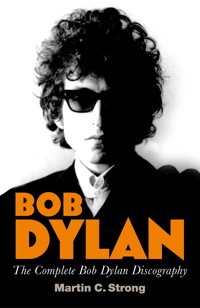
Bob Dylan: The Complete Bob Dylan Discography contains all you will ever need to know about Bob Dylan and his releases. Including an expansive biography, album reviews and comprehensive discography, it is an invaluable guide for Dylan fans everywhere. This is an essential purchase for all lovers of Bob Dylan, with details of everything the legendary singer/songwriter produced.
Sie lesen das E-Book in den Legimi-Apps auf:
Seitenzahl: 68
Veröffentlichungsjahr: 2012
Das E-Book (TTS) können Sie hören im Abo „Legimi Premium” in Legimi-Apps auf:
Ähnliche




















This ebook edition published in 2011 by Birlinn Limited West Newington House Newington Road Edinburgh EH9 1QSwww.birlinn.co.uk
Copyright © Martin Strong, 2011
Extracted from The Great Folk Discography, Volume One by Martin Strong
First published by Birlinn Ltd in 2010
The moral right of Martin Strong to be identified as the author of this work has been asserted by him in accordance with the Copyright, Designs and Patents Act 1988
All rights reserved. No part of this publication may be reproduced, stored or transmitted in any form without the express written permission of the publisher.
ebook ISBN: 978-0-85790-167-5
British Library Cataloguing-in-Publication Data
BOB DYLAN
ONE of the founding fathers of modern popular music, Bob Dylan is quite probably the most talented, most misunderstood, most covered, and certainly the most written-about songwriter and performer in recent history. His early work inspired the Beatles and furnished many songs for the Byrds, while his politicised folk and flights of poetic genius gave voice to the fledgling counter-culture. Famously booed by outraged luddites when he swapped his acoustic guitar for a Fender Stratocaster, Dylan courted controversy as casually as he wooed the gypsy women in his songs. His mid-1960s albums set the bar before he went into seclusion up in Woodstock, New York, emerging in the following decade with arguably the best work of his career.
Robert Allen Zimmerman (to state his birth and given names) was born on May 24, 1941 in Duluth, Minnesota, and from the age of six was raised in nearby Hibbing, where he was taught guitar and harmonica. Inspired by a host of folk, blues and country luminaries including Woody Guthrie, Jesse Fuller and Hank Williams, he left the University of Minnesota at the beginning of the 1960s, changing his name to Bob Dylan. (That was inspired, according to which version of the story you prefer, by either the poet Dylan Thomas or Marshal Matt Dillon, hero of the TV western series ‘Gunsmoke’. In a 2004 TV interview for CBS, Dylan enigmatically put his new name down to “destiny”.)
Dylan moved to New York, where he almost immediately impressed the folk hierarchy of Greenwich Village; he played his first gig at Gerde’s Folk City, supporting John Lee Hooker, on April 11, 1961. Harmonica session work for singer Carolyn Hester followed, and her label, Columbia Records, signed him in October 1961 through A&R man John Hammond. His rugged aura and his love of the dying Guthrie, whom he would regularly visit in hospital, signified a true folk spirit.
His debut album, BOB DYLAN (1962) {*8} (rated 8 stars out of ten), made few waves outside the insular folk scene at the time, although his live work attracted critical attention; Robert Shelton, of the New York Times, was an early patron. The record showed Bob at his most organic and angst-ridden, although there was room for only two worthy originals, ‘Talkin’ New York’ and the poignant ‘Song To Woody’. Before Dylan’s recordings, not many people had heard traditional folk-blues fare such as ‘In My Time Of Dyin’’ (certainly not Led Zeppelin), ‘House Of The Risin’ Sun’ (Josh White was the inspiration for the Animals’ chart-topper), or the likes of Blind Lemon Jefferson’s ‘See That My Grave Is Kept Clean’, the Rev. Gary Davis’s ‘Baby, Let Me Follow You Down’, Jesse Fuller’s ‘You’re No Good’, Bukka White’s ‘Fixin’ To Die’ and Curtis Jones’s ‘Highway 51 Blues’. The more folk-orientated ‘Man Of Constant Sorrow’ and ‘Pretty Peggy-O’ and Jimmie Rodgers’s ‘Freight Train Blues’ were also featured, but not his first 45, ‘Corrina, Corrina’, which found its way on to his next set.
On the back of this considerable debut, he unleashed THE FREEWHEELIN’ BOB DYLAN (1963) {*10}, and after Peter, Paul & Mary lifted a million-seller from it in ‘Blowin’ In The Wind’, the album sold well enough to give him a US Top 30 entry. The record also saw a pronounced development in Dylan’s songwriting on tracks like the cutting ‘Masters Of War’, ‘Oxford Town’, ‘A Hard Rain’s A-Gonna Fall’, ‘Don’t Think Twice, It’s All Right’ and ‘Talking World World III Blues’. While his untrained, nasal vocals could be something of an acquired taste, his voice communicated the lyrics in a way that lent them greater depth and resonance. In Britain the LP entered the charts in May 1964 and, after initially peaking at No.16, reached No.1 a year later.
Dylan really hit his stride with THE TIMES THEY ARE A-CHANGIN’ (1964) {*9}, the album that contains his most pointed protest writing. On subsequent albums Dylan would shy away from direct messages like those of ‘Only A Pawn In Their Game’, which pitied the dirt-poor Southern whites deceived into hating their black neighbours, and ‘With God On Our Side’, a rueful comment on the unholy alliance between gung-ho patriotism and religion. ‘The Lonesome Death Of Hattie Carroll’ and ‘Ballad Of Hollis Brown’ levelled their fire against social injustice, but also expressed a profound human sympathy with its individual victims that raised the songs far above the level of mere anti-Establishment rants.
ANOTHER SIDE OF BOB DYLAN (1964) {*9} was contrastingly personal in tone, ‘I Don’t Believe You’ and ‘It Ain’t Me, Babe’ venting Dylan’s spleen on matters of the heart rather than the soapbox. The lyrics also began to assume an air of enigmatic suggestiveness, ‘My Back Pages’ and ‘Chimes Of Freedom’ employing striking, lucid imagery that the Byrds would later complement with their chiming, incandescent guitars and ringing harmonies.
Influenced by the British R&B boom and by the Beatles, Dylan stunned folk purists with the half-electric/half-acoustic BRINGING IT ALL BACK HOME (1965) {*9}. The newly plugged-in Dylan was a revelation, and songs like ‘Maggie’s Farm’ and the stream-of-consciousness ‘Subterranean Homesick Blues’ influenced in their turn the bands from whom he had taken his cue. The acoustic tracks on the second side, such as ‘Mr Tambourine Man’ and ‘It’s All Over Now, Baby Blue’, rank among Dylan’s finest, the former giving the Byrds their breakthrough hit.
While the folk faithful booed Dylan at that summer’s Newport Festival, he wowed the rock world with the masterful ‘Like A Rolling Stone’ single and followed it up with the seminal HIGHWAY 61 REVISITED (1965) {*10}. A free-flowing hybrid of blues, folk and R&B backed by such esteemed musicians as Al Kooper, Mike Bloomfield, Charley McCoy and Paul Griffin, rock music had never been graced with such complex, expansive lyrics, evident
on so many classics ranging from ‘It Takes A Lot To Laugh, It Takes A Train To Cry’ and ‘Just Like Tom Thumb’s Blues’ to the 11-minute finale, ‘Desolation Row’. Although it irked many of the purists, many new Dylan fans were attracted by garage-rock cuts like ‘From A Buick 6’, ‘Tombstone Blues’ and the rollicking title track.
During the same year’s solo, all-acoustic UK tour Dylan was the subject of D.A. Pennebaker’s acclaimed documentary film ‘Dont Look Back’ (released in 1967), which mixed tantalising performance clips with backstage, hotel-room and press-conference footage that captured the singer’s razor-sharp hipness and glacial cool. Donovan, Joan Baez, Derroll Adams and an anonymous ‘science student’ were among the innocent bystanders.
Backed by members of the Hawks (who had supported him on his 1966 tour and who later became the Band) plus a posse of crack Nashville session men, Dylan recorded another rock milestone in BLONDE ON BLONDE (1966) {*10}. A 14-track double LP that absorbed new influences from the burgeoning country-rock establishment (Hawks guitarist Robbie Robertson had replaced Bloomfield), it overflowed with sheer classics such as ‘Rainy Day Women # 12 & 35’, ‘Just Like A Woman’, ‘I Want You’, ‘Stuck Inside Of Mobile With The Memphis Blues Again’, ‘Most Likely You Go Your Way (And I’ll Go Mine)’, ‘One Of Us Must Know (Sooner or Later)’ and ‘Leopard-Skin Pill-Box Hat’. ‘Visions Of Johanna’ was Dylan at his most lysergic, casting surreal lyrical spells with hypnotic ease, and the side-long finale, ‘Sad Eyed Lady Of The Lowlands’, was his tribute to his new wife, Sara.




