


18,49 €
Mehr erfahren.
- Herausgeber: Nick Hern Books
- Kategorie: Geisteswissenschaft
- Sprache: Englisch
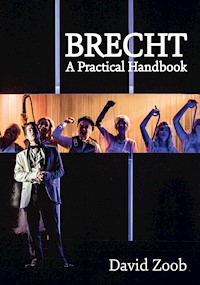
A bold and exciting new approach to Bertolt Brecht, making his theories and ideas about theatre accessible to a new generation of actors, directors, students and theatre-makers, and showing how they can be put into practice. Theatre practitioner and academic David Zoob demystifies Brecht's theories, and offers an approach to study and performance that can be applied to a wide range of texts and theatre styles. With close analysis of texts by writers including Shakespeare, Chekhov, Miller, Pinter, and of course Brecht himself, the author demonstrates how Brechtian techniques can provide practical pathways to exploring plays across the canon, as well as non-traditional forms of theatre. Also included are dozens of exercises to help turn theory into practice, and explore what Brecht's ideas mean for actors and directors, both in training and rehearsal. Whether you're a student, a teacher, an actor or a theatre-maker, this book will change the way you view and work with Brecht. 'Zoob has engaged with Brecht's many and varied principles for a politicised theatre and channelled them into a wide range of novel and innovative exercises that are applicable to a great many dramas and can equally interrogate devised material… Excellent ' David Barnett, Professor of Theatre, University of York, and author of Brecht in Practice
Das E-Book können Sie in Legimi-Apps oder einer beliebigen App lesen, die das folgende Format unterstützen:
Veröffentlichungsjahr: 2018
Ähnliche




















BRECHT
A Practical Handbook
David Zoob
NICK HERN BOOKS
London
www.nickhernbooks.co.uk
Contents
Foreword
Acknowledgements
Introduction
1.Reading a Text
2.Contradiction
3.Storytelling
4.Gestus: Part One
Gestus: Part Two
5.Emotion
6.Fun (Spass)
Final Thoughts
Glossary
Endnotes
Bibliography
Index
Index of Exercises
About the Author
Copyright Information
For Ana and Kat
Foreword
David Barnett
Brecht valued a number of qualities in both theoretical and practical work. Clarity, precision and lightness were certainly important, but perhaps the highest praise he could lavish on an idea or an approach was that it was useful. David Zoob’s book is eminently useful because it is steeped in years of development and practice. Zoob has engaged with Brecht’s many and varied principles for a politicised theatre and channelled them into a wide range of novel and innovative exercises that are applicable to a great many dramas and can equally interrogate devised material.
Zoob’s short videos, posted on YouTube, give a concrete flavour of the kind of work you will find in this excellent book. They show how directorial and actorly practice is a collective, collaborative process of discovery. He teases out political aspects that go unspoken or unnoticed in a scene or situation and works through practical solutions. Here he shows how restlessly asking questions and continually seeking answers are the means of creating what Brecht called ‘realistic’ theatre.
There have been a number of books published recently that take Brecht’s theories for the stage seriously and speculate on how they might manifest themselves in the rehearsal room. Zoob’s book doesn’t speculate; the pages are suffused with the experience of years of practice. This is what makes this book unique: the ideas and exercises are the product of trial and error, reflection and refinement, engagement and achievement. As a result, the reader encounters tried and tested approaches to staging text and dramatic material that are both clear and effective. Zoob presents the reader with a comprehensive array of ideas, methods and exercises that have already shown him and his students their usefulness, and he now passes these on to you.
David Barnett is Professor of Theatre at the University of York. His books include Brecht in Practice: Theatre, Theory and Performance and A History of the Berliner Ensemble.
Acknowledgements
I am immensely grateful to Professor David Barnett for his encouragement, rigorous criticism, and insightful suggestions – many of which you will read in the pages that follow; to the stubbornly Stanislavskian Julian Jones for his refusal to let me get away with anything; to Stephen Unwin for his stimulating lectures on Shakespeare and Brecht, and his equally stimulating conversation; to Rose Bruford College for giving me time to start this book; and to Nick Hern whose patience and guidance helped me to finish it. I owe a great deal to the theatre professionals, academic students and actors in training who have debated the ideas and tried the exercises. I must finally thank the family members, friends and colleagues who have had to listen to me rehearsing the arguments and exercises that fill these pages.
*
The author and publisher gratefully acknowledge permission to quote from the following: The Antigone of Sophocles by Bertolt Brecht in Bertolt Brecht, Collected Plays: Eight, edited by Tom Kuhn and David Constantine; Brecht on Theatre: The Development of an Aesthetic, eighth edition edited and translated by John Willett; Brecht on Theatre, third edition edited by Marc Silberman, Steve Giles and Tom Kuhn; The Caucasian Chalk Circle by Bertolt Brecht, translated by James and Tania Stern with W. H. Auden; and Oleanna by David Mamet, all © Bloomsbury Methuen Drama, an imprint of Bloomsbury Publishing Plc. Celebration and The Lover by Harold Pinter; Philistines by Maxim Gorky, translated by Andrew Upton; and Stuff Happens by David Hare, all published and reproduced by permission of Faber and Faber Ltd. The Cherry Orchard and Three Sisters by Anton Chekhov, translated by Stephen Mulrine, both published and reproduced by permission of Nick Hern Books Ltd. A Human Interest Story (or The Gory Details and All): A Play for Six Voices by Carlos Murilo, published by Dramatists Play Service and reproduced by permission of Carlos Murilo.
Introduction
‘So what’s this book of yours about?’ I have been asked this question several times by people who don’t work in theatre. When they ask this I feel mild panic – I ask myself, why should these people with proper jobs care about the peculiarities of rehearsing plays? But they have asked, so I must answer: I try to describe some of Brecht’s ideas in a brief and lively way, and the reply is often the same: ‘But that’s just good acting, isn’t it?’ My first instinct is to say: ‘No! no! This is a radical challenge to the way things are usually done…’ but I stop myself. Their reply is refreshingly encouraging: it suggests that Brecht’s theories have more common sense in them than his detractors think. His ideas are often regarded by theatre practitioners as impenetrable and off-putting, to the extent that the theories are fast becoming the preserve of what might be called the ‘Theatre Studies Industry’. Worse still, there may be practitioners who have tried to implement the theories and have been confounded by confusions or prejudices among colleagues, and a lack of time to work things out away from the pressures of getting a show on.
Still… if people tell me that actually the theories sound like common sense, then the exercises in this book could offer something of genuine practical use to actors and directors, both in training and in their respective professions.
So why do so many practitioners dismiss Brecht’s theories? I would suggest the answer lies in a letter Brecht wrote to an unnamed actor in 1951:
I have been brought to realise that many of my remarks about theatre are misunderstood.1
And why should that be? Bear in mind that 1951 was less than five years before his death, so he is referring to almost all of his remarks, although not all were published by then. Anyone who has tried to read Brecht on Theatre from cover to cover would agree that his prose is, to say the least, difficult to follow. Moreover, actors frequently complain that ‘Brechtian’ direction makes them feel like puppets. The unnamed actor above said as much in a letter to Brecht, complaining that Brecht’s ideas seem to turn the craft of acting into ‘something purely technical and inhuman’. Brecht’s reply was that readers would think this because of his ‘way of writing’. He then added ruefully ‘to hell with my way of writing’.2
The result of all this miscommunication seems to be an unhelpful combination of caricature and bafflement. I have seen productions of Brecht’s plays cluttered with visual reminders that ‘this is theatre and not real life’. These include: props that aren’t needed in the scene; huge projected labels scrawled on top of a giant backdrop of sketches representing scenery; an apparatus of ‘Brechtian’ devices like placards and video projections; cartoon-like characterisations, or characters dressed up to look like the Emcee from Cabaret… In the interval, the conversation I overhear most frequently concerns these devices. The uninitiated ask what is the point of all this clutter and they are informed that this is ‘alienation’.
This bafflement could well be felt too by the actors, who aren’t sure whether they should be performing in a way that’s different from ‘normal acting’.
The aim of this book is to get past Brecht’s peculiar prose and explain the principles of his theories, acknowledging that they changed over time. I have devised short dialogues between an actor and a director in an attempt to represent the frustrations experienced by those actors baffled by ‘Brechtian’ theory or direction. These are accompanied by a series of practical exercises designed to address the questions these dialogues raise. Should you try the exercises, I encourage you to adapt and develop the techniques for yourself: the explanations should clarify the theories, and the exercises are opportunities to test that understanding. Adapt the exercises to suit your needs. It may turn out that the exercises simply help actors to be braver, more physically precise, or more playful.
I hope to demystify the theories and offer an approach to performance applicable to a wide range of texts and theatre styles. These theories certainly can help to bring out the meaning of Brecht’s plays, sharpening their impact for an audience. More importantly, they offer an interpretative framework, influencing work on any piece of theatre. They can help us to see and present classic plays differently and are a long way from the ‘Brechtian’ clichés listed above.
You don’t have to agree with Brecht’s Marxism to make use of the exercises. Nonetheless, many of the activities in this book have a social dimension: they shift emphasis away from the private, and towards the public; from personal to social, from symptom to possible cause. They are informed by the idea of ‘dialectical performance’, which means exploiting the provocations that lie in contradictions and juxtapositions. Their impact can be addressed to the emotions as much as to the intellect. They provoke questions rather than providing answers from a political creed or orthodoxy.
There is no specific ‘Brechtian’ acting style. Performance work influenced by the activities in this book could stylistically resemble a performance resulting from training methods associated with Sanford Meisner or Konstantin Stanislavsky. The difference will be found in the textual interpretation that informs the performances; or, more specifically, the social dynamics that underpin human behaviour.
There is little concern in this book for the notion that being ‘Brechtian’ requires actors constantly to address or even preach at the audience or ‘remind them that they are in a theatre’. People who go to the theatre are perfectly aware of where they are.
Brecht’s poems and plays are full of humanity, invention and humour. Turning his theory into practice is rich in those qualities too.
Reading a Text
Astonishment – Interpretation – Strangeness
1
Without opinions and intentions one cannot represent anything.
Bertolt Brecht, ‘A Short Organum for the Theatre’3
It is necessary to rehearse not just how a play should be performed but also whether it should be performed.
Bertolt Brecht, ‘On Determining the Zero Point’4
If the actors, having acquired a more complete knowledge of the play and a clearer idea of its social purpose, were allowed to rehearse not only their own parts but also those of their fellow actors, the performance as whole could be improved enormously.
Bertolt Brecht5
Brecht’s theatre is founded on the idea that scenes are presented as living illustrations of what he called Einzelgeschehnisse,6 meaning individual events of social significance. A ‘Brechtian’ reading of any play will involve making these incidents striking and strange, considering their interrelationship, and revealing their social causes.
The reader may be struck by some similarities with some of Stanislavsky’s methods in a ‘Brechtian’ pre-rehearsal textual close reading:
1. Research the play’s historical context, considering the possible social-historical factors that influence the characters’ behaviour.
2. Break down the text into a sequence of social incidents or events; describe the action of each event. As you do so, consider how odd, outrageous, or astonishing the event might be. In other words, take nothing for granted. Brecht called the list of events produced the Fabel, defined as a politically engaged interpretation of the story.
Lesen Sie weiter in der vollst?ndigen Ausgabe!
Lesen Sie weiter in der vollst?ndigen Ausgabe!
Lesen Sie weiter in der vollst?ndigen Ausgabe!
Lesen Sie weiter in der vollst?ndigen Ausgabe!
Lesen Sie weiter in der vollst?ndigen Ausgabe!
Lesen Sie weiter in der vollst?ndigen Ausgabe!
Lesen Sie weiter in der vollst?ndigen Ausgabe!
Lesen Sie weiter in der vollst?ndigen Ausgabe!
Lesen Sie weiter in der vollst?ndigen Ausgabe!
Lesen Sie weiter in der vollst?ndigen Ausgabe!
Lesen Sie weiter in der vollst?ndigen Ausgabe!
Lesen Sie weiter in der vollst?ndigen Ausgabe!
Lesen Sie weiter in der vollst?ndigen Ausgabe!




