


Erhalten Sie Zugang zu diesem und mehr als 300000 Büchern ab EUR 5,99 monatlich.
- Herausgeber: Pocket Essentials
- Kategorie: Geisteswissenschaft
- Sprache: Englisch
Bruce Springsteen grew from a dishevelled, bearded singer of youthful street ballads to become the hottest name in the rock world - twice. The resilience of the New Jersey troubadour has seen him top the album charts in four successive decades, and his epic world tours with the legendarily hard-working E Street Band are still sell-outs well into the new millennium. Once seen as another Bob Dylan wannabe, Springsteen became rock's definitive chronicler of blue-collar life, inheritor of the spirit of Woody Guthrie. Beyond the cars (and there are a lot) and the working-class lives, he has also addressed matters of the heart on albums such as Lucky Town and Tunnel Of Love. Whilst Ronald Reagan famously misappropriated the mournful Born In The U.S.A. as a patriotic anthem, Springsteen has found the confidence to stand up and be counted with songs such as American Skin (41 Shots), a controversial account of a police killing, and the Oscar-winning Streets Of Philadelphia. 2002's The Rising returned Springsteen to the top of the album charts with a stately and balanced investigation of loss, in the aftermath of September 11th 2001. When the world needed a compassionate artistic statement, he delivered one. This guide examines the growth of Bruce Springsteen's career, from the optimistic youth who wrote Born To Run to the respected heavyweight songwriter of today. Collaborations and side projects, and the work of band members away from E Street are also detailed and rated.
Sie lesen das E-Book in den Legimi-Apps auf:
Seitenzahl: 167
Veröffentlichungsjahr: 2012
Das E-Book (TTS) können Sie hören im Abo „Legimi Premium” in Legimi-Apps auf:
Ähnliche




















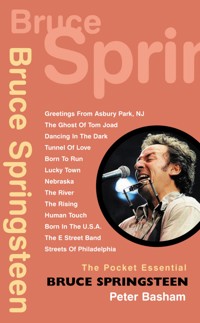
Bruce Springsteen
Peter Basham
POCKET ESSENTIALS
Contents
Acknowledgements
Introduction
1. Jersey Nights
2. Dark Currents
3. Fistful Of Dollars
4. Walking Like A Man
5. Shadows And Ghosts
6. Rising Star
7. Blood Brothers (And Sisters)
8. Paying Tribute
9. Proving It All Night
10. Bruce And The Silver Screen
11. Official Videos And DVDs
12. Bibliography
13. Websites
Copyright
Acknowledgements
Thanks to my family and friends. Special thanks to Ed for expert advice and to Florence for amazing patience.
Introduction
Bruce Springsteen is not a musical pioneer, but he is a great artist. He has survived youthful hype – he appeared simultaneously on the covers of Time (with the story ‘Rock’s New Sensation’) and Newsweek (‘Making of a Rock star’) when just twenty-six years old. At his first peak of popularity he endured a protracted legal battle against his then manager, the aggressive, but undeniably resourceful, Mike Appel. Albums such as Nebraska, Tunnel Of Love and The Ghost Of Tom Joad have seen Springsteen follow his muse rather than the obvious commercial path that his writing could easily have seen him mine, and yet time and again he has resurfaced at the very top, against expectation or industry trend. Ultimately, he has weathered the fickle changes in taste from generation to generation, still remains capable of selling millions of records, and is now a hugely respected old-timer who has confounded his critics by remaining decidedly down-to-earth in nature and well-liked by those with whom he has worked.
What his career has shown is that Bruce Springsteen has an uncanny ability to write narratives that cover any subject that connects to, or interests him. That he is able to do this with a clarity and directness, particularly after the adrenalin rushes of his first two records, distinguishes him from both contemporaries and those predecessors who so influenced him. Greil Marcus acknowledges “it’s just amazing how much he can do in just two or three lines… you know exactly where you are and you can follow the story.” It is Bruce’s dedication to a largely narrative and direct style of songwriting, as opposed to simple boy-meets-girl or girl-leaves-boy or the abstract imagery of other artists, that separates him and gives his work a vivid, often widescreen cinematic feel. With this directness of storytelling and a recurring working-class man versus hard-nosed authority theme, it is not surprising to find that Bruce has drawn from the cinema world. An artist who collects phrases and lines for potential lyrics, Bruce has notched up a number of tracks that borrow film titles. ‘Thunder Road’ was previously a Robert Mitchum bootlegging/gangland film and ‘Badlands’ shares the title of Terrence Malick’s movie account of the Starkweather murder spree, a story that Bruce would actually describe years later on the title track of his Nebraska album. The brooding and regretful ‘Point Blank’ and the paranoid Born In The U.S.A. outtake ‘Murder Incorporated’ also hark back to classic film noir, a world where typically a good man at heart is forced to struggle against corruption and injustice just to get by, emerging, if at all, with an ambiguous sense of survival.
Bruce Springsteen’s own life story has been one of outstanding success, musical integrity and resilience, notching up hit albums in each decade of his professional recording career. From the youthful drive of 1975’s Born To Run, through to his first U.S. number one with 1980’s The River, and on to the stately ‘comeback’ of 2002, The Rising, Bruce has remained at the very top of his profession. For all his successes, however, critics continually make play of Springsteen for singing his songs full of desperate working-class lives while he himself is performing in the wealthy arena of the world’s huge, bland stadiums. A simplistic view is that Springsteen has exploited themes of blue-collar life whilst attaining a great personal wealth. However, aside from the fact that Bruce’s early life was not one of great comfort or stability and he knew the hardships of working life through his father, Bruce has attained his wealth through hard work that should be heralded for the inspiration it offers to others – not to become megastars as he has, but to make something of themselves according to their own talents. He personifies his lyric (dramatically adapted from an Elvis Presley recording) urging that we should “Follow That Dream.”
Another criticism of Bruce is that he frequently and therefore unimaginatively uses cars as props in his work. Just a cursory glance at Springsteen’s song titles, art work and lyrics will indeed reveal his considerable lyrical use of the automobile. For Bruce, however, cars and roads are potent vehicles, or rather metaphors, for so much of the deeper significance that he is looking to address. They provide a perceived route of escape for the youths in ‘Thunder Road’, through to The Rising album where cars are no longer racing around, but “snakin’ slow through town”, embodying the mourning of a community. Even here, however, there is a hope that one-day strength will be found “further on up the road”. Elsewhere – and there are a lot of examples! – cars are symbols of oppression in ‘Seeds’, lust in ‘Pink Cadillac’ and temporary release in ‘Racing In The Street’. ‘Stolen Car’ depicts the dramatic loss of purpose in a relationship, ‘Used Cars’ finds their value as social status symbols and the loneliness of driving alone runs through ‘Valentine’s Day’. Cars and huge open roads are a classic and very American picture and, rather than being lazily used by Springsteen, they give a sense of consistency to his narratives. Through all their various symbolic purposes, the solid form of this everyday utility is an unremarkable presence that the singer chooses to remark upon and draws moods from. Away from this seriousness, Bruce is certainly aware of the view of him as car-obsessed and is prepared to admit to his regular use of the motif with humour. At a Woody Guthrie tribute concert in 1996 (released as ’Til We Outnumber ’Em: The Songs Of Woody Guthrie, 2000), Springsteen parodies himself, introducing his performance of ‘Riding In My Car’ by stating indignantly “automobiles… Mr Guthrie, no disrespect, but that’s my business”. Why give up an image that he has learnt to use so effectively? After all, the great Chuck Berry’s entire career is based upon a mere handful of motorised anthems.
As for the stadium rock tag that has been hung on him since he toured the world with the ubiquitous Born In The U.S.A. during 1984–5 (and Springsteen undoubtedly enjoyed the success of this period if not the political misinterpretation of his work), it came on the back of the stunningly bleak acoustic demo-tape album, Nebraska, which told of serial killers and no-hopers. After the overblown (and arguably over-delayed, coming some thirteen years after his debut) live album release in 1986, Bruce then reigned back for the studio follow-up, the introspective and largely solo Tunnel Of Love, took five years off, and returned without his popular band in an attempt to explore new sounds. No simple following of the formula and cashing-in. Whilst he reconstituted the E Street Band for more huge world tours from 1999, he did not rock out with a tour to promote his 1995 Greatest Hits, but waited for that year’s devastatingly quiet The Ghost Of Tom Joad before setting out, travelling the world with just guitar and harmonica (actually, with a vast array of each), playing at theatres and even his old school. Every bar band dreams of selling millions of records and playing to as many people as possible, and Bruce has managed to achieve that. He has, however, always shown signs of humility and grounding by numerous appearances in the very bars he started out in, even stepping back and playing the guitar in a series of club gigs for his Pittsburgh soulmate, Joe Grushecky, in the mid-1990s. In addition, he has also continuously supported community charities and causes (in 2004 he held a book signing in New Jersey to aid local retailers!). Springsteen hasn’t broken new ground in his career, except perhaps to carry over a liberal sensibility into the highest echelons of the mainstream where many artists have either failed or instead become ghettoised. Steve Earle, a Springsteen fan and fine songwriter himself, sings aggressively of his own political feelings, and it is arguably this directness that has prevented Earle reaching beyond a strong core fanbase that shares many of his ideologies. He remains singing to the converted while Bruce reaches a far broader audience.
Frequently Bruce goes back, both physically and musically, to his roots and, whilst not a pioneer, he is an inspiring and powerful storyteller. He has taken the concerns of his heroes like Woody Guthrie and John Steinbeck, and even the youthful exuberance of Chuck Berry’s car-bound characters, to a new level of success, familiarity and maturity.
1. Jersey Nights
Having spent his formative years as a musician in a host of wonderfully named bands – The Rogues, The Castiles, Earth, Child, Steel Mill, Dr Zoom And The Sonic Boom – based around the clubs of New Jersey and most specifically his adopted seaside home of Asbury Park, Bruce Springsteen finally landed his professional recording contract at Columbia Records, as a solo artist. The heavy metal and blues-rock fusion of Child – strongly influenced by acts such as the Eric Clapton-led Cream – had been re-branded under the moniker of Steel Mill. This group built up enough of a following to open for an act as well known as Grand Funk Railroad, whilst the subsequent Dr Zoom had landed a support slot for The Allman Brothers. However, with his new group, the horn-enhanced Bruce Springsteen Band, counting membership in the double figures, money was proving very tight for the young Bruce who was resolutely unemployed in a ‘proper job’, clinging to that of hopeful musician. Various band members had taken part-time work to make ends meet, while Bruce increasingly looked for solo gigs in the folk clubs of New York to keep himself occupied, and in money. Thus, it was when his original, informal manager, Carl ‘Tinker’ West, put Springsteen in touch with showbiz wannabes Mike Appel and Jim Cretecos, that he played solo and acoustic for them. This pair of occasional pop producers and songwriters, who had written a couple of Partridge Family hits, were undoubtedly dominated by Appel and, after a delay that forced Bruce to re-contact Appel to remind him who he was, Springsteen’s career was taken firmly in hand. Appel had an unusually aggressive approach to promotion in which there was little space for subtlety and building relationships, and once he fell for Springsteen’s act, he went all out to make him a success. He forced Columbia Records’ legendary A&R man John Hammond to give his new client an audition through sheer cheek, insinuating that Hammond would be making a huge mistake if he passed up a chance to hear Bruce. The A&R man must have heard this kind of bravado hundreds of times before, yet Appel’s manner was persuasive, even if it was curiosity on Hammond’s part as to whether this upstart might just be peddling a future star. When Springsteen played his demo set on 3 May 1972 (widely bootlegged since and with some of the performances given an official release on Tracks), Hammond felt that Appel had indeed been right and this New Jersey singer was something special, particularly impressing him with a rendition of ‘If I Was The Priest’. Just over a month later, on 9 June, Bruce Springsteen became a Columbia recording artist, signed by the man who had previously brought Bob Dylan’s signature to the label. It has often been suggested that Springsteen was seen as a ‘new’ or replacement Dylan, whose own powers seemed in decline after a run of albums that had not been greeted critically with the previously mandatory ‘classic’ status, although Blood On The Tracks was just around the corner. Bruce, however, was a rock and roll fan at heart (as, ironically, was Dylan himself despite being first claimed and then savaged by the folk purists). Bruce was devoted to Little Richard and Chuck Berry, the Stax and Motown label sounds, British invasion bands, and the great showman, Elvis Presley. Where Dylan’s early lyrics – and indeed melodies – did draw heavily on folk music (1963’s ‘Girl From The North Country’ strongly borrowed from the traditional ‘Scarborough Fair’, for example) and followed the civil rights political protests of Woody Guthrie and Pete Seeger, Springsteen sang of the everyday lives he witnessed being acted out around him. The nightlife and the curious street characters, his friends and all their dreams – this was a world in which he was an active participant and that he found himself able to recount vividly in his music. Therefore, despite being keen to sign under his own name with a batch of songs he had specifically written to enable him to play solo gigs and travel lighter, it is no surprise to find various members from his recent past rock bands helping out on the debut Bruce Springsteen album, Greetings From Asbury Park, N.J., rather than it simply being a vehicle for one man and his guitar.
Greetings From Asbury Park, N.J., 1973.
Produced By:
Mike Appel, Jim Cretecos.
Personnel:
Clarence Clemons, Vincent ‘Loper’ Lopez, David Sancious, Bruce Springsteen, Garry Tallent.
Additional Musicians:
Richard Davis, Harold Wheeler.
Songs:
‘Blinded By The Light’, ‘Growin’ Up’, ‘Mary Queen Of Arkansas’, ‘Does This Bus Stop At 82nd Street?’, ‘Lost In The Flood’, ‘The Angel’, ‘For You’, ‘Spirit In The Night’, ‘It’s Hard To Be A Saint In The City’.
The urgent ‘Blinded By The Light’ opened Springsteen’s debut, and first of two albums, in 1973. It was a torrent of surreal images and phrases that the twenty-three year old had seemingly thrown down for the primary purpose of connecting renditions of the lively chorus, although the writer’s resourcefulness to find the endless rhymes is undeniably impressive. The rest of the album – and his previous two years of prolific songwriting and demo recording – reveal an artist learning as he went along how to tailor his cinematic storytelling and poetic imagery, streetwise and colourful characters to the medium of popular song. At their best the songs on Greetings, although flawed (far too many dense similes – “I’ve been a shine boy for your acid brat and a wharf rat of your state” he sings to ‘Mary Queen Of Arkansas’), are undeniably passionate. ‘For You’ has even made a reappearance some thirty years down the line as a solo interlude in the E Street Band stadium shows, with Bruce at the piano, but, as part of the hook has it, “you did not need my urgency…”. Tracks such as ‘The Angel’ and ‘Mary Queen Of Arkansas’ succeed in slowing down the frenetic pace, allowing the listener to catch some sort of breath, but even within the sparse acoustic strumming of these songs, the imagery is never less than gushing out, like oil from a cracked tank. Closing with the impressively swaggering ‘It’s Hard To Be A Saint In The City’, Bruce may not have quite “burst just like a supernova” as the song has it, but this album is a very solid start from a man who had already written scores of songs but had yet to understand quite how to harness his writing to his chosen form of expression. Perhaps the record’s biggest weakness is the undermining tension between Appel and Columbia’s hopes for an acoustic collection, and Bruce’s natural ease in the company of his musician friends and a band sound. Bruce has claimed that it was through Clive Davis’ initial rejection of the album for its lack of obviously commercial singles that caused him to go and write ‘Blinded By The Light’ and ‘Spirit In The Night’, two of the more orchestrated tracks. Bruce may originally have been keen to be signed as a solo act but he gradually pulled in more of his past Jersey band colleagues over the course of recording, despite a reluctance for this augmentation by his manager/producers. Come the follow-up record, there was no doubt who had begun to win that battle.
Highlights:
‘Growin’ Up’ – a warm, early anthem that has Bruce playing the rebel, but with great humour in place of brooding bravado that might have been expected from a young newcomer. Here he flies a pirate flag and takes care to look “just right” before, prophetically, he finds “the key to the universe in the engine of an old parked car”!
‘For You’ – densely packed with similes, as is too much of this album, this is one of the more satisfying tracks on the album for its passionate hook, despite an unclear narrative. The hospital imagery points to the object of the narrator’s frustrated affection being in physical trouble, whilst there is mention of “your Chelsea suicide” to suggest an even darker aspect to the tale, as does the past tense of “your life was one long emergency”.
Weak Spots:
‘Does This Bus Stop At 82nd Street?’ – here the lovingly drawn characters of the Jersey shore make way for a cascade of fairly minimal descriptions. There is plenty of early Bruce surreal rhyming and the song still sounds fun on those rare occasions when it makes a present-day concert appearance, but it also has the feel of something very slight, perhaps emphasised by being sandwiched by two epic five-minute-plus songs in the running order on side one.
Key Missing Tracks (official release status is noted in parenthesis):
‘If I Was The Priest’ (unreleased) – when Bruce wasn’t singing of the colourful characters peopling the Jersey shore, he was transposing them to the Wild West or the Civil War, where they became soldiers or outlaws, still competing for women’s affections, and which suited his filmic aptitude to songwriting. The still unreleased ‘Cowboys Of The Sea’, ‘Evacuation Of The West’ (a full band workout) and ‘Visitation At Forth Horne’ all use Western imagery. ‘If I Was The Priest’, however, combines this Catholic religious imagery, another popular early Bruce trait. The Virgin Mary runs the saloon and the Holy Ghost heads the burlesque show. Along with many of the scores of demos and outtakes from the early Bruce canon, this song is impressively structured, although probably not a track that would have added significantly to his reputation. As a song that Bruce felt confident enough to play at his Columbia audition, and the one that John Hammond subsequently commented had helped persuade him of Bruce’s special talent, it is curious that this did not even make the final cut for the Tracks boxset and remains unreleased, whilst four of the first album’s nine songs were included from this session.
As the bootlegs that Bruce went to court to suppress in 1998 revealed, there were a lot of well-recorded demos and studio run-throughs made prior to the 1973 album recordings. While many of these are more curiosities than classics, the dramatic content and cinematic feel to unreleased songs such as ‘Lady And The Doctor’, ‘Southern Son’ and ‘Randolph Street (Master Of Electricity)’ suggest that a darker and quite unique record could have been assembled at this time.
The Wild, The Innocent And The E Street Shuffle, 1973.
Produced By:
Mike Appel, Jim Cretecos.
Personnel:
Clarence Clemons, Danny Federici, Vini ‘Mad Dog’ Lopez, David L. Sancious, Bruce Springsteen, Garry W. Tallent.
Additional Musicians:
Richard Blackwell, Albany ‘Al’ Tellone.
Songs:
‘The E Street Shuffle’, ‘4th Of July, Asbury Park (Sandy)’, ‘Kitty’s Back’, ‘Wild Billy’s Circus Story’, ‘Incident On 57th Street’, ‘Rosalita (Come Out Tonight)’, ‘New York City Serenade’.
The follow-up to Bruce’s debut album showed a growing ambition from the outset with its witty, sprawling and film-referencing title, The Wild, The Innocent And The E Street Shuffle




