


Erhalten Sie Zugang zu diesem und mehr als 300000 Büchern ab EUR 5,99 monatlich.
- Herausgeber: Mercier Press
- Kategorie: Geisteswissenschaft
- Sprache: Englisch
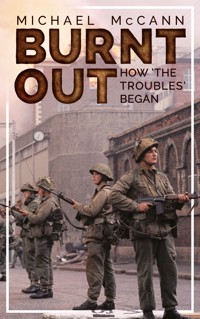
On 14 August 1969, at the age of 14, Michael McCann and his family fled their home. Life changed totally for the McCanns and the entire nationalist community. Thousands of innocent people vacated their homes, driven out by the initial pogrom and then by the ongoing campaign of expulsion by loyalist violence and intimidation. The British army occupation and the continuing violence utterly devastated communities on a monumental scale. Burnt Out: How the Troubles Began, shows how the truth became one of the first casualties of the horrific events of August 1969. It examines the prominent role of state forces and the unionist government in the violence that erupted in Derry and Belfast and assesses how and why the violence began and generated three decades of subsequent brutality. Against a mountain of contrary evidence, many still choose to blame the violence on the commemoration of the Easter Rising in 1966 and the efforts of the nationalist community to defend themselves on two hellish August nights in the late summer of 1969. Burnt Out: How the Troubles Began, is essential reading for anybody interested in the outbreak and causes of 'the Troubles'.
Sie lesen das E-Book in den Legimi-Apps auf:
Seitenzahl: 464
Veröffentlichungsjahr: 2019
Das E-Book (TTS) können Sie hören im Abo „Legimi Premium” in Legimi-Apps auf:
Ähnliche



















For my parents and for a special family who have made me proud
MERCIER PRESS
3B Oak House, Bessboro Rd
Blackrock, Cork, Ireland.
www.mercierpress.ie
www.twitter.com/MercierBooks
www.facebook.com/mercier.press
© Michael McCann, 2019
ISBN: 978 1 78117 619 1
Epub ISBN: 978 1 78117 620 7
Mobi ISBN: 978 1 78117 621 4
This eBook is copyright material and must not be copied, reproduced, transferred, distributed, leased, licensed or publicly performed or used in any way except as specifically permitted in writing by the publishers, as allowed under the terms and conditions under which it was purchased or as strictly permitted by applicable copyright law. Any unauthorised distribution or use of this text may be a direct infringement of the author’s and publisher’s rights and those responsible may be liable in law accordingly.
Inhalt
Maps
Abbreviations
Editorial Note
Foreword
Introduction
1 Orange State in Crisis
2 The Evictions Commence
3 Derry in the Eye of the Storm
4 Ashes to Ashes: Pogrom on the Falls
5 From Epicentre to Periphery: Clonard and Ardoyne
6 Picking up the Pieces
7 Absolving the Establishment
Conclusion
Notes
Bibliography
Acknowledgements
Northern Ireland
(Taken from the Cameron Commission report)
Derry
(Taken from the Cameron Commission report)
CONWAY AND CLONARD
(Taken from the Scarman Tribunal report)
ARDOYNE
(Taken from the Scarman Tribunal report)
DIVIS STREET
(Taken from the Scarman Tribunal report)
Abbreviations
CCDC Central Citizens Defence Committee
DCAC Derry Citizens Action Committee
DCDA Derry Citizens Defence Association
DI District Inspector
DUP Democratic Unionist Party
GPMG General Purpose Machine Gun
PD People’s Democracy
GOC General Officer Commanding
IRA Irish Republican Army
NICRA Northern Ireland Civil Rights Association
RUC Royal Ulster Constabulary
RUCR Royal Ulster Constabulary Reserve
SDA Shankill Defence Association
SLR Self-loading Rifle
UCDC Ulster Constitution Defence Committee
UDA Ulster Defence Association
UPA Ulster Protestant Action
UPL Ulster Protestant League
UPV Ulster Protestant Volunteers
USC Ulster Special Constabulary
UUP Ulster Unionist Party
UVF Ulster Volunteer Force
Editorial Note
As anyone familiar with the material covered in this book will know, there are problems in imposing any label on the two main communities that together comprise the large majority of Northern Ireland’s population. Many but not all Catholics are also nationalists in their political aspirations; most but not all Protestants are also unionists. However, there were then, and are now, substantial numbers of nationalists who are not devout Catholics, and many unionists for whom religion is peripheral to their attitude towards the constitutional question. The polarisation that has characterised the history of the state, and which became especially pronounced in the period discussed in the pages that follow, had little to do with religious differences, though at times (and particularly in the rhetoric of Ian Paisley and his followers) strident objections to Catholic religious teachings featured prominently. Mindful of these problems, I have usually opted to use the terms nationalist and unionist when describing these communities, though occasionally I also use Catholic and Protestant. In general I have used the terms republican and loyalist when describing groups or actions with some formal relationship to political and/or paramilitary organisations, or individuals who figure here as participants in specific organised actions.
My study makes extensive use of the Scarman Report ofTribunal of Inquiry: Violence and Civil Disturbances in Northern Ireland in 1969, which is cited in footnotes as Scarman Report. I have also utilised the testimony of hundreds (mostly civilians) who submitted eyewitness accounts of events during the inquiry. These accounts are separate to the Scarman Report and have been cited in footnotes as originating in the Scarman Transcripts.
Foreword
Tommy McKearney1
The events of August 1969 in Derry and Belfast were among the most consequential to occur in the history of the troubled political entity that is Northern Ireland. During a forty-eight-hour period over 14–15 August, eight civilians were shot dead – four of them by the local police force, the Royal Ulster Constabulary.2 Thousands more were made homeless as the result of a concerted incendiary assault led, on occasion, by members of the northern state’s police reserves, the Ulster Special Constabulary. The violence was directed against a practically defenceless nationalist population and was carried out by state agents acting in concert with their unofficial supporters. Such happenings would cause tremors in any society. In the North of Ireland, the consequences were profound and lasting.
In the first instance, the lethal nature of the violence effectively dashed hopes for a non-violent transformation of Northern-Irish society and largely sidelined the peaceful civil rights movement. Secondly, the scale of death and destruction meant that the British government was forced to commit its regular army to the region and, with direct intervention from London, Stormont’s half century of absolute authority was brought to an end. A third consequence of those traumatic days was to bring another army into Belfast: a split in the republican movement caused by the bloodshed led directly to the formation of the Provisional IRA. The events also had a major impact south of the border, where the reverberations of August 1969 were felt all across the twenty-six-county state. The Dublin government performed a series of contortions as it sought to contain the anger of its citizens, then largely sympathetic to the plight of northern nationalists. Finally, the findings of the official Scarman investigation into August 1969 were skewed in order to exonerate the British state from complicity. Along with the Widgery Report into Bloody Sunday, Scarman’s whitewash of state violence after the most traumatic episode in its short and violent history added further weight to the republican argument for breaking entirely with Britain.
Northern Ireland was created in 1920, partly to accommodate a pro-unionist community in the north-east of the island, but more significantly to guarantee the British Empire a physical presence in the strategically important island close to its west coast. A major weakness in the plan was the presence of a large minority in the newly created state that resented the arrangement from the beginning. From the foundation of the Northern Ireland state, this community of Irish nationalists was subjected to structural discrimination in employment, housing and cultural recognition. Crucially, the largest block of nationalists lived in virtual ghettoes in the state’s principal city, Belfast. The experience of previous pogroms within living recollection was seared into the folk memory of this tightly knit community.
In January 1967, inspired in part by the black civil rights campaign in the US South, a mixed group of liberals, radicals, civil libertarians and left-leaning republicans formed an alliance seeking reform in Northern Ireland. Unlike previous campaigns in the region, this initiative sought what appeared to many outside the six-county entity to be a modest package of reforms. An infuriating dilemma for the staunchly pro-British Ulster Unionist government was that this new Northern Ireland civil rights movement began with the most moderate of aspirations – a demand that the old order could not easily refuse: British rights for British citizens.
To this day there remains a question as to whether granting a reasonable, democratic package of reform would have changed the subsequent course of history. Had an enlightened Stormont regime enacted a series of reforms, might the nationalist people have warmed to a Northern Ireland based on genuine equality, one that guaranteed opportunity for all its citizens? After all, hard-bitten, ideologically committed anti-partitionist republicans were a minority across the six counties and had not traditionally held real sway among Belfast nationalists in particular.
The answer, of course, is that we will never know, because the opportunity did not arise. What is of more relevance to what happened is whether this option was ever a realistic possibility, given the make-up and nature of the political entity that was Northern Ireland. From its founding, the state’s existence was dependent on the promotion of communal identity politics, and therein lay its vulnerability. Unionist dominance hinged on two factors: one, that they remained a majority, and two, their ability to maintain unity within their own ranks. Democratic reform threatened both. Deprived of the ability to discriminate in the fields of employment and housing and thereby compel economic emigration, there was a distinct possibility that the nationalist population would eventually match or even outnumber the unionist community. Moreover, without the advantage of providing preferential treatment to its supporters in the world of paid employment, unionist solidarity and unity could not be guaranteed.
Such calculations were never far from the mind of unionist leaders. They were acutely aware of being in a minority on the island, and aware also by the mid-1960s that the southern economy was then developing from its long decades of peasant poverty. Equally disturbing for them was an ever-present, albeit rarely voiced, fear of English betrayal.
All of which begs the question: to what extent were the bloody events of August 1969 spontaneous? Were they, as some suspect, coldly calculated?
What is now beyond dispute is that senior figures within unionism were concerned even by the cautious steps taken by Stormont Prime Minister Captain Terence O’Neill towards limited detente with nationalists in Northern Ireland and a thaw in relations with the southern government. More sinister still is the fact that, according to a senior loyalist, the late Billy Mitchell, the UVF was resurrected in the mid-1960s with the encouragement of leading unionists in order to stem the perceived drift towards liberalism in Northern Ireland. Add into that the absence of any clear lines of demarcation within unionism as official and unofficial (legal and covert) structures overlapped – all elected unionist political representatives were members of the Orange Order, as were a majority of police officers and civil servants – and it is not necessary to organise a conspiracy, because one was already in place.
The question of how we can best understand the developments that occurred subsequent to August 1969 is one that deserves careful academic scrutiny. Having profited from pogroms in the early 1920s and mid-1930s, did the unionist ruling class tacitly orchestrate the attack on nationalist Belfast in 1969? Why did the British state not then grasp the nettle of reforming an undemocratic regional administration operating in an integral part of the United Kingdom? Were those advocating a purely peaceful civil rights agenda dangerously naive or did they offer the only viable path forward? Did the Provisional IRA’s founders cynically exploit a tragic situation or respond to a crisis in the only way possible? In light of the current state of affairs in the Northern-Irish six-county state – marked, it seems, by chronic crisis – an even more intriguing question arises: will history eventually decide that August 1969 in Belfast was, in reality, not just the start of the modern ‘Troubles’ but also the beginning of the end for Northern Ireland? Whatever the answer to these important questions, Michael McCann has provided us with an invaluable contribution to our understanding of that crucial period, and one which will no doubt inform and enlighten contemporary discussion about the future of this part of the world.
Introduction
The prominent civil rights activist and founder of People’s Democracy, Michael Farrell, once wrote that while ‘in most of the world, and even in the rest of Ireland, differences between Catholic and Protestants had ceased to matter much politically … in Ulster they persisted.’1 Not only did sectarian divisions persist; in Northern Ireland they constituted the bedrock of the Stormont regime, perceptively characterised by a British journalist as ‘rule by the Orange Order through the medium of the Unionist Party’.2
The Government of Ireland Act (1920) effectively sanctioned and financed a sectarian state. The years between 1921 and 1969 witnessed one-party rule, underpinned by a Special Powers Act in 1922 and reinforced by a well-armed paramilitary police force. From its seat of power in Stormont, the government entrenched discriminatory policies and practices into the fabric of northern society, reinforcing a system of social, political and economic apartheid which flouted democratic conventions to secure unionist control of local government and the patronage, in housing and employment, which came with it.
When a new generation of young, university-educated Catholics emerged in the late 1960s to challenge the status quo, the state resorted to the traditional methods of repression so successful over the previous half century in containing militant republicanism. On 5 October 1968, for example, the Royal Ulster Constabulary (RUC) battered civil rights demonstrators from the streets of Derry. This time, however, the brutality of the Stormont regime, Britain’s nasty little secret, was exposed to a global television audience. Journalist Mary Holland later recalled in the pages of The Irish Times:
… the shock of what happened … still sears the memory. As far as we were concerned this was a British city and these were British police. In 1968 I’d never seen a policeman use a baton let alone charge a crowd of demonstrators, trapped in a narrow street, with such naked eagerness.3
Yet it would be wrong to view the Derry march in isolation, or as the trigger to the violence that ensued. The hard-line Protestant firebrand, Ian Paisley, had stoked the sectarian embers in 1964, inciting the Divis Street riots in Belfast. Two years later, he established the Ulster Constitution Defence Committee (UCDC) and the Ulster Protestant Volunteers (UPV), both closely linked to the emerging loyalist Ulster Volunteer Force (UVF). In 1966, two years before the Derry march, loyalists turned ominously towards a sectarian murder campaign, while Paisley orchestrated counter-demonstrations against the emerging civil rights movement, railing against ecumenism, popery and the timid reforms enacted by unionist Prime Minister Terence O’Neill. This book attempts to demonstrate that the rise of militant loyalism in the mid-1960s was a crucial factor in pushing Northern Ireland towards the decades-long protracted conflict that became known as ‘the Troubles’.
Paisley’s reactionary and incendiary rhetoric worked because he exposed developing fissures in the unionist monolith. O’Neill’s measures, though moderate and piecemeal, only exposed the Orange state’s incapacity for reform. A cross-class consensus among northern unionists constructed before the First World War, based on relative economic prosperity and held together by the rhetorical glue of anti-Catholicism, appeared by the late 1960s to be unravelling under the weight of new challenges. The Loyal Orders (Orange Order, Apprentice Boys and Royal Black Preceptory) had long acted as the gatekeepers of the Orange state, and the regime’s inability to break its relationship with a blatantly sectarian organisation left it badly exposed in an era of social liberalisation and democratic change across much of Europe and America.
During July 1969, however, the loyalist backlash against the civil rights movement took on a familiar character. The lodges marched while, behind them, the forces of reaction prepared to teach Northern Ireland’s nationalist minority a lesson – to show them that hard-line unionism still ruled the roost. One month later, Stormont’s unwillingness to proscribe the Apprentice Boys’ annual parade in Derry on 12 August led to large-scale unrest. Abetted by loyalist militants, the RUC mounted a prolonged assault on the nationalist Bogside. These actions provoked a series of tragic events that reverberated throughout the North, but found fullest expression in the narrow, terraced streets of the unionist citadel of Belfast.
This book analyses the assault on the nationalist community in Derry and particularly Belfast before and after what became known as the ‘Battle of the Bogside’. It uses evidence provided to the Scarman Inquiry, established by the British government to investigate the acts of violence and civil disturbance that occurred between March and August 1969, but more significantly, it triangulates this against a host of eyewitness accounts of the horrendous violence and the expulsions of thousands of Belfast’s beleaguered Catholic minority. In doing so it challenges the conventional wisdom shared by most professional historians and social scientists who have written about this period and who almost uniformly misrepresent the dynamics of sectarian violence in the tragedy of 1969 and (in the name of ‘balance’) equivocate in identifying the perpetrators of the pogrom of August 1969 in North and West Belfast. There are complexities to the story related here, but there are unequivocal facts as well, and nothing can be gained by pretending otherwise.
At the heart of this book lies a close assessment of how and why the violence of 1969 began. Through recorded oral histories and primary source material a compelling case is made that the Troubles did not start on 14 August 1969, because the cataclysm visited upon nationalists in the Lower Falls and surrounding areas commencing on that day had been conceived some weeks and months previous. Particular attention will be paid to the central role played by John Dunlop McKeague, a disciple of Paisley, and his Shankill Defence Association (SDA) in orchestrating events from April 1969 onwards.
I also seek to establish how the truth became one of the first casualties of the horrific events of August 1969. The unionist regime’s attempted cover-up began just a few hours after the RUC killed nine-year-old Patrick Rooney and while loyalist mobs were continuing their push to drive out vulnerable nationalists. By 18 August Stormont ministers were publicly accusing nationalist victims of burning their own homes and attributing the wider violence to a well-planned republican uprising. Since the earliest attempts to spin the events, this flagrantly absurd version has found its way into many ‘objective’ accounts penned by academic historians and others. Most accounts fail to mention the number of families made refugees in the violence (1,820), while the greatest sin of omission surely lies in the failure to acknowledge that it was RUC machine-gunners in armoured vehicles who spearheaded the assault on nationalist districts in Belfast – firing indiscriminately into homes, killing one child and injuring countless innocent people. Their reckless actions provided a bridgehead for loyalist mobs, which flooded into the breach to continue the attack on nationalists.
Finally, and significantly, I demonstrate that loyalist violence did not cease in mid-August, but continued to touch North, South, East and West Belfast, swelling the numbers of nationalist refugees. I assess the systematic attacks on Catholic-owned businesses – particularly public houses and off-licences – from April 1969, and illustrate how a heady mix of sectarian bile and looted alcohol fuelled the pogrom. It was in the immediate aftermath of the Belfast burnings that the first British soldier was wounded and then the first RUC man lost his life in the Troubles – both shot by loyalists before the Provisional Irish Republican Army had even been founded. This book challenges and attempts to counter the spurious accounts that have, until now, dominated our understanding of these events, and seeks to establish the basic facts relating to the beginning of the modern Troubles – a conflict born of sectarian violence instigated by the state and its loyalist defenders in the fiery cauldron of August 1969.
1 Orange State in Crisis
Academic Bias: The Spectre of a Rising Republican Threat
One of the most unbelievable feats in Irish history writing over the past generation has been the largely successful attempt to transform the main victims of the traumatic violence of the summer of 1969 into the chief villains in starting the Troubles. Most of the published accounts of these critical events locate the origins of armed conflict in the North of Ireland not in the failed policies of a discriminatory colonial state, or in the aggressive actions carried out by the substantial paramilitary forces it had at its disposal, or even in the provocations of murderous sectarian mobs, but in the peaceful, mostly symbolic attempts by Belfast’s beleaguered nationalist community to mark the fiftieth anniversary of the Easter Rising in the narrow streets of their own ghettoes.
Paul Bew’s reference to 1966 in Ireland: The Politics of Enmity 1789–2006, led one reviewer to harbour the suspicion that this choice was made to allow Bew to target ‘the 1916 celebrations as the fuse that ignited the Troubles’.1 In this Bew is not alone: several prominent Irish academics point to 1966 and an alleged resurgence of militant republicanism in explaining the source of conflict. In Northern Ireland Since 1945, the former Queen’s University academic Sabine Wichert emphasised the role of ‘rumours of an IRA revival’ amidst the republican celebrations of 1966 in aggravating sectarian tensions across the North.2 Thomas Hennessey’s Northern Ireland: The Origins of the Troubles recounts Northern Ireland Prime Minister Terence O’Neill’s conversation with his British counterpart, Harold Wilson, to claim that ‘the passionate celebrations of the fiftieth anniversary of the Easter Rebellion, had led to a “backlash” of ultra Protestant feeling’.3 Fear of this ‘backlash’ becomes, in Hennessey’s rendering, a rationalisation for Stormont’s unwillingness to reform: in considering whether to ban civil rights marches, O’Neill’s Minister for Home Affairs, William Craig, ‘had to bear in mind how the 1916 commemoration … had led to a dangerous deterioration in community relations, leading to Protestant extremists taking up arms’.4 One of the key achievements of ostensibly liberal unionist history writing has, therefore, been its success in embedding the idea that the Easter 1966 commemorations started the North down the path towards the Troubles. But the evidence points in a very different direction.
As it had throughout the history of the Northern Ireland state, the spectre of republican subversion proved an effective device for blocking reform, and Ian Paisley exploited this skilfully in galvanising a new generation of loyalist militants. The reality, however, was that by the mid-1960s the IRA was at the weakest it had been since partition. Its border campaign (‘Operation Harvest’ 1956–62) had ended in dismal failure, demoralising supporters and establishing a broad consensus among northern nationalists that physical force was ineffective for challenging partition. ‘The hoped-for uprising of northern nationalists had failed to materialise,’ one recent study acknowledges. ‘Some southern republicans had come to realise how little they actually knew about the North and unionism.’5 This failure led republicans towards a fundamental reconsideration of strategy and tactics, the outcome of which was a rejection of the narrow nationalism and militarist obsession that, except for a brief period in the 1930s, had long dominated the movement north of the border. Establishing Wolfe Tone Societies and Republican Clubs across the north, the republican leadership acknowledged the futility of armed struggle as a vehicle for ending partition, abandoning its short-term perspective in favour of a class-based analysis and popular, anti-sectarian agitation. The IRA posed no military threat to Stormont in 1966, and its forces were far too weak and undeveloped to pose a serious political challenge. Two men who joined the movement in Belfast during the early 1960s describe the situation at the time:
I joined the IRA in 1962. The recruitment classes lasted some twelve months. The classes were to deter anyone joining the movement. A fair number of people started together and when the twelve months had finished only three remained. When I became a volunteer I was immediately sent to ‘D’ Company based in the Lower Falls, simply because there was no IRA structure in Belfast. The IRA were in effect ‘history’ … What surprised me during this period was that the IRA engaged in an indoctrinating programme … The weaponry the IRA had were [sic] sold off and the Free Wales Army was buying it … many senior IRA men held a mistrust of the direction in which the leadership was taking it – namely a political agenda – and the IRA was to be made defunct. [In 1966] we found ourselves in a terrible situation, because of our protest over political agitation; we were looked over and forgot [sic] about. To give the background, I had done nothing [in the] movement for years. 1966 was a gesture from the movement in order to celebrate the Rising: a few things happened, but nothing of significance.6
The second man concurs:
The army [IRA] was doing nothing during these times. They were marking time: neither going forward nor backwards. From 1962 and throughout the 1960s the IRA did not exist as a fighting force. At that point agitation was happening and we were having meetings … The older people in the movement wanted change and if the army were kept it would be a stumbling block – young men like myself began to drift away.7
While this sense of drift, reorientation, disarmament and decline features almost universally in the memories of northern republicans active at the time, historians have seemed eager to embrace official perceptions of a mounting republican threat. In reality, however, Stormont ministers conjured the republican threat to deflect from increasingly anxious scrutiny from London.
A short distance from Hastings Street RUC Barracks in West Belfast, the republicans’ ‘48 Club’ operated. A regular of the social club claimed that Special Branch officers, who were on first-name terms with many members, openly watched the premises and were well aware what was and what was not happening on the ground. By contrast, the unionist government never seems to have instructed the RUC to monitor loyalist activity and in fact, it seems that loyalists and police already had a growing relationship at this time. On 11 July 1966 the Nationalist MP for Mid-Tyrone, Thomas Gormley, claimed that ‘a number of members of the Special Constabulary in Ulster were involved with militant extremists and Protestant Unionist organisations in a plot to overthrow the Ulster Government. It was clear that [loyalist] extremist movements were well armed with Government-owned weapons.’8 It was suspected by some nationalists that loyalists may have been involved in acquiring additional arms. In Cookstown, the RUC investigated the suspicious robbery of a sub-machine gun, a pistol and a substantial amount of ammunition from the homes of three B-Specials.9
Despite clear evidence of an emerging threat from loyalism, Hennessey focuses on activity within the pre-Troubles IRA as evidence of republican manipulation of civil rights agitation, which led to the Troubles.10 Close examination reveals that much of the analysis and most of the sources he employs are highlighted by the Scarman Tribunal’s Violence and Civil Disturbances in Northern Ireland in 1969, from which the author paraphrases.11 One of the documents that Hennessey quotes is an IRA document which claimed that ‘we must learn from the Cypriots and engage in terror tactics only’.12 Crucially, however, Scarman himself acknowledged that these were merely captured draft documents that few republicans had ever discussed, let alone adopted.
This concentration on extravagant republican plots distracts from the widespread, deeply felt outrage over flagrant sectarian discrimination that was the main underlying cause of the conflict. Cameron’s Disturbances in Northern Ireland, published in 1969, acknowledged widespread discrimination. However, within the revisionist lexicon, the legitimacy of nationalist grievances seems impossible to establish: Roman Catholics merely ‘believed themselves to be the victims’, they embraced ‘a collective perception’ that they were discriminated against.13 In fact, the historiography has largely ignored the findings of Cameron, Scarman and Hunt, all contemporaneous official British inquiries containing evidence emanating from the political establishment but critical of the Stormont regime. Conversely, numerous historians have relied heavily (and largely uncritically) on local newspapers for information. The unionist press argued consistently that the republican marches of 1966 and Terence O’Neill’s superficial gestures towards the minority nationalist community heightened tensions and fears within unionism. What is obviously and again quite naturally absent from such publications is a close documentary examination of, or any genuine critical commentary on, the rise of loyalist extremism. Academics largely overlook the sectarianism that was ever-present in the North, and ignore especially the loyalist violence of 1969.
Marianne Elliott attempts to plot a middle path, arguing that ‘[a]s ever, the extremes fed off each other. Widespread republican rallies for the fiftieth anniversary of the 1916 Rising produced Paisleyite counter-demonstrations and excessive deployment of armed police.’14 Nonetheless, contemporaneous records reported no trouble resulting from republican commemorations in London, Dublin or across the North.15 In reality, it was Paisley’s ongoing sectarian speeches, illegal assemblies and marches – which actually preceded republican demonstrations – that drove the unionist government’s violent overreaction. This reflexive urge to mete out repression against nationalists reflected the structural basis of the unionist consensus and the insecurity of the Stormont elite. Michael Farrell points out that ‘[i]n April Paisley forced the government to mobilise the B-Specials for a month and ban trains from the South from coming to commemorations of the fiftieth anniversary of the 1916 Rising, and then denounced them for not banning the parades altogether’.16 This chronology is affirmed by the London Sunday Times Insight Team, who claimed that the ‘first challenge to O’Neill came not from the Republicans, nor from the pacific Catholics like the McCluskeys [founders of the Campaign for Social Justice]’, but from one of his nominal supporters, Ian Paisley.17 Indeed, according to the same source, in 1965 O’Neill informed Harold Wilson that while he could ‘walk through the Catholic Falls Road area of Belfast without an escort, even with a full bodyguard they could give him no guarantee of security in the extremist Protestant areas’.18 In his autobiography, O’Neill claimed that he lost the post of prime minister because the Ulster Unionist Party (UUP) ‘would never stand for change’; it was loyalist extremists who drove him from office.19 Put simply, ‘[t]he old sectarian and anti-Catholic forces within Protestantism and Unionism ruled the day, leaving O’Neill to lament on his resignation in 1969’.20
The O’Neill Years
An ill-founded consensus exists that Terence O’Neill’s ascent to power after loyalist hard-liner Basil Brooke resigned in 1963 heralded a sea change in unionism. In fact, O’Neill’s appointment was contingent on his membership of the Orange Order. Having taken up office, he subsequently joined the Royal Black Preceptory and the Apprentice Boys of Derry. Appointed by the unionist elite, O’Neill was a member of the landed gentry, a son of a Unionist MP who had served at Westminster, and an ex-British army officer. He succeeded Brooke as leader of a sectarian administration, sanctioned and financed from Westminster; to his credit Patterson admits that in spite of his reputation as an avid reformer ‘the dismal truth about O’Neill was that he displayed not the slightest inclination to do anything on this issue [discrimination]’.21
Apart from its annual subsidy to Stormont, the British government had largely disassociated itself from Northern Ireland at this juncture. James Callaghan, then (1967) British Home Secretary and future Labour Prime Minister, recalled: ‘Not surprisingly, the staff at the Home Office engaged on Northern Ireland was extremely small. Indeed, Northern Ireland was crammed into what was called the General Department, which was responsible for anything which did not fit into any of the major departments … It covered such matters as ceremonial functions, British Summer Time, London taxicabs, liquor licensing, the administration of state-owned pubs in Carlisle, and the protection of animals and birds.’22 Occasionally throughout the tenure of the post-war Attlee government and into the mid-1950s, small groups of Labour MPs at Westminster had highlighted the discriminatory practices of the Stormont regime. From 1964, Labour MPs Paul Rose and Stanley Orme raised the same issue, but to no avail. Successive Speakers of the House of Commons, under the influence of Ulster Unionists and Conservatives, rejected any discussion of internal Northern Ireland affairs. Despite its reputation for violence and discrimination, Stormont was granted free rein to oversee affairs in the six-county state.
From its inception as the UUC in 1905, the Unionist Party relied on the Orange Order as a bulwark against concessions and a vehicle for cross-class Protestant solidarity. In his famous 1934 speech at Stormont, James Craig claimed that ‘I have always said I am an Orangeman first and a politician and member of this parliament afterwards … all I boast is that we are a Protestant parliament and a Protestant state.’23 Between 1921 and 1969 only three of fifty-four members holding cabinet rank at Stormont were not Orangemen and ‘of the remaining ninety-five backbenchers, eighty-seven were members; all Unionists elected to the Northern Ireland Senate between 1921 and 1968 belonged to the Institution, as did fifty-four of the fifty-six Unionist MPs elected to the Westminster parliament – the other two were women.’24 Even during periods of perceived unionist moderation, the UUP and Orange Order denied Catholics’ applications for party membership. Indeed, ‘[f]or all his talk of bridge-building’, Captain O’Neill ‘found the question of Catholic membership of Unionism too hot to handle’.25
Between 1963 and 1966, O’Neill faced several problems: high rates of unemployment, particularly in the heavy industries which had provided a measure of prosperity for skilled Protestant workers; rising expectations among the Catholic minority for equal rights, and the growing threat of Paisley and the extremists within his own party. ‘Within that black reactionary group [Harold Wilson’s apt description] were John Brooke, John Taylor, the Unionist MP for South Tyrone; William Craig, whom O’Neill dismissed from his cabinet; Harry West, whom he also dismissed, and [Brian] Faulkner.’26 After O’Neill met Taoiseach Seán Lemass in January 1965, despite strong opposition from elements of his own party, these difficulties intensified. Faced with widespread unionist dissatisfaction, O’Neill abandoned any inclination to cede the basic reforms demanded by nationalists. Stormont’s decision to build a new university at Coleraine instead of Derry, and to name a new model town in mid-Ulster after the staunch unionist and sectarian bigot James Craig, offered powerful evidence that while O’Neill’s premiership differed in tone, it remained fully committed to the substance of the traditional unionist programme. This motivated a small group of moderate activists, who had been collaborating in documenting anti-Catholic discrimination, to launch a civil rights campaign, a new development predictably denounced by unionist hard-liners within the government as part of a republican plot. Unsurprisingly, ‘[f]or many unionists, the civil rights demonstrations from the outset bore the mark of Cain as an essentially nationalist movement’.27 A large section of the unionist community responded negatively to the Northern Ireland Civil Rights Association’s (NICRA) demand for civil rights, and ‘the opposition to O’Neill was carried far beyond street protests and counter-demonstrations to obstruct the civil-rights movement’ to ‘secret caucus meetings in the drawing rooms of Unionist politicians’.28 Boyd noted:
In public Faulkner stood a little to one side when Paisley was causing turmoil in Northern Ireland and so making O’Neill’s premiership uncomfortable and embarrassing. In private Faulkner was not above plotting with Paisleyites against O’Neill. It was, in fact, revealed that [Desmond] Boal, who is now the theorist of the Orange extremist party, the Democratic Unionist Party, and others met in Faulkner’s house to discuss a plan to overthrow O’Neill. Faulkner later denied, when asked about this meeting, if [sic] he had taken part in the discussion. He said he left the room when Boal and his friends were talking.29
As early as January 1965 (and therefore well before the republican Easter commemorations), MP for Belfast’s Shankill district Desmond Boal joined Ian Paisley, future co-founder of the DUP, in warning against UUP capitulation to those fighting discrimination. Other leading unionists strained to deflect criticism for this from the Stormont regime. Before a civil liberties conference in London in March 1965, John Taylor attempted to shift the blame onto ‘the South’s hostility to Northern Ireland, IRA attacks, Nationalist Party propaganda, and the Catholic church’s segregatory attitude for keeping alive old sectarian animosities’, denying any culpability for his own party or the Orange Order.30 Nevertheless, the British media’s increasing scrutiny of discrimination in local government and in housing allocation in the North deepened unionist anxiety. By the summer of 1966 even the Tory-leaning Daily Telegraph pointed out ‘that the government in Northern Ireland still presents features which look shocking when viewed from Westminster’.31
Unlike Taylor, Stormont Minister for Home Affairs William Craig never concealed his contempt for nationalists, whom he claimed suffered from educational and social deficiencies. ‘When you have a Roman Catholic majority … you have a lesser standard of democracy: rule by the people was not much of an idea if they were the wrong people …’32 Craig led the reaction against O’Neill’s reforms within the cabinet. In December 1966 he informed a trade union delegation seeking equal voting rights that ‘Britain was out of step with Northern Ireland’.33 Craig regularly banned marches by NICRA, which he frequently characterised as a communist-republican front.34 Eventually O’Neill grew tired of the backbiting, dismissing Craig from his cabinet on 11 December 1968, after which Craig continued to agitate from the political sidelines.
The Rise of Loyalist Vigilantism
Despite his involvement on the fringes of political activity since 1949, Ian Paisley only really came to public attention in the 1960s. Paisley directed his vitriol against Catholicism, ecumenism, republicanism, communism and, indeed, those Protestants he castigated as ‘Lundys’ and reformers at Stormont.35 Having denounced the BBC for being ‘infested with Papists’, the staunchly unionist News Letter as ‘cowardly’ and the Belfast Telegraph for its ‘lying and treachery’, the relentless barrage of sectarian rhetoric pounded out by Paisley from the early 1960s manifested itself powerfully on the streets in August 1969. Yet Paisley did not conjure sectarian conflict out of thin air: Belfast was by then home to a long and deeply rooted tradition of radical fundamentalist preachers, embodied in an earlier century by Henry Cooke, who had wielded a domineering influence on Ulster Protestantism from the late 1820s to his death in 1868. ‘It was Cooke,’ John Brewer writes, ‘who forged the link in the public’s mind between evangelicalism, doctrinal orthodoxy and anti-Catholicism. “We will fight”, said the dying Henry Cooke in 1868 … “and this will be our dying cry, echoed and re-echoed, ‘No Popery’.” “No Surrender”.’ Brewer continues, ‘Anti-Catholicism at the level of behaviour therefore often showed itself in violence.’36
The Rev. Hugh Hanna (‘Roaring Hanna’), a disciple of Cooke, took up the mantle of sectarian demagoguery after the latter’s death. The years 1857, 1864, 1872, 1886 and 1898 witnessed brutal attacks on the city’s growing Catholic minority. Inflammatory sermons at open-air gatherings helped stimulate a remarkable growth in Orangeism and, unsurprisingly, a sharp and often lethal rise in sectarian polarisation. The Rev. Thomas Drew, Orange Grand Chaplain and Church of Ireland minister on the Shankill Road, claimed at a large rally on 12 July 1867 that the ‘lives and property of the Protestants of Ireland are prey to the despoiling priest’, and this kind of rhetoric – drawing on the tradition established by Cooke and Hanna – became typical fare in Belfast and beyond, employed annually in July, and especially in times of high Protestant unemployment and political instability.37
From its inception, the Stormont administration relied on special ‘emergency’ legislation and permanent access to state paramilitary forces – the Ulster Special Constabulary (USC), organised into A-, B- and C-Specials, an exclusively Protestant and wholly partisan paramilitary force – to deal with the threat from republicans and forestall potential challenges from an intermittently militant labour tradition. The regular RUC was itself a partisan force from the outset, the core of its ranks drawn from the loyalist UVF. The Sir Robert Peel Orange Lodge, registered with the Grand Lodge of Ireland in 1923, included some 300 RUC men, or ten per cent of the force. Indeed, J. W. Nixon, a district inspector and notorious ringleader of the Cromwell Club (the loyalist murder gang responsible for the brutal McMahon murders and the Arnon Street massacre at the founding of the Northern Ireland state in 1921), held the post of worshipful master. In April 1923 Stormont Minister of Home Affairs Dawson Bates attended the Lodge’s AGM, making ‘a belligerent and highly political speech’, with the political tone of the meeting ‘strengthened by the presence of three UULA [Ulster Unionist Labour Association] MPs and the secretary of the Unionist Party’.38 In effect, the unionist government at Stormont commanded a highly partisan security force in defence of the Orange State, employing overtly coercive legislation and regularly overriding basic liberal democratic rights in the process.
Notwithstanding the protection available from regular state forces, leading unionists also supported extra-judicial loyalist gangs. For instance, the Ulster Protestant Association, formed in 1920, essentially carried out a campaign of workplace expulsions and murder against Catholics. The Stormont administration responded ‘not by interning its members under the Special Powers Act, but by enrolling them in the USC and enlisting their aid in the work of a newly established Secret Service! Indeed, considerable latitude was given to Protestant and Orange extremists in the police forces.’39 To the extent that the new Northern Ireland state managed to establish some stability in the years immediately after its founding, the costs were borne overwhelmingly by working-class nationalists subjected to vicious assault from state and non-state loyalist paramilitaries intent on a pogrom:
Catholics, who were heavily out-numbered and relatively poorly armed, were largely on the receiving end of the violence, an estimated twenty-three thousand of them having been driven out of their homes. During a two-year period nearly five hundred people were killed with over two thousand wounded, but Catholics were killed on a ratio of two to one, even though they constituted only one-third of the population. In fact, the situation is thrown into sharper relief when we bear in mind that, in terms of the areas where most of the troubles took place, the Catholics constituted a mere one-sixth of the population. Indeed, nearly half the Protestants who died were killed by British military fire in riot situations.40
Lily Fitzsimmons recounts what happened to her grandfather when he worked in the shipyard during the same period:
My grandfather Charlie Begley married a girl called Marie-Ellen Murphy. They moved to a house in Mary Street, off the Falls Road. In 1922 Charlie worked in the shipyard and in the same year they had their seventh child. It was also a period of unrest against the Catholics in the shipyard. Charlie and other Catholic men decided to go into work together, believing in safety in numbers. They knew the dangers that were there but they had no choice because times were hard, jobs were hard to come by, and when you had a family you had to feed them and clothe them: they had no choice. One morning they had entered the gates of the shipyard when a Protestant man who knew Charlie shouted a warning to him, telling him to watch themselves: that a crowd was waiting for them. When they got further into the yard they were pelted with nuts, bolts, lumps of metal and spanners. The loyalist mob chased them and my grandfather was caught. My grandfather was beaten so badly he received severe head injuries; his teeth were kicked down his throat. He was dragged over to the water and thrown in. The mob threw everything on top of him and other Catholic men. My grandfather went under the water, but somehow he was pulled out [and] taken to hospital with serious multiple injuries. A short time later my grandfather died from his injuries, aged 38. Less than a year later my grandmother Marie-Ellen became ill and was taken to the City Hospital where she died, aged 36. Their seven children were left orphaned.41
In 1931, in the face of growing agitation induced by the Great Depression, the unionist elite founded the Ulster Protestant League (UPL) to thwart attempts by labour and left-wing militants to unite workers across the divide. Farrell points out that ‘government speeches became more sectarian and violence escalated up to the riots of 1935’.42 Sir Basil Brooke, Stormont Minister for Labour J. M. Andrews and Senator Joseph Davison, Grand Master of the Orange Order, implored employers to hire only Protestants and expel Catholic workers. The small Catholic business class, particularly victuallers, represented a particular target for loyalist mobs, which launched concerted attacks against Catholic-owned pubs; this pattern would be repeated in August 1969. Like its predecessor, the UPL carried out sectarian attacks and murders, killing ten people and burning fifty-six homes after an Orange march in York Street on 12 July 1935. Budge and O’Leary noted that the Minister of Home Affairs, Dawson Bates, first banned all processions, then capitulated to a demand by the Orange Order to exempt their processions, culminating in riots lasting three weeks and rendering 400 (mainly nationalists) homeless.43 Ironically, fleeing nationalists sought refuge in newly built houses in Glenard, Ardoyne – houses initially built for Protestant families. Although the 1935 sectarian riots, instigated by prominent figures at Stormont, were among the most violent episodes ever experienced in Northern Ireland, together the unionists and the British government effectively blocked demands for a Royal Commission inquiry.
John McGreevy recounts what happened to his mother in this area:
My mother came from the Docks area – Sailor Town. Her maiden name was Holden. Around 1934–5 the trouble had been very bad in Sailor Town, York Street and Lancaster Street areas. Film newsreels have recorded the trouble at the time, so there is a record of this. Buck Alec, the famous loyalist gunman, was very active at the time. A Catholic man was shot in North Thomas Street. My mother lived in North Thomas Street, and this was a mixed street [in that both Catholics and Protestants lived there]. Around this time my mother was shot in the neck when she was expecting me. She was coming home one night and she reached my grandmother’s doorway. I could not tell you who shot her, but I know the people shouted over to her, ‘Your bastard will never be born’, and they fired at her. My mother survived because it was not a serious injury.44
In the House of Commons the usually verbose Nationalist MP Joe Devlin bluntly summarised the predicament facing his constituents in Belfast: ‘If Catholics have no revolvers to protect themselves, they are murdered. If they have revolvers, they are flogged and sentenced to death.’45
These deep-rooted traditions of loyalist vigilantism, endorsed since the founding of the state by official unionism, combined with a toxic legacy of sectarian street-preaching to elevate the public career of Ian Paisley. In December 1956 Paisley joined the UPL veteran Ernie Lusty and fellow UUP member Albert Thoburn at the founding meeting of Ulster Protestant Action (UPA) at UUP headquarters. Others attending included Johnny McQuade, Charlie McCullough, Frank Millar and Billy Spence, the brother of Gusty Spence, later a leading figure in the UVF. One academic tracing the lineage of extreme loyalism argues that it was underpinned by fears among Protestant fundamentalists that any concessions to the Catholic minority would enhance the threat of a takeover by a monolithic, aggrandising church at Rome. ‘These believers were an important element in groups like the Ulster Protestant League (founded in 1933) and Ulster Protestant Action (founded in 1959). But [they] did not confine themselves to religious issues. Arising during economic recession, they also demanded job reservation for Protestants and drew much support from shipyard men, unemployed and marginal workers.’46Paisley became the first leader of the UPA in 1959, later the Protestant Unionist Party – formed ‘to resist ecumenism in the province’ and undergoing another name change in 1971, to the Democratic Unionist Party.47 In June 1959, on the Lower Shankill Road, Paisley’s supporters in the UPA launched a wave of anti-Catholic violence unseen in Belfast for over a decade, with nationalist homes and businesses attacked on the Shankill. An excerpt from Paisley’s speech at the time points to a direct connection between his sectarian rhetoric and the subsequent violence:
You people of the Shankill Road: what’s wrong with you? Number 425 Shankill Road – do you know who lives there? Pope’s men, that’s who! Forte’s ice cream shop, Italian papists on the Shankill Road! How about 56 Aden Street? For ninety-seven years a Protestant lived in that house and there’s a Papisher in it. Crimea Street, Number 38! Twenty-five years that house has been up, twenty-four years a Protestant lived there but there’s a Papisher there now.48
In 1964 Paisley sparked vicious rioting in Divis Street that lasted for a number of days. His threat to lead a loyalist mob into nationalist-dominated Divis Street to remove an Irish tricolour in a shop window of the Republican Club raised tensions dramatically, but in this case the RUC determined to pre-empt Paisley by assuming the burden of carrying out his mission themselves. Predictably, serious rioting erupted between the RUC and nationalist youth when the police waded through a crowd to smash the shop window and remove the offending flag. Four bloody nights of rioting ensued, with many police officers and hundreds of men, women and children injured, and damage costing thousands of pounds caused. Farrell noted that the Divis Street riots ‘served to focus British attention on the Northern Ireland situation at the very time when a new Labour government was coming into office’.49
Paisley’s power and influence among disaffected loyalists was on a steady upward trajectory following the so-called Tricolour Riots. In early 1966 loyalists attacked a number of schools, homes and Catholic-owned businesses across Belfast, daubing ‘Fenian Bastards’ and ‘Up the UVF’ on public houses owned by nationalists. The UVF apparently sent threatening letters to Catholics living in the Glenbryn housing estate in North Belfast, a fate also shared by visiting BBC reporter Cliff Michelmore. Clearly intent on raising tensions between his followers and the nationalist minority, and in the process undermining O’Neill, in February Paisley demanded that the administration name a new bridge after Edward Carson, enlisting the UVF founder’s son to assist him in challenging O’Neill. In the same month Paisley declared that ‘Every Ulster Protestant must unflinchingly resist these leaders and let it be known in no uncertain manner that they will not sit idly by as these modern Lundys pursue their policy of treachery. Ulster expects every Protestant in this hour of crisis to do his duty.’50 Less than two months later, in April, Paisley launched his Protestant Telegraph in response to criticism that The Revivalist, the newspaper of the Free Presbyterian Church, had become too political. The Telegraph ‘provided its loyalist and fundamentalist readership with a regular and often bizarre diet of anti-Catholicism, sometimes heavily laced with sexual innuendo. It became an outlet for bigotry, insecurity, ignorance, frustration and latent violence.’51
In March 1966, a month before the Easter Rising commemorations, a group of loyalists on the Shankill Road re-formed the UVF. The UVF gang immediately issued a warning declaring that it would defend Northern Ireland and eradicate the IRA. Two months later, on 7 May, the gang attacked and firebombed a Catholic-owned public house in Upper Charleville Street, critically injuring a seventy-seven-year-old Protestant, Matilda Gould, who died the following month. On 28 May they entered the Clonard area off the Falls Road and murdered an innocent Catholic, John Patrick Scullion. By 26 June the same gang had murdered a young Catholic barman, Peter Ward, and injured his two friends in Malvern Street off the Shankill Road. The UVF’s rabid sectarianism attracted an expanding membership and ‘by the Summer of 1966 there were rural cells in South Antrim, Portadown, County Armagh, and Pomeroy, County Tyrone’.52
Arrests quickly followed and O’Neill banned the UVF under the Special Powers Act. One convicted Ulster Volunteer, Hugh McClean, told police that he ‘was asked did I agree with Paisley, and was I prepared to follow him. I said that I was.’ Later he lamented that he was ‘terrible sorry I ever heard tell of that man Paisley or decided to follow him. I am definitely ashamed of myself to be in such a position’.53Paisley condemned the murderers, denied any connection with loyalist extremism and criticised O’Neill for not proscribing the UVF earlier. Responding, O’Neill quoted Paisley’s speeches at the Ulster Hall, where he ‘thanked all those who had marched that day and specifically mentioned the UVF by name’ (17 April), and a resolution from ‘ex-servicemen … now comprising four divisions of the UVF’ (16 June) to question ‘the extent to which Mr Paisley can properly claim ignorance of the activities of the UVF’.54
In April Paisley, together with Noel Doherty, ‘[t]he driving force behind the construction of a political vehicle for Paisleyite politics’, established the twelve-man UCDC, whose objective was to uphold the ‘Protestant constitution’ and force O’Neill from office.55Paisley was made chairman on 22 May 1966, the same month the UPV emerged, a more sinister group linked with UCDC and organised along military lines under the old UVF motto ‘For God and Ulster’. Interestingly, the UPV encouraged membership amongst the USC, yet excluded RUC men. The UPV provided the backbone of Paisley’s entire movement. Some of its members were later convicted for conspiracy to commit explosions.
Acquainted with Paisley since the mid-1950s, Noel Doherty was a printer who had established the Puritan Printing Press in 1966 to produce the Protestant Telegraph. Both men established the UCDC and UPV, with Doherty – already a B-Special – setting up cells within the UPV. ‘We already had government-issued .45 Webleys and government-issued Sten guns,’ Doherty later recalled, ‘so we thought, “Why not have our own – under the floorboards”, and that’s what we started to do.’56Doherty then became associated with fellow Free Presbyterian Billy Mitchell, later a leading UVF member convicted for a vicious double murder. On 21 April 1966 Paisley brought both men to Loughgall to meet with local Free Presbyterians, including several B-Specials, before driving to another meeting in Armagh. Doherty was introduced by Mitchell to a local quarryman and UPV member, Jim Marshall, who would be able to supply him with gelignite. Doherty and two UVF men from the Shankill – Desmond Reid and George Bigger – collected this the following month. Doherty became ‘the intermediary through whom members of Loughgall UPV supplied gelignite to the Shankill UVF’.57Paisley subsequently disowned Doherty, changing the locks on the latter’s printing operation when, in October 1966, Doherty and two others were convicted on explosives charges. The spurned Doherty later acknowledged that Paisley’s disowning ‘was worse than the two-year gaol sentence’.58
The Rise of Paisley
On 6 June 1966 Paisley organised a rally in Belfast against ecumenism and the ‘Romeward trend’ within the Presbyterian Church, leading a march to the General Assembly. Serious violence ensued as the (illegal) march passed the predominantly nationalist Markets area en route to the city centre: mayhem erupted when the Paisleyites broke through RUC lines, ‘calling the police Nazis and Northern Ireland a police state’.59 His supporters then swarmed into Fisherwick Place in Belfast city centre, abusing the dignitaries of the Irish Presbyterian Assembly as ‘Romanists’, ‘Popeheads’ and ‘Lundys’, while their leader lambasted the moderator by loudhailer, bellowing that ‘They can go to Rome if they wish, but they will not take Ulster with them.’ The Stormont administration responded by charging Paisley and six others (including two clergymen) with public order offences. Paisley and the two clergymen were sent to Crumlin Road Gaol on 20 July for refusal to pay their fines.
Paisley settled comfortably into this new role of loyalist martyr. Outraged by his imprisonment, thousands of loyalists ‘rampaged through the centre of the city breaking shop windows, stoning the Catholic-owned International Hotel and going to Sandy Row where they tried to burn down a bookie’s shop which employed Catholics’. The authorities placed a three-month moratorium on demonstrations in Belfast, giving ‘the RUC power to break up any gathering of three or more people’.60 Bruce argues that ‘[w]hether or not the procession from the Ravenhill Church and the barracking of the Presbyterian Church Assembly had been to constitute a direct challenge to the government, things were moving rapidly in that direction … there is no doubt that the imprisonment was a major breakthrough for both religious and political Paisleyism. Different sorts of supporters reacted in different ways. The young urban loyalists took to the streets.’61Paisley claimed ‘on the Sunday before imprisonment, that it might be his last religious service since the government had declared war on Protestantism, making it clear that he was prepared for martyrdom like other Protestant martyrs. If his life “has to go”, he announced, “it will go in that cause”.’62
Paisley’s prolonged campaign helped resurrect deep-seated anti-Catholic sentiment among many loyalists, sustaining the sectarian tensions that normally emerged and subsided again annually during the summer marching season over an extended period. His incessant agitation was central to generating a deep reservoir of bitterness, and it was entirely predictable that this would eventually spill over into sectarian violence. Buckland writes that although at times ‘the consequences did alarm him, as when his oratory was said to have inspired Protestants to kill Catholics’,




