


1,99 €
Mehr erfahren.
- Herausgeber: Full Well Ventures
- Kategorie: Geisteswissenschaft
- Sprache: Englisch
"Caliban" is an article originally published in the March 1899 issue of “American Illustrated Methodist Magazine.”
Das E-Book Caliban wird angeboten von Full Well Ventures und wurde mit folgenden Begriffen kategorisiert:
Das E-Book können Sie in Legimi-Apps oder einer beliebigen App lesen, die das folgende Format unterstützen:
Veröffentlichungsjahr: 2021
Ähnliche




















CALIBAN.
WILLIAM A. QUAYLE
CONTENTS
Caliban
Originally published in the March 1899 issue of “American Illustrated Methodist Magazine.”
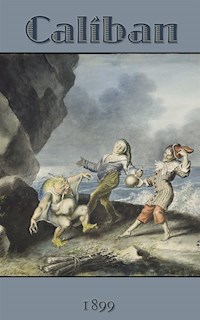
On the cover: Caliban, Stephan and Trinculo dancing.
Modern Edition © 2021 Full Well Ventures
Created with Vellum
CALIBAN
Your great poet is eminently sane. Not that this is the conception current concerning him, the reverse being the common idea: that a poet is a being afflicted with some strange and unclassified rabies. He is supposed to be possessed like the Norwegian berserker, whose frenzy amounted to volcanic tumult. The genesis of misconceptions, however, is worth one’s while to study; for in a majority of cases there is in the misconception a sufficient flavoring of truth to make the erroneous notion pass as true. At bottom, the human soul loves truth, nor willingly believes or receives a lie. Our intellectual sin is synecdoche, the putting a part truth for a whole truth. Generalization is dangerous intellectual exercise. Our premise is insufficient and our conclusion is self-sufficient, like some strutting scion of a decayed house. Trace the origin of this idea of a poet’s non-sanity. He was not ordinary, as other men, but was extraordinary, and as such belonged to the upper rather than the lower world; for we must be convinced how wholly the ancients kept the super-earthy in mind in their logical processes, an attitude wise and in consonance with the wisest of this world’s thinking. Heaven must not be left out of our computations, just as the sun must not be omitted in writing the history of a rose or a spike of goldenrod. In harmony with this exalted origin of the poet went the notion that he was under an afflatus. A breath from behind the world blew in his face; nay, more, a breath from behind the world blew noble ideas into his soul and he spake as one inspired of the gods. This conception of a poet is high and worthy; nothing gross grimes it with common dust. Yet from so noble a thought, because the thought was partial, grew the gross misconception of the poet as beyond law, as not amenable to social and moral customs, as one who might transgress the moral code with impunity and stand unreproved, even blameless. He was thought to be his own law; a man whose course should no more be reproved or hindered than the winds. The poet’s supremacy brought us to a wrong conclusion. The philosopher we assumed to be balanced, the poet to be unbalanced. Shelley, and Poe, and Hine, and Byron, and Burns elucidate this erroneous hypothesis of the poet. We pass lightly their misrule of themselves with a tacit assumption of their genius having shaken and shocked their moral faculties as in some giant perturbation.




