


Erhalten Sie Zugang zu diesem und mehr als 300000 Büchern ab EUR 5,99 monatlich.
- Herausgeber: Diëresis
- Kategorie: Lebensstil
- Serie: Intelligent Travel Guides
- Sprache: Englisch
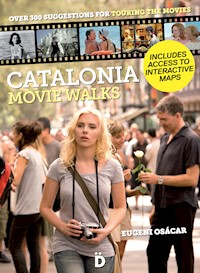
300 Catalonia movie locations to visit. Enjoy a star-struck holiday in Catalonia in the footsteps of Ava Gardner, Elizabeth Taylor, Orson Welles, Robert de Niro, Woody Allen, Scarlett Johansson, Robert Pattinson and many more. Make your visit to Catalonia a film-star experience: Catalonia´s famous beaches have been attracting film makers ever since the Golden Age of Hollywood. Visit the idyllic locations used for such mythical films as Pandora and the Flying Dutchman, Suddenly Last Summer or Falstaff - Chimes at Midnight. You can also take a walk with the stars of the 21st century. Catalonia´s spectacular cultural heritage and vast natural diversity have made it one of the best places in the world to combine holidays and cinema. Discover the locations for great movies like Vicky Cristina Barcelona, Perfume or films by Pedro Almodóvar. Your holidays in Catalonia are about to begin - lights, camera, action!
Sie lesen das E-Book in den Legimi-Apps auf:
Seitenzahl: 320
Veröffentlichungsjahr: 2014
Das E-Book (TTS) können Sie hören im Abo „Legimi Premium” in Legimi-Apps auf:
Ähnliche
















EUGENI OSÁCAR
Barcelona, 1963. Professor at the CETT-University of Barcelona Hospitality and Tourism School, director of research and director of the Official University Master’s Degree in Innovation in Tourism Management.
An expert in marketing, heritage and cultural tourism, in recent years he has specialised in tourism and cinema. He has headed several projects about film tourism, including Barcelona Movie (2008), the first initiative in Barcelona for cultural tourism based on films, and Horta-Guinardó de Cinema (2013), an innovative project that has made this district of Barcelona the first to include cinema in its promotional plan for culture and tourism.
He has published a number of film tourism guides to cities such as Barcelona, Paris, Rome and Venice for smartphone and tablet. In 2013 he published the book Barcelona Movie Walks, available in English, Spanish and Catalan. It is the first guide to Barcelona to focus on the cinema.
HOW TO USE THIS GUIDE
In the e-book edition of Catalonia Movie Walks you can find 9 chapters with one or more routes in each focused on the parts of Catalonia that have been immortalized by filmmakers. Each route is a description in the form of a walking tour around hundreds of selected spots in the whole of Catalonia.
Every chapter begins with a presentation: you will find detailed and interesting information about films of a certain genre shot in Catalonia, or about a specific director or film. You can find more information about the shoots and then re-live stories on the routes.
The second half of the chapter offers one or more theme-based routes that can be enjoyed as tourist excursions, locating all the cities, towns and spots related to the films. All the places we suggest you visit are marked in bold.
We have created a great interactive tool for you to use on the routes when visiting Catalonia: at the end of each route description you will find a QR code that can be scanned with a smartphone to open a Google map of the area. On these maps you can see different stages of the route are shown and all the places are named. All you have to do is scan the QR codes and each route will be displayed on your screen on a web page. These web maps offer exclusive content for e-book readers. We recommend you use an updated browser to watch them.
This new feature offers a really useful way to follow our Catalonia movie walks: transfer each route directly from your e-book to your smartphone.
Additionally, at the end of the e-book you will find two interactive indexes: the first includes all the films that appear in Catalonia Movie Walks and the second contains all the towns, cities and other locations mentioned. Through these interactive indexes you can easily find with a single click where in the e-book each place is mentioned. Almost 500 references will enhance your reading experience! We hope you will enjoy them as well as the whole e-book.
Are you ready? Catalonia is on the big screen – lights, camera, action!
The Golden Age of the Big Productions
In 1908 Ferran Agulló, a writer and journalist from Girona first gave the Girona coastline the name the Costa Brava. Specifically, it was on 12 September when the newspaper La Veu de Catalunya (The Voice of Catalonia) published “On the costa brava”, an article which was considered a baptism of the Girona shoreline that starts at the rock of Sa Palomera, in Blanes, and ends at Portbou on the French border.
The strategic geographical location of the Costa Brava on the Iberian Peninsula has blessed it with a pleasant climate and some spectacular and unique scenery. Added to this, its human and artistic wealth have given it an identity and individuality that have made the area one of the top tourist destinations in the world.
Although tourism as we understand it today didn’t reach Spain until the end of the 1960s, the Costa Brava had built up a certain reputation decades earlier with the construction of some superb summer residences that saw the arrival of the first high class visitors. During the 1920s and 30s these practically virgin landscapes became home to the Woevodskys, a couple popularly known as “The Russians”, who built Cap Roig Castle and gardens. Two years later in 1929, Lord Islington, who was governor of New Zealand and Kenya, built La Musclera, near Tamariu. There were also major residences belonging to Catalan families, such as the Ensesa family with their grand garden city in S’Agaró, and painter Josep Maria Sert, who built Mas Juny on El Castell beach. All of these contributed significantly to making the Costa Brava a peaceful and pleasant refuge for people from the business world, European aristocracy and artists of all kinds to relax and have fun. At the same time, the first hotels were being opened: by the Trias family in Palamós, the Johnstones in Tossa de Mar and the Ensesa family, founders of the Hostal La Gavina in S’Agaró. All three are good examples of great pioneers of the Costa Brava.
But it was arguably the cinema, and the American productions in particular, which put the Costa Brava on the map once and for all. The first big shoot, in 1950, was Pandora and the Flying Dutchman, and even today the arrival of film legend Ava Gardner remains one of the most memorable moments in more than one hundred years of history of the Costa Brava.
Before looking in detail at this first major production, it is interesting to remember just why producers were keen to film in Europe from the 1940s onwards, first in England, then in Italy and finally in Spain. When World War II ended, the financial difficulties of most countries in Europe forced them to block profits from American companies. By making it illegal to convert European currencies into dollars, Hollywood producers believed they could get back their earnings by reinvesting in film production in Europe. So once the films had been released, the investments could be sent back to the United States in the form of films. This is how films made outside the USA earned the nickname “runaway productions”. Pandora and the Flying Dutchman was the first film of its kind in Spain. But why did they choose the Costa Brava?
Let’s look at it step by step: Albert Lewin, an associate producer at Metro and director of several films, asked for leave to be able to work on Pandora and the Flying Dutchman, his most personal project up to that time. His own production company, Dorkay, along with the British company, Romulus, would be in charge of shooting although perhaps the most significant factor for getting the project off the ground was the involvement of Metro as the international distributor, and above all the fact that it was willing to offer a star as huge as Ava Gardner. Once the financing was settled, the participation of great names and a solid story penned by Lewin himself, all that was left was to decide where to make the film. They were looking for somewhere in the Mediterranean, but preferably in Italy or Greece, the idea being a beach location with some some kind of archaeological site site. This plan changed when the film director met a friend of his, Catalan businessman Alberto Puig Palau, in London, to talk about the project.
“Do you know the Costa Brava?” Palau asked him. “Where’s that?” answered Lewin. After showing him some photographs of the El Castell beach in Palamós, Palau convinced Lewin to spend a few days at Mas Castell, his house on the very same beach. While walking in that unique spot, between the pine trees and the sea, complete with an Iberian settlement on the hill above, Lewin was dazzled by the beauty of the place. On 25 March 1950, a few months after the meeting in London, the film crew, under the direction of Lewin, arrived at Tossa de Mar to start shooting what would mark a historic point in the film history of the Costa Brava. The decisive part that Puig Palau played was surely not coincidental. Besides being a successful businessman he was also a patron of the arts and a flamenco and gypsy enthusiast. He was the driving force behind the artistic career of the famous flamenco dancer La Chunga, and he set up the first tablao on the Costa Brava in Palamós, called La Pañoleta. He was also patron to Catalan singer Joan Manuel Serrat, who showed his gratitude in the song he dedicated to him, Tío Alberto (Uncle Alberto). He also helped produce several films and was deeply involved in the making of Pandora and the Flying Dutchman: once shooting on the Costa Brava was finished and when all the crew was back in London filming the interior sequences at the Shepperton studios, they realised that they didn’t have a scene with a flamenco dance. The only thing to do was to shoot it right there in London. When Puig Palau found out, he was horrified, and believing it wouldn’t be done well otherwise, had his gypsy friends flown to London by plane. And, naturally, he footed the bill!
In 1950 the affair between Ava Gardner and Catalan bullfighter Mario Cabré turned the making of this film into a quite an event.
Editorial Diëresis
In spite of the iconic presence of Ava Gardner and James Mason, this free adaption of the Greek myth of Pandora and the legend of the ghost ship was not a box office success. It was considered too intellectual, and it was not recognised for its true cinematographic worth until the 1960s, especially by French critics. It did, however, manage to generate a lot of noise in the media, both in Spain and abroad. The rumours of an alleged affair between Ava Gardner, at the height of her beauty, and the Catalan toreador and poet Mario Cabré, who had a supporting role as a bullfighter in the film, provoked an immediate reaction from Frank Sinatra, who was married to Gardner at the time. In fact, the news was spread internationally by Cecilia Ager, one of the most feared reporters and critics of the time. She went to Tossa to cover the filming as columnist for the magazine Variety, and she also published an article under the particularly eloquent headline, ˝The Star and the Romantic Matador˝. Ava saw herself forced to call Frank Sinatra to tell him that it had all been made up, an explanation that failed to convince him, as he had also seen photos of the two together that the magazine had published. He cancelled his shows in New York and on 11 May, after a brief stopover in London, arrived in Barcelona accompanied by his friend and composer Jimmy Van Heusen. It is not hard to imagine that the arrival of Sinatra eclipsed the film shoot. Despite proof of the real reason for the visit, in an improvised press conference at the El Prat airport Sinatra stated that he had come to rest and get his strength back after a throat infection, and that he had chosen — what a coincidence — the Costa Brava! A lot of stories circulated about the days that the tumultuous couple spent together: rows, reconciliations, gift-giving and so on. Once he got back to New York on 28 May Frank Sinatra repeated the same version to the journalists there as to his reasons for going to Barcelona, and denied giving Ava necklace worth $10,000. We will never know the truth of the story for sure, but the fact is that the Costa Brava was witness to the noisy row and subsequent reconciliation of two Hollywood legends, with a Catalan bullfighter as an unexpected guest!
S'Agaró was chosen by Orson Welles for the setting of the adventures of the enigmatic Mr. Arkadin.
Mercury / Cervantes Films / Filmorsa / Album
It was not long before a second international production with a famous cast followed. In the spring of 1952 filming began for Decameron Nights, A Spanish-British co-production starring Frenchman Louis Jourdan and the already revered British-American star, Joan Fontaine.
Winner of the Oscar for Best Actress in 1942 for Suspicion, directed by Alfred Hitchcock, Fontaine had made her name internationally with Rebecca (1940), Hitchcock’s first film in the United States for which he had received his first Oscar nomination. Although a decade had passed since her tour de force, Joan Fontaine still kept her aura of a Hollywood great. So this particular comedy version of Boccaccio’s Decameron enabled one of the cinema’s iconic blondes to film for the first and last time in Spain. As well as Granada, Segovia and Sitges, the town of Blanes was chosen for one of the settings. It is interesting to note that among the cast was the British actress, Joan Collins, who would later become a household name for her role in the TV series Dynasty.
After the enjoying the presence of three Hollywood giants of the grandeur of Ava Gardner, James Mason and Joan Fontaine, the Costa Brava would once again be witness to the presence of another undisputable genius — Orson Welles. During the first half of 1954, the creator of Citizen Kane chose to shoot in different parts of Spain for his film Mr. Arkadin, a curious half-thriller half-psychological drama. Welles wrote, directed and acted in the film, making it one of the most personal and misunderstood films in his long and erratic film career. The film tells the story of the quest for the truth about Arkadin, one of the most mysterious and disturbing characters created by this extraordinary director. It is a muddled story, related in a fascinating and visually powerful way. For various reasons, one of them being disagreements with the producer, there are in fact at least five versions of the film: a Spanish one, with the participation of actresses Amparo Rivelles and Irene López de Heredia, one French, one German and two English versions; one for the United States and another international one under the name of Confidential Report. Despite the deleted shots and the changes of actresses, in all the versions we can see S’Agaró, one of the main settings for this enigmatic story.
In 1956 the powerful British production company, Rank Organisation, believed the Costa Brava would be the right place to shoot The Spanish Gardener. The drama was directed by Philip Leacock and featured a young Dirk Bogarde in the role of the gardener. The charismatic and attractive British actor, who achieved international fame with Death in Venice (1971), went largely unnoticed by onlookers during the film shoot, made entirely in the Girona region. As the plot included apparent homosexual tendencies, it was never released in Spain, and is still largely unknown here today.
In The Light at the Edge of the World, the pirates led by Yul Brynner take over the lighthouse, built specially for the film.
Bryna Production / National General / Album
A few months after the shooting of The Spanish Gardener, several towns on the Costa Brava were chosen as settings by English director Michael Anderson for Chase a Crooked Shadow, a suspense movie which, according to the film’s advertising campaign, was a film “Hitchcock would have liked to make”. The cast was led by American actress Anne Baxter, who had won an Oscar in 1947 for her supporting role in The Razor’s Edge. In Spain she had become famous through her recent successes like All About Eve and I Confess. The great American actress played alongside Irish actor Richard Todd, nominated for an Academy Award for Best Actor in 1949 and British actor Herbert Lom, who would later become known for his role as Inspector Dreyfus in the Pink Panther series. To top it all, the film was produced by Douglas Fairbanks Jr., the then retired actor and son of the giant legend of the silent screen.
Much of the film Suddenly Last Summer (1959) was shot in the seaside town of Begur.
Columbia Pictures / Album
In 1958, L’Estartit joined the list of towns on the Costa Brava to play host to international film shoots. The British production Sea Fury, about an oil tanker run aground on the Cantabrian coast starred veteran actor Victor McLaglen. He was 75 years old when he came to film in Catalonia and, in spite of being in the twilight of his career, he was still remembered for his roles in some of John Ford’s memorable westerns such as The Informer. Made in 1935, it would bring Ford the first of his four Oscars for Best Director and Best Actor for McLaglen. Unfortunately, Sea Fury was never released in Spain.
It is no mean feat for films to be well-known for their visual effects technician, but this is what American Ray Harryhausen achieved (he died in May 2013). At the end of the 1950s and throughout the 60s he became interested in Eastern mythological fantasy cinema and several of these productions were made in Spain, specifically on the beach of Sa Conca in S’Agaró. Films like The 7th Voyage of Sinbad, The Three Worlds of Gulliver and Mysterious Island, are fine examples of a genre that had tremendous international appeal, especially among younger film-goers.
However, the next great movie event came along with the shooting of Suddenly, Last Summer. It was a film that had all the ingredients for success: produced by Sam Spiegel, who had already won two Oscars for Best Film and who would go on to win another for Lawrence of Arabia (1962), directed by Joseph L. Mankiewicz, the most ingenious Hollywood director at the time The story was based on a play by the great Tennessee Williams, who was at the height of his fame and finally, a script co-written by Williams himself and revered American intellectual, Gore Vidal. Evidence of William’s prestige as a playwright at that time is that he asked for the then astronomical sum of $50,000 for the script plus 20% of the profits. Spiegel accepted without hesitation. To round off the group, the starring roles would feature three of the top Hollywood stars, Elizabeth Taylor, Montgomery Clift and Katherine Hepburn.
The film tells a disturbing tale based on themes which were controversial at the time — some of them still are today — such as incest, homosexuality, male prostitution and cannibalism. Notwithstanding the problems of American censorship and the fact that it was ahead of its time, it enjoyed considerable box office success. Many of the outdoor scenes were filmed in 1959 on different beaches of the Costa Brava and in the town of Begur, representing an undefined place somewhere in Spain. Of the three stars, only Elizabeth Taylor, playing Catherine Holly, came to Spain to film what would be one of the best performances of her career.
After fifty spectacular years the 1960s gave way to low budget and experimental Spanish productions. It seems, and to some extent it was true, that the Costa Brava’s heyday as a natural setting was over. Nevertheless, in the 1960s the Costa Brava would still be home to a few interesting films and the great stars would once again travel to its shores.
In 1970, Cap de Creus, today a natural park, was the setting for the filming of The Light at the Edge of the World. It was an adaption of the novel by Jules Verne, directed by Kevin Billington and starring Kirk Douglas, one of the greatest American actors of all times, famous for epic films such as Spartacus (1960), and Yul Brynner, winner of the Oscar for Best Actor in 1951 for The King and I. A US-Spanish co-production, it also featured Spanish actor Fernando Rey, internationally renowned for his character performances. Despite the ambition of the project (which included three months of filming in Catalonia) and the international distribution by Metro-Goldwyn-Mayer, the film failed to live up to expectations.
About a year later, in the spring of 1971, S’Agaró and Sant Feliu de Guíxols were once again the setting for an international super production. Producer Sam Spiegel and Columbia Pictures decided once again that Spain, and specifically the Costa Brava, would provide the star locations for Nicholas and Alexandra. The film was directed by Franklin J. Schaffner, who was still celebrating after his recent success with Patton, winner of seven Oscars, including Best Film and Best Director. It starred top-class actors, albeit in supporting roles, such as Lawrence Olivier and Michael Redgrave. The film relates the life of the last Russian monarchs, Tsar Nicholas II and his wife, Alexandra, who would see the end to 300 years of the Romanov dynasty. Among the many awards it received was the Oscar for Best Artistic Direction for the team which included Spaniard Gil Parrondo, who had already won his first Oscar for Patton.
Although they lacked the glitz and glitter of previous eras, the last years of the 1960s still brought several big films to the Costa Brava, which would practically mark the end of the love story between the big stars and the Catalan coast. In 1977, British film director Ken Russell made Valentino, a biography about the legendary Hollywood star and idol of the silent cinema. Surprisingly enough, the role fell to Rudolf Nureyev, the great Russian ballet dancer, who had no acting experience. In the same year Calella de Palafrugell fell victim to the visit of the unstable Maria Schneider, famous for Last Tango in Paris (1972). She was acting in Io Sono Mia, which turned out to be a total flop: Ms Schneider’s presence is remembered more for the pages it filled in the gossip magazines and tabloids than for her thespian talent. Another film shoot in 1977, again in Calella de Palafrugell, was Roads to the South, a Spanish-French co-production, directed by American Joseph Losey, better known in Europe than in his own country. The script was written by Jorge Semprún and it featured the great French star, Yves Montand and fellow French actress Miou-Miou.
Kirk Douglas waving the day he arrived at Barcellona Airport on 20 August 1970. He came to shoot The Light at the Edge of the World accompanied by one of his sons. The actor headed for Cadaqués right away, where the film crew was waiting.
Pérez de Rozas / PHOTOGRAPHIC ARCHIVE OF BARCELONA
We end our review of the stars who have visited the Costa Brava with Mexican actor, Anthony Quinn. Having already won two Oscars for Best Actor, Quinn came in 1988 to make A Man of Passion, a film directed by José Antonio de la Loma. The studio of painter Modest Cuixart in Palafrugell was used as the setting for the story about an ageing artist, played by the international film legend.
Ava Gardner and Frank Sinatra in Tossa de Mar with their friends Frank and Doreen Grant. Composer Jimmy van Heusen shows Ava how to use the camera.
Editorial Diëresis
ROUTE
The wild and unspoilt Costa Brava, a far cry from what we can see today was, for some time, especially in the 1950s, an ideal setting for many American productions who found in this hitherto unknown scenery a privileged natural landscape where they could make all kinds of films that were set in symbolic, imaginary places and, up to a point, a lost paradise. With some exceptions, most foreign directors and producers turned the Costa Brava into idyllic Mexican shores, tropical islands, inhospitable places depicting the end of the world, a fishing village on the Bay of Biscay, and even an imaginary and legendary place called Esperanza.
In spite of the obvious transformations that have taken place over the last fifty years, this route along the Costa Brava in the footsteps of the Hollywood stars allows us to remember and relive the great moments of these small fishing villages that were beginning to witness the dawn of tourism. A keen eye can also discover hidden corners and villages that today offer an admirable physical and especially human landscape that is certainly worthy of a movie walk.
We set off on our route in Blanes, on the beach of Sant Francesc, also known as Cala Bona. It is a ten-minute drive from the town centre, towards Lloret de Mar, along a relatively quiet stretch of coast with crystalline waters and surrounded by pine trees. At the beginning of the 1950s the beauty of the landscape and the undisturbed calm of this area were key factors for the producers of Decameron Nights to shoot the scenes where the beach would represent an island occupied by pirates. They even brought galleons from the port of Barcelona, and professional wrestlers were hired to make the action scenes seem more realistic.
From Lloret de Mar, a twenty-minute drive takes us to Tossa de Mar. The town, which the Russian artist Marc Chagall called the “lost paradise” when he spent the summer there in 1934, has been host to painters, writers and people from the world of film. But in 1950 it was the arrival of Ava Gardner, “the most beautiful woman in the world”, as she was known at the time, that would shake up this small fishing village. She was 28 years old when she came to film Pandora and the Flying Dutchman, and the locals welcomed the novelty of the first Hollywood film to be made in their town with surprise and admiration, and with Hollywood stars to boot! The film crew installed themselves towards the end of March with director Albert Lewin at the head of the project. On 20 April, after arriving at Barcelona the night before, Ava Gardner discovered Tossa. In her memoirs she writes that the first contact with the village, at night, with its narrow, unpaved streets, shrouded in a deep silence, seemed intensely unreal. At first she stayed in the Hotel Àncora (on the Passeig del Mar and which no longer exists), where most of the production team were also staying. Some days later she moved to a house near the Codolar viewpoint, where James Mason was also staying with his wife, Pamela Kellino, who had a small role as Jenny.
The Gran, Mar Menuda and Codolar beaches, the walled Vila Vella (Old Town), with its Torre de l’Homenatge and the Church of Sant Vicenç, were the main settings for the fictitious village of Esperanza, located on the Spanish Mediterranean coast, as we are told at the very beginning of the film. For this reason a jetty and a tavern named Les Dues Tortugues were built on Gran beach, the latter a homage by the director to himself for his previous film, The Picture of Dorian Gray, which features an inn of the same name. From the outset, the locals threw themselves into the filming, working as extras and hands. In fact in the first sequence you can see a group of fishermen and their boat, fishing and speaking Catalan, something highly unusual both for the time and for a Hollywood film. The five fishermen were from the village and the boat belonged to one of them, Pere Alsina. He was paid 50 pesetas (about 30 cents of a euro) a day for hiring the boat and 75 pesetas (45 cents) as an extra, a very respectable amount for the time. At the end of the shoot all the participants, extras included were invited to a lunch in the restaurant Can Biel, on the Passeig del Mar, which today is known as La Fragata.
A good way to end our visit to Tossa is to go up to the highest part of the Vila Vella, where we find a small square, (which is also a viewpoint) with a striking life-size bronze statue of Ava Gardner, by the Girona artist Ció Abellí. From this stunning spot it is not hard to imagine the American actress, sensual and beautiful, looking out at the horizon and enjoying one the most spectacular views of the Costa Brava.
Although it is just a few kilometres from Tossa de Mar to Sant Feliu de Guíxols, the winding road with its 365 bends, one for every day of the year, means that most people choose to take the inland road. If time is no object, it is worth taking the coastal route to enjoy scenery seldom found on the Costa Brava today. Cork oaks and mountains that dip down to the sea, with small coves where you can enjoy almost total solitude, are our companions on this half-forgotten stretch of coast. Do not, however, try to imitate Ward Prescott, played by Richard Todd in Chase a Crooked Shadow, who in an attempt to show off his driving skills, completes the six kilometres in three minutes. The feat ends with a fabulous shot of Todd and Anne Baxter, sitting in the sports car, with the bay of Tossa de Mar in the background.
Before reaching the town, it is a good idea to turn off towards a headland next to the sea, where we come to the Chapel of Sant Elm, which has a viewpoint. This privileged spot, from where we can see the coastline from Tossa to Palamós, was used in Pandora and the Flying Dutchman to shoot a scene with Ava Gardner and the British actor Nigel Patrick. And it is also here that a monolith was erected in homage to Ferran Agulló, as it is believed it was at Sant Elm that he got the inspiration for the name the Costa Brava. Whether that is true or not, it is a great homage to this distinguished son of Sant Feliu de Guixols.
Frank Sinatra, centre, arrives in Tossa, prompted by rumours of an affair between Ava Gardner and toreador Mario Cabré.
Editorial Diëresis
The sensual scene of Elizabeth Taylor in swimsuit in Suddenly Last Summer was filmed on the beach of Sant Pol, Sant Feliu de Guíxols.
Columbia Pictures / Album
Many directors of the time were mesmerised by the splendid bay and the Italian-style Passeig de Mar which, together with Sant Feliu de Guíxols’s rich artistic heritage, form a visually very aesthetic picture. Several scenes, for instance, for the controversial drama The Spanish Gardener (never released in Spain), starring Dirk Bogarde, were shot using exteriors of the town, such as the majestic gate in the wall, known today as the Arch of Sant Benet, or the magnificent Passeig de Mar, with its stately houses. One of these is the Casa Ribot, located at 19-20, which we can admire in the film. We can also see the expansive beach of Sant Pol, which in 1959 witnessed the presence of one of the great film legends, Elizabeth Taylor, star of Suddenly Last Summer. In a scene which the local inhabitants remember well, as some of them were hired in as extras, Liz Taylor is used as bait by her cousin Sebastian, who drags her into the sea so that her swimsuit gets wet and shows off her curves, to the delight of the young male onlookers. It seems that Mankiewicz tried out the scene in two different ways: once with a normal swimsuit and once with a transparent one. Logically, censorship or common sense prevailed so that the first version is the one that made the final cut. Later on, in 1977, during the filming of Valentino, the same beach and promenade would become the beach of Santa Monica (California) in the 1920s. Finally, a curious detail is that the well-known restaurant La Taverna del Mar, on the beach of Sant Pol and which Orson Welles featured in Mr. Arkadin, had to close its doors in October 2013 (hopefully only temporarily) due to a court case between the owners and tenants.
A short walk along the beach of Sant Pol takes us to S’Agaró (Castell-Platja d’Aro), a name associated with the Ensesa family. During the 1920s Josep Ensesa i Pujades and his son, Josep, together with the architect Rafael Masó, built the first and probably only garden city in the Catalan Noucentista style in this part of the Costa Brava. It is a model of urban planning by the sea, with high-class detached houses which made S’Agaró, and the Costa Brava with it, a budding tourist destination for the wealthy. In 1932, to complement the residential development, the Ensesa family opened the Hostal La Gavina, a luxury hotel also designed by Masó, which is still today one of the top hotels of the Costa Brava. The hotel dazzled most of the film stars who came here in the fifties to shoot in the Girona area. Among the many celebrities who stayed here were Ava Gardner, who came for the first time during the making of Pandora and the Flying Dutchman, Orson Welles, who even used its luxurious interiors in several scenes of Mr. Arkadin, and Elizabeth Taylor, who starred in a scene typical of a great star during the filming of Suddenly Last Summer: she had the bright idea to lie on the silk and silver bedspread in the Royal Suite while she was wet! Sean Connery, John Wayne and Robert de Niro are a few other star names who have also stayed here.
The best way to continue our walk along this unique part of the Costa Brava is by taking the coastal path that leads from the beach of Sant Pol to Sa Conca beach. This path, next to the sea surrounded by rocks and pines, will lead us to the Senya Blanca, the house built by the Ensesa family in the 1920s. Its elegant Brunellescian-style loggia, with arcades and pillars, in the same style as the Hostal La Gavina, was the setting chosen by Orson Welles as the meeting place for the characters of Arkadin and Van Stratten, supposedly a secluded Mexican beach. Its magnificent gardens combined, once again, with the salons of the Hostal La Gavina, became the residence of the Russian tsar and tsarina in Livadiya, on what is today the controversial peninsula of Crimea, in Nicholas and Alexandra. Very close by is the Church of Nostra Senyora de l’Esperança, a tiny marvel that did not go unnoticed by the film crew of Valentino, who used it, appropriately transformed, as the façade of the residence of the legendary producer of the time, Jesse Lasky.
At the end of the coastal path we come to the beach of Sa Conca, a cove sheltered from the north wind, with very few buildings overlooking it. The transparent sea, pine trees and rocks seduced many a production company into choosing this breathtaking location for their films, three of which, The 7th Voyage of Sinbad, The 3 Worlds of Gulliver and Mysterious Island, found the perfect setting here to recount their adventures. It was also used to recreate a beach in the Crimea in Nicholas and Alexandra.
Our next point of interest is Palamós, a town with over seven hundred years of history and home to one of the legendary hotels on the Costa Brava, the Hotel Trias. Opened at the beginning of the 20th century, it is one of the oldest on the Girona coast. Located on the Passeig del Mar and managed by the Trias-Colomer family up until recently, it has been host to many great artists and writers. Some of the suites are even named after the famous names who stayed there, such as Ava Gardner, David Niven and the brilliant and controversial author Truman Capote. For three summers, from 1960 to 1962, Capote lived in virtual anonymity in several houses in Sant Antoni de Calonge and Palamós. His first lodgings though were in the Hotel Trias: he made a dramatic entrance, as if he was on the film set, in the middle of the afternoon on 26 April 1960. Capote got out of a Chevrolet and went up to the reception desk with his lover Jack Dunphy, along with his old bulldog, a blind poodle, a Siamese cat and twenty-five suitcases! In fact it was during the summers spent on the Costa Brava that Capote wrote most of In Cold Blood, his masterpiece.
The Passeig del Mar takes us to the historic centre of Palamós, on a peninsula jutting out to into the sea. In Chase a Crooked Shadow, we see Anne Baxter driving a luxurious Bentley convertible through the town centre’s narrow streets. After leaving Carrer Major and turning into what is today Avinguda Onze de Setembre, she stops in front of a small alleyway with steps either side to make the slope more manageable, and goes into a building where a police detective is waiting for her, played by Herbert Lom. The former Modernista-style house, Casa Roger Ribera, which was pulled down in 1974 despite an intense battle to save it, is the headquarters of the Civil Guard. In another part of the sequence we see Anne Baxter coming out of the building and going down the steps of the alleyway. This is Carrer Canó, which owes its present name to the cannon that was moved here in 1962 – and so did not feature in the film – and was the source of inspiration for the sea shanty El Canó de Palamós (The Palamós Cannon). At the end of the 1960s, the great sea shanty composer, José Luis Ortega Monasterio, author of such well-known pieces as El Meu Avi (My Grandfather), composed El Canó de Palamós, a sailor’s waltz dedicated to peace and not war. In 1984 a plaque was placed in commemoration of the musical piece. The previously mentioned sequence ends with a general shot from the balcony of the Casa Ribera, from which you can see the fishing port with its large warehouse known as the Edifici del Tinglado, nowadays the Museu de la Pesca (Fishing Museum).
Rudolf Nureyev (centre), as the legendary Rudolph Valentino. Sant Pol beach represented Santa Monica in California.
United Artists / Album
A glamorous sequence in Chase a Crooked Shadow was filmed in what is today Carrer Canó in Palamós.
Editorial Diëresis
El Castell beach, to the north, is one of the last unspoilt parts of the Costa Brava. It is unusual to see a beach with no buildings to spoil it. However, beyond the Iberian settlement at the top we can just make out a couple of houses hidden among the trees and vegetation. These are Mas Juny and Mas Castell




