


80,99 €
Mehr erfahren.
- Herausgeber: John Wiley & Sons
- Kategorie: Fachliteratur
- Serie: Clinical Cases
- Sprache: Englisch
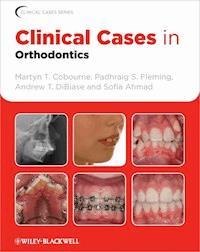
Wiley-Blackwell's Clinical Cases series is designed to recognize the centrality of clinical cases to the profession by providing actual cases with an academic backbone. Clinical Cases in Orthodontics applies both theory and practice to real-life orthodontic cases in a clinically relevant format. This unique approach supports the new trend in case-based and problem-based learning, thoroughly covering topics ranging from Class I malocclusions to orthognathic surgery. Highly illustrated in full color, Clinical Cases in Orthodontics' format fosters independent learning and prepares the reader for case-based examinations.
Sie lesen das E-Book in den Legimi-Apps auf:
Seitenzahl: 584
Veröffentlichungsjahr: 2012
Ähnliche



















Table of Contents
Cover
Title page
Copyright page
Acknowledgements
Preface
1 Clinical and Cephalometric Analysis
Introduction
Dental History
Family History
Medical History
Clinical Examination
Radiographic Analysis
Summary
Summary
Summary
2 The Developing Dentition
Introduction
Case 2.1
Case 2.2
Summary
Treatment Plan
Case 2.3
Summary
Treatment Plan
Case 2.4
Other local problems
Case 2.5
Case 2.6
Case 2.7
What is selective tooth agenesis?
Case 2.8
Treatment Plan
Case 2.9
Case 2.10
Case 2.11
Case 2.12
Case 2.13
Case 2.14
Case 2.15
Case 2.16
Case 2.17
Case 2.18
Case 2.19
3 Class I Malocclusion
Introduction
Case 3.1
Summary
Treatment Plan
Treatment Progress
Case 3.2
Summary
Treatment Plan
Case 3.3
Radiographic Findings
Summary
Treatment Plan
Case 3.4
Summary
Treatment Plan
Case 3.5
Summary
Treatment Plan
Case 3.6
Radiographic Findings
Summary
Case 3.7
Summary
Case 3.8
Case 3.9
Case 3.10
Summary
Treatment Plan
Case 3.11
Case 3.12
Summary
Treatment Plan
4 Class II Division 1 Malocclusion
Introduction
Case 4.1
Summary
Treatment Plan
Case 4.2
Summary
Treatment Plan
Case 4.3
Summary
Treatment Plan
Case 4.4
Summary
Treatment Plan
Case 4.5
Summary
Treatment Plan
Case 4.6
Summary
Treatment Plan
Case 4.7
Summary
Treatment Plan
Case 4.8
Case 4.9
Case 4.10
Summary
Case 4.11
Summary
Case 4.12
Summary
Case 4.13
Summary
Case 4.14
Case 4.15
Case 4.16
Case 4.17
Case 4.18
5 Class II Division 2 Malocclusion
Introduction
Case 5.1
Summary
Treatment Plan
Case 5.2
Summary
Treatment Plan
Case 5.3
Summary
Treatment Plan
Case 5.4
Summary
Treatment Plan
Case 5.5
Summary
Case 5.6
6 Class III Malocclusion
Introduction
Case 6.1
Summary
Treatment Plan
Case 6.2
Summary
Treatment Plan
Comment on the principles and design of protraction headgear
Case 6.3
Summary
Treatment Plan
Case 6.4
Summary
Case 6.5
Summary
Treatment Plan
Case 6.6
Case 6.7
Discuss the aetiology of this patient’s malocclusion
Case 6.8
Case 6.9
Case 6.10
Case 6.11
Case 6.12
Summary
Treatment Plan
Case 6.13
Case 6.14
Case 6.15
Case 6.16
Summary
Treatment Plan
Case 6.17
Treatment Plan
Case 6.18
7 Tooth Impaction
Introduction
Case 7.1
Summary
Treatment Plan
Case 7.2
Summary
Treatment Plan
Case 7.3
Summary
Treatment Plan
Case 7.4
Summary
Treatment Plan
Case 7.5
Treatment Plan
Case 7.6
Treatment Plan
Case 7.7
Summary
Treatment Plan
Case 7.8
Summary
Treatment Plan
Case 7.9
Case 7.10
Case 7.11
8 Fixed Appliances
Introduction
9 Stability and Retention
Introduction
Case 9.1
Treatment Plan
Case 9.2
Summary
Treatment Plan
Case 9.3
Summary
Case 9.4
Summary
Treatment Plan
Case 9.5
Summary
Treatment Plan
Case 9.6
10 Orthognathic Surgery
Introduction
Case 10.1
Summary
Treatment Plan
Case 10.2
Summary
Treatment Plan
Case 10.3
Case 10.4
Case 10.5
Summary
Treatment Plan
Case 10.6
Summary
Treatment Plan
Case 10.7
Summary
Case 10.8
Case 10.9
Summary
Treatment Plan
Case 10.10
Summary
Treatment Plan
Case 10.11
Case 10.12
11 Development of the Craniofacial Region
Embryonic Development of the Face
Tooth Development
Genetics
Facial Clefting
Cleidocranial Dysplasia
Index
This edition first published 2012
© 2012 by Martyn T. Cobourne, Padhraig S. Fleming, Andrew T. DiBiase and Sofia Ahmad
Wiley-Blackwell is an imprint of John Wiley & Sons, formed by the merger of Wiley’s global Scientific, Technical and Medical business with Blackwell Publishing.
Registered office: John Wiley & Sons, Ltd, The Atrium, Southern Gate, Chichester, West Sussex, PO19 8SQ, UK
Editorial offices: 9600 Garsington Road, Oxford, OX4 2DQ, UK
The Atrium, Southern Gate, Chichester, West Sussex, PO19 8SQ, UK
2121 State Avenue, Ames, Iowa 50014-8300, USA
For details of our global editorial offices, for customer services and for information about how to apply for permission to reuse the copyright material in this book please see our website at www.wiley.com/wiley-blackwell.
The right of the author to be identified as the author of this work has been asserted in accordance with the UK Copyright, Designs and Patents Act 1988.
All rights reserved. No part of this publication may be reproduced, stored in a retrieval system, or transmitted, in any form or by any means, electronic, mechanical, photocopying, recording or otherwise, except as permitted by the UK Copyright, Designs and Patents Act 1988, without the prior permission of the publisher.
Designations used by companies to distinguish their products are often claimed as trademarks. All brand names and product names used in this book are trade names, service marks, trademarks or registered trademarks of their respective owners. The publisher is not associated with any product or vendor mentioned in this book. This publication is designed to provide accurate and authoritative information in regard to the subject matter covered. It is sold on the understanding that the publisher is not engaged in rendering professional services. If professional advice or other expert assistance is required, the services of a competent professional should be sought.
Library of Congress Cataloging-in-Publication Data
Clinical cases in orthodontics / Martyn T. Cobourne ... [et al.].
p. ; cm. – (Clinical cases uncovered)
Includes bibliographical references and index.
ISBN 978-1-4051-9779-3 (pbk. : alk. paper)
I. Cobourne, Martyn T. II. Series: Clinical cases uncovered.
[DNLM: 1. Orthodontics, Corrective–methods–Case Reports. 2. Orthodontics, Corrective–methods–Problems and Exercises. 3. Malocclusion–therapy–Case Reports. 4. Malocclusion–therapy–Problems and Exercises. 5. Orthognathic Surgical Procedures–methods–Case Reports. 6. Orthognathic Surgical Procedures–methods–Problems and Exercises. WU 18.2]
617.6'43–dc23
2011048153
A catalogue record for this book is available from the British Library.
Wiley also publishes its books in a variety of electronic formats. Some content that appears in print may not be available in electronic books.
Cover images supplied by the authors
Cover design by Meaden Creative
Acknowledgements
We are indebted to our many colleagues who have also been involved in the treatment of cases presented within this book. In particular, we are grateful to the maxillofacial surgeons who carried out the orthognathic surgery for the combined cases that are shown and the technicians who performed the model surgery and wafer construction. At King’s College Hospital, Christoph Huppa operated on cases 10.3, 10.7, 10.11 and 10.12 and Shaun Matthews on cases 6.18 and 10.8. At East Kent Hospitals, Jeremy McKenzie operated on cases 10.1, 10.6 and 10.9 and Nicholas Goodger on cases 10.2 and 10.10. At Bart’s and the Royal London Hospital, Michael Millwaters operated on case 10.5. At the Queen Victoria Hospital, East Grinstead, Ken Sneddon operated on case 10.4 and Darryl Coombes on case 6.14. MTC is also grateful to Natalie Short and Cristina Nacher for model surgery and wafer construction and both Jerry Kwok and Chris Sproat at Guy’s Hospital, who expertly carried out the necessary oral surgery on a number of cases illustrated here. In addition, the orthodontic treatment for several of the cases was carried out by specialist registrars. At East Kent Hospitals, Omar Yaqoob treated cases 4.5, 5.2 and 5.3 and Saba Qureshi treated case 5.4 under the supervision of ATD. At Guy’s Hospital, Cleopatra Darwish treated case 10.3 and Poh Then treated case 6.18 under the supervision of MTC. Some of the cases shown were treated by SA at the Queen Victoria Hospital, East Grinstead in conjunction with Lindsay Winchester. SA would also like to acknowledge Nadia Alwash for her contribution to the completion of case 6.7, and Aneel Jaisinghani for his contribution to the treatment of case 7.11. Philip Ellisdon kindly provided Figure 8.8 and Archie Cobourne was good enough to allow his uncle to take numerous photographs of his developing dentition (he knows where he is!). We are also grateful to the Journal of Orthodontics and Maney Publications for permitting the re-use of images in cases 4.1 and 7.3 (Fleming PS. BOS MOrth cases prize 2008. Journal of Orthodontics 2010; 37:188–201. http://jorthod.maneyjournals.org).
MTC would like to acknowledge Jackie, Miles and Max; PSF would like to acknowledge Oliver, Sophie, John, Anne and particularly Caroline Fleming; and ATD would like to acknowledge Sarah, Wilf, Arthur and Stanley. Without their collective unwavering help, encouragement and support, this book would not have been possible. SA would also like to acknowledge the Department of Medical Photography at the Queen Victoria Hospital, East Grinstead and her secretary Beverley Cressey for their support. Finally, we would like to thank all of the patients, who generously consented to the use of their clinical photographs within the pages of this book. Without them we would have been unable to illustrate the clinical aspects of orthodontic treatment.
Preface
We think that orthodontics is one of the most interesting and challenging of the dental specialties. Although we might be biased in this assumption, there are some persuasive reasons for believing that it is true. The treatment of malocclusion represents a combination of science and artistic flair, and is often, although not exclusively, carried out on a young and vibrant population. The results of orthodontic treatment and the positive impact that it can have on the patient can also be intensely rewarding for the clinician. Moreover, developments in diagnostic tools, appliance systems and orthodontic materials continue at some considerable pace within the profession, which provides considerable stimulus to the contemporary clinician.
We have written this textbook primarily to be used as a tool for dental professionals who wish to broaden their experience and understanding of clinical orthodontics. The intention has been to show a wide variety of individual cases and clinical scenarios that illustrate many of the problems commonly seen during development of the craniofacial region, with emphasis on the jaws, dentition and occlusion. All of these cases have been treated or directly supervised by the authors, primarily in secondary care, following referral from general practitioners and specialists. We have attempted to illustrate a wide variety of problems that present in the orthodontic clinic, both common and rare, and demonstrate different approaches to their management. Relevant discussion around the etiology, diagnosis and planning of these cases is included in each presentation. We hope that this book will be of particular benefit to postgraduate orthodontic students preparing for their MSc, MClinDent, DDS and Membership examinations in orthodontics. Indeed, a number of the cases included have been successfully used in recent sittings of these examinations. However, the clinical focus underlying this text should mean that it will also be of benefit to other dental professionals involved in management of the developing occlusion, including therapists and undergraduate dental students – who indeed, represent the orthodontists of the future.
It was not our intention to write a definitive textbook on orthodontics, but rather to illustrate contemporary practice using clinical cases and individual examples. Therefore, the introduction to each chapter gives a general overview of the subject area, which is then followed by a series of cases with appropriate questions and answers. We have included the answers to these questions within the cases to avoid the need for constant reference to other parts of the book. Hopefully, this will make it relatively straightforward for the reader to follow the treatment strategies that have been used. In some of the clinical scenarios, more emphasis has been given to clinical examination and diagnosis; whilst in others, questions focus on the treatment that has been carried out. Indeed, many of these cases have been chosen to illustrate specific aspects of etiology, diagnosis, treatment planning or use of mechanics in the management of malocclusion. This problem-based approach of discussing aspects of malocclusion should allow practising clinicians to develop their skills in the management and care of orthodontic patients, from initial assessment, through to the completion of treatment. However, whilst we strive to achieve clinical excellence for the cases that we treat, we did want to illustrate those that had been treated ‘in the real world’ and therefore have not excluded examples where difficulties have been experienced. In addition, some cases have the cephalometric values provided in the diagnostic information, whilst some do not. We believe that cephalometrics should be used to supplement the clinical diagnosis and felt that the reader would benefit from having them provided in some, but not all, of the case records included.
In setting out this book, we have attempted to arrange the chapters into a series that progresses logically, although there can be considerable flexibility in the precise order in which they can be read, particularly those chapters dealing with specific malocclusions. Chapter 1 provides an introduction to clinical examination and diagnosis of the orthodontic patient, including the use of radiographic and cephalometric analysis in treatment planning. This chapter also covers aspects of the patient medical history that can be of relevance to orthodontic treatment. Chapter 2 is concerned with postnatal development of the dentition and has been designed to include individual examples of anomalies that can occur during establishment of the dentition (both common and rare), the use of interceptive treatment and major aspects of tooth agenesis. Chapters 3–6 are organized according to the conventional classification of malocclusion and include the management of class I, class II division 1, class II division 2 and class III cases. Chapter 7 covers problems associated with tooth impaction in the permanent dentition and Chapter 8 focuses on fixed orthodontic appliances, using individual examples to demonstrate issues relating to their use and the application of treatment mechanics. Chapter 9 covers the subject of post-treatment stability and the management of retention, whilst Chapter 10 explores diagnosis and treatment of cases requiring a combined orthodontic and surgical approach to correct significant skeletal discrepancies. Finally, Chapter 11 is concerned with the etiology and management of developmental conditions that can affect the craniofacial region.
Inevitably, amongst all of the cases that have been used, there is some repetition of problems that can occur in relation to malocclusion; however, we hope that this adds rather than subtracts from the quality of the text. Indeed, many different philosophies and approaches exist regarding the management of malocclusion and we hope that many of these have been suitably illustrated. This book does not represent a comprehensive text, but hopefully does cover most aspects of contemporary clinical orthodontics through the documentation of treated cases. We hope that the style and content of the book is stimulating and that you as the reader are broadly in agreement with the treatment decisions that have been made and satisfied with the final results that have been achieved.
Martyn T. CobournePadhraig S. FlemingAndrew T. DiBiaseSofia Ahmad
1
Clinical and Cephalometric Analysis
Introduction
Orthodontics is the area of dentistry concerned with the management of deviations from normal occlusion or malocclusion and involves treatment of children, adolescents and, increasingly, adults. Malocclusion is a variation on normal occlusion and is not a disease entity. Consequently, orthodontic planning and management does not involve binary decisions, but rather evaluation of a range of possibilities to decipher the most appropriate option for each individual.
An ideal static occlusion is characterized by class I molar and incisor relationships, with well-aligned teeth. An acceptable occlusion, however, develops naturally in only 30–40% of the population in Western societies. The occurrence of an acceptable occlusion is multi-factorial, although important factors include the size of the jaws; the relationship of the jaws to each other; the size, number and morphology of the teeth; and the morphology and behaviour of the lips, tongue and peri-oral musculature.
Given that malocclusion does not represent a pathological process but rather a variation from an accepted norm, there is little agreement, even among orthodontists, as to when orthodontic treatment becomes necessary (Richmond et al., 1984). As a consequence, a variety of orthodontic indices have been developed to ration treatment where care is provided as part of a public health service, such as in the UK and Scandinavia (Brook and Shaw, 1989), based primarily on aesthetic and dental health impairment.
The demand for orthodontic treatment has increased universally, particularly over the past two decades. A desire to enhance dental appearance is the underlying motivation for most patients who seek orthodontic treatment (Shaw et al., 1991). Furthermore, the lay public has developed an increasing awareness of the importance of the dentition to overall attractiveness. Carefully planned and well-executed orthodontics can also enhance facial appearance, which in turn has been linked to improved social skills, greater desirability, higher intellectual ability and enhanced occupational prospects (Shaw et al., 1979).
Deviation from occlusal norms may leave children susceptible to harassment, teasing and bullying, with obvious psychosocial implications (Shaw et al., 1980; Seehra et al., 2011). Consequently, orthodontic treatment may have significant psychosocial benefits (Shaw et al., 1980; O’Brien et al., 2003) and can often lead to improved oral health-related quality of life. Similarly, combined orthodontic–surgical treatment has been linked to notable enhancement of both self-esteem and quality of life (Arndt et al., 1986).
The undoubted benefits of orthondontics are, however, reliant on careful diagnosis, planning and management. Clinical assessment and radiographic analysis are central to the formulation of appropriate treatment decisions leading to the best aesthetic and functional outcome from treatment.
As in any other area of medicine or dentistry, to reach a diagnosis in orthodontics requires a thorough history, examination and special tests. A comprehensive history should be undertaken to clarify the motivation for treatment, the dental and orthodontic history, and any relevant medical history that might impact on the provision of orthodontic treatment (Patel et al., 2009).
Dental History
A history of dental attendance is relevant in relation to caries experience and the presence of restorations. Caries experience is the best predictor of future caries. Poor oral hygiene predisposes to two risks of treatment: gingivitis and demineralization. Premature loss of primary teeth due to caries may also have consequence for the developing dentition. In particular, early loss of primary teeth may hasten or retard eruption of permanent teeth and lead to space loss, which can result in centre line discrepancies or potential tooth impaction.
What Has Led to Crowding of the Second Premolars in Figure 1.1?
Early loss of the second primary molars has allowed the first permanent molars to drift forward in the dental arch. The second premolars are most vulnerable to space loss in this region.
Figure 1.1
Restorations
Heavily-restored teeth may pose problems in relation to bonding, necessitating alteration of the bonding protocol, with sandblasting of amalgam and precious metal restorations proven to enhance bond strength (Zachrisson et al., 1995; Büyükyilmaz et al., 1995). There is conflicting evidence in relation to the susceptibility of root canal-treated teeth to root resorption during treatment. Nevertheless, the health of root-treated teeth should be monitored throughout treatment.
Lesen Sie weiter in der vollständigen Ausgabe!
Lesen Sie weiter in der vollständigen Ausgabe!
Lesen Sie weiter in der vollständigen Ausgabe!
Lesen Sie weiter in der vollständigen Ausgabe!
Lesen Sie weiter in der vollständigen Ausgabe!
Lesen Sie weiter in der vollständigen Ausgabe!
Lesen Sie weiter in der vollständigen Ausgabe!
Lesen Sie weiter in der vollständigen Ausgabe!
Lesen Sie weiter in der vollständigen Ausgabe!
Lesen Sie weiter in der vollständigen Ausgabe!
Lesen Sie weiter in der vollständigen Ausgabe!




