


Erhalten Sie Zugang zu diesem und mehr als 300000 Büchern ab EUR 5,99 monatlich.
- Herausgeber: Quintessence Publishing Co, Inc
- Kategorie: Fachliteratur
- Sprache: Englisch
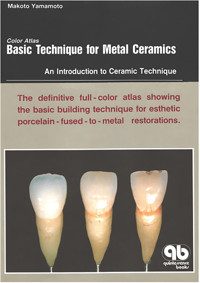
The basic porcelain building technique developed by Mr Makoto Yamamoto, an internationally-known ceramist from Japan, has published his technique in this practical textbook, the latest edition for ceramists to learn esthetic techniques.
Sie lesen das E-Book in den Legimi-Apps auf:
Seitenzahl: 113
Veröffentlichungsjahr: 2024
Das E-Book (TTS) können Sie hören im Abo „Legimi Premium” in Legimi-Apps auf:
Ähnliche



















Makoto Yamamoto
Mr. Makoto Yamamoto was born in 1949 and graduated from Aishi Dental Technician School. After working for a dental laboratory about twenty years, he started his own laboratory, M. YAMAMOTO CERAMIST’S INC. in 1988. His principal publication, METAL-CERAMICS was translated into English, German, and Italian and has been praised as the bible of ceramics. In 1989, He invented “Opal Porcelain” as a compilation of all his studies thus far and he is active worldwide.
▲ The three porcelain crowns shown on the cover are included in this photo.
Basic Technique for Metal Ceramics
Author: MAKOTO YAMAMOTO
Publisher: Ikko Sasaki
Editor: Lily T. Garcia
Published by Quintessence Publishing Co., Ltd.
Hirose Ochanomizu Bldg. 4F
2-1 Kanda Surugadai Chiyoda-ku, Tokyo
Telephone: (03)3292-3691
© 1990 Quintessence Publishing Co., Ltd.
No part of this book may be reproduced by any means or in any form without the written permission of the publisher.
E-ISBN: 978-1-64724-199-5
Preface
Almost three decades have passed since the porcelain-fused-to-metal restoration was introduced into dental treatment. Exclusive machines and materials for this type of fixed prosthodontics have been developed and it seems that this prosthetic option is firmly established in daily clinical treatment.
However, as patients’ demands for esthetics increase, the limits of this prosthetic treatment are more pronounced especially due to difficulties in reproducing an esthetic restoration.
Castable-ceramics, all ceramics crown, or metal-foil-fused-to-porcelain have been introduced to solve the esthetic reproduction difficulties of porcelain-fused-to-metal restorations.
Since this restoration also has a strength problem, the clinical application range is limited according to the patient’s occlusal relationship and the application of fixed bridgework is extremely difficult. Other problems such as too much reduction of the abutment, full-shoulder preparation, and complex impressions lead us to depend on porcelain-fused-to-metal restorations clinically in spite of esthetic problems. It means we are required to improve esthetics and this requirement will be solved through advancements.
Under these circumstances, I was asked to extract some parts from the Metal-Ceramics and make a 100 page textbook for porcelain building. Frankly, I could not agree with this proposal because I think at least the whole grasp of Metal-Ceramics is necessary to gain knowledge and understand techniques for esthetic porcelain-fused-to-metal restorations. Furthermore, five years have passed since Metal-Ceramics was released and new materials, techniques, and theories have been introduced after the publication. Even thorough reading of Metal-Ceramics cannot cover up-to-date knowledge and techniques of porcelain-fused-to-metal restorations. Since publishing an abstract of a textbook is against my policy, I must remind the reader that this text is intended only as an introduction to porcelain building techniques for porcelain-fused-to-metal restorations. And as I mentioned above, new materials and theories have appeared after publication of Metal-Ceramics while changes and developments have occurred. I conclude that the porcelain building technique is constantly developed and upgraded daily according to advanced esthetic demands of patients.
Although it is impossible to cover all these techniques in this text, it is true that these high-level techniques consist of a combination of basic techniques. Only those basic techniques excerpted from Metal-Ceramics are classified and edited with supplements. As a result, the necessary detailed theories and materials for porcelain-fused-to-metal are omitted in this book. I recommend Metal-Ceramics or the prospective Metal-Ceramics, Part II, when the reader needs exhaustive study according to their own experience and proficiency in techniques.
M. YAMAMOTO CERAMIST’S INC. MAKOTO YAMAMOTO
CONTENTS
Preface
Chapter I
Introduction to Metal Ceramics
1. Metal Framework
2. Pretreatment of the Metal Surface
a. Precious Metal Alloys
b. Semiprecious Metal Alloys
c. Nonprecious Metal Alloys
3. Crack Measures
4. Metal Framework Distortion Measures
5. How to Make Porcelain Layers
Chapter II
Basic Technique for Building Porcelain Layers
1. Building Technique
2. Hot-Air Technique
3. Instruments
a. Instruments Used for Kneading Porcelain
b. Instruments Used for Building Porcelain
4. Foundation
a. Primer
1. Precious Metal Alloys
2. Nonprecious Metal Alloys
b. Opaque Porcelain Build-Up
c. Cervical Porcelain Build-Up
d. Foundation Stain
5. Dental Porcelain Build-Up
a. Build-Up
b. Cut-Back
1. Labial Cut-Back
2. Proximal Cut-Back
3. Provision of the Fingerlike Structure
6. Building Enamel Porcelain
7. Building Transparent Porcelain
8. Correction of the Incisal Portion
a. Lingual Cutting
b. Building the Lingual Aspect
c. Addition to Proximal Surface
9. Precautions for Condensation of Body Porcelain
10. Completion
Chapter III
Clinical Example of a Young Patient
Chapter IV
Clinical Example of an Older Patient
Chapter V
Building Technique for the Posterior Region
1. Construction of Porcelain Layers
2. Building and Carving the Occlusal Surface
a. Power Carving Technique
b. Carving Technique
3. Construction of Occlusion
4. Clinical Cases
Chapter VI
Porcelain Margin Technique
1. Procedures
a. Die Materials
b. Selection of Metal and Porcelain Materials
c. Types of Metal Framework
d. Pretreatement of Metal Surface
e. Application of Opaque Porcelain
f. Application of Porcelain to the Shoulder Area
2. Morphology of Abutment
Epilogue
Chapter I
Introduction to Metal Ceramics
This textbook covers only one porcelain building technique and does not discuss the entire porcelain-fused-to-metal fabrication procedures.
In fixed prosthodontics, it is essential to understand basic knowledge about crown and bridge procedures, occlusal theory, crown carving techniques, and material theory and usage. For example, the operator should understand technical and physical characteristics of metal alloys. He or she should be able to select a suitable alloy, decide the correct thickness for the metal framework and size of the connectors, select the appropriate porcelain that is compatible with the thermal expansion of the alloy, decide the firing cycle and soldering procedures (presoldering or postsoldering), in addition to many other details.
Porcelain can be especially difficult to handle if the operator does not know its physical characteristics such as thermal expansion, coloration specifications, firing method, and amount of firing shrinkage, all of which is learned through experience by handling the material, not from a manual. Operators should understand how and when to use certain materials, instruments, and techniques such as high fusing investment, porcelain furnaces, and pretreatment techniques for metal surfaces.
Other factors such as alloy distortion, creating internal cracks, porcelain condensation, the color theory of shade selection and shade matching, and recontouring porcelain should also be studied. Basically, a comprehensive knowledge of dental technology is required for metal ceramics. The steps before porcelain building are discussed briefly in this chapter.
1. Metal Framework
It is very important to design the metal framework for strength since the strength of the ceramics depends on its framework.
Operators tend to overcompensate for the amount of space needed for porcelain because they stress the importance of esthetics. As a result, the metal framework is thin and weak, and its strength is compromised considerably. If the metal framework for a crown is thin, it does not cause a big problem since a crown can withstand excessive occlusal pressure. On the other hand, a bridge must withstand more occlusal pressure and requires adequate strength.
To make the metal framework, the crown should be waxed completely for full contour then the wax is cut back to create enough space for the porcelain; this procedure is referred to as cut-back. Only a cut-back method can create the ideal metal framework with the most effective design to support metal ceramic restorations. The metal framework should have 0.3–0.4 mm minimum metal thickness. The larger the framework, the better strength which is especially important for a bridge. Regardless of the type of alloy, either precious, semiprecious, or nonprecious, the metal framework should have a specific thickness as mentioned above.
2. Pretreatment of the Metal Surface
As mentioned previously, the strength of the porcelain-fused-to-metal restoration depends on the strength of the metal framework. This strength depends on the condition that the porcelain adheres to the metal framework firmly. For porcelain-fused-to-metal procedures, pretreatment of the metal surface directly affects the strength of the bond between porcelain and the metal surface. Pretreatment varies depending on the type of alloy and includes surface grinding, cleaning, heating, and acid pickling.
a. Precious Metal Alloys (more than 70% Au)
To minimize the generation of interfacial bubbles on precious metal alloys (“soft” metal alloys), the metal surface should be prepared using a fissure or carbide bur. After grinding the metal surface, clean using a steam-cleaner or an organic solvent such as CCl4 (carbon tetrachloride) or chloroform. After this, the metal is placed in a porcelain furnace through the first heat treatment, a single cycle called degassing.
The degassing cycle or first heat treatment is done under reduced pressure and at approximately the same firing temperature as done for opaque porcelain, for five to ten minutes. After cooling, the metal should be pickled in acid in an ultrasonic cleaner to remove the oxide film. Place the metal in either hydrochloric acid, hydrofluoric acid, or other agents designed for surface treatment for five minutes. Next, do the second heat treatment.
The time and temperature of the second heat treatment are the same as the first one, however it should be accomplished in atmosphere. This produces an optimal oxide film thickness to bind to porcelain firmly and to help in optimal coloration.
b. Semiprecious Metal Alloys
Semiprecious metal alloys are used quite frequently. There are many types of semiprecious alloys available such as Au-Pd, Au-Pd-Ag, Pd-Ag, and Pd-Cu. The conventional method for pretreatment of the metal surface is introduced here since there is no one uniform way of pretreatment of a metal surface for semiprecious alloys.
The operator should be careful since some of the semiprecious alloys have a tendency to discolor porcelain due to the composition of the metal alloy. The alloy may contain silver which discolors porcelain to a yellowish shade, or copper which discolors porcelain to a greenish shade. Since most semiprecious alloys have has their main component, Pd, the palladium tends to absorb gases such as oxygen, hydrogen, and nitrogen during the casting process. The gases may be released during the porcelain firing procedures. This can cause interfacial bubbles between the porcelain and metal surface. Therefore, degassing is an important process for semiprecious metal alloys.
Initially, a carborundum point is used to grind the surface. Next, it is sandblasted using alumina particles with an average of 50 micron diameter. The surface is cleaned using a steam-cleaner or an organic solvent such as carbon tetrachloride or chloroform. After cleaning the metal surface, the metal is degassed by heat treatment in the porcelain furnace. The heat treatment should be done under reduced pressure and fired at approximately 1000 degrees Centigrade for ten minutes. Finally after cooling, a flash coating of opaque porcelain is applied and the opaque porcelain is built up.
The heat treatment of semiprecious alloys causes the metal surface to blacken. If sandblasting is done again to remove this layer, the surface that can produce gases is exposed once again. To avoid producing gases during porcelain firing cycles, the opaque porcelain should be built up directly on the heat-treated surface, even if the appropriate color is compromised.
c. Nonprecious Metal Alloys (Ni-Cr)
Burs with high cutting efficiency like carborundum points are usually used for grinding the metal surface. After grinding the metal surface, use alumina particles with an average of 50 to 100 micron diameter to microblast the surface. Clean the surface with an organic solvent such as carbon tetrachloride or chloroform, or use a steam-cleaner. If these steps are followed precisely, it is not necessary to do the first heat treatment or degassing for nonprecious alloys. Directly after cleaning, a flash coating is done and the opaque porcelain is built up.
If interfacial bubbles are produced for some reason, the degassing is done under reduced pressure at the firing temperature for opaque porcelain, for five minutes after microblasting and cleaning.
3. Crack Measures
Cracks may occur during fabrication procedures for a metal ceramic restoration. To avoid this, it is very important to understand the characteristics of thermal expansion. The difference between the thermal expansions of metal and porcelain is the cause for cracks in the porcelain.
Beginners tend to think that they can make a metal ceramic restoration without problems by using any combination of metal alloys and porcelains. However, a proper relationship between the thermal expansion of the metal alloy and the porcelain should exist. If changes occur in the thermal expansion due to changes in firing or cooling which exceed the normal range, or a metal alloy is combined with an incompatible porcelain, cracks occur in the porcelain.
The author has eliminated the detailed explanation of thermal expansion characteristics for lack of space. For additional information and further reference, please refer to the text “Metal-Ceramics; Principles and Methods of Makoto Yamamoto”.
4. Metal Framework Distortion Measures
Although unbelievable, metal frameworks can distort and a poor marginal fit can occur in practice after firing the porcelain and completion of the crown even when a good marginal fit existed immediately after casting. This type of distortion does not occur frequently with nonprecious alloys but does with precious and semiprecious alloys.
Distortion of the metal framework occurs during degassing and porcelain firing procedures because of the repeated heating cycles. Hysteresis or residual displacement resulting in alloy elongation can occur by heating. At the same time, strain during casting and manipulation is also released by the heating processes. The metal framework can be distorted because of this multiplier effect.
Since metal framework distortion is inherent with metal alloys, it is impossible to avoid it completely. However, metal framework distortion can be minimized if the heat treatment is accomplished before the surface grinding so that the thermal expansion distortion caused by hysteresis (residual displacement) and shrinkage distortion caused by release of manipulation strain from surface grinding do not occur at the same time. The “preheating” should not be confused with heat treatment (degassing).




