


18,99 €
Mehr erfahren.
- Herausgeber: MANZ Verlag Wien
- Kategorie: Fachliteratur
- Sprache: Englisch
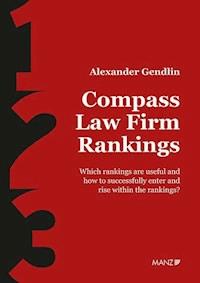
Law firm rankings have established themselves around the world as the means for evaluating law firms and lawyers. Chambers and Partners alone covers over 190 countries. This book will provide answers to the most important questions when dealing with rankings: • How can law firms determine, which ranking is to be taken seriously and furthermore is suitable for the law firms’ purpose (e. g. small law firms must not work with the exact same rankings as large law fi rms) • What should law firms and all members of the legal profession do to effectively communicate their performance to the ranking publications in order to improve their own rankings? • How can the law firms‘ clients distinguish between important and less relevant rankings? This book for the first time offers an overview of the law firm ranking industry and gives recommendations as to why which rankings are suitable for which law firms and legal fields. Case studies and practice notes are also provided for working properly with rankings.
Das E-Book können Sie in Legimi-Apps oder einer beliebigen App lesen, die das folgende Format unterstützen:
Seitenzahl: 150
Veröffentlichungsjahr: 2016
Ähnliche



















COMPASS LAW FIRM RANKINGS
Which rankings are useful and what does successful ranking work look like?
By
Alexander Gendlin
All rights, in particular the right to duplication and distribution as well as translation, are reserved. No part of the work may be reproduced or stored using electronic systems, processed, duplicated or distributed in any form (by photocopy, microfilm or other process) without written permission of the publishing company.
All information in this book is without guarantee despite careful editing; liability of the author as well as the publishing company is excluded.
ISBN 978-3-214-11246-2
© 2016 Manz’sche Verlags- und Universitätsbuchhandlung GmbH, Vienna
Telephone: +43 (0)1 531 61-0
E-mail: [email protected]
www.manz.at
Photo credit: © Alexandra Langeder
PREFACE
I have been working with law firms since 2004 and together with my partners I advise law firms in all business and strategic aspects. Rarely do you find a topic as emotionally charged as rankings.
It’s no secret that decision processes in law firms are frequently “overly spontaneous” and made on the basis of emotions. But with rankings the emotional momentum is clearly greater than with almost any other area—with the exception of the issue of compensation of course.
Rankings are hated and loved at the same time. If your own law firm is ranked at the very top for a change and you read positive quotations about your own performance, the ranking cannot be praised highly or often enough. However, if you did not achieve the placement you subjectively believe you deserve, the reaction is correspondingly negative. Nevertheless, the law firms, of course, keep trying to receive good rankings since a ranking list is very easy to read for clients, journalists, reference law firms and law students and therefore contributes significantly to fast evaluations of law firms.
Due to this emotionalisation law firms often make the wrong decisions, particularly when selecting rankings and participate in rankings that often hardly benefit them. The amount of work involved in participating in rankings is also frequently underestimated.
Both of these factors were the main motivation to write this book to create a bit of clarity regarding the existing selection and work processes. All terms relating to people always also refer to the opposite gender as well.
Vienna, July 2015 Alexander Gendlin
ABOUT THE AUTHOR
© Alexander Gendlin
Mag. Alexander Gendlin has been working in the legal industry since 2004. After employments at law firms as well as banks he founded the business consulting firm “Law Business—Business Consulting For The Legal Industry” (www.lawbusiness.at) were he consults on Business Development & Sales, Directories & Rankings, Marketing & Public Relations, Business Models & Compensation and much more. His customers include renowned national and international law firms.
Contents
1.THE INITIAL SITUATION
1.1.Origins of the Rankings
1.1.1.Forefather Martindale-Hubbell
1.1.2.Chambers & Co—New Kids on the Block
1.2.Definition of “Matters”
1.3.Advantages and Added Value of the Rankings –Why Rankings Work
1.3.1.Creating Comparison Systems
1.3.2.Translation for Non-Lawyers
1.3.3.Support by the Legal Industry
1.4.Target Groups of Rankings
1.4.1.Clients
1.4.2.Law Firms and Lawyers
1.4.3.Reference Law Firms
1.4.4.Future Lawyers
1.4.5.Journalists
1.5.How the Evaluations in Rankings Are Generated
1.5.1.Document Analysis by Researcher
1.5.2.Votes by Clients, Lawyers/Jurists
1.5.3.Readership Opinions
1.6.Business Model of the Rankings
1.6.1.Advertising Inserts and Paid Publishing
1.6.2.Conferences
1.6.3.Physical Trophies, Ranking Plaques
1.6.4.Company Profiles
1.6.5.Anonymised Publication of Client Surveys
1.7.Improvement Potentials for the Rankings
1.7.1.Deadlines
1.7.2.Client Interviews
1.7.3.Even More Differentiated Decisions
1.7.4.Make it easier for Smaller Law Firms to Participate
1.7.5.Too Many Bad and Pseudo Rankings
1.7.6.The End of PLC Which Lawyer?
2.WHAT TYPES OF RANKINGS EXIST?
3.HOW TO RECOGNIZE THE QUALITY OF A RANKING
3.1.How is the Data Collection Performed?
3.2.Is the Ranking Part of a Non-Juristic Publication?
3.3.Table and Weighting of Current Rankings
3.3.1.Rankings Level 1
3.3.2.Rankings Level 2
3.3.3.Rankings Level 3
3.3.4.Rankings Level 4
4.WHICH LAW FIRMS MUST BE REPRESENTED IN WHICH RANKINGS?
4.1.Comprehensive Strategy
4.2.Selective Strategy
4.3.Niche Strategy
5.PROPER EVALUATION OF RANKING RESULTS
5.1.Example for the Selection of a Law Firm
5.2.Restrictions of the Example & Additional Selection Criteria
6.PRACTICAL GUIDELINES FOR WORKING PROPERLY WITH RANKINGS
6.1.Selection of the Proper Rankings
6.2.Medium to Long Term Planning
6.3.Be aware of time and effort needed
6.4.Provide Sufficient and the Right Resources
6.4.1.Sufficient Resources
6.4.2.The Proper Resources
6.5.Planning and Controlling Submissions using Project Management
6.5.1.Two Round Feedback System
6.5.2.Reminder
6.5.3.Project plans
6.5.4.Project Governance—Integrating Submissions into the Law Firm’s Management Processes
6.5.5.Effectiveness of Project Management in Practice
6.6.Client Referee Management
6.6.1.Client Referee Tracking
6.6.2.Client Referee Selection
6.6.3.Advance Notification of Client Referees
6.6.4.Follow-up
7.GUIDELINES FOR CREATING SUBMISSION TEXTS
7.1.Official Structure Information
7.2.Special Aspects & Highlights of Your Law Firm in a Nutshell
7.3.Reply to Current Ranking Placement
7.4.Client Names
7.5.Matters (Cases)
7.5.1.Definition of Terms
7.5.2.Proper Texting of Matters
8.CASE STUDIES SUBMISSIONS
8.1.Case Study: Law Firm with 15 Equity Partners
8.2.Case Study: Law Firm with Six Equity Partners
8.3.Case Study: Law Firm with Two Equity Partners
9.PROPER COMMUNICATION AND ADVERTISING OF RANKING RESULTS
9.1.Your Own Website
9.1.1.Only Advertise Your Own Results
9.1.2.No “Ranking Collages”
9.2.Direct Mailings & Press Releases
9.3.Press Reports
9.4.Email Signatures
9.5.Social Business Networks
9.6.Marketing and Sales Documents
10.HOW RANKINGS HAVE CHANGED THE LEGAL INDUSTRY
10.1.Development of new Job Descriptions and Service Providers
10.2.Increased Competition
10.3.“War for Talents”
10.4.Professionalization, Semi-Professionalization and Displacement
10.5.Big Advantages for Ongoing Professionalization
11.APPENDIX:
11.1.Chambers Global—Template for Entering Submission Data
11.2.Legal 500
11.2.1.Legal 500 editorial submission guidelines
11.2.2.Legal 500 emea referees explained
11.3.Thomson Reuters
11.3.1.Thomson Reuters deals League tables—Why contribute Legal Advisory
11.3.2.Snapshot of Thomson Reuters
MANAGEMENT SUMMARY / CONTENT OF THE BOOK
–Law firm rankings have established themselves around the world as the means for evaluating law firms and lawyers. Chambers and Partners alone covers over 190 countries.
–But still many questions remain widely unanswered:
–How can law firms and lawyers determine, which ranking is to be taken seriously and is suitable for their own purposes?
–What should law firms and all members of the legal profession do to effectively communicate their performance to the ranking publications in order to improve their own rankings?
–How can the law firms‘ clients distinguish between important and less relevant rankings?
–This book for the first time offers an overview of the law firm ranking industry and gives recommendations as to why which rankings are suitable for which law firms and legal fields.
–Case studies and practice notes are also provided for working properly with rankings.
1.THE INITIAL SITUATION
Law firm rankings have established themselves as means for evaluating law firms and lawyers. While the evaluation of law firms and lawyers has been polarizing since its creation, it has spread from modest beginnings to a veritable industry sector. Rankings have gained a reputation in the industry akin to the dentist: No one really likes him and many think of surprisingly creative ways to postpone the visit to Dr. Directory—but in the end most agree that you cannot avoid the appointment, especially since everyone is relieved afterward.
Lesen Sie weiter in der vollständigen Ausgabe!
Lesen Sie weiter in der vollständigen Ausgabe!
Lesen Sie weiter in der vollständigen Ausgabe!
Lesen Sie weiter in der vollständigen Ausgabe!
Lesen Sie weiter in der vollständigen Ausgabe!
Lesen Sie weiter in der vollständigen Ausgabe!
Lesen Sie weiter in der vollständigen Ausgabe!
Lesen Sie weiter in der vollständigen Ausgabe!
Lesen Sie weiter in der vollständigen Ausgabe!
Lesen Sie weiter in der vollständigen Ausgabe!
Lesen Sie weiter in der vollständigen Ausgabe!




