


112,99 €
Mehr erfahren.
- Herausgeber: John Wiley & Sons
- Kategorie: Geisteswissenschaft
- Sprache: Englisch
Updated edition of the comprehensive rulebook to the specifier's craft
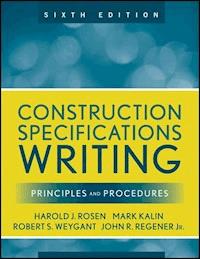
With this latest update, Construction Specifications Writing, Sixth Edition continues to claim distinction as the foremost text on construction specifications. This mainstay in the field offers comprehensive, practical, and professional guidance to understanding the purposes and processes for preparation of construction specifications.
This new edition uses real-world document examples that reflect current writing practices shaped by the well-established principles and requirements of major professional associations, including the American Institute of Architects (AIA), the Engineers Joint Contract Documents Committee (EJCDC), and the Construction Specifications Institute (CSI). Also included are guidelines for correct terminology, product selection, organization of specifications according to recognized CSI formats, and practical techniques for document production. Fully revised throughout, this Sixth Edition includes:
-
Updates to MasterFormat 2004, as well as SectionFormat/PageFormat 2007 and Uniformat
-
End-of-chapter questions and specification-writing exercises
-
Samples of the newly updated construction documents from the AIA
-
New chapter on sustainable design and specifications for LEED projects
-
Updated information on the role of specifications in Building Information Modeling (BIM)
Sie lesen das E-Book in den Legimi-Apps auf:
Seitenzahl: 753
Veröffentlichungsjahr: 2011
Ähnliche




















Table of Contents
Title Page
Copyright
Preface
The Authors
Specifications Overview
Introduction
Chapter 1: The Role of Specifications
Documents for Construction
Bidding Documents
Contract Documents
Specifications
Study Questions
Chapter 2: Relationship between Drawings and Specifications
What Goes Where
The Drawings
The Specifications
Coordinating the Design Process
Terminology
Considerations for Users of Drawings and Specifications
Study Questions
Chapter 3: Organization of Specifications
History of Construction Specifications Organization
Organizing Specifications According to MasterFormat™ 2004
Study Questions
Chapter 4: The Project Manual and Specifications Sections
The Project Manual Concept
Alternative and Supplemental Formats for the Project Manual
Study Questions
Chapter 5: Formats for Specification Sections
Need for Formats for Specification Sections
SectionFormat
PageFormat
Study Questions
Chapter 6: Types of Specifications
Methods for Writing Specifications
Study Questions
Chapter 7: Specifications Writing Principles
Determining Content for the Specifications
Specifying
Study Questions
Chapter 8: Bidding Requirements
Three Basic Bidding Documents
Study Questions
Chapter 9: General Conditions of the Contract
Contractual Relationships
Other Public Agency and Corporate General Conditions
Study Questions
Chapter 10: Supplementary Conditions of the Contract
Supplementary Conditions
Guide for Producing Supplementary Conditions
Study Questions
Chapter 11: Bonds, Guaranties, and Warranties
Bonds
Warranties and Guarantees
Study Questions
Chapter 12: Division 01 - General Requirements
Scope of Division 01
Relationship of Division 01 Sections to Other Documents
Writing Division 01 Sections
Study Questions
Chapter 13: Modifications
Modifications to Bidding and Contract Documents
Addenda
Change Orders
Other Modifications
Study Questions
Chapter 14: Specifications Language
General Precepts
Applications
Study Questions
Chapter 15: Specifications Resources
Overview
Construction Specifications Resources
Study Questions
Chapter 16: Product Selection
Product Selection Factors
Mandated Requirements
Design Criteria
Substitutions and Product Options
Communicating and Recording Product Selections
Study Questions
Chapter 17: Specifications Writing Procedures
Getting Started
Product Selections
Project Information
Specifications Format
Specifying Method
Specifications Detail
Order of Sections to be Produced
Editing and Writing Specification Text
Specifications Checklists
Study Questions
Chapter 18: Master Guide Specifications
Specification Guides and Intact Masters
Public Agency Master Guide Specifications
Commercial Master Guide Specifications
Office Master Guide Specifications
Study Questions
Chapter 19: Computer-Assisted Specifications
Introduction
The First four Decades of Automation
Transforming the Specification Process
Word Processing Software
Computers and Peripheral Equipment
Word Processing Enhancements for Specifications
Knowledge-Based, Computer-Assisted Specifications
Specifiers Property Sets (SPie)
Study Questions
Chapter 20: Preliminary Project Description
UniFormat®
Project Description
Preliminary Project Description
Computer-Assisted PPDS
Study Questions
Chapter 21: Outline and Shortform Specifications
Outline Versus Shortform Specifications
Outline Specifications
Preliminary Project Description (PPD) Versus Outline Specifications
Shortform Specifications
Study Questions
Chapter 22: Green Specs/LEED Specs
Sustainable Design
Leed Specifications
Green Products
Green Project Master Specifications
Resources
Study Questions
Chapter 23: Building Information Modeling
Changing Specification Practice
Standards and Formats for BIM
Organizing BIM Data
The Evolving Role of the Specifier
The Ever-Evolving Specification
Changing the Specifier's Workflow
Conclusions
Study Questions
Appendix A: Project Manual Checklist
Foreword
Use of the Project Manual Checklist
Appendix B: Sample Division 01 - General Requirements
Introduction
Appendix C: Sample Preliminary Project Description
Introduction
Appendix D: Sample Outline Specifications
Introduction
Appendix E: Sample AIA Documents
Introduction
Appendix F: Sample EJCDC Documents*
Study Questions: Answers
Index
This book is printed on acid-free paper.
Copyright © 2010 by John Wiley & Sons, Inc. All rights reserved.
Published by John Wiley & Sons, Inc., Hoboken, New Jersey
Published simultaneously in Canada.
No part of this publication may be reproduced, stored in a retrieval system, or transmitted in any form or by any means, electronic, mechanical, photocopying, recording, scanning, or otherwise, except as permitted under Section 107 or 108 of the 1976 United States Copyright Act, without either the prior written permission of the Publisher, or authorization through payment of the appropriate per-copy fee to the Copyright Clearance Center, Inc., 222 Rosewood Drive, Danvers, MA 01923, (978) 750-8400, fax (978) 750-4470, or on the web at www.copyright.com. Requests to the Publisher for permission should be addressed to the Permissions Department, John Wiley & Sons, Inc., 111 River Street, Hoboken, NJ 07030, (201) 748-6011, fax (201) 748-6008, e-mail: [email protected].
Limit of Liability/Disclaimer of Warranty: While the Publisher and author have used their best efforts in preparing this book, they make no representations or warranties with respect to the accuracy or completeness of the contents of this book and specifically disclaim any implied warranties of merchantability or fitness for a particular purpose. No warranty may be created or extended by sales representatives or written sales materials. The advice and strategies contained herein may not be suitable for your situation. You should consult with a professional where appropriate. Neither the Publisher nor author shall be liable for any loss of profit or any other commercial damages, including but not limited to special, incidental, consequential, or other damages.
For general information on our other products and services or for technical support, please contact our Customer Care Department within the United States at 800-762-2974, outside the United States at (317) 572-3993 or fax (317) 572-4002.
Wiley also publishes its books in a variety of electronic formats. Some content that appears in print may not be available in electronic books.
Library of Congress Cataloging-in-Publication Data:
Construction specifications writing : principles and procedures / Mark Kalin … [et al.]. – 6th ed.
p. cm.
Rev. ed. of: Construction specifications writing : principles and procedures / Harold J. Rosen, John R. Regener, Jr. 2005.
Includes index.
ISBN 978-0-470-38036-9 (pbk.)
1. Specification writing. 2. Buildings.Specifications. I. Kalin, Mark. II. Rosen, Harold J. Construction specifications writing.
TH425.R59 2010
692'.3–dc22
2009051013
Preface
As the Construction Specifications Institute (CSI) notes at the beginning of its Manual of Practice, the history of construction specifications can be traced all the way back to Noah's Ark. Instructions for construction of the Ark were expressed in specifications; there were no drawings.
So make yourself an ark of cypress wood; make rooms in it and coat it with pitch inside and out. This is how you are to build it: The ark is to be 450 feet long, 75 feet wide and 45 feet high. Make a roof for it and finish the ark to within 18 inches of the top. Put a door in the side of the ark and make lower, middle and upper decks. Genesis, Chapter 6, Verses 14–16 (The Holy Bible, New International Version, 1978, by New York International Bible Society)
Specifications alone were apparently sufficient to design and build the Ark in ancient times. Today, however, the process has become more complicated and specifications have evolved into complex documents and drawings have been added, reflecting new technologies and contractual relationships.
Both drawings and specifications have evolved as construction has become more complex. In the early 1900s, architectural drawings became virtually an art form, with ink drafting on cloth. Reproduction of drawings was by “blueprints”: white lines on blue backgrounds. Specifications were essentially notes on the drawings, except on some large projects where the notes were gathered into “book specs.” Now, production of graphic and text documents has been computerized with Computer-Aided Drafting (CAD) and at least computer-based word processing. The prospect is pending for the abolition of traditional drawings and specifications in favor of an interoperable database of information, known as the Building Information Model (BIM).
The benefits and consequences of BIM and its allied programs are being determined as this is written. Issues such as contractual duties and responsibilities, procurement (bidding) processes, compliance with regulatory requirements, and copyright protections are yet to be worked out for BIM projects. Somehow, the fundamental concept of a designer instructing a builder through specifications will prevail.
It is perceived that traditional construction documents will need to be produced for the foreseeable future. Thus, the focus of this book is on the conventional principles and procedures for production and use of construction specifications.
The Authors
Mark Kalin, FAIA, FCSI, CCS, SCIP, LEED AP
Mark Kalin is President of Kalin Associates, an independent specification consulting firm in the Boston area. In 2010, Mark is National Chair of the Sustainable Facilities Practice Group of the Construction Specifications Institute and President of Specifications Consultants in Independent Practice, an organization of independent and in-house specification writers in its 50th year. For the AIA, Mark has served as Chair of the MasterSpec Review Committee, the Library and Archives Committee, and the Specifications Professional Interest Area. For CSI, Mark has been President of the Boston Chapter and now serves on the national CSI Technical Committee.
Mark is the author of the original GreenSpec (1996) and Kalin Associates has completed specifications for over 160 projects seeking USGBC LEED certification. Mark has taught a course on Specification Writing at Harvard University's Graduate School of Design for several years, and is the primary author of the SPie Specifiers Property Set database now being used to link specification and BIM data.
Robert S. Weygant, CSI, CDT, SCIP
Robert Weygant is Owner of Sumex Design, a BIM consulting and development firm located in New Hampshire. Robert is focused on development of BIM components for manufactured products and systems while promoting the use of new interoperability standards, the integral link between BIM and construction documentation. In 2010, Robert is the National Chair of the BIM Practice Group for the Construction Specifications Institute and a member of the national CSI Technical Committee. Complete with specification, performance, and lifecycle information, Robert has developed, and continues to manage, BIM components for many major building product manufacturers.
Robert's background consists of active roles as a general contractor, draftsman, product representative, and specifier. Combining the knowledge of these roles, he has a unique perspective on how to create and manage information necessary for all aspects of a project's lifecycle and improve communication of information through new technologies and techniques.
John Regener, AIA, CCS
John Regener is an Architect and Certified Construction Specifier (CCS) working in Irvine, CA. He is a member of both the American Institute of Architects (AIA) and the Construction Specifications Institute (CSI). In addition to CCS certification, he is a Certified Construction Contract Administrator (CCCA) and a MasterFormat Accredited Instructor (MAI) by CSI. Mr. Regener has been active in CSI and its education programs and is Past-President of Specifications Consultants in Independent Practice (SCIP). He has taught construction specifications at the community college level.
In 1992, John established an independent practice as a construction specifications writer and joined Specifications Consultants in Independent Practice (SCIP). His practice has been diverse in project types and has included commercial, industrial, hospitality, medical, and religious facilities, with about 80 percent of his projects K-12 schools. John is a frequent contributor to the specifiers’ forums for 4specs and CSI.
Harold J. Rosen, PE, Hon. CSI
Harold Rosen retired in Chevy Chase, Maryland, after more than 60 years as a Professional Engineer specializing in producing construction specifications. An Honorary Member of the Construction Specifications Institute (CSI), the highest honor bestowed by the Institute, Mr. Rosen began writing construction specifications in 1942 while working for the U.S. Army Corps of Engineers, during a period of immense and extremely rapid construction due to World War II. After the war, Mr. Rosen worked for architectural firms during the busy post-war period. He witnessed firsthand the countless changes that have occurred in the construction industry and the practice of specifications writing.
Harold Rosen's experience included eight years as chief specifications writer for the New York City office of Skidmore, Owings and Merrill and eight years as an independent specifications consultant. He was one of the shapers of standard organization of construction specifications, especially the 16 Divisions that were a major organizational tool. Harold compiled and edited his articles for Progressive Architecturemagazine into the basis for the first edition of Construction Specifications Writing: Principles and Procedures in 1973.
Specifications Overview
Following World War II, the pace of construction became intense, with new technologies for materials and new construction procedures. Yet, specifications writing resumed as it had been practiced since the beginning of the twentieth century. Construction contracting became highly competitive and expedience dominated over quality. “Successful” bidders were compelled to scrutinize the specifications to find the cheapest way to build. Construction specifications took on greater importance as a means of communicating design intent and quality assurance.
There were no standards for how the specification sections were placed in each book of specifications, except that there was an attempt to arrange them on the basis of chronology of the work: first earthwork, then concrete, masonry, structural steel, carpentry, and so forth. The “and so forth” varied from office to office and even within the same office. In addition, there were no groupings of similar specifications into what are now call “Divisions,” to facilitate locating information.
In the public sector, interest in standardization carried over from war production. Experienced specifications writers from large public agencies, such as the Army Corps of Engineers (COE) and the Naval Facilities Engineering Command (NAVFAC), became involved with specifications writers from large corporations to form the Construction Specifications Institute (CSI) in 1948. Their intention was to organize construction specifications and develop recognized principles and procedures to make bidding and construction more coherent.
As a result, in 1963, CSI introduced a 16-division format for organizing specifications. In 1965, the American Institute of Architects (AIA) conceived a new title for the book of specifications, calling it the Project Manual because it contained more than the specifications. The Project Manual also contained bidding, construction contract, insurance, administration, and technical documents and specifications. CSI's 16-division format was applied to AIA's Project Manual concept and resulted in CSI's flagship document, MasterFormat.
After nearly four decades, MasterFormat plus the principles and procedures published in the CSI Manual of Practice have proven to be effective. The ordering of documents according to these national standards continues to evolve to this day, accommodating changes in construction contracting and construction technology.
Not only the formats but also the physical production of construction specifications has undergone major changes over the past five decades. Making multiple copies of specifications with a hectograph (a machine used for making copies of text transferred to a gelatin surface) gave way to the mimeograph machine (which used a waxed fabric stencil that had typed characters cut by a typewriter, through which ink passed onto paper). In the late 1970s, xerographic copiers using an electrostatic image transfer process to apply and fuse powdered ink onto a page became affordable for businesses.
Specifications were typewritten onto bond paper, as business documents have been produced since the typewriters took over for hand-written business correspondence. Technical improvements were made to typewriters, especially the addition of electric assistance. Innovations such as IBM's “Selectric” typewriters with their golf ball–like, interchangeable type fonts advanced the productivity of typewriters.
In the middle to late 1960s, computers began to be used to produce documents. Keypunch cards and tape reels were used with mainframe computers to record text for replay through a printer that was essentially an automated typewriter. Later, punch cards and tape reels were replaced by “mag cards” (index card–size polyester sheets with magnetic recording media) and 8-inch “floppy disks” used with early generation mini-computers. In the mid-1980s the desktop personal computer (PC) superseded the minicomputer, and software was developed so that true computer-assisted text production was realized and made available to large and small businesses and to individuals.
With the introduction of laser-controlled electrostatic printers (“laser printers”) in the late 1980s, the typewriter was supplanted by the computer for specifications production. Now PCs have capabilities that were unthinkable for even the most powerful mainframe computers four decades ago.
Some large architectural firms in the mid-1960s acquired in-house mainframe computers. Included in the use of these computers was the production of standardized documents. From this, the concept of “master specifications” was developed to make production of similar yet customized documents easier. These masters reflected the specific materials and designs that these firms had become familiar with and represented their continued and consistent experience project after project.
A national trend toward the development of master specifications started in the late 1960s and early 1970s, when large public agencies and private organizations, in addition to the AIA and CSI, began to produce standardized master texts for specifications. These masters enhanced the quality of specifications by guiding the specifier through notes and alternative choices.
However, a disturbing trend arose as a result of the availability of master specifications. Some firms decided that it was unnecessary to have a qualified construction specifier on staff to prepare project specifications. It was assumed that, with the imprimatur of the AIA and CSI on standardized master specifications, project-specific specifications could be produced less expensively by having a project designer, a job captain, or, in some cases, a draftsperson edit the office masters to produce project-specific specifications. The specialized training, aptitude, and skills of a construction specifier were not recognized.
There are countless anecdotal accounts of master specifications being utilized by individuals unschooled and ill prepared to edit master specifications, producing unintended and notably negative consequences. Staff without the ability to edit, fill in blanks, and select options resulted in project specifications subject to construction claims and lawsuits, because the final specification document was replete with errors and was not in sync with the drawings.
The development of master specifications, the development of more efficient reproduction techniques, and the ease of document editing by means of word processing software have evolved. Specifications themselves have evolved into voluminous documents reflecting the growth in complexity of construction technology, the increase in regulatory (building code) requirements, the inclusion of detailed quality assurance procedures, and recently adopted provisions for sustainable design and certification have made specifications writing more challenging.
Unfortunately, as the curricula of architectural and engineering schools have kept pace with the complexity of design and construction, education in construction documents, including construction specifications, has been largely omitted. Most colleges and universities today offer as little education in specifications and other construction contract documents as they did a half-century ago. This has led to a misconception: If it isn't taught in school, it must not be important.
There are signs that this situation may be changing. Some colleges and universities have had long-standing classes in construction specifications, construction contracts, and construction materials. Others are becoming aware of the need for architects and engineers to have basic education in written construction documents, especially with the advent of the Building Information Model (BIM) more integrated processes for design and construction. Books such as this one, with its roots back into the 1960s and others are selling because of increased interest in specifications. Internet-based education programs are being introduced for continuing education of practicing design professionals.
This increased interest in specifications will probably mean a change in the role of those design professionals whose primary task has been that of a “specifications writer.” In the future, specifications decision making and production (specifications writing) will be by generalists. The vision being promoted by those who publish specification masters is one where computer-based programs will guide a specifications process that is integrated into an overall computerized model of the facility to be designed, constructed, operated, maintained, and ultimately deconstructed or adaptively reused. Within this futuristic vision is the need for all design professionals to be educated in the production of construction specifications and other bidding and contract documents.
An analogy would be that of a young driver being given a high-performance sports car to drive. The car is a marvel of technology whose performance is dazzling. The young driver has played video games that simulate driving, and dreams of the day when the experience becomes real. The young driver in this analogy is the design professional with limited or no education in specifications and other construction contract documents. The high-performance sports car is the Building Information Model (BIM) or even a computer-assisted specifications program. The chances for a mishap or even a calamity are high.
To reduce the risk and raise the prospects of successful and profitable use of the “high-performance vehicles” now being developed for construction specifications, education and training in colleges and universities, and in continuing education programs for design professionals, are needed. Thus, this book has been produced.
Introduction
Knowledge of specification writing principles and procedures is essential to the specifier in an architectural or engineering firm in order to prepare sound, enforceable construction specifications. Unless skills are properly developed to understand and apply these principles, and unless expert knowledge of materials, contracts, and construction procedures is also applied, the architect or engineer cannot communicate successfully with the ultimate users of the specifications: facility owners, general contractors, subcontractors, materials suppliers, code authorities, and quality assurance inspectors.
What, then, constitute the principles of specification writing? Basically, the principles should encompass those factors that permit architects and engineers to understand clearly the relationship between drawings and specifications—between the graphic and the verbal—and should enable them to communicate effectively by setting forth in logical, orderly sequence information to be incorporated into the specifications portion of the construction documents.
This book presents the principles and procedures for organizing and producing construction specifications. It is intended for students in architecture and engineering curriculums and for practicing design professionals who participate in professional development and continuing education programs. It is also appropriate for others involved in the production and use of construction specifications, including facility managers, construction managers, and building product representatives.
In summary, this book presents principles and procedures for construction specifications writing as follows:
1. The Role of the Specifications. Specifications are one component of the documents used for bidding and construction of a project. Another component is the drawings. The specifications and drawings are intended to work in harmony to describe what shall be built. Other components are bidding requirements and other contract requirements, which prescribe the duties and responsibilities of the primary parties of the construction contract. Bidding requirements are applicable during the procurement or bidding phase prior to actual construction. Contract requirements apply during fulfillment or execution of the Contract for construction. Each component has distinct purposes. Specifications, as written instructions, are frequently judged by courts as having greater importance than drawings when these documents are in conflict, with judgments based usually on what is contained in the specifications. This means that specifications should be carefully prepared by knowledgeable people. Chapter 1 discusses the role of specifications in detail.
2. The Relationship between Drawings and Specifications. Specifications address qualitative requirements for products, materials, and workmanship, while the drawings indicate relationships between elements and show the location, identification, dimension and size, details and diagrams of connections, and shape and form. There should not be duplication or conflict between these two documents. Instead, they should be complementary. To improve coordination between drawings and specifications, there should be standardization of the information appearing in them. Chapter 2 discusses the purposes of drawings and specifications and their relationship.
3. Organization of Specifications. For many years, specifications were arranged in a series of Sections based on the order or chronology in which various trades appeared on the construction scene. However, it was found that our increasingly complex building structures did not necessarily follow these simple rules, nor was there a uniform nationwide system of specifications. In 1963, the Construction Specifications Institute (CSI) established a uniform arrangement of the various Sections in a division-section organization titled the CSI Format, which in subsequent revisions has evolved into the CSI MasterFormat. The lists of Section numbers and titles in MasterFormat enable construction information to be consistently identified and retrieved. Chapter 3 discusses industry standards, including CSI formats, for organizing specifications.
4. The Project Manual and Specifications Sections. Specifications are included in a book published for the project titled the Project Manual. The Project Manual contains bidding and contract requirements and the construction contract Specifications. The Project Manual is divided into chapter-like Sections organized according to MasterFormat.™ Chapter 4 discusses how to determine the level of detail for Specifications and the appropriate Section number and title according to MasterFormat.
5. Format for Specification Sections. Until CSI promulgated the three-part SectionFormat, there was no universal arrangement of information in an orderly, coherent series of paragraphs dealing with the content of the Specification Section. With the addition of CSI PageFormat, there are industry standards for internal organization of the Section and standardized page presentation. Chapter 5 discusses how to organize and present a Section of the Specifications.
6. Types of Specifications. There are four methods of specifying the Work of a construction Contract to be performed by the Contractor. These methods, used individually or in combination, are descriptive specifying, reference standard specifying, proprietary specifying, and performance specifying. Additionally, there are considerations of whether the Specifications are “restrictive” (sole source or limited sources) or “nonrestrictive” (commonly known as “or equal”) Specifications. Chapter 6 discusses how to choose and use the various methods of specifying.
7. Specifications Writing Principles. After the formats for specifications and the methods of specifying are understood, the technical and procedural content of the Specifications needs to be determined. The content is described using techniques involving appropriate specifications language, workmanship requirements, and coordination among various Specifications Sections to avoid redundancy and conflicting requirements. Chapter 7 discusses these principles.
8. Bidding Requirements. Bidding requirements consist of documents that are used in the solicitation of bids and typically include the Advertisement or Invitation to Bid, the Instructions to Bidders, and the Bid Form. The specifier often prepares these documents based on instructions from the owner. Chapter 8 discusses the content, purposes, and formats for the bidding requirements.
9. General Conditions of the Contract. The Conditions of the Contract define basic rights, responsibilities, and relationships of the entities involved in the performance of the Contract. The Conditions of the Contract are an inherent part of the Owner-Contractor Agreement and are considered to be the “general clauses” of the Agreement. There are generally two types of Conditions of the Contract: the General Conditions, which are found in a standardized, preprinted document, and the Supplementary Conditions, which are project-specific modifications to the standard document. Chapter 9 discusses the General Conditions of the Contract, and Chapter 10 discusses the Supplementary Conditions of the Contract.
10. Supplementary Conditions of the Contract. Each project has unique requirements. In terms of the general clauses or Conditions of the Contract, the unique requirements are presented in the form of Supplementary Conditions of the Contract, which modify the standard preprinted General Conditions. Chapter 10 discusses the typical content of Supplementary Conditions of the Contract.
11. Bonds, Guarantees, and Warranties. To ensure performance by the Contractor and to protect the owner from premature failure of products and workmanship, the Contract Documents include provisions related to bonds, guarantees, and warranties. These are presented in general terms as part of the Contract requirements, preceding the Specifications in the Project Manual, and in Specifications Sections to describe specific provisions. Chapter 11 discusses bonds, guaranties, and warranties.
12. Division 01 - General Requirements. These are Sections of the Specifications that apply generally to all Sections. The use of Division 1 follows one of the prime principles of Specifications writing: “Say it once.” Chapter 12 discusses the use and content of Division 01 Specifications.
13. Modifications. It is inevitable that the bidding and Contract requirements, the Specifications, and the Drawings will require revision after being issued. Chapter 13 discusses the procedures and formats for preparing the various types of modification documents.
14. Specification Language. It is imperative to use clear technical language that can be understood by those who use the Specifications. In order to communicate with proper language, the specifier must sufficiently master the tools of specifications language, including grammar, vocabulary, spelling, use of abbreviations and symbols, punctuation, capitalization, sentence structure, and the unique considerations of streamlined writing and specifications detail. The specifier must not only follow hard rules of language but must understand the subtleties of language. Chapter 14 discusses the unique language requirements of construction specifications.
15. Specification Resources. Construction technology, project delivery methods, and sources of construction information change constantly and rapidly. Chapter 15 presents some common resources useful for specifiers.
16. Products Evaluation. Other books address construction technology in much more detail than can be accommodated in this book. Chapter 16, however, discusses fundamental procedures for evaluating products, identifying necessary attributes, and selecting appropriate products to be included in the Specifications.
17. Specification Writing Procedures. Applying the principles of specifications writing is facilitated if there are established procedures for producing Specifications Sections. Chapter 17 discusses those procedures and the use of Specifications checklists when gathering information, researching, and writing.
18. Master Guide Specifications. Master guide specifications are published and nationally marketed to assist specifiers. The publishing organizations have resources to continually research, create, and maintain construction specifications. Many architectural and engineering offices and independent specifications consultants use these master guide specifications to create office-specific master specifications that serve as the basis for project-specific specifications. Chapter 18 discusses the use of master guide specifications published by commercial organizations and public agencies, as well as the development of office-specific masters.
19. Computer-Assisted Specifications. Today, several true computer-assisted specifications programs are in the marketplace. These programs offer automation features beyond word processing programs that enable the specifier to more expediently and accurately create project-specific specifications—or so the marketing materials promise. Chapter 19 discusses the history and current offerings of three of the computer-assisted specifications programs.
20. Preliminary Project Description. During the preliminary design phase of a project, an alternative format, based on building Elements, is sometimes used to provide information for scope descriptions and cost estimating. Based on Uniformat rather than MasterFormat, a Preliminary Project Description (PPD) is produced from which Specifications are derived at later phases of the project. Chapter 20 discusses the PPD.
21. Outline and Shortform Specification. Used during the preliminary design of a project, Outline Specifications are produced using either the typical three-part Section format or an abbreviated format with sequentially identified articles. Outline Specifications describe preliminary product selections and other project-specific requirements. Another abbreviated specifications format, shortform specifications, is used for less complicated projects or those of limited scope where highly detailed information is either unnecessary or inappropriate. Chapter 21 discusses outline and shortform specifications.
22. Green Specs / LEED Specs. Specifications for projects seeking USGBC LEED certification must include procedures and products that comply with the requirements for achieving individual LEED credits. Division 01 in the Project Manual will typically include requirements for LEED submittals, construction waste management, indoor air quality during construction, commissioning and the LEED Scorecard for the project. Specifications in other Divisions will include requirements including materials with recycled content, regionally sourced materials, rapidly renewable materials, certified wood, and low-emitting adhesives, sealants, paints, and flooring. While green specs for sustainable design and LEED specs may be different, the principles of specification writing apply to both.
23. Building Information Modeling (BIM) is an emerging technology affecting not just the design team, but the specifier, contractor, owner, and facilities managers. BIM couples traditional CAD-based projects with the product information and documentation associated with specific products, systems, and elements found on projects. In order for BIM to be fully effective, it requires an individual knowledgeable with not only the products and systems in the project, but the organization structure necessary to make the information useful. Just as specifications follow a standardized format, the information within a BIM requires standardization and organization to allow clear, concise, complete, correct, and consistent information among the documents, drawings, and 3D models.
Appendices follow the text and provide examples of Specifications and other Bidding and Construction Contract documents.
Chapter 1
The Role of Specifications
Documents for Construction
When an Owner decides to build, renovate, or reconstruct a facility, the Owner usually engages others to prepare documents describing the Work to be performed and the contractual requirements under which construction and related administrative activities are accomplished. Contemporary construction practices in North America are varied, and construction contracts likewise express varied contractual relationships, procurement (bidding and negotiation) methods, and regional construction practices.
This complexity can be very confusing, so, for the purposes of this book, the discussion will be generally limited to the context of the traditional design-bid-build method for construction procurement, with comments occasionally describing alternative procurement methods, such as design-build, multiple prime contracts, and phased (“fast track”) construction. Also, the discussion will be in the context of three primary parties in the construction contract: the Owner, the Architect/Engineer, and the Contractor.
The Architect or Engineer, and his or her various consultants, prepare documents for construction of the facility. These develop over time, from conception of the design through gestation of design development, through the birth pangs of bidding/pricing and construction, until delivery of the completed facility at closeout of the construction Contract. Many types of documents are used during design and construction, but for actual construction three basic types of documents are used:
1. Bidding and Contract Requirements: Text documents
2. Drawings: Graphic documents
3. Specifications: Text documents
Combined, these three types of documents are called the Bidding Documents (before signing of the Agreement or “contract”) and the Contract Documents (after signing the Agreement or contract). The difference concerns when the documents are used. Prior to execution (signing) of the Agreement, the combined documents are known as Bidding Documents under traditional design-bid-build projects. Under design-build and certain types of construction management-type projects, the documents prior to execution of the Agreement may be known as “Procurement Documents.” This is a fine distinction reflecting the process of negotiation for selection of product vendors and subcontractors, but in most cases, even under design-build and construction management-type projects, a competitive bidding process is used. So, “Bidding Documents” will be the term used here for the documents prior to execution of the Agreement. After execution of the agreement, the documents are known as the Contract Documents.
Bidding Documents
“Bidding documents” is a term generally used to describe the documents furnished to bidders. For traditional design-bid-build projects, the Architect/Engineer and Owner prepare the set of Bidding Documents, consisting of bidding requirements, Drawings, and Specifications. These are issued to prospective general contractor bidders for competitive bidding and for the Owner to select the Contractor named in the Agreement and referenced in other Contract Documents.
However, there are projects where the Contractor is selected by a method other than competitive bidding, such as direct selection by the Owner based on qualifications of the Contractor. In such cases, competitive bidding still occurs but it is managed by the Contractor, who issues Bidding Documents and manages the bidding process.
The primary difference in documents between Bidding Documents and Contract Documents is the inclusion in the Bidding Documents of Bidding Requirements. These generally consist of the Advertisement or Invitation to Bid, the Instructions to Bidders, the Bid Form, and other documents to be submitted to the Owner for the Owner's selection of the Contractor and modifications to the documents issued during bidding (addenda). The Bidding Requirements are removed after bidding and selection of the Contractor and are replaced by the Contract Requirements. The Contract Requirements typically consist of the executed (signed) Agreement with its related documents, such as insurance forms, bonds, and certifications. Note: the Bidding Documents typically include copies of the Agreement form and the Conditions of the Contract (General Conditions and Supplementary Conditions when industry-standard documents are used). The bidding process is described further in Chapter 8.
As noted above, two other types of documents are included in the Bidding Documents and the Contract Documents: the Drawings and the Specifications. This book will not describe principles and practices for production of the Drawings but will describe the types of information best presented on the Drawings (graphic presentation) and in the Specifications (text presentation), and the discussion will include coordination issues between the Drawings and the Specifications. Chapter 2 discusses the relationship between the Drawings and the Specifications in greater detail.
Contract Documents
“Contract Documents” is the term used for documents identified in the Agreement (construction Contract). It appears simple, but, of course, these documents can become complicated as the project delivery process becomes more complex and the relationships between the parties involved in the project become more varied and obscure. Considering the typical design-bid-build project, the Contract Documents consist of the following:
Agreement —A written agreement between the Owner and the Contractor summarizing the work to be performed, the Time in which the Work shall be completed, and the Contract Sum to be paid. Also identified in the Agreement are the Contract Drawings, the Contract Specifications, and other referenced documents such as bond forms, insurance certificates, other certifications, Contractor's qualifications statement, documentation of the Contractor's financial status, subcontractors and suppliers lists, special warranty documents, and just about any other type of written document that the Owner requires. Note: the Agreement is typically prepared by the Owner's legal and insurance counsels or by the Construction Manager if one is involved in the project. The Architect/Engineer typically does not prepare the Agreement and its attachments. If the Architect/Engineer is involved in producing the Agreement and its attachments, it should be under the direction of the Owner. Architects and engineers are not trained to produce legal instruments (documents) and insurance documents, nor are they licensed to practice law and insurance underwriting.Conditions of the Contract—Typically, these consist of the General Conditions and the Supplementary Conditions. General Conditions are typically preprinted standard documents prepared by professional societies such as (for architectural projects) the American Institute of Architects (AIA) and (for engineering projects) the National Society of Professional Engineers (NSPE), American Consulting Engineers Council (ACEC), and American Society of Civil Engineers (ASCE). Together, the listed engineering societies jointly publish documents as the Engineers Joint Contract Documents Committee (EJCDC). The Conditions of the Contract are discussed in greater detail in Chapter 9.Drawings—Graphic descriptions of the Work to be performed by the Contractor. The content of Drawings and the relationship between the Drawings and Specifications are discussed in greater detail in Chapter 2.Specifications—Written descriptions of the Work to be performed by the Contractor. The types of Specifications, their content, and specification writing principles and practices are discussed in greater detail below and in Chapters 5, 6, and 7.Modifications—Architect's Supplemental Instructions (for contracts based on AIA A201, General Conditions of the Contract), Field Orders (for contracts based on EJCDC C-700, General Conditions of the Contract), Construction Change Directives (for contracts based on AIA A201, General Conditions of the Contract), Work Change Directives (for contracts based on EJCDC C-700, General Conditions of the Contract), and Change Orders (for contracts based on both AIA and EJCDC General Conditions of the Contract). “Modifications” are changes to the documents after execution (signing) of the Agreement. Prior to execution of the Agreement, changes are generally made using Addenda. Addenda and Contract Modifications are discussed in greater detail in Chapter 13.Often the term “construction documents” is used as a synonym for “Contract Documents.” This is incorrect. Simply stated, the Contract Documents are the documents identified in the Agreement. The Contract Documents, together with other documents used during construction, may be called construction documents. Contractually, this is a fine but important distinction. The Contractor, the Architect/Engineer, and the Owner are only obligated to perform according to the Contract Documents. Other documents may be required by the Contract Documents to be produced and used during performance of the Work under the Contract, including shop drawings, construction schedules, construction reports, meeting notes, submittals, installation instructions, test reports, permits, and certificates from authorities having jurisdiction, and operating and maintenance data. However, these are not Contract Documents, although most should become part of the “contract record documents,” which describe the completed Work of the Contract and which may be used by the Owner for operation and maintenance purposes.
Specifications
Imagine a movie or video presentation of the construction of a building, park, water or sewage treatment plant, refinery, highway, or bridge. Imagine that all the activities of construction are shown in great detail, from procurement of materials and manufactured products, through fabrication, delivery to the job site, storage and staging on the job site, surface preparation, mixing, application, installation, fitting, and finishing. Also imagine the Owner, the Architect/Engineer, the Contractor's managers and supervisors, the subcontractors, the testing and inspection agency personnel, the manufacturers’ representatives, and code authorities meeting and discussing matters related to the construction. Imagine the movie or video presentation without a sound track. There is not only no background music, there is no dialog. It would be very difficult to construct the facility based only on a silent movie. To properly understand the requirements and construct the facility, dialog is essential.
The relationship between the Contract Drawings and the Contract Specifications is equivalent to this dialog. The Contract Specifications are essential for complete understanding of the Work to be performed by the Contractor.
Most Conditions of the Contract recognize the significance of construction specifications and refer to the Specifications as part of the Contract Documents, with importance equivalent to that of the Drawings. Because of this, it is imperative that all parties identified in the Agreement (the Owner, the Architect/Engineer, and the Contractor) understand the role of the Specifications and understand how the Specifications are used during bidding and performance of the Work under the Contract. Moreover, the Architect/Engineer should be just as skilled in preparing the Specifications as in preparing the Drawings. The documents are complementary and carry equal weight for interpretation of Contract requirements.
Unfortunately, the education of architects, landscape architects, engineers, specialty designers, construction managers, constructors, inspection personnel, code authorities, manufacturers, fabricators, installers, and applicators rarely includes more than superficial instruction in written documents for construction, including construction specifications. Perhaps this is because these parties are more familiar and comfortable with graphic documents (drawings) and computations (spreadsheets and calculations). Nevertheless, proper performance of the Work requires clear, correct, and adequate descriptions of the requirements of the project, including written documents called the “Specifications.”
While the future appears to hold major changes in the way construction information is managed and presented, including object-oriented, 3D computer-assisted drafting (CAD) that blurs the lines between drawings and specifications, the current separation of information into Contract Drawings and Contract Specifications for bidding and construction will continue for many years. It is essential that those who prepare and use these documents understand their purposes and properly integrate them.
To drive this point home, realize that attorneys and some construction managers understand information written on an 8½-by-11-inch page much better than they understand what is shown on a drawing. Although the General Conditions of the Contract may state otherwise, there is a tendency in a dispute to give greater significance to the Specifications than to the Drawings. This is a particularly good reason to apply as much care in preparing the Specifications as the Drawings.
Study Questions
1. What are the three basic types of documents used in construction contracts?
a. Bidding and Contract Requirements
b. Drawings
c. Specifications
d. Marketing data
2. Which of the following are included in the Bidding Documents but not in the Construction Contract Documents?
a. Instructions to Bidders
b. General Conditions of the Contract
c. Agreement Form
d. Bid Form
3. True or False? Specifications describe the construction in text form.
4. True or False? Construction specifications apply only to the Construction phase of a project.
5. True or False? Development of construction specifications for a project begins during the Contract Document phase.
6. True or False? Procurement documents include construction specifications.
7. True or False? Design-Bid-Build and Design-Build are two valid methods to procure a construction project.
8. True or False? Contract Documents are identified in the Agreement for a construction project.
9. True or False? Drawings are the graphic descriptions of the work to be performed by the Contractor.
10. The Agreement includes which of the following for the construction contract?
a. Summary of the work to be performed by the Contractor
b. Time within which work shall be completed
c. Amount of money to be paid by Owner to Contractor
d. All of the above
Chapter 2
Relationship between Drawings and Specifications
What Goes Where
The information necessary for construction of a facility is developed by the Architect/Engineer and is presented in two basic types of documents: the Contract Drawings and the Contract Specifications. These two types of documents are a means of communicating information between the Architect/Engineer and the Contractor, but each type uses special forms of communication. One is pictorial or graphic, and the other is verbal or textual. Despite these distinctions, each type of document should complement while not contradicting or duplicating the other. In this way, each type of document fulfills its unique function.
According to AIA Document A201-2007 - General Conditions of the Contract for Construction, Paragraph 1.1.5, “The Drawings are the graphic and pictorial portions of the Contract Documents showing the design, location and dimensions of the Work, generally including plans, elevations, sections, details, schedules and diagrams.”
According to AIA Document A201-2007, Paragraph 1.1.6, “The Specifications are that portion of the Contract Documents consisting of the written requirements for materials, equipment, systems, standards and workmanship for the Work, and performance of related services.”
Lesen Sie weiter in der vollständigen Ausgabe!
Lesen Sie weiter in der vollständigen Ausgabe!
Lesen Sie weiter in der vollständigen Ausgabe!
Lesen Sie weiter in der vollständigen Ausgabe!
Lesen Sie weiter in der vollständigen Ausgabe!
Lesen Sie weiter in der vollständigen Ausgabe!
Lesen Sie weiter in der vollständigen Ausgabe!
Lesen Sie weiter in der vollständigen Ausgabe!
Lesen Sie weiter in der vollständigen Ausgabe!
Lesen Sie weiter in der vollständigen Ausgabe!
Lesen Sie weiter in der vollständigen Ausgabe!
Lesen Sie weiter in der vollständigen Ausgabe!
Lesen Sie weiter in der vollständigen Ausgabe!
Lesen Sie weiter in der vollständigen Ausgabe!
Lesen Sie weiter in der vollständigen Ausgabe!
Lesen Sie weiter in der vollständigen Ausgabe!
Lesen Sie weiter in der vollständigen Ausgabe!
Lesen Sie weiter in der vollständigen Ausgabe!
Lesen Sie weiter in der vollständigen Ausgabe!
Lesen Sie weiter in der vollständigen Ausgabe!
Lesen Sie weiter in der vollständigen Ausgabe!
Lesen Sie weiter in der vollständigen Ausgabe!
Lesen Sie weiter in der vollständigen Ausgabe!
Lesen Sie weiter in der vollständigen Ausgabe!
Lesen Sie weiter in der vollständigen Ausgabe!
Lesen Sie weiter in der vollständigen Ausgabe!
Lesen Sie weiter in der vollständigen Ausgabe!
Lesen Sie weiter in der vollständigen Ausgabe!
Lesen Sie weiter in der vollständigen Ausgabe!




