


32,99 €
Mehr erfahren.
- Herausgeber: ibidem
- Kategorie: Geisteswissenschaft
- Sprache: Englisch
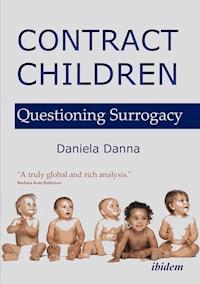
Surrogate motherhood is expanding all over the world. Debates rage over how public policy should consider the signing away of the parental rights of birth mothers in favor of a 'commissioning' couple or an individual. In this book, Daniela Danna describes the situation in English-speaking countries and worldwide, from California to Greece, presenting the legal alternatives regulating (or not) these peculiar exchanges. Should surrogacy remain a private agreement? Should it be treated as an enforceable contract? Are surrogate mothers workers? What happens inside the countries that have chosen different ways of handling this new and controversial matter? And, the most important question of all: How can we live in this era of new techno-medical possibilities and try to stay human? Can we resist commodification in the field of human relations concerning procreation? CONTRACT CHILDREN discusses the different ways available to obtain a child through surrogate motherhood. It is fundamental reading for anyone wanting to be involved in the surrogacy process. It gives prospective surrogate mothers and infertile couples the background information necessary for their own informed decision. It is also an essential instrument for policy makers and activists in the field of women's rights, social justice, and children's rights. The question of how to publicly deal with surrogate motherhood touches upon our social vision of motherhood, ultimately marking the position of women in contemporary society.
Das E-Book können Sie in Legimi-Apps oder einer beliebigen App lesen, die das folgende Format unterstützen:
Seitenzahl: 451
Veröffentlichungsjahr: 2015
Ähnliche




















ibidemPress, Stuttgart
Alla mia mamma
Table of Contents
Introduction
We women have long been struggling to maintain power over our capacity to give birth. In thetrès longue duréesince the defeat of matriarchy (if ithad everexisted), more and more of us across the planet have regained this power, becoming able to choose if and when to have children. Reproductive rights are the legal expression of this regainingourprocreative capacities. The goal of reproductive rights for all women was stated in the Convention for the Elimination of All Forms of Discrimination against Women (CEDAW) adopted in 1979, and in all subsequent and related international treaties under the aegis of the UN. Reproductive rights, put into national laws and then into effect byan increasing number ofcountries, include the right for women"to decide freely and responsibly on the number and spacing of their children and to have access to the information, education and means to enable them to exercise these rights."In Beijingin1995 it was made explicit that:"Acts of violence against women also include forced sterilization and forced abortion, coercive/forced use of contraceptives, female infanticide and prenatal sex selection"(Platform of Action for the Beijing Declaration).
How will women who have regained power over the birthing process decide to use it? If a woman uses it to have a child in order to help the infertile, will it mean that she has enslaved herself again with her own hands? Is it different whether she takes money for this act or not? What about the reimbursement of her expenses, what about her foregone gains? Should she be able to decide by herself on the destiny of a child born to her even if it was conceived by agreement? When should she decide his or her family destination? Moreover: what is the role of the concrete conditions of inequality in the present world-economy for the use that women make of their reproductive capacities? Generalizations are difficult: my point of view is from a core country, where women who cannot themselves bear children (or men) can utilize their other powers to ask a woman to bear a child for them—and not from a peripheryor semiperipherycountry where women areoftenasked to work in this way(countries of the"core"are richer as a result of their unequal exchange with the world's peripheries, in world-systems analysis terminology—see the works of Immanuel Wallerstein, Terence Hopkins, Giovanni Arrighi and their social science school).
I am writing this book to make a contribution to the debate, striving to preserve and enhance women's rights over our natural reproductive powers,within the context of all the new possibilities that reproductive technologies have brought about since the first successful birth of a baby conceived in vitro in 1978(she was called Luise Brown).But technology is not involvedinthe minimal definition of the practice of surrogacy, which is basically the surrendering of a child after its birth to those who arranged for the pregnancy of the willing woman to take place. Or maybe, as in the Bible, who imposed the pregnancy on a slave. In fact, many authors point out that the—rather unfortunate—beginnings of surrogacy go as far back as the Old Testament. The Book of Genesis tells that Sarai, at 75, was too old to give the slightly younger Abram the progeny that would constituteYahweh'speople of the covenent. She suggested thatAbramshould make Hagar pregnant, and then she would raise the child as her own. Hagar was a slave in Abram's house, therefore not really entitled to express her opinion about the procedure. She gave a son to Abram, and Saraibecame Ishmael's social mother, but only until she herself became pregnant and gave birth to their true heir Isaac. At that point,not only Abraham and Sarah got h's in their names, butboth Hagar and Ishmael were thrown out of the house andsent intothewilderness,sinceher contribution to the construction of the new nation was no longer needed. In another passage from the Book of Genesis we can also find references to the direct purchase of children:"Every male among you who is eight days old must be circumcised, including those born in your household or bought with money from a foreigner,"are Yahweh's reported words.Another biblical story of surrogacy involves two female slaves, Bilhahand Silpah, belonging to the sisters Rachel and Leah, with a partially unhappy ending: the second sister did not recognize the two sons that Silpahbore for her (Genesis 30).
In patrilinear societies, as legitimacy is conferred upon the child by the father, a male heir is strongly desired. Childrenwereeasily circulated from fertile to infertile couples in the extended family or beyond it. Now we have progresstohelp in procuring heirs with medical interventions, and infertility has become surmountable for many. Not having one's own children has become the difficult decision of when to stop medical interventions—however uncertain, costly, and painful they are.
Fostered by IVF technology (in vitro fertilization), surrogate agreementshave seenafast growth, similar to what happened when single heterosexual and lesbian women started having childrenen massemaking recourse to assisted insemination with frozen sperm. There has always been the possibility to procreate with casual sex with a man, or with self-insemination, the low-tech, DIY option of inserting sperm intothe vagina without sexual relations or medical intervention (a turkey baster does it). But only a minority conceives in these ways. Instead of community organizing to find donors and to secure anonymity (if wished for), and instead of going through the inconvenience of having casual sex with an untested stranger, paying doctors looks simpler and is therefore preferred—as it is by heterosexual couples, who could also practice self-insemination. We are used to delegatingresponsibility for our acts to"experts."But the reverse side is the application of more and more technology to the pregnancy and birthing process.As Caterina Botti conveys it: the main character at birth is not the woman becoming a mother, but the medical personnel—or rather thegynaecologist(Botti 2007). And in surrogate motherhood the main character it's not the pregnant woman at all, but the phantom of a child coming from nowhere, concretely manufactured by a clinic or by the services of an intermediating agency.
Women themselves perceive their bodies as fragile and inapt. On the contrary, no less than 80% of women (an estimate made by the gynecologists of IRIS, an Italian association promoting the rights to health and well-being) are able to give birth without complications—not really by themselves, but with the assistance of a midwife and of the pregnant woman's"birth team"of her choice.[1]But only a minority of women are confident enough in their natural powers to make this choice. The way in which womenexperiencetheir pregnancy and delivery is increasingly a surrender to the experts'advice, a constant relationship with doctors instead of making recourse to medicine only if in need, and the acceptance ofanytechnological intervention, useful or not. For instance, both in developed and developing countries, women increasingly lie in bed in the gynecological position at delivery (Makuch 2010). This position is comfortable only for the clinicians who supervise the delivery (in fact gynecologists invented it, puttingthe gestatorial chairaway in the attic).[2]But it is doubtful that women would choose it, as it contrasts gravity and makes the descent of the fetus through the birth canal much more difficult than any other position—except beinghungupside down.
Are the technological novelties enhancing women's freedom, solving the infertility problems of those who do not possess procreative natural power, or are they just a deceptive device to deprive women of what used to be a unique experience and a unique tie between mother and child? We stand at a crossroad.
The preamble of the Convention for the Elimination of All Forms of Discrimination against Women stresses "that a change in the traditional role of men as well as the role of women in society and in the family is needed to achieve full equality of men and women."New reproductive techniques, in particular IVF plus implant of the fecundated egg, certainly amount to an abrupt change in traditional gender roles: the fragmentation of the"mother"is the most commented upon of its features. Since 1978 we must distinguish between egg, pregnancy, and social motherhood on one hand, and on the other (as also in former times) between sperm and social fatherhood. The Convention on the Rights of the Child (1989) recognizes the child's right to grow up with her or his family, and also the European Convention for Human Rights has codified a right totherespect of one's"family life,"but the new technologies have confused the scene, and many now have doubts about what the family of a child conceived in vitro with a donor egg really is.Amonggenes, intentions and pregnancy, what and who decides?
I will show how the doubts about what the child's familyisand who her or his motherisrather derive from a linguistic sleight of hand, because"mother"is not the feminine for"father,"and vice versa. The doubts can grow on this (literal)"gender"confusion, while the fundamental question is quite simple, looking at the existing relationships.
Should we welcome the new techniques for this"gender deconstructive"effect?Can they work towards gender equality and against gender discrimination? Will it do good that a woman can freely give, or contract out her"gift of life"to others? Should not women be able to enter rational contracts, even if they entail the decision of conferring the child they bore to another family? Will the new possibilities helpto stopthe consideration of women as inferior to men, of men as superior to women?
Some commentators (Carmel Shalev, MarcelaIacub)welcome the deliberate detachment of pregnancy and motherhood, because they praisecontractas a practice of the right to choose, even a marker for a democratic society, in opposition tostatus, representing all the oppressive ways of traditional society and the expression of the inescapable obligations imposed by"the power"over the individual. Others (Carole Pateman, Margaret Radin, Elizabeth Anderson) consider such a contract demeaning for women and entailing a sale of children, whose psychological foundations are damaged by having been bought. Others still (Gena Corea, Maria Mies, Janice Raymond, Phyllis Chesler) do not only protest the contract, but the agreement itself, showing how surrogacy exploits women and fosters false consciousness over its sacrifices, embraced as self-enhancing acts of giving. But I find it impossible to condemn all acts of surrogacy. It can be welcomedundercertain conditions: to be voluntary and gratuitous, thus avoiding the slippery slopes that transform it into a (demeaning) job. I am simply advocating for the centrality of the pregnant woman, that is the mother, in the process of creation of families (see also Zipper and Sevenhuijsen 1987, Field1988, Shanley 1993 and of course the works of Barbara Katz Rothman).
Families created through surrogate motherhood are growing exponentially."Surrogate babies"are now a 5-digit figure, as the very beginnings of surrogacy are quitelong ago. The lawyer Noel Keane invented the term in 1976 to broker the agreements. In 1984 the first surrogate motherhood agreement with an embryo transfertook place: the egg came from a woman without a uterus and was implantedin one of her friends (Utian et al. 1985). In the US,Gena Corea (1985) estimated thatin the decadebeginning from1976, births by agreement were 75–100, andina similar period of time (1977–1988) about 40"surrogacy babies"cameinto the world in Australia, while in the UK the Brazier report (1988) estimated that 50–80 new babies were born every year out of 100–180 agreements. The estimates for Canada were of 118 babies born up to 1992. Up tothatyear the worldwide total could be 4,000 (Spitz 1996, 70).
In the U.S,the American Society for Reproductive Medicine estimates that 530"surrogacy babies"were born in 2004 and 1,179 in 2011.McDermott (2012) estimates a lower number of about 750 births per year.India soon followed the US: in fact the second place where an IVF baby was born was Kolkata, also in 1978, just two months after Louise Brown (but the case is controversial, see Smerdon 2008, 19–20). Three thousand births were estimated to have taken place in India in the decade since 1994. In 2004 in the small city of Anand the now famous clinic of doctor Nayna Patel opened: it has facilitiesfor half a hundredpregnant women. Until recently, 100–300 births were estimated tooccurevery year in India, half of them destined to the"export market,"mainly the"Anglo-Saxon"countries: US, Australia, UK, Canada—especially to Indian families residing there (Smerdon 2008, 22). Now it is estimated that in the 350 Indian clinicswhichmainly specialize in surrogate motherhood, around 3,000 birthsoccurevery year, dwarfing all the EU countries. In the UK from 1995 to 2007 the transfers of parental authority recorded by authoritieswerebetween 33 and 50, then the number started rising,up to149 in 2011, approximately a fifth ofthemto same sex couples—a possibility that becamelegalin 2010 (Crawshaw, Blyth and van Akker 2013). In France it is estimated that 100–200"surrogate babies"are fetched from abroad every year (Perreau-Saussine and Sauvage 2013, 119), in the Czech Republic about 15 a year (Pauknerová 2013,108).
In Israel from 1996 to 2001 therewere108 applications for surrogacymadeto its Approval Committee which accepted 90 of them, with 30 babies born in 22 deliveries. In the period 2001–2006 the applications were 360, with 287 approvals, and 156 babies in 125 deliveries:"By the end of 2010, the Committee had received a total of 723 applications, out of which 327 babies were born in 260 births"(Shakargy 2013, 243).In Russia surrogacy programs made a total of 430 IVF cycles in 2009, but this is just the number of embryo transfers effected, not of resulting pregnancies (Kahzova 2013, 312). A truly astonishing estimate comes from China, where—prohibition of surrogacy notwithstanding—thereareestimated tohave been 25,000 births from these agreements up to 2009, according to theSouthern Metropolis Weekly—maybe just a journalist's exaggeration (Huo 2013, 93). But, numbers apart, the picture is quite different fromthatof a prohibitionist country:
Though the Ministry of Public Health of the PRC banned surrogacy in 2001, underground surrogacy businesses are thriving in the world's most populous country. Today, there are numerous surrogacy agencies in mainland China, most of which are located in big cities such as Beijing, Shanghai, Guangzhou, Wuhan and so on. Notwithstanding the tight control over the Internet by the Chinese Government, the websites of such agencies can easily be accessed. In the city of Beijing where the author lives, surrogacy advertisements are posted along the streets. The Chinese Government seems to turn a blind eye to the underground surrogacy industry in spite of the prohibition of surrogacy arrangements. (Huo 2013, 97)
The debate about ethics and policies for surrogacy has raged for three decades now, since the famous legal case of Baby M, born in 1986 and disputed between the birth mother and the commissioning couple. Conflicts have arisen not only about the delivery of babies, but also about abortion/embryo reduction, control of the pregnant woman's lifestyle, unwanted babies because of the end of the intended parent's relationships or because the baby was handicapped. Judiciary disputes in transnational surrogacy can arise if the home country's laws have been broken by performing surrogacy abroad in permissive or corrupt countries, obtaining a birth certificate for the child that is invalid in the parents'country.
The fears expressed by feministssuchas Gena Corea inThe Mother Machine(1985), Maria Mies and Vandana Shiva inEcofeminism(1993), and Barbara Ehrenreich inThe Worst Years of Our Lives: Irreverent Notes from a Decade of Greed(1990) that the"work"of pregnancy would be outsourced to poor women in Third World countries, have now come true: Indian clinicshavemasteredembryo-transfer technology, and it is cheaper for infertile couples to go there and use a"baby farm"than bother with arrangements or contracts at home.[3]Coreaalsoforesaw that rich womenwouldprefer not to go through pregnancy themselves—while Margaret Atwood in her dystopian novelAHandmaiden's Tale, 1984, shows a near future where a despised class of breeders is assigned to reproduction. This is not (yet?) true, but the growing engagement of women in labor markets where maternity is discouraged contributes to the postponing of childbearingwhichbecomes increasingly difficult with age.[4]
But it is difficult to renounce having a child. Motherhood is still a battlefield to define femininity, a dangerous zone wherevarioussocial meanings and social and economic interests are fighting. It is a territory only partially liberated.In the'70sAdrienne Rich denounced thepatriarchal institution of motherhood, but kept its oppressive imperatives distinct from a woman's possibility to live this experience in a satisfying and creative way if she rebelled against the rules of this social institution. Only by refusing to live in its cage and in the cage of the nuclear family, by not accepting to be an object of medical interference and control, by being insubmissive to the rules of male-ruled society (patriarchal power, as Rich wrote)cana woman live the joys of pregnancy and motherhood in full: by freeing herself, she frees her children, too. The price to pay is to be considered"mother outlaws,"as Andrea O'Reilly proudly baptized her web site dedicated to activism and study about motherhood, with the aim of restoring its naturally empowering function for women, and of combating the emotional blackmailing and guilt feelings arising when a woman does not sacrifice everything to her family: "Mother Outlaws recognize that mothers and children benefit when the mother lives her life, and practices mothering, from a position of agency, authority, authenticity and autonomy."[5]
Surrogacy is one of the arenas where social meanings of motherhood are defined. The situation of a"carrier mother"cannot be univocally described, as laws are different, attitudes towards the phenomenon vary, and debates are inflamed. Where are we now? How to define what happens in surrogacy situations both from the point of view of public policies and individual ethics? What if the actors do not agree on these definitions? Whose definitionshouldprevail?
Let us start by charting the ground: What are the social and biological interactions that configuresurrogate motherhood? This is the theme of the first chapter.How issurrogacyperformed?How is it similar or different to other kinds of motherhood? Thesecondchapter illustrates the answers to these questions.Then: what are the legal boundaries that permit or prohibit the practice? Thethirdchapter explores laws and rules in a global overview. Finally, who are the participants in these social or economic exchanges, in particular the surrogate mothers? Thefourthchapter answers this question. Is there a wayof allowingsurrogacy that respects the prerogatives and rights of all parties involved? The conclusion answers this final question, suggesting a public policy to deal with the matter.
My sources for this book are mainly textual: the vast existing literature (legal material and ethnographic accounts, plus the debates about ethics and politics) and a few formal interviews that I conducted in a very difficult field.
I warmly thank my few interviewees for the sharing of their experiencesand ideas; Angela Greco, Laila Sage, Veruska Sabucco, Olivia Garavaglia, Marta Fontana for their assistance in the research; the exponents of the network in-Fercit, led by Venetia Kantsa, and of the COST action BIRTH for correspondence and info; the staff at the University of Milan library for theirvaluableinformation and help; Mary Ellen Lanczak for her correction of my not native English language, and finally my editoratibidem, Jakob Horstmann, for his convictionaboutthe feasibility of this book.
Chapter 1)Familial constellations
What is surrogacy?
"Surrogate motherhood,"or surrogacy,"gestation for others"in French,"motherhood by legal substitution"or"by proxy"in Italian,"gestation by legal substitution"in Spanish"motherhood by interposed person"in Greek,"innkeeper mother"in Hebrew,"borrow-motherhood"in German,"carry-motherhood"in Dutch,[6]is just one of the many ways for infertile couples or individuals to try to have a child, involving the help of a willing woman.Surrogate motherhood does not take place in only one way, but is a varied practice basically consisting in an agreement between different subjects (singlesorcouples of the same or the opposite sex) and a woman who bears a child for them.According to the agreement, the natural mother will then sever her parental ties to the newborn (at birth or soon thereafter)infavorof the intended parent(s), who then become the primary caretaker(s) of the child and also—by various procedures—its legal parent(s).
It is sought especially in cases of infertility of the woman if she has viable eggs. Generally the"surrogate mother"gets pregnant using the intended father's semen—but in surrogacy the intended parent(s) are not necessarily the genetic parent(s), nor must the intended mother necessarily be infertile or with health issues impeding her pregnancy. It is also the only way to obtain a child for gay men who do not want to share parenthood with a woman. Surrogacy is sometimes called"contractual pregnancy"—which is inappropriate because a valid contract is only a special case in surrogacy, as only few jurisdictions grant its validity to regulate the practice. In fewer still does it provide for the enforcement of the relinquishment of parental rights by the birth mother. As surrogacy can take place both with an (informal) understanding or with a (legal) contract, we will generally call it an agreement. The woman who bears a child for others can have various motives, as the specifications"commercial"vs"altruistic"surrogacy indicate.
In the past, arrangements like these were unusual, since informal adoption was much easier and the"adulterous,"out-of-wedlock pregnancies that constitute surrogacy agreements today were heavily stigmatized. In modern societies with rule of law, this arrangement can legally work only in three si
Lesen Sie weiter in der vollständigen Ausgabe!
Lesen Sie weiter in der vollständigen Ausgabe!
Lesen Sie weiter in der vollständigen Ausgabe!
Lesen Sie weiter in der vollständigen Ausgabe!
Lesen Sie weiter in der vollständigen Ausgabe!
Lesen Sie weiter in der vollständigen Ausgabe!
Lesen Sie weiter in der vollständigen Ausgabe!
Lesen Sie weiter in der vollständigen Ausgabe!




