


18,99 €
Mehr erfahren.
- Herausgeber: John Wiley & Sons
- Kategorie: Geisteswissenschaft
- Serie: Interventions: Studies in Film and Television
- Sprache: Englisch
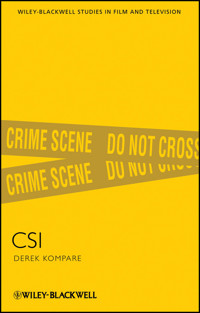
There are certain films and shows that resonate with audiences everywhere—they generate discussion and debate about everything from gender, class, citizenship and race, to consumerism and social identity. This new ‘teachable canon’ of film and television introduces students to alternative classics that range from silent film to CSI.
- Since its debut in September 2000, CSI’s fusion of cinematic spectacle, forensic pathology and character drama has regularly drawn in tens of millions of viewers around the world
- This original new study investigates CSI’s cultural importance, both for the media industry and for the criminal justice system itself, exploring its formal and narrative style, and its impact on media culture
- CSI provides a model for studying how genre, narrative, industry concerns, and the broad 'public life' of a television series contribute to our understanding of the nature and function of contemporary popular television
Sie lesen das E-Book in den Legimi-Apps auf:
Seitenzahl: 212
Veröffentlichungsjahr: 2011
Ähnliche




















Contents
List of Figures
Acknowledgments
Introduction: Why CSI Matters
1. Science, Spectacle, and Storytelling
2. What Happens in CSI’s Vegas
3. Finding Balance: Professionalism in Serial Narrative
4. CSI Effects
Conclusion
Appendix: CSI Episode Guide, 2000–9
Notes
References
Index
Praise for CSI
“This book acutely ‘follows the evidence’ of CSI’s spectacle, setting, and seriality. Unusually for academic work, Derek Kompare also pays close attention to the show’s developing characters. Careful, subtle, intelligent; Kompare takes CSI seriously not just as a brand, but as classic American television.”
Matt Hills, Cardiff University
“Kompare shows that we should take CSI seriously as a dense and fascinating example of American popular culture which has appealed to millions of viewers over ten seasons and established itself as the most important network franchise of its time.”
Roberta Pearson, University of Nottingham
Wiley-Blackwell Studies in Film and Television
Series Editors: Diane Negra and Yvonne Tasker
Experienced media studies teachers know that real breakthroughs in the classroom are often triggered by texts that an austere notion of the canon would disqualify. Unlike other short book series, Wiley-Blackwell Studies in Film and Television works from a broad field of prospective film and television programs, selected less for their adherence to definitions of “art” than for their resonance with audiences. From Top Hat to Hairspray, from early sitcoms to contemporary forensic dramas, the series encompasses a range of film and television material that reflects diverse genres, forms, styles, and periods. The texts explored here are known and recognized worldwide for their ability to generate discussion and debate about evolving media industries as well as, crucially, representations and conceptualizations of gender, class, citizenship, race, consumerism, and capitalism, and other facets of identity and experience. This series is designed to communicate these themes clearly and effectively to media studies students at all levels while also introducing groundbreaking scholarship of the very highest caliber. These are the films and shows we really want to watch, the new “teachable canon” of alternative classics that range from silent film to CSI.
This edition first published 2010© 2010 Derek Kompare
Blackwell Publishing was acquired by John Wiley & Sons in February 2007. Blackwell’s publishing program has been merged with Wiley’s global Scientific, Technical, and Medical business to form Wiley-Blackwell.
Registered OfficeJohn Wiley & Sons Ltd, The Atrium, Southern Gate, Chichester, West Sussex, PO19 8SQ, United Kingdom
Editorial Offices350 Main Street, Malden, MA 02148-5020, USA9600 Garsington Road, Oxford, OX4 2DQ, UKThe Atrium, Southern Gate, Chichester, West Sussex, PO19 8SQ, UK
For details of our global editorial offices, for customer services, and for information about how to apply for permission to reuse the copyright material in this book please see our website at www.wiley.com/wiley-blackwell.
The right of Derek Kompare to be identified as the author of this work has been asserted in accordance with the UK Copyright, Designs and Patents Act 1988.
All rights reserved. No part of this publication may be reproduced, stored in a retrieval system, or transmitted, in any form or by any means, electronic, mechanical, photocopying, recording or otherwise, except as permitted by the UK Copyright, Designs and Patents Act 1988, without the prior permission of the publisher.
Wiley also publishes its books in a variety of electronic formats. Some content that appears in print may not be available in electronic books.
Designations used by companies to distinguish their products are often claimed as trademarks. All brand names and product names used in this book are trade names, service marks, trademarks or registered trademarks of their respective owners. The publisher is not associated with any product or vendor mentioned in this book. This publication is designed to provide accurate and authoritative information in regard to the subject matter covered. It is sold on the understanding that the publisher is not engaged in rendering professional services. If professional advice or other expert assistance is required, the services of a competent professional should be sought.
Library of Congress Cataloging-in-Publication Data
Kompare, Derek, 1969–
CSI / Derek Kompare.
p. cm. – (Wiley-Blackwell series in film and television)
Includes bibliographical references and index.
ISBN 978-1-4051-8609-4 (hardcover : alk. paper) – ISBN 978-1-4051-8608-7 (pbk. : alk. paper) 1. CSI, crime scene investigation (Television program) 2. Television–Social aspects–United States. I. Title.
PN1992.77.C75K66 2010
791.45′72–dc22
2010016195
A catalogue record for this book is available from the British Library.
List of Figures
Crime and investigation: Catherine and Grissom investigate a dead body in a Strip hotel room
Teamwork: Sara and Nick discuss a case as they walk through the crime labs
Arriving at the scene: Catherine and Grissom search for clues late at night on a desert highway
Investigation: Sara and Warrick piece together the chain of events in a road accident
Investigation: Warrick attempts to match a blown-up film image of the Stratosphere Tower to the view from a dilapidated hotel room, in order to find the scene of the crime
Transparent science and justice: Sara and Hodges discuss evidence in the lab
The autopsy room: Grissom and Doc Robbins diagnose the cause of death (COD)
The interrogation room: Catherine and Brass confront the suspicious parents of a dead child
The Strip, in nocturnal glory
Death in Sin City: Grissom and Brass at another apparent murder in a Strip hotel
Sam Braun, icon of Old Vegas, keeping secrets from Catherine
Death in the Wilderness: Grissom, Catherine, and Brass at a triple murder scene in the Mojave Desert
Death in the Wilderness: Grissom studies a headless body buried up to its shoulders in a remote forest
Soulmates, or kindred intellects?: Grissom and Lady Heather get intimate
Through one-way glass, Sara sees Grissom obliquely confess his feelings for her
Searching for “the rush”: Catherine searching for an incriminating frame of film
Fleeting connection: Catherine and Warrick share an (almost) intimate moment, helping fuel fan speculation about their unrequited passions
Tenacity: Sara investigates every scrap of evidence at the scene of the accident
Focus: Warrick tests a ladder for blood traces
Empathy: Nick calmly gets a teen boy to confess to masturbation, in order to account for traces of semen found on a shirt in the suspect’s house
Exuberance: Greg triumphantly shows off an incriminating evidence sample
Reality/fiction: Technical consultant and former criminalist Elizabeth Devine displays real lab equipment on the CSI set, like this polarized light microscope
Watching the detectives: Catherine and Grissom encounter a reality TV camera crew
Mediated justice: Brass, Grissom and Warrick meet the press after the arrest of Hollywood star Tom Havilland
Public justice: Greg faces the media after the mixed findings of the coroner’s inquest which ruled the death of Demetrius James “excusable”
Forensic science on trial: Warrick is cross-examined about a knife found in a defendant’s car
Acknowledgments
Researching and writing about an individual, though long-running, television show has been a particular challenge, and I am very grateful to those who have assisted me along the way.
First, I cannot thank enough the series editors, Diane Negra and Yvonne Tasker, for their support and guidance throughout this process. Their understanding, encouragement, and comments helped provide a supportive environment throughout its development, and ultimately made this a stronger book. Similarly, I must thank Wiley-Blackwell’s acquisition editor Jayne Fargnoli for introducing me to this book series, and for her support of all of its titles.
I am grateful to the Division of Cinema-Television and the Meadows School of the Arts at Southern Methodist University for allowing me a research leave that enabled me to thoroughly research CSI and begin writing this book. The time spent researching crime fiction and the history of Las Vegas, and viewing and annotating each episode was immeasurably valuable, and I am thankful for this academic support. This research work has also led me to create a new course on crime television, so my SMU students are already getting a return on their investment!
I must also acknowledge the unconditional support of my family: my children Ben and Rose, and especially my wife Sally, for putting up with my obsessive viewing routines and persistent work schedule for many months. Similarly, I thank my brother John for hosting me in Las Vegas for several days, and showing me around many facets of this fascinating city. Creative projects are shared not only by those who create, but also by those who live with the creators, and I am thankful that they have allowed me to share it with them.
Despite what one may think, an extensive analysis of a long-running TV series is not necessarily a pleasurable experience. Thus, I would also like to tip my hat to the cast and crew of CSI, for inciting my interest in this intriguing series nine years ago, and consistently delivering on its promise in surprising and rewarding ways for over 200 episodes. It has indeed been a pleasure, and I hope this study can contribute to an appreciation and understanding of this engrossing, classic and popular (yet still relatively overlooked) series.
Introduction
Why CSI Matters
Bodies tell a story because we interpret them the way our predecessors taught us to. Just because we don’t see something we’re supposed to see doesn’t mean that it’s not there.
(Grissom, 2.3, “Overload”)1
On the surface, CSI: Crime Scene Investigation (CBS, 2000–) appears nearly identical to the dozens of crime-based television dramas that preceded it. A murder has apparently occurred. The police investigate. The crime is solved. The guilty are brought to justice. The pattern is well entrenched in popular culture, and particularly on TV. However, as chief crime scene investigator Gil Grissom tells his team of criminalists (science-trained forensic investigators, also known as CSIs) we must look more closely at the available evidence. What seemed obvious at first is now thick with meaning and mystery. A murder has apparently occurred . . . but why is the blood spatter on the walls from someone else? The police investigate . . . spending as much time in the lab as on the street. The crime is solved . . . only after the painstaking processing of a wide array of evidence, from crushed cars to human DNA. The guilty are caught . . . but they have yet to be tried in court. takes the formula of classic detective fiction, extending from literature to television, and injects it with conspicuous spectacle and style, creating a contemporary mythos of science and the law, and enthralling tens of millions of regular viewers.
Lesen Sie weiter in der vollständigen Ausgabe!
Lesen Sie weiter in der vollständigen Ausgabe!
Lesen Sie weiter in der vollständigen Ausgabe!
Lesen Sie weiter in der vollständigen Ausgabe!
Lesen Sie weiter in der vollständigen Ausgabe!
Lesen Sie weiter in der vollständigen Ausgabe!
Lesen Sie weiter in der vollständigen Ausgabe!
Lesen Sie weiter in der vollständigen Ausgabe!
Lesen Sie weiter in der vollständigen Ausgabe!




