


Erhalten Sie Zugang zu diesem und mehr als 300000 Büchern ab EUR 5,99 monatlich.
- Herausgeber: The History Press
- Kategorie: Geisteswissenschaft
- Sprache: Englisch
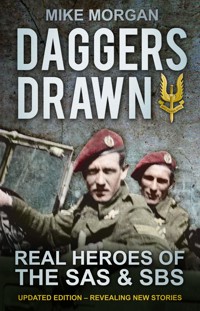
Mike Morgan presents 25 stories about the larger-than-life exploits of the SAS and SBS in World War II, supported by a selection of rare archive and action shots. These vivid stories, including some new and previously unpublished, supported by an updated selection of rare archive and action photographs, explore the larger-than-life escapades of the Special Air Service in the Second World War. From an SAS Jeep patrol in France, outnumbered fifty-to-one, who shot their way out to safety in their bullet-riddled vehicle and killed a quarter of their SS opposition, to an SAS soldier who talked his way through enemy roadblocks in North Africa in full British uniform and tore a strip off the guard for neglecting to check his papers, this is the first comprehensive collection of all the best stories in one book.
Sie lesen das E-Book in den Legimi-Apps auf:
Seitenzahl: 469
Veröffentlichungsjahr: 2011
Das E-Book (TTS) können Sie hören im Abo „Legimi Premium” in Legimi-Apps auf:
Ähnliche


















This special new selection of stories is dedicated to my great friends Arthur Huntbach and Rennie Roberts, brave, colourful warriors of the wartime SAS, and to 22 SAS veteran Graham ‘Tommo’ Thomson, a connoisseur of all things written about this extraordinary regiment and its unique history.
Acknowledgements
I would like to thank the many SAS veterans of the Second World War who have helped with key information and advice for this book regarding Regimental matters and history, especially the late Maj Roy Farran, one of the outstanding commanders of the wartime SAS, for his friendship over many years, his informative correspondence, advice and encouragement.
Also, I am especially grateful for his permission to quote at length from his classic wartime book Winged Dagger.
The extensive selection of authentic photographs, many rare and previously unpublished, have been provided from the collections of wartime veterans of the SAS, the Imperial War Museum and my own sources.
I am grateful to all veterans and their families who have played a part including Denis Bell, George Daniels, Gary Hull, Arthur Huntbach, Tom Robinson, Mark Rhodes, Steve and Kevin James, Jan Weekes and family and also the Blair Mayne Association of Northern Ireland.
There have been many more supporters, both individuals and past and present members of the Regiment too numerous to name. My thanks to all.
Finally, I would like to acknowledge the debt I owe to the SAS soldier who inspired me to become interested in the history of the Regiment in the first place - my late father Cpl Jack Morgan. An original wartime veteran of the 2nd SAS Regiment, he later served in Italy working on the intelligence of Maj Farran’s famous missions, the secret planning for the major behind-the-lines SAS drops in support of the D-Day invasion of Europe and the liberation of Norway.
My memories of his skill, determination and steadfast resolve provided the motivation and inspiration to write this book.
Contents
Title
Dedication
Acknowledgements
Foreword
By Major Roy Farran, DSO, MC and two bars
Preface to the New Edition
Introduction
How the SAS was Born
The Fearless Legends
David Stirling, Paddy Mayne, Anders Lassen VC, Roy Farran
Demons of the Desert
Jock Lewes, Fitzroy Maclean, Bob Lilley, John Sillito, Johnny Cooper
Blistering Action – France and Germany
Derrick Harrison, Chalky White, Ian Fenwick, Bill Fraser
Three Great SBS Commanders
George Jellicoe, David Sutherland, John Lapraik
The Hell that was Italy
George ‘Bebe’ Daniels, Philip Pinckney, Reg Seekings
Leading from the Front
Brian Franks, Bill Stirling, Eric Barkworth
Unsung Heroes
Denis Bell
New SAS Revelations
Appendix I
Maps
Appendix II
Official Citations: Lt Col Robert Blair Mayne and Maj Anders Lassen
Bibliography
Plates
Copyright
Foreword
By Major Roy Farran DSO, MC and two bars Former 2nd SAS Operational Commander
A personal appreciation of the Special Air Service Regiment and its most famous fighting son, Lt Col Paddy Mayne DSO and three bars.
‘Although I was a late arrival and fought in the Western Desert and Crete with my own parent regiment, the 3rd The King’s Own Hussars, I am very proud that I was recruited later into the Second SAS by Sandy Scratchley in North Africa. It is an invidious distinction to single out different SAS characters for praise – that is apart from the obvious stars like David Stirling himself, Blair (Paddy) Mayne, and George Jellicoe etc., and I cannot do it. I admire and am proud of them all. Indeed I am very proud to have been associated with such a band of heroes of all ranks. I also feel that those who have served in the SAS since the Second World War have been worthy successors of the originals. Honour and praise to them all!
Paddy Mayne was a great friend of mine and I have stayed in his home at Newtownards – a neat white house kept in immaculate shape by his mother. Blair Mayne was a very strong man and played rugby football for Ireland, one of the few areas where north and south combined for a united team. He was an Orangeman but knew the words of all the Irish rebel songs as well as ‘The Sash Me Father Wore’. So did I, and once in his company I began to sing ‘The Foggy Dew’ in a pub in Belfast. Paddy was horrified and sprang to my defence when hostile Orangemen took umbrage. He was strong enough to bend an iron bar or a nail in his bare hands. Yet, except in his cups, he was very gentle. Of course, in action he was like a Viking who runs berserk and I can quite well imagine his pulling the dashboard out of a Messerschmitt when his party had run out of explosives and ammunition, as he actually did in an early desert raid. He was fearless when his blood was up.
David Stirling had recruited him in Cairo when he was in trouble for banging together the heads of two military policeman who objected to his pulling trees out by their roots along a main boulevard. When he had been drinking he was a holy terror, but brave as a lion. His officers and men adored him, even though they were terrified of him when he was taken with drink. He was a great soldier with good tactical sense and his men would follow him anywhere. I only fought alongside him once – at Termoli – and was most impressed by him and his raiding force.
Paddy was quite well read and had a very soft voice on most occasions. He did not get along with women – I think he was frightened of them in some way, although he was neither a homosexual nor misogynist. Towards the end of his life he did become very attached to a girl who knew how to handle him. He was not a bigoted Ulsterman either and one of his best friends was Ambrose McGonigal, ex-SAS, Roman Catholic and a judge after the war. Some accounts leave the impression that Paddy Mayne was an alcoholic and drunk most of the time. That is just not true although he enjoyed a party. Most of the time, he did not drink at all.
Mayne was a fascinating character and reminded one of some Celtic warrior of ancient times who could mow down his opponents with a double-edged claymore that no one else could even lift.
Preface to the New Edition
Nazi Atom Bombs and More Untold Secret History of the SAS
Since this top-selling book was first published in 2000, it has gone out to countries all over the world including Europe, America, Japan, New Zealand and Australia – even Germany and has been reprinted many times.
Told entirely from an individual perspective, it’s not only a firm favourite with the public and military buffs, but with veterans and serving members of the Special Air Service Regiment and current leading serving Special Forces in the USA and Australia and New Zealand – as can be seen by its many positive reviews. Its extensive photographic record rivals, or surpasses, that of any Second World Two book on the SAS. This, combined with its wealth of distinctive and exciting true life stories, has ensured that Daggers Drawn is now firmly established as a British classic of the genre.
Now seven more true life stories, most of which have never been told before, make this new edition a special collector’s item.
The authentic wealth of SAS contacts in this book are a key part of its success, and for this I must acknowledge the part played by my late father Corporal Jack Morgan, of the elite wartime 2nd SAS Intelligence unit, whose connection opened the door for me to meet many of the outstanding veterans of 1st and 2nd SAS, whose stories are so vividly told within. He was a brave, highly intelligent and modest man, and I’m sure he would be proud to know that his son has kept close contact with so many SAS wartime veterans over the course of more than a decade, including several who served with him and who have acknowledged his personal contribution to the war effort.
Inevitably, the remaining veterans are now steadily dwindling, with those surviving being in their late eighties or early nineties, and the comment is often heard that ‘there are now no new stories to be told about the wartime SAS’. However, this most certainly is not the case, as this new edition so strikingly shows. The story of the SAS in the Second World War is now a key part of history, but there are still many stories and important facts still to be discovered, including key omissions lost in the mists of time – by accident, or deliberately. Most of the official records of the SAS mysteriously vanished at the end of the war, in any case.
In addition, a number of wartime veterans have assured me that a sizeable number of missions which L Detachment SAS mounted in the Western Desert, and others by the SAS in Europe, were never recorded at the time – with so many patrols going out daily, there simply wasn’t time.
More importantly, there are also claims of crucial major contributions by the SAS which have never been recorded in any books, or documents, or even acknowledged by the powers that be. For instance, Trooper ‘T’ a highly respected member of 1st SAS, with impeccable credentials, told me that a small hand-picked team of SAS advised on the famed mission/s to sabotage the Vemork hydroelectric plant in Norway which was producing heavy water with the potential to give the Germans the first atom bomb, ahead of the Allies, in 1942/43. If this terror weapon had been married up with Hitler’s V2 ballistic rocket programme, a nightmare scenario could easily have led to Allied defeat in Europe, at least. At worst the war could have been irrevocably lost.
He did not stipulate whether he was referring to SAS involvement in the first, heroic but disastrous British Forces glider borne attempt to destroy the vital plant, or the second successful Special Operations Executive (SOE) mission involving Norwegian commandos – or both. This may be academic in any event as the mistakes learned from the first mission helped ensure the vital success of the second.
Firstly, in November 1942, the airborne Operation Freshman raid was mounted, comprising ‘Commando’ trained volunteer bands of highly skilled demolition experts from the Royal Engineers. Two Halifax bombers towing Horsa gliders left Wick in Scotland on the night of 19 November, to destroy the plant and then attempt to escape via Sweden with the help of the Norwegian Underground. But the mission, ruined by poor luck and bad weather, was a disaster. Both gliders crash landed in enemy held Norway and the survivors were captured, tortured and shot, or poisoned, shortly afterwards under Hitler’s Commando Order.
Some time later in 1943, it’s famously recorded that a team of brave and able Norwegian commandos did succeed in destroying the production facility in a successful second attempt on the facility, called Operation Gunnerside, in a clandestine operation led by the SOE. It’s arguably the most successful act of sabotage in the whole of the Second World War and was the inspiration for the famous film The Heroes of Telemark, starring Kirk Douglas.
However, my 1st SAS friend, who was not prone to exaggeration, not only told me that the SAS helped train the saboteurs and advised on their method of insertion into Norway and their exfiltration, but that he was actually one of the team. He also told me that this involved travelling through Sweden, a neutral country, and other details – which ties in with the known facts - but sadly died suddenly just a few weeks later, so that the full story of this SAS connection, never before divulged, was not fully revealed. He asked me not to divulge any details while he was alive and I only do so now, many years later, as a tantalising piece of verbal evidence of possible unknown, but momentous, connection with a key part of history. It certainly would, however, have made perfect sense for the SAS to have been involved in this crucial mission at this time, as they were the world’s leading exponents on sabotage and stealthy methods of travelling to and from enemy targets undetected. It is not suggested, however, that the SAS in any way took part in the final mission/s, whichever was referred to by Trooper ‘T’, but was part of the training and sabotage expertise involved. A clue may lie in the fact that, towards the end of his life just a few years ago, 1st SAS veteran George Daniels, another soldier whose outstanding story of personal survival is told in this book, showed me photos of a special pilgrimage he made to Norway to visit the graves of the executed Freshman heroes. This puzzled me at the time, as I failed to see what connection this had with the SAS. However, maybe his memories were more personal than I knew at the time – of comrades met, known and lost.
I accept though that although I have a face-to-face account from a highly trusted veteran who later operated many months behind-the-lines in France and had a distinguished SAS career, I cannot prove this connection and have no doubt that sceptics will say that Trooper ‘T’ was mistaken, or this connection never happened. We may never know for sure, unless this rings a bell with other veterans. I would be most interested to hear more if it does. If it is true, as I suspect, the free world owes the SAS an acknowledgement for its vital part in a potential war-winning mission hitherto not publicly known.
National security is not involved, as all this happened nearly seventy years ago. However, I emphasise that the writing about the methods, training, tactics and operation of the modern-day SAS is an altogether different matter.
I wholeheartedly support – and have scrupulously adhered to in my writing career – the Disclosure system governing serving personnel, books and information on modern SAS missions which the SAS Association and the Ministry of Defence so successfully introduced more than a decade ago.
History is one thing, but Britain’s security and the lives and welfare of our current serving SAS soldiers in many places around the world is entirely another matter.
Mike Morgan, 2012
Introduction
How the SAS was Born
The Special Air Service is, without question, the most famous and accomplished of all the world’s Special Forces, with a track record of achievements second to none. Many countries from various continents and with differing political backgrounds have attempted to emulate the success of Lt Col David Stirling’s stunning concept of behind-the-lines raiding. However, none have so far bettered the tough standards laid down by the widely respected – and feared - British force, hand-picked from the cream of the finest recruits in the British Army.
From the Second World War, through Malaya and a multitude of hot spots to the Falklands, the Gulf War, Northern Ireland to Kosovo and the ongoing tragedy of the Balkans and the Iraq crisis, the SAS and its sister unit the Special Boat Service have constantly been at the forefront of the action. In recent times in the deadly mountains of Afghanistan they have operated fearlessly and heroically against the Taliban and Al Qaeda terrorists. Soldiers and officers of the SAS and SBS have always taken on the most difficult and dangerous covert assignments from behind-the-lines sabotage and surveillance, to counter terrorism and siege busting.
The SAS Regiment rocketed to fame in May 1980 with the spectacular storming of the Iranian Embassy in London when a highly trained counter-terrorist team halted the murder by terrorists of twenty-one hostages, the drama being transmitted by television cameras to millions worldwide. But popular fascination and admiration of this intensity is a relatively modern phenomenon. The current prestige of the Regiment, and the familiarity with which the general public perceives it, is demonstrably at an all time high. It is therefore sometimes diffcult to grasp that before the Second World War the SAS and SBS simply did not exist. The fact that the SAS grew, under Lt Col David Stirling’s driving inspiration, into the world-leading force it is today is a lasting tribute to his unique foresight, courage and tenacity and of the calibre of the men and officers he recruited to join his fledgling team. However, recognition of the true value of such specialist, modern raiding forces took a long time to be fully acknowledged.
From 1941 to 1945, thousands of SAS and SBS raiders operated in campaigns in North Africa and other widely dispersed theatres, including Italy, the Mediterranean, the Aegean, France, Belgium, Holland and Germany, destroying hundreds of enemy aircraft, trains, troops, supplies, installations and communication facilities. But even so, few people at home in Britain at the time had even heard of the units. When the war ended, the SAS Regiment was declared to be surplus to requirements and summarily disbanded. It was thought by those in higher command to have been a wartime ‘one-off’ which would never be needed again in peacetime. However, as soon as the crisis in Malaya flared up in 1948, the SAS wartime veterans were urgently recalled for active service and won a brilliantly successful campaign against Communist terrorists. Subsequently, the Regiment has hardly been out of action ever since in numerous trouble spots all over the world.
It was not until years after the Second World War had ended that books started to be written by veterans and authors divulging the spell-binding contributions made by the SAS to the war effort against Hitler and Mussolini, giving a true inkling of their immense part in the victory. These early ground-breaking successes were achieved by troops operating in many cases hundreds of miles behind enemy lines using fighting knives, pistols, grenades, Tommy and Bren guns and machine-guns, and finding their way to the target on foot or in jeeps, using a compass, maps and gut instinct. Today’s SAS and SBS have a bewildering and powerful array of modern weapons and high technology at their disposal, including hand-held satellite navigation systems which can tell soldiers precisely where they are anywhere in the world to within a matter of centimetres. They are versatile, highly trained specialists who can turn their hands to almost any military or covert task asked of them. One traditional link between the SAS of the Second World War and those of the present day remains, however, in the shape of the arduous SAS selection process. This tests physical and mental toughness to the limit to ensure that only the best recruits go through to gain the ultimate honour of wearing the famous Winged Dagger badge.
While the future of Britain’s SAS Regiment seems assured for many years to come, never has it been more important to remember the Regiment’s illustrious roots. It is also a near-certainty that never again will so many SAS and SBS soldiers go into action as they did in their thousands in the white hot cauldron of the Second World War – the time when the ‘Who Dares Wins’ heroes were born.
Origins
The Special Air Service was a development of the Commandos, whose daring raids took the war directly to the enemy, a form of warfare much favoured by pugnacious British war leader Winston Churchill, especially after things went so badly for Britain early in the war. After Britain’s forces were ejected from Europe by the all-conquering German Army in 1940, Churchill was desperate to hit back at the enemy by any means available, in the air, via the sea and on land. Therefore, when Lt Col Dudley Clarke prepared a report suggesting the formation of a mobile, highly trained fighting force which could strike suddenly at widely dispersed targets on land or by sea, Churchill eagerly approved the scheme for a so-called Commando force. Churchill’s ‘leopards’, as he termed them were, like the SAS who followed them, recruited from existing units of the British Army and were equipped with the finest weaponry imported from America, including the trademark Tommy guns and razor sharp Commando knives for silent killing of sentries.
By the end of June of that year, almost 200 officers and men formed the first Commando unit, which began the soon-to-be-familiar intensive training programme. Many more were to follow in this unit’s wake. However, though early cross-Channel raids were relatively successful, later larger scale operations in Syria, Crete and North Africa by Layforce Commando Brigade were not. This was because large seaborne formations made it almost impossible to surprise the enemy; the situation was compounded by a chronic shortage of suitable ships. The desperately brave but unsuccessful raid to kill or capture Rommel led by Lt Col Geoffrey Keyes, who won a posthumous VC in the vain attempt in November 1941, was the last operation true to the original concept. For the rest of the war, the Commandos were largely used as a hard-hitting shock assault force going in first in large-scale landings or operations.
Significantly for the birth of the SAS, a highly important event occurred earlier in 1941 when a consignment of parachutes bound for the 2nd Parachute Brigade in India found their way into the hands of Lt Jock Lewes, of No. 8 Commando, based at Alexandria, North Africa. Lewes was a very intelligent, determined and adventurous officer who was also, coincidentally, a close friend of David Stirling, a Commando officer himself and the man who was to make the SAS dream a reality. Lewes obtained Maj Gen Sir Robert Laycock’s permission to experiment with the parachutes. Stirling joined the risky venture and with a handful of fellow Commandos jumped from an obsolete Valencia bomber – but things went wrong. Stirling badly damaged his spine in a heavy landing and was temporarily paralysed. However, being the productive genius he undoubtedly was, he put an enforced spell in the Scottish Military Hospital in Alexandria to excellent use.
Stirling wrote a lucid report on airborne raiding operations, arguing that current Commando raids were too large and that groups of about sixty men divided into four-man patrols should be used instead to strike at enemy airfields on the vulnerable coastal plain. Other existing forces were well aware of the possibilities posed by the long and wide-open desert flank, which stretched for many hundreds of miles. Using Lewes’ skill with compact bomb making, the raiders would strike swiftly and silently at their targets using special charges and then simply melt away into the darkness to rendezvous with the Long Range Desert Group who would bring them back by truck to British lines.
The daring plan required a minimum of men and resources and seemed feasible. So, after being discharged from hospital in July, Stirling, in a famous incident, wangled his way into the office of the deputy commander Gen Ritchie by a mixture of cunning and sheer good luck to try to get top-level backing for his scheme. Fortunately, his plan appealed to Ritchie and the commander-in-chief, Gen Auchinleck. At this time, Auchinleck was under intense pressure from Churchill to mount a new offensive and believed special operations such as the scheme put forward by Stirling would help the success of his general attack. He was building up a mass of men and resources and hoping to knock Rommel out of the desert war for good. The Layforce group of Commando units, coincidentally, was earmarked for disbandment and so a rich pool of crack, highly trained soldiers was available in the Middle East, ripe for picking. The man destined to reap the harvest was the young Lt Stirling, soon to lead the newly formed SAS.
Stirling was itching to unleash his bold raiding plan, using small patrols of men to strike deep behind enemy lines, causing untold mayhem and confusion. The redundant Commandos were just the troops he needed to do the job. They were, after all, presently unemployed and trained in all the necessary close fighting and demolition skills. Thus, at the end of July 1941, the Special Air Service was formed. The choice of name coincidentally involved Dudley Clarke, now a brigadier, and formerly the founder of the Commandos. He was trying to deceive the Axis forces about the size, strength and composition of British formations in North Africa by cunning subterfuge, including dummy gliders designed to fool enemy spotter planes into believing Allied positions were far stronger at certain points than they actually were.
Formation of L Detachment
Dudley Clarke developed bogus units, one of which was called 1st Special Air Service Brigade and, when he heard of the formation of Stirling’s parachute unit, suggested Stirling’s real raiding unit be similarly named to reinforce credibility in his deception schemes. Stirling readily agreed to calling his force L Detachment, Special Air Service Brigade … and a legend was born.
By August, Stirling had been authorised by Auchinleck to recruit sixty-six Commandos from Layforce. He established L Detachment at Kabrit, a desolate area in the Canal Zone about 100 miles from Cairo. The area was barren when his men arrived to set up camp and they had to beg, steal or borrow tents and equipment from wherever they could find them. The men improvised, as SAS soldiers the world over have ever since. The clock was ticking with just three months to go before Auchinleck’s long awaited November offensive and the SAS’s inaugural mission. Stirling’s original officers were Fraser, Lewes, Thomas, Bonnington, McGonigal and Mayne. Stirling recruited Mayne even though he was under arrest for striking his commanding officer. He recognised that as he was such a fine, aggressive soldier he would make a valuable recruit to the SAS. As future events unfolded, Stirling’s faith in the tall, powerful, courageous Irishman was repaid a thousandfold, especially after he took command when Stirling was later disastrously captured.
Intensive training began and all recruits were trained in a high level of skill in explosives, navigation and night movement. Expert handling of all Allied and Axis weapons was a priority, with troops continually stripping and reassembling weapons, sometimes blindfold. In fact, some of the German weapons such as the Schmeisser machine pistol were far superior to the British versions and were often used in combat. It became a trademark of the SAS that a mixture of weapons was used – sometimes American, sometimes British, sometimes German – whichever was judged to be the best at any particular point in time. Parachute training was greatly improvised. Stirling and his men performed hair-raising backward rolls off the back of a 3-ton lorry at 30 to 50mph and many back, leg and ankle injuries resulted! But Stirling allowed no let up. No proper parachute training facilities were available at first, although later towers of varying height were built out of scaffolding with impressive ingenuity for more realistic practice.
Nothing could, however, substitute for the real thing. Several appeals to the parachute training school at Ringway, near Manchester, for advice on equipment and procedure fell on deaf ears and this had a direct bearing on the tragic deaths of two troopers when the SAS made their first jumps from an RAF Bristol Bombay. The two men were killed when the static line clips on their chutes failed – an accident that the personnel at Ringway already had experience of. An immediate strengthening of the clips solved the problem and Stirling was first to jump next day, sensibly leaving his men little time to dwell on the disaster.
At about this time, the L Detachment raiders became the target of ribbing from certain members of headquarters’ staff who had a derisory opinion of irregular units such as the SAS. One senior RAF officer took Stirling to task on this point. Rising to the challenge, the SAS commander bet him his men could get into Heliopolis, the main RAF airbase outside Cairo, without being spotted. Stirling gauged it would also be useful practice for his imminent groundbreaking SAS raids against German and Italian air bases. The SAS men set out across the desert by various routes, reaching the guarded British base undetected. They broke in through the perimeter and stuck labels on most of the aircraft there. Some had several labels plastered all over them, veterans of the time recall. Then the raiders silently melted away into the darkness. The SAS had won the bet hands down, to the embarrassment of the RAF!
As Auchinleck’s November offensive approached, Stirling and Jock Lewes and their men were trained to a high peak of readiness. Countless hours were spent poring over intelligence reports, checking maps, weapons and explosives. Everyone felt it was now or never for the Special Air Service. The plan was to parachute in to attack a group of German frontline airfields which housed some of the best of the Luftwaffe’s aeroplanes, including fighters. Lewes had perfected his famous ‘sticky bomb’ which was specially designed to wreck aircraft with a deadly combined incendiary and blast charge made of thermite and plastic explosive. It was this secret weapon that the SAS planned to unleash on the unsuspecting Germans.
The First SAS Raid
Tragically, blistering desert winds – the worst for years - turned the SAS’s first mission on 16 November 1941 into a disastrous nightmare. More than sixty SAS officers and men in five groups were dropped from Bristol Bombay aircraft, but the vicious gale-force winds scattered the raiders all over the desert. Some were severely injured on landing and many more were literally blown away into the desert, never to be seen again. Only twenty-two officers and men returned from the raid. Fortunately, the key men, Stirling, Lewes and Mayne, were among those who lived to fight another day, but all the containers, bombs and most of the weapons were lost in the mayhem and so none of the chosen airfields could be attacked.
The LRDG met the group as arranged to ferry the disconsolate survivors back to Allied lines. Stirling immediately realised he had to abandon the idea of parachuting into the desert. Less-determined men would have called it a day after this débâcle but, after talking over the matter with LRDG commander David Lloyd Owen, Stirling decided that in future the raiders would be dropped off and picked up near their targets by the LRDG. This simple change of plan was to be the crucial key to success for the fledgling SAS force.
The LRDG, brainchild of Ralph Bagnold, was formed in June 1940 as an intelligence-gathering unit. Its soldiers travelled in specially modified Chevrolet and Ford trucks, defended by heavy machine-guns. But as the war progressed, the LRDG diversified its method of operations, raiding bases and airfields in its own right. Patrols took British agents to and from their destinations, patrolled very deeply behind enemy lines, gathered valuable intelligence and found new routes for larger forces. They also operated their famous clandestine road watches to observe and count the strength and composition of enemy convoys and other forces. Now they became the ’taxi force’ that the SAS desperately needed to survive.
Gen Ritchie, now commander-in-chief of the Eighth Army, ordered L Detachment to Jalo oasis, which it shared with a unit of the LRDG. It was soon to become a happy hunting ground for both units. Stirling struck swiftly to eliminate all memory of the failure of the first SAS raid and to spike the guns of the gathering group of GHQ and other doubters. In December 1941, SAS squads simultaneously attacked three enemy airfields at Sirte, Agheila and Agedabia. These raids brought an astonishing success and the SAS was credited with destroying over sixty enemy aircraft and thirty vehicles with their Lewes bombs. Then, just before Christmas, another raid was mounted with Stirling and Paddy Mayne attacking airfields at Tamet and Sirte, while Lewes and others targeted a similar site at Nofilia. While Mayne’s charmed Irish luck held again, Lewes was tragically killed during the return trip, when his column of vehicles was strafed by an enemy plane and he was hit, dying almost immediately. His loss was keenly felt by the SAS as he was one of the unit’s leading strategists and Stirling’s right-hand man. Lewes was also the SAS’s training supremo, cunningly schooling his men in the intricacies of behind-the-lines desert raiding.
The Famous Badge and Wings
The raiders were by now sporting their famous insignia of a flaming sword of Damocles over the legendary motto ‘Who Dares Wins’. Though the debate continues to this day over the actual origins of the world-famous badge, it was allegedly originally made up by a Cairo tailor and many believe it was for this reason that the flaming sword came out looking more like a dagger with wings! The colours of dark and light blue represented the Oxford and Cambridge University rowing background of Oxbridge officers, including Lewes. Parachute wings in white and two-tone blue were proudly worn on the right upper arm of troopers after five or more jumps. Officers wore them on the left breast and, after a period of operational service, other ranks were allowed to follow suit. These wings became more highly prized to the SAS than virtually any award for bravery.
Free French Swell the Ranks
Stirling was promoted major in January 1942 and, as the score of enemy aircraft destroyed climbed steadily, he was encouraged to enlarge his unit with new recruits. This, of course, was just what Stirling wanted and had planned for. Among these recruits was a company of Free French paratroopers under Capt Berge. This unit became the French Squadron of the SAS and was later to distinguish itself on returning to its home country after D-Day.
In the earliest days, distinctive white berets were originally worn to complement the SAS insignia, but these drew scorn from other units and caused fights in the bars in Cairo. A sand-coloured beret soon replaced the embarrassing white versions and these became the unit’s distinctive headgear. Although, as will be seen later, after 2nd SAS was officially formed in 1943, they wore a maroon version. In January 1944, when the SAS Brigade was formed under the 1st Airborne Division, red berets were supposed to be worn by all SAS units. Though these continued to be accepted by 2nd SAS and the foreign SAS squadrons, many of the later re-named 1st SAS and SBS veterans stubbornly refused to obey orders to replace their beige berets with maroon. One of the foremost to stick to his guns on this issue of pride and tradition was the fearsome Lt Col Paddy Mayne. A similar beige beret is worn by the modern equivalents today.
The SBS Join the Fray
Backtracking to the desert, Stirling’s ceaseless determination to widen the role of his raiding force led to the absorption into the SAS of the men of the Special Boat Section of No. 8 Commando. A joint raid on shipping in Bouerat harbour followed in January 1942. This original SBS unit, which was in fact a separate Commando entity, is easily confused with the later SAS Special Boat Squadron and, ultimately, the Special Boat Service which also came under the SAS umbrella. The combined SAS and Commando SBS raiders on Bouerat were again transported to the target by truck and the unerring accuracy of the ace navigators of the LRDG, but unfortunately the canoe that was to be used in the raid was damaged en route. Even so, a great deal of damage was done to the harbour facilities, stores and petrol tankers were devastated by the raiders’ bombs. In March of the same year, Stirling tried a similar attack on Benghazi harbour, but again the boat being carried was damaged, although Paddy Mayne destroyed about fifteen aircraft at Berka.
The Greek Sacred Squadron
At about this time, the Greek Sacred Squadron joined Stirling’s flourishing SAS L Detachment. This unit was commanded by Col Kristodoulus Tsigantes, who later served in the Aegean, winning the DSO. The squadron comprised former officers and men of the Greek Army who had bravely escaped German occupation of their homeland. The French Squadron of the SAS had just completed their SAS training and now it was the turn of the Greeks to be put through their paces. They passed with flying colours. Having witnessed the crushing of their home country by the Nazi invaders, these men were desperately keen to get to grips with the enemy. They were hell bent on revenge, having witnessed countless atrocities against their families and countrymen. In truth, they were a bloodthirsty bunch and little quarter was asked or given.
The SAS received top-priority orders to stop the Luftwaffe from sinking a vital convoy bound for Malta. Several groups of raiders were ordered to attack aircraft on airfields at Benghazi, Barce, Derna and Heraklion on Crete. The Crete raiders, led by Capt Berge and comprising British and Free French SAS, were decimated after successfully damaging the enemy airfield. Earl Jellicoe, later commander of the Special Boat Service, managed to escape to safety along with a Greek guide. The rest of the party were either killed or taken prisoner and shot – the fallen unfortunately included the courageous Berge.
The Arrival of the Famed SAS Jeeps
In June 1942 a consignment of jeeps arrived from the USA and Stirling immediately realised that not only would these be ideal for desert raiding and could carry heavy weaponry, but would give the SAS independence from the LRDG. Their radiators were fitted with simple but highly effective condensers, which enabled the vehicles to cope with the fierce desert temperatures. Water expanded into the condensers in the same way that expansion bottles work on modern motor cars. As a result, the vehicles did not overheat and when the radiators cooled, the water simply drained back into them without loss of precious coolant.
By chance, while looking for suitable machine-guns, Stirling came across some RAF Vickers K drum-fed weapons which used to be fitted to now obsolete aircraft and were on their way for scrap. Not only did these have a phenomenally high rate of fire at more than a thousand rounds a minute, but they were principally designed to shoot up and set ablaze aircraft in air-to-air combat, having a deadly mixture of tracer, armour-piercing and explosive bullets. These simple and highly effective weapons could be mounted in pairs and so twin sets of machine-guns were fixed front and rear on the jeeps which, with extra jerrycans strapped on to the rear and bonnet, had an extended range of several hundred miles. Browning .5-inch heavy machine-guns were placed on some of the jeeps in anti-aircraft mountings to give further range and firepower.
In due course, what was to become one of the legendary missions in SAS history took place thanks to the arrival of a further batch of twenty brand new four-wheel-drive jeeps.
The Big Jeep Raid
The target selected for a massive, co-ordinated jeep raid was Sidi Haneish, a landing ground in the Fuka area that housed a large number of Ju 52 transport planes. These were, at this crucial stage of the desert war, in short supply and were a vital part of Rommel’s stretched supply lines. Stirling hatched a daring plan to destroy as many planes as possible in one devastating raid made in the light of the full moon. Surprise and overwhelming strength were the keywords. Eighteen jeeps drove at the base in line abreast, allowing a clear field of fire to knock out the perimeter defences. Then, once on the field, a green Very light was fired and the jeeps changed formation to an arrowhead, headed by Stirling’s jeep with a co-ordinating navigator’s jeep in the front centre behind. The SAS drove straight on to the airfield between the rows of planes. Almost seventy machine-guns opened up simultaneously with devastating results, blasting everything in their path on either side. Planes were set ablaze or literally shot to pieces.
To ensure pinpoint precision, the SAS had practised the manoeuvre in the desert beforehand, including live firing sessions. Nothing was left to chance as Stirling realised that this was one ploy that could be used once and once only on this grand scale, as counter measures were bound to be taken by a furious enemy. To the raiders’ delight, there were not only Ju 52s but also Messerschmitts and Stukas on the airfield. The SAS just could not miss from less than 50 yds and the deafening roar of their machine-guns was joined by the dull thuds of exploding petrol tanks as plane after plane was blown sky high. The heat was so intense some of the British men’s hair and eyebrows were singed and panic-stricken German troops could be seen running about in the distance, silhouetted by the flames.
Stirling’s jeep was hit by a stray burst of fire and put out of action, but he signalled for another jeep to pick up him and his crew. A heavy enemy machine-gun returned fire and caused the only SAS casualty of the action – Sandy Scratchley’s front gunner was hit and killed outright. However, concentrated fire from the jeeps soon silenced all opposition. Stirling ordered his men to destroy some remaining planes temptingly sited on the edge of the airfield and then the raiders roared away into the desert. As a parting gesture, the irrepressible Paddy Mayne was seen running from his jeep to place a bomb on the wing of an undamaged plane and then rushing back to his jeep. The airfield and its planes were a scene of total devastation.
The jeeps drove off into the desert, split up into groups and independently made their way to a pre-determined rendezvous. One group got lost, driving on to a flat stretch of stony desert with absolutely no cover from the enemy aircraft that would be sent out to look for them. Luckily, an early mist cleared and they found a large depression cut by deep wadis, with thick scrub – a perfect hiding place. Soon all the jeeps were hidden and it was only then that the tension that had built up during the high drama of the attack could be released. The dead soldier was buried with simple dignity with the men briefly paying their last respects.
This one big raid, together with a smaller one nearby, had accounted for up to 50 enemy aircraft, bringing the running total after a year’s operations to about 250 destroyed. An impressive number by any standards. Afterwards, however, it was a case of once bitten, twice shy as far as the Germans were concerned and the number of sentries posted was increased dramatically. Jeep raids were mounted in future many times, but never on this awesome scale. It was a magnificent one-off, so typical of Stirling’s flamboyant daring and improvisation, which he repeated time and again throughout the desert war.
Evolution of the Special Boat Squadron
In August 1942, the Special Boat Section of Middle East Commando came under SAS control. Earl Jellicoe and Fitzroy Maclean organised units within the overall SAS unit, which would later emerge as the SAS Special Boat Squadron. The SBS were equivalent members of the SAS, entitled to wear the coveted wings and sand-coloured beret. Maclean was given command of M Detachment and trained for operations behind enemy lines in case Germany invaded Persia and Iraq. When this threat failed to materialise, Maclean was parachuted into Yugoslavia as Churchill’s personal representative to Tito’s partisans, playing a vital part in ultimate victory in that country and the tying up of countless German forces. His detachment was taken over by Ian Lapraik and Langton and Sutherland commanded other units. In September 1942, the SBS attacked the island of Rhodes, destroying aircraft and stores.
Formation of 1st SAS
Meanwhile, Stirling’s L Detachment dropped its title and became the 1st Special Air Service, a regiment in its own right with a strength of about 400. The disbandment of Middle East Commando allowed Stirling to recruit 10 more valuable and highly trained officers and 100 extra men. Stirling’s command now comprised almost 800 men, including 1st SAS, French SAS Squadron, Greek Sacred Squadron and Special Boat Section men. A 2nd SAS Regiment now began to be formed under Stirling’s brother William. It began training with the US 1st Army which landed in Africa during the Operation Torch invasion in November 1942.
Stirling’s Capture
In January 1943 disaster struck when Stirling was captured by a German counter-SAS unit in the Gabes area of Tunisia while attempting to link up with American forces for the first time. Despite several escape attempts, he was eventually incarcerated at Colditz Castle, where he spent the rest of the war. Paddy Mayne took over as commander of 1st SAS. At the end of the war in North Africa, the SAS had destroyed more than 400 of the enemy’s best fighters and bombers - a phenomenal and decisive contribution to the overall victory.
The French Squadron returned to Britain and was strengthened and retrained while 1st SAS was split in two with 250 men under Earl Jellicoe becoming the Special Boat Squadron, absorbing the Special Boat Section and the Small Scale Raiding Force. This highly specialised unit had seen action off the coast of France and Africa, before becoming part of the Commandos.
Anders Lassen VC
The SBS made a base near Haifa and linked up with the Greek Sacred Squadron to raid enemy occupied Mediterranean and Aegean islands and the Adriatic. The SBS was later retitled the Special Boat Service and Anders Lassen became its most famous son, winning a magnificent VC posthumously with the end of the war almost in sight by knocking out a series of heavily defended strong points at Lake Comacchio, in northern Italy.
The Formation of the 2nd SAS
The 2nd SAS was officially formed in May 1943 at Philippeville in Algeria. It raided Sardinia, Sicily and the Italian mainland, but Lt Col William Stirling soon had the first of several fierce arguments with his superiors, believing his men would be more effectively used in small sabotage groups parachuted far behind enemy lines than in a Commando-type role.
Assault on Sicily and Italy
Paddy Mayne’s 1st SAS was temporarily renamed the Special Raiding Squadron and led the assault on Sicily, operating for the next few months on Commando lines, landing by sea against well-defended enemy positions on mainland Italy. One of the toughest SAS engagements of the war was at Termoli in October 1943 when 1st SAS, with Commando units and a contingent of 2nd SAS, repulsed a series of attacks by the crack German 1st Parachute Division despite being heavily outgunned and outnumbered. Serious losses were sustained, however, including an entire SAS section wiped out by a single shell blast. At the end of 1943, SRS reverted to 1st SAS once again and was placed under the command of 1st Airborne Division.
Preparations for D-Day
In early 1944, it was decided to form a full SAS Brigade and in March, after further action in Italy, 1st and 2nd SAS were ordered back to Britain to retrain for Overlord, the long-awaited invasion of Europe. At about this time Lt Col William Stirling, commanding officer of the 2nd SAS, resigned. Some senior staff members at Army headquarters wanted the SAS to be parachuted into France to operate as the filling in a sandwich between the invasion beach area forces and the Panzer reserve divisions deeper inland, waiting ready to move towards the coast and crush the invaders. Stirling rightly argued that such a deployment would not only be a total misuse of his highly trained SAS men, but would also be suicidal and lead to the annihilation of the SAS.
Stirling won his argument but overstepped the subtle line of Army protocol and was forced to resign. An extremely able commander was lost who was much missed by the SAS. He was succeeded by another equally able commander, Lt Col Brian Franks, who led his men to glory in France right up to the very borders of Germany itself.
The SAS brigade, now some 2,000 strong, was formed in Ayrshire in January 1944 consisting of 1st and 2nd British and Commonwealth SAS, 3rd and 4th French SAS, the Belgian SAS Squadron and F Squadron HQ signals and communications, otherwise known as Phantom. This intelligence, signals and reconnaissance unit gathered information in forward areas behind enemy lines, radioing the vital data back to GHQ. One of its most famous members was the Hollywood film actor David Niven. Shoulder titles were now issued for the SAS units in the airborne colours of pale blue on maroon.
Hitler’s Infamous Execution Order
In behind-the-lines missions on a mainland Europe teeming with enemy forces, SS and Gestapo units, the SAS were to face greater dangers than ever before. Hitler had issued his infamous Commando Order in retaliation for earlier Commando and SAS raids. Its orders were that all SAS and Commandos were to be handed over to the Gestapo to be interrogated and executed. Several veterans recall that units were called out on parade and informed of the order and its consequences should they be captured in France or elsewhere in Europe. They were told they could return to their units with no honour lost if they chose to leave. But as far as is known, no one did.
As D-Day, 6 June 1944, dawned, British SAS troops parachuted into enemy occupied France in unprecedented force, operating in clandestine groups all the way across central and northern France. Other units went into Belgium to prepare resistance there ready for the approach of the main invasion force. The codenames of the operations were to become milestones in SAS history – Kipling, Loyton, Wallace, Bulbasket, Hardy, Houndsworth and Haggard. In the case of Loyton, the very borders of Germany itself were reached, but at a tragically high cost. The full story of what happened to many of the missing men was not known until after the war when the brilliant 2nd SAS intelligence officer Maj Eric Barkworth tracked down and brought to the hangman’s noose those responsible for unspeakable atrocities.
Behind the Lines in France
Carefully hidden bases were set up in the forests of France. These were supplied by air with ammunition, explosives and rations and after completion of the initial phase, the famous heavily armed jeeps were parachuted in, now fitted with armour-plate shields and bullet-proof windscreens for additional protection. Overall, a massive amount of damage was done to enemy communications, trains, fuel supplies, railway lines, troop convoys and enemy headquarters.
Casualties inflicted on the enemy in these lightning raids were, as usual, totally out of proportion to the numbers of SAS employed. However, owing to the large quantities of SAS troops deployed overall and the much larger numbers of ruthless SS troops and Gestapo throughout the various areas of operations, SAS casualties were sometimes very heavy indeed. Many were, however, only captured after fierce firefights against vastly superior enemy forces when all ammunition was exhausted. The elite British fighters even tried to battle their way out with their bare fists as a last resort in some cases and a few managed miraculous escapes in amazingly difficult circumstances.
Crucially, the constant, harrying attacks and self-sacrifice of the SAS caused a major paralysis of the enemy communication network, especially among the main railway lines around the Paris, Lyons and Dijon area which were continually cut, preventing reinforcements and supplies getting through to the invasion area. Movement of the decisive Panzer divisions was slowed and restricted.
High Price Paid by SAS and the Resistance
Inevitably, the price of success was high with many SAS officers and men brutally tortured and executed after capture. Even though their deaths were avenged ten times over in the final reckoning, it was difficult for comrades to bear the loss of close friends, some of whom had been with the Regiment from its earliest days in the desert.
Roughly 150 men of the French SAS corps operated with about 3,000 Maquis fighters in Operation Dingson, near Vannes. But the large and obtrusive base was, not unsurprisingly, surrounded and heavily attacked by the Germans and though the defenders gave a good account of themselves it was clear that the group could not fight on indefinitely. Members were forced to disperse, with the SAS breaking up into smaller units to continue operating with success in Brittany. SS reprisals on civilians in areas where the SAS were working were savage, with countless men, women and sometimes children executed with terrifying savagery.
Final Victory in Italy and Germany
As the advancing Allied armies caught up with the behind-the-lines men, the SAS moved further forward, working with resistance groups in Belgium and Holland, finally driving into Germany itself. In late 1944, members of 2nd SAS, commanded by Major Roy Farran, parachuted into Italy in the famous Operation Tombola mission, working with Italian partisans and causing mayhem in that region until Italy was finally liberated.
In March 1945 Brig McLeod, the officer then commanding the SAS, was posted to India and his replacement was the famous Chindit brigadier ‘Mad Mike’ Calvert, an exceedingly brave officer who had seen extensive action behind Japanese lines in Burma. Calvert seemed a natural choice for the SAS as he was an acknowledged expert on guerrilla warfare and long-range penetration behind enemy lines.
The Belgian Squadron became 5th SAS as more recruits enabled units to sweep through liberated Belgium en route for Holland and Germany itself. Squadrons operated with the Canadian Army in a reconnaissance role in northern Holland and Germany and, later, the Belgian SAS were involved in counter-intelligence work in Denmark and Germany as the final and total defeat of Nazi Germany approached at last. When the war ended in Europe on 8 May 1945 about 330 casualties had been sustained by the SAS Brigade, which in return had killed or seriously wounded a staggering total of almost 8,000 of the enemy and had assisted in the capture of a further 23,000.
Norwegian Interlude
Both 1st and 2nd SAS were sent to Norway to supervise the surrender of 300,000 German troops who had been ‘sitting out’ the war there on Scandinavia’s long and vulnerable coastline waiting for a British invasion that never came. The all-conquering SAS were fêted as heroes by the brave Norwegians who had withstood the Nazis stubbornly with a thriving resistance network for five long years. Lasting ties were cemented and a grateful King Olav rewarded members of the SAS with a personally signed scroll to commemorate the liberation and the unique part the SAS had played.
Stirling Plans Attacks on Japanese Empire
David Stirling was freed from Colditz prison and, with Japan still far from beaten, returned to the SAS with plans to launch operations against the Japanese along the Manchurian railway. The use of the vastly experienced SAS was considered an essential factor in the final defeat of the Empire of the Rising Sun. However, when the world’s first atomic bombs were dropped on Hiroshima and Nagasaki in August 1945, the unconditional surrender of the Japanese made these plans unnecessary.
In only four years, the SAS had grown from a germ of an idea in Stirling’s fertile imagination to a full-scale brigade in the British Army. Its members had achieved, at proportionately little cost, decisive damage where it hurt most and inflicted casualties on the enemy forces that far exceeded all expectations.
Shock of Disbandment
When the SAS returned from Germany and Norway to their base at Wivenhoe in Britain as conquering heroes after four long years of war, it is little wonder that they were shocked and dismayed at the bombshell news that the Regiment was to be disbanded and they were to be returned unceremoniously to their parent regiments, or back to civilian life. The High Command had decided, in its wisdom and, many veterans feel, thinly disguised envy, that there was no place in post-war forces for specialist elite units like the SAS, and by October the Regiment had ceased to exist. How very wrong those chair-borne soldiers were, as world events were shortly to prove in Malaya and numerous operations ever since.




