


3,49 €
Mehr erfahren.
- Herausgeber: neobooks
- Kategorie: Fachliteratur
- Sprache: Deutsch
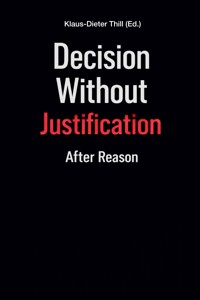
Decisions are made. Reasons are added afterwards. This book examines a profound structural shift: justification has ceased to steer decisions and survives only as retrospective legitimation. In systemic environments, automated processes, and stabilised decision architectures, decisions emerge without deliberation, without judgement, without rational justification. Systems do not choose because reasons persuade, but because conditions take effect. Discussions no longer change anything. Transparency explains – it does not steer. "Decision Without Justification" is neither an attack on reason nor a plea for arbitrariness. It is a reconstruction: how justification moved from the origin of decision to its communicative aftercare. Why rationality lost its steering function and legitimation mutated into a social mechanism of connectivity. Rethinka writes from the perspective after the fact. Not to evaluate decisions, but to make visible what happens when reasons no longer decide – but merely explain. This book does not ask why a decision was made. It shows why that question has lost its effectiveness.
Das E-Book können Sie in Legimi-Apps oder einer beliebigen App lesen, die das folgende Format unterstützen:
Seitenzahl: 19
Veröffentlichungsjahr: 2026
Ähnliche














Klaus-Dieter Thill
Decision Without Justification
After Reason
Dieses ebook wurde erstellt bei
Inhaltsverzeichnis
Titel
ARCHIVAL NOTE · After Reason
The Cognitive Architecture of This Book
1 IGNITE: When Decisions Happen Before Reasons Exist
2.1 REFLECT: Why You Still Believe Decisions Need Reasons
2.2 ANALYZE: Justification as a Pre-System Narrative
2.3 ADVANCE: Stop Asking Why This Was Chosen
3.1 REFLECT: Where Did Reasons Actually Go?
3.2 ANALYZE: Decision as Structural Consequence
3.3 ADVANCE: The End of Rational Decision-Making
4.1 REFLECT: If Decisions Have No Reasons – What Still Holds?
4.2 ANALYZE: Justification as Post-Decisional Infrastructure
4.3 ADVANCE: Designing Systems Beyond Justification
5 EMPOWER: Operating Without Reasons
6 EMBODY: The Last Justified Decision
Closing Sentence (2049)
2 UNLEARN: Why Justification Was Never the Cause of Decision
3 DISRUPT: How Systems Decide Without Reasons
4 REINVENT: What Decision Becomes After Reason
Impressum neobooks
ARCHIVAL NOTE · After Reason
This book does not explain decisions.It reconstructs why justification has lost its steering function.
I do not write from the perspective of deliberation,but from the perspective after the fact.From the point at which decisions have already been made,systems are functioning stably,and reasons appear onlyto create continuity.
Not as causes.But as post-processing.
I do not analyse rationality.I do not question legitimacy.I observe structuresin which decisions take effectwithout ever having been justified.
What followsis not an attack on reason.It is a diagnosisof its operational irrelevance.
The Cognitive Architecture of This Book
This book follows no methodand no decision model.It follows a cognitive architecturethat becomes necessaryonce justification loses its steering role.
This architecture consists of three movements:
UNLEARNWhy justification was never the cause
UNLEARN begins at the pointwhere reasons are still treatedas the starting point of decisions.
Nothing is criticised here,nothing corrected,and nothing relativised.
UNLEARN withdraws the taken-for-granted validityof the assumptionthat decisions arise from reasons.
Not because justification is wrong.But because it was neverwhat it was believed to be.
DISRUPTHow systems decide without needing reasons
DISRUPT does not describe provocation.It describes an interruption.
Here it becomes visiblehow decisions emergein systemic environments,how they stabiliseand how they take effect




