


Erhalten Sie Zugang zu diesem und mehr als 300000 Büchern ab EUR 5,99 monatlich.
- Herausgeber: 404 Ink
- Kategorie: Geisteswissenschaft
- Serie: Inklings
- Sprache: Englisch
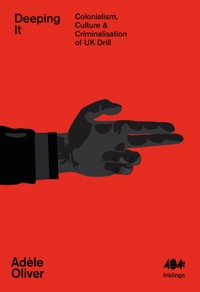
Deeping It analyses drill's fight against moral panic and its fraught relationship with the police and political authority in the UK, exemplified by constant censorship, racism, and moments such as when a drill duo became the first people in British legal history to receive a prison sentence for simply performing a song. Policing, policy and criminalisation are the cornerstones of colonial suppression; art, self-expression and collective action are beacons of resistance. Deeping It places drill firmly in the latter category, tracing its production and criminalisation across borders and eras of the British Empire, exploring drill's artistic singularity but also its inherent threat as a Black artform in a world that prioritises whiteness. Intervening on this discourse steeped in anti-Blackness, this Inkling 'deeps' how the criminalisation of UK drill cannot be disentangled from histories, technologies, and realities of colonialism and consumerism.
Sie lesen das E-Book in den Legimi-Apps auf:
Seitenzahl: 127
Veröffentlichungsjahr: 2023
Das E-Book (TTS) können Sie hören im Abo „Legimi Premium” in Legimi-Apps auf:
Ähnliche




















Deeping It
Published by 404 Ink Limited
www.404Ink.com
@404Ink
All rights reserved © Adèle Oliver, 2023.
The right of Adèle Oliver to be identified as the Author of this
Work has been asserted by her in accordance with the Copyright, Designs and Patent Act 1988.
No part of this publication may be reproduced, distributed, or transmitted, in any form or by any means, electronic, mechanical, photocopying, recording, or otherwise, without first obtaining the written permission of the rights owner, except for the use of brief quotations in reviews.
Please note: Some references include URLs which may change or be unavailable after publication of this book. All references within endnotes were accessible and accurate as of June 2023 but may experience link rot from there on in.
Editing: Arusa Qureshi
Typesetting: Laura Jones
Proofreading: Laura Jones
Cover design: Luke Bird
Co-founders and publishers of 404 Ink:
Heather McDaid & Laura Jones
Print ISBN: 978-1-912489-78-7
Ebook ISBN: 978-1-912489-79-4
Deeping It
Colonialism, Culture & Criminalisation of UK Drill
Adèle Oliver
Contents
Introduction: Is it really that deep?
Chapter 1: Drill as Crime
Chapter 2: Drill as Black Noise
Chapter 3: Drill as Art
Chapter 4: Drill as Commodity
Conclusion: Drill as the future?
References
Acknowledgements
About the Author
About the Inklings series
Introduction: Is it really that deep?
deep (transitive verb) /diːp/
discern, unpack, realise, or understand the depth, extent, magnitude of.
‘If there wasn’t such a thing as music, the crime rate would be higher. People in London are bored. If you’re on the roads and you’re not doing music, then what else are you doing? Me, if I’m not going to the studio, I’ve got nothing positive to do in my life […] Picture every London drill artist right now. If there was no music, what would we all be doing? Think about it. There is nothing else for us to do. Nobody helps us through nothing. We try to help ourselves through music, and then they try to take it away from us.’1
Digga D, Vice Interview
I spent much of the late noughties and early 2010s on double decker buses, headphones in tow, listening to over-compressed MP3 files with dubious origins. The early British pioneers of UK drill are of a similar Y2K ilk, raised on a steady diet of grime, dancehall, garage, UK funky, R&B, Afrobeats, and hip-hop (add other genres to taste). These are some of the ingredients that go into making a twenty-first century cultural phenomenon – as well as a liberal dose of defiance and gen Z tenacity. UK drill is driven by gritty, sliding 808 basslines; dark, atmospheric melodies; syncopated, skippy hi-hats; defiantly playful ad-libs; insouciant dance moves; black ballies; gloved-hands unfurled into gun fingers; and sardonically violent bars about the realities of life on road. I think of it as the transatlantic love child of UK road rap, the unadulterated offshoot of British hip-hop, and Chicago drill, the southern-fried trap influenced zeitgeist of early 2010s rap music. It’s a new sprig in a family tree of Black music that spans centuries and continents. The British and American press, on the other hand, think of it as ‘the soundtrack to London’s murders’2, ‘the violent soundtrack at the heart of London’s gangland’3 and ‘the “demonic” music linked to a rise in youth murders’4, or, if they’re in the mood for less sensationalism, ‘the controversial music that is the sound of global youth’5. They’ve got one thing right; the consumption, production and criminalisation of drill is truly a global phenomenon. It has exploded from the fringes of SoundCloud and YouTube to the very centre of international pop culture and police attention.
Between 2017 and 2021, drill enjoyed a 42% overall listening share increase on Spotify, a fact reinforced by the genre’s chart success in the same period.6 2018 saw the first UK drill track creep into the Top 100 of the Official Singles Chart and by 2021, drill was topping the pop charts with Tion Wayne and Russ Millions’ ‘Body (Remix)’ reaching the Number One spot in the UK and Australia. In February 2022, Central Cee’s drill mixtape 23 climbed to Number One on the UK Official Albums Chart and in April of the same year Noughty by Nature, drill savant Digga D’s third mixtape, debuted at Number One. Today, young drill artists barely out of their teens are headlining large festivals and selling out tours in front of mixed audiences, ‘ranging from the likes of sixteen-year-olds from Milton Keynes to twenty-four-year-olds from Hackney to forty-year-olds who would look more at home in a quiet pub in the Cotswolds,’7 as the crowd at Digga D’s first headline show was described. Alongside traditional commercial success, UK drill has taken social media by storm. Snippets of songs and new dances or ‘bops’ are consistently going viral on TikTok, amassing millions of views and reposts worldwide, not to mention the impact on fashion and marketing (yes, Asda did advertise its back-to-school range with George-clad primary school kids rapping over a drill beat in a school playground). These bubble-gum reincarnations show that drill has become increasingly commodifiable and ripe for capitalistic co-opting, but it’s the genre’s raw origins that have propelled it to its current level of popularity. Listen to tracks from the canon of UK drill such as, ‘Lets Lurk’ by 67 and ‘Know Better’ by Headie One, and you can hear the youthful intensity and haunting synths that scream Southside Chicago. But the bounce, foreboding feel and deliciously distorted sound design is Jamaican-influenced British grit à la grime, garage, and jungle.
This vibe can be detected in its returnee offshoots such as New York drill, which is sonically much closer to the UK than it is to Woodlawn, the Chicago neighbourhood where drill first began to sprout. New York native Pop Smoke’s viral smashes ‘Welcome to the Party’ and ‘Dior’, collaborations with London producer 808Melo, are perhaps the best examples of this. It’s the New York rap scene being reignited by UK drill instrumentals, animated by a distinctly Brooklyn vocal flare. AXL Beats, another Londoner producing hit songs for Brooklyn rapper Fivio Foreign, Travis Scott and hip-hop’s resident culture vulture, Drake, was behind some of the biggest rap songs coming out of the US in the past three years, drill or otherwise. This transatlantic exchange is the kind of full circle family moment that just makes sense when considering the experimentalism at the heart of genres like hip-hop. To give an example, ‘Talkin’ Da Hardest’, the insignia of UK road rap, was produced by Compton’s Dr Dre but immortalised by Giggs’ unmistakably Peckham flow. Drill artist Loksi discussed UK drill’s transatlantic roots in an interview with Apple:
‘When I was younger, Chicago’s drill music had a big influence on us. I remember every day going home from school to look on YouTube at all the Chicago music and what was going on. Then people in Brixton started doing it, but we were also speeding up the tempo of the beats almost, we didn’t know we would start anything – that’s what we do.’8
Here, Loski articulates the Afrodiasporic urge to appreciate, reinterpret, and refashion other Black musics that have themselves been crafted and recrafted over the ‘Black Atlantic’.9 Musically and aesthetically drill is also seeping into the consciousness of other rappers involved in international scenes, who in turn add their own sauce. For example, UK drill has been mixed with Baltimore and Jersey club music to create a new, rambunctious, hybrid sound that the likes of Bronx rapper Ice Spice and (you guessed it) Drake are capitalising on. There is also a burgeoning sound of punk-tinged emo drill, particularly popular in Eastern Europe and the US. This sonic collision is an ode to the long history of alliance between hip-hop and punk – two art movements that are undeniably intertwined in their growth.10 Still, the ‘traditional’ drill sound that matured in the UK has been blowing up in Australia, Brazil, Ghana, Russia, France, Italy, Japan, and the UAE to name a few places. At this point, the instrumental sound of drill has become so ubiquitous that the only way to differentiate between drill songs made in different parts of the world is by the accent of the lyricist. It’s important to keep this global context in mind, but in my use of the term UK drill in this book, I’m focussing on the ways drill is criminalised on this side of the pond.
When I say ‘criminalised’ I mean the way that drill, a musical genre, artform and culture that is not intrinsically criminal, is being treated as such. In the UK, those that perform drill or appear in videos, usually young Black British men, have faced Criminal Behaviour Orders (CBOs), suspended prison sentences, and gang injunctions as well as intense surveillance and monitoring. Of all the content that exists on the internet, the Met Police have only requested the removal of drill music and videos in recent years. A Freedom of Information request filed by the Meta-funded Oversight Board revealed that ‘all of the 992 requests […] that the Metropolitan Police made to social media companies and streaming services to review or remove content between June 2021 and May 2022 involved drill music; those requests resulted in 879 removals.’
After their performance of the song ‘Attempted 1.0’ at a London show towards the end of 2018, drill duo AM and Skengdo famously became the first people to receive a prison sentence for performing a song in British legal history, which began with the institution of common law in the twelfth century. This decision was a watershed moment in both the history of censorship in the UK and in the personal and artistic lives of the rappers. Skengdo, who was 21 at the time of sentencing, remarked: ‘It’s changed the way we have to write, the way we express ourselves, the things we say – and that in itself is a problem. We have to change the way we do things to accommodate the police, which is ridiculous. And that’s literally just the music side of things – there are food shops 10 minutes away in Oval that we can’t use, because it’s in SE11.’11
Even downloading drill music or streaming drill videos can be used as damning evidence. This was the case for the ‘Manchester 10’, who were convicted of conspiracy to murder and conspiracy to cause grievous bodily harm in July 2022. During their trial drill music was played, and lyrics and videos were analysed to prove gang affiliation and ‘bad character’,12 defined as ‘evidence of, or of a disposition towards, misconduct’13 in the section 98 of the 2003 Criminal Justice Act (CJA). Later in the CJA ‘misconduct’ is defined as ‘the commission of an offence or other reprehensible behaviour’.14 So, writing or just consuming violent or graphic drill lyrics is, in the eyes of the law , a crime.15 These flawed logics are not exclusive to drill but an extension of ideas about an unfounded link between rap music and violent crime that have pervaded in the sphere of politics and media in Britain for decades. After two Black teenagers, Charlene Ellis and Latisha Shakespeare, were shot dead over a Birmingham ‘turf war’ in 2003, the then Culture Secretary Kim Howells pinned partial responsibility on rap music, stating that ‘idiots like the So Solid Crew are glorifying gun culture and violence’.16 In response to the murders, former Home Secretary David Blunkett called on record labels to censor rap music that he said fuelled black-on-black violence.17 The discourse around UK rap and increased violence has not progressed much since then. Only now, it’s ‘drill’ that is the buzzword instead of ‘rap’, ‘hip-hop’, or ‘grime’.
Most recently and outrageously, a 2021 report by Policy Exchange, the UK’s leading think tank, argued that drill plays a role in ‘perpetuating violence and destroying lives among young black Londoners.’18 They made the controversial claim that at least 23% of gang-related homicides in 2018-9 were ‘linked to drill music.’19 These findings were swiftly dismissed as ‘factually inaccurate, misleading and politically dangerous’,20 not least because the methods and evidence used to come up with statistics are shaky at best and fabricated at worst. An empirical study by professors in UCL’s Department of Security and Crime also concluded that ‘there is no meaningful relationship between drill music and “real-life” violence when compared to three kinds of police-recorded violent crime data in London.’21 Still, drill, like its alleged outcome knife crime, is an epidemic and a threat in the eyes of the law and the court of public opinion. The best course of treatment? The strong arm of the law, the carceral state’s go-to appendage when the threat of dissent looms.
So, why is the perceived threat level of drill so high? It’s less about what the music sounds like and more about what the people creating it look like. As critical criminologist Lambros Fatsis says: ‘The feeling of threat that drill represents in the penal and public imagination – “depends on the acceptance of [racist] cultural stereotype[s]”22 that cast drill rap(pers) as a threat in the first place.’23 Initially, the Crown Prosecution Service (CPS) and police took a reactionary stance to drill, arguing that the threat it posed was immediate, as narratives in songs recounted or incited specific acts of interpersonal violence. In 2018, for example, former Met Police commissioner Cressida Dick said, ‘We have gangs who make drill videos and in those videos, they taunt each other. They say what they’re going to do to each other and specifically what they are going to do to who.’24 More recently though, with that line of reasoning becoming increasingly untenable as a broad stroke argument, the focus has shifted to the purported link between drill and gang membership. This is known as the drill-gang nexus – an adaption of lecturer Patrick William’s notion of the ‘race-gang nexus’, defined as ‘the proliferation of unstated associations between young Black men, youth violence and “gangs”.’25
This builds on what Paul Gilroy called ‘the myth of Black criminality’26 in the 1980s – the idea that criminality is an inherent feature of Blackness. Going one step further, the race-gang nexus suggests that the proliferation of ‘gang violence’ amongst Black communities shows that ‘Black people now fulfil some supposed compulsion for (violent) crime collectively, as well as individually.’27 We can see how reactions to this threat of individual and collective violence manifests in legislature. Warning: we’re about to get into some legal rigmarole.
The CPS provides a definition of ‘gang’ and ‘gang-related’ activity that is, by their own admission, intentionally vague and wide-reaching ‘for the purposes of the power to obtain an injunction.’28 These are gang injunctions which may prohibit individuals from being in a particular place; being with particular persons in a particular place; and wearing particular descriptions of articles of clothing in a particular place amongst other prohibitions and requirements. Gang injunctions last up to two years and can be taken out on anyone aged fourteen and above by either a local authority, local police or British Transport Police.
Section 34(5) of the Policing and Crime Act 2009, as amended by the Serious Crime Act 2015 states:
‘Something is “gang-related” if it occurs in the course of, or is otherwise related to, the activities of a group that –
(a) consists of at least three people, and




