


17,99 €
Mehr erfahren.
- Herausgeber: John Wiley & Sons
- Kategorie: Geisteswissenschaft
- Serie: Key Contemporary Thinkers
- Sprache: Englisch
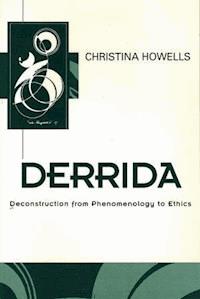
This book is an unusually readable and lucid account of the development of Derrida's work, from his early writings on phenomenology and structuralism to his most recent interventions in debates on psychoanalysis, ethics and politics.
Christina Howells gives a clear explanation of many of the key terms of deconstruction - including différance, trace, supplement and logocentrism - and shows how they function in Derrida's writing. She explores his critique of the notion of self-presence through his engagement with Husserl, and his critique of humanist conceptions of the subject through an account of his ambivalent and evolving relationship to the philosophy of Sartre. The question of the relationship between philosophy and literature is examined through an analysis of the texts of the 1970s, and in particular Glas, where Derrida confronts Hegel's totalizing dialectics with the fragmentary and iconoclastic writings of Jean Genet.
The author addresses directly the vexed questions of the extreme difficulty of Derrida's own writing and of the passionate hostility it arouses in philosophers as diverse as Searle and Habermas. She argues that deconstruction is a vital stimulus to vigilance in both the ethical and political spheres, contributing significantly to debate on issues such as democracy, the legacy of Marxism, responsibility, and the relationship between law and justice.
Comprehensive, cogently argued and up to date, this book will be an invaluable text for students and scholars alike.
Sie lesen das E-Book in den Legimi-Apps auf:
Seitenzahl: 363
Veröffentlichungsjahr: 2013
Ähnliche



















Table of Contents
Cover
Title page
Copyright page
Key Contemporary Thinkers
Acknowledgements
Abbreviations
Works by Derrida
Works by Other Writers
Apologia
1 Phenomenology
2 Structuralism
3 Language: Speech and Writing
4 Deconstructing the Text: Literature and Philosophy
5 Deconstruction and Psychoanalysis
6 The Ethics and Politics of Deconstruction and the Deconstruction of Ethics and Politics
Ethics
Politics
Bibliography
Index
Copyright © Christina Howells 1999
The right of Christina Howells to be identified as author of this work has been asserted in accordance with the Copyright, Designs and Patents Act 1988.
First published in 1998 by Polity Press in association with Blackwell Publishers Ltd.
Editorial office:
Polity Press
65 Bridge Street
Cambridge CB2 1UR, UK
Marketing and production:
Blackwell Publishers Ltd
108 Cowley Road
Oxford OX4 1JF, UK
Published in the USA by
Blackwell Publishers Inc.
Commerce Place
350 Main Street
Malden, MA 02148, USA
All rights reserved. Except for the quotation of short passages for the purposes of criticism and review, no part of this publication may be reproduced, stored in a retrieval system, or transmitted, in any form or by any means, electronic, mechanical, photocopying, recording or otherwise, without the prior permission of the publisher.
Except in the United States of America, this book is sold subject to the condition that it shall not, by way of trade or otherwise, be lent, re-sold, hired out, or otherwise circulated without the publisher’s prior consent in any form of binding or cover other than that in which it is published and without a similar condition including this condition being imposed on the subsequent purchaser.
ISBN 0-7456-1167-2
ISBN 0-7456-1168-0 (pbk)
ISBN 9780-7456-6727-0 (epub)
ISBN 9780-7456-6726-3 (mobi)
A catalogue record for this book is available from the British Library and has been applied for from the Library of Congress.
Key Contemporary Thinkers
Published
Jeremy Ahearne, Michel de Certeau: Interpretation and its Other
Peter Burke, The French Historical Revolution: The Annales School 1929–1989
Colin Davis, Levinas: An Introduction
Simon Evnine, Donald Davidson
Edward Fullbrook and Kate Fullbrook, Simone de Beauvoir: A CriticalIntroduction
Andrew Gamble, Hayek: The Iron Cage of Liberty
Phillip Hansen, Hannah Arendt: Politics, History and Citizenship
Sean Homer, Fredric Jameson: Marxism, Hermeneutics, Postmodernism
Christopher Hookway, Quine: Language, Experience and Reality
Christina Howells, Derrida: Deconstruction from Phenomenology to Ethics
Simon Jarvis, Adorno: A Critical Introduction
Douglas Kellner, Jean Baudrillard: From Marxism to Post-Modernism and Beyond
Chandran Kukathas and Phillip Pettit, Rawls: A Theory of Justice and its Critics
Lois McNay, Foucault: A Critical Introduction
Philip Manning, Erving Goffman and Modern Sociology
Michael Moriarty, Roland Barthes
William Outhwaite, Habermas: A Critical Introduction
John Preston, Feyerabend: Philosophy, Science and Society
Susan Sellers, Hélène Cixous: Authorship, Autobiography and Love
David Silverman, Harvey Sacks: Social Science and Conversation Analysis
Geoffrey Stokes, Popper: Philosophy, Politics and Scientific Method
Georgia Warnke, Gadamer: Hermeneutics, Tradition and Reason
James Williams, Lyotard: Towards a Postmodern Philosophy
Jonathan Wolff, Robert Nozick: Property, Justice and the Minimal State
Forthcoming
Alison Ainley, Irigaray
Maria Baghramian, Hilary Putnam
Sara Beardsworth, Kristeva
Michael Caesar, Umberto Eco
James Carey, Innis and McLuhan
Thomas D’Andrea, Alasdair MacIntyre
Eric Dunning, Norbert Elias
Jocelyn Dunphy, Paul Ricoeur
Graeme Gilloch, Walter Benjamin
Sarah Kay, Ž iže k: A Critical Introduction
Paul Kelly, Ronald Dworkin
Valerie Kennedy, Edward Said
Carl Levy, Antonio Gramsci
Harold Noonan, Frege
Wes Sharrock and Rupert Read, Kuhn
Nick Smith, Charles Taylor
Nicholas Walker, Heidegger
Acknowledgements
My thanks are due to many friends and colleagues who contributed to this study, in particular by reading draft versions of the various chapters and helping me to clarify my ideas and understanding. I am especially grateful to Michael Ayers, Malcolm Bowie, Colin Davis and Alan Montefiore, and most of all to my husband, Bernard, who read the whole text with an extremely vigilant eye and suggested many vital improvements. The errors that remain are, of course, ‘all my own work’. I would also like to thank Lydia Rainford for her meticulous work on the Bibliography and Index. I thank Wadham College, the University of Oxford and the British Academy for the extended period of leave which enabled me to finish the project. Finally, I thank my children, Marie-Elise and Dominic, for their tolerance and good-humour, as well as for their refreshingly deflating remarks about the ‘deconstruction of the (l)ego’.
Abbreviations
References to most works are given in the text. Translations from French are my own, and references are therefore to the French editions.
Works by Derrida
AdieuAdieu: à Emmanuel LevinasCPLa Carte postaleDissLa DisséminationDroitDu droit à la philosophieEDL’Écriture et la différence ForceForce de loiGramDe la GrammatologieMargesMarges: de la philosophiePolitiques Politiques de l’amitiéPosPositions SpectresSpectres de MarxVPLa Voix et le phénomèneWorks by Other Writers
ENL’Être et le Néant (Sartre)Essai Essai sur l’origine des connaissances humaines (Condillac)OGL’Origine de la géometrie (Husserl)SGSaint Genet (Sartre)TELa Transcendance de l’ego (Sartre)TITotalité et infini (Levinas)Apologia
Derrida is one of the most significant and brilliant French philosophers of the twentieth century. He is also one of the most prolific and currently one of the most popular, though not of course in the sense that he is easily accessible. It is not possible today to be a well-educated intellectual without knowing at least something about Derrida and the way of reading most closely associated with him: deconstruction. Indeed the vogue for deconstruction has spread from France to England and the United States and far beyond, and Derrida may well be more appreciated outside France than inside it, though at the same time the sharpest attacks on his thinking have come from philosophers belonging to the AngloSaxon analytical tradition. In the Continental context, on the other hand, in which his work is embedded, it might appear less contestatory and therefore be less contested, with the result that if his prestige is undisputed his pre-eminence is not taken for granted. The sheer difficulty of Derrida’s texts is legendary, and this too has been held against him by critics suspicious of mystification and unwilling to make the effort required to respond to writing that can sometimes be Mallarmean in its verbal density. It is my aim here to encourage and facilitate such an effort, in the conviction that the reward may be a mind-expanding delight rarely equalled elsewhere.
Derrida is an unusual philosopher, and hard to categorize, in that much of his best work constitutes an extensive critique of other texts, literary, philosophical, psychoanalytic and political. The very term ‘deconstruction’ was, as Derrida explains in his ‘Lettre à un ami japonais’ (Psyché, 1987), chosen by him from Littré to translate Heidegger’s Destruktion and Abbau, both of which imply a dismantling but not a destruction of the traditional organizing concepts of Western ontology and metaphysics (p. 388).1 When he chose the term, Derrida suggests, he had little or no idea of the importance it would assume for his later thinking. Derrida’s early work was primarily concerned, as we shall see, with a critique of Husserl and phenomenology. Soon Heidegger, Hegel, Nietzsche, Plato, Foucault, Lévi-Strauss, Rousseau, Freud, Levinas, Mallarmé, Artaud and Bataille, amongst others, were to become objects of the deconstructive strategy. In all his books and essays Derrida is a scrupulous, meticulous, patient reader, determined to disentangle what has been conflated, to bring to light what has been concealed, and to pay scrupulous attention to marginalia and footnotes, in the expectation that what has been relegated to the margins may prove paradoxically central to a less parochial understanding of the text.
In part because of historical coincidence, and in part because of theoretical misunderstanding, Derrida has sometimes been described as a postmodernist or a post-structuralist. It is true that he shares much with both postmodernism and post-structuralism, in particular an implacable opposition to the hegemony of the human subject as it is manifest in philosophical humanism, and a concomitant will to question the nature of the relationship between reality, language, history and the subject. None the less, both labels are potentially misleading: post-structuralism asserts that truth claims are ultimately dependent on the discourse or conceptual scheme from which they emanate; postmodernism further concludes that all epistemological enterprises – including those of science and philosophy – are merely operative fictions. For postmodernism even the very questions of relativism and indeterminacy are not matters of truth or falsehood but rather ‘performative utterances’. In other words, the ‘baby’ of truth has been thrown out with the ‘bathwater’ of positivist certainty. Derrida, as will become progressively clearer in the course of this book, is not part of the move to debunk truth. For this reason amongst others, critics2 who imagine they are turning the tables on Derrida when they point out that in taking issue with a particular argument or textual interpretation, Derrida himself is implying a notion of ‘truth’ which he has elsewhere abandoned, are deluded. As I argue explicitly in my final chaper in particular, Derrida believes it would be literally non-sensical to attempt, or even to wish, to abandon truth or meaning. Deconstruction may set out to ‘read between the lines’, or even ‘read against the grain’, but it always attempts to read, and understand. The so-called ‘play’ of interpretation, which Derrida refers to as ‘dissemination’, is a play in the linguistic mechanism perhaps, but it is not the ‘free play’ beloved of some of Derrida’s less rigorous followers. It is rather the demonstration of textual self-contradiction which is the essence of the deconstructive project. It differs from the standard philosophical technique of finding flaws in the logic of an opponent’s argument in that the contradictions uncovered reveal an underlying incompatibility between what the writer believes himor herself to be arguing and what the text itself actually says. This gap between authorial intention and textual meaning is a key focus of deconstruction.
The extraordinary acceleration of Derrida’s publishing record is daunting as well as impressive. When I started thinking seriously about Derrida in 1980 he had published a dozen books, four in the 1960s and the rest in the seventies, as well, of course, as numerous articles and essays. Reading the written corpus seemed a manageable goal. By 1990, when I first considered writing a book on Derrida, he had published another twenty. Nor could I anticipate that his output would further accelerate: at least another twenty books have appeared since 1990, three in the first three months of 1997, just as I imagined I was putting the final touches to my last chapter. One of his latest works is, indeed, particularly germane to my subject, entitled Adieu and devoted to Levinas, and I give an account of it in my chapter on ethics and politics.
This book cannot claim to be fully comprehensive, but it is as up-to-date as publishing delays permit, and indeed takes account of L’Animal autobiographique, the ten-day ‘Colloque de Cerisy’ devoted to Derrida’s work in July 1997, which I was lucky enough to be able to attend, though its proceedings are as yet unpublished. I have not been able, however, to make room in this book for some of the texts which gave me most enjoyment, such as Donner le temps (1991), devoted, at least in part, to ‘La fausse monnaie’, one of Baudelaire’s prose poems, and to Marcel Mauss’s theory of the gift. Nor is much time spent on the love letters of La Carte postale (1980), or on the wonderful study of painterly self-portraiture in Mémoires d’aveugle (1990). I say little about Nietzsche, less than I would like about Hegel, and very little about Derrida’s relationship to negative theology, which is an abiding concern. On the other hand, this book returns at several points to Derrida’s relation to Sartre, more frequently, perhaps, than some readers may like, but ‘Derrideans’ and ‘Sartreans’ have tended to inhabit very different, even opposed camps, either side of the structuralist divide, and I wanted to take this opportunity to bring them together through my delight in, and admiration for, both philosophers. I remember a similar experience of secretly longing for Sartre to stop publishing twenty years ago, in the 1970s, as I was trying to finish my thesis and, to my dismay, a third 600-page volume of L’Idiot de la famille, his study of Flaubert, appeared. It is my joint interest in Sartre and Derrida that motivates my interest in the various theories of the subject, which, in their implications for ethics and politics in particular, are among the most fruitful aspects of Derrida’s thinking.
But if this study cannot claim to be comprehensive, I know full well that no other study could either. How to convey more than a fraction of such an extraordinary output? A restriction of scope and a rigorous, if sometimes painful, policy of exclusion of certain texts was the only possible way forward. I have, however, tried to be clear, analytic, objective and jargon-free, not imitating Derrida’s style and not shunning explanation and paraphrase. This, of course, will be deeply unfashionable among many Derrida scholars, who might judge such an approach as a betrayal of Derrida or as evidence of a lack of understanding of his whole enterprise. What is more, I know that it is bound to fail. There is no way I can make some of Derrida’s more difficult ideas clear without simplification, no way I can avoid ‘jargon’ entirely (though I hope I have explained Derridean terminology when I use it), and no way my own preoccupations and interests will leave my text uncoloured. But all this is en connaissance de cause: I will do best justice to both Derrida and my readers if I aim for an impossible clarity and an equally impossible objectivity, while confessing that I know I have no hope of achieving either.
Finally, a bit of advice on how to approach this book, what Derrida calls a ‘protocole de lecture’: the chapter headings are transparent, and it will be evident what each section is concerned with. But the level of difficulty is variable. Chapter 1, on phenomenology, lays the philosophical basis for much of what is to follow, dealing, for example, with the status of ideal objects, and with some of the complexities of Husserlian theory. It is the most textual and detailed of the chapters, as is required by its argument. It is also, I think, the hardest, and readers who do not have a philosophical bent might leave it aside and pass quickly on to the chapter on structuralism, or even go straight into chapter 3, on speech and writing, if they are looking for an account of the most popular aspects of Derrida’s thinking. On the other hand, readers already familiar with Derrida’s work may well find most to interest them in the last two chapters, which deal with the more recent texts and attempt to disentangle the relationship of deconstruction to psychoanalysis and to ethics and politics. However, I have absorbed the Derridean lesson: this book is out of my hands and my control once it has reached the public domain, so my desire to hold the reader’s hand and guide her through, explaining as I go, can be no more than a nostalgic aspiration to recover the long-gone and illusory authority of the writer.
Notes
1 So we read in ch. 1 of De la grammatologie of modern linguistics ‘working on the deconstruction of the constituted unity of the word “to be” [être]’ (p. 35).
2 See, for example, John M. Ellis in Against Deconstruction (Princeton, Princeton University Press, 1989).
1
Phenomenology
As the twentieth century draws to its close, phenomenology is largely out of fashion in France, having been replaced by intellectual movements such as existentialism, structuralism, postmodernism and post-structuralism in increasingly rapid succession. But in the opening years of the century, and indeed up until the 1960s, phenomenology was a force to be reckoned with, and was the first sparring partner of many of the major exponents of those later philosophical movements just evoked. Sartre, Levinas, Lyotard and Derrida himself all started their publishing careers with a critique/ exposition of a certain aspect of phenomenology. Their works cannot be properly understood without some knowledge of what they are criticizing or refining. This chapter will attempt to elucidate the phenomenological enterprise itself and Derrida’s own engagement with it. It will necessarily be somewhat technical: phenomenology had radical ambitions, it set out to revolutionize epistemology, psychology and ultimately science, and its terminology may present some difficulties to those unfamiliar with it.
Phenomenology is a philosophy of consciousness which attempts to avoid the reefs of dualistic views such as empiricism and idealism by putting aside all preconceptions about the relationship between mind and world. It sets out to rethink the fundamental distinction between subject and object, and to go beyond naturalist epistemology to describe afresh how consciousness relates to the world of phenomena. Consciousness, according to phenomenology, is always directed outside itself to the world, and this relationship is referred to as one of ‘intentionality’. Husserl, the major founder of phenomenology, described it as ‘the true positivism’ (ED, 229), aiming to return ‘to things themselves’ (‘zu den Sachen selbst’). Its specificity lies not so much in its object – after all, as Husserl commented, other sciences also treat of ‘phenomena’, be they psychological, scientific, cultural or historical (Ideas, 42) – as in its method. Phenomenology entails ‘a new way of looking at things … one that contrasts at every point with the natural attitude of experience and thought’ (p. 43). This method is that of ‘phenomenological reduction’, a set of procedures which involve purifying the natural outlook of the contingencies of psychology and empiricism. To use its own terminology, phenomenology aims to describe transcendental consciousness through an intuition of essences. More simply, phenomenology describes consciousness stripped of its personal, empirical irrelevancies. Its object is transcendental in so far as it is not identified with any particular individual. Phenomenological reduction, also known as the epoche, puts aside, or ‘brackets off’ the contingent and personal to reveal the underlying universal structures of, for example, imagination or perception. It abandons the ‘natural attitude’ in an effort to describe, without preconception, what appears to consciousness, that is, phenomena as they are ‘intended’ by consciousness. But this is, as we shall see, easier said than done.
Derrida studied phenomenology in Paris with Emmanuel Levinas and Paul Ricoeur. He considers Husserl to have been one of the major influences on his philosophical formation, along with Heidegger and Hegel. Indeed, Derrida’s whole philosophical programme seems to spring from his tussle with phenomenology. It is the phenomenological attempt to ground knowledge in experience, evidence and self-presence, and its apparent failure, that leads him to the conclusion that the attempt itself is fundamentally misconceived. Phenomenology does not fail, as Husserl believed, because it is still only in its infancy and success has so far eluded it, but because it is engaged in a project based on false, though ineluctably seductive, premises. As Derrida explains in an interview published in 1984, ‘I never shared Husserl’s pathos for, and commitment to, a phenomenology of presence. In fact, it was Husserl’s method that helped me to suspect the very notion of presence and the fundamental role it played in all philosophies.’1 This is, of course, a retrospective interpretation of his own attitude to Husserl, and by examining the three major texts Derrida devotes to the phenomenologist we will be able to assess the development of ‘suspicion’ as a dominant feature in his analyses.
Derrida’s first and second published books both deal with Husserl: he translates and introduces The Origin of Geometry in 1962, producing a 170-page Introduction to a work of forty pages; and in 1967 La Voix et le phénomène is subtitled Introduction au problème du signe dans la phénoménologie de Husserl. Earlier still, as a research student in 1954, Derrida devoted his MA dissertation to Le Problème de la genèse dans la philosophie de Husserl (not published until 1990). Derrida’s first published paper on Husserl, ‘ “Genèse et structure” et la phénoménologie’,2 was delivered at the invitation of Maurice de Gandillac at a conference in Cerisy la Salle in 1959 dedicated to Genesis and Structure. It opens with a warning: the attempt to apply the polarized concepts of ‘genesis’ and ‘structure’ to Husserl’s work involves doing violence to the nature of his thought. The use of antagonistic and antithetical terms is out of keeping with Husserl’s own dislike of debate, aporias and dilemmas. Husserl shunned efforts to find decisive solutions to philosophical questions, and associated such attempts with the ‘speculative’ or dialectical method which he rejected. In Husserl’s view, both metaphysicians and empiricists are guilty of similar oversimplifications. However, Derrida accepts the challenge of the conference topic, and agrees to engage in what he describes as an ‘aggression’ and an ‘infidelity’ towards Husserl (ED, 228). Husserl himself, argues Derrida, would have rejected the opposition between genesis and structure as false: some areas of investigation invite a structural approach, some a genetic one; some layers of meaning appear in the form of systems and static configurations, others reveal their origins and development and demand a genetic interpretation. Husserl’s objective is faithful description rather than rigid categorization. Derrida demonstrates how consistent Husserl is in this respect, combining and moving between analyses of genetic constitution and descriptions of formal, static structures in works as diverse as Philosophie der Arithmetik (1891), Logical Investigations (1900–1), and Ideas (1913). Indeed, Husserl’s analyses frequently pass from an account of structures precisely to an investigation of the production of those structures, which in turn leads to a further exploration of the forms (what Husserl refers to as the ‘structural a prioris’) of that very genesis. Husserl, then, is ‘serene’ in his unified conception of the phenomenological endeavour (ED, 232).
Derrida, however, is less convinced. The tensions implicit in a mode of thinking that is simultaneously an exploration of intangible, a priori essences and a philosophy of experience, becoming and temporal flux cannot be so easily overcome. Derrida envisages two main problematic areas. Firstly, he considers that an unfinished debate underlies the apparent ‘serenity’ of all the major phases of phenomenological reduction, with the consequence that there is an indefinite need for a further reduction, however far the process has gone already. Secondly, this same debate appears to imperil the very principles of the phenomenological method, and to compel Husserl to transgress the supposedly descriptive nature of his work and its transcendental aims, and to enter into the metaphysics of history, the teleology of which becomes increasingly incompatible with a priorism or transcendental idealism.
In fact, Derrida maintains, it was an initial failure to reconcile the demands of structure with those of genesis that founded the phenomenological project. Husserl’s investigations began with his Philosophy of Arithmetic (1891), intended to lay the foundations of a philosophy of mathematics, in which he analyses the concept of number from both a logical and a psychological point of view, relating the objectivity of arithmetical series and numbers to their concrete genesis. In the first place, he refuses to envisage the ‘universal structure’ of numbers as an eternal truth produced by an infinite reason. On the contrary, he insists on seeking its roots in subjectivity and acts of perception, and thereby lays himself open to accusations of ‘psychologism’, though he never falls into the trap of confusing factual constitution with epistemological validation. Indeed, Husserl’s respect for what Derrida calls the ‘ideal’ and ‘normative’ nature of ‘arithmetical meaning’ (ED, 234) ultimately prevents him from espousing a psychological theory of the origin of arithmetic and forces him to accept Frege’s criticism: the essence of number is no more dependent on consciousness than the existence of the North Sea. Logicism (the theory that all mathematics can be deduced from logic), however, is equally insufficient as an explanatory system: Husserl is determined to maintain simultaneously the autonomy of logic or mathematics with respect to individual consciousnesses and their originary dependence on subjectivity in general. It is this need for a concrete, but non-empirical, transcendental form of intentional consciousness that leads Husserl to his series of ‘reductions’. His search for a common root for the objective structures of mathematics involves the wholesale rejection of causalism, naturalism and historicism, but not (in the long term) the abandonment of genetic description. Nor will Husserl consent to solve the problems he encounters by simply distinguishing between the natural and the human sciences: this very distinction begs all the questions it sets out to resolve.
Interestingly, Derrida points out, phenomenology and structuralism are born almost simultaneously: at the same time as Husserl is developing his earliest phenomenological theories, the first structuralist projects are being produced. And what is even more intriguing is that Husserl’s objections to these – as they are exemplified by Gestalt3 psychology and by Dilthey’s critique of historical reason – are identical with his objections to geneticism. In his view, Dilthey’s hermeneutic structuralism is historicist and, despite Dilthey’s protests, relativist and sceptical (ED, 237). Husserl is positive about Dilthey’s notion of compréhension (verstehen),4 about his conception of unified, totalized structures, and about the distinction he draws between physical and mental structures, but he believes that these modifications are not radical, and in fact increase the threat of historicism by making it more seductive. History does not stop being an empirical science simply by reforming its methods.
In reaction, Derrida surmises, against historicist and psychologist forms of geneticism, the first phase of Husserl’s elaboration of the phenomenological method entails a radical rejection of all geneticism and is resolutely static and structuralist. At this stage, Husserl distinguishes between empirical and eidetic or transcendental structures, but has not yet made a similar distinction regarding genesis. Derrida here engages directly with the very specialized argumentation of phenomenology in terms of noetico-noematic structures on the one hand and morphe-hyletic structures on the other (very broadly speaking, form and matter, but I do not propose to enter into these complex, technical issues) and argues that matter itself, for Husserl, necessarily implies temporality. The implications of this are immense: if the hyle (matter) is intrinsically temporal, then Husserl’s attempt to eschew geneticism is undermined from within. If the transcendental structure of consciousness necessitates a passage to its genetic constitution, then Husserl’s determination to remain in the domain of pure structure has brought about its own downfall. As Derrida will argue time and again, the basic premises of phenomenology, that is to say, originary evidence and the unmediated presence of the thing itself to consciousness, are radically put in question by the logic of phenomenology itself (ED, 244).
These problems arise from the attempt to determine the ‘objectivity’ of the object. A similar set of problems is attached to phenomenological psychology: if structuralist psychology claims to be independent of transcendental phenomenology, can it escape accusations of psychologism? Husserl himself recommended the establishment of a phenomenological psychology in parallel to transcendental phenomenology. However, the notion of a parallel implies the impossibility of moving from one plane to the other, and Husserl’s criticisms of Gestalt psychology concern precisely its attempt to make such a move. In a sense, psychology and transcendental phenomenology are separated by nothing, but, like a good negative theologian, Derrida claims that it is this very ‘nothing’ that makes the transcendental reduction possible (ED, 246. See also VP, 12).
Derrida concludes his essay on ‘Genèse et structure’ with a brief examination of some of the later concerns of genetic phenomenology. He describes it as diffracted, after Ideas 1, in three different directions: firstly, towards the domain of logic, in which the ‘reduction’ is applied not merely to scientific idealizations but also to those of cultural life and lived experience. Secondly, towards a description of the ego: Husserl recognized explicitly that his accounts of the relationship between consciousness and its objects presupposed an ego whose constitution he should in due course account for (ED, 247. See the Cartesian Meditations). And thirdly, in the direction of history and teleology: indeed, history and teleology are not separable for Husserl, since he describes the eidos or essence of historicity as its telos. What is more, Derrida argues, the eidos of history is for Husserl not merely one essence amongst others, it implies the whole of existing beings in so far as these are part of human, animal or natural life. Here, Derrida suggests, Husserl has surely gone beyond phenomenological description into the domain of metaphysics. Reason, Husserl maintains, is the Logos as it is produced in history. It is speech as auto-affection, self-presence mediated through language only to return once more to its original self-identity. The deconstruction of this position is one of Derrida’s major concerns in La Voix et le phénomène. The Origin of Geometry describes the exposition of reason in the world as both indispensable to the constitution of truth yet threatened by the exteriority of the sign. This text was to be the subject of Derrida’s first book and we shall examine it shortly.
Phenomenology, then, in Derrida’s first account of it, is both a critique of metaphysics and also a participant in the metaphysical enterprise. It cannot avoid entrapment in the system it is setting out to criticize.5 Husserl himself recognizes and indeed asserts this relationship in his Cartesian Meditations when he claims that phenomenology is indeed metaphysical in so far as the term implies the deepest knowledge of being. He envisages phenomenology as the final phase in a process that has led from pre-theoretical culture through philosophy to the phenomenological project itself. And it is this project that finally reconciles structure and genesis in so far as it may be described structurally as genesis itself. These descriptions, Derrida maintains, have depended on a series of fundamental distinctions between different kinds of genesis (worldly and transcendental) and different kinds of structure (empirical, eidetic and transcendental). Ultimately, it makes no sense to ask what the notions of structure and genesis in general mean, or even mean for Husserl. Husserl himself did not overlook or neglect these general questions; rather he recognized that answering them would involve moving into a domain prior to the transcendental reduction itself. And this domain would be that of the very possibility of questioning, of interrogation itself. It would be the domain therefore of meaninglessness and death, and as such prior to philosophical investigation.6
Derrida’s first account, then, takes phenomenology on its own terms, at the same time as teasing out the contradictions and tensions which are implicit in the project and which Husserl himself believed to be symptoms of its immaturity rather than aporias lying at its very heart. Derrida does not declare himself on the vexed question of genesis versus structure, but reveals the disturbing paradoxes raised both by an attempt to reconcile them and by an attempt to opt for one at the expense of the other. For the moment genesis and structure appear in an uneasy and unstable symbiosis.
Derrida’s translation and Introduction to The Origin of Geometry was published in 1962, three years after his Cerisy paper was delivered, though a couple of years before it appeared in print in Gandillac’s collection of the conference proceedings (Genèse et structure, Paris, Mouton, 1964). As a first book from a now major figure it is notable as providing a clear foretaste of Derrida’s later procedures: it is an exceptionally close reading of a text he knows inside out having undertaken its translation, in which, under the guise of exposition, he unravels and unpicks all the stitchings and patchings that have gone towards making an apparently seamless surface from a tangled web of philosophical conflicts. Once again, Derrida is concerned to explore the limits of transcendental phenomenology, but this time his object is more specific and his approach more focused and less wide-ranging. Methodologically, a major difference is the emergence of what is to become one of Derrida’s trade-marks: the attention to the textuality of the philosophical argument, and, concomitantly, the preoccupation with the role of linguistic expression as it figures in the argument itself. In other words, Derrida is concerned with both the language of Husserl’s thesis and the role played by questions of language in that thesis.
In The Origin of Geometry, a version of which was first published in 1939, though the full text had to wait until 1954, Husserl returns to the realm of mathematics and sets out to demonstrate the nature of the historicity of ideal objects7 such as the concepts of geometry. In his account, ideal objects have their origin in human thought rather than in nature, they are not located in space or time, they are universally available and objective, and they possess what Derrida terms an ‘ideal omnitemporality’ (OG, 65–6). They do not depend for their constitution on any particular human subject, but emerge from a process of idealization and imagination in which features of the perceptual field are ‘subtracted’ and intuited in a kind of leap of intellectual progress. Husserl is concerned to rebut both historicism and objectivism: neither empirical transmission nor ahistorical idealism can properly explain the origin of what appears to be the privileged object of Husserl’s reflexion – mathematical objects. Fifty years earlier, in The Philosophy of Arithmetic (1891), Husserl had accounted for the originary meaning of the ideal unities of arithmetic by returning to the structures of perception. Already at that stage he had attempted to explain both the ideal normativity of number and its foundation in and through an act of production. The origin of arithmetic was described in terms of ‘psychological genesis’. Half a century later, The Origin of Geometry returns to the same project in terms of ‘phenomenological history’ (OG, 6–7). Derrida points out that the continuity is all the more remarkable in that, in the meantime, Husserl has rejected psychological and historical genesis, and that, when he does discover the genetic aspect of phenomenology, he still does not relate it to historicity. It is not until Die Krisis in 1935–7,8 that history irrupts finally into phenomenology, and even there it is not explicitly problematized. Husserl still has the triple task of demonstrating that history, as an empirical science, depends, like all empiricism, on phenomenology to reveal its presuppositions; that history, despite its irreversibility, is still susceptible to imaginary variations; and finally, that the empirical content of certain eidetic structures such as geometry has itself been produced in history. It is these three ambitions which, in Derrida’s view, motivate The Origin of Geometry. What is more, Husserl’s brief text audaciously transgresses the limits of its specific and ostensible subject – geometry – to explore the conditions of possibility of the history of science in general, and, beyond even that, to consider universal historicity as the ultimate horizon of meaning and objectivity (OG, 13–14).
Unlike Dilthey, Husserl is not really interested in the specifics of the historical transmission of the realm of ideas but rather in the conditions of possibility for the constitution of that realm. Husserl’s phenomenology of history is concerned not with empirical origins but rather with the very notion of origin. None the less, as Derrida insists, constitution and transmission, origin and telos, cannot be radically separated from each other. Derrida is fascinated by the implications of a phenomenology of historicity in so far as it necessarily implies a ‘phenomenology of phenomenology’ of which phenomenology itself is ultimately incapable (OG, 155 and ED, 248).
In 1980 Derrida refers to Husserlian phenomenology as ‘a discipline of incomparable rigour’, but goes on to describe his own Introduction to The Origin of Geometry as an opportunity to explore its ‘un-thought-out axiomatics’, and in particular ‘the lack of attention paid to the problem of its own phenomenological enunciation, to transcendental discourse itself … to the necessity of recourse … to a language that could not itself be submitted to the epoche … thus to a language which remained naive’.9 Husserl explores the problematics of writing in the constitution of ideal objects with a rigour that Derrida describes as ‘unprecedented in the history of philosophy’, but does not consider the logical implications of this for the phenomenological enterprise itself. This lack of philosophical reflexivity is the weak spot in Husserl’s thinking, and one that will, in Derrida’s view, ultimately prove the undoing of his project.
Husserl describes his technique of historical questioning as a Rückfrage, translated by Derrida as ‘question en retour’, in English as ‘return inquiry’. Its method is that of a ‘zigzag’: a to-and-fro procedure between understanding and investigation, in a kind of hermeneutic circle which proceeds retrospectively from the state of contemporary science to an understanding of its development and origins. Husserl examines ‘what must have been the case’ (OG, 35). Where Derrida parts company with him is over the question of the status of the failures and misunderstandings which dog the transmission of knowledge and understanding. Even apparently fundamental axioms are surrounded, in Husserl’s view, by a ‘sedimentation of meaning’ that separates him from their ‘origin’, to which he is attempting to return (OG, 42). Sometimes Husserl considers geometry and science in general as cultural forms amongst others (OG, 44), at other times he describes science as unique: an exemplary cultural form which transcends specific cultures through its universal truth-value. This contradiction underlies his hesitations concerning the significance of historical errors: for example, what he calls Galileo’s ‘fatal negligence’, i.e. his failure to reflect on the origin of geometry (OG, 17; Krisis, 49), is interpreted variously as an empirical necessity, that is to say as a contingent matter of individual psychology; as a moral failure involving an abdication of philosophical responsibility; and as an eidetic necessity. This last interpretation would threaten Husserl’s thesis if it were allowed to prevail. Derrida refutes Husserl’s contention that non-communication and misunderstanding are inessential, maintaining on the contrary that they are part of a finitude which can never be entirely overcome (OG, 77). Forgetfulness of truth, Derrida argues, is not merely empirical weakness, it is essential to the nature of historical transmission, and may be radical (OG, 98).
The disagreement between Derrida and Husserl is particularly apparent where language is concerned. Husserl describes linguistic objectivation and mathematical symbolization as an occasion for alienation and degradation. In certain kinds of education, for example, signs may be used without any understanding of their original meaning, which is hidden beneath layers of sedimentation (OG, 99). But it is none the less writing which creates an autonomous transcendental field, an ideal objective meaning, independent of a singular speaking subject in the first place (OG, 83–4). Writing is a condition of what Hyppolite called ‘a transcendental field without a subject’, it is the locus of ‘absolute objectivity’ (OG, 85). However, the absence of subjectivity from the transcendental field may guarantee its objectivity, but such an absence can only ever be artificial ( factice). Writing may be independent of any actual reader, but its essence as intelligibility requires a transcendental subject if it is to retain its transcendental function. It is this ‘pure juridical possibility of intelligibility’ that leads Husserl to describe the linguistic or graphic text as a ‘spiritual body’ or flesh. Writing is not simply the vehicle for a meaning which is independent of it, not a mere ‘mnémotechnique’, auxiliary to the truth which has no need of it. It is the act of writing that constitutes its very objectivity; the grapheme is not just the clothing of the idea, but its incarnation (OG, 86). Paradoxically, the possibility of writing permits the liberation of ‘ideality’. But the embodiment of truth in the grapheme is necessarily double-edged: while it may make possible the persistence of truth over time, it also makes possible its loss. The illegibility of the documents of ancient civilizations is not a simple misfortune, it is a potential feature of all inscription, and reveals the transcendental meaning of death and failure (OG, 85). In Husserl’s account, writing has a very special status: neither purely sensible nor purely intelligible, it is the locus of a whole series of ambiguities centred on the movement between essence and contingency, pure potential and the empirical, dependence and independence (OG, 90). Husserl, in Derrida’s view, never satisfactorily resolves the problems raised in his transcendental philosophy by the possibility of the loss of meaning and truth. He can deal with the notion of the destruction of inscribed meaning only as a contingent accident. While acknowledging that the risk of destruction is real, he denies it all philosophical significance. Truth, for Husserl, cannot be seen to depend on its embodiment, even if it is that embodiment that guarantees its durability and objectivity. Derrida puts this attitude in parallel with a similar analysis in Ideas concerning the intangibility of pure consciousness, and the fortunes of consciousness in a hypothetical situation where the existing world would be destroyed. While recognizing that in this extreme scenario all consciousnesses would in fact be annihilated, Husserl still insists that this would not eliminate transcendental consciousness in so far as it is absolutely independent of any individual consciousness (OG, 95). Similarly, the truths of geometry are deemed independent of all facticity, and Husserl maintains that they could not be threatened even by a world-wide catastrophe. This position, Derrida argues, is radically incompatible with Husserl’s view of writing as the incarnation of truth rather than a mere sensible phenomenon.
Derrida, then, shows Husserl unable to resolve the internal contradictions of his own theses: language and symbolization are necessary to science and truth but, by the same token, the occasion of their alienation and degradation. The notion of the ‘sedimentation’ of truth implies simultaneously the possibility of its rediscovery and reactivation after a period of loss, but also, and less desirably, the danger that it may be permanently forgotten (OG, 100). Transcendental phenomenology appears unable to deal properly with the implications of human finitude and historicity.
This weakness in Husserlian phenomenology characterizes not only his reflections on language but also on imagination, reason and temporality. Imagination, Derrida points out, is ambiguous in status: derivative and reproductive on the one hand, the manifestation of radical freedom on the other. In what is (probably) his first published reflection on Sartre, Derrida correctly pinpoints this dual aspect of the imagination as the key to Sartre’s disruption and later abandonment of the phenomenological project (OG, 135. See also p. 148). We shall return to the complex interrelationship of the thought of Sartre, Derrida and Husserl when we examine La Voix et le phénomène. So far as The Origin of Geometry is concerned, the idealizing procedure which results in geometrical truths is never fully grounded in the morphology of the physical world: ‘sensible idealities’ provide a support for ‘ideal essences’ but these always result ultimately from an intellectual leap, the product of radical liberty and discontinuity which defies a genealogical account (OG, 145). Similarly, the phenomenological privileging of the present moment, maintained as an absolute origin, is undermined by the selfsame phenomenological account which displays the imbrication of the present in structures of retention and protention which ultimately reveal the relationship of temporality to historicity, facticity and death (OG, 149–50). Finally, the notions of the historicity of reason and a teleologically determined rationality are explored by Derrida in an analysis which once again brings to light the contradictions and paradoxes contained in Husserl’s account. The historicity of reason and the rationality of history sit ill with the absolute transcendence of the Logos. But the ambiguities in his account are never recognized by Husserl as a ‘dilemma’ in the phenomenological scheme. The impossibility of maintaining the plenitude of the present, the purity of the origin, or the selfidentity of the absolute in the face of ‘delay’, ‘postponement’ and ‘originary Difference’ is the focus of Derrida’s final paragraph in his Introduction to The Origin of Geometry. It will be one of his major preoccupations in La Voix et le phénomène.
Husserl’s Logical Investigations of 1900 founded his phenomenological critique of metaphysics and set forth the key concepts which dominate his writing right up until the Krisis




