


45,99 €
Mehr erfahren.
- Herausgeber: John Wiley & Sons
- Kategorie: Geisteswissenschaft
- Serie: AD Smart
- Sprache: Englisch
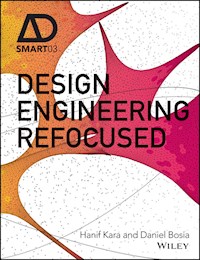
The contents of the book will highlight the differences between the design and engineering disciplines – strengths and flaws. It will also illustrate examples of interdisciplinary interactions. Any false dichotomies will be revealed and the many non-linear processes borne out of challenging conventions between traditional and new modes of practice will be revealed. Projects based on a body of experience spanning many years will be selected to support experimentation that goes beyond an undisciplined search for originality, innovation and creativity. In addition to writings from Hanif Kara and Daniel Bosia contributions will be sought from specialists in the field who have played a role in the operations of P.art® at AKT II – past and present – qualifying them to disseminate and distribute a particular form of ‘knowledge’.
- Features work of architectural practices: Adjaye Associates, Foster + Partners, Heatherwick Studio, HOK, Serie Architects, Wilkinson Eyre Architects and Zaha Hadid Architects.
- In addition to AKT II, it will encompass the work of engineers and engineering consultants such as: Arup, Cecil Balmond, Buckminster Fuller, Buro Happold, Pier Luigi Nervi and Peter Rice.
Sie lesen das E-Book in den Legimi-Apps auf:
Seitenzahl: 292
Veröffentlichungsjahr: 2016
Ähnliche




















This edition first published 2016Copyright © 2016 John Wiley & Sons Ltd
Registered officeJohn Wiley & Sons Ltd, The Atrium, Southern Gate, Chichester, West Sussex, PO19 8SQ, United Kingdom
For details of our global editorial offices, for customer services and for information about how to apply for permission to reuse the copyright material in this book please see our website at www.wiley.com.
All rights reserved. No part of this publication may be reproduced, stored in a retrieval system, or transmitted, in any form or by any means, electronic, mechanical, photocopying, recording or otherwise, except as permitted by the UK Copyright, Designs and Patents Act 1988, without the prior permission of the publisher.
Wiley publishes in a variety of print and electronic formats and by print-on-demand. Some material included with standard print versions of this book may not be included in e-books or in print-on-demand. If this book refers to media such as a CD or DVD that is not included in the version you purchased, you may download this material at http://booksupport.wiley.com. For more information about Wiley products, visit www.wiley.com.
Designations used by companies to distinguish their products are often claimed as trademarks. All brand names and product names used in this book are trade names, service marks, trademarks or registered trademarks of their respective owners. The publisher is not associated with any product or vendor mentioned in this book.
Limit of Liability/Disclaimer of Warranty: while the publisher and author have used their best efforts in preparing this book, they make no representations or warranties with respect to the accuracy or completeness of the contents of this book and specifically disclaim any implied warranties of merchantability or fitness for a particular purpose. It is sold on the understanding that the publisher is not engaged in rendering professional services and neither the publisher nor the author shall be liable for damages arising herefrom. If professional advice or other expert assistance is required, the services of a competent professional should be sought.
A catalogue record for this book is available from the British Library.
ISBN 978-1-119-16487-6 (hardback)ISBN 978-1-119-16486-9 (ePDF)ISBN 978-1-119-16485-2 (ePub)ISBN 978-1-119-16483-8 (O-BK)
Executive Commissioning Editor: Helen CastleProject Editor: Miriam MurphyAssistant Editor: Calver Lezama
Page design by Emily ChickenCover design and page layouts by Karen Willcox, www.karenwillcox.comPrinted in Italy by Printer Trento SrlCover concept and image © AKT IIImages pp 12-13 and 110-111 © AKT II
DESIGN ENGINEERING REFOCUSED
Hanif Kara and Daniel Bosia
CONTENTS
Acknowledgements
Future Focus
Engineering as Exploration
Part 1: Introduction and Terrain
1 The Pink Noise’ of Design Engineering
The Present Condition and Redefinition of Design Engineering
The Design Engineer as Practitioner
Pars Pro Toto
Sustaining the Outcomes Through Economic Challenges Today
References
Text
Images
2 Digital to Post-Digital
References
Text
Images
3 So Digital, It’s Analogue
Continuity deconstructed
Maturity of mind and tool
The misled surface fetish
Geometric currency of compiling matter
Particles and waves
References
Text
Images
4 Architecture–Engineering Interface
Translation interface: taking advantage of common representations
Communication interface: navigating the issue of control
Cross-disciplinary observables: UK Pavilion, Shanghai Expo
Intuition interface: computer–human interface for design
References
Text
Images
5 Abacus and Sketch
Case studies
St Paul’s Cathedral
Munich Olympic Stadium
Sydney Opera House
Downland Gridshell
Conclusion
References
Text
Images
6 Digital Dexterity
Design studio curriculum and material-based studies
Interpretation and development of structural models in architectural education
Conclusions
References
Text
Images
7 Digital Vernacular
Digital fabrication
What can be learnt from vernacular architecture?
Addis Ababa experiment on building envelopes
Construction and industry
New materiality
Where do we go from here?
References
Text
Images
Part 2: HEFT, Ontology and Horizon
8 Geometry and Organisation
References
Text
Images
9 Material Matter
Material world
Fibre-reinforced polymers
Text
Images
10 Structural Dynamics
Text
Images
11 Forces of Nature
Outdoor microclimate comfort
Bioclimatic Comfort Toolkit
Interrogating the simulation
The immediate future
The task of validation
Text
Images
12 Structural Skins
Traditional construction of buildings
Structural envelopes
Drawing studio at the Arts University Bournemouth
Surface geometry
Structural weight/cost optimisation
Stiffeners pattern
Fabrication
Site assembly
Text
Images
13 Hybrid Shells
Concrete hybrid shells
Steel hybrid shells
Conclusion
Text
Images
14 Tensile Structures
Geometric principles and forms
Form-finding and computational approach
Analysis/design
Case study: catenary roof
Conclusion
History
Sustainability
Rediscovery
Materiality
The future
References
Text
Images
15 Interweaving Practice
Package vs interface
Analysis vs synthesis
Al Fayah Park
Merchant Square
Central Bank of Iraq
Silo vs hybrid
The beyond
References
Text
Images
Editor Biographies
Contributor Biographies
Select Bibliography
Index
EULA
List of Illustrations
Chapter 1
1 AKT II, birth of the structural engineer (c 1800).
2 AKT II, evolution of reinforced-concrete design codes of practice. These codes have evolved since 1930, they assess how factors of safety, combined with new analysis, allow the reuse of old structures.
3 AKT II, prism.
4 AKT II, value of design and non-linear processes.
5 AKT II, p.art’s role.
6 AKT II, design research: scientific vs architectural endeavour (adapted from William Caudill).
7 Foster + Partners with AKT II, Masdar Institute, Abu Dhabi, UAE, 2010.
8 AZPML with AKT II, Birmingham New Street station, Birmingham, UK, 2015. A geometry that designs a ‘form’ of complex geometry, extending the use of advances in software and the connections between digital manufacturing and design.
9 Asif Khan with AKT II, Radiant Lines installation, Melbourne’s Federation Square, 2014.
10 OFIS Architects with AKT II, bivouac, Slovenia, 2014.
11 ACME with AKT II, Hunsett Mill, Stalham, UK, 2010, rear elevation.
12 Allford Hall Monaghan Morris with AKT II, BAM, Angel Building, London, UK, 2010.
13 Zaha Hadid Architects with AKT II, Heydar Aliyev Centre, Baku, Azerbaijan, 2012. The completed building required advanced scripting methods and analysis for sensitivity in developing countries.
14 Zaha Hadid Architects with AKT II, Heydar Aliyev Centre, Baku, Azerbaijan, 2012, Heyda Aliyev Centre analysis. The design was based on simplifed linear frames to cope with the complexity of the facade. Facade tiles were optimised to mainta overall form but economy in manufacture and installation.
15 Zaha Hadid Architects with AKT II, Heydar Aliyev Centre, Baku, Azerbaijan, 2012. Final construction introduced off-the-shelf space to construct a unique form, challenging the purpose of space frames.
16 David Chipperfeld Architects with AKT II, Turner Contemporary, Margate, UK, 2011. Annual overtopping of the water required careful modelling for extreme conditions.
17 AKT II, pink noise graph. Pink noise can mask low-frequency background sound, helping to increase one’s productivity and concentration. The themes and projects here are intended to mask the wide-ranging disciplinary activity of structural engineering.
5
18 AKT II, pink noise function. We borrow the use of this ‘function’ as a metaphor to make a distinction between the general implications of ‘design engineering’ and the specific approach discussed in this publication.
Chapter 2
1 Frei Otto, Mannheim Multihalle, Mannheim, Germany, 1975.
2 Grimshaw, Eden Project, Cornwall, UK, 2001.
3 Toyo Ito & Associates, Serpentine Gallery Pavilion, London, UK, 2002.
4 Toyo Ito & Associates, Serpentine Gallery Pavilion, London, UK, 2002.
5 UNStudio, Arnhem Centraal station, Arnhem, the Netherlands, 1998.
6 UNStudio, Arnhem Centraal station, Arnhem, the Netherlands, 1998.
7 Matthew Ritchie with Aranda\Lasch, The Morning Line, Seville, Venice, New York, Istanbul, Vienna, Karlsruhe, 2009.
8 Matthew Ritchie with Aranda\Lasch, The Morning Line, Seville, Venice, New York, Istanbul, Vienna, Karlsruhe, 2009.
9 Zaha Hadid Architects with AKT II, Central Bank of Iraq, Baghdad, Iraq, from 2011.
10 AKT II, the AKT II Re.AKT interoperable workflow.
11 AKT II, form- and pattern-finding.
12 Foster + Partners with AKT II, stair of the Bloomberg headquarters, London, UK.
13 CRAB with AKT II, drawing studio, Arts University Bournemouth, UK, 2015.
14 Pernilla & Asif with AKT II, Coca-Cola Beatbox Pavilion, Olympic Park, London, 2012.
15 AKT II genealogy of structural envelopes.
Chapter 3
1 George L Legendre, mathematical formula and geometry for Glasshouse Street Canopy design.
2 IJP Corporation with AKT II, planar glass study for Glasshouse Street Canopy design.
3 IJP Corporation with AKT II, Gaussian curvature analysis of different concept models.
4 AKT II, planar tessellation of double-curved surface.
5 Autodesk, 3D printed multi-material cube with functional gradient from elastomer (top) to rigid polymer (bottom).
6 Autodesk, generatively designed pedestrian bridge.
7 AKT II, artist’s sketch of particle-wave duality phenomenon.
Chapter 4
1 Topostruct, 2008.
2 Future Systems with AKT II,
3 Structural patterns, 2008.
4 Future Systems with AKT II,
5 Heatherwick Studio with AKT II, UK Pavilion, Shanghai Expo, China, 2010.
6 Heatherwick Studio with AKT II, UK Pavilion, Shanghai Expo, China, 2010.
7 Heatherwick Studio with AKT II, UK Pavilion, Shanghai Expo, China, 2010.
8 Zaha Hadid Architects with AKT II, Heydar Aliyev Center, Baku, Azerbaijan, 2012.
9 Zaha Hadid Architects with AKT II, Heydar Aliyev Center, Baku, Azerbaijan, 2012.
10 Zaha Hadid Architects with AKT II, Guggenheim Hermitage Museum, Vilnius, Lithuania, 2007.
11 Zaha Hadid Architects with AKT II, Guggenheim Hermitage Museum, Vilnius, Lithuania, 2007.
12 Zaha Hadid Architects with AKT II, Guggenheim Hermitage Museum, Vilnius, Lithuania, 2007.
13 Zaha Hadid Architects with AKT II, Guggenheim Hermitage Museum, Vilnius, Lithuania, 2007.
14 Topostruct, 2008.
15 Topostruct, 2008.
16 Topostruct, 2008.
17 Topostruct, 2008.
Chapter 5
1 AHMM with AKT II, 240 Blackfriars, London, UK, 2014.
2 Notre-Dame Cathedral, Reims, France, 13th century.
3 Sketching design ideas.
4 AKT II, design office, 2015, digital tools for visualisation and exploration.
5 Christopher Wren, St Paul’s Cathedral, London, 1675–1710.
6 Christopher Wren, St Paul’s Cathedral, London, 1675–1710.
7 Frei Otto and Günter Behnisch, Olympic Stadium, Munich, Germany, 1972.
8 Jørn Utzon, the Sydney Opera House, Australia, 1973.
9 Edward Cullinan Architects, the Weald and Downland Museum Gridshell, West Sussex, UK, 2002.
10 Edward Cullinan Architects, the Weald and Downland Museum Gridshell, West Sussex, UK, 2002.
Chapter 6
1 Djordje Stojanovic, prototypical model, ‘Inconsistencies v.03’, Belgrade, Serbia, 2012.
2 Djordje Stojanovic, prototypical model, ‘Inconsistencies v.04’, Belgrade, Serbia, 2011.
3 Djordje Stojanovic, prototypical model, ‘Inconsistencies v.02’, Tehran, Iran, 2011.
Chapter 7
1 Sebastian Partowidjojo, private residence, Surabaya, Indonesia, 2015.
2 Sebastian Partowidjojo, private residence, Surabaya, Indonesia, 2015.
3 Light horn.
4 A craftsman preparing clay moulds for cooking stoves from recycled metal at Menalesh Tera in Addis Ababa, Ethiopia.
5 A craftsman proudly showing off his workmanship at Menalesh Tera in Addis Ababa, Ethiopia.
6 Stacks of recycled and reshaped steel pans for sale at Menalesh Tera in Addis Ababa, Ethiopia.
7 Project Echo.
8 Metalworker welding connection points for the individual discs in a steel facade mock-up during the EBE workshop at the EiABC in Addis Ababa, Ethiopia.
9 Completed steel frame and leather panels for a steel and leather facade mock-up during the EBE workshop at the EiABC in Addis Ababa, Ethiopia.
10 Processed leather hide at Menalesh Tera in Addis Ababa, Ethiopia.
11 Leather leaf.
Part 2
Bjarke Ingels Group (BIG) with AKT II and AECOM, London, UK, 2016.
Chapter 8
1 AKT II, Canstruction installation, Canary Wharf, London, UK, 2012.
2 AKT II, Canstruction installation, Canary Wharf, London, UK, 2012.
3 AKT II, S-String installation, London, UK, 2011.
4 AKT II, S-String installation, London, UK, 2011.
5 AKT II, S-String installation, London, UK, 2011.
6 Balmond Studio with AKT II, Crystal Ceiling, Beauvallon, France, 2012.
7 Balmond Studio with AKT II, Crystal Ceiling, Beauvallon, France, 2012.
8 Balmond Studio with AKT II, Crystal Ceiling, Beauvallon, France, 2012.
9 Aranda\Lasch with AKT II, Palais des Banquets roof canopy, Libreville, Gabon, 2013.
10 Aranda\Lasch with AKT II, Palais des Banquets roof canopy, Libreville, Gabon, 2013.
11 Aranda\Lasch with AKT II, Palais des Banquets roof canopy, Libreville, Gabon, 2013.
12 Aranda\Lasch with AKT II, Palais des Banquets roof canopy, Libreville, Gabon, 2013.
13 Pernilla & Asif with AKT II, Coca-Cola Beatbox, Olympic Park, London, UK, 2012.
14 Pernilla & Asif with AKT II, Coca-Cola Beatbox, Olympic Park, London, UK, 2012.
15 Pernilla & Asif with AKT II, Coca-Cola Beatbox, Olympic Park, London, UK, 2012.
16 SimpsonHaugh and Partners with AKT II, Library Walk Link Building, Manchester, UK, 2015.
17 SimpsonHaugh and Partners with AKT II, Library Walk Link Building, Manchester, UK, 2015.
18 SimpsonHaugh and Partners with AKT II, Library Walk Link Building, Manchester, UK, 2015.
19 AKT II, Centre Point, London, UK, 2014.
Chapter 9
1 AKT II, materials paradigm represented in the form of a tetrahedron.
2 AKT II, study for a carbon fibre cable-net structure, 2015.
3 SimpsonHaugh and Partners with AKT II, Library Walk Link Building, Manchester, UK, 2015.
4 SimpsonHaugh and Partners with AKT II, Library Walk Link Building, Manchester, UK, 2015.
5 SimpsonHaugh and Partners with AKT II, Library Walk Link Building, Manchester, UK, 2015.
6 AKT II, 2015.
9 AKT II, 2015.
7 Stanton Williams Architects with AKT II, Aga Khan student residence block, King’s Cross, London, UK, 2015.
8 Stanton Williams Architects with AKT II, Aga Khan student residence block, King’s Cross, London, UK, 2015.
10 Marvin Goody & Richard Hamilton, Monsanto House of the Future, Disneyland, California, USA, 1957.
11 Kéré Architecture with AKT II, Sensing Spaces exhibition, Royal Academy of Arts, London, UK, 2014.
12 Kéré Architecture with AKT II, Sensing Spaces exhibition, Royal Academy of Arts, London, UK, 2014.
13 Kéré Architecture with AKT II, Sensing Spaces exhibition, Royal Academy of Arts, London, UK, 2014.
14 Kéré Architecture with AKT II, Sensing Spaces exhibition, Royal Academy of Arts, London, UK, 2014.
15 Kéré Architecture with AKT II, Sensing Spaces exhibition, Royal Academy of Arts, London, UK, 2014.
16 The Chevrolet Corvette from 1953, featuring an FRP body.
17 The Spieringbrug movable bridge near Muiden, the Netherlands, 2015.
18 Synthesis Design + Architecture, dismountable pavilion for the introduction of the Volvo V60, Milan, Italy, 2013.
19 FRPs are used extensively in the Airbus A350 XWB, and during its first flight it was provided with a carbon fabric-style livery to illustrate this.
20 Institute for Computational Design (ICD) and Institute of Building Structures and Structural Design (ITKE), ICD/ITKE Research Pavilion 2012, University of Stuttgart, 2012.
Chapter 10
1 AKT II, classic dynamic model.
2 AKT II, the principles of divergence in the context of bridge design.
3 Tacoma Narrows Bridge, Tacoma, Washington, USA, 1940.
4 Foster + Partners, Millennium Bridge, London, UK, 2000.
5 Foster + Partners with AKT II, Bloomberg headquarters, London, UK, 2017, analysis model of the Bloomberg stair.
6 Foster + Partners with AKT II, Bloomberg headquarters, London, UK, 2017, hypotrochoid ramped staircase.
7 Foster + Partners with AKT II, Bloomberg headquarters, London, UK, 2017, cut-away of ramp section.
8 Foster + Partners with AKT II, Bloomberg headquarters, London, UK, 2017, response factor distribution for entire staircase.
9 Foster + Partner with AKT II, Bloomberg headquarters, London, UK, 2017.
10 The tuned mass damper used in Taipei 101, Taiwan, 2004.
11 AKT II, diagram highlighting the dramatic reduction in the response factor through the use of a tuned mass damper.
Chapter 11
1 Altiplano region, Bolivia.
2 AKT II, large movement of air masses creates global wind patterns driving meteorological variations in wind climates.
3 AKT II, schematic representation of the urban atmosphere, showing a build-up of the Urban Boundary Layer above the build environment.
4 AKT II, typical wind patterns around solitary buildings following different orientations to the wind direction.
5 AKT II, flow regimes associated with different urban geometries and proximity between blocks.
6 AKT II, Millbank Tower redevelopment, London, UK.
7 AKT II, Millbank Tower redevelopment, London, UK.
8 AKT II, full radiation effects on urban surface geometry.
9 AKT II, Centre Point, London, UK.
10 AKT II, Centre Point, London, UK.
11 AKT II, Centre Point, London, UK.
12 AKT II, Centre Point, London, UK.
13 AKT II, Universal Thermal Comfort Index (UTCI).
14 AKT II, Millbank Tower redevelopment, London, UK.
15 AKT II, Millbank Tower redevelopment, London, UK.
Chapter 12
1
Typical construction of first aircrafts: Bristol F.2B fighter bomber (designed in 1916).
2
Slim Concorde supersonic transport, second prototype, assembled at Filton, just outside Bristol, UK.
3
Zaha Hadid Architects with AKT II, Middle East Centre, St Antony’s College, Oxford, UK, 2014.
4
Zaha Hadid Architects with AKT II, Middle East Centre, St Antony’s College, Oxford, UK, 2014.
5
AZPML with AKT II, Birmingham New Street station, Birmingham, UK, 2015.
6
AZPML with AKT II, Birmingham New Street station, Birmingham, UK, 2015.
7
CRAB with AKT II, drawing studio, Arts University Bournemouth, Poole, Dorset, UK, 2015.
8
CRAB with AKT II, drawing studio, Arts University Bournemouth, Poole, Dorset, UK, 2015.
9
CRAB with AKT II, drawing studio, Arts University Bournemouth, Poole, Dorset, UK, 2015.
10
Smooth reverse of the Loop and Catmull–Clark subdivision.
11
CRAB with AKT II, drawing studio, Arts University Bournemouth, Poole, Dorset, UK, 2015.
12
CRAB with AKT II, drawing studio, Arts University Bournemouth, Poole, Dorset, UK, 2015.
13
CRAB with AKT II, drawing studio, Arts University Bournemouth, Poole, Dorset, UK, 2015.
14–16
CRAB with AKT II, drawing studio, Arts University Bournemouth, Poole, Dorset, UK, 2015.
17
CRAB with AKT II, drawing studio, Arts University Bournemouth, Poole, Dorset, UK, 2015.
18
CRAB with AKT II, drawing studio, Arts University Bournemouth, Poole, Dorset, UK, 2015.
Chapter 13
1
Zaha Hadid Architects with AKT II, hybrid shells.
2
Zaha Hadid Architects with AKT II, hybrid shells, crude mesh and smooth mesh.
3
Zaha Hadid Architects with AKT II, hybrid shells, geometric algorithm form-finding process.
4
AKT II, Catmull–Clark smoothing and subdivision algorithm.
5
Zaha Hadid Architects with AKT II, hybrid shells.
6
Zaha Hadid Architects with AKT II, hybrid shells.
7
Zaha Hadid Architects with AKT II, hybrid shells.
8
Zaha Hadid Architects with AKT II, hybrid shells.
9
Zaha Hadid Architects with AKT II, hybrid shells, study on the method of construction for formwork.
10
Grimshaw, Messehalle 3, Frankfurt, Germany, 2001.
11
Grimshaw, Messehalle 3, Frankfurt, Germany, 2001.
12
Grimshaw, Messehalle 3, Frankfurt, Germany, 2001.
13
Grimshaw, Messehalle 3, Frankfurt, Germany, 2001.
14
Grimshaw, Messehalle 3, Frankfurt, Germany, 2001.
Chapter 14
1
St Peter’s Basilica, Rome, Italy, 1506–1626.
2
AKT II, synclastic curvature in a suspended catenary, characterised by positive Gaussian curvature.
3
AKT II, anticlastic curvature in a pre-stressed tensile structure, characterised by negative Gaussian curvature.
4
Alvaro Siza’s Portuguese National Pavilion, Expo 1998, Lisbon, Portugal, 1998.
5
Frei Otto and Günter Behnisch, aerial view of Munich Stadium, Germany, 1972.
6
Antoni Gaudí, Sagrada Família, Barcelona, Spain.
7
AKT II, section of an anticlastic pre-stressed cable-net or membrane structure.
8
AKT II, analysis of reaction forces at the base of a cable-net structure where perimeter anchor forces at primary cable locations are larger due to global lateral stability loads.
9
AKT II, flat panelisation of a synclastic translational surface using a translational surface method.
10
AKT II, geometric warp analysis in cladding panels of an anticlastic cable-net structure.
11
AKT II, typical detail of cable-net structure.
12
AKT II, typical detail of a grid-net structure.
13
AKT II, study for a hybrid grid-net structure, composed of slender layered steel sheets or bars.
14
AKT II, CFD wind analysis on a long-span lightweight structure to assess pressures on building enclosure.
15
Davis, Brody, Chermayeff, Geismar, deHarak Associates / David Geiger–Horst Berger, US Pavilion for the 1970 Expo, Osaka, Japan, 1970.
16
O’Dell, Hewlett & Luckenbach / Geiger Berger Associates, Silverdome, Michigan, USA, 1975.
17
Skidmore, Owings & Merrill / Geiger Berger Associates, Herbert H Humphrey Metrodome, Minneapolis, USA, 2013.
18
O’Dell, Hewlett & Luckenbach / Geiger Berger Associates, Silverdome, Michigan, USA, 2013.
19
AKT II, scaling of air-supported structures.
20
AKT II, cost versus time of an air-supported structure compared with a typical spanning enclosure.
21
AKT II, designing without the constraint of gravity.
22
AKT II, structural concepts for air-supported structures utilising an ETFE membrane.
23
AKT II, critical issues to the design of air-supported structures are air loss and redundancy.
24
AKT II, applications for air-supported structures in an increasingly uncertain world.
Chapter 15
1
AKT II, 2015; p.art atmosphere.
2
Ivan Sutherland, 1963; Sketchpad: A Man-Machine Graphical Communication System.
3
Ivan Sutherland, 1963; Sketchpad pointing device.
4
IBM, 1956; 305 RAMAC 5 MB hard drive.
5
AKT II, 2015; package or interface, that is the question.
6
AKT II, 2015; reunite the intelligence.
7
AKT II, 2015; Re.AKT.
8
AKT II, 2015; blending analysis and synthesis.
9
AKT II, 2015; interface loop.
10
Heatherwick Studio with AKT II, Al Fayah Park, Abu Dhabi, 2015.
11
Heatherwick Studio with AKT II, Al Fayah Park, Abu Dhabi, 2015.
12
Heatherwick Studio with AKT II, Al Fayah Park, Abu Dhabi, 2015.
13
Knight Architects with AKT II, Merchant Square bridge, London, UK, 2014.
14
Knight Architects with AKT II, Merchant Square bridge, London, UK, 2014.
15
Knight Architects with AKT II, Merchant Square bridge, London, UK, 2014.
16
Zaha Hadid Architects with AKT II, Central Bank of Iraq, Baghdad, Iraq, 2014; structural model.
17
Zaha Hadid Architects with AKT II, Central Bank of Iraq, Baghdad, Iraq, 2014; tower structure.
18
Zaha Hadid Architects with AKT II, Central Bank of Iraq, Baghdad, Iraq, 2014; Re.AKT design stages.
19
DeWitt Godfrey with AKT II, Odin, Colgate University, Hamilton, NY, USA, 2014, Odin hybrid process.
20
AKT II, 2015; enhancing professional figure.
Guide
Cover
Contents
1
Pages
4
6
8
9
10
11
12
13
14
15
16
17
18
19
20
21
22
23
24
25
26
27
28
29
30
31
32
33
34
35
36
37
38
39
40
41
42
43
44
45
46
47
48
49
50
51
52
53
54
55
56
57
58
59
60
62
63
64
65
66
67
68
69
70
71
72
73
74
75
76
77
78
79
80
81
82
83
84
85
86
87
88
89
90
91
92
93
94
95
96
97
98
99
100
101
102
103
104
105
106
107
108
109
110
111
112
113
114
115
116
117
118
119
120
121
122
123
124
125
126
127
128
129
130
131
132
133
134
135
136
137
138
139
140
141
142
143
144
145
146
147
148
149
150
151
152
153
154
155
156
157
158
159
160
161
162
163
164
165
166
167
168
169
170
171
172
173
174
175
176
177
178
179
180
181
182
183
184
185
186
187
188
189
190
191
192
193
194
195
196
197
198
199
200
201
202
203
204
205
206
207
208
209
210
211
212
213
214
215
216
217
218
219
220
221
222
223
224
225
226
227
228
229
230
231
232
233
233
234
236
237
238
239
240
ACKNOWLEDGEMENTS
We would first like to thank the directors and all the staff at AKT II, past and present; without them and their projects, this publication would not have been possible. It also goes without saying that this applies to all their clients, patrons and collaborators over the many years, as without them there would be no projects. We would also like to thank Professor John Ochsendorf for a considered and most welcome foreword. Hanif would like to single out Dean Mohsen Mostafavi at GSD for inspiring, advising and supporting this publication and for his poignant contribution ‘Future Focus’ at the start of this book.
To the authors who provided us with this book's exceptional content; Jordan Brandt, Marco Cerini, Diego Cervera de la Rosa, Philip Isaac, Jeroen Janssen, Sawako Kaijima, James Kingman, Alessandro Margnelli, Panagiotis Michalatos, Ed Moseley, Richard Parker, Andrew Ruck, Adiam Sertzu, Djordje Stojanovic, Edoardo Tibuzzi, Martijn Veltkamp and Marc Zanchetta.
Thanks, in particular, to Harvard University GSD and the AA, for encouraging us, but also to all the other institutions over the years.
We would like to thank Joshua Simpson and Kate Hobson for supervisory editing, Jan Friedlein, Erica Choi and Fritzie Manoy for graphic design, and Jessica Wainwright-Pearce for all the support in coordinating both internally and with the Wiley team.
Finally, we wish to thank our families for putting up with the late nights and long weekends during the construction of this book over the last two years.
FUTURE FOCUS
MOHSEN MOSTAFAVI
In architecture, the connection between the logic of a form and the logic of its structure always used to be thought of as direct, linear, and overtly rational. Right up to the latter part of the twentieth century, the principle of upright structural support, represented by vertical columns and horizontal beams, provided the dominant method for the conceptualisation and design of most buildings.
This Cartesian mode of imagining the reciprocities between form and structure, in all its many iterations, is of course still very much with us today. It continues to be the reference point for the vast majority of contemporary architectural projects, shaping our imaginations as well as the prevalent methods of the building industry, which in turn feed back into the design process through, for example, the considerations of cost and period of construction.
Buildings produced through a column grid structure can vary enormously in their systematic adherence to the relation between form and structure. But this relation was itself radically transformed during the second part of the twentieth century, with the evolution of concrete thin shell structures that brought about a synthetic unity between form and structure. Engineers such as Pier Luigi Nervi, Eduardo Torroja, and Felix Candela were instrumental in developing forms that were no longer purely reliant on traditional methods of building construction. In place of structure as form, they proposed the notion of form as structure.
Through its exploration of both the geometric properties of shell structures and the elastic qualities of reinforced concrete, the work of these engineers produced a radically different conception of architectural form. Their research resulted in spatial forms that at times seem to closely resemble shapes and patterns found in nature.
These developments in the field of engineering also have some parallels with the earlier work of the Scottish biologist and mathematician D'Arcy Wentworth Thompson, whose classic book On Growth and Form, first published in 1917, would become a primary source for subsequent studies of morphogenesis—the idea of forms and their connections with plants and animals. Similarly, one key consideration of the work presented in this book is the shift from linear to non-linear geometry. The structural behaviour of many contemporary designs no longer follows—or perhaps more importantly, necessarily needs to follow—traditional methods for calculating structural forces. In addition, technological advances have made it possible to both imagine and construct forms that previously would have been nearly impossible to conceive.
While often focused on the articulation of continuous skins and variations in the curvature of building envelopes, these explorations can nevertheless also be utilised to transform our traditional conceptions of architectural design and construction.
It is against this backdrop, and with advances made in computation, materials and fabrication procedures, that the contributions to this book have taken shape. Design Engineering Refocused proposes a new way of considering the hybrid relationship between design and engineering. For it is in the space of entanglement and reciprocities between these two types of practice that the authors have discovered innovative ideas and unexpected solutions that respond to typical programs and everyday needs of users and clients.
Mohsen Mostafavi is Dean of the Harvard Graduate School of Design and the Alexander and Victoria Wiley Professor of Design.
ENGINEERING AS EXPLORATION
JOHN OCHSENDORF
In his 2004 essay ‘In Search of Brunel’,1 architect Charles Correa lamented the hyper-specialisation of the contemporary engineer, having evolved from the visionary master builder of the past to the number-crunching designer of individual components of today. The great structural engineers of the late 19th and early 20th centuries, such as Isambard Kingdom Brunel, Gustave Eiffel and Robert Maillart, designed holistically to invent new technological possibilities. The vision of the pure engineer as lone genius, achieving beauty through the constraints of economy and efficiency, has been celebrated by Sigfried Giedion,2 Le Corbusier,3 David Billington4 and many others over the past century. The structural engineer as singular artist applies most clearly to bridge design, where the challenge of spanning allows structure to dominate the design process. On the other hand, building design requires a level of synthesis among disciplines which does not often allow structure to emerge as the primary consideration, and it is therefore more difficult to identify examples of the heroic engineer in the design of buildings.
The profession of structural engineering is in a state of open crisis today. A Vision for the Future of Structural Engineering,5 published by the Structural Engineering Institute, identifies severe problems and characterises the field as occupying a ‘shrinking space’. It also highlights the challenges in structures education and laments that most undergraduate curricula have not changed in decades. Compared with the staggering pace of change in computing, biomedical engineering or nanotechnology, the field of structural engineering can seem frozen in time. So it is a challenging time for structural engineering. Engineers are asked to do more with less: to deliver more design options with lower costs and lower environmental impact. And to have fewer people design more complex projects in less time. Yet, within this landscape of crisis, there are numerous examples today of stellar structural engineers bringing value to design teams.
In characterising the interwoven roles of the architect and engineer, Le Corbusier defined this as a struggle between the ‘spiritual’ and the ‘economical’ (Figure 1). Design is an endless frontier. It requires finding a balance between the pragmatic and the sublime. Architectural education emphasises the plurality of solutions and encourages exploration. Engineering education emphasises unique solutions, which can lead to a reluctance to explore. But the greatest engineers are ceaseless explorers. Today, increased computational power is allowing engineers to shorten feedback loops in design by articulating a common language for design goals and by providing a clearer view of the terrain to be explored. Instead of providing a unique solution for the design team to accept or reject, the best engineers can map the design constraints in a productive way. The exploration of the engineer is bounded by ethics: by protecting human life in building safely; by pursuing design efficiency in a resource-constrained world; and by seeking economical solutions for clients within a finite budget. Without constraint, there is no design.
This is an optimistic book. It portrays a highly creative practice exploring new frontiers in structural engineering and it provokes questions on the multidimensional roles of engineering in contemporary architecture and art. Structure is not the only driver in architecture, nor should it be. But the projects and methods described here demonstrate the myriad ways in which the mature field of structural engineering can still contribute in new ways. The book demonstrates the powerful opportunities for engineers to serve as collaborative synthesisers in the endless frontier of design. The fearless exploration of AKT II exemplifies the burgeoning potential for the structural engineer in the 21st century. Brunel would be impressed.
John Ochsendorf is Professor of Civil and Environmental Engineering at the Massachusetts Institute of Technology. He became a MacArthur Fellow in 2008.
References
1 Charles Correa, ‘In Search of Brunel’,
A Place in the Shade: The New Landscape and Other Essays
, Penguin Books (Delhi), 2010, pp144–7.
2 Sigfried Giedion,
Space, Time, and Architecture: The Growth of a New Tradition
, Harvard University Press (Cambridge, MA), 1941.
3 Le Corbusier,
Vers une architecture, Éditions Crès,
Collection de ‘L'Esprit Nouveau’ (Paris), 1923.
4 David P Billington,
The Tower and the Bridge: The New Art of Structural Engineering
, Basic Books (New York), 1983.
5
A Vision for the Future of Structural Engineering and Structural Engineers: A Case for Change
, ASCE: Structural Engineering Institute, 2013,
http://www.asce.org/uploadedFiles/visionforthefuture.pdf
Images
Figure 1© FLC/DACS, 201
1




