


4,99 €
Mehr erfahren.
- Herausgeber: Stefano Caggiano
- Kategorie: Geisteswissenschaft
- Sprache: Englisch
Most of the people who work in the field attain an implicit knowledge of design languages through exposure to design discourse, that is to say, to the ecosystem comprised of products, companies, showrooms, trade shows, events, exhibitions, magazines, and blogs that deal with design. And just as there is no need to study grammar in order to speak effectively, so too can one learn to “speak” design proficiently without necessarily studying its “grammar.” Yet, as more and more people enter the field of design, the bar is raised in terms of the skills required to be groundbreaking in design field—both from a cultural and from a market perspective. Direct exposure to the evolution of objects remains fundamental to work within the design system, but passing from an empirical to a strategic knowledge of design languages requires a specific understanding of the ways in which the different aesthetics embodied in objects refer to the cultural meanings underlying them. With this in mind, this book aims to provide a guide to the “grammar” of design languages, with an emphasis on the contemporary scene. It cannot and in no way intends to replace direct exposure to design languages. Instead, it tries to make explicit the aesthetic-cultural pivots of such languages and thus aid design professionals in their passage from being merely familiar with the aesthetics of objects to being able to understand and use such aesthetics strategically.
Das E-Book können Sie in Legimi-Apps oder einer beliebigen App lesen, die das folgende Format unterstützen:
Veröffentlichungsjahr: 2015
Ähnliche




















Stefano Caggiano
DESIGN LANGUAGES
The Aesthetic and Meaning of Objects in Contemporary Culture
Copyright: © 2015 Stefano Caggiano
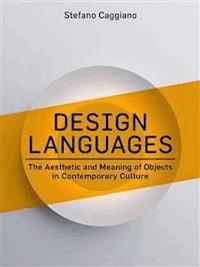
Cover image: Ferréol Babin, “Lunaire,” manufactured by FontanaArte, 2013.
All images are copyright to their respective owners.
Footnotes with comments are indicated by letters [a, b, c, ...].
Table of Contents
INTRODUCTION
A Grammar for Design Languages
What a Design Language Is
1. PRE-LINGUISTIC PATHS IN DESIGN FROM THE ORIGINS TO THE FIFTIES
From a Representative Aesthetic to a Conformative Aesthetic
Rationalism
Organic Design
2. DESIGN LANGUAGES FROM THE FIFTIES TO THE PRESENT TIME
The Legacy of the Pre-Linguistic Period
The Fifties – Design as Language
The Sixties – Plastic and Freedom
The Seventies – Crisis and Austerity
The Eighties – The Postmodern Aesthetic Apocalypse
The Nineties – Minimalism and Communication
The Zero – Liquid Society
3. CONTEMPORARY DESIGN LANGUAGES
On Design as a Project Discipline: From a Heliocentric System to a Polycentric Ecosystem
On Design Culture in the Contemporary Scene: The Culture of the Two Convergences
Convergent Sustainability
Convergent Digitality
Design Languages in the Present Time
Obvious Construction (S)
Transitional Objects (S)
Graphic Blocks (D)
Real Toys (D)
Low Res (D)
Digital Organic (D)
Arts & Witchcrafts (S)
Non-Language Design
Mysterious Science (S)
Footnotes
The Author
INTRODUCTION
A Grammar for Design Languages
Children learn to speak by participating in the linguistic practices of a cultural community. Exposed to language well before school age, they adopt the patterns of linguistic behavior they observe in adults. These regularities are the “rules” of grammar. They function less like a list of orders than a set of “pivots” through which one can give shape to the linguistic mass. The mastery of language thus involves an implicit, operational form of knowledge that can sometimes be explained explicitly in terms of grammar (e.g., at school), but works just as well without such formal instruction.
A similar distinction between implicit and explicit knowledge applies to design languages. Most of the people who work in the field attain an implicit knowledge of design languages through exposure to design discourse, that is to say, to the ecosystem comprised of products, companies, showrooms, trade shows, events, exhibitions, magazines, and blogs that deal with design. And just as there is no need to study grammar in order to speak effectively, so too can one learn to “speak” design proficiently without necessarily studying its “grammar.”
Yet, as more and more people enter the field of design, the bar is raised in terms of the skills required to be groundbreaking in design field—both from a cultural and from a market perspective. Direct exposure to the evolution of objects remains fundamental to work within the design system, but passing from an empirical to a strategic knowledge of design languages requires a specific understanding of the ways in which the different aesthetics embodied in objects refer to the cultural meanings underlying them.
With this in mind, this book aims to provide a guide to the “grammar” of design languages, with an emphasis on the contemporary scene. It cannot and in no way intends to replace direct exposure to design languages. Instead, it tries to make explicit the aesthetic-cultural pivots of such languages and thus aid design professionals in their passage from being merely familiar with the aesthetics of objects to being able to understand and use such aesthetics strategically.
INTRODUCTION
What a Design Language Is
Design languages do not arise out of nowhere, they evolve over time. Accordingly, this book traces the pre-linguistic paths in the history of design, as they have shifted from the origins of the field in the second half of the nineteenth century, up to and then through the two World Wars of the first half of the twentieth century. It then charts the design languages of the second half of the twentieth century, until turning finally to contemporary design languages in the last and longest part of the book.
But to begin: a few clarifications. First, it should be immediately clear that no object is able to “make up” a language by itself. A flock of birds illustrates the point well. None of the birds know the overall shape to be kept as a group, yet their interaction produces striking aesthetics that belong to the flock as a whole. A design language takes shape in the same way. It is a “language” insofar as it is shared by several objects, each of which has its own design, but which constitute and convey together a specific aesthetic, an emerging property belonging to the group as a whole.
A second point (which flows directly from the first) is that a language is not the “style” of a single designer. In fact, whereas a style is individual and deliberate, a language is inherently transverse and, as argued above, engendered only by a group of objects.
A last clarification is that the term “language” is not used here as synonymous with “aesthetic.” Instead, a language is comprised of an aesthetic connected to a meaning or set of meanings, to which it refers and by which it’s given shape and content. Put another way, a design language consists of aesthetics + meaning, and what gives a language its peculiar morphology is the specificity of the aesthetic-semantic pivot it puts in the field of design. When we speak of a design language we are focusing neither on the personal style of a designer nor on any one individual object, but to a peculiar connection between an aesthetic and a cultural meaning characterizing a group of objects as a whole.
Through what channels and how quickly an aesthetic might take root and circulate has clearly shifted in this digital age, but the compelling question is still why certain aesthetics propagate more than others. The reason, I argue, lies in the very definition and form of design languages. Designed objects and aesthetic forms do not exist within a void but draw upon and express specific meanings. So, instead of “beautiful” objects, it is more appropriate when speaking of design languages to talk about aesthetically meaningful objects. As such, the book’s concern is not what makes designed objects look good, but what makes them look meaningful—how cultural meaning is embodied in them. To offer a final analogy, a design language can be compared to an iceberg: there is its above-water, visible forms—its aesthetic, and a submerged, imperceptible body—that deeper cultural content upon which the aesthetic is based and only thanks to which that aesthetic can even be perceived as meaningful, and, sometimes, “meaningfully beautiful.”
Pre-linguistic paths in design from the origins to the Fifties ↵
Design languages from the Fifties to the Eighties ↵
Design languages from the Nineties to the present time ↵
Lesen Sie weiter in der vollständigen Ausgabe!
Lesen Sie weiter in der vollständigen Ausgabe!
Lesen Sie weiter in der vollständigen Ausgabe!
Lesen Sie weiter in der vollständigen Ausgabe!
Lesen Sie weiter in der vollständigen Ausgabe!
Lesen Sie weiter in der vollständigen Ausgabe!
Lesen Sie weiter in der vollständigen Ausgabe!
Lesen Sie weiter in der vollständigen Ausgabe!
Lesen Sie weiter in der vollständigen Ausgabe!
Lesen Sie weiter in der vollständigen Ausgabe!
Lesen Sie weiter in der vollständigen Ausgabe!
Lesen Sie weiter in der vollständigen Ausgabe!
Lesen Sie weiter in der vollständigen Ausgabe!
Lesen Sie weiter in der vollständigen Ausgabe!
Lesen Sie weiter in der vollständigen Ausgabe!
Lesen Sie weiter in der vollständigen Ausgabe!
Lesen Sie weiter in der vollständigen Ausgabe!
Lesen Sie weiter in der vollständigen Ausgabe!
Lesen Sie weiter in der vollständigen Ausgabe!
Lesen Sie weiter in der vollständigen Ausgabe!
Lesen Sie weiter in der vollständigen Ausgabe!
Lesen Sie weiter in der vollständigen Ausgabe!
Lesen Sie weiter in der vollständigen Ausgabe!
Lesen Sie weiter in der vollständigen Ausgabe!
Lesen Sie weiter in der vollständigen Ausgabe!
Lesen Sie weiter in der vollständigen Ausgabe!
Lesen Sie weiter in der vollständigen Ausgabe!
Lesen Sie weiter in der vollständigen Ausgabe!
Lesen Sie weiter in der vollständigen Ausgabe!




