


43,99 €
Mehr erfahren.
- Herausgeber: John Wiley & Sons
- Kategorie: Geisteswissenschaft
- Serie: Wiley Series in The Psychology of Crime, Policing and Law
- Sprache: Englisch
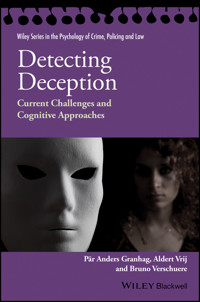
Detecting Deception offers a state-of-the-art guide to the detection of deception with a focus on the ways in which new cognitive psychology-based approaches can improve practice and results in the field.
- Includes comprehensive coverage of the latest scientific developments in the detection of deception and their implications for real-world practice
- Examines current challenges in the field - such as counter-interrogation strategies, lying networks, cross-cultural deception, and discriminating between true and false intentions
- Reveals a host of new approaches based on cognitive psychology with the potential to improve practice and results, including the strategic use of evidence, imposing cognitive load, response times, and covert lie detection
- Features contributions from internationally renowned experts
Sie lesen das E-Book in den Legimi-Apps auf:
Seitenzahl: 693
Veröffentlichungsjahr: 2014
Ähnliche




















CONTENTS
Cover
Wiley Series in the Psychology of Crime, Policing and Law
Title page
Copyright page
Contributors
Series Preface
Introduction
THE PRESENT VOLUME
REFERENCES
Acknowledgements
Section I: Deception Detection
1 Verbal Lie Detection Tools
STATEMENT VALIDITY ANALYSIS
CRITERIA-BASED CONTENT ANALYSIS
THE VALIDITY CHECKLIST
REALITY MONITORING
SCIENTIFIC CONTENT ANALYSIS
A SVA, RM AND SCAN COMPARISON
REFERENCES
2 New Findings in Non-Verbal Lie Detection
THEORETICAL HISTORY
EMPIRICAL EVIDENCE FOR NON-VERBAL CUES TO DECEPTION
CONTEMPORARY RESEARCH
NON-VERBAL DETERMINANTS OF DECEPTION JUDGEMENTS
LIE DETECTION ACCURACY
CONCLUSION
REFERENCES
3 The Polygraph
THE POLYGRAPH
THE CONTROL QUESTION TEST
ACCURACY
PSEUDOSCIENCE
DISCLOSURE: JOB APPLICANTS AND SEX OFFENDERS
THE FUTURE OF THE CQT
CONCEALED INFORMATION
THEORY
ACCURACY
APPLICATION OF THE CIT
NEW APPROACHES: THE SEARCHING AND GROUP CIT
THE FUTURE OF THE CIT
CONCLUDING REMARKS
REFERENCES
4 Forensic Application of Event-Related Brain Potentials to Detect Guilty Knowledge
THE CASE FOR THE P300-GKT
IMPORTANT PERSPECTIVE FOR MOVING FORWARD WITH THE DEVELOPMENT OF A FIELD-APPLICABLE P300-GKT
OPTIMIZING THE P300-GKT
MOVING FORWARD WITH REAL-LIFE APPLICATION OF THE P300-GKT
CONCLUSION
ACKNOWLEDGEMENT
REFERENCES
5 Deception Detection Using Neuroimaging
THEORETICAL FRAMEWORK
NEUROIMAGING APPROACH
fMRI STUDIES OF DECEPTION DETECTION
ACCURACY OF fMRI-BASED DECEPTION DETECTION
DO fMRI DECEPTION DETECTION RESULTS REPLICATE?
fMRI DECEPTION DETECTION AND FIELD VALIDITY
CONCLUSIONS
ACKNOWLEDGEMENTS
REFERENCES
Section II: Current Challenges
6 Exploring the Nature and Origin of Beliefs about Deception
METHODS OF RESEARCH INTO SUBJECTIVE CUES TO DECEPTION
MAJOR FINDINGS
CAUSES OF CORRECT AND INCORRECT BELIEFS
ORIGIN OF THE STEREOTYPE ABOUT DECEPTIVE BEHAVIOUR
IMPLICIT AND EXPLICIT BELIEFS ABOUT DECEPTION
CONCLUSIONS AND DIRECTIONS FOR FUTURE RESEARCH ON BELIEFS ABOUT DECEPTIVE BEHAVIOUR
REFERENCES
7 Discriminating between True and False Intentions
WHERE WE ARE
WHERE WE ARE GOING
A NOTE OF CAUTION: THE ELUSIVE NATURE OF INTENT
CONCLUSIONS
REFERENCES
8 Cross-Cultural Deception Detection
CROSS-CULTURAL JUDGEMENTS ABOUT DECEPTION
CROSS-CULTURAL MODERATORS OF DECEPTION JUDGEMENTS
CULTURAL ROOTS OF JUDGEMENT ERRORS
CROSS-CULTURAL DIFFERENCES IN CUES TO DECEPTION
SUMMARY
REFERENCES
Section III: Improving Lie Detection
9 A Cognitive Approach to Lie Detection
LYING AND COGNITIVE LOAD
CONCLUSIONS AND FINAL THOUGHTS
REFERENCES
10 The Strategic Use of Evidence Technique
THE SUE MODEL
THE GENERAL PRINCIPLES OF THE SUE TECHNIQUE
THE RELATION BETWEEN SUE PRINCIPLES
EMPLOYING THE SUE TACTICS
THE OVERALL AIMS OF THE SUE TECHNIQUE
THEMES OF EVIDENCE: A CHALLENGE FOR THE FUTURE
LIMITATIONS
CONCLUSIONS
REFERENCES
11 Investigating Deception and Deception Detection with Brain Stimulation Methods
TMS BACKGROUND
TMS FINDINGS
TDCS BACKGROUND
TDCS FINDINGS
FUTURE DIRECTIONS
A NOTE ON ETHICS
FINAL CONSIDERATIONS AND CONCLUSIONS
REFERENCES
12 Detecting Deception Through Reaction Times
INTRODUCTION
BOUNDARY CONDITIONS AND NEW DIRECTIONS
SUMMARY
ACKNOWLEDGEMENT
REFERENCES
13 Suspects' Verbal Counter-Interrogation Strategies
INTRODUCTION AND BACKGROUND
THEORETICAL BACKDROP
SUSPECTS' COUNTER-INTERROGATION STRATEGIES: BASIC FINDINGS
TOWARDS A CAUSAL MODEL
FUTURE DIRECTIONS
CONCLUSIONS
REFERENCES
14 Covert Detection of Deception
UNDERLYING THEORETICAL APPROACHES TO DETECTING DECEPTION
COVERT DETECTION OF MICRO-EXPRESSIONS IN THE FACE
PSYCHOPHYSIOLOGICAL DETECTION OF DECEPTION
VOICE STRESS ANALYSIS
EYE-TRACKING TECHNOLOGIES
THERMAL IMAGING
COVERT RESPIRATION MEASURES IN PHYSIOLOGICAL DETECTION OF CONCEALED INFORMATION
COVERT RESPIRATION MEASURES IN THE GROUP CONCEALED INFORMATION TEST (GCIT): A PROMISE FOR THE FUTURE
COUNTER-COUNTERMEASURES IN THE COMPARISON QUESTION TEST (CQT) USING COVERT RESPIRATION MEASURES
ETHICAL CONSIDERATIONS
CONCLUDING REMARKS
References
Index
End User License Agreement
List of Tables
Chapter 01
Table 1.1 The criteria-based content analysis criteria
Table 1.2 The reality monitoring criteria
Table 1.3 The scientific content analysis criteria
Table 1.4 A summary of the three tools based on the Daubert guidelines
Chapter 02
Table 2.1 Individual differences in apparent honesty across deception media
Table 2.2 Lie–truth discrimination with
direct
and indirect measures
Chapter 03
Table 3.1 Overview of the accuracy figures yielded by laboratory and field studies for the control question and concealed information polygraph test
Chapter 05
Table 5.1 Accuracy rates for fMRI studies that performed single-subject analyses
Chapter 06
Table 6.1 Common explicit (self-reported) beliefs about deception
Table 6.2 Implicit beliefs about deception
Chapter 08
Table 8.1 Summary of differences in language use between genuine and deceptive statements across four cultural groups
Chapter 12
Table 12.1 Test structure of the RT-based Concealed Information Test (RT-CIT)
Table 12.2 Laboratory studies of the RT-based Concealed Information Test
Table 12.3 Test structure of the autobiographical Implicit Association Test (aIAT). The combined blocks (Block 3 and Block5) are crucial as they pair the statements with TRUE versus FALSE. The dots (
●
) indicate the required button press (left versus right)
Table 12.4 Laboratory studies of the Autobiographical Implicit Association Test (aIAT)
List of Illustrations
Chapter 02
Figure 2.1 A decline effect in cues to deception. The scatterplot depicts a decline effect in cues to deception. Each data point represents one of the 158 cues in the DePaulo et al. meta-analysis. The horizontal axis of the plot is the number of times a cue had been studied at the time of the DePaulo et al. meta-analysis (
k
). On the
y
-axis is the absolute strength of the cue (as an absolute weighted mean
d
). As the scatterplot shows, the strongest cues to deception have rarely been studied, and that the most widely studied cues are weak.
Chapter 05
Figure 5.1Schematic of the deception research continuum, from theoretical (top) to field applications (bottom).
Figure 5.2Theoretical framework illustrating the logic of deception detection methods.
Figure 5.3Theoretical framework illustrating the logic of neuroimaging-based deception detection methods.
Chapter 08
Figure 8.1A summary of eight communication dynamics that often lead to misunderstanding during cross-cultural interaction.
Chapter 10
Figure 10.1The SUE model.
Figure 10.2Suspects' perception of the evidence. The figure illustrates the general notion that a suspect will estimate the amount of information held by the interviewer on a scale ranging from low to high (the horizontal axis). In this particular example, the suspect is underestimating the amount of information held by the interviewer.
Figure 10.3Causal relations between three of the SUE principles. As the figure illustrates, suspects' perception of the evidence dictates their choice of counter-interrogation strategy, which in turn dictates their verbal response.
Figure 10.4The relation between suspect-related principles and perspective-taking on behalf of the interviewer.
Chapter 12
Figure 12.1Expected response pattern in the RT-based Concealed Information Test (RT-CIT), as observed in Noordraven and Verschuere (2013).
Figure 12.2Expected response pattern in the autobiographical IAT (aIAT), as observed in Verschuere Prati, et al. (2009) Experiment 1 (aIAT1, before receiving faking instructions).
Chapter 13
Figure 13.1A causal model of suspects' counter-interrogation strategies.
Chapter 14
Figure 14.1 Recordings of covert back and seat respiration responses. Upper graph – covert back respiration recordings. Lower graph – covert seat respiration recordings.
Guide
Cover
Table of Contents
Begin Reading
Pages
iii
ii
iv
vii
viii
ix
xi
xii
xiii
xv
xvi
xvii
xviii
xix
1
3
4
5
6
7
8
9
10
11
12
13
14
15
16
17
18
19
20
21
22
23
24
25
26
27
28
29
30
33
34
35
37
38
39
40
41
42
43
44
45
46
47
48
49
50
51
52
53
54
55
56
57
58
59
60
61
62
63
64
65
66
67
68
69
70
71
72
73
74
75
76
77
78
79
80
81
82
83
84
85
86
87
88
89
90
91
92
93
94
95
96
97
98
99
100
101
102
103
105
106
107
108
109
110
111
112
113
114
115
116
117
118
119
120
121
123
125
126
127
128
129
130
131
132
133
134
135
136
137
138
139
140
141
142
143
144
145
146
147
148
149
150
151
152
153
154
155
156
157
158
159
160
161
162
163
164
165
166
167
168
169
170
171
172
173
175
176
177
178
179
180
181
182
183
184
185
186
187
188
189
190
191
192
193
194
195
196
197
198
199
200
201
203
205
206
207
208
209
210
211
212
213
214
215
216
217
218
219
220
221
222
223
224
225
226
227
228
229
231
232
233
234
235
236
237
238
239
240
241
242
243
244
245
246
247
248
249
250
251
253
254
255
256
257
258
259
260
261
262
263
264
265
266
267
268
269
270
271
272
273
274
275
276
277
278
279
280
281
282
283
284
285
286
287
288
289
290
291
293
294
295
296
297
298
299
300
301
302
303
304
305
306
307
308
309
310
311
312
313
315
316
317
318
319
320
321
322
323
324
325
326
327
328
329
330
331
332
333
334
335
336
337
338
339
340
341
342
343
344
345
346
Wiley Series in the Psychology of Crime, Policing and Law
Series Editors
Graham M. Davies and Ray Bull
University of Leicester, UK
The Wiley Series in the Psychology of Crime, Policing and Law publishes concise and integrative reviews on important emerging areas of contemporary research. The purpose of the series is not merely to present research findings in a clear and readable form, but also to bring out their implications for both practice and policy. In this way, it is hoped the series will not only be useful to psychologists but also to all those concerned with crime detection and prevention, policing, and the judicial process.
For other titles in this series please see www.wiley.com/go/pcpl
Detecting Deception
Current Challenges and Cognitive Approaches
Edited by
Pär Anders Granhag, Aldert Vrij and Bruno Verschuere
This edition first published 2015© 2015 John Wiley & Sons, Ltd.
Registered OfficeJohn Wiley & Sons, Ltd, The Atrium, Southern Gate, Chichester, West Sussex, PO19 8SQ, UK
Editorial Offices350 Main Street, Malden, MA 02148-5020, USA 9600 Garsington Road, Oxford, OX4 2DQ, UK The Atrium, Southern Gate, Chichester, West Sussex, PO19 8SQ, UK
For details of our global editorial offices, for customer services, and for information about how to apply for permission to reuse the copyright material in this book please see our website at www.wiley.com/wiley-blackwell.
The right of Pär Anders Granhag, Aldert Vrij, and Bruno Verschuere to be identified as the authors of the editorial material in this work has been asserted in accordance with the UK Copyright, Designs and Patents Act 1988.
All rights reserved. No part of this publication may be reproduced, stored in a retrieval system, or transmitted, in any form or by any means, electronic, mechanical, photocopying, recording or otherwise, except as permitted by the UK Copyright, Designs and Patents Act 1988, without the prior permission of the publisher.
Wiley also publishes its books in a variety of electronic formats. Some content that appears in print may not be available in electronic books.
Designations used by companies to distinguish their products are often claimed as trademarks. All brand names and product names used in this book are trade names, service marks, trademarks or registered trademarks of their respective owners. The publisher is not associated with any product or vendor mentioned in this book.
Limit of Liability/Disclaimer of Warranty: While the publisher and authors have used their best efforts in preparing this book, they make no representations or warranties with respect to the accuracy or completeness of the contents of this book and specifically disclaim any implied warranties of merchantability or fitness for a particular purpose. It is sold on the understanding that the publisher is not engaged in rendering professional services and neither the publisher nor the author shall be liable for damages arising herefrom. If professional advice or other expert assistance is required, the services of a competent professional should be sought.
Library of Congress Cataloging-in-Publication Data
Detecting deception : current challenges and cognitive approaches / edited by Pär Anders Granhag, Aldert Vrij, and Bruno Verschuere. pages cm Includes bibliographical references and index.
ISBN 978-1-118-50966-1 (cloth) – ISBN 978-1-118-50975-3 (pbk.)1. Lie detectors and detection. 2. Forensic psychology. 3. Deception.I. Granhag, Pär Anders, editor. II. Vrij, Aldert, editor. III. Verschuere, Bruno, editor. HV8078.D463 2015 614′.15–dc23
2014020572
A catalogue record for this book is available from the British Library.
Cover image: Women behind mask © selimaksan/iStock
Contributors
Charles F. BondTexas Christian University, Fort Worth, TX, USA
Franziska ClemensDepartment of Psychology, University of Gothenburg, Gothenburg, Sweden
Stacey M. ConchieDepartment of Psychology, Lancaster University, Lancaster, UK
Evelyne DebeyDepartment of Experimental-Clinical and Health Psychology,Ghent University, Ghent, Belgium
Eitan ElaadDepartment of Behavioral Sciences, Ariel University, Ariel, Israel
Giorgio GanisSchool of Psychology, University of Plymouth, Plymouth, UKDepartment of Radiology, Harvard Medical School, Boston, MA, USAMassachusetts General Hospital, Athinoula A. Martinos Center for Biomedical Imaging, Charlestown, MA, USA
Pär Anders GranhagDepartment of Psychology, University of Gothenburg, Gothenburg, SwedenNorwegian Police University College, Oslo, Norway
Maria HartwigDepartment of Psychology, John Jay College of Criminal Justice, City University of New York, New York, NY, USA
William G. IaconoDepartment of Psychology,University of Minnesota, Minneapolis, MN, USA
Samuel LarnerSchool of Language Literature and International Studies, University of Central Lancashire, Lancashire, UK
Timothy R. LevineMedia School, Korea University, Seoul, South Korea
Erik Mac GiollaDepartment of Psychology, University of Gothenburg, Gothenburg, Sweden
Ewout H. MeijerDepartment of Clinical Psychological Science, Maastricht University, Maastricht, the Netherlands
Kristina SuchotzkiDepartment of Experimental-Clinical and Health Psychology, Ghent University, Ghent, Belgium
Paul J. TaylorDepartment of Psychology, Lancaster University, Lancaster, UKDepartment of Psychology of Conflict, Risk and Safety, Twente University, Enschede, the Netherlands
Bruno VerschuereDepartment of Clinical Psychology, University of Amsterdam, Amsterdam, the NetherlandsDepartment of Clinical Psychological Science, Maastricht University, Maastricht, The NetherlandsDepartment of Experimental Clinical and Health Psychology, Ghent University, Ghent, Belgium
Aldert VrijPsychology Department, University of Portsmouth, Portsmouth, UK
Sophie van der ZeeDepartment of Psychology, Lancaster University, Lancaster, UK
Series Preface
The Wiley Series on the Psychology of Crime, Policing and the Law publishes reviews of important areas of contemporary research. Books in the series not only present research findings in a clear and readable form, they also bring out their implications for both practice and policy. Thus, books in the series are not only of use to psychologists but also to all those concerned with policing, crime investigation and prevention, and judicial processes.
The current volume has a focus on the detection of deception and of truthfulness. Each chapter commendably commences with a clear statement of the main issues to be addressed. Chapter 1 overviews three techniques for assessing the veracity of verbal accounts and importantly it then compares these with United States Supreme Court guidelines regarding the admittance of expert evidence. Chapter 2 has a complementary focus on the possible use of non-verbal techniques and innovatively contends that those cues which might be the most useful are those that have relatively rarely been researched. It also mentions some crucial research on the effects of people having the appearance of being honest/deceptive. Chapter 3 interestingly highlights the promises and pitfalls of the use of polygraph procedures for the detection of truthfulness/deception, and it also presents new research on trying to extract/determine information not yet known to the investigator. Although this chapter does not review ‘countermeasures', this is done in Chapter 4 on the use of event-related brain potentials. That chapter also importantly mentions procedures that should prevent participants trying not to attend to the stimuli being presented, though more work is needed on how best to try to detect those who have ‘guilty knowledge' because they are falsely ‘confessing' on behalf of someone else who has passed on that ‘knowledge' to them.
Chapter 5 is on the possible role of brain imaging (i.e. functional magnetic resonance imaging, fMRI) which focuses on the ‘mental states' that may be associated with lying/truth-telling, rather than on other detection phenomena (such as contradictions in what a person says). It offers some optimism that when further research has been conducted, such a procedure may turn out to be of some use in certain situations (e.g. when the person being tested agrees to have their brain activity monitored). Chapter 6 examines the beliefs that most people have about the behaviours associated with lying, which seem to be rather similar across the cultures studied to date. A limited number of such beliefs are supported from research on actual cues, such as plausibility/coherence/inconsistency and amount of details. Interestingly, prison inmates' views seem to be more valid than other people's. Lying about intentions is the focus of the following, innovative chapter, Chapter 7, which addresses the crucial question of whether what we know concerning lying about the past can fully generalize to lying about the future. However, lying about intentions may sometimes involve lying about past thoughts (of not yet conducted actions).
Chapter 8 importantly demonstrates that the accuracy of truth/deception detection can be poorer when made cross culturally and reminds us that cultural differences exist in the acceptability of deception. Chapter 9 adopts a ‘cognitive load' approach, looking at interventions rather recently developed to try to enhance the difference in such load between truth-tellers and liars that may result in less plausible accounts/answers or fewer details being produced by liars (if people are interviewed/interrogated in ways that allow them to provide as much information as possible). The strategic use of evidence is the focus of Chapter 10 which meaningfully presents detailed explanations and examples of ways in which interviewers can reveal information to suspects not only in terms of the timing of such disclosures but also in the ‘framing' of the information.
Chapter 11 examines the relatively new topic of what stimulating certain parts of the brain could tell us about deception processes. The few studies available to date have not produced consistent results. Whether it takes deceivers longer to react to certain items is covered in Chapter 12, which suggests that it might – though research on real life conditions is needed. Chapter 13 addresses the crucial topic of suspects' counter-interrogation/interview strategies on which little research has to date been published. Such strategies include those who are being deceptive saying as little as possible, thus it is important to interview these in ways that encourage them to speak/converse (as advocated for over 20 years now by the British PEACE approach). The final chapter, Chapter 14, focuses on ‘covert' methods such as micro expressions, voice stress, eye tracking, and facial thermal imaging, noting that these raise issues of ethics/consent/privacy. In addition, research on these topics has not produced consistent findings on possible efficacy.
One of the many strengths of this book is that its chapter authors appropriately mention the limitations of the available research, including their own work. Thus, the contents of this excellent book are believable.
Ray Bull, April 2014
Introduction
Deception, a deliberate attempt to convince someone of something the liar believes is untrue, is a fact of everyday life. DePaulo and her colleagues (1996) asked participants to keep a diary for a week of all their social interactions that lasted more than 10 min and to note how often they lied during these interactions. Almost all participants admitted that they had lied during the week they kept a diary. They lied in one out of every four social interactions and to more than 30% of all the people they interacted with.
The overwhelming majority of lies people tell are not serious, and many lies told in daily life are social lies (e.g. ‘I like your hair cut'). Conversations could become awkward and unnecessarily rude, and social interactions, including friendships and romantic relationships, could easily turn sour if people were to tell each other the truth all the time. In order to maintain a good working relationship with colleagues, it is better to pretend to be busy when invited for lunch than to admit that you find their company boring and would rather avoid them. Similarly, it may be kinder to respond with enthusiasm when receiving an expensive present from a friend even when you don't like the gift. Social relationships benefit from people making each other compliments now and again because people like to be liked and like to receive compliments (Aron, Dutton, Aron, & Iverson, 1989).
However, sometimes the situation is different. Sometimes the lies that are told are serious, and we would like to detect them. Who would not have liked to know earlier that Mohammad Atta and 18 others came to the United States with the intention to carry out four coordinated suicide attacks on the New York Twin Towers, the Pentagon and the White House? In a similar vein, the police detective wants to know whether the suspect's alibi is reliable, the customs officer wants to know whether the traveler really has nothing to declare, the immigration officer wants to know whether the asylum seeker's life in his native country is indeed in danger as he claims, and the employer wants to know whether the candidate is indeed as capable as the candidate says. Being able to detect these sorts of lies would benefit individuals or the society as a whole.
In order to detect serious lies, researchers have been examining how liars respond and how they could be detected. There are four general approaches to detect lies. Investigators could measure someone's (i) physiological responses, (ii) observe their behaviour, (iii) analyse their speech, or (iv) measure their brain activity.
Throughout history, it has been assumed that lying is accompanied by physiological activity within the liar's body. The underlying assumption was that the fear of being detected was an essential element of deception (Trovillo, 1939). Early lie detection attempts were based on the idea that fear is associated with a dry mouth. Therefore, the Chinese in 1000 B.C., but also people in India and Western Africa, used to force suspected liars to chew rice powder and then to spit it out. If the resultant powder was dry then the person was judged to have been lying (Kleinmuntz & Szucko, 1984; Trovillo, 1939). Based on the same dry mouth assumption, the accused in north Bengal was told to prove his innocence by applying his tongue to a red-hot iron nine times. The full extent of this ordeal becomes clear when one realizes that the accused was also instructed to carry the red-hot iron in their hands (Trovillo, 1939).
Analyses of non-verbal behaviour also have a long history, and it also assumes fear underlies deception. A Hindu writing from 900 B.C. mentioned that liars rub the great toe along the ground and shiver and they rub the roots of their hair with their fingers (Trovillo, 1939), and Münsterberg (1908) described the utility of observing posture, eye movements, and knee jerks for lie detection purposes.
Lie detection through analysing speech also became apparent throughout history. In around 900 B.C., a papyrus of the Vedas described how to identify a poisoner. In addition to some physiological and behavioural cues, it says that a poisoner ‘does not answer questions, or they give evasive answers; he speaks nonsense' (Trovillo, 1939, p. 849). Tardieu, a French forensic expert, already acknowledged in the 1850s that in children's alleged sexual abuse cases, certain characteristics in the story needs to be considered, such as ‘quantity of detail' (Lamers-Winkelman, 1999). Walker (1886), an American forensic medical doctor, claimed that mere reliance upon the physical examination in alleged child sexual abuse cases is unreliable. Rather, according to Walker, children should be encouraged to tell their stories in their own words, and the way in which children tell their stories and the expressions they use are amongst the best guides to distinguish truth from deception in children (see Lamers-Winkelman, 1999).
Since the 1950s, the search for (non)verbal cues and physiological cues to deceit has accelerated. The development of methods to monitor neural activity non-invasively in humans, such as electroencephalography (EEG) and functional magnetic resonance imaging (fMRI), has enabled researchers to examine brain activity during deceit, the fourth way of detecting lies nowadays used to detect deceit. The use of EEG to detect deceit dates back to the late 1980s (Rosenfeld et al., 1988), whereas the first fMRI article on deception was published in 2001 (Spence et al., 2001).
THE PRESENT VOLUME
The field of ‘deception detection' is one of the most expansive sub-fields of legal psychology. All major scientific journals in the field regularly publish papers on lie detection, and to date more than 150 articles about deception are published each year. Furthermore, most conferences on ‘psychology and law' contain special seminars on how to detect deceit. Hence, it makes sense to now and then take stock of the field.
The present state-of-the-art volume differs from previous volumes in several ways. First, in addition to reviewing the most established approaches for detecting deceit, it also acknowledges a number of new challenges (e.g., how to discriminate between true and false intentions and how to covertly detect deceit). Second, the present volume takes a strong cognitive approach to deception detection. This in contrast to the more traditional anxiety-based approaches (basically, fear and/or anxiety is assumed to be stronger in liars than in truth tellers). The cognitive approach is visible by paying particular attention to the mental processes at play when lying and telling the truth. For example, the volume makes clear that concepts such as ‘memory', ‘cognitive load', ‘reality monitoring', ‘planning', ‘episodic future thought', ‘strategizing' and ‘perspective-taking' are highly relevant for deception detection. Third, many of the chapters in the volume reflect a new wave in deception research – ‘interviewing to detect deception'. For this new direction, the interviewer plays a vital role and the aim is to elicit and enhance cues to deceit by interviewing strategically (Vrij & Granhag, 2012). This new strand of research contrasts the traditional way of conducting deception detection research, in which observers assess short video clips in which there are few (if any) cues to deceit and truth.
The volume contains 14 chapters, organized into three main sections. The first section, ‘Established Approaches', contains five chapters and offer comprehensive and up-to-date reviews of the most basic approaches to deception detection. The second section, ‘Current Challenges', contains three chapters and draws attention to some current and future challenges in the field. The third and final section is ‘Improving lie detection' and it contains six chapters. In this section, new and constructive approaches for detecting deceit are described and developed. All in all, we believe that the volume will be perceived as instructive for practitioners in the field and inspiring for academics.
REFERENCES
Aron, A., Dutton, D. G., Aron, E. N., & Iverson, A. (1989). Experiences of falling in love.
Journal of Social and Personal Relationships
, 6
, 243–257.
DePaulo, B. M., Kashy, D. A., Kirkendol, S. E., Wyer, M. M., & Epstein, J. A. (1996). Lying in everyday life.
Journal of Personality and Social Psychology
, 70
, 979–995.
Kleinmuntz, B., & Szucko, J. J. (1984). Lie detection in ancient and modern times: A call for contemporary scientific study.
American Psychologist
, 39
, 766–776.
Lamers-Winkelman, F. (1999). Statement validity analysis: Its application to a sample of Dutch children who may have been sexually abused.
Journal of Aggression, Maltreatment & Trauma
, 2
, 59–81.
Münsterberg, H. (1908).
On the witness stand: Essays on psychology and crime
. New York, NY: Doubleday.
Rosenfeld, J. P., Cantwell, B., Nasman, V. T., Wojdac, V., Ivanov, S., & Mazzeri, L. (1988). A modified, event-related potential-based guilty knowledge test.
International Journal of Neuroscience
, 42
,
157–161.
Spence, S. A., Farrow, T. F. D., Herford, A. E., Wilkinson, I. D., Zheng, Y., & Woodruff, P. W. (2001). Behavioral and functional anatomical correlates of deception in humans.
Neuroreport
, 12
, 2849–2853.
Trovillo, P. V. (1939). A history of lie detection, I.
Journal of Criminal Law and Criminology
, 29
, 848–881.
Vrij, A., & Granhag, P. A. (2012). Eliciting cues to deception and truth: What matters are the questions asked.
Journal of Applied Research in Memory and Cognition
, 1
, 110–117.
Walker, J. (1886). Reports, with comments, of twenty-one cases of indecent assault and rape upon children.
Archives of Pediatrics
, 3
, 269–286.
Acknowledgements
We would like to thank all contributing authors for taking on their task so seriously. We used an external review system, where a group of international experts offered comments which sent the volume in the right direction. We would like to thank Lucy Akehurst (UK), Matthias Gamer (Germany), Maria Hartwig (USA), Jaume Masip (Spain), Ewout Meijer (the Netherlands), Henry Otgaar (the Netherlands), Teresa Schuhmann (the Netherlands) and Kristina Suchotzki (Belgium). We would also like to thank Femke Brankaert for helping us with the Index.
Section IDeception Detection: Established Approaches
1Verbal Lie Detection Tools: Statement Validity Analysis, Reality Monitoring and Scientific Content Analysis
Aldert Vrij
One approach to detecting lies that has a long history is to analyse speech content. In around 900 BC, a papyrus of the Vedas described how to identify a poisoner. In addition to some physiological and behavioural cues, it says that a poisoner ‘does not answer questions, or they give evasive answers; he speaks nonsense' (Trovillo, 1939, p. 849). Tardieu, a French forensic expert, already acknowledged in the 1850s that in children's alleged sexual abuse cases, certain characteristics in the story needs to be considered, such as ‘quantity of detail' (Lamers-Winkelman, 1999). Walker (1886), an American forensic medical doctor, claimed that mere reliance upon the physical examination in alleged child sexual abuse cases is unreliable. Rather, according to Walker, children should be encouraged to tell their stories in their own words, and the way in which children tell their stories and the expressions they use are amongst the best guides to distinguish truth from deception in children (see Lamers-Winkelman, 1999).
Lesen Sie weiter in der vollständigen Ausgabe!
Lesen Sie weiter in der vollständigen Ausgabe!
Lesen Sie weiter in der vollständigen Ausgabe!
Lesen Sie weiter in der vollständigen Ausgabe!
Lesen Sie weiter in der vollständigen Ausgabe!
Lesen Sie weiter in der vollständigen Ausgabe!
Lesen Sie weiter in der vollständigen Ausgabe!
Lesen Sie weiter in der vollständigen Ausgabe!
Lesen Sie weiter in der vollständigen Ausgabe!
Lesen Sie weiter in der vollständigen Ausgabe!
Lesen Sie weiter in der vollständigen Ausgabe!
Lesen Sie weiter in der vollständigen Ausgabe!
Lesen Sie weiter in der vollständigen Ausgabe!
Lesen Sie weiter in der vollständigen Ausgabe!
Lesen Sie weiter in der vollständigen Ausgabe!
Lesen Sie weiter in der vollständigen Ausgabe!
Lesen Sie weiter in der vollständigen Ausgabe!




