


34,99 €
Mehr erfahren.
- Herausgeber: John Wiley & Sons
- Kategorie: Geisteswissenschaft
- Sprache: Englisch
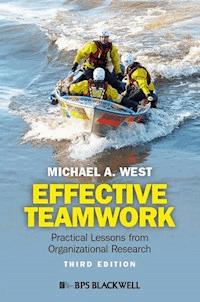
Updated to reflect the latest research evidence, the third edition of Effective Teamwork provides business managers with the necessary guidance and tools to build and maintain effective teamwork strategies.
- A new edition of a bestselling book on teamwork from an acknowledged leader in the field
- Offers a unique integration of rigorous research with practical guidance to develop effective leadership teams
- Features new chapters on virtual teams and top management teams, plus contemporary themes of ethics and values
- Utilizes research based on positive psychology techniques
Sie lesen das E-Book in den Legimi-Apps auf:
Seitenzahl: 542
Veröffentlichungsjahr: 2012
Ähnliche




















Contents
Acknowledgements
Part 1 Team Effectiveness
1 Creating Effective Teams
Task and Social Elements of Team Functioning
Team Effectiveness
Key Revision Points
Further Reading
Web Resources
2 Real Teams Work
Why Work in Teams?
Barriers to Effective Teamwork
What is a Team?
What do Teams do?
How can we build Effective Teams?
Conclusions
Key Revision Points
Further Reading
Web Resources
Part 2 Developing Teams
3 Creating Teams
Personality and Ability
Teamwork Skills
Diversity of Team Members
Benefiting from Team Diversity
Implications of Diversity
Key Revision Points
Further Reading
Web Resources
4 Leading Teams
The Three Team Leadership Tasks
The Three Elements of Leading Teams
Tripwires for Team Leaders
Developing Team Leadership Skills
Self-managing or Shared Leadership Work Teams
Key Revision Points
Further Reading
Web Resources
5 Team Training
The Stages of Team Development
Types of Team Training Interventions
Conclusions
Key Revision Points
Further Reading
Web Resources
Part 3 Team Working
6 Setting Team Direction
Team Objectives
The Elements of Team Vision
Strategy for Teams
Key Revision Points
Further Reading
Web Resources
7 Team Playing
Interaction
Information Sharing
Influencing and Decision Making
Creating Safety in Teams
Key Revision Points
Further Reading
Web Resources
8 Team Quality Management
Groupthink
Team Pressures to Conform
Obedience to Authority
Team Defence Mechanisms
Commitment to Quality
Task Focus/Constructive Controversy
Encouraging Constructive Controversy in Teams
Conclusion
Key Revision Points
Further Reading
Web Resources
9 Creative Team Problem Solving
Team Innovation
Creative Problem Solving in Teams
Techniques for Promoting Creativity within a Team
Using Creativity Techniques in Team Meetings
Other Influences on Team Innovation
Key Revision Points
Further Reading
Web Resources
10 Team Support
The Emotional Life of Teams
Social Support
Support for Team Member Growth and Development
Balance between Home and Work Life
Social Climate
Conclusions
Key Revision Points
Further Reading
Web Resources
11 Conflict in Teams
Team Conflicts
Types of Team Conflict
Resolving Team Conflicts
Organizational Causes of Conflict
Interpersonal Conflicts
Difficult Team Members
Key Revision Points
Further Reading
Web Resources
Part 4 Teams in Organizations
12 Teams in Organizations
Introducing Team-based Working (TBW)
The Relationship between Teams and their Organizations
What do Teams need from their Organizations?
The Role of Human Resource Management (HRM)
What do Organizations require from Teams?
Bridging across Teams
Conclusions
Key Revision Points
Further Reading
Web Resources
13 Virtual Team Working
What is Virtual Team Working?
Advantages and Disadvantages of Virtual Teams
How to Develop Effective Virtual Team Working
Lifecycle of Virtual Teams
Conclusion
Key Revision Points
Further Reading
Web Resources
14 Top Management Teams
Task Design
Team Effort and Skills
Organizational Supports
Top Management Team Processes
Top Team Participation
Corporate Social Responsibility
Top Team Meetings
Conflict
CEO Leadership
Conclusions
Key Revision Points
Further Reading
Web Resources
References
Author Index
Subject Index
This edition first published 2012 by the British Psychological Society and John Wiley & Sons, Ltd© 2012 John Wiley & Sons, Ltd.
First edition published by Blackwell Publishers 1994, second edition published by Blackwell Publishing 2003.First edition copyright Michael A. WestSecond edition copyright Michael A. West
BPS Blackwell is an imprint of Blackwell Publishing, which was acquired by John Wiley & Sons, Ltd in February 2007.
Registered OfficeJohn Wiley & Sons, Ltd, The Atrium, Southern Gate, Chichester, West Sussex, PO19 8SQ, UK
Editorial Offices350 Main Street, Malden, MA 02148-5020, USA9600 Garsington Road, Oxford, OX4 2DQ, UKThe Atrium, Southern Gate, Chichester, West Sussex, PO19 8SQ, UK
For details of our global editorial offices, for customer services, and for information about how to apply for permission to reuse the copyright material in this book please see our website at www.wiley.com/wiley-blackwell.
The right of Michael A. West to be identified as the author of this work has been asserted in accordance with the UK Copyright, Designs and Patents Act 1988.
All rights reserved. No part of this publication may be reproduced, stored in a retrieval system, or transmitted, in any form or by any means, electronic, mechanical, photocopying, recording or otherwise, except as permitted by the UK Copyright, Designs and Patents Act 1988, without the prior permission of the publisher.
Wiley also publishes its books in a variety of electronic formats. Some content that appears in print may not be available in electronic books.
Designations used by companies to distinguish their products are often claimed as trademarks. All brand names and product names used in this book are trade names, service marks, trademarks or registered trademarks of their respective owners. The publisher is not associated with any product or vendor mentioned in this book. This publication is designed to provide accurate and authoritative information in regard to the subject matter covered. It is sold on the understanding that the publisher is not engaged in rendering professional services. If professional advice or other expert assistance is required, the services of a competent professional should be sought.
Library of Congress Cataloging-in-Publication Data
West, Michael A., 1951– Effective teamwork : practical lessons from organizational research / Michael A West. – 3rd ed. p. cm. Includes bibliographical references and index.
ISBN 978-0-470-97498-8 (cloth) – ISBN 978-0-470-97497-1 (pbk.)
1. Teams in the workplace. I. Title. HD66.W473 2012 658.4′022–dc23
2011035195
A catalogue record for this book is available from the British Library.
This book is published in the following electronic formats: ePDFs 9781119966005; ePub 9781444355345; eMobi 9781444355338
To: Rosa Hardy
for being a wonderful example of the supportiveness, courage and creativity that are essential for great teamwork
Acknowledgements
My thanks to the members of the research teams I have the privilege to be a part of, particularly Jeremy Dawson and Joanne Richardson, whose thinking and collaboration have influenced the preparation of this latest edition of Effective Teamwork. Lynn Markiewicz continues to inspire my thinking through her work in AstonOD and many of the examples of good practice either spring from her work in organizations or have been tested by her in challenging organizational settings. Thanks also to Lilian Otaye who patiently and kindly helped develop case studies, find useful web sites for readers and ensure a finished product. And to Ellie Hardy for so carefully proofreading and indexing to the high standards of an Oxford English scholar. And thanks to readers of previous editions who have offered useful suggestions for improvements.
Michael WestLancaster University Management School, and The Work FoundationMay 2011
Part 1
Team Effectiveness
In this first section of the book, we examine what effective teamwork means. The first chapter looks at what is required for effective teamwork, identifying two themes that run through the book. These are team task functioning and team socio-emotional climate. The chapter explains how effective teams take time to review their performance in these areas and to adapt accordingly. Ensuring the team is functioning well both as a task group and as a social group is vital to ensuring team effectiveness. Reflecting on these areas of teamwork regularly and making changes in objectives, strategies and team processes as necessary are vital for the long-term effectiveness of the team.
The second chapter focuses on the research evidence about whether teams work or not. Are teams effective in getting work done and does teamwork in organizations lead to improved organizational performance? Effectiveness includes the well-being and development of team members as well as the level of innovation in the team. The chapter reviews the research on the problems of team working to show the circumstances in which teams perform badly. However, the chapter also shows that teams outperform the aggregate of individuals working alone and are essential for the performance of many tasks in organizations. The key is knowing how to create the conditions for teams to work effectively – the subject of this book.
1
Creating Effective Teams
Never doubt that a small group of thoughtful, committed citizens can change the world. Indeed, it is the only thing that ever has. (Margaret Mead)
Key Learning Points
The basic conditions for effective teamworkThe conditions for outstanding teamworkTeam reflexivity and its importance in team functioningThe two dimensions of team functioning – task and social reflexivityThe five elements of team effectivenessThe relationship of team reflexivity to team effectivenessThe application of the reflexivity questionnaire to real teamsOur societies and communities face the fundamental challenge of how to enable people to combine their efforts and imaginations to work in ways that enhance quality of life through the achievement of our shared goals. The major challenges that face our species today require us to cooperate effectively in order to maximize the quality of life for all people while, at the same time, sustaining the resources offered by the planet? For thousands of years the most potent solution we have found has been teamwork. So why the need for a book on teamwork if we have been working in teams successfully for so long? Because the landscape of teamwork has changed fundamentally in the last 200 years. The growth of modern organizations has created a context in which teams no longer work in isolation. Teams must work together with other teams and with organizational systems and processes to achieve the goals we aspire to and overcome the challenges we face. This book offers guidelines for this new context, largely based on research evidence, for how to ensure effective teamwork and how to enable multi-team systems to operate in an integrated and effective way. More than that what the book offers is insights into how to create outstandingly effective teams – dream teams – teams that achieve more than their members imagined possible and which enable and inspire the success of other teams within their organizations. The book describes both the basic conditions for effective team working and the conditions that will produce dream teams.
The basic conditions for effective teamwork include having a real team whose membership is clear, which is of the right size, relatively stable in membership and working on a task that requires teamwork. The team must have an overall purpose that adds value and which is translated into clear, challenging team objectives. And the team needs the right people as team members with the required skills in the right roles. They must be enablers not derailers – people who support effective team working through their behaviours, not people who sabotage, undermine or obstruct team functioning.
In addition to these basic conditions, dream teams are characterized by transformational leadership that reinforces an inspiring and motivating team purpose focused sharply on the needs of the team’s stakeholders (clients, customers, patients); that encourages all team members to value the diversity of its membership. Members have opportunities to grow and learn in their roles and there is a strong sense of continuous growth and development as a team. Dream teams have a high level of positivity, characterized by optimism and a healthy balance of positive and negative interactions. Members are open, appreciative, kind and genuine in their interactions with each other and eager to learn from each other. Team members believe in the team’s ability to be successful and effective in their work (team potency). They are secure in their team membership and attached to the team because of the level of trust and support they encounter – and the fact that members appropriately back each other up in crises. And the team’s relationship with the wider organization is engaged and supportive. The team actively builds effective inter-team relationships and members identify enthusiastically, not just with their team, but with the wider organization of which they are a part. Such dream teams, and teams of dream teams, enable effective communication and fruitful collaborations in which new ideas are shared and integrated, work load is shared, mutual support is provided and opportunities are exploited to their full potential. Later in the book, the reader will discover how to create these conditions.
Creating and sustaining effective teams requires persistent renewal and discovery of good practice. Moreover, teams vary in the tasks they undertake, the contexts they work in and their membership. And change is a constant: so teams must adapt to the changes that confront them within and outside their organizations. Both the variation between teams and the changing context of all teams requires flexible team members, flexible team processes and flexible organizations. And we have a wondrous capacity to encourage such flexibility. What we are able to do – and no other animal can – is to reflect upon our experiences and consciously adapt what we do to adjust to changing circumstances. And we can use this ability to learn to dance the dance of teamwork ever more effectively. Applied at team level, this is termed team reflexivity.
Team reflexivity involves:
regular team reviews of the team’s objectives including an assessment of their continuing relevance and appropriateness, as well as progress towards their fulfilment;team member vigilance for external changes that could affect the team’s work;awareness, review and discussion of the team’s functioning with a view to improving performance;creativity, flexibility and adaptability;tolerance of uncertainty;team members valuing the different perspectives, knowledge bases, skills and experience of team members.Teams operate in varied organizational settings – as diverse as multinational oil companies, voluntary organizations, healthcare organizations and the military – so we need to be cautious about offering one-size-fits-all prescriptions for effective teamwork. Within organizations too, teams differ markedly. Teams are often composed of people with very different cultural backgrounds, ages, functional expertise and personalities. Teams may span national boundaries, including members located in several countries. Differences in work patterns such as part-time, flexitime, contract working and home working all add further mixes to the heterogeneity of teams. As teams become more diverse in their constitution and functioning, team members must learn to reflect upon, and intelligently adapt to the constantly changing circumstances in order to be effective. In this book, it is proposed that, to the extent that team members collectively reflect on the team’s objectives, strategies, processes and performance and make changes accordingly (team reflexivity) (West, 2000; Widmer, Schippers, and West, 2009), teams will be more productive, effective and innovative.
Task and Social Elements of Team Functioning
There are two fundamental dimensions of team functioning: the task the team is required to carry out, and the social factors that influence how members work together as a social unit. The basic reason for the creation of teams in work organizations is the expectation that they will carry out some tasks more effectively than individuals and so further organizational objectives overall. In fact, some tasks can only be undertaken by teams of people working together rather than individuals working alone – think of open-heart surgery, the construction of a car, catching an antelope on the savannah without the benefit of modern technology or weapons. Consideration of the content of the task, and the strategies and processes employed by team members to carry out that task, is therefore important for understanding how to work in teams. At the same time, teams are composed of people who have a variety of emotional, social and other human needs that the team as a whole can either help to meet or frustrate. Feeling valued, respected and supported by other team members will be a prerequisite for people offering their ideas for new and improved ways of ensuring team effectiveness. If we ignore either dimension in trying to achieve team effectiveness, we will fail to achieve the potential of team performance.
Research evidence now shows convincingly how important positive emotions, such as hope, pleasure, happiness, humour, excitement, joy, pride and involvement, are as a source of human strength (Fredrickson, 2009). When we feel positive emotions we think in a more flexible, open-minded way, and consider a much wider range of possibilities than if we feel anxious, depressed or angry. This enables us to accomplish tasks and make the most of the situations we find ourselves in. We are also more likely to see challenges as opportunities rather than threats. When we feel positive we exercise greater self-control, cope more effectively and are less likely to react defensively in workplace situations. The litany of benefits does not stop there. It spills over too into what is called ‘pro-social behaviour’ – cooperation and altruism. When we feel positive emotion we are more likely to be helpful, generous and to exercise a sense of social responsibility (for a review, see Fredrickson, 2009). The implications for teams are that by developing a team environment where people feel positive, we can encourage organizational citizenship – in other words the tendency of people at work to help each other and those in other departments; to do that bit extra which is not part of their job. And such citizenship makes a major difference between the most effective teams and the rest. The idea that we can create effective teams by focusing simply on performance and ignoring the role of our emotions is based on the false premise that emotions can be ignored at work. Positive relationships and a sense of community are the product and cause of positive emotions. We must work with human needs and capacities and potentials rather than against them if we are to create positive teams that succeed and at the same time, foster the health and well-being of those who work within them.
In order to function effectively, team members must actively focus upon their objectives, regularly reviewing ways of achieving them and the team’s methods of working – ‘task reflexivity’. At the same time, in order to promote the well-being of its members, the team must reflect upon the ways in which it provides support to members, how conflicts are resolved and what is the overall social and emotional climate of the team – or its ‘social reflexivity’. The purpose of these reviews should be to inform the next steps by changing as appropriate the team’s objectives, ways of working or social functioning, in order to promote effectiveness.
Team Effectiveness
So what does ‘team effectiveness’ mean? Team effectiveness can be seen as constituting five main components:
1 Task effectiveness is the extent to which the team is successful in achieving its task-related objectives.
2 Team member well-being refers to factors such as the well-being or mental health (e.g., stress), growth and development of team members.
3 Team viability is the likelihood that a team will continue to work together and function effectively.
4 Team innovation is the extent to which the team develops and implements new and improved processes, products and procedures.
5 Inter-team cooperation is the effectiveness of the team in working with other teams in the organization with which it has to work in order to deliver products or services.
Table 1 shows the two elements of teams, the task and social elements, drawn together in a two-by-two model to illustrate four extreme types of team functioning and the likely effects upon the five principle outcomes of team functioning: task effectiveness, team members’ mental health, team viability, innovation and inter-team cooperation (such models are a simplification of reality but for our immediate purposes this model serves to illustrate some important points).
Type A, the Resilient team, represents a team which is high in both task and social reflexivity, that is, the extent to which the team reflects on and modifies its objectives, processes, task and social support strategies appropriately in changing circumstances. Such teams are likely to have good levels of well-being amongst team members, high task effectiveness, and sustained viability, that is, they have the capacity and desire to continue to work together. Because of the high levels of both task and social reflexivity they are able to adapt to changing circumstances and ensure sustained high performance. Consequently, they are also more likely to innovate and have the capacity to work effectively with other teams within the organization with which they have to work in order to deliver goods or services.
Table 1 Four types of teams and their outcomes.
High Task ReflexivityType D: Driven teamType A: Resilient teamHigh short-term task effectivenessHigh task effectivenessPoor team member well-beingGood team member well-beingShort-term viabilityLong-term viabilityModerate innovationHigh innovationHigh inter-team conflictHigh inter-team cooperationLow Social ReflexivityHigh Social ReflexivityType C: Dysfunctional teamType B: Complacent teamPoor task effectivenessPoor task effectivenessPoor team member well-beingAverage team member well-beingVery low team viabilityShort-term viabilityLow innovationLow innovationHigh inter-team conflictModerate inter-team conflictLow Task ReflexivityType B, the Complacent team, is high in social reflexivity and low in task reflexivity. This is a team where there is a good deal of warmth, support and cohesion amongst team members, but where the ability to get the task done effectively is low. Team members do not dedicate time to reflecting upon the team’s task objectives, strategies and processes and therefore do not confront their performance problems, learn from mistakes or adapt their task performance to ensure effectiveness. Therefore, while team members’ well-being is good and they value their colleagues, the organization’s satisfaction with team performance is low and team members experience the disappointment of membership of a failing or at best poorly performing team. As a result its viability is threatened. Even if team members wish to continue to work together over a period of time, the organization is likely to break the team up. In the longer term team members’ well-being will be adversely affected by the low levels of competence experienced by team members in a team which is minimally task effective. We like to be successful and effective in our work. Staying in a poorly functioning team corrodes job satisfaction. Such a team, with a lack of performance focus, is unlikely to have the motivation to innovate. Despite their warmth, they will create a degree of irritation and dissatisfaction in the other teams they have to work with, because of their ineffectiveness.
Type C, the Dysfunctional team, is the worst scenario – a team that is low on both task and social reflexivity. Such teams fail to reflect on and change their functioning in either domain. They will not be viable in the long term since team members leaders will be dissatisfied with both the interpersonal relationships and with the team’s failures to achieve. Frustration with the team’s poor performance will cause organization leaders to intervene or disband the team. Interventions to promote both task and social reflexivity in the team should be immediate and sustained since team members will learn to function effectively both in the team of which they are currently members and in teams they are part of in the future. The lack of safety and effectiveness combine to mitigate against innovation and the team’s performance creates high levels of conflict with the other teams that rely on them, because of their failure to deliver.
Finally team type D, the Driven team, is a team in which task reflexivity is high, but where the social functioning of the team is poor. Members are driven to focus on achieving task objectives as quickly as possible with minimum distractions. Task performance is generally good in the short term, but poor social functioning damages team viability and the well-being of members. Team members do not enjoy working in a team that they perceive as providing little social support and which has a poor social climate. Moreover, because the team does not feel safe, levels of innovation are low. The team fails to reflect on its health as a social entity, so little progress is made in improving the team’s functioning as a social unit. In the long term, the team will fail to achieve its potential. Without a positive, supportive climate, levels of cooperation will be low and the team’s capacity for creativity and innovation will be limited. In some circumstances (such as a short-term crisis) focusing on the task to the exclusion of all else might make sense but at some point there must be healthy reviews of social functioning. Support, backing up, enabling and coaching are vital team member behaviours in any team. Moreover, because they are driven, they are likely to come into conflict with the other teams with which they need to work, either because they become frustrated by the speed of delivery from other teams or because they are too concerned with their own team’s performance and less concerned with findings ways of helping other teams.
These two aspects of team functioning, namely task and social reflexivity, have a direct impact upon the three principal outcomes of team functioning – task effectiveness, team members’ well-being and team viability. In this book we examine these elements of team functioning and describe practical ways in which team reflexivity can be enhanced.
Research evidence drives the content of the book. We will challenge many assumptions about teamwork that the research evidence does not support by informing the reader on what research reveals about effective teamwork, rather than on what consultants and pundits guess makes for effective teamwork. I also offer examples from my experience of working with teams in a wide variety of settings and across many different countries.
Throughout the book, we will focus on answering the question: ‘what makes teams effective?’ in a way that will prove practically useful to you in working in or with teams, and will help you to develop them into fully functioning teams which are high in both task and social reflexivity.
Exercise 1 The team reflexivity questionnaire
How effectively does your team function?
To measure levels of task and social reflexivity in your team, ask all team members to complete this questionnaire without consulting each other about the answers. Add the scores for task reflexivity and social reflexivity separately, that is, add all team members’ scores for the task element and then all team members’ scores for the social element. Divide both totals by the number of people completing the questionnaire. At the bottom of this box are values against which you can determine whether your team’s scores are high, low or average compared with the scores of other teams.
Instructions for completion:
Indicate how far each statement is an accurate or inaccurate description of your team by writing a number in the box beside each statement, based on the following scale of 1 to 7:
As a team, you can discuss how to improve your functioning where it seems low for no good reason. Such a discussion can be a first step towards improving the extent to which the team reflects on its objectives, strategies, processes and social functioning in order to ensure it is a fully functional team.
Key Revision Points
What are the basic conditions for effective teamwork?What are the conditions necessary for outstanding or ‘dream’ teams?What is team reflexivity and what is the difference between task and social reflexivity?What are the main elements of team effectiveness?How do task and social reflexivity affect team effectiveness?Further Reading
Cameron, K.S., Dutton, J.E. and Quinn, R.E. (2003) Positive Organizational Scholarship: Foundations of a New Discipline, Berrett-Koehler, San Francisco.
Fredrickson, B. (2009) Positivity, Random House, New York.
Linley, P.A., Harrington, S. and Garcea, N. (eds) (2010) Oxford Handbook of Positive Psychology and Work, Oxford University Press, Oxford.
West, M.A. (2000) Reflexivity, revolution, and innovation in work teams, in Product Development Teams (eds M.M. Beyerlein, D.A. Johnson and S.T. Beyerlein), JAI Press, Stamford, CT, pp. 1–29.
Widmer, P.S. Schippers, M.C. and West, M.A. (2009) Recent developments in reflexivity research: a review. Psychology of Everyday Activity, 2, 2–11.
Web Resources
Reflexivity: http://reflexivitynetwork.com/index.php?option=com_content&view=article&id=47&Itemid=53 (last accessed 25 July 2011).
Team development: www.astonod.com (last accessed 25 July 2011).
Positivity: www.positivityratio.com/
www.cappeu.com/ (last accessed 25 July 2011).
2
Real Teams Work
There is no hope for creating a better world without a deeper scientific insight in the function of leadership and culture, and of other essentials of group life … (Kurt Lewin, 1943)
Key Learning Points
The difference between pseudo teams and real teamsThe organizational benefits of team workingThe drawbacks of working in teams – weaker effort, decision making and creativityTeams defined and types of teamsTasks for teamsHow to build an effective teamHow to measure team performanceCase Study
18 carat or fool’s gold: Team work and patient mortality in health care
The United Kingdom National Health Service employs in the region of 1.4 million staff whose responsibility is to provide high-quality and safe patient care. Every year a staff survey is carried out to elicit their views about their working conditions, their management and leadership, the quality of care they provide and the environment within which they work. They are asked ‘Do you work in a team?’ and typically each year around 90% of staff say ‘yes’ in response. Given the evidence on the importance of teamwork in health care for better patient outcomes, this might seem very encouraging. However, the survey asks three follow-up questions of those who indicate they work in a team: ‘Does your team have clear objectives? Do you work closely together to achieve those objectives? Do you meet regularly to review your performance and how it can be improved?’ These three questions tap the very basic dimensions of team working – shared objectives, interdependence and review meetings. Staff who answer ‘no’ to one or more of these questions are categorized as belonging to a pseudo team (around 50% of staff). Those who answer ‘yes’ to all three questions are classified as working in a real team (around 40%). There are therefore three groups: those who indicate they do not work in a team; those who work in real teams; and those who work in pseudo teams. The data reveal that the greater percentage of staff working in pseudo teams within a hospital or other healthcare organization, the higher the levels of injuries to staff at work (typically from needles, lifting and falls); the higher the level of witnessed errors that could harm patients or staff; the higher the levels of violent assaults from patients or their carers, relatives and friends; and the higher the levels of bullying, harassment and abuse from those same groups. The opposite relationships is observed in relation to the percentage of staff in the hospital working in real teams – fewer injuries, errors, violent assaults and cases of harassment, bullying and abuse. Moreover absenteeism is lower the greater the percentage of staff working in real teams. Most strikingly, there is a strong relationship with patient mortality. Having more real teams is associated with lower patient mortality and more pseudo teams are independently associated with higher mortality. The data show that 5% more staff working in real teams would be associated with a decrease of 3.3% in patient mortality (typically 40 deaths per year in each hospital). With 50% working in pseudo teams, the opportunities for improvement in mortality figures (assuming a causal relationship) are enormous and added across the entire National Health Service, truly staggering. (Further details of this work are available from the author at )
Lesen Sie weiter in der vollständigen Ausgabe!
Lesen Sie weiter in der vollständigen Ausgabe!
Lesen Sie weiter in der vollständigen Ausgabe!
Lesen Sie weiter in der vollständigen Ausgabe!
Lesen Sie weiter in der vollständigen Ausgabe!
Lesen Sie weiter in der vollständigen Ausgabe!
Lesen Sie weiter in der vollständigen Ausgabe!
Lesen Sie weiter in der vollständigen Ausgabe!
Lesen Sie weiter in der vollständigen Ausgabe!
Lesen Sie weiter in der vollständigen Ausgabe!
Lesen Sie weiter in der vollständigen Ausgabe!
Lesen Sie weiter in der vollständigen Ausgabe!
Lesen Sie weiter in der vollständigen Ausgabe!
Lesen Sie weiter in der vollständigen Ausgabe!
Lesen Sie weiter in der vollständigen Ausgabe!
Lesen Sie weiter in der vollständigen Ausgabe!
Lesen Sie weiter in der vollständigen Ausgabe!
Lesen Sie weiter in der vollständigen Ausgabe!




