


16,99 €
Mehr erfahren.
- Herausgeber: John Wiley & Sons
- Kategorie: Geisteswissenschaft
- Serie: Global Political Hot Spots
- Sprache: Englisch
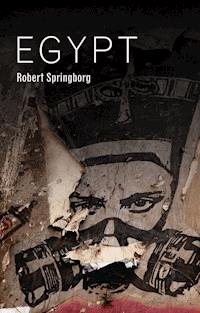
Egypt is one of the few great empires of antiquity that exists today as a nation state. Despite its extraordinary record of national endurance, the pressures to which Egypt currently is subjected and which are bound to intensify are already straining the ties that hold its political community together, while rendering ever more difficult the task of governing it.
In this timely book, leading expert on Egyptian affairs Robert Springborg explains how a country with such a long and impressive history has now arrived at this parlous condition. As Egyptians become steadily more divided by class, religion, region, ethnicity, gender and contrasting views of how, by whom and for what purposes they should be governed, so their rulers become ever more fearful, repressive and unrepresentative. Caught in a downward spiral in which poor governance is both cause and consequence, Egypt is facing a future so uncertain that it could end up resembling neighboring countries that have collapsed under similar loads. The Egyptian "hot spot", Springborg argues, is destined to become steadily hotter, with ominous implications for its peoples, the Middle East and North Africa, and the wider world.
Sie lesen das E-Book in den Legimi-Apps auf:
Seitenzahl: 420
Veröffentlichungsjahr: 2017
Ähnliche



















Table of Contents
Series page
Title page
Copyright page
Dedication
Preface
Acknowledgments
Map
Abbreviations
1: Eroding Historical Legacies
Causes of the Uprising
Why the Uprising Was Not Anticipated
Why the Uprising Failed
Consequences for State and Nation of the Coup-Volution
Conclusion
Notes
2: The Deep State Presides: Military, Presidency, and Intelligence Services
A Limited Access Order
Despotic not Infrastructural Power: A Fierce but Brittle State
Caught in a Socio-Fiscal Trap
The Deep State Tripod
The Military
Intelligence Services
The Presidency
Conclusion
Notes
3: Under the Thumb: Bureaucrats, Judges, and Parliamentarians
Executive Branch
Judicial Branch
Parliament
Conclusion
Notes
4: Political and Civil Society: Little Room to Breathe
The Religious
Hobbled Vanguards: Youth and Organized Labor
Conclusion
Notes
5: Reaping What is Sown
In Search of a Development Model
Rent-Seeking in Lieu of Development
Human Resources Imperiled
Physical and Environmental Decay
Foreign Policy Adrift
Conclusion
Notes
6: The Rocky Road Ahead
Note
Index
End User License Agreement
Guide
Cover
Table of Contents
Start Reading
Preface
CHAPTER 1
Index
Pages
ii
iv
v
vi
viii
ix
x
xi
xii
xiv
1
2
3
4
5
6
7
8
9
10
11
12
13
14
15
16
17
18
19
20
21
22
23
24
25
26
27
28
29
30
31
202
203
32
33
34
35
36
37
38
39
40
41
42
43
44
45
46
47
48
49
50
51
52
53
54
55
56
57
58
59
60
61
62
63
64
65
66
67
68
69
70
71
72
204
205
206
207
208
209
210
73
74
75
76
77
78
79
80
81
82
83
84
85
86
87
88
89
90
91
92
93
94
95
96
97
98
99
100
101
102
103
104
105
106
107
108
109
110
111
112
113
114
115
116
211
212
213
214
117
118
119
120
121
122
123
124
125
126
127
128
129
130
131
132
133
134
135
136
137
138
139
140
141
142
143
144
145
146
147
148
149
150
151
152
153
154
155
156
157
158
159
160
215
216
217
218
161
162
163
164
165
166
167
168
169
170
171
172
173
174
175
176
177
178
179
180
181
182
183
184
185
186
187
188
189
190
191
192
193
194
195
219
220
221
222
223
224
196
197
198
199
200
201
225
226
227
228
229
230
231
232
233
234
235
236
237
238
239
240
241
242
243
244
245
246
Series page
Hot Spots in Global Politics Series
Samer Abboud,
Syria
Christoph Bluth,
Korea
Alan Dowty,
Israel/Palestine
, 4th edition
Kidane Mengisteab,
The Horn of Africa
Amalendu Misra,
Afghanistan
Gareth Stansfield,
Iraq
, 2nd edition
Jonathan Tonge,
Northern Ireland
Thomas Turner,
Congo
Copyright page
Copyright © Robert Springborg 2018
The right of Robert Springborg to be identified as Author of this Work has been asserted in accordance with the UK Copyright, Designs and Patents Act 1988.
First published in 2018 by Polity Press
Polity Press
65 Bridge Street
Cambridge CB2 1UR, UK
Polity Press
101 Station Landing
Suite 300
Medford, MA 02155, USA
All rights reserved. Except for the quotation of short passages for the purpose of criticism and review, no part of this publication may be reproduced, stored in a retrieval system or transmitted, in any form or by any means, electronic, mechanical, photocopying, recording or otherwise, without the prior permission of the publisher.
ISBN-13: 978-1-5095-2048-0
ISBN-13: 978-1-5095-2049-7(pb)
A catalogue record for this book is available from the British Library.
Library of Congress Cataloging-in-Publication Data
Names: Springborg, Robert, author.
Title: Egypt / Robert Springborg.
Other titles: Hot spots in global politics.
Description: Malden, MA : Polity Press, 2017. | Series: Hot spots series | Includes bibliographical references and index.
Identifiers: LCCN 2017007693 (print) | LCCN 2017010789 (ebook) | ISBN 9781509520480 (hardback) | ISBN 9781509520497 (pbk.) | ISBN 9781509520510 (Mobi) | ISBN 9781509520527 (Epub)
Subjects: LCSH: Egypt–Politics and government–1981- | Political culture–Egypt.
Classification: LCC DT107.88 .S67 2017 (print) | LCC DT107.88 (ebook) | DDC 962.056–dc23
LC record available at https://lccn.loc.gov/2017007693
Typeset in 10.5 on 12 pt Sabon by Toppan Best-set Premedia Limited
Printed and bound in Great Britain by Clays Ltd, St Ives PLC
The publisher has used its best endeavours to ensure that the URLs for external websites referred to in this book are correct and active at the time of going to press. However, the publisher has no responsibility for the websites and can make no guarantee that a site will remain live or that the content is or will remain appropriate.
Every effort has been made to trace all copyright holders, but if any have been inadvertently overlooked the publisher will be pleased to include any necessary credits in any subsequent reprint or edition.
For further information on Polity, visit our website: politybooks.com
Dedication
FOR ZIYAD AND GEORGE, LEYLA AND LUKE
Preface
Egypt, China, and Iran are the three great empires of antiquity that exist today as nation states, the sovereignty of which extends over much the same territory ruled by those ancient empires. This remarkable durability attests to the special if not unique natures of both rulers and ruled in these countries. Those ruling have been able to assert their authority and claim on loyalties for millennia, while the ruled have shared sufficient in common to remain united as political communities over this longue durée.
Egypt is especially remarkable in these regards, reflecting the unique unifying force of the Nile River. Relative ease of communication and transportation, combined with remarkably fertile arable land, enabled successive governments to organize and control populations and to extract the resources necessary to sustain centralized government. Further benefits to the state and its peoples derived from Egypt's strategic location at the junction of two continents and the gateway to a third. Since Roman times trade between Asia and Europe has passed through Egypt. The most important legacies of Egyptians having been governed as a united people over millennia have been a sense of common national identity combined with loyalty to political community and the institutions governing it.
Given this extraordinary record of national endurance and unity it would seem rash to even speculate that Egypt's contemporary nation state is at risk of fracturing. Yet, the pressures to which it is currently subjected and which are bound to intensify are already straining the ties that hold the political community together, while rendering ever more difficult the task of governing it. As Egyptians become steadily more divided by class, religion, region, ethnicity, gender, and contrasting views of how, by whom, and for what purposes they should be governed, so do their rulers become ever more fearful, repressive, and unrepresentative. Caught in a downward spiral in which poor governance is both cause and consequence of mounting political, economic, environmental, regional, and other pressures, Egypt is facing a future so uncertain that it could come to resemble neighboring countries that have essentially collapsed under similar loads, albeit having had weaker states to bear them.
Egypt, in sum, is not just a temporary hotspot, it is an exemplar of a broader trend in the Middle East and North Africa (hereafter, MENA) of the collapse of political orders and of the economies, environmental resources, and societies upon which those orders have been based. No small political changes, such as replacement of Egypt's President Abd al Fattah al Sisi by another general, or even by a civilian so long as he remains subordinate to the existing power structures, will arrest the decline. So Egypt exemplifies a broader problem and in that sense is a hotspot, but not one that is going to cool any time soon.
This book will seek to explain how a country with such a long and impressive history—successfully transitioning from empire to a modern state that came to dominate its region and become a leader of the then Third World—has arrived at this parlous condition. The structure of the argument and the book is that the key explanatory variable is the manner in which state power has been acquired and exercised, while the dependent variables are measures of the country's performance, whether economic, societal, environmental, demographic, infrastructural, or its role in the region and the world. As the economy and society weaken, the environment and infrastructure deteriorate, population growth accelerates, and Egypt's roles in the region and the world become more marginal, the task of governing becomes ever more challenging. The performance decline also indicates that the country faces not just a temporary political crisis, but an existential one, aggravated yet more by the forces of economic globalization to which the country is ill-prepared to adjust.
Egypt is thus caught up in a vicious circle. Its unaccountable, unrepresentative, authoritarian government undermines the structural and resource foundations upon which a more accountable, representative, and capable government could be built. Such a government is essential if Egypt is to confront the rising tide of domestic threats and take advantage of the opportunities provided by the forces of economic globalization, rather than just be buffeted by them. Reversing this downward spiral is an ever more difficult challenge, not only because of continued erosion of the structural and resource foundations upon which government rests, but because alternatives to the political status quo become steadily fewer, less appealing and less likely to have the competence and support to reverse the downward spiral. The Egyptian “hot spot” thus seems destined to become steadily hotter, with ominous implications for its peoples, its neighbors in the MENA, and for Europe and beyond.
The book's chapters can be thought of as composing four steps. The first, comprised of Chapter 1, will provide an historical account of the rise and decline of the capacities of state and nation, thereby setting the stage for the investigation of the causes and consequences of that decline. The second step in the following three chapters will be to investigate the nature of the military government in order to explain why it has failed to adequately develop the polity and economy and the human and physical contexts in which they operate. Chapter 2 focuses on the “deep state” itself. Chapter 3 then investigates how it controls the state “superstructure,” while Chapter 4 focuses on its manipulation of political and civil societies. The third step will be to review in Chapter 5 the intensifying crises of the economy, of human and physical resources, and of foreign relations. The conclusion in Chapter 6 will present and assess three scenarios for the country's future as its rulers and people grapple with the challenges outlined in the preceding chapters.
Acknowledgments
Having lived and worked in and studied Egypt intermittently for more than half a century, my debts of gratitude to scores of friends, colleagues, and fellow students of the country are huge. Regrettably many of them cannot be acknowledged here without fear of retribution as they continue to live or visit there. I would like to single out those who read and commented on the manuscript or who indirectly contributed to it through discussing with me either theoretical or empirical material contained in it. In alphabetical order they are Zeinab Abul-Magd, Amr Adly, Soha Bayoumi, Gerhard Behrens, Kirk Beattie, Guilain Denoeux, Philippe Droz-Vincent, Khaled Fahmy, Anthony Gorman, Hazem Kandil, Giacomo Luciani, Tamir Moustafa, Roger Owen, Donald Reid, Glenn Robinson, Ron Wolfe, and Polity's anonymous reviewers.
Most of the book was written while I was the Kuwait Foundation Visiting Scholar at the Middle East Initiative of the Belfer Center at the Kennedy School of Harvard University. Harvard faculty Middle East specialists Nicholas Burns, Melani Cammett, Ishac Diwan, Tarek Masoud, and Gary Samore went out of their way to welcome me into their ranks and share their information and thoughts about contemporary Egypt, as did Bill Granara, Director of Harvard's Center for Middle Eastern Studies. The staff of the Middle East Initiative, led by Director Hilary Rantisi and including Chris Mawhorter and Julia Martin, spoiled me far beyond the call of duty.
Nathalie Tocci, Deputy Director of the Istituto Affari Internazionale in Rome, allowed me the opportunity on several occasions to present at the Istituto thoughts about Egypt and benefit from the feedback she and her colleagues provided.
The idea for the book was that of Louise Knight, my editor at Polity Press. She and her assistant, Nekane Tanaka Galdos, encouraged and guided me expertly through the writing and production processes. Tim Clark's editing greatly improved my frequently awkward prose.
I appreciate permission being granted by the editor of The International Spectator, Gabriele Tonne, to reproduce herein some of the material that first appeared in my article “Caudillismo along the Nile,” Vol. 51, Issue 1 (2016).
Finally, I have benefitted from the friendship, advice, and assistance of scores of Egyptians who over the years have welcomed me into their lives and country while candidly providing me with their thoughts and views on many of the subjects taken up in this book. It is to them and their fellow Egyptians that this book is primarily addressed, in the hope that it may be of some use to them in their struggle to overcome the baleful legacy of authoritarian government from which they have suffered most, if not all of their lives.
Abbreviations
1Eroding Historical Legacies
By late 2010 former Air Force General Husni Mubarak had been ruling Egypt for almost thirty years. His primary preoccupation had become securing his younger son Gamal's succession as president. Otherwise there were relatively few clouds on his political horizon. The military, a perennial if intermittent challenger to presidential rule, he had successfully defanged in 1989 by discrediting and purging the charismatic minister of defense, Field Marshal Abd al Halim Abu Ghazala. Security and intelligence forces, which he had beefed up as counterbalances to the military and to repress autonomous political expression, were held securely in check by his key aide, General Umar Suliman, head of General Intelligence. He had already handed the ruling National Democratic Party (NDP) over to son Gamal, who was busy extending its reach into the organs of the state and the patronage networks through which organized political life had long been controlled. Parliamentary elections held earlier in the year had, through a record amount of fraud and intimidation, produced a supermajority for the NDP, upping its seat total to 420 of the 444 possible from the 330 it had won in the more free and fair 2005 election. Conversely, the Muslim Brotherhood, the only effective organized opposition force, saw its record eighty-eight seats won in the 2005 elections reduced to one. So the newly elected parliament in 2010 promised to be docile, posing no threat to the father-son presidential succession.
As for the third branch of government, the judicial system, it was no longer the thorn in President Mubarak's side it had once been. He turned his attention to it in the wake of the 2005 elections, combining constitutional changes, intimidation of the small cadre of independent-minded judges entrenched in the Judges’ Club, and direct interventions into court management to effectively subordinate this third branch to the all-powerful executive by 2010. Civil society organizations were being choked by a yet more restrictive legal framework and interdiction by the Egyptian government of their sources of funding, primarily foreign. Newly emerged, privately owned media outlets had come grudgingly to accept the regime's more tightly drawn “red lines.” Mubarak, in sum, appeared on the 2010–11 New Year to be sitting astride an increasingly repressive but nevertheless stable authoritarian system that he could reasonably hope to bequeath to his son, albeit with some pushback from the military and ineffective grumbling from opposition elements and civil society activists.
As it transpired, this was a myopic view. On January 25, 2011, a veritable political explosion occurred as thousands of demonstrators, encouraged by civil society activists networked through social media—the Facebookiyyin as they were dubbed in Arabic—poured into the streets to voice their discontent with Mubarak, shouting for the fall of his regime. Within days the largest demonstrations since the funeral of President Nasser in 1970 were rocking Cairo, Alexandria, Port Said, Ismailiya, and various urban centers in the Delta. As the crowds continued to swell in the face of remarkably poorly prepared security forces and with the tacit approval of the military, the Mubarak regime that had been in place for just shy of three decades collapsed in a remarkably brief eighteen days, with comparatively little bloodshed. The president fled to his villa at Sharm al Shaikh on the southern tip of the Sinai Peninsula to await his fate.
At first blush these dramatic events appeared to be a classic example of a “color revolution,” akin to those that had swept through the former Soviet Union and the Balkans. Essentially non-violent and led by non-governmental organizations, they relied on sheer “people power” to overthrow authoritarian regimes and begin transitions to democracy. The hundreds of thousands of demonstrators in Cairo's Midan al Tahrir (Liberation Square) appeared to embody this inclusive people power, including as they did Muslims and Coptic Christians, middle-class professionals and workers, youths and retirees, women and men. But virtually from the moment of its success this broad-based if loose coalition began to fracture and be overwhelmed by two other, competitive forces. One was the military, which had deceptively claimed to be “of one hand” with the demonstrators, but which under Mubarak's long-serving minister of defense, Muhammad Husayn Tantawi, immediately began to assert its authority and reel in what it viewed as the excessive exuberance and inappropriate clamoring for democracy of the “mob.” The other was the Muslim Brotherhood, which had provided the most dedicated shock troops in dramatic battles with security forces in and around Midan al Tahrir and whose leaders and members believed that it was they, not the more secular Facebookiyyin demonstrators, who had engineered Mubarak's downfall. They thus felt entitled to exercise power in the new order they, in collaboration with the military, would establish.
Over the next two years the military played the mongoose against the Brotherhood cobra, first handing civilian power to it as a check on the more radical, democratic secular forces, then skillfully undermining it before dramatically overthrowing it by coup d’état in July 2013. In the interim the officers and Brothers collaborated to rehabilitate the much discredited security services, as both sought to use them against the other and against their common enemy, the civil society activists who had initially triggered the uprising. They also cooperated in drafting a new constitution that awarded the military powers it had never previously exercised, the tradeoff being an electoral law that virtually guaranteed the Brothers victory, hence control over parliament. State institutions, including the judiciary, parliament, and virtually the entirety of the public administration, suffered extensive collateral damage from this struggle for power that was frequently played out within and between those institutions, destroying any pretense to their impartiality and professionalism. As for civil society, it was marginalized through the application of brute force by the reconstituted security services, now backed by the military, and by its own internal fragmentation and weakness. Nobel Prize winner Muhammad al Baradei, a prominent international symbol of the uprising and the sole elder statesman with the potential to unify its forces, resigned his post as vice-president in protest against the killings by military and security forces of more than 800 Brotherhood supporters in Rabaa al Adawiyya and al Nahda Squares in Cairo in August 2013. He went into self-declared exile and has yet to return, his absence symbolizing that of civil society more generally.
The uprising thus turned out to be not a color revolution, but a “coup-volution,” aptly named such by an analyst of the country's armed forces.1 The military had “sucker punched” both civil society activists and the Muslim Brothers, leading the former to believe that officers would midwife fundamental political reforms, and the latter to surmise that those officers would depend upon the Brotherhood as its chief instrument of civilian rule. In reality the high command, constituted as the Supreme Council of the Armed Forces (SCAF), had from the outset intended to jettison Mubarak, but then protect him, in order to preserve, even expand the military's political role and their command of it. Although it took considerable maneuvering for the SCAF to accomplish this—including a change of its leadership, with Field Marshal Tantawi being replaced by the politically more adroit General Abd al Fattah al Sisi in September 2012—the outcome was never much in doubt. The SCAF first used the Brothers to crush the enthusiastic but weak and disorganized secular “revolutionaries,” then rehabilitated some of those very same marginalized, youthful elements to advocate and justify the coup they were planning against the Brothers’ president, Muhammad al Mursi.
If this was a color revolution, its color was black. Its net result was to strip away the civilian accretions on top of the military regime that had originally been established with Gamal Abdel Nasser's July 1952 coup d’état that overthrew King Faruq and ended the monarchy. Those accretions in the form of state institutions and processes, such as a formally civilian presidency, parliament, and elections, organizations of political society such as political parties, and a range of civil society actors, had over the years diluted military rule, hiding its residue from view. But the 2013 coup-volution restored direct military rule, paving the way for the officers to undermine virtually all manifestations of civilian rule, whether administrative, political, or even economic. The repression required to erode these civilian institutions, organizations, and actors exceeded that which Nasser and his Free Officer colleagues had employed when they destroyed the remnants of monarchial and constitutional government and politics back in the 1950s. In both cases the Brotherhood was a primary target of the crackdown, with General Sisi employing more draconian means than Nasser had, including cold-blooded killings of hundreds of its members in Cairo's Rabaa al Adawiyya and al Nahda squares, inglorious firsts in the history of Republican Egypt.2 Once Sisi was sworn in as president in June 2014, discredited Mubarak-era officials were gradually rehabilitated, albeit more with the style than the substance of their former powers. The coup-volution, in sum, inverted the power relationship between Mubarak and his immediate entourage, on the one hand, and the military on the other, leaving in place an officer republic more brutal than any since the darkest days of the Nasser era, causing many “revolutionaries” and Brothers to long for the “good old days” of Mubarak, indeed, even for the monarchy.
The dramatic events since January 2011 raise four interrelated questions. First, what caused the 2011 uprising? Second, why did so few, including those who participated in it, not anticipate it? Third, why did it fail? And finally, what consequences have these tumultuous few years had for the political foundations of the country?
Causes of the Uprising
Of these queries, that of the uprising's causes is the easiest to answer, both because they are the most apparent and because they have been extensively analyzed, due primarily to the fact that the Egyptian uprising was but one case of the wider “Arab Spring” of 2011, exploding first in Tunisia in the last month of 2010. Indeed, cross-border learning was a primary cause of Egypt's and then other countries’ uprisings. The dramatic events on the streets of Tunis were graphically depicted in the pan-Arab media. Egyptians could see and easily identify with Tunisian protesters. It did not take a great stretch of their imagination to transpose the hated Ben Ali regime there to the unpopular Mubarak regime at home. Once the uprising had occurred in Egypt, others erupted in Libya, Yemen, Syria and elsewhere in the Arab world, adding further regional pressure to the gathering momentum for change along the Nile.
The causes of the Arab Spring were both economic and political. The global economic downturn that commenced in 2008 had placed additional pressure on economies that were already underperforming. In Egypt's case, GDP per capita growth had been stagnating at a paltry 1 percent or so for years, the rapidly growing population eating up much of the economic growth that did occur. Unemployment hovered around 10 percent even during the boom period of 2003–7 that was fired by an export surge of natural gas. Youth unemployment was double, then growing to triple the overall proportion. Almost three quarters of new jobs were in the informal sector, meaning without contracts, social or medical insurance, serious prospects for advancement, or adequate remuneration. The absolute and proportionate growth of the middle class, one of the achievements of the Nasser era and still occurring under Sadat, had ground to a halt by the mid-1980s, then gone into reverse. The “desertion of the middle class,” a warning and cause of revolutions, was more pronounced in Egypt than other Arab countries.3 As middle-class prosperity became an ever more distant dream and unemployment and poverty spread, so did inequality grow. By the time of the uprising four of the ten richest Africans were Egyptians, but one quarter of the entire population and more than half the population in Upper Egypt lived in dire poverty. According to Facundo Alvaredo and Thomas Piketty, a careful analysis of available data reveals Egypt as having one of the highest degrees of income and asset inequality among lower middle income countries.4 Not surprisingly, most Egyptians suffered from relative deprivation, profoundly resenting the wealthy and the corruption commonly believed to have made them rich.
As the Mubarak regime ground on, it provided ever fewer vents for the political steam generated by the malfunctioning economy. Never an adroit politician and having a bland public persona, Mubarak seemed to lose interest in playing the public political game, spending longer periods in his villas on the Mediterranean Coast and in Sinai, and relying on his security and intelligence services to intimidate other active and potential players. Under pressure from the Bush administration after 9/11 to liberalize and even democratize, Mubarak grudgingly conceded relatively free and fair elections in 2005. The outcome frightened him and his security specialists, threatening as it did to derail plans for Gamal Mubarak's succession.
So despite lingering, albeit declining, pressure from President Bush and Secretary of State Condoleezza Rice, then virtually none from President Obama, Mubarak ordered a political U-turn. His security and intelligence forces commenced a crackdown in 2006 that continued virtually until the day of his removal five years later. Hopes for democratic reforms were dashed, so those associated with them, essentially the leaders of the long-tamed political parties, lost what little credibility and influence they still had. Moving into the breach were increasingly active and radical civil society activists. The Brotherhood bided its time, assuming that at some stage the regime would again have need of it, as it had at various times in the past dating back to the monarchy. Its leadership continued to express support for democratic change, especially to western audiences, but as subsequent events were to amply demonstrate, those words did not reflect the Brothers’ true belief or calculation—namely, that the primary and probably only pathway to power was through a combination of democratic and undemocratic means of gaining control over state institutions. So by the end of 2010 the political game, tame as it had long been, had come to a virtual standstill, opening the door to those who argued that taking to the streets was the only way to secure change, even if they did not really believe it would have much effect.
The political psychology of uprisings reflects relative deprivation and political repression. One key element of it is the desire for human dignity. Egyptians, like Tunisians, believed that the regime simply did not care whether they lived or died, or how they lived. They felt denied of human dignity, so desperately wanted to assert it. The second vital element is fear. Repression works so long as it instills fear. If coercive forces are challenged and found to be ineffective, fear morphs into confidence and a willingness to take risks, including physical ones. That is what happened in the streets of Cairo, Alexandria, and the Canal Zone cities. The chief riot-control forces, Central Security and State Security, had over the years grown soft from meeting few challenges from crowds that were typically small and easily dispersed. When on January 25 they confronted thousands and then tens of thousands of demonstrators, they did not know how to respond. As other Egyptians, in person, on TV or on social media, watched the demonstrations grow and then overwhelm security forces, their innate fear gave way to a desire for justice, revenge and assertion of dignity. When the security forces belatedly toughened up and began brutalizing, even killing demonstrators, it was in vain. The crowds were by then of overwhelming size and commitment. Most importantly, the military chose to abandon the hapless riot-control troops to their fate. The SCAF had other plans.
Why the Uprising Was Not Anticipated
Roger Owen aptly described the Arab republics prior to the 2011 uprisings as ruled by “presidents for life.”5 These rulers, including Mubarak, were among the longest serving in the world, many actively seeking to hand power to a son. Given the presidents’ longevity, participants and analysts alike believed their “hybrid” authoritarian regimes, which alternated political liberalizations with crackdowns of varying intensities, would indeed survive father-son successions. None did. Of them, only Tunisia and Egypt now have states that govern more or less all of their sovereign territory and political communities which, if more divided than before the uprisings and generally less loyal to their governments, are at least not embroiled in civil wars.
The comparative durability of state and nation in Tunisia and Egypt has not occurred by chance. These two Arab republics have the longest traditions of coherent and effective statehood and unified national identities. Of the two, Egypt's traditions are longer and stronger. Egypt's was the first modern state to emerge in the Arab world, resting on already firmly established foundations of centralized, legitimate authority. Egyptian identity was also the earliest to form and the most uniform Arab national consciousness.
Almost uniquely in the Arab world, and central to its persistence in the face of centrifugal forces currently assailing virtually every country in the Middle East and North Africa (MENA), Egypt's beneficial legacies of state and nation are the product of their interaction. The state forged the nation, the coherence of which in turn reinforced the state and its administrative powers. At the heart of that reciprocal relationship was the ability of the state to enforce its writ throughout the land. The comparative dearth of rugged, remote territory to host insurrections rendered that task easier. Relative ease of transport and communications along the Nile, readily controlled from Cairo, the point at which the River fans out to form the Delta, combined with ample material surplus produced by agriculture and trade, were also key factors making possible successive, powerful Egyptian states dating back to 4000 BCE. The Romans, for example, marveled at Ptolemaic Egypt's extensive governance, including its capacity to oversee the harvest and distribution of grain throughout the land, to say nothing of its support for institutions of learning and research that were the envy of the Mediterranean and indeed, the entire world. In the fourteenth century, Egypt under its Mamluk rulers dominated the Far Eastern spice trade, the Eastern Mediterranean coast up to what is now Turkey, and the Nile Valley into Sudan. When the famous Moroccan traveler, Ibn Battuta, arrived in Cairo, its population of 600,000 made it the largest city west of China, fifteen times the size of London. Alexandria was the biggest port on the Mediterranean. Mamluk architecture was structurally and artistically the most sophisticated then known.
Since most Egyptians reside along the Nile, they have for millennia had little chance of successfully resisting central government, so have accommodated to it. For their part, governments have facilitated that acceptance by propagating legitimating ideologies, the earliest of which were religious. Kingship has its origins in pharaonic Egypt. The pharaoh-king was a god on earth whose legitimacy was an integral, indeed essential feature of the Egyptian religion. The Greeks and then the Romans did not supplant the Egyptian religion when they conquered the country. Instead they wisely adopted it themselves to gain popular acceptance. Christianity subsequently legitimated Byzantine rule. Islam, brought to Egypt from the Arabian Peninsula by the Arab conquest of 642, did not deify rulers but instructed people to submit to them so long as they obeyed the tenets of the faith. Since Islam was the belief system that legitimated the government, its rulers, whether Mamluks, sultans, khedives, or kings, had only to be of that religion. They did not have to be native Egyptians, none of whom strictly speaking were, from the defeat of the Pharaohs by the Greeks, to the rise of Gamal Abdel Nasser in 1952. Egyptians are in fact of diverse origins. The Nilotic majority are descended from the original population along the Nile, while minorities include those originally from elsewhere on the African continent; Semites from the Arabian Peninsula; “Turks,” referring to Muslims whose family origins were in lands controlled by the Ottoman Empire in what is now Turkey or the Transcaucasian region; and Syro-Lebanese, meaning Christians who typically migrated from the Levant to Egypt from the late eighteenth century to the mid twentieth. None of these ethno-religious subgroups is considered more essentially Egyptian than another, or characterized by a distinctive accent. All have been Egyptianized in a society penetrated and homogenized by centralized rule. By contrast, the populations of many other MENA countries, much less subject to continuous, effective central governance, are cleaved by ethnic divisions far deeper and more recalcitrant to being “melted down” by governmental action.
The one distinction that does assume major sociopolitical importance is that between Muslims and Christians. This is the only subcultural divide in which some believers on one side seek to excommunicate those on the other from the national political community, to say nothing of disputing estimates of proportions of the respective populations. Christian–Muslim antagonisms are, however, muted by the fact that they are not reinforced by other deep, overlapping cleavages, whether linguistic, regional, class or otherwise. Although historically Christians were wealthier than Muslims and began entering middle-class professions earlier and in greater numbers, differences in wealth, education, and professional attainment steadily declined in Republican Egypt. Egypt has not experienced a war of religion in the more than 1,300 years since Islam was established as the faith of the state and majority of its citizens. Intermittent hostilities, however, have occurred, such as those that broke out in Alexandria at the time of the British invasion in 1882. Members of both faiths were active in the nationalist movement against the British.
The religious tension that has been growing since the late Sadat era results not from age-old antagonisms, but from the contemporary politicization of religion, in both Egypt and the surrounding Arab world. As Islamists, especially the Muslim Brothers, gained influence under Presidents Sadat and Mubarak, Christians, suffering from discrimination of various sorts and increasingly marginalized in public life, reinforced their own intra-communal organizational solidarities, including those based in monasteries on the periphery of the Nile Valley, and in overseas Coptic communities.6 In the wake of Mubarak's removal, to which Copts contributed by joining rallies in Cairo's Tahrir Square and elsewhere, tensions between the two communities resumed when the Muslim Brotherhood won control of parliament and the presidency in 2012 and, from the Coptic perspective, began to try to Islamize the country. Most Christians welcomed the coup that removed President Mursi. Many of his Brotherhood supporters believed the coup to be the manifestation of a Christian plot against them and Islam more generally. Muslim–Christian tensions thus now threaten the nation's sense of political community, although Egypt's comparatively benign history of Muslim–Christian relations and the lack of overlapping cleavages render that threat less profound than are religious or ethnic cleavages in Lebanon, Syria, Iraq, or within or between the two Sudans.
In sum, there are two answers as to why the 2011 uprising was not anticipated. The simple, immediate one is that the authoritarian status quo was so long established, so complete, and so lacking visible, potent challengers, whether domestic or foreign, that it seemed inevitable it would continue into the indefinite future. The second answer, which occasioned this digression into Egypt's distinctive record as an effective, centralized state sitting astride a unified political community sharing a common national consciousness, is that by regional standards Egypt has enjoyed remarkably stable politics for centuries, precisely because historically it has been the region's most impressive nation state. The Mamluks and the Ottomans ruled separately and in cooperation for half a millennium before Napoleon's invasion in 1798. The regime of Muhammad Ali that emerged from the several years of tumult following that invasion ruled alone or under British tutelage until 1952. The coup that overthrew that dynasty was bloodless. The successor republican regime survived catastrophic defeat in the 1967 war against Israel, the assassination of President Sadat in 1981, and some thirty years of uninspiring leadership under President Mubarak. After a partial, one-year interlude under the Muslim Brotherhood, the military-dominated republican government has been restored. Given this record of the longevity and durability of regimes, owing to the sturdy underpinnings of state and nation, it is hardly surprising that the default assumption has been one of continuity and persistence, not change and disruption. That this key assumption may no longer be correct is suggestive of the magnitude of change the country is presently undergoing.
Why the Uprising Failed
The uprising did not develop into a color revolution because it did not produce a transition to anything resembling democracy. While not all of those who joined or just passively supported the demonstrators were ardent democrats, and indeed economic motivations were probably just as determinative as political ones for their behavior, most were searching for something other than the military-backed authoritarian order under which they had lived for so long. So most were disappointed with the outcome of the coup-volution. So, too, were reformers regionally and globally disappointed that a potential democratic transition aborted in Egypt. Had it succeeded there it might have reverberated in other Arab countries, as a group the world's least democratic. In the event, the restoration of draconian military rule along the Nile, coupled with the return to power of much of the Mubarak ancien regime, dashed the reform hopes of Egyptians and Arabs more generally.
The failure of the eighteen-day, sadly misnamed Tahrir, or January 25, Revolution, to produce a more liberal political order can be explained on two levels. On the surface it was a political cacophony, with a hopelessly diverse cast of individual and institutional players vying for center stage, such as the Facebookiyyin, the Muslim Brothers, yet more fundamentalist Islamists known as Salafis, the military high command, Mubarak loyalists, and so on. This type of explanation centers on the political dramatis personae, their relative powers, strategies and tactics. An attempt will be made in the following chapter to sketch out this drama in order to illustrate the workings of the country's political system at the time and more generally. A second level of analysis focuses on the sub-structural conditions of the political economy that facilitate or impede a democratic transition. It is that level to which we shall now turn as those conditions constitute the political and economic legacies bequeathed to Egypt's rulers and peoples as they commenced their intense political struggle in early 2011.
A country's political legacy is reflected in its human resources, the endowment of which is of vital political importance. Recent empirical research on preconditions for democratization has identified seven dimensions of a population that render it more or less supportive of a democratic transition.7 On none of those dimensions does Egypt score highly. First, its population is too young. The probability of a democratic transition increases as the median age of the population rises. Thirty years of age appears to be the threshold above which such transitions have a far higher chance of success. Egypt's median age is twenty-four, about average for the Arab world, in which only Tunisia's median age almost reaches the thirty-year threshold.
Second, Egypt's population is too rural. Democratization is facilitated by urbanization, presumably because moving to cities not only broadens political horizons and opens new avenues for political participation, but also reflects economic conditions. In East Asia, for example, urbanization has been driven by economic growth in general and industrialization in particular. In Egypt, by contrast, the stagnating industrial sector has been economically too inconsequential to act as a strong magnet attracting dwellers in the countryside into cities. Egypt was more urban in the period between 1975 and 1991, when 44 percent of Egyptians were urban residents, than it has been since. To express the ratio differently, Egypt has the world's twenty-third largest urban population, but its eleventh largest rural one.8 With flagging industrialization young Egyptians have chosen to stay at home in rural and semi-urban areas, where living expenses are lower and where their chances of eking out a living in the informal sector are about the same as they are elsewhere in the country. Only external migration offers real hope of a dramatic change in income and lifestyle, but such migration undermines pressure for democratic reforms rather than intensifying it.
A third demographic deficiency in Egypt is that its people are too poor. Cross-national comparative research has established that the GDP per capita threshold above which regressions to authoritarianism are unlikely following the establishment of at least a partial democracy is about $11,000. In 2016 Egypt's GDP per capita was some $2,700. Even if measured according to purchasing power parity, with Egypt's being 58 percent of the world's average, per capita GDP in the country still only reaches about 60 percent of the threshold figure.9 Averages aside, Egypt's high and growing incidence of poverty must surely add an additional obstacle to democratic transition. Between 2000 and 2010, the proportion of Egyptians living on the equivalent of less than $2 per day rose from 20.2 percent to 29.2 percent and by 2017 may have reached as much as 40 percent in the wake of the halving of the pound's value in December 2016.10 As many as 18 million Egyptians were living on less than $1 per day in 2016. So poverty, reinforced by profound inequality, militates against democracy in Egypt.
A fourth drag effect on Egypt's potential democratization results from the shrinking of its middle class. One of the most secure empirical findings on the correlates of democratization is that which links it to the growth of the middle class. Among other reasons for this correlation is that the security provided by middle-class status is essential for thought and action by citizens on policy matters, for otherwise they are consumed with the struggle for material existence. Having been built primarily on the steady expansion of public employment from the Nasser era until recently, the Egyptian middle class has suffered disproportionately from the slowing of recruitment into the civil service and the relative deterioration of wages and conditions within it. At its high point, public employment accounted for at least one third of the non-agricultural labor force, a proportion that by 2016 had dropped to around one quarter, albeit with 7 million of the country's total labor force of around 28 million still employed in it. The vast majority of them, however, are finding it ever more difficult to make ends meet, so do not have the security provided by true middle-class status. Private sector employment has not picked up the slack. A recent study of middle-level employment in the private sector revealed it as having declined by 5 percent in numbers and its total share of wages/salaries by more than 9 percent between 2000 and 2009, years that incorporated the gas-fired boom.11 Within the Middle East, according to the World Bank, only in Egypt and Yemen did the middle class contract in the first decade of the twenty-first century, falling in the former from 14.3 to 9.8 percent of the population.12 The Egyptian middle class is, in short, a shrinking demographic enclave, neither large nor robust enough to provide a solid foundation upon which democratic institutions and practices could readily be built.
A fifth correlate of democratization, and one related to but more encompassing than an expanding middle class, is that of the material security of the entire population. Insecurity is the enemy of democracy and Egyptians suffer greatly from it. Unpaid family work and own-account workers are, according to the World Bank, in “vulnerable employment.” Twenty-one percent of all male and 44 percent of all female members of Egypt's labor force are so classified. The rate for both is increasing. In 1998, 12 percent of the employed were irregular wage workers, meaning intermittent or seasonal. As the economy grew in the early 2000s that proportion dropped, by 2006 to 8 percent. But over the next six years as the economy slowed, the rate more than doubled to 17 percent. Almost three quarters of new entrants to the labor market are now absorbed into the informal sector. About one third of all workers in 2012 were either irregular or informal workers, more than three times the proportion of those employed on contracts in the private sector.13 In 1988 firms employing fewer than five workers accounted for 54 percent of all employment, a ratio that grew to two thirds by 2008. Similarly, the average size of micro firms in Cairo fell from 3.6 to 2.5 employees in the dozen years from 1986. So the decline of the public sector, paralleled by the downward slide in formal employment and the proliferation of micro businesses and own-account workers, all point to an ever tighter labor market, one increasingly unable to provide security for even a constant proportion of the population, much less an expanding one.
A sixth obstacle to democratization also involves material security, but turns on the question of who provides it. If it is primarily the government, the inevitable consequence will be its use of resource allocations to foster vertical, patron-client relations of dependency. They in turn militate against the strengthening of horizontal ties necessary for vibrant civil and political societies.14 The Arab population as a whole is more dependent upon government than the peoples of any other region, that dependence determined by the world-leading proportion of public employees in the workforce, combined with the highest level globally of consumer subsidies. Dependence is further augmented by selective allocation of financial credit on grounds other than sheer creditworthiness. By these three measures, Egyptians are extraordinarily dependent upon their government for their material welfare.
As just noted, of the country's labor force of 28 million, fully 7 million, or one quarter, are employed in the civil service. Another half a million serve in the armed forces. Assuming an average family size of just over four, this suggests that as many as 33 million people, more than a third of the total population, depend for their income primarily on government. It is all the more remarkable that profound dependence on government employment also characterizes even farming communities in rural Egypt. A 2005 survey revealed that 40 percent of such households relied on at least one government salary as their largest income source, compared to 37 percent who derived the bulk of their income from agriculture.15




