


5,49 €
Mehr erfahren.
- Herausgeber: Emily Whiteman
- Kategorie: Sachliteratur, Reportagen, Biografien
- Sprache: Englisch
Is the man trying to save the world the same one who might burn it down?
To the public, he is the real-life Iron Man: the billionaire who lands rockets on drone ships and wills the future into existence. But behind the memes and the billions lies a figure far more volatile, driven by a ghost that refuses to let him rest.
From the violent playgrounds of Pretoria to the windswept launchpads of Texas, ELON: The Architect of Tomorrow uncovers the raw, unvarnished truth of the century’s most polarizing visionary. This is not merely a business success story; it is a psychological thriller about a boy who escaped a brutal home life by dreaming of other planets—and then grew up to build the machines to get us there.
This narrative plunges you directly into the fire: the "production hell" where Musk slept on factory floors to save Tesla from ruin; the boardroom coups that forged his ruthlessness; and the chaotic corridors of Twitter as he dismantled a cultural institution with a sink in his hand. It peels back the layers of his complex personal life, revealing the "demon mode" that drives his 120-hour workweeks and the terrifying logic behind his obsession with Mars.
He has revolutionized the way we drive, the way we communicate, and the way we dream. But as he expands his empire from brain chips to starships, a singular question remains: Is his vision the salvation of humanity, or the ultimate vanity project?
Propulsive, dramatic, and unflinchingly honest, this is the definitive chronicle of the man who sold the world on the impossible.
Want to read a concise and informative book on Elon Musk, simply scroll up and click the "Buy now" button for instant access!
Das E-Book können Sie in Legimi-Apps oder einer beliebigen App lesen, die das folgende Format unterstützen:
Veröffentlichungsjahr: 2023
Ähnliche














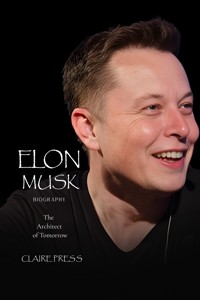
ELON MUSK
Biography
The Architect of Tomorrow
Claire Press
Table of Contents
Copyright
Dedication
Prologue: Starman in the Sky
Chapter 1: The Haldeman Spirit
Chapter 2: Shadows in Pretoria
Chapter 3: North of the Border
Chapter 4: The Silicon Gold Rush
Chapter 5: Rocket Man
Chapter 6: Electric Avenue
Chapter 7: Iron Man Rising
Chapter 8: Production Hell
Chapter 9: Unfiltered
Chapter 10: The Bird Is Freed
Chapter 11: The Musk Dynasty
Conclusion: The Mars Imperative
Author’s Note
Copyright
Copyright © 2025 by Claire Press
All rights reserved. Cover design by Claire Press. No part of this book may be reproduced in any form or by any electronic or mechanical means, including information storage and retrieval systems, without written permission from the author, except for the use of brief quotations in a book review.
Dedication
To the dreamers who look up at the stars and see home.
Prologue: Starman in the Sky
When the South African–born billionaire Elon Reeve Musk stood inside the firing room at the Kennedy Space Center on the afternoon of February 6, 2018, he was arguably the most anxious man on the planet. Outside, under the brilliant blue canopy of the Florida sky, the world was watching.
In the most anticipated space event for a generation, Musk’s aerospace company, SpaceX, was attempting the impossible. Perched ominously on Launch Complex 39A—the very same hallowed concrete pad from which the brave men of Apollo 11 had departed for the moon nearly half a century earlier—stood the Falcon Heavy. It was a behemoth of white metal and volatile fuel, a twenty-three-story skyscraper filled with kerosene and liquid oxygen, ready to unleash five million pounds of thrust.
The sheer audacity of the moment was redolent with symbolism. For years, the aerospace establishment—the "old guard" of Boeing, Lockheed Martin, and NASA bureaucrats—had dismissed Musk as a wealthy dilettante, a dot-com playboy playing with rockets. They whispered that he was reckless, that his timelines were fantasies, and that this rocket, a Frankenstein’s monster comprising three Falcon 9 cores strapped together, would never fly. Even Musk, usually a man of supreme, almost pathological confidence, harbored dark doubts.
"I had this image of a giant explosion on the pad, a wheel bouncing down the road, and the Tesla logo landing somewhere with a thud," he later confessed to a reporter. He gave the mission a fifty-fifty chance of success. If it exploded, he reasoned, he just hoped it would happen high enough in the atmosphere not to damage the historic launchpad.
Yet, as the countdown clock ticked toward zero, the atmosphere along the Space Coast was electric, reminiscent of the glory days of the Space Shuttle. Hundreds of thousands of spectators, tourists, and space enthusiasts had clogged the causeways and beaches of Cape Canaveral, squinting into the sun, cameras ready. They had come to witness a spectacle that promised to be either a fireworks display of epic proportions or a revolution in spaceflight.
But it was the payload, secreted inside the rocket’s nose cone, that truly captured the public imagination and marked this occasion as uniquely, unapologetically Muskian.
Traditionally, test flights of new rockets carry concrete blocks or steel plates as mass simulators—boring, functional dead weight. Musk, a showman who understands the currency of memes and media better than any CEO in history, decided that was too pedestrian. "Test flights of new rockets usually contain mass simulators in the form of concrete or steel blocks," he wrote on Instagram. "That seemed extremely boring... so we decided to send something unusual, something that made us feel."
His choice was a cherry-red Tesla Roadster, his own personal sports car, with a mannequin nicknamed "Starman" sitting in the driver’s seat. Clad in a sleek, white SpaceX pressure suit, one arm casually resting on the door sill, Starman looked like a cosmic James Dean, ready for a Sunday drive through the vacuum of space.
On the dashboard was a tiny Hot Wheels model of the same car with a tiny astronaut inside. On the circuit board, immortalized in tech history, was etched the phrase "Made on Earth by humans." And in the glove box, a copy of The Hitchhiker’s Guide to the Galaxy and a towel, a nod to the Douglas Adams science fiction novels that had offered a lonely boy in Pretoria a refuge from a harsh world. To complete the tableau, the car’s sound system was programmed to play David Bowie’s "Space Oddity" on an endless loop, though in the silence of the void, no one would hear it.
It was silly, it was profound, and it was brilliant marketing. It was a union of Musk’s two great passions—sustainable energy and space exploration—fused together in one indelible image.
At 3:45 p.m., the twenty-seven Merlin engines ignited.
The ground shook. Clouds of steam and smoke billowed outward, engulfing the launchpad as the hold-down clamps released. Slowly, majestically, the Falcon Heavy rose on a pillar of fire, clearing the tower and piercing the sky. The roar was deafening, a physical force that rattled chests miles away. In the control room, the cheers of the SpaceX employees competed with the telemetry readouts. "Holy flying f***, that thing took off!" Musk yelled, running out of the control center to watch the ascent with his own eyes, pointing at the sky like a giddy schoolboy.
It didn't explode. It flew.
But the true "aha" moment, the sequence that would leave even the most cynical observers slack-jawed, was yet to come. Minutes into the flight, the two side boosters separated from the center core and flipped around. In a choreographed ballet of engineering that seemed to defy physics, they began their descent back to Earth.
On the live stream, millions of viewers watched in disbelief. The two boosters, falling from the edge of space, reignited their engines. They plummeted toward the landing zones at Cape Canaveral, side by side, synchronized perfectly.




