


Erhalten Sie Zugang zu diesem und mehr als 300000 Büchern ab EUR 5,99 monatlich.
- Herausgeber: Landauer
- Kategorie: Lebensstil
- Sprache: Englisch
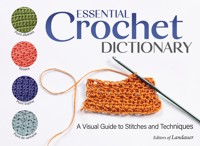
Essential Crochet Dictionary is an incredible reference guide that covers 100 stitches you need to know to be a successful crocheter, including the rosette stitch, honeycomb mesh stitch, iris stitch, Albanian stitch, checkerboard stitch, bobble stich, and so much more! You will be able to tackle any crochet project after mastering the correct stitch for it with these easy-to-follow, step-by-step instructions and over 150 photos for guidance. Great for beginner, intermediate and advanced crocheters, the stitches are organized by style including full, mesh, open, relief, border, and Tunisian. The stitches have been photographed on a black background, making the details of the stitch easier to see -- and learn! The stitches in this dictionary have been chosen for their diversity, rendering, modernity, and simplicity of execution. It's a must-have for any yarn-lover's library.
Sie lesen das E-Book in den Legimi-Apps auf:
Seitenzahl: 104
Veröffentlichungsjahr: 2024
Das E-Book (TTS) können Sie hören im Abo „Legimi Premium” in Legimi-Apps auf:
Ähnliche















Essential Crochet Dictionary
Landauer Publishing, www.landauerpub.com, is an imprint of Fox Chapel Publishing Company, Inc.
L’essentiel des points de crochet © 2016, 2022, Éditions Eyrolles, Paris, France
English translation, Essential Crochet Dictionary, © 2024 Fox Chapel Publishing Company, Inc.
Essential Crochet Dictionary is an translation of the 2022 version originally published in French by Éditions Eyrolles under the title L’essentiel des points de crochet in Paris, France. This version is published by Landaur, an imprint of Fox Chapel Publishing Company, Inc.
All rights reserved. No part of this book may be reproduced, stored in a retrieval system, or transmitted in any form or by any means, electronic, mechanical, photocopying, recording, or otherwise, without the prior written permission of Fox Chapel Publishing, except for the inclusion of brief quotations in an acknowledged review and the enlargement of the template patterns in this book for personal use only. The patterns themselves, however, are not to be duplicated for resale or distribution under any circumstances. Any such copying is a violation of copyright law.
Éditions Eyrolles Team
Editorial Director: Claire Rius
Art Director: Charles Buxin
Photography: Étienne Galopin
Fox Chapel Publishing Team
Managing Editor: Gretchen Bacon
Acquisitions Editor: Amelia Johanson
Translator: Heather Carroll
Tech Editor: Rita Greenfeder
Copy Editor: Christa Oestreich
Designer: Freire Disseny + Comunicació
ISBN 978-1-63981-099-4
eISBN 978-1-63741-411-8
Library of Congress Control Number: 2024910237
To learn more about the other great books from Fox Chapel Publishing, or to find a retailer near you, call toll-free 800-457-9112, send mail to 903 Square Street, Mount Joy, PA 17552, or visit us at www.FoxChapelPublishing.com.
We are always looking for talented authors. To submit an idea, please send a brief inquiry to [email protected].
This book has been published with the intent to provide accurate and authoritative information in regard to the subject matter within. While every precaution has been taken in the preparation of this book, the author and publisher expressly disclaim any responsibility for any errors, omissions, or adverse effects arising from the use or application of the information contained herein.
Contents
GETTING STARTED
Terms Used
Foundation Chain
Single and Extended Single Crochet
Half Double Crochet
Double Crochet
Treble and Double Treble Crochet
Tunisian Crochet
FULL STITCHES
Lemon Peel Stitch
Wattle Stitch
Albanian Stitch
Slanting Squares Stitch
Cross Stitch
Rosette Stitch
Arch Stitch
Judith Stitch
Braided Stitch
Open Diamond Stitch
Star Stitch
Pike Stitch
Square Stitch
Palm Stitch
Starry Stitch
Waffle Stitch
Shell Stitch
Moss Stitch
Back Cross Stitch
Herringbone Stitch
MESH STITCHES
Mesh Stitch
Offset Mesh Stitch
Lace Mesh Stitch
Honeycomb Mesh Stitch
Picot Lattice Stitch
Picot Mesh Stitch
Picot Trellis Stitch
Ladder Stitch
OPEN STITCHES
Iris Stitch
Wicker Stitch
Checkerboard Stitch
Open Arches Stitch
Scalloped Diamond Stitch
Triangle Stitch
Rug Stitch
Fan Stitch
Slanting Knotted Stitch
Open Crown Stitch
Ribbon Stitch
Flower Basket Lace Stitch
Open Cross Stitch
Lacy Rib Stitch
English Lace Stitch
Lacy Basket Stitch
RELIEF STITCHES
Puff Stitch
Relief Double Crochet Stitch
Pineapple Stitch
Bobble Bridge Stitch
Double Crochet Rib Stitch
Bobble Stitch
Ball Stitch
BORDER STITCHES
Picot Stitch
Palm Arches
Shell Stitch
Clover Stitch
Wavy Shell Stitch
Wavy Stitch
Picot Cone Stitch
Flower Border Stitch
Half-Daisy Border Stitch
Crown Stitch
Floral Tiara Stitch
TUNISIAN STITCHES
Simple Tunisian Stitch
Twisted Simple Tunisian Stitch
Extended Tunisian Knit Stitch
Tunisian Mesh Stitch
Tunisian Shell Stitch
Tunisian Cross Stitch
CROCHET HOOK SIZES
Terms Used
ARC OR ARCH
Chain stitches form an arc or arch which, in the next row, provides support for other stitches. For this, the hook is hooked under the arch. The arc can be more or less rounded, depending on the ratio between the number of chain stitches and the number of skipped stitches.
BORDER
This is a crochet pattern used to decorate the edge of a crocheted or knitted item. For the latter, the stitches are bound off using slip stitches. Examples found here.
CHAIN STITCH
Abbreviated as ch, a chain stitch is made without inserting the hook under a top stitch. It can be used to restore the row height at the beginning of a row (chain stitch for turning). If so, it is not included in the pattern stitches. The first stitch in the row always begins after the turning chain stitch(es).
DECREASE
The most common way of doing this is to skip the stitches you’d like to reduce at the end of a row. For a single crochet piece, start the row with slip stitches over the number of stitches to be reduced. To achieve a rounded reduction on a row of double crochet stitches, use a slip stitch, a single crochet, and a half double crochet in succession over the stitches to be reduced.
DOUBLE CROCHET
Abbreviated as dc, the double crochet is one of the basic stitches.
DOUBLE TREBLE CROCHET
Abbreviated as dtr, the double treble crochet is one of the basic stitches (see here).
DRAW THROUGH LOOPS
This expression is used when you have several loops or stitches on your hook. The yarn from a yarn over is pulled through. For certain relief stitches, several stitches may be drawn together.
EXTENDED SINGLE CROCHET
Abbreviated as esc, the extended single crochet is one of the basic stitches (see here).
Table of Chain Stitches for Turning
The number of chain stitches required for turning depends on the height of the stitch used to make the first chain stitch in the row. This number is usually indicated at the beginning of the row. The table below shows the quantities needed for basic stitches.
slip stitch: 1 chain stitch
single crochet: 1 chain stitch
extended single crochet: 2 chain stitches
half double crochet: 2 chain stitches
double crochet: 3 chain stitches
treble crochet: 4 chain stitches
double treble crochet: 5 chain stitches
FORWARD AND RETURN
The term “forward” is used in Tunisian crochet to refer to the row running from right to left on the piece. On the forward pass, the stitches are kept on the hook. On the return pass, i.e. from left to right, they are drawn through.
FOUNDATION CHAIN
The foundation chain is made up of a sequence of chain stitches; it’s the starting point for all stitches, including in Tunisian crochet. The pattern explanations start at the first row, assuming that a foundation chain has already been made (see here).
FRONT AND BACK LOOPS
The top stitch is made up of two loops. The one at the front is called the “front loop,” while the one behind is called the “back loop.” Inserting the hook through either loop creates a small line on the opposite row. Some patterns, such as the Albanian stitch (see here), make use of this effect.
HALF DOUBLE CROCHET
Abbreviated as hdc, the half double crochet is one of the basic stitches.
INCREASE
Stitch increases are quite subtle. They are achieved by inserting the hook into the same stitch twice, preferably at the end of a row. To keep track of increases, we recommend marking them with colored yarn. To increase the number of stitches, add chain stitches at the end of the row.
LONG LOOPS
Long yarn overs can form long loops. On a row of single crochet stitches, wrap the yarn around a thick or thin needle (depending on the size of loop you want) as you make a stitch. Once the row is complete, you can cut the loops to create a fur-like texture.
LONG STITCH
Inserting the hook under one or more previous rows, rather than under the top stitch, lengthens the stitch.
LOOP OR STITCH
The term “loop” or “stitch” is used to refer to the stitch actually on the hook; it may be the result of the yarn over passing through one or more other stitches. When the loops are “drawn through,” the thread passes through them, and they are no longer on the hook.
MESH OR NETTING
The mesh design is a set of very loose stitches that can be used as the base for other decorative stitches. Examples found here.
NUMBER OF STITCHES
Indicated for each different stitch, the number of individual stitches can be “any” or multiples of a number. One or more individual stitches can be added at the beginning or end of the row to complete the pattern.
PICOT
The picot is a small tooth made from chain stitches, joined at the base by a slip stitch.
PULL A LOOP
After one yarn over, the yarn is pulled through a stitch, forming a new loop.
RELIEF STITCH
Inserting the hook under a stitch in the previous row, rather than under the top stitch, shifts the row and creates a relief.
SCALLOP
When several double crochets (made in either a stitch or an arch) are tightened together, they form a scallop.
SELVAGE STITCH
When chain stitches are used for turning, they can create a selvage. On the other hand, additional stitches (indicated as additional to the pattern stitches) are sometimes required to complete a pattern.
SINGLE CROCHET
Abbreviated as sc, the single crochet is one of the basic stitches.
SKIP STITCHES
Some stitches require you to skip one or more top stitches. For example, when three stitches are skipped, the hook is inserted into every fourth top stitch.
SLIP STITCH
Abbreviated as sl st, the slip stitch involves inserting the hook, making one yarn over, and drawing the yarn through the two loops. This inconspicuous stitch is used to hold picots in place. For when several stitches are drawn through together, see Draw Through Loops (here).
TOP STITCH
Once completed, a row is made up of top stitches under which the hook can be inserted to create the next row. Each top stitch is made up of two loops: front and back.
TREBLE CROCHET
Abbreviated as tr, the treble crochet is one of the basic stitches.
TRIM
Made with just a few rows (one to four), a trim is a narrow strip sewn onto a piece of fabric. A trim can decorate the edge or any other part of a piece
YARN OVER
The yarn over consists of wrapping the yarn around the hook to form a new stitch. Depending on the stitch, one or more yarn overs can be performed.
Abbreviations Used
To save time when reading, most crochet instructions use abbreviations. Use this handy reminder to keep yourself on track.
*…*: repeat the steps between the asterisks
ch: chain stitch
dc: double crochet
dtr: double treble crochet
esc: extended single crochet
hdc: half double crochet
nxt: next
prev: previous
rw: row
sc: single crochet
sl st: slip stitch
st(s): stitch(es)
tog: together
tr: treble crochet
Foundation Chain
This is the starting row for all stitches. The foundation chain owes its name to the series of small stitches that look like a chain.
EQUIPMENT
• crochet hook
• yarn
USES
• the starting row for all stitches
1 Place the yarn across the hook, leaving a short end of about 4" (10.2cm).
2 Wrap it around the hook once and pull the yarn through the loop. You’ll then have a first loop. Hold the short end of the yarn with the hand that’s holding the hook.
3 Pass the other end of the yarn around the hook. Using the tip of the hook, pull the yarn through the loop. You’ve made your first stitch.
4 To form a new stitch, wrap the yarn around the hook, and pull it through the loop formed by the first stitch.
Tip
To make sure your chain is even, don’t tighten the yarn, as this makes it difficult to insert the hook into each stitch.
Single and Extended Single Crochet
These compact stitches, made up of two or three yarn overs, form the basis of many decorative stitches.
EQUIPMENT
• crochet hook
• yarn
USES
• basic stitch
ABBREVIATIONS
• sc (single crochet)
• esc (extended single crochet)
SINGLE CROCHET
Number of Stitches: any
Row 1: 1 ch to turn, *insert under top stitch, 1 yarn over, pull 1 loop, 1 yarn over, pull yarn through 2 loops*
Repeat this row as many times as needed.
TECHNIQUE
1 Insert the hook under the top stitch and do 1 yarn over.
2 Pull the yarn through the top stitch. You’ll now have 2 loops on your hook.
3 Yarn over once more.
4 Pull the yarn through the 2 loops. You’ll be left with 1 stitch on your hook.
EXTENDED SINGLE CROCHET
1. In contrast to the single crochet stitch, the extended single crochet has 1 extra yarn over and uses 2 chain stitches to turn.
2. Do steps 1 and 2 the same as single crochet. Add an extra yarn over and pull the yarn through the loop. You’ll now have 2 loops on your hook. Continue with steps 3 and 4.
Half Double Crochet
Halfway between the single and double crochet stitches, the half double crochet is produced using three yarn overs.
EQUIPMENT
•




