


36,99 €
Mehr erfahren.
- Herausgeber: John Wiley & Sons
- Kategorie: Fachliteratur
- Serie: Essentials of Psychological Assessment
- Sprache: Englisch
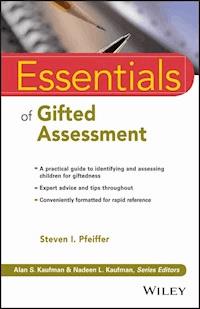
An Up-to-Date Overview of the Theory and Practice Underlying Gifted Assessment Essentials of Gifted Assessment introduces readers to the theory and practice underlying gifted assessment. Steven Pfeiffer, a leading expert in the field of gifted assessment, discusses what it means to be gifted, why we should identify gifted students, and the purposes of gifted assessment. Well-organized and engaging, the book examines key principles of gifted assessment and provides an up-to-date overview of gifted assessment measures. Topics include the use of local norms, measuring creativity and motivation, nonverbal measures, the importance of recurring gifted assessment, multi-potentiality, gifted testing and minority group students, and evaluating the twice-exceptional student. Early identification and intervention greatly benefits gifted students, who may otherwise never realize their full potential. Throughout the book, Pfeiffer equips school psychologists with the tools they need to: * Identify and assess uniquely bright and talented students * Integrate multiple assessment measures including intelligence, cognitive ability, and achievement tests * Assess gifted students with coexisting disabilities and disorders * Promote the abilities of gifted students using evidence-based strategies The book also includes extensive illustrative material, such as callout boxes and case examples, that facilitate use as a quick reference, plus end-of-chapter "Test Yourself" questions that help reinforce key concepts. Essentials of Gifted Assessment helps new and seasoned school psychologists and other professionals acquire the skills and knowledge needed for ethical, evidence-based, and informed clinical practice with high-ability students.
Sie lesen das E-Book in den Legimi-Apps auf:
Seitenzahl: 348
Veröffentlichungsjahr: 2015
Ähnliche



















CONTENTS
Cover
Essentials of Psychological Assessment Series
Title Page
Copyright
Series Preface
Acknowledgments
Chapter One: Introduction to Gifted Assessment
Who Are the Gifted?
Brief History of Gifted Education
Giftedness as a Social Construction
Tripartite Model
Should We Identify Gifted Students?
Purposes of Gifted Assessment
Chapter Two: Conceptions of Giftedness Guide Gifted Assessment
Traditional Psychometric View
Talent Development Models
Expert Performance Perspective
Multiple Intelligences Model
Theory of Successful Intelligence: WICS
Synthesis of Divergent Views of Giftedness
Conclusion
Chapter Three: Gifted Assessment: Guiding Principles and Fundamental Beliefs
Fundamental Beliefs of Gifted Assessment
Key Principles in Gifted Assessment
Beliefs and Principles Conclusion
Decision-Making or Selection Models
Chapter Four: Measuring Intellectual and Academic Ability
Why and When to Use Tests of Cognitive and Academic Ability
Where Does Abstract Reasoning Fit In?
What Tests of Cognitive Ability Measure
General and Specific Abilities
General Ability Index
Clinical Considerations and Adaptations for High-Ability Students
Some Popular IQ Tests Used in Gifted Assessment
A Few Illustrative Academic Measures
Conclusion and Recommendations
Chapter Five: Identifying and Assessing Creativity
Defining Creativity
Measuring Creativity
Creativity, Intelligence, and Talent Development
Chapter Six: Alternative Gifted Assessment Methods
Teacher and Parent Nominations
Portfolio Assessment
Nonverbal Measures
Teacher Ratings
The GRS as a Measure of Change
Assessing Readiness for Grade Acceleration
Chapter Seven: Frequently Asked Questions About Gifted Assessment
Six Questions
Concluding Comments
References
About the Author
Index
End User License Agreement
List of Tables
Table 4.1
Table 4.2
List of Illustrations
Figure 5.1
Figure 6.1
Figure 6.2
Figure 6.3
Guide
Cover
Table of Contents
Begin Reading
Chapter 1
Pages
i
ii
iv
v
vi
xi
xii
xiii
xiv
1
2
3
4
5
6
7
8
9
10
11
12
13
14
15
16
17
18
19
20
21
22
23
24
25
26
27
28
29
30
31
32
33
34
35
36
37
38
39
40
41
42
43
44
45
46
47
48
49
50
51
52
53
54
55
56
57
58
59
60
61
62
63
64
65
66
67
68
69
70
71
72
73
74
75
76
77
78
79
80
81
82
83
84
85
86
87
88
89
90
91
92
93
94
95
96
97
98
99
100
101
102
103
104
105
106
107
108
109
110
111
112
113
114
115
116
117
118
119
120
121
122
123
124
125
126
127
128
129
130
131
132
133
134
135
136
137
138
139
140
141
142
143
144
145
146
147
148
149
150
151
152
153
154
155
156
157
158
159
160
161
162
163
164
165
166
167
168
169
170
171
172
173
174
175
176
Essentials of Psychological Assessment Series
Series Editors, Alan S. Kaufman and Nadeen L. Kaufman
Essentials of 16 PF®Assessment
by Heather E.-P. Cattell and James M. Schuerger
Essentials of ADHD Assessment for Children and Adolescents
by Elizabeth P. Sparrow and Drew Erhardt
Essentials of Assessment Report Writing
by Elizabeth O. Lichtenberger, Nancy Mather, Nadeen L. Kaufman, and Alan S. Kaufman
Essentials of Assessment with Brief Intelligence Tests
by Susan R. Homack and Cecil R. Reynolds
Essentials of Autism Spectrum Disorders Evaluation and Assessment
by Celine A. Saulnier and Pamela E. Ventola
Essentials of Bayley Scales of Infant Development–II Assessment
by Maureen M. Black and Kathleen Matula
Essentials of Behavioral Assessment
by Michael C. Ramsay, Cecil R. Reynolds, and R. W. Kamphaus
Essentials of Career Interest Assessment
by Jeffrey P. Prince and Lisa J. Heiser
Essentials of CAS Assessment
by Jack A. Naglieri
Essentials of Cognitive Assessment with KAIT and Other Kaufman Measures
by Elizabeth O. Lichtenberger, Debra Broadbooks, and Alan S. Kaufman
Essentials of Conners Behavior Assessments™
by Elizabeth P. Sparrow
Essentials of Creativity Assessment
by James C. Kaufman, Jonathan A. Plucker, and John Baer
Essentials of Cross-Battery Assessment, Third Edition
by Dawn P. Flanagan, Samuel O. Ortiz, and Vincent C. Alfonso
Essentials of DAS-II®Assessment
by Ron Dumont, John O. Willis, and Colin D. Elliot
Essentials of Dyslexia Assessment and Intervention
by Nancy Mather and Barbara J. Wendling
Essentials of Evidence-Based Academic Interventions
by Barbara J. Wendling and Nancy Mather
Essentials of Executive Functions Assessment
by George McCloskey and Lisa A. Perkins
Essentials of Forensic Psychological Assessment, Second Edition
by Marc J. Ackerman
Essentials of IDEA for Assessment Professionals
by Guy McBride, Ron Dumont, and John O. Willis
Essentials of Individual Achievement Assessment
by Douglas K. Smith
Essentials of KABC-II Assessment
by Alan S. Kaufman, Elizabeth O. Lichtenberger, Elaine Fletcher-Janzen, and Nadeen L. Kaufman
Essentials of Millon™ Inventories Assessment, Third Edition
by Stephen Strack
Essentials of MMPI-A™ Assessment
by Robert P. Archer and Radhika Krishnamurthy
Essentials of MMPI-2®Assessment, Second Edition
by David S. Nichols
Essentials of Myers-Briggs Type Indicator®Assessment, Second Edition
by Naomi Quenk
Essentials of NEPSY®-II Assessment
by Sally L. Kemp and Marit Korkman
Essentials of Neuropsychological Assessment, Second Edition
by Nancy Hebben and William Milberg
Essentials of Nonverbal Assessment
by Steve McCallum, Bruce Bracken, and John Wasserman
Essentials of PAI®Assessment
by Leslie C. Morey
Essentials of Planning, Selecting, and Tailoring Interventions for Unique Learners
edited by Jennifer T. Mascolo, Vincent C. Alfonso, and Dawn P. Flanagan
Essentials of Processing Assessment, Second Edition
by Milton J. Dehn
Essentials of Response to Intervention
by Amanda M. VanDerHeyden and Matthew K. Burns
Essentials of Rorschach®Assessment
by Tara Rose, Nancy Kaser-Boyd, and Michael P. Maloney
Essentials of School Neuropsychological Assessment, Second Edition
by Daniel C. Miller
Essentials of Specific Learning Disability Identification
by Dawn Flanagan and Vincent C. Alfonso
Essentials of Stanford-Binet Intelligence Scales (SB5) Assessment
by Gale H. Roid and R. Andrew Barram
Essentials of TAT and Other Storytelling Assessments, Second Edition
by Hedwig Teglasi
Essentials of Temperament Assessment
by Diana Joyce
Essentials of WAIS®-IV Assessment, Second Edition
by Elizabeth O. Lichtenberger and Alan S. Kaufman
Essentials of WIAT®-III and KTEA-II Assessment
by Elizabeth O. Lichtenberger and Kristina C. Breaux
Essentials of WISC®-IV Assessment, Second Edition
by Dawn P. Flanagan and Alan S. Kaufman
Essentials of WJ III™ Cognitive Abilities Assessment, Second Edition
by Fredrick A. Schrank, Daniel C. Miller, Barbara J. Wendling, and Richard W. Woodcock
Essentials of WJ IV™ Tests of Achievement Assessment
by Nancy Mather and Barbara J. Wendling
Essentials of WMS®-IV Assessment
by Lisa Whipple Drozdick, James A. Holdnack, and Robin C. Hilsabeck
Essentials of WNV™ Assessment
by Kimberly A. Brunnert, Jack A. Naglieri, and Steven T. Hardy-Braz
Essentials of WPPSI™-IV Assessment
by Susan Engi Raiford and Diane Coalson
Essentials of WRAML2 and TOMAL-2 Assessment
by Wayne Adams and Cecil R. Reynolds
Essentials of Gifted Assessment
Steven I. Pfeiffer
Cover image: Wiley
Cover design: © Greg Kuchik/Getty Images
This book is printed on acid-free paper.
Copyright © 2015 by John Wiley & Sons, Inc. All rights reserved.
Published by John Wiley & Sons, Inc., Hoboken, New Jersey.
Published simultaneously in Canada.
No part of this publication may be reproduced, stored in a retrieval system, or transmitted in any form or by any means, electronic, mechanical, photocopying, recording, scanning, or otherwise, except as permitted under Section 107 or 108 of the 1976 United States Copyright Act, without either the prior written permission of the Publisher, or authorization through payment of the appropriate per-copy fee to the Copyright Clearance Center, Inc., 222 Rosewood Drive, Danvers, MA 01923, (978) 750-8400, fax (978) 646-8600, or on the web at www.copyright.com. Requests to the Publisher for permission should be addressed to the Permissions Department, John Wiley & Sons, Inc., 111 River Street, Hoboken, NJ 07030, (201) 748-6011, fax (201) 748-6008.
Limit of Liability/Disclaimer of Warranty: While the publisher and author have used their best efforts in preparing this book, they make no representations or warranties with respect to the accuracy or completeness of the contents of this book and specifically disclaim any implied warranties of merchantability or fitness for a particular purpose. No warranty may be created or extended by sales representatives or written sales materials. The advice and strategies contained herein may not be suitable for your situation. You should consult with a professional where appropriate. Neither the publisher nor author shall be liable for any loss of profit or any other commercial damages, including but not limited to special, incidental, consequential, or other damages.
This publication is designed to provide accurate and authoritative information in regard to the subject matter covered. It is sold with the understanding that the publisher is not engaged in rendering professional services. If legal, accounting, medical, psychological or any other expert assistance is required, the services of a competent professional person should be sought.
Designations used by companies to distinguish their products are often claimed as trademarks. In all instances where John Wiley & Sons, Inc. is aware of a claim, the product names appear in initial capital or all capital letters. Readers, however, should contact the appropriate companies for more complete information regarding trademarks and registration.
For general information on our other products and services please contact our Customer Care Department within the United States at (800) 762-2974, outside the United States at (317) 572-3993 or fax (317) 572-4002.
Wiley publishes in a variety of print and electronic formats and by print-on-demand. Some material included with standard print versions of this book may not be included in e-books or in print-on-demand. If this book refers to media such as a CD or DVD that is not included in the version you purchased, you may download this material at http://booksupport.wiley.com. For more information about Wiley products, visit www.wiley.com.
Library of Congress Cataloging-in-Publication Data:
Library of Congress Cataloging-in-Publication Data has been applied for and is on file with the Library of Congress.
ISBN 978-1-118-58920-5 (paper); ISBN 978-1-118-70564-3 (ePDF); ISBN 978-1-118-87316-8 (ePub)
Series Preface
In the Essentials of Psychological Assessment series, we have attempted to provide the reader with books that will deliver key practical information in the most efficient and accessible style. Many books in the series feature specific instruments in a variety of domains, such as cognition, personality, education, and neuropsychology. Other books, like Essentials of Gifted Assessment, focus on crucial topics for professionals who are involved in any way with assessment—topics such as specific reading disabilities, evidence-based interventions, or ADHD assessment. For the experienced professional, books in the series offer a concise yet thorough review of a test instrument or a specific area of expertise, including numerous tips for best practices. Students can turn to series books for clear and concise overviews of the important assessment tools and key topics in which they must become proficient to practice skillfully, efficiently, and ethically in their chosen fields.
Wherever feasible, visual cues highlighting key points are utilized alongside systematic, step-by-step guidelines. Chapters are focused and succinct. Topics are organized for an easy understanding of the essential material related to a particular test or topic. Theory and research are continually woven into the fabric of each book, but always so as to enhance the practical application of the material rather than to sidetrack or overwhelm readers. With this series, we aim to challenge and assist readers interested in psychological assessment to aspire to the highest level of competency by arming them with the tools they need for knowledgeable, informed practice. We have long been advocates of intelligent testing—which incorporates the notion that numbers are meaningless unless they are brought to life by the clinical acumen and expertise of examiners. Assessment must be used to make a difference in the child's or adult's life, or why bother to test? All the books in this series—whether devoted to specific tests or general topics—are consistent with this credo. We want this series to help our readers, novice and veteran alike, to benefit from the intelligent assessment approaches of the authors of each book.
We are delighted to include Essentials of Gifted Assessment in our series. Dr. Steven Pfeiffer is, in our opinion, among the small group of the world's leading experts in the field. He is an unusually articulate spokesperson on the varied topics that make up the broad domain of gifted education and gifted assessment. Essentials of Gifted Assessment introduces the theory and practice underlying gifted assessment within the context of the history that produced this important field. This book provides an overview of who the gifted are, the reasons why we should identify gifted students, and the purposes of gifted assessment. Key principles of gifted assessment are discussed and an up-to-date overview on gifted assessment measures is provided. Topics include the use of local norms, measuring creativity and motivation, nonverbal measures, the importance of recurring gifted assessment, multipotentiality, gifted testing and minority group students, and evaluating the twice-exceptional student. This book provides practitioners with the tools needed for ethical, evidence-based, and informed clinical practice with high-ability students.
Alan S. Kaufman, PhD, and Nadeen L. Kaufman, EdD
Series Editors
Yale Child Study Center
Yale University School of Medicine
Acknowledgments
Iwant to thank Alan Kaufman and Nadeen Kaufman, editors of the Essentials of Psychological Assessment Series, for inviting me to write this book. It has been a great intellectual pleasure. Having spent a long and very satisfying professional career working with high-ability students—beginning with my dissertation on creativity, followed by my work at Duke University and later at Florida State University as an administrator, clinician, consultant, and researcher—it has been extremely gratifying writing this book as part of the Wiley assessment series.
I gratefully acknowledge the many high-ability students and also parents, psychologists, and educators that I had the privilege of working with and learning from during my tenure as executive director of the Duke University Talent Identification Program and later, as professor and director of clinical training at Florida State University and codirector of the Florida Governor's School for Space Science and Technology. I appreciate, value, and hold in reverence the many lessons learned from the extremely bright students whom I have worked with over the past thirty-five years. I owe special thanks to Professor James Gallagher for sparking my initial interest in the gifted and serving as an early mentor and role model while I was still a doctoral student at the University of North Carolina-Chapel Hill. It saddened me to learn, as I was writing this book, that Jim had passed away. I had looked forward to sharing a draft and inviting his feedback.
Others who have inspired my thinking about gifted assessment and who deserve mention for ideas that appear in this volume include Professor Michael Wallach (the importance of “what we measure”), Professor Louis Hsu (“respecting psychometrics”), clinical psychologist Andy Burka (“appreciating and searching for the uniqueness in every client”), test author Jack Naglieri (my mentor early in my career in “test development 101”), and Dr. Maureen Neihart (National Institute of Education, Singapore) and Dr. Pauline Dixon (Newcastle University, England) for helping me experience firsthand the “impact of culture.” Special thanks are due to Susie Raiford at Pearson Assessment for her invaluable input into the new WISC-V. Finally, thanks to Elspeth MacHattie for her exquisitely valuable editing and to Emilee Valler, one of my doctoral students, for her dogged sleuth work in locating missing references and citations.
I continue to appreciate and respect the support of my wife, Jan, who graciously permitted me many evenings and weekends away from bike rides, tennis games, and trail runs to write this book.
I dedicate this book, as I did my last book, Serving the Gifted,1 to practitioners who hold an interest in identifying and working with students of high ability. For far too long, school psychologists and other professionals working in the schools have focused the great majority of their time, effort, and creative resources on those students who fall at the lower end of the ability continuum. I hope that Essentials of Gifted Assessment helps to focus greater attention on the identification and assessment needs of students of uncommon ability and high potential. I also hope that this volume contributes in some meaningful way to best practices in gifted assessment. One final point: this book isn't about assessing intelligence. It is about the theory and practice underlying assessing giftedness.
Note
1.
Serving the Gifted
was published in 2013 by Routledge in its School-Based Practice in Action Series.
Lesen Sie weiter in der vollständigen Ausgabe!
Lesen Sie weiter in der vollständigen Ausgabe!
Lesen Sie weiter in der vollständigen Ausgabe!
Lesen Sie weiter in der vollständigen Ausgabe!
Lesen Sie weiter in der vollständigen Ausgabe!
Lesen Sie weiter in der vollständigen Ausgabe!
Lesen Sie weiter in der vollständigen Ausgabe!
Lesen Sie weiter in der vollständigen Ausgabe!
Lesen Sie weiter in der vollständigen Ausgabe!
Lesen Sie weiter in der vollständigen Ausgabe!
Lesen Sie weiter in der vollständigen Ausgabe!




