


36,99 €
Mehr erfahren.
- Herausgeber: John Wiley & Sons
- Kategorie: Fachliteratur
- Serie: Essentials of Psychological Assessment
- Sprache: Englisch
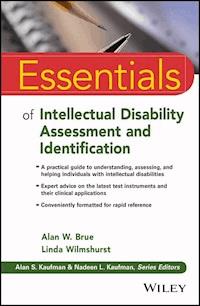
Brue's Essentials Intellectual Disability is a concise, up-to-date overview of intellectual disability evaluation and assessment. This text offers a practical, concise overview of the nature of intellectual disability and adaptive skills functioning in children, adolescents, and adults. Coverage includes the latest information on prevalence, causes, differential diagnoses, behavioral and social concerns, test instruments, and the new DSM-5 diagnostic criteria. The discussion promotes a deeper understanding of the use of assessment data to inform interventions in clinical practice. Designed for easy navigation, each chapter highlights important points and key cautions to allow quick reference without sacrificing depth. A sample assessment report illustrates how findings should be communicated to better inform treatment, giving you a practical reference to ensure comprehensive reporting. In 2013, the DSM-5 conceptualization of intellectual disabilities was significantly changed. It's important for professionals to have access to the most current guidelines from a variety of sources, and this book compiles them all into a single reference.
Sie lesen das E-Book in den Legimi-Apps auf:
Seitenzahl: 291
Veröffentlichungsjahr: 2016
Ähnliche



















Table of Contents
Title Page
Copyright
Dedication
Series Preface
Acknowledgments
Chapter One: History of Intellectual Disability
Early Beginnings
The Turn of the Century: 1900 to 1950
The Age of Assessment: Late 1950s to 1970
1980s to the Present
Summary
Test Yourself
Chapter Two: Prevalence, Causes, Issues, and Comorbid Disorders
Etiology of Intellectual Disabilities: Subtypes
Differential Diagnoses
Comorbidity
Test Yourself
Chapter Three: Current Intellectual Disability Diagnostic and Federal Education Criteria
The
DSM–5
American Association on Intellectual and Developmental Disabilities
Individuals with Disabilities Education Improvement Act of 2004
Differential Diagnoses and Comorbid Conditions
Specific Learning Disabilities
Test Yourself
Chapter Four: Legal Issues and Concerns
Education and the Law: Issues and Concerns
Test Yourself
Chapter Five: Theories of Intelligence and the Flynn Effect
Spearman's Two-Factor Theory
Thurstone's Primary Mental Abilities
Cattell-Horn-Carroll Theory
Triarchic Theory of Intelligence
Planning, Attention-Arousal, Simultaneous, and Successive Theory of Intelligence
Theory of Multiple Intelligences
Flynn Effect
Intellectual Disability and Capital Punishment Cases
Test Yourself
Chapter Six: Assessment of an Intellectual Disability
Designing a Test Battery
Areas to Assess
Test Yourself
Chapter Seven: Integration of Assessment Results
Report Sample #1
Report Sample #2
Test Yourself
Chapter Eight: Postassessment Planning
Common Parent Reactions to Learning a Child has a Disability
Guidelines for Parents of Individuals with Developmental Disabilities
Transition Planning
Self-Determination and Individuals with Developmental Disabilities
Application of Self-Determination Practices
Results of The Arc Survey: FINDS 2011
Test Yourself
Appendix A: State Departments of Special Education
Appendix B: AAIDD and The Arc Position Statement on the Criminal Justice System
Criminal Justice System
Appendix C: American Association on Intellectual and Developmental Disabilities (AAIDD): Guidelines to Professional Conduct
Position Statement of AAIDD
Appendix D: The ARC Position Statement on Self-Determination
Self-Determination
Appendix E: AAIDD and The Arc Position Statement on Self-advocacy
Self-Advocacy
Appendix F: The ARC Position Statement on Education
Education
Appendix G: The ARC Position Statement on Employment
Employment
Appendix H: Helpful Websites
References
About the Authors
Index
End User License Agreement
Pages
xv
xvi
xiii
xiv
xv
xvi
1
2
3
4
5
6
7
8
9
10
11
12
13
14
15
16
17
18
19
20
21
22
23
24
25
26
27
28
29
30
31
32
33
34
35
36
37
38
39
40
41
42
43
44
45
46
47
48
49
50
51
52
53
54
55
56
57
58
59
60
61
62
63
63
64
65
66
67
68
69
70
71
72
73
74
75
76
77
78
79
80
81
82
83
84
85
86
87
88
89
90
91
93
94
95
96
97
98
99
100
101
102
103
104
105
106
107
108
109
110
111
112
113
114
115
116
117
118
119
120
121
122
123
124
125
126
127
128
129
130
131
132
133
134
135
136
137
138
139
140
141
142
143
144
145
146
147
148
149
150
151
152
153
154
155
156
157
158
159
160
161
162
163
164
165
166
167
169
170
171
172
173
174
Guide
Cover
Table of Contents
Begin Reading
Essentials of Intellectual Disability Assessment and Identification
A Field Guide for Applied Research
Alan W. BrueLinda Wilmshurst
Copyright © 2016 by John Wiley & Sons, Inc. All rights reserved.
Published by John Wiley & Sons, Inc., Hoboken, New Jersey.
Published simultaneously in Canada.
No part of this publication may be reproduced, stored in a retrieval system, or transmitted in any form or by any means, electronic, mechanical, photocopying, recording, scanning, or otherwise, except as permitted under Section 107 or 108 of the 1976 United States Copyright Act, without either the prior written permission of the publisher, or authorization through payment of the appropriate per-copy fee to the Copyright Clearance Center, Inc., 222 Rosewood Drive, Danvers, MA 01923, 978-750-8400, fax 978-646-8600, or on the Web at www.copyright.com. Requests to the publisher for permission should be addressed to the Permissions Department, John Wiley & Sons, Inc., 111 River Street, Hoboken, NJ 07030, 201-748-6011, fax 201-748-6008, or online at www.wiley.com/go/permissions.
Limit of Liability/Disclaimer of Warranty: While the publisher and author have used their best efforts in preparing this book, they make no representations or warranties with respect to the accuracy or completeness of the contents of this book and specifically disclaim any implied warranties of merchantability or fitness for a particular purpose. No warranty may be created or extended by sales representatives or written sales materials. The advice and strategies contained herein may not be suitable for your situation. You should consult with a professional where appropriate. Neither the publisher nor author shall be liable for any loss of profit or any other commercial damages, including but not limited to special, incidental, consequential, or other damages. Readers should be aware that Internet Web sites offered as citations and/or sources for further information may have changed or disappeared between the time this was written and when it is read.
This publication is designed to provide accurate and authoritative information in regard to the subject matter covered. It is sold with the understanding that the publisher is not engaged in rendering professional services. If legal, accounting, medical, psychological or any other expert assistance is required, the services of a competent professional should be sought.
For general information on our other products and services, please contact our Customer Care Department within the U.S. at 800-956-7739, outside the U.S. at 317-572-3986, or fax 317-572-4002.
Wiley publishes in a variety of print and electronic formats and by print-on-demand. Some material included with standard print versions of this book may not be included in e-books or in print-on-demand. If this book refers to media such as a CD or DVD that is not included in the version you purchased, you may download this material at http://booksupport.wiley.com. For more information about Wiley products, visit www.wiley.com.
Library of Congress Cataloging-in-Publication Data
Names: Brue, Alan W., author. | Wilmshurst, Linda, author.
Title: Essentials of intellectual disability assessment and identification / Alan W. Brue, Linda Wilmshurst.
Description: Hoboken, New Jersey : John Wiley & Sons, Inc., 2016 | Series: Essentials of psychological assessment | Includes index.
Identifiers: LCCN 2015051194| ISBN 9781118875094 (paperback) | ISBN 9781118875643 (ePDF) ISBN 9781118875537 (epub)
Subjects: LCSH: Mental retardation. | Developmental disabilities. | Intelligence tests. | Educational tests and measurements. | BISAC: PSYCHOLOGY / Assessment, Testing & Measurement.
Classification: LCC RC570 .B78 2016 | DDC 362.3—dc23 LC record available at http://lccn.loc.gov/2015051194
Cover design by Wiley
Cover image: © Greg Kuchik/Getty Images
This book is dedicated to the memory of my mentor and friend, Dr. Thomas Oakland, who has been and continues to be an inspiration to many around the world.
—Alan W. Brue
Series Preface
In the Essentials of Psychological Assessment series, we have attempted to provide the reader with books that will deliver key practical information in the most efficient and accessible style. Many books in the series feature specific instruments in a variety of domains, such as cognition, personality, education, and neuropsychology. Other books, like Essentials of Intellectual Disability Assessment and Identification, focus on crucial topics for professionals who are involved in any way with assessment—topics such as specific reading disabilities, evidence-based interventions, and ADHD assessment. For the experienced professional, books in the series offer a concise yet thorough review of a test instrument or a specific area of expertise, including numerous tips for best practices. Students can turn to series books for a clear and concise overview of the important assessment tools and of key topics in which they must become proficient to practice skillfully, efficiently, and ethically in their chosen fields.
Wherever feasible, visual cues highlighting key points are utilized alongside systematic, step-by-step guidelines. Chapters are focused and succinct. Topics are organized for an easy understanding of the essential material related to a particular test or topic. Theory and research are continually woven into the fabric of each book, but the aim always is to enhance the practical application of the material rather than to sidetrack or overwhelm readers. With this series, we aim to challenge and assist readers interested in psychological assessment to aspire to the highest level of competency by arming them with the tools they need for knowledgeable, informed practice. We have long been advocates of “intelligent” testing—the notion that numbers are meaningless unless they are brought to life by the clinical acumen and expertise of examiners. Assessment must be used to make a difference in the child's or adult's life, or why bother to test? All books in the series—whether devoted to specific tests or general topics—are consistent with this credo. We want this series to help our readers, novice and veteran alike, to benefit from the intelligent assessment approaches of the authors of each book.
We are delighted to include Essentials of Intellectual Disability Assessment and Identification in our series. This book offers a concise overview of the nature of an intellectual disability and adaptive skills functioning in children, adolescents, and adults. Providing an in-depth look at intellectual disability assessment and identification, the authors discuss the history of intellectual disability, its causes, comorbid disorders, diagnostic criteria and special education eligibility criteria, legal issues such as capital punishment, theories of intelligence, test instruments used in the assessment of an intellectual disability, and postassessment planning. In addition, they illustrate in sample reports how assessment data can be integrated in a brief report in order to inform treatment and guide interventions.
Alan S. Kaufman, PhD, and Nadeen L. Kaufman, EdD, Series EditorsYale Child Study Center, Yale University School of Medicine
Acknowledgments
We would like to thank Marquita Flemming, Senior Editor at Wiley, for all of her assistance. She provided a great deal of help and support – from project inception to the final manuscript – and always offered great feedback. We are grateful to have worked with her.
Chapter OneHistory of Intellectual Disability
This introductory chapter provides a brief but significant discussion concerning how intellectual disability (ID) has been defined and conceptualized historically by the different classification systems: ), American Association on Mental Retardation/American Association on Intellectual and Developmental Disabilities (AAMR/AAIDD), and Individuals with Disabilities Education Act (IDEA). This background information lays the foundation for a more complete understanding of issues associated with the diagnosis of intellectual disability and the evolution that has occurred in the ways the disorder is conceptualized today. This chapter will discuss the shift in conceptualization from variations in the degree to which the disorder is manifested (: mild, moderate, severe, profound) to variations in the intensity of services needed (AAIDD: intermittent, limited, extensive, pervasive). The 2010 is addressed.
Lesen Sie weiter in der vollständigen Ausgabe!
Lesen Sie weiter in der vollständigen Ausgabe!
Lesen Sie weiter in der vollständigen Ausgabe!
Lesen Sie weiter in der vollständigen Ausgabe!
Lesen Sie weiter in der vollständigen Ausgabe!
Lesen Sie weiter in der vollständigen Ausgabe!
Lesen Sie weiter in der vollständigen Ausgabe!
Lesen Sie weiter in der vollständigen Ausgabe!
Lesen Sie weiter in der vollständigen Ausgabe!
Lesen Sie weiter in der vollständigen Ausgabe!
Lesen Sie weiter in der vollständigen Ausgabe!
Lesen Sie weiter in der vollständigen Ausgabe!
Lesen Sie weiter in der vollständigen Ausgabe!
Lesen Sie weiter in der vollständigen Ausgabe!
Lesen Sie weiter in der vollständigen Ausgabe!
Lesen Sie weiter in der vollständigen Ausgabe!
Lesen Sie weiter in der vollständigen Ausgabe!
Lesen Sie weiter in der vollständigen Ausgabe!
Lesen Sie weiter in der vollständigen Ausgabe!




