


Erhalten Sie Zugang zu diesem und mehr als 300000 Büchern ab EUR 5,99 monatlich.
- Herausgeber: Books on Demand
- Kategorie: Geisteswissenschaft
- Serie: rüffer & rub visionaries
- Sprache: Englisch
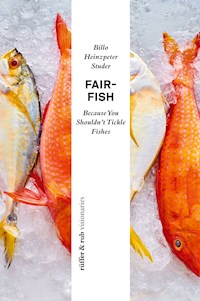
Billo Heinzpeter Studer has been a devotee of fishes for over 20 years: 'Fishes have always fascinated me, while I also feel sympathy for them. Because they are rather neglected, and mainly attract our attention in large groups - but fishes are not vegetables!' Fishes are stranger to us than other (working) animals, and we have very limited knowledge about them and their needs. What defines a good life for a fish? Most of us have no idea. Billo Heinzpeter Studer is on a mission to change this. He explains why fishes are close to his heart, describing his aim to protect them as well as the practical projects, strategies and solutions to realize his vision. One such a project leads to Senegal. He goes fishing with local fishermen to observe what happens at sea. He discusses a more humane and sustainable method of fishery for the fishes. The fishermen not least would reap the reward, by asking fairer prices for fairly caught and paid for fishes. This could safeguard their long-term livelihoods. 'C'est intéressant, ça,' they tell Billo Heinzpeter Studer who is on board with the fishermen and on their side.
Sie lesen das E-Book in den Legimi-Apps auf:
Seitenzahl: 195
Veröffentlichungsjahr: 2021
Das E-Book (TTS) können Sie hören im Abo „Legimi Premium” in Legimi-Apps auf:
Ähnliche
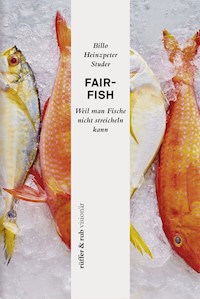



















About the subtitle | In exceptional cases, fishes in captivity let their keepers stroke, tickle or touch them (for instance, carps, kois, sturgeons, trouts, dolphins or squids). Yet as a general rule, we are unable to make an emotional connection to aquatic animals through touch – and that’s as it should be. Because we could harm the fish’s mucus, protecting their bodies from parasites and bacteria. Even more so than for creatures that exist on land and breathe air like us, forming an emotive bond with aquatic animals requires us to know the facts about their vastly different lifestyle. The fair-fish association campaigns to impart these facts and to raise the profile of fishes.
Table of Contents
Preface |
Anne Rüffer
Back to the Beginning: From Hens to Fishes.
Fair Fishes from Swiss Lakes.
Excursus 1 – fair-fish Guidelines 2000 for Fish Farming
Excursus 2 – fair-fish Guidelines 2000 for Fish Capture
Excursus 3 – Interlude with Ornamental Fish?
Fair Fishes from Africa.
Excursus 4 – fair-fish on Senegal’s Fishery Policy
Excursus 5 – A Ship Cargo of Tinned Fish – Why Not?
Excursus 6 – Why No Fair Fishery in Europe?
Excursus 7 – Campaigns Instead of Projects
Back to Aquaculture: When Are Fishes Happy and Healthy?.
Excursus 8 – Do fishes experience pain?
Excursus 9 – How fair-fish almost had a model fish farm..
Handover to the Next Generation
Which Fish Can I Still Eat?
Glossary
Map of Senegal.
Notes
Photo Credits.
Thanks.
About the Author.
Preface
Anne Rüffer, publisher
2 December 2015, Geneva. Standing room only in the city’s Auditorium Ivan Pictet. A group of distinguished guests has assembled to honour the four winners of this year’s Alternative Nobel Prize. The auditorium’s building is named ‘Maison de la paix’ – ‘home of peace’. Rarely has a name so closely accorded with the special meaning of the occasion. The evening begins with two speakers: Barbara Hendriks, who serves as Germany’s Minister of the Environment, and Michael Møller, who is Director-General of the United Nations Office in Geneva. The event’s title is ‘On the Frontlines and in the Courtrooms: Forging Human Security’.
Dr Gino Strada, one of the 2015 laureates, comments: ‘The UN was founded in the aftermath of the Second World War. Its purpose was and is to liberate future generations from being hostages of unceasing conflict. Since that day, the world has experienced more than 170 armed conflicts. And you never broached the subject of how to abolish warfare? Come on, guys, this is incredible!’ The audience responds with embarrassed laughter and polite murmurs of disbelief. Gino Strada founded the international aid organization ‘Emergency’ in 1994, and knows all too well what he is talking about. His organization runs clinics in regions destroyed by conflict and provides medical treatment to victims of warfare – 10% are soldiers themselves, with the remaining 90% being civilians. Strada ends his statement with, ‘You can call me a utopian if you like. But remember, everything appears to be a utopia until someone realizes his vision.’
‘I have a dream.’ Dr Martin Luther King’s statement is probably one of the most often quoted over the last few decades. That’s because Dr King’s dream of a world in which justice prevails is shared by so many people. Some of them – more than we are probably aware of and yet not enough by far – have devoted themselves head, heart and soul to making this dream come true. They were remarkable pioneers in their fields and could certainly be called ‘utopians’. And yet, each great advance recorded by humanity originally began as a utopian idea, a hope, a vision.
This book appears in our series of ‘rüffer&rub visionaries’. These books are intended to fan the sparks emanating from the ideas and hopes nurtured by these visionaries into the ardent flames of perseverance and endeavour. The heart of each book is the author’s very personal look at her or his scientific, cultural or societal area of focus.
Each author will convey – in plain, inspiring words – how the fascination with the topic began. Each story reveals a personal quest to look for comprehensive answers and sustainable solutions. These books will tell you what it means to commit yourself to a cause, to live your commitment every day, to develop and implement a vision for its realization. These visions are highly variegated – political, scientific or spiritual – in nature, but the individual authors are united by a yearning for a better world – and a willingness to put their hearts and souls into achieving them.
All of these visions and the activities undertaken to make them come true possess something else in common: the deep-rooted belief that we can positively shape our future, that we can restore the health of the planet on which we all live. We too are convinced that each and every one of us is capable of pursuing the steps required to make each of us part of the solution, and not of the problem.
So Fishes Suffer Less and Fewer Fishermen Have to Emigrate
European perch [Perca fluviatilis] Short profile: fishethobase.net/db/35
Kayar, one of Senegal’s major fishing ports, at 5 am in mid-January 2005. An old fisherman, the leader of the handliners [], meets me in the pitch dark in Medina. Untypically for Africans, he arrives half an hour earlier than yesterday’s arranged time. Hastily, he flip-flops across the sand between the tightly parked pirogues [], glancing back at me repeatedly and urging me to hurry along. On arrival at the beach, he tells one of the assembled figures waiting by a boat to bring out his oilskins. I am supposed to take his place and slip into the clammy gear, grab hold of the side of the boat, then heave-ho, until the pirogue is pushed down the beach and afloat, and quickly jump aboard and off we go. Captain Banda Diouf, who is right behind me, switches on the engine for a top-speed chase in the pirogue, which is as narrow as a dugout canoe, out onto the open sea. It is blackest night as the bright lights of Kayar’s large fishing port disappear. So, who am I crouching next to, here in the same boat?
Clinging onto both sides with my hands, I wedge my feet against the rib; I concentrate entirely on the constant shifting of my weight to counter-balance the fierce crashing of the waves, which rock the boat up and down and back and forth, threatening to capsize the craft, or so I fear. Hold tight, no sliding around! What is the lunatic doing ahead of me? Standing upright … he takes a pee, in all honesty, calmly and without falling overboard. I count my blessings that I had no time for breakfast; I don’t even know if my stomach is seaworthy.
It’s daybreak; behind me the captain slows down the engine, looking for the perfect spot above a reef, then one of his crew at the bow drops anchor. We sit here in the heavy swell; the boat is still rocking. I stay wedged in, looking at the three youths as they cast their handlines, guiding and adjusting them through their fingers taped with plasters, and constantly pulling them in to replace the bait on the hooks, pieces of yesterday’s fish. A fish rarely bites. ‘Marée haute’, says Banda, who is sitting opposite me, shrugging his shoulders, as though he would like to apologize from the outset: fishing is no good at high tide.
It’s true, the other two fishermen don’t see much activity either. Only Banda is lucky today; now and again, a fish wriggles on his line with eight hooks. ‘Tu veux essayer?’, you wanna try?, he asks me, holding out his line towards me. I wave it aside. ‘Just tell me exactly how you do it.’ He lets the line glide over his finger, waiting, waiting, and pulls sharply. ‘You see?’ he says, articulating with his fingers more than with his voice. ‘With some fish, you have to let the line go when they bite, whereas with others you have to pull instantly, so they get caught.’ ‘And how do you know what kind of fish you’ve hooked?’ He shrugs his shoulders dismissively, as if to say: ‘It’s obvious, man, I’ve been doing nothing else since I was a child!’ They have been returning daily to the same places for generations; they know every inch of their reefs, even if they use GPS nowadays to check that they have arrived at the right location.
My backside aches from sitting for so long on the same spot. Yet, I’m more focused on Banda, who speaks a little French and likes using it, while the others remain silent. I find out that the three cousins have been fishing together for years. Do they love their work? ‘Travail? Ce n’est même pas un travail de merde!’ It’s not even a shit job; it’s lousy pay, and the fish stocks are virtually nil at the moment, because the Spanish, Japanese and Koreans are exploiting the sea on a grand scale. Or else, I reflect, they get others to do the overfishing for them. I picture myself on my first visit here, half a year ago, on the short ferry crossing from Gorée Island back to Dakar. Thousands of dead fishes were adrift on the water, floating into the distance, their appearance unscathed and fresh. The puzzle was solved soon afterwards at the sight of a Korean factory ship at anchor. That’s where the pirogues were selling their catch, and from here countless fish were being discarded because they didn’t fulfil certain criteria. ‘But thousands of people could be fed with these fish,’ I had said to our guide. And after he politely nodded, I probed further: ‘So why does your government allow that?’ ‘We’re just a poor country,’ he remarked quietly, ‘and we absolutely need foreign currency …’




