


Erhalten Sie Zugang zu diesem und mehr als 300000 Büchern ab EUR 5,99 monatlich.
- Herausgeber: Birlinn
- Kategorie: Geisteswissenschaft
- Sprache: Englisch
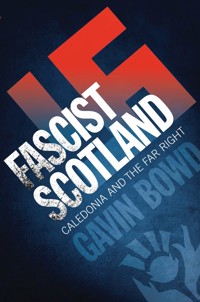
On 10 May 1941, Rudolf Hess, Deputy Fuhrer of the Third Reich, entered Scottish airspace in an ill-fated attempt to discuss peace with the Duke of Hamilton. For the Nazis, Hess was the victim of 'tragic hallucinations'. But how far had Hess really flown from reality? Although Fascism in Britain is normally associated with England, and especially the East End of London, and even then dismissed as a marginal political phenomenon, Fascism did find support in Scottish society. Scotland has provided its own cohort of idealists, fanatics and traitors for extreme racist, nationalist and authoritarian politics. From Dumfries to Alness, one of the main ideologies of the first half of the twentieth century found its standard-bearers. But when Fascism crossed the Cheviots, it found itself in a restless part of a multi-nation state, riven by sectarian hatreds. Rudolf Hess felt the natives looked at him 'in a compassionate way', but Scottish Fascism had to carve out a niche in a crowded market for bigotry. In this book Gavin Bowd relates a fascinating and little-known part of our history which reveals some uncomfortable truths which are bound to stimulate debate even now.
Sie lesen das E-Book in den Legimi-Apps auf:
Seitenzahl: 563
Veröffentlichungsjahr: 2013
Das E-Book (TTS) können Sie hören im Abo „Legimi Premium” in Legimi-Apps auf:
Ähnliche




















FASCIST SCOTLAND
Gavin Bowd teaches French at St Andrews University. He has published widely on Scottish, French and Romanian culture and politics. He is also a poet, fiction writer, journalist and translator.
First published in 2013 byBirlinn LimitedWest Newington House10 Newington RoadEdinburghEH9 1QS
www.birlinn.co.uk
Copyright © Gavin Bowd 2013
The moral right of Gavin Bowd to be identified asthe author of this work has been asserted by him in accordancewith the Copyright, Designs and Patents Act 1988.
All rights reserved.
No part of this publication may be reproduced, stored ortransmitted in any form without the express writtenpermission of the publisher.
ISBN: 978 1 78027 052 4
British Library Cataloguing-in-Publication DataA catalogue record for this book is available from the British Library
Typeset by Iolaire Typesetting, NewtonmorePrinted and bound by Grafica Venetawww.graficaveneta.com
‘It is a terrible thing’, said Miss Carmichael, ‘to see the best of our lads marched off, generation after generation, to fight the battles of the English for them. But the end is upon them. When the Germans land in Scotland, the glens will be full of marching men come to greet them, and the professors themselves at the universities will seize the towns. Mark my words, don’t be caught on Scottish soil on that day.’
Evelyn Waugh, Officers and Gentlemen
Contents
List of Illustrations
Acknowledgements
Prologue
1 Mosley’s Lost Legion
2 Fasci di Scozia
3 Scotland for Franco
4 The Nazis and the Nats
5 Tartan Treachery
6 The Third Reich No More?
Notes
Select Bibliography
Index
List of Illustrations
Rudolf Hess. The Deputy Führer’s ‘peace mission’ to Scotland in May 1941 still provokes speculation.
The Duke of Hamilton denied all acquaintance with Hess, but had been a prominent friend of Nazi Germany.
North of the Cheviots, Mosley’s Blackshirts came up against religious sectarianism and the Scottish national question.
Thomas Carlyle was an inspiration to Fascists and the bunker bedtime reading of Adolf Hitler in the twilight of the Third Reich.
Nazi turned SNP supporter, the warrior-writer Graham Seton Hutchison enjoys some Alpine air with nordic youth.
Already in 1923, the Scottish Renaissance poet Hugh MacDiarmid was calling for a native ‘species of Fascism’.
As early as May 1931, the Glasgow Evening Times drew parallels between Scottish nationalism and the Nazi Party on the rise in Germany.
The Scottish Protestant League’s hatred of all things ‘Papist’ led it to support Spanish anticlericalism before rallying to a latter-day Martin Luther, Adolf Hitler.
Charles Saroléa, Edinburgh University’s first Professor of French, was an outspoken supporter of Fascism.
The Duchess of Atholl paid heavily for her support of the Spanish Republic and opposition to the politics of appeasement.
In 1938, the affair of Mrs Jessie Jordan, Dundee hairdresser and German spy, became a sensation in the Scottish press.
After a hapless career as a spy, Norman Baillie-Stewart served the Nazi cause on radio.
The rabidly anti-semitic Captain Archibald Maule Ramsay was the only MP to be interned during the Second World War.
Propaganda for the Wood Elves (Ian Hamilton Finlay, in collaboration with Harvey Dwight).
Acknowledgements
I would like to thank the following for their help and inspiration while writing this book: Dani Bruns, Stephen M. Cullen, Mairi Cunningham, Nigel Dennis, Alec Finlay, Ray Furness, Stuart Kelly, John Manson, Annie Tindley, Agnès Villette, Ian S. Wood, Matt Worsley and Annette Zimmermann.
The second e-book edition has enabled us to properly reference the work of Mark Gilfillan.
Prologue
At dusk on 10 May 1941, an enemy aircraft was plotted off the coast of Northumberland and made landfall close to the Farne Islands. Wing Commander the Duke of Hamilton, then on duty at RAF Turnhouse near Edinburgh, received a report from the Royal Observer Corps that the enemy aircraft was an Me110 fighter-bomber. The duke thought this to be a mistaken identification as this type of plane had only once before been seen as far north as Northumberland, and, without extra fuel tanks, could not make a return flight to Germany.
The audacious pilot of this intruding aircraft was Rudolf Hess, Deputy Führer of the Third Reich. He had begun his journey in Augsburg, Bavaria, navigating northwards with the help of transmitting stations in Denmark – Jackal, Jasmine and Hyena – before turning westwards. On two Ordnance Survey maps covering the south of Scotland and the north of England, Hess had marked railways and prominent landmarks. With a red arrow he had indicated his planned destination: Dungavel House, near Glasgow, home of the Duke of Hamilton.
On approaching the coast, Hess spotted the peak of the Cheviot. In a letter to his five-year-old son ‘Buz’, he would describe a ‘heavenly, polar-like view’.1 Hess’s manoeuvres, and the arrival of a bank of mist on the coast-line, confused the Spitfires scrambled to intercept him. Instead, the Deputy Führer climbed up the side of the Cheviot Hills and slid down into Scotland. He then headed for St Mary’s Loch. On this late spring evening, there were still people working in the fields, and Hess waved cheerfully to them from treetop level. His aircraft sped on at 300 mph, burning up its fuel. At about 22.45 he passed very close to Dungavel House.
The Observer Corps in Galashiels reported the enemy aircraft’s entry into the Ayr Sector of No. 13 (Fighter) Group. Normal action was taken to intercept, and a Defiant fighter took off in hot pursuit. Meanwhile, Hess passed over the Renfrewshire constituency that the Duke of Hamilton (then Marquis of Clydesdale) had represented in parliament for ten years, before arriving over the west coast, where he saw what he described to Buz as a ‘fairy-like view’, with ‘steep mountainous islands visible in the moonlight and fading twilight’. After the Cumbrae Islands, he turned inland and tried to use the railway line to Kilmarnock to lead him towards Dungavel. But fuel was getting very low and it was now necessary to bale out. He climbed to 6,000 feet, feathered the propellers and opened the cockpit roof. Pushing with his legs, he fell backwards into the air. His parachute opened while the Me110 crashed and burst into flames at 23.09 hours. The RAF report read: ‘It was with disappointment that the Wing Commander learnt that [the Defiant’s] guns had not been fired. Later it was reported that the enemy aircraft had crashed two miles from Eaglesham close to Mearns Road and that it was definitely an Me110. A German having baled out had been captured.’2
On landing, Hess had lost consciousness. He told Buz:
I woke in a German-looking meadow, not realising where I was and what was happening to me. When I first saw my parachute lying behind me, it became clear to me that I had arrived in Scotland, the first landing place of my ‘Plan’. I was lying some ten metres from the front door of the house of a Scottish goatherd. People came running towards me, alarmed by the burning aircraft. They looked at me in a compassionate way.
He had landed at Floors Farm, 12 miles to the west of Dungavel House. He was lying ten metres from the cottage of a ploughman, Donald McLean, who had been preparing to go to bed when he heard the noise of the aircraft, and had gone to investigate when he saw a parachute floating down. On helping the man to his feet, he noticed he was wearing a foreign uniform underneath his flying clothes. McLean asked him if he was German, to which Hess replied in English, ‘Yes, I am Hauptmann Alfred Horn. I have an important message for the Duke of Hamilton.’
While an elderly neighbour went off to report the incident and get help, McLean helped Hess into the cottage he shared with his mother. The Deputy Führer was offered a cup of tea but said he preferred a glass of water. His hosts were impressed by Hess’s air of authority, uniform of fine soft cloth, expensive gold wristwatch and magnificent flying boots lined with fur. Two Home Guard officers turned up at the cottage, one of them the worse for wear, and the captive was eventually transferred to Maryhill Barracks in Glasgow.
In conversation with the Scottish Area Commander of the Observer Corps, Major Graham Donald, ‘Alfred Horn’ declared that he was on a ‘special mission’ to see the Duke of Hamilton. Donald was sure that he was in fact Rudolf Hess and reported: ‘he is, if one may apply the term to a Nazi, quite a gentleman . . . I found him to be a very interesting, and quite pleasant fellow, not in the least of the tough young Nazi type, but definitely an officer who might be a very important man in higher Nazi circles’.3
On 11 May, at 10.00 hours, the Duke of Hamilton arrived at Maryhill Barracks with an intelligence officer. They first examined the prisoner’s effects: a Leica camera, photographs of himself and a small boy, and some medicines, as well as visiting cards of Professor Karl Haushofer and his son, Dr Albrecht Haushofer. The duke then entered the room of the prisoner. The prisoner, whom he had no recollection of ever having seen before, at once requested to speak with him alone. The duke asked the other officers to withdraw. There followed a conversation in English:
The German opened by saying that he had seen me in Berlin at the Olympic Games in 1936, and that I had lunched in his house, he said, ‘I do not know if you recognise me but I am Rudolf Hess.’ He went on to say that the Führer did not want to defeat England and wished to stop fighting. His friend Albrecht Haushofer had told him that I was an Englishman who, he thought, would understand [Hess’s] point of view. He had consequently tried to arrange a meeting with me in Lisbon. He went on to say that he had tried to fly to Dungavel and this was the fourth time he had set out, the first time being in December. On the three previous occasions he had turned back owing to bad weather. He had not attempted to make the journey during the time when Britain was gaining victories in Libya, as he had thought this might be interpreted as a weakness, but now that Germany had gained successes in North Africa and Greece, he was glad to come.
The very fact that the Reich minister had come to Scotland in person, Hess explained to the duke, showed his sincerity and Germany’s willingness to make peace:
[The Führer] was convinced that Germany would win the war, possibly soon but certainly in one, two or three years. He wanted to stop the unnecessary slaughter that would otherwise inevitably take place. He asked me if could get together leading members of my party to talk over things with a view to making peace proposals. I replied that there was now only one party in this country. He then said he could tell me what Hitler’s peace terms would be. First, he would insist on an arrangement whereby our two countries would never go to war again. I questioned him as to how that arrangement would be brought about, and he replied that one of the conditions, of course, is that Britain would give up her traditional policy of always opposing the strongest power in Europe. I then told him that if we made peace now, we would be at war again certainly within two years. He asked why, to which I replied that if a peace agreement was possible, the arrangement could have been made before the war started, but since, however, Germany chose war in preference to peace at a time when we were most anxious to preserve peace, I could put forward no hope of a peace agreement.
Hess then requested that the duke ask King George VI to give him ‘parole’, as he had come unarmed and of his own free will. He further asked him to inform his family that he was safe. He also asked that his identity not be disclosed to the press. The wing commander concluded: ‘From previous photographs and Albrecht Haushofer’s description of Hess, I believed that this prisoner was indeed Hess himself. Until this interview I had not the slightest idea that the invitation in Haushofer’s letter to meet him in Lisbon had any connection at all with Hess.’4
The Haushofer connection helps us understand Hess’s motives. Albrecht Haushofer’s father was a key figure in the German school of geopolitics, and was notably the theorist behind the policy of Lebensraum or ‘living space’, Germany’s need to collect the resources and land of neighbouring countries. After the Great War, Rudolf Hess, an army veteran embittered by the humiliation of Germany at Versailles, keenly followed Professor Haushofer’s lectures at the University of Munich and became his personal assistant. Hess then became one of the founder members of the Nazi Party. After the failure of the 1923 Bierkeller Putsch, Hess and Hitler found themselves in Landsberg Prison. It was there that Hess transcribed and edited Hitler’s autobiography and manifesto, Mein Kampf. Personal contact with Karl Haushofer and the work of the school of geopolitics influenced the Führer’s Weltanschauung. Hess had earlier become acquainted with the professor’s son, himself a brilliant geopolitician and poet, though not a Nazi. In the 1930s, Hess would turn to him as an adviser on foreign affairs.
James Douglas-Hamilton, grandson of the duke, explains further the Hamilton–Haushofer–Hess ‘nexus’:
Albrecht Haushofer spoke English like an Englishman, had a great admiration for the British Empire, and wanted Germany to have peaceful relations with Britain. In August 1936 Albrecht Haushofer met a group of British MPs at the Berlin Olympic Games, one of whom was the Marquis of Clydesdale, who became Duke of Hamilton in 1940. Clydesdale was of interest to the Germans, because he had been the first man in the world to fly over Mount Everest. Aviators in those days were regarded in much the same way as the early astronauts, and aviation was looked upon as a top priority by the leaders of the Third Reich. Clydesdale kept in contact with Albrecht Haushofer and, after a skiing holiday in Austria, visited him and his father at Hartschimmelhof in January 1937. Clydesdale later sent his book The Pilot’s Book of Everest to Karl Haushofer, who replied saying he would review it in the Zeitschrift für Geopolitik. What Clydesdale did not know was that four days after his visit to the Hartschimmelhof, Hess would arrive. He would be told about Clydesdale’s visit, and be shown The Pilot’s Book of Everest, which interested him greatly.5
It was this mutual acquaintance, increasingly alarmed by the expansionist policies of Hitler, who put the idea in Rudolf Hess’s head that the Duke of Hamilton was a man open to a peace agreement. Although profoundly sceptical about the possibility of peace, given Hitler’s track record of breaking treaties, on 8 September 1940 Albrecht Haushofer suggested to Hess ‘a personal meeting on neutral soil with the closest of my English friends, the young Duke of Hamilton, who has access at all times to all important persons in London, even to Churchill and the King’.6 On 23 September, Haushofer wrote to ‘my dear Douglo’, asking whether he ‘could find time to have a talk with [him] somewhere on the outskirts of Europe, perhaps in Portugal’.7 This letter was intercepted by MI5 and not seen by its addressee until March the following year, and no reply was sent.
Despite the silence, Hess did not give up on his mission, which he prepared in secret with the complicity of his adjutant, Karlheinz Pintsch. The flight to Scotland apparently caused consternation in the Nazi leadership. On hearing the news at Berchtesgaden, Hitler burst into tears. In a Nazi Party statement, Hess was described as having undergone severe physical suffering for some years, which had led him increasingly to seek relief in the various methods practised by mesmerists and astrologers. He was an ‘idealist’ who had fallen prey to ‘tragic hallucinations’. A letter left behind ‘showed traces of mental disturbances’.8 Josef Goebbels commented privately that ‘there are situations which even the best propagandist in the world cannot cope with’. He noted in his diary: ‘What a spectacle for the world: a mentally deranged second man after the Führer.’9 The BBC may have crowed about the unmasking of the ‘moth-eaten myth of Nazi might’,10 but Hess’s unwilling hosts were either bewildered or flippant. After a good dinner, Winston Churchill is said to have declared: ‘Well, Hess or no Hess, I am going to see the Marx Brothers.’11 Nevertheless, Hess was soon placed under special guard and considered a potential war criminal.
Like Dungavel House, the geopolitical objective had not been reached. A preliminary report by the Foreign Office noted that ‘when he contemplates the failure of his “Mission”, [Hess] becomes emotionally dejected and fears he has made a fool of himself ’. The Deputy Führer had flown from Augsburg under the impression that his prospects of success were much greater than he now realised:
He imagined that there was a strong Peace party in this country, and that he would have the opportunity of getting in touch with leading politicians who wanted the war to end now. At first, he asked constantly to see leaders of the Opposition, and even imagined himself as likely to negotiate with a new government. He is profoundly ignorant of our constitutional system, and the unity of this country. He has constantly asked to have a future meeting with the Duke of Hamilton, under the delusion that ‘der Herzog’ – perhaps because of his rank! – would be the means of getting him contact with people of a different view from the ‘clique’ who are holding Hess prisoner i.e. the Churchill government. His confusion of mind on all this is extreme.12
On 15 June 1941, Hess wrote to his son:
Buz, take notice, there are higher fate-forming forces – if we wished to give them a name, we would call them divine forces – which intervene, at least when it is necessary in a great event. I had to come to England and speak hope of understanding and peace. Often, we do not understand the decisions which are sometimes hard; at a later date, their importance will always be recognised.
Hess’s motives and his state of mental health were, and still remain, objects of speculation. After a brief sojourn in the Tower of London, he became the only prisoner at ‘Camp Z’ in Surrey. There, every conversation he had, with members of the Scots Guards and Coldstream Guards as well as Lords Beaverbrook and Simon, intelligence officers and psychiatrists, was recorded in order to glean intelligence and delve the depths of the German’s psyche. They did not get far with ‘Jonathan’, who was increasingly despondent, hypochondriac, paranoid and suicidal. ‘Fate-forming forces’ meant the war had taken another course: with Hitler’s invasion of the Soviet Union, Britain now no longer stood alone – though the compulsively suspicious Stalin could not help seeing in Hess a conduit for Churchillian treachery. The ‘great event’ had turned out to be a tragi-comic incident. The now former Deputy Führer, whose letters to the Duke of Hamilton and the king were never delivered, withdrew into dreams of a return to Scotland, and sketched a Highland country house from which, after the war, he would indulge his passion for walking and cycling.
Historians Ron Conyers Nesbit and Georges van Acker have convincingly challenged the sometimes outlandish myths surrounding the flight of Rudolf Hess: that British military intelligence induced Hess to make his flight; that Hess was in fact acting with Hitler’s knowledge and as his emissary; that he could not have flown over German territory without authorisation; that he was escorted for part of his flight by the architect of the Final Solution, Reinhard Heydrich; or even that the man who flew to Scotland was an imposter. Nesbit and van Acker also dismantle the thesis that, at Dungavel House, the Nazi peace envoy was awaited by the dukes of Kent and Buccleuch.13 As for the Duke of Hamilton, he successfully sued the Communist Party of Great Britain, in February 1942, for a pamphlet asserting that Hamilton and Hess were friends and that the duke approved of the Nazi regime.
But how far had Rudolf Hess flown from reality? After all, such distinguished Scottish peers as the dukes of Hamilton and Buccleuch and the earls of Erroll and Glasgow, along with much of the British ruling class, had not been averse to ‘peaceful arrangements’ with Hitler before 1939: the peoples of Austria, Czechoslovakia and Spain could vouch for that. As late as October 1939, the Duke of Hamilton had written to The Times: ‘The moment the menace of aggression and bad faith has been removed, war against Germany becomes wrong and meaningless (. . .) We do not grudge Germany Lebensraum, provided that Lebensraum is not made the grave of other nations. We should be ready to search for and find a just colonial settlement’.14 Organisations such as the Anglo-German Fellowship and the Link looked favourably on the Hitlerite energy resurrecting Germany, and sought both to avoid a repeat of the carnage of the Great War and to support a rampart against the evils of Bolshevism. Such sympathies were not restricted to the ‘Cliveden set’. The world of aviation had been particularly favourable to the Third Reich: the editor of The Aeroplane, C.G. Grey, wrote in 1936 that Germany was now ruled by ‘sensible middle-class men of real intelligence’, who had ‘freed Germany from Communism and disruption by Oriental square-heads’.15 More broadly, opinion polls in the late thirties showed the popularity of Germany in a considerable minority of the British public, with it coming third in a list of people’s favourite countries after the United States and France.
This Germanophilia was expressed by some non-aristocratic Scots. In March 1939, one Samuel Strachan of Pollokshaws, Glasgow, wrote to the Anglo-German Review:
I would place the majority of Germany’s critics in this country in the following categories: first, the ignorant, who know nothing whatever about their subject; secondly, political journalists who obey the instructions of their bosses; and thirdly, the evilly disposed critic whose intention is to harm Germany in every possible way (. . .) Having visited most of the big towns in Germany, I can truthfully say that I have seen more poverty and misery in one district here in Glasgow than I saw anywhere in the Reich.16
On 28 April 1939, the Glasgow and West of Scotland branch of the Link held an evening of Schubert, ‘Mr Kayser’s trio and the singing of Miss Constance Vanstone and Miss Betty Doherty being greatly appreciated’.17 As late as June 1939, three months after the Nazi invasion of what remained of Czechoslovakia shattered residual illusions, the Link could boast that its Glasgow branch had successfully held a musical evening, a ‘mystery’ bus tour and numerous rambles in the surrounding countryside. In August 1939, Reichsmarschal GÖring had discussed with Hitler the idea of his flying to Britain to offer peace. It was therefore not as a victim of ‘tragic hallucinations’ that Hess made his ill-fated flight to Eaglesham.
Although Fascism in Britain is normally associated with England, and especially the East End of London – and even then dismissed as a marginal political phenomenon – Fascism did find support in Scottish society. Scotland has provided its own cohort of traitors, idealists and fanatics for extreme racist, nationalist and authoritarian politics. From Dumfries to Alness, one of the main ideologies of the first half of the twentieth century found its standard-bearers. But when Fascism crossed the Cheviots, it found itself in a restless part of a multi-nation state, riven by sectarian hatreds. Rudolf Hess felt the natives looked at him in a compassionate way, but Scottish Fascism had to carve out a niche in a crowded market for bigotry.
1
Mosley’s Lost Legion
In the early twentieth century, Scotland could be fertile ground for the politics of xenophobia. On 15 May 1915, after a German U-boat sank the Lusitania with the loss of more than 1,000 lives, a crowd wrecked a butcher’s shop in Annan belonging to one C. Feyerband. There had already been strident demands from the Scottish labour movement for strong immigration controls in the run-up to the 1905 Aliens Act. Politicians, both Independent Labour Party and Conservative, as well as trade unionists, joined these calls and in 1919, the year of the 40-hour strikes and mass agitation in Glasgow, there were violent anti-black riots. These riots, which occurred in nine British port towns, involved thousands of whites and dozens of black men. Behind these figures lay a background of economic competition in the merchant shipping industry as it began to contract in peacetime. In the case of Glasgow, sailors from Sierra Leone were made the scapegoats for the social and economic pressures felt by white sailors and the wider white community. Three sailors, one black and two white, received serious injuries. On 18 June 1919, in the aftermath of the race riots, one ‘Hal O’ the Wynd’ adopted a bitter tone in the Evening Times: ‘In this country Sambo has been usually regarded with general tolerance. We have looked upon him as an “amoosin’ cuss”, who would never create anything approaching a problem.’ Racial tension on the waterfront was not limited to this incident. One of the grievances of Emmanuel Shinwell and the Seafarers’ Union was the use of cheap Chinese labour. Red Clydeside could also be brown.1
The First Fascisti
Nevertheless, the first ‘Fascists’ did not emanate from the radical Left, nor from the Scottish Nationalists, despite Hugh MacDiarmid’s call for a ‘Scottish fascism’ as early as 1923, after Mussolini’s march on Rome. Instead, the Right, terrified at the imminence of Bolshevik insurrection, and inspired by the robust actions of Il Duce, founded the British Fascisti (BF). As Richard Griffiths points out, Fascist Italy ‘presented, to many, the picture of a country that had turned from chaos to order, from widespread poverty to comparative affluence’.2 The BF were founded in 1923 by Rotha Lintorn-Orman, a young woman from a military family, who had served during the Great War in an ambulance unit in the Balkans. Basically a Conservative movement, obsessed by the threat of civil emergency, the BF fought the shadow of the Russian Revolution. It seemed that Fascism had come to save Italy from Bolshevism. Lintorn-Orman’s movement would be based upon this new, virile regime. On the enrolment form of the BF, entrants undertook ‘to uphold His Most Gracious Majesty King George V, his heirs and successors, the established constitution of Great Britain, and the British Empire’, and to ‘render every service . . . to the British Fascists in their struggle against all treacherous and revolutionary movements now working for the destruction of the Throne and Empire’. The BF’s activities included stewarding Conservative Party meetings, waving Union Jacks, and shouting ‘for King and Country’. Despite their admiration for Mussolini, there was, in their literature, an absence of corporatism or revolutionary doctrine. The membership was predominantly from the military and the gentry.
Scotland played its role in this burgeoning movement, notably in the case of the eighth Earl of Glasgow, born in 1874. As Commander Lord Kelburn, he had landed at Vladivostock in 1917 to succour British subjects who were stranded by the events. His Times obituary in 1963 remarked that ‘what he saw of Bolshevik brutality appalled him, and his horror of Communism was to colour the next twenty years of his life, and to lead him into some indiscretions’.3 The BF had a Glasgow branch and city centre headquarters, and marched in Glasgow on Armistice Day 1924. Their HQ in Pitt Street would become that of the British Union of Fascists in Glasgow some ten years later.
Scotland therefore contributed to the fight against ‘Communist poison and Godless Soviets’. In June 1925, the British Fascist Bulletin carried a report by Miss Blake, Area Commander for Edinburgh, on ‘Women’s Units and Fascist Sunday Schools’. While in Scotland, she ‘was greatly struck by the predominance of the very poorest kind of women, who were among the very keenest members. This, in my mind, is due to two things: the wearing of uniform by all members who can afford to do so, thus doing away with class distinction, and the fact that kitchen meetings are held everywhere, especially in the poorest parts of the cities . . . A further point of interest very noticeable in the Scottish units is the fact that the slack member has been almost entirely ‘‘eliminated’’ ’.
At a meeting in Edinburgh, General Blakely had denounced a ‘Gang of internationalists seek[ing] control of the world’. The Earl of Glasgow described the fascist movement as ‘a lifebuoy for a drowning man’, while Mrs Hamilton More-Nisbett, vice-president of the Women’s Units in Scotland, spoke of the menace to Christianity posed by communist and socialist Sunday schools. At the Berkeley Hall in Glasgow, the general traced the Bolshevik conspiracy to its source: ‘we found a gang of internationalist Jews, having their headquarters in Berlin, whose secret aim was the absolute control of a chaotic and defenceless world.’ 4
Later that month, the Bulletin reported on the Women’s HQ at 34 Shandwick Place, Edinburgh. Three kitchen meetings had taken place in poor parts of the town, while a ‘Helping Hand Fund’ had been set up ‘for our poorer Fascist sisters’, who had been interviewed by the Evening News. In Glasgow, recruiting progressed favourably. In Ayr, the Countess of Eglinton and Winton accepted office as Country Commander for Ayrshire and Wigtownshire, while ‘Miss Thorneycroft, of Plean House, has promised to give a drawing-room meeting at Plean next month with a view to starting Fascists in Stirlingshire, a very “Red” district’.5
In July 1925, the Bulletin announced that in Glasgow, Fascists had inspired the spirit of patriotism. There had been clashes with Communists at Central Station. The Fascists had boarded the train taken by Harry Pollitt, Communist leader: down the aisle, they had sung ‘Rule, Britannia’ and the national anthem, drowning out ‘The Red Flag’.6
A fortnight later, Lord Ernest Hamilton, in his editorial ‘What is Fascism?’, called for ‘a more robust, egoistic patriotism’ .7 His prayers seemed answered on 16 August, with a Fascist demonstration at the evening service at the Ross Street Unitarian Church, Glasgow. The Blackshirts ‘sang the National Anthem with the Church at the conclusion of the service as a protest against the persistent preaching of revolution by the Minister, Mr R. Lee’.8 There were actions against the Red Councils of Action in Glasgow, Edinburgh and Methil. Scottish Fascists set up children’s clubs, and sold Fascist cigarettes, ties and pennants. That said, the Bulletin gave much more news from Tunbridge Wells and Tooting, as well as of the exploits of the London Cycling Club.
The year 1926 would pose a decisive challenge to the BF, and the Scottish section in particular. Certainly, there was a promising start. In February 1926, the Bulletin wrote of the success, in Glasgow, of speakers’ and ju-jitsu classes. There was a fund-raising bazaar, and, what’s more, the vice-president the Earl of Glasgow had returned from Ceylon. In March 1926, it was reported that, at the bazaar and carnival in the McLellan Galleries, ‘the numerous side shows and attractions were managed by assistants in fancy dress, which added to the gaiety of the proceedings. The Newton Players, an excellent concert party, gave three performances, while a “Palais de danse” was run in two sessions’. There were promising developments in the Tradeston branch, ‘the Troop Leader in charge allowing the use of push cycles in his shop to Fascists to help in the distribution of literature. In fact, he has the nucleus of a “mobile column” which may yet prove very useful’.9
But the General Strike of May 1926, which seemed to justify anti-Bolshevik fears, tore apart the organisation. BF offered their help to the government’s strike-breaking Organisation for the Maintenance of Supplies. This help was refused, unless they gave up calling themselves Fascists, and dismantled their paramilitary organisation. This was rejected by the Fascist Grand Council, which precipitated the departure of Earl of Glasgow to form the Loyalists. The rapid collapse of the General Strike, with its dire consequences for the British labour movement, made apocalyptic fears of revolution appear unjustified. The BF’s decline followed, with remaining strength concentrated in the London area. On 6 June 1926, the Bulletin, renamed the British Lion, affirmed Fascist principles: the king, promotion of class friendship, improvement of social conditions, preferential treatment for ex-servicemen, inter-Empire trade, and purification of the British race. Notable by their absence were Scottish ‘Command Notices’, in comparison with those of Ulster, Dublin, Birmingham, and the Northern, Western and Southern Commands.
However, in August 1927, the British Lion could announce that Glasgow Fascists were at work again. Members of the Glasgow branch of the BF had rallied again, and on 1 July ‘went over the top’, the enemy being the Glasgow Occult and Psychic Investigation Society. The psychics had said:
These are Pyramids and they prophesy a World War in May, 1928, or 1929. The extremists of both classes will fight it out to the bitter end. The oppressed will rise. Seven years later [that being 1936], our coasts will not be visited. The steamers will but steam around, refusing to enter our ports because of the unsanitary after-effect of the Revolution.
The Lion reported that ‘a brief speech by the Troop Leader of the British Fascists bluntly told those on the platform that they were nothing but Bolshies and their doctrines nothing but unadulterated, polluting Bolshevism’.10
In 1928, the Fascist John Colquhoun of Glasgow addressed ‘This Nationalism’ that would harass the movement throughout its history: ‘During the last few months we who are carrying the Fascist banner into the enemy camp in Scotland have heard quite a lot about Scottish nationalism. This is, to our mind, nothing but Socialism disguised under the cloak of Nationalism.’ What was really wanted in Scotland was ‘more British Fascism, which is the only thing that will bind us closer to the Empire and the throne’. The Socialists who preached ‘“universal brotherhood” while making us antagonistic to each other by their so-called nationalistic doctrines, should be shunned by all who believe in the Empire Brotherhood’.11
The struggle for hegemony did not cease. In June 1929, the Fascists announced a Patrol wedding: ‘The wedding took place at Ballimore Otter Ferry, Argyll on Wednesday June 12, of Miss Barbara Macrae, daughter of Lieutenant-Colonel and Mrs Macrae-Gilstrap, of Eileen Donan, to Captain Henry Laharde Mayne, formerly of the KOSB.’ The London Special Patrol, of which she was OC, ‘were mostly Scotch and were devoted to her although most rigidly disciplined and relentlessly kept up to the mark’. The London Special Patrol therefore felt ‘the loss of such an officer and are only consoled by the fact that she remains an honorary member and has promised to visit the Patrol whenever she comes south’.12 The new Mrs Mayne settled down at Barguillean Farm, Taynult, Argyll, but did not abandon her convictions. In the same issue that described the Patrol wedding, she announced the creation of a Fascist Dogs’ Club.
But the pioneers of British Fascism did not benefit from the dramatic upheavals exacerbated by the Wall Street Crash. While Britain’s overall unemployment rose from 11% in 1929 to around 22.5% in 1932, it rose to disproportionate heights in Scotland, from 12.1% to around 27%. Symptomatic of internal strife on the far right was the British Lion article of 1 March 1932, asking ‘Who began Fascism in Great Britain?’. In its final years, the BF cast around for a coherent identity, from No Surrender in Ulster to out-and-out Nazism. The autumn issue of 1933 contained a double page spread on ‘the death camps of the Soviets’ and ‘why we are anti-semitics’. In March 1934, the BF was denouncing the Austrian Fascist but anti-Nazi Engelbert Dollfuss, and reprinting the ‘Horst Wessel’ song. In April 1934, the BF had adopted as emblem the ‘spiral’, for its ‘cosmic significance’ as ‘creative force’. It also denounced the ‘Messiah’ Arnold Leese, founder of the Imperial Fascist League. But the energies of the cosmos no longer served them, and the British Lion’s last issue appeared in autumn 1934. A year later Lintorn-Orman, ravaged by drink and drugs and dogged by lurid rumours of orgies and other ‘indecent practices’, died at the age of 40.
Against the Old Gang
On Hogmanay 1929, John Buchan, Perth-born author of The Thirty-nine Steps, wrote in the Morning Post: ‘but for the bold experiment of Fascism the decade has not been fruitful in constructive statesmanship’.13 However, up until the 1930s, there was no major organisation in Britain which could emulate Mussolini’s example. This appeared to change with the emergence of the New Party, originally conceived by ex-Labour minister Sir Oswald Mosley as an organisation independent of the mainstream political parties, and which would be committed to Keynesian economic strategies. Mosley had serious connections with Scotland: he was close to several Clydeside MPs, and his initial programme was similar to the ideas of James Maxton.
The New Party campaign in Scotland was launched with a rally in the City Halls of Glasgow in March 1931. The Glasgow Herald reported that the interruptions were of a humorous nature. The appeal of the New Party was shown by the size of the meeting (a full hall and at least 2,000 people who could not obtain admission) and the range of speakers, which included Oswald Mosley, Cynthia Mosley, Robert Forgan (MP for West Renfrewshire), John Strachey MP for Birmingham Aston and Rosslyn Mitchell (former MP for Paisley).
Robert Forgan had been MP for West Renfrew since 1929. On 24 February 1931, he had sent a private letter of resignation to Ramsay Macdonald. For him, the strategy and policy pursued by the National Government were ‘far removed from what was advocated at the General Election in 1929’. Promised investment in public works and public health had not materialised. He concluded:
The electorate was asked to believe, with the sanction of the Labour Party, that the Liberal leader was not to be trusted: now an alliance has been entered into with a partner who less than two years ago was held up to ridicule and dishonour. It is such a contradiction and subterfuge (of a kind practised by all Parties) that has brought politics into disrepute with a large section of the community. It may be all in accordance with the character of the old game: but a more serious conception of the function of Government is necessary if the needs of the nation are to be met. Holding this opinion, I can do no other than resign from a Party that is content to tolerate indefinitely the futility of present parliamentary methods and the trend of present Government policy.14
Thus, in Forgan’s eyes, the action proposed by Mosley was the only real way of addressing the slump.
Significant disturbances took place at the next New Party mass meeting, in the Flesher’s Haugh, Glasgow Green. According to the police, it attracted 8,000 people, but the press amplified its importance, and that of the incidents following the arrival of 200 members of the Communist-controlled National Unemployed Workers Movement (NUWM). The Glasgow Herald reported ‘New Party Rally Uproar’. According to The Scotsman, ‘a loud burst of cheering, mingled with boos and jeers, greeted Sir Oswald as he made his way from a gaily decorated motor car to the platform’. He was assailed by cries of ‘traitor’. Introduced by Robert Forgan, Mosley denounced the ‘noisy futility’ which reduced the House of Commons to ‘the conduct of a girls’ school in hysterics’. The youth of the nation were ‘discarding the old ways and demanding a new movement. If you are prepared to make a new start in Britain to get rid of the old men and the old measures, join with us, fight with us, and on the ashes of the past, its failures and its betrayals, we will build a new Britain and a model State of which we can be proud’. Mosley went on to denounce the threat of sweated labour from poorer countries: ‘They could not make the working classes of Britain fight for their salvation until every Hottentot in Africa had joined the ILP. They should take action to protect the home market, and to protect the workers from the chaos of world conditions.’ The New Party held that ‘the worker and employer should both be protected by a scientific system which served efficiency in industry, good wages to the worker, and low prices to the consumer’. At the end of the speech, some of the crowd – estimated at 15,000 by The Glasgow Herald and 40,000 by The Times – had stampeded towards the platform. The Daily Express reported:
After replying to numerous questions which had been put to him, Sir Oswald stepped forward to the front of the platform, looked resolutely in the face of the crowd which surged towards him, and with a cry of ‘Now boys’, leaped to the ground. His supporters quietly followed, and the crowd, taken by surprise, scattered, completely nonplussed. It was only a moment, however, before they rushed back to the rear of the Mosley party, making a concentrated attack with razors, stones, life preservers, walking-sticks, and other missiles. The mob stampeded, and for a few seconds there was complete confusion, women and children jumping into the shrubbery as the crowd surged past them.
Sticks and stones were thrown, and the England rugby internationalist Peter Howard and others in the civil ‘bodyguard’ ‘had their clothes cut, evidently with knives or razors’. An effort to strike Sir Oswald Mosley with a life-preserver was also frustrated. Apparently unperturbed, the Leader ‘waved a nonchalant au revoir to the noisy assembly as the car moved off ’.
Seen in the Central Hotel by a Scotsman representative after the meeting, Mosley said the gathering was ‘one of the best he had ever addressed’. He confirmed to the Daily Express journalist that he himself ‘saw razors flourished’. Peter Howard added: ‘Two or three men came up and kicked me on the shins. They persisted, and I stood it as long as I could. I did not want to go for the wrong man, so I just watched and singled out the best kicker. I let him have it when he kicked me again. That stopped the kicking.’ Another famous tough associated with the New Party, the boxing champion Ted ‘Kid’ Lewis, declared: ‘I was continually kicked, but I did not retaliate. I know how to hit,’ he added significantly, ‘and that is why I never use my fists outside of the ring.’
Nevertheless, on 23 September 1931, Glasgow’s Assistant Chief Constable played down the incidents in a report to the Under-Secretary of State at the Scottish Office: ‘An ambulance squad and a large body of police were in attendance during the meeting. No complaints of any kind were received by the police, and no person was injured. The reports in the daily newspapers regarding this meeting were greatly exaggerated.’15 Nevertheless, the robust reaction to the New Party, which involved the substantial Jewish working-class presence in the west of Scotland, would mark out Glasgow as a relatively ‘no-go’ area for Mosley: in the course of the thirties, he would look rather to Edinburgh and other parts of Scotland.
The New Party may have made the headlines, but it failed to make an electoral impact in Scotland. In the October 1931 rectorial election at Glasgow University, Compton Mackenzie made a major breakthrough for the Scottish Nationalists, while Mosley polled an embarrassingly low 21 votes out of 2,323. At the general election, even Robert Forgan and Major C. Randolph Dudgeon, sitting MPs who had come over to Mosley from the Labour and Liberal Parties respectively, polled poorly, with 4% for Forgan in Renfrewshire and 3% for Dudgeon in Galloway. This electoral disaster contrasted sharply with the performance of the Nationalists and the Communists: the Nationalists received 11% of the vote in West Renfrew. Mosley’s illness, the electoral failure of the New Party candidates under the first-past-the-post system, the consequent disillusionment of Mosley’s initial support, and the growing strength of Fascism in Europe all served to suggest to Mosley that what was needed was an out-and-out Fascist party with a clearly defined programme.
It was not that there was no sympathy for Fascism among the Scottish elites. In April 1933, the Union Debating Society of St Andrews University invited a German government language tutor, Otto Wagner, to propose the motion: ‘This House approves of the Nazi Party, and congratulates it on its splendid work in the reformation of Germany.’ According to the Society’s Annual Report, ‘Herr Wagner overcame the language difficulties with such skill’. The minutes of the debate recorded that ‘the 75 members on the floor with a further 50 in the gallery’ passed the motion with a clear majority. Wagner reported to his masters in London that the debate was widely reported in the Scottish press, and that the success of the motion contrasted with ‘anti-German’ ones proposed elsewhere in Great Britain, notably at the London School of Economics.16
One of the speakers, and the university’s future convenor of debates, was George K. Young, whose right-wing radicalism had led him to try to thwart the National Government candidate in the East Fife by-election of 1933 and even to help Labour. In November 1933, to a packed chamber, Young spoke in opposition to the Student Representative Council’s motion ‘This House deplores the rise of Fascism’. Although the motion was carried, most of the floor speakers argued from a pro-Fascist standpoint. St Andrews students would confirm their right-wing reputation in February 1934 with the defeat of the motion ‘That socialism is the only solution for man’s problems’. In November 1935, ‘That National Socialism spells the damnation of Germany’ was carried by ‘a fairly small majority’. At this event, it was minuted that ‘Mr Thompson, moving the counter-motion, gave a good imitation of General Goering, in boisterous mood, and indeed was so funny that he broke down several times himself’.17
Nevertheless, despite such pro-Fascist sympathies among Scotland’s gilded youth, after the British Union of Fascists (BUF) was finally launched in October 1932 a second Scottish launch had to be held a year later. It was not until late in 1933 that the movement established a branch in Edinburgh, under the leadership of a Major Sleigh. However, on 12 January 1934, Blackshirt announced:
Fascism in Scotland is making great headway, and it is expected that at least three new branches will be opened in Edinburgh during the present month. An interesting innovation in uniform, peculiar to Scotland, is being introduced. This is the kilt, to be worn with the blackshirt. The colour will be a neutral grey, tartan being impossible, as the Fascist policy is to embrace all clans and classes. This does not mean any attempt to interfere with the wearing of Clan tartan, for only when the member is in uniform will the BUF kilt be worn.
A Fascist dance would be held that weekend, and it was ‘expected that there will be an excellent performance’.18 In March, it was announced that in Motherwell ‘the re-organisation of this branch has eliminated certain disturbing factors, and the branch will grow all the stronger for this pruning’.19 Motherwell would became a pocket of strong BUF activity, following the recruitment of some very active members, in particular a Mr and Mrs Nixon. The branch held rallies, maintained a Fascist Hall and were granted leasehold of the tennis courts at Calder Park. Lady Mosley (Sir Oswald’s mother), visiting the Motherwell branch in June 1934, would speak at the tennis courts and the Fascist hall. She was reported as saying that she ‘didn’t know of any branch of the movement that had started on such strong lines as the one in Motherwell’. The neighbouring town of Wishaw also witnessed big levels of BUF activity, involving meetings, social events and rallies.
In this first spring of Scottish Fascism, Edinburgh was rapidly consolidated, with the creation of a blood transfusion corps, made up of 30 members including four women, and a defence force. That March, according to Blackshirt, Dundee ‘received a shock’: ‘an “advance guard” of Blackshirts penetrated still further north and held a successful surprise meeting on the spacious city square’. Greenock was now assured of ‘a fine Defence Force. Several young men, some of them well-known boxers, are already training in Defence Force work’.20 In April, at the Gardners Hall in Edinburgh, a debate between Willie Gallacher and Captain Vincent Collier attracted more than 700 people, ‘nearly all socialists’.21
Scotland’s first UF rally was at the Drill Hall, Dumfries on 6 April 1934. According to The Scotsman, it was attended by around 3,000 people and, despite an overnight attempt at sabotage, the audience was mainly well-behaved: ‘The Communist element was in evidence, but their singing was drowned by broadcast music before Sir Oswald went on to the platform. Sir Oswald spoke from a table draped with the Union Jack.’ After rebuking the Communists, Mosley argued against the weakening of the link between Scotland and England on the grounds that both would suffer. He maintained, however, that it was thoroughly understandable why the Scots had grievances with Westminster: under Fascism, Scottish questions would be settled by Scotsmen ‘on the spot’. They would be assisted in their work by the ‘corporate system’. As regards agriculture, ‘Fascism alone, through the corporate system, had the policy to provide the market which agriculture lacked through an increase in the purchasing power of the great towns, by raising wages and salaries as science increased the power of industry to produce.’ Mosley argued that tariffs and quotas were ineffective. There should be total exclusion of foreign foodstuffs, except from the Dominions. Ominously, however, ‘during Sir Oswald’s speech there was an interruption lasting two minutes, during which two men had to be ejected from the hall. Following the disturbance two Blackshirts received blows to the head, and had to be assisted to an ante-room to receive attention’.22
A Special Branch summary of April 1934 gave a sober assessment of the beginnings of Fascism north of the Cheviots. At a time when the BUF had 120 branches in England and Wales, with nine regional and area headquarters, Scotland still only had a temporary headquarters, under Richard Adolph Plathen, who was at that time seconded to Scotland. Membership in Aberdeenshire, Aberdeen, Argyll and Ayrshire was nil. It was reported that the Earl of Glasgow ‘was at one time connected with the movement but has since left it’. Dumfriesshire counted about 100 members: ‘The membership is reported to be growing especially since the visit of Sir Oswald Mosley on the 6 April. No great importance is to be attached to the movement, which is not sympathetically received by the local press, Liberal or Conservative.’ Fife, Inverness and Glasgow still counted nil, while Edinburgh had about 50 Blackshirts. This branch had already proved schismatic:
A branch of the BUF was formed in Edinburgh in November 1933 under Major Sleigh and Mr Geddes. After the arrival of a Captain Collier from the National HQ in London friction occurred, and the original Edinburgh leaders broke away and formed a Scottish Union of Fascists with National HQ at 44 Hanover St, Edinburgh. This party wears the usual Fascist badge with the addition of a St Andrew’s Cross. They appear to be in sympathy with the SDSA [Scottish Democratic Self-government Association], of which the leader is Miss Wendy Wood. The BUF and the SUF both continue to display activity, but no great importance is to be attached to them.
The strength of Fascism in Renfrewshire was unknown: ‘Some indications of the Fascist movement are reported. They are attributed to Dr Robert Forgan’s previous association with the West Renfrewhire constituency’.23
The first success story was the Dalbeattie branch, led by James Little. At that time, Little was the most successful BUF leader across the border. By summer of 1934, he was promoted to Officer-in-Charge, Scotland. He was a bank manager, town hall clerk and a well-known and respected figure in the social life of the town. At the end of the month, Blackshirt praised Dalbeattie: ‘this branch has been dubbed by the local press “the cradle of Fascism” which is regarded as a great compliment by the members’.24
In September 1934, Special Branch reported that the Dumfries branch had about 400 members, although their real activity was questioned:
A fairly large percentage of the numbers are described as ‘passive’ members, who do not attend the meetings held in the HQ of the local branch, nor wear the Blackshirt uniform. A large number of that class consists of business men, mostly in a small way. It is said that it is intended to make Dumfries the HQ for Scotland. This branch is regarded as one of the most flourishing in Scotland.25
The deep south therefore seemed particularly propitious terrain. In May a very successful dance was held in Gatehouse of Fleet and a badminton court furnished with the proceeds. The ‘Reds’ had ‘miserably fizzled out in their threat to drive the Blackshirts out of Dalbeattie’.26 In Dumfries, the Women’s Branch had begun to hold highly popular physical culture classes.
However, the high-point of BUF activity in Scotland in 1934 was the visit at the beginning of June by the Leader himself. At the Usher Hall, wrote Blackshirt, ‘the Leader was heard by people representative of all classes and all political beliefs. There were in the audience: ministers of religion, prominent lawyers, city councillors, farmers, clerks, shop assistants and artisans’. He presented to this august audience a policy that was ‘British first, the Dominions next, and the foreigners nowhere’. In ‘Scotland re-visited’, ‘Anglo-Scot’ wrote at length on the Scottish situation and the Leader’s visit. He was not insensitive to the rise of separatist sentiment:
It is interesting indeed to go north after an interval of many years, to Scotland once more, to hear Mosley speak on Fascism for the first time in the ancient Scottish capital. Edinburgh outwardly seems to change very little with the years; there are the same grey stone houses, the same beautiful Princes St facing the Castle Rock, the same dour Scots accent heard on every hand that warms the heart of the returning traveller. But one thing struck me at first sight – on the flagstaffs of the city flies an unwanted flag, the St Andrew’s Cross of Scotland. During my whole stay in Edinburgh I have seen only one Union Jack and that was draped on the table of the Fascist platform. The many trials which have beset the Scottish people within recent years have made them bitter and inclined to blame the Southerner for their present plight. The trend of industry southwards has its serious effects in England, but here it is interpreted as a deliberate attempt of the Sassenach to save himself at the expense of Scotland.27
It was in such a spirit that the people of Edinburgh thronged to hear Mosley at the Usher Hall, the greatest one in the city. There were some demonstrations by Scottish Nationalists outside the hall, but these were ‘soon drowned by Communist rowdyism, showing clearly that it is with the Hammer and Sickle of Moscow, not with the St Andrew’s Cross, that Fascism has ultimately to contend in the North’. Inside the crowded hall, Mosley began with a strong challenge to the separatists:
He points out that it is all very well to say that the English have no right to speak in Scotland (ironic applause), but the English might retaliate by insisting that no Scot has a right to speak in England; they might even carry out the dire threat of returning Ramsay Macdonald to his native land (groans and laughter). He then proceeds to show that it is possible to solve our economic problems only by planning the joint resources of Britain and that it is the very lack of planning which has caused the serious trend of industry southwards, which has intensified the sufferings of Scotland.
For ‘Anglo-Scot’, the reactions of the listeners were entirely different from those of an English audience:
Where sentiment avails but little, Mosley’s reasoned economic arguments win intelligent response; especially his analysis of the shipping problem, with irrefutable statistics to support his clear-cut logic. Again, in the questions at the end – which come thicker and faster than at any Fascist meeting which I have attended in England – intelligent criticism is everywhere made manifest.
Needless to say, The Scotsman gave much more coverage to the less ‘reasoned’ street fighting that followed the meeting in the Usher Hall:
Between 300 and 400 uniformed Blackshirts attended the meeting and acted as stewards, and it was on the departure of these that the trouble developed. Contingents had come from Manchester, New-castle, Glasgow and Edinburgh, and their appearance outside the hall apparently raised the ire of the large crowd which had gathered in the vicinity. Later there were fights between groups of Blackshirts and their opponents, principally near Tollcross, and a bus was stoned. Six or eight Blackshirts, and several civilians, including a bus driver, had to receive attention at the Royal Infirmary, and one was detained.
During the meeting, about 100 Communists marched repeatedly around the hall, where at one time a crowd of between 2000 and 3000 people collected. After half an hour mounted police were called. The Dumfries bus was made the object of a special attack. An ugly situation developed in Melville Road, when a bus of Manchester Blackshirts was attacked.
Nevertheless, The Scotsman remarked on the charismatic presence of the Fascist orator: ‘The Black Shirt leader entered the hall to the tape of a Fascist hymn, and spoke behind a table draped with the Union Jack. Gigantic loud speakers on the platform, where he was a solitary figure, amplified his powerful voice.’ Mosley’s speech ‘was accompanied by characteristic gestures. At one moment he spoke with his left hand on his hip and his right arm and fingers extended. At other times both his hands grasped the buckle of his belt, with its emblem of the fasces; at rare intervals, while driving home some particular point of his policy, his fist was clenched. It was a fluent oration expressed with logical arrangement’.28
For ‘Anglo-Scot’, the success of this meeting was ‘indicated by the enthusiastic recruiting that has followed the Leader’s stirring message’. It was therefore unnecessary to attach any great importance to the riotous incidents which happened when his men left the hall:
They were deliberately engineered by a small Communist minority. Indeed, I myself travelled in the same train with three Communists from London to Edinburgh who arrived shortly before the meeting. The worst elements gathered from Canongate and Tollcross, and because of the prohibition of a march by the city authorities, our men had to leave the hall in motor coaches. Finding our men at a disadvantage, Red hooligans surrounded the coaches and rained stones and bricks, smashing the windows and seriously injuring several of our men. One of them is still in the Edinburgh Infirmary with glass splinters in his eyes.
‘Anglo-Scot’ therefore reached this satisfied and optimistic conclusion:
On my return from the North, I feel that one thing alone can restore the loyalty of Scotland to the Union, and that is the early formation of a planned Corporate State in Britain, with which Scotland may be assured her rightful place; in which her local industries would be governed by Scotsmen, and her local cultural traditions preserved and strengthened as a precious part of the great communal heritage of the British people . . . It is the disintegrating influences of a corrupt and effete clan which are at present driving the two countries apart. Fascism, here as elsewhere, will restore co-operation and understanding for the mutual benefit of all.
Yet the incidents at the Usher Hall had made the uniformed troops of Mosley’s legion look, if not effete, then at least curiously effeminate. A week later, The Scotsman




