


21,60 €
Mehr erfahren.
- Herausgeber: John Wiley & Sons
- Kategorie: Geisteswissenschaft
- Sprache: Englisch
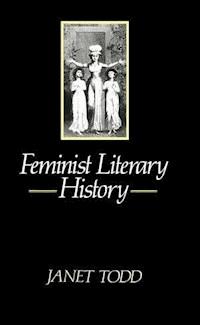
In this timely book Janet Todd offers an analysis and defence of the feminist literary history practised by Elaine Showalter and other contemporary American literary critics. She argues that this approach rightly links the political concerns of feminist criticism to the uncovering of female voices embedded in history.
Todd reconstructs the development of feminist literary history from the 1960s through to the present day, highlighting the central themes as well as the strengths and weaknesses. She then examines the debate between American feminist critics, on the one hand, and feminist critics inspired by the work of French theorists such as Kristeva, Irigaray and Cixous, on the other. She defends feminist literary history against its critics and casts doubt on some of the uses of psychoanalysis in feminism. Todd also considers the debate with men and assesses the relevance of academic analyses of gender, masculinity and homosexuality.
Feminist Literary History is a forceful and committed work, which addresses some of the most important issues in contemporary feminist theory and literary criticism. It will be widely read as an introductory text by students in English literature, modern languages, women's studies and cultural studies.
Sie lesen das E-Book in den Legimi-Apps auf:
Seitenzahl: 310
Veröffentlichungsjahr: 2013
Ähnliche



















Feminist Literary History
A Defence
JANET TODD
Polity Press
Copyright © Janet Todd 1988
First published 1988 by Polity Press in association with Blackwell Publishers Ltd
Reprinted 1991, 1995, 2005, 2007
Polity Press65 Bridge StreetCambridge, CB2 1UR, UK
Polity Press350 Main StreetMalden, MA 02148, USA
All rights reserved. Except for the quotation of short passages for the purposes of criticism and review, no part of this publication may be reproduced, stored in a retrieval system, or transmitted, in any form or by any means, electronic, mechanical, photocopying, recording or otherwise, without the prior permission of the publisher.
Except in the United States of America, this book is sold subject to the condition that it shall not, by way of trade or otherwise, be lent, re-sold, hired out, or otherwise circulated without the publisher’s prior consent in any form of binding or cover other than that in which it is published and without a similar condition including this condition being imposed on the subsequent purchaser.
ISBN: 978-0-7456-6882-6 (Multi-user ebook)
A CIP catalogue record for this book is available from the British Library.
Typeset in 10 on 12 pt Baskerville by Opus, Oxford.Printed and bound in Great Britain by Marston Book Services Limited, Oxford
For further information on Polity, visit our website: www.polity.co.uk
For James
Contents
Acknowledgements
Introduction
1 Early Work
2 Consolidation and Reaction
3 French theory
4 Confrontations
5 Directions
6 Readings of Mary Wollstonecraft
7 Men in Feminist Criticism
Conclusion
Notes
Bibliography
Index
Acknowledgements
I am grateful to Steve Watts, Naomi Segal, John Mullan, Alice Jardine, Peter Collier, Lisa Jardine and especially Alison Hennegan, for supplying books and articles. I am also grateful to the speakers in the series on feminism and psychoanalysis in Cambridge 1986–7 who were generous with references and who helped me clarify my ideas despite my basic disagreement with their approach. I should like to thank Marilyn Butler and James Lynn for their help and encouragement.
Introduction
It has become fashionable to criticize, even mock, American socio-historical feminist criticism and to see it as nave beside the enterprise of French deconstructive and psychoanalytical theory. Francophile critics like Toril Moi, Mary Jacobus, and Alice Jardine are exasperated at what they see as benighted empiricism and ‘essentialist simplicities’.
Some of the mockery undoubtedly sticks but some should be deflected, deriving as it does from a determined misreading of the method of historical enquiry and a refusal to acknowledge the context in which this criticism was produced. It is easy in the late 1980s to lay out the past in clear space for observation and comparison and ignore the obscured and shifting time in which it occurred. The early socio-historical criticism that is now denigrated formed the base and condition of later study, was in a way the begetter of us all, and so inevitably, like a mother, appears nave in the light of changing modes. This criticism belonged to a time that still hoped for a wide, increasingly feminist audience; it was written in a more activist and interventionist spirit than seems possible today. The more sophisticated readings that are now privileged derive from a time or a place when certain forms of feminist or gender criticism are inevitably the preserve of the mandarin or the theoretical academic. In the late 1980s women often come into feminist criticism without the apprenticeship or context of active feminism; they may enter it having already established security of tenure through other work or they may arrive through theory rather than protest, through psychoanalysis and deconstruction rather than demonstrations. They may use the distinguishing term ‘intellectual’ – a term hardly heard in the early 1970s – to describe themselves and their separation from other women.
I should like here to provide not another introduction to feminist criticism – many admirably clear ones are now available – but a defence of the early socio-historical enterprise, together with an assessment of its likely developments and my hopes for a feminist literary history founded on its base. In this enterprise I am no doubt partially motivated by piety – a residue of the filial piety imposed on writing women from the eighteenth century onwards. But I do not believe we must be oedipal, especially not across gender lines.
Yet, while my position is defensive and, ultimately, admiring, I also find much that is limited in this criticism. Elaine Showalter has argued that pioneering socio-historical criticism was not as nave as it is made out to be, that American feminist criticism in general is ‘as theoretically sophisticated as its continental sister’. Perhaps, but I am unconvinced. Instead of arguing for parity, I think it useful to set the early writing within the history of feminist criticism and relate it to a moment when women critics wished to avoid being reliant on abstract systems of thought that could not be appreciated by the philosophically uneducated. It is then possible to accept that initially this criticism was indeed insufficiently aware of the constructed nature of gender identities and the difficulty of self-consciously encountering all our rooted assumptions. It is also possible to admit that it often settled for easy socio-cultural generalizations instead of pursuing the more intractable and specific history.
Lesen Sie weiter in der vollständigen Ausgabe!
Lesen Sie weiter in der vollständigen Ausgabe!
Lesen Sie weiter in der vollständigen Ausgabe!
Lesen Sie weiter in der vollständigen Ausgabe!
Lesen Sie weiter in der vollständigen Ausgabe!
Lesen Sie weiter in der vollständigen Ausgabe!
Lesen Sie weiter in der vollständigen Ausgabe!
Lesen Sie weiter in der vollständigen Ausgabe!
Lesen Sie weiter in der vollständigen Ausgabe!
Lesen Sie weiter in der vollständigen Ausgabe!
Lesen Sie weiter in der vollständigen Ausgabe!




