


96,99 €
Mehr erfahren.
- Herausgeber: John Wiley & Sons
- Kategorie: Fachliteratur
- Serie: Wiley Finance Series
- Sprache: Englisch
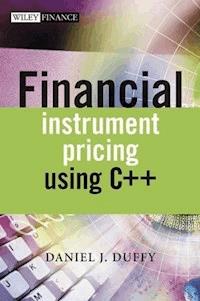
One of the best languages for the development of financial engineering and instrument pricing applications is C++. This book has several features that allow developers to write robust, flexible and extensible software systems. The book is an ANSI/ISO standard, fully object-oriented and interfaces with many third-party applications. It has support for templates and generic programming, massive reusability using templates (?write once?) and support for legacy C applications.
In this book, author Daniel J. Duffy brings C++ to the next level by applying it to the design and implementation of classes, libraries and applications for option and derivative pricing models. He employs modern software engineering techniques to produce industrial-strength applications:
- Using the Standard Template Library (STL) in finance
- Creating your own template classes and functions
- Reusable data structures for vectors, matrices and tensors
- Classes for numerical analysis (numerical linear algebra ?)
- Solving the Black Scholes equations, exact and approximate solutions
- Implementing the Finite Difference Method in C++
- Integration with the ?Gang of Four? Design Patterns
- Interfacing with Excel (output and Add-Ins)
- Financial engineering and XML
- Cash flow and yield curves
Included with the book is a CD containing the source code in the Datasim Financial Toolkit. You can use this to get up to speed with your C++ applications by reusing existing classes and libraries.
'Unique... Let's all give a warm welcome to modern pricing tools.'
-- Paul Wilmott, mathematician, author and fund manager
Sie lesen das E-Book in den Legimi-Apps auf:
Seitenzahl: 566
Veröffentlichungsjahr: 2013
Ähnliche















Contents
Cover
Half Title page
Title page
Copyright page
Chapter 1: Executive Overview of this Book
1.1 What is this book?
1.2 What’s special about this book?
1.3 Who is this book for?
1.4 Software requirements
1.5 The structure of this book
1.6 Pedagogical approach
1.7 What this book is not
1.8 Source code on the CD
Part I: Template Programming in C++
Chapter 2: A Gentle Introduction to Templates in C++
2.1 Introduction and objectives
2.2 Motivation and background
2.3 Defining a template
2.4 Template instantiation
2.5 Function templates
2.6 Default values and typedefs
2.7 Guidelines when implementing templates
2.8 Conclusions and summary
Chapter 3: An Introduction to the Standard Template Library
3.1 Introduction and objectives
3.2 A Bird’s-eye view of STL
3.3 Sequence containers
3.4 Associative containers
3.5 Iterators in STL
3.6 Algorithms
3.7 Using STL for financial instruments
3.8 Conclusions and summary
Chapter 4: STL for Financial Engineering Applications
4.1 Introduction and objectives
4.2 Clever data structures
4.3 Set theory and STL
4.4 Useful algorithms
4.5 STL adaptor containers
4.6 Conclusions and summary
Chapter 5: The Property Pattern in Financial Engineering
5.1 Introduction and objectives
5.2 The Property pattern
5.3 An example
5.4 Extending the Property pattern: property sets and property lists
5.5 Properties and exotic options
5.6 Conclusions and summary
Part II: Building Block Classes
Chapter 6: Arrays, Vectors and Matrices
6.1 Introduction and objectives
6.2 Motivation and background
6.3 A layered approach
6.4 The Array and Matrix Classes in Detail
6.5 The vector and Numeric Matrix classes in detail
6.6 Associative arrays and matrices
6.7 Conclusions and summary
Chapter 7: Arrays and Matrix Properties
7.1 Introduction and objectives
7.2 An overview of the functionality
7.3 Software requirements
7.4 The core processes
7.5 Other function categories
7.6 Using the functions
7.7 An introduction to exception handling
7.8 Conclusions and summary
Chapter 8: Numerical Linear Algebra
8.1 Introduction and objectives
8.2 An introduction to numerical linear algebra
8.3 Tridiagonal systems
8.4 Block tridiagonal systems
8.5 What requirements should our matrix satisfy?
8.6 Conclusions and summary
Chapter 9: Modelling Functions in C++
9.1 Introduction and objectives
9.2 Function pointers in C++
9.3 Function objects in STL
9.4 Some function types
9.5 Creating your own function classes
9.6 Arrays of functions
9.7 Vector functions
9.8 Real-valued functions
9.9 Vector-valued functions
9.10 Conclusions and summary
Chapter 10: C++ Classes for Statistical Distributions
10.1 Introduction and objectives
10.2 Discrete and continuous probability distribution functions
10.3 Continuous distributions
10.4 Discrete distributions
10.5 Tests
10.6 Conclusions and summary
Part III: Ordinary and Stochastic Differential Equations
Chapter 11: Numerical Solution of Initial Value Problems: Fundamentals
11.1 Introduction and Objectives
11.2 A Model Problem
11.3 Discretisation
11.4 Common Schemes
11.5 Some Theoretical Issues
11.6 Fitting: Special Schemes for Difficult Problems
11.7 Non-Linear Scalar Problems and Predictor—Corrector Methods
11.8 Extrapolation Techniques
11.9 C++ Design and Implementation
11.10 Generalisations
11.11 Conclusions and Summary
Chapter 12: Stochastic Processes and Stochastic Differential Equations
12.1 Introduction and Objectives
12.2 Random Variables and Random Processes
12.3 An Introduction to Stochastic Differential Equations
12.4 Some Finite Difference Schemes
12.5 Which Scheme to Use?
12.6 Systems of Sdes
12.7 Conclusions and Summary
Chapter 13: Two-Point Boundary Value Problems
13.1 Introduction and Objectives
13.2 Description of Problem
13.3 (Traditional) Centred-Difference Schemes
13.4 Approximation of the Boundary Conditions
13.5 Exponentially Fitted Schemes and Convection—Diffusion
13.6 Approximating the Derivatives
13.7 Design Issues
13.8 Conclusions and Summary
Chapter 14: Matrix Iterative Methods
14.1 Introduction and Objectives
14.2 Iterative Methods
14.3 The Jacobi Method
14.4 Gauss-Seidel Method
14.5 Successive Overrelaxation (SOR)
14.6 Other Methods
14.7 The Linear Complementarity Problem
14.8 Implementation
14.9 Conclusions and Summary
Part IV: Programming the Black-Scholes Environment
Chapter 15: An Overview of Computational Finance
15.1 Introduction and Objectives
15.2 The Development Life Cycle
15.3 Partial Differential Equations
15.4 Numerical Approximation of PDEs
15.5 The Class of Finite Difference Schemes
15.6 Special Schemes for Special Problems
15.7 Implementation Issues and the Choice of Programming Language
15.8 Origins and Application Areas
15.9 Conclusions and Summary
Chapter 16: Finite Difference Schemes for Black—Scholes
16.1 Introduction and Objectives
16.2 Model Problem: The One-Dimensional Heat Equation
16.3 The Black—Scholes Equation
16.4 Initial Conditions and Exotic Options Payoffs
16.5 Implementation
16.6 Method of Lines: A Whirlwind Introduction
16.7 Conclusions and Summary
Chapter 17: Implicit Finite Difference Schemes for Black—Scholes
17.1 Introduction and Objectives
17.2 Fully Implicit Method
17.3 An Introduction to the Crank—Nicolson Method
17.4 A Critique of Crank—Nicolson
17.5 Is There Hope? The Keller Scheme
17.6 Conclusions and Summary
Chapter 18: Special Schemes for Plain and Exotic Options
18.1 Introduction and Objectives
18.2 Motivating Exponentially Fitted Schemes
18.3 Exponentially Fitted Schemes for Parabolic Problems
18.4 What Happens When the Volatility Goes to Zero?
18.5 Exponential Fitting With Explicit Time
18.6 Exponential Fitting and Exotic Options
18.7 Some Final Remarks
Chapter 19: My First Finite Difference Solver
19.1 Introduction and Objectives
19.2 Modelling Partial Differential Equations in C++
19.3 Finite Difference Schemes as C++ Classes, Part I
19.4 Finite Difference Schemes as C++ Classes, Part II
19.5 Initialisation Issues
19.6 Interfacing with Excel
19.7 Conclusions and Summary
Chapter 20: An Introduction to ADI and Splitting Schemes
20.1 Introduction and Objectives
20.3 Motivation and History
20.4 Basic ADI Scheme for the Heat Equation
20.5 Basic Splitting Scheme for the Heat Equation
20.6 Approximating Cross-Derivatives
20.7 Handling Boundary Conditions
20.8 Algorithms and Design Issues
20.9 Conclusions and Summary
Chapter 21: Numerical Approximation of Two-Factor Derivative Models
21.1 Introduction and Objectives
21.2 Two-Factor Models in Financial Engineering
21.3 Finite Difference Approximations
21.4 ADI Schemes for Asian Options
21.5 Splitting Schemes
21.6 Conclusions and Summary
Part V: Design Patterns
Chapter 22: A C++ Application for Displaying Numeric Data
22.1 Introduction and Objectives
22.2 Input Mechanisms
22.3 Conversion and Processing Mechanisms
22.4 Output and Display Mechanisms
22.5 Putting it All Together
22.6 Output
22.7 Other Functionality
22.8 Using Excel and Property Sets
22.9 Extensions and the Road to Design Patterns
22.10 Conclusions and Summary
Chapter 23: Object Creational Patterns
23.1 Introduction and Objectives
23.2 The Singleton Pattern
23.3 The Prototype Pattern
23.4 Factory Method Pattern (Virtual Constructor)
23.5 Abstract Factory Pattern
23.6 Applications to Financial Engineering
23.7 Conclusions and Summary
Chapter 24: Object Structural Patterns
24.1 Introduction and Objectives
24.2 Kinds of Structural Relationships Between Classes
24.3 Whole—Part Pattern
24.4 The Composite Pattern
24.5 The FaçAde Pattern
24.6 The Bridge Pattern
24.7 Conclusions and Summary
Chapter 25: Object Behavioural Patterns
25.1 Introduction and Objectives
25.2 Kinds of Behavioural Patterns
25.3 Iterator Pattern
25.4 The Visitor Pattern
25.5 Notification Patterns
25.6 Conclusions and Summary
Part VI: Design and Deployment Issues
Chapter 26: An Introduction to the Extensible Markup Language
26.1 Introduction and Objectives
26.2 A Short History of XML
26.3 The XML Structure
26.4 Document Type Definition
26.5 Extensible Stylesheet Language Transformation (XSLT)
26.6 An Application of XML: Financial Products Markup Language
26.7 Conclusions and Summary
Chapter 27: Advanced XML and Programming Interface
27.1 Introduction and Objectives
27.2 XML Schema
27.3 Accessing XML Data: The Document Object Model
27.4 DOM and C++: The Essentials
27.5 DOM, Entities and Property Sets
27.6 XML Structures for Plain and Barrier Options
27.7 Conclusions and Summary
Chapter 28: Interfacing C++ and Excel
28.1 Introduction and Objectives
28.2 Object Model in Excel: An Overview
28.3 Under the Bonnet: Technical Details of C++ Interfacing to Excel
28.4 Implementing the Core Process
28.5 Extensions
28.6 Application Areas
28.7 Conclusions and Summary
Chapter 29: Advanced Excel Interfacing (Daniel Duffy and Robert Demming)
29.1 Introduction and Objectives
29.2 Status Report and New Requirements
29.3 A Gentle Introduction to Excel Add-Ins
29.4 Automation Add-in in Detail
29.5 Creating A COM Add-in
29.6 Future Trends
29.7 Conclusions and Summary
Chapter 30: An Extended Application: Option Strategies and Portfolios
30.1 Introduction and Objectives
30.2 Spreads
30.3 Combinations: Straddles and Strangles
30.4 Designing and Implementing Spreads
30.5 Delta Hedging
30.6 An Example
30.7 Tips and Guidelines
Appendix I: My C++ Refresher
A1.1 Summary
A1.2 What is C++ and Why is it Important?
A1.3 The Datasim C++ Self-Test
A1.4 The Essentials of a C++ Class: The Canonical Header File
A1.5 An Overview of Object-Oriented Programming in C++
A1.6 The European Option in C++: The Details
Appendix II: Dates and Other Temporal Types
A2.1 Summary
A2.2 The Date Class
A2.3 The Time Class
A2.4 Extensions
A2.5 A Simple Example
References
Index
Financial Instrument Pricing Using C++
Wiley Finance Series
Hedge Funds: Quantitative Insights
François-Serge L’habitant
A Currency Options Primer
Shani Shamah
New Risk Measures in Investment and Regulation
Giorgio Szegö (Editor)
Modelling Prices in Competitive Electricity Markets
Derek Bunn (Editor)
Inflation-Indexed Securities: Bonds, Swaps and Other Derivatives, 2nd Edition
Mark Deacon, Andrew Derry and Dariush Mirfendereski
European Fixed Income Markets: Money, Bond and Interest Rates
Jonathan Batten, Thomas Fetherston and Peter Szilagyi (Editors)
Global Securitisation and CDOs
John Deacon
Applied Quantitative Methods for Trading and Investment
Christian L. Dunis, Jason Laws and Patrick Naïm (Editors)
Country Risk Assessment: A Guide to Global Investment Strategy
Michel Henry Bouchet, Ephraim Clark and Bertrand Groslambert
Credit Derivatives Pricing Models: Models, Pricing and Implementation
Philipp J. Schönbucher
Hedge Funds: A Resource for Investors
Simone Borla
A Foreign Exchange Primer
Shani Shamah
The Simple Rules: Revisiting the Art of Financial Risk Management
Erik Banks
Option Theory
Peter James
Risk-adjusted Lending Conditions
Werner Rosenberger
Measuring Market Risk
Kevin Dowd
An Introduction to Market Risk Management
Kevin Dowd
Behavioural Finance
James Montier
Asset Management: Equities Demystified
Shanta Acharya
An Introduction to Capital Markets: Products, Strategies, Participants
Andrew M. Chisholm
Hedge Funds: Myths and Limits
François-Serge L’habitant
The Manager’s Concise Guide to Risk
Jihad S. Nader
Securities Operations: A Guide to Trade and Position Management
Michael Simmons
Modeling, Measuring and Hedging Operational Risk
Marcelo Cruz
Monte Carlo Methods in Finance
Peter Jäckel
Building and Using Dynamic Interest Rate Models
Ken Kortanek and Vladimir Medvedev
Structured Equity Derivatives: The Definitive Guide to Exotic Options and Structured Notes
Harry Kat
Advanced Modelling in Finance Using Excel and VBA
Mary Jackson and Mike Staunton
Operational Risk: Measurement and Modelling
Jack King
Interest Rate Modelling
Jessica James and Nick Webber
© 2004 Daniel J Duffy Published by John Wiley & Sons, Ltd
Registered office John Wiley & Sons Ltd, The Atrium, Southern Gate, Chichester, West Sussex, PO19 8SQ, United Kingdom
For details of our global editorial offices, for customer services and for information about how to apply for permission to reuse the copyright material in this book please see our website at www.wiley.com.
All rights reserved. No part of this publication may be reproduced, stored in a retrieval system, or transmitted, in any form or by any means, electronic, mechanical, photocopying, recording or otherwise, except as permitted by the UK Copyright, Designs and Patents Act 1988, without the prior permission of the publisher.
Wiley publishes in a variety of print and electronic formats and by print-on-demand. Some material included with standard print versions of this book may not be included in e-books or in print-on-demand. If this book refers to media such as a CD or DVD that is not included in the version you purchased, you may download this material at http://booksupport.wiley.com. For more information about Wiley products, visit www.wiley.com.
Designations used by companies to distinguish their products are often claimed as trademarks. All brand names and product names used in this book are trade names, service marks, trademarks or registered trademarks of their respective owners. The publisher is not associated with any product or vendor mentioned in this book.
Limit of Liability/Disclaimer of Warranty: While the publisher and author have used their best efforts in preparing this book, they make no representations or warranties with the respect to the accuracy or completeness of the contents of this book and specifically disclaim any implied warranties of merchantability or fitness for a particular purpose. It is sold on the understanding that the publisher is not engaged in rendering professional services and neither the publisher nor the author shall be liable for damages arising herefrom. If professional advice or other expert assistance is required, the services of a competent professional should be sought.
Library of Congress Cataloging-in-Publication Data
Duffy, Daniel J. Designing and implementing financial instruments in C++ / Daniel J. Duffy. p. cm. ISBN 0-470-85509-6 1. Investments – Mathematical models. 2. Financial engineering. 3. C++ (Computer program language) I. Title HG4515. 2. D85 2004 332.6_0285_5133 – dc22
2004008925
A catalogue record for this book is available from the British Library.
ISBN 978-0-470-85509-6 (HB)
Chapter 1
Executive Overview of this Book
1.1 WHAT IS THIS BOOK?
The goal of this book is to model financial instruments, such as options, bonds and interest-rate products by partial differential equations, finite differences and C++. It is intended for IT and quantitative finance professionals who know this material and wish to deepen their knowledge and for those readers who use techniques such as Monte Carlo, Fourier transform methods, stochastic differential equations and lattice methods (for example, the binomial method) for instrument pricing.
We integrate a number of well-known areas to create a traceable and maintainable path from when a financial engineer proposes a new model to when he or she codes the resulting equations in C++. When viewed as a black box, the core process in this book is to produce C++ classes and code for financial engineering applications. Furthermore, we give lots of examples of code that developers can use without much hassle. The accompanying CD contains all the source code in this book. We provide guidelines, algorithms and reusable code to help the reader to achieve these ends. The main activities that realise the core process are:
Activity 1: Map the financial model to a partial differential equation (PDE)
Activity 2: Approximate the PDE by the finite difference method (FDM)
Activity 3: Implement the FDM using C++ and design patterns.
In this book we shall concentrate on Activities 2 and 3. Since this is a book on the application of C++ to financial engineering we concentrate on mapping the numerical algorithms from Activity 2 to robust and flexible C++ code and classes. However, we shall provide sufficient motivation and background information to help the reader to understand the complete ‘instrument life cycle’. This life cycle describes the processes, activities, decisions and alternatives that describe how to program models for financial instruments in C++.
The topics in this book relate to finance, partial differential equations, numerical schemes and C++ code, and for this reason we use the term Computational Finance to sum up these related activities (see Seydel, 2003, where the same phrase is used). The foundations for partial differential equations and finite difference schemes for financial engineering applications are discussed in Duffy (2004b).
1.2 WHAT’S SPECIAL ABOUT THIS BOOK?
This book is part of a larger, ongoing project. It is the outcome of one part of this project and concentrates on showing how to program finite difference schemes in C++. Our approach is novel in a number of respects.
In short, this book describes in a step-by-step manner how to create ‘good’ software for financial engineering applications; it also integrates established techniques from fluid mechanics, numerical analysis and software design to produce a coherent and seamless approach to the design and implementation of financial models in C++.
1.3 WHO IS THIS BOOK FOR?
This book is meant for IT and quantitative finance professionals (risk managers, product development and derivatives research groups) who work in financial institutions and software companies and are involved in designing and implementing pricing models in C++. This book deals with fundamental issues such as C++ design and implementation, design patterns, finite difference methods and advanced software environments. Thus, it is of value to financial engineers (‘Quants’), software developers and financial modellers.
We feel that the book is useful for universities and other educational institutes that deliver financial courses. This is not a book on instrument theory as such, and we assume that the reader has knowledge of option theory as presented in books by Hull (2000) and Wilmott (1998), for example. We also assume that the reader has had some exposure to differential equations, differential and integral calculus and matrix algebra. Finally, the reader should have a working knowledge of C++.
As we have already mentioned in this chapter, the book is suited not only to those readers from a partial differential equation (PDE) background but also to those who use techniques such as Monte Carlo, Fourier transform methods, stochastic differential equations (SDEs) and the binomial method for instrument pricing. We do our best to show that finite differences compare well with, and even outperform, these former methods, especially for complex and non-linear one-factor and two-factor Black – Scholes models.
Finally, the real option theory is emerging and many of the techniques in this book can be used in decision support systems in the oil, gas and energy industries. Thus, the book is also of interest to engineers, scientists and financial engineers in these fields.
1.4 SOFTWARE REQUIREMENTS
We have written this book from a number of viewpoints that have to do with what we call software quality. In general, we adopt the ISO 9126 quality characteristics (see Kitchenham and Pfleeger, 1996) as our working model. ISO 9126 describes how good a software product is. It consists of six top-level characteristics:
Functionality
: The ability of the software to satisfy stated or implied customer needs.
Reliability
: Does the software maintain its level of performance for a stated period of time?
Usability
: Is the software easy to understand, learn or integrate with other applications?
Efficiency
: Describes the response times in the application and the corresponding re\-sources that are needed.
Maintainability
: How easy is it to modify, adapt and test the application? How stable is the application under Change?
Portability
: The ease with which the application can be adapted to work in some new software or hardware environment.
Any one (or all) of the above requirements may be important for your new or existing software project. In general, the more requirements your applications must satisfy the more time it will take to satisfy them. In this book we classify applications into three broad categories, depending on the level of flexibility that they must have:
Low flexibility
: These are either throwaway prototypes or simple programs in order to test a piece of code or check the validity of some new model
Medium flexibility
: The code and classes in this category can be customised (by changing its source code if necessary) and used in your own applications
High flexibility
: The code in this category can be used in your applications without any Changes.
It is important to know at the outset how flexible our solutions must be; on the one hand, we do not want to ‘over-engineer’ our application, but nor do we want to produce code that is difficult to maintain, understand or falls apart when we modify it. This book will provide you with guidelines to help you to produce good designs for financial engineering applications.
We layer the software in this book by examining it at four different levels:
Foundation classes and building blocks
: Reusable components for vectors, lists, matrices and other containers. We make ample use of the Standard Template Library (STL).
Mechanisms
: Tightly coupled groups of generic functions that are related to a specific piece of functionality. An example is a set of functions for Date manipulations (cash flows, interest rate Curves).
Half-products
: Ready-to-use libraries that you can use as part of your own applications. We can place these half-products in assemblies and DLLs.
Applications
: Dedicated applications for the user (not the developer). These applications are usually executables.
There are many advantages associated with taking this layered approach to software development, as we shall see in this book.
1.5 THE STRUCTURE OF THIS BOOK
This book is partitioned into six major parts, each of which deals with a major topic and consists of a number of chapters. These chapters deal with techniques that help to achieve the goals of each part.
Part I This part is an introduction to C++ template classes. We define what templates are, how to create them and how to use them in financial engineering applications. We give an overview of the Standard Template Library (STL). This is a C++ library consisting of template classes for a wide range of data containers, algorithms and functionality for navigating in these containers. We develop a number of template classes based on STL that we can use in financial engineering applications.
Part II In this part we create classes and code that will be used when approximating partial differential equations by finite difference methods. First, we create template classes for arrays, vectors and matrices as well as the corresponding mathematical operations on them. Furthermore, we introduce several classes that solve linear systems of equations. These classes implement direct and iterative matrix solvers in numerical linear algebra. Second, we create a number of other foundation classes that we need in numerical differentiation and integration. Finally, some useful classes for statistics are introduced.
Part III This part represents the start of the book as far as the mathematical core is concerned. We motivate the finite difference method by applying it to a simple first-order ordinary differential equation in Chapter 11. This chapter discusses the most important ideas and schemes that will serve us well in later chapters. Continuing from Chapter \chapr{11, we introduce stochastic differential equations and the finite difference schemes needed in order to approximate them. We also propose several schemes to approximate two-point boundary value problems. Special attention is paid to the Crank – Nicolson scheme and why it fails to approximate the solution of the convection-diffusion equation in certain circumstances. It is in this part of the book that we introduce the class of exponentially fitted schemes and explain how they resolve the spurious oscillation problems associated with Crank – Nicolson.
Part IV In this part we introduce the one-factor and two-factor Black – Scholes equations and devise appropriate finite difference schemes for them. Before we reach this level of Nirvana, we begin with the one-dimensional heat equation and discuss explicit and implicit finite difference schemes to approximate its solution. The schemes are extensions of the time-independent schemes that we introduced in Part III. Slightly increasing the level of difficulty, we discuss the Crank – Nicolson and fully implicit schemes for the one-dimensional convection-diffusion equation (and its specialisation, the Black – Scholes equation). We analyse the schemes in some detail, discussing why they work, when they do not work and how to produce fitted schemes that approximate the solution and the delta of the Black – Scholes equation.
Proceeding to two-factor problems, we propose Alternating Direction Implicit (ADI) and splitting methods and compare their relative merits.
Part V: In this part we give an introduction to design patterns. Design is about alternatives and we have many choices when designing a system as the choices are determined by the software requirements. We begin with an introduction to some general design principles. In particular, we focus on templates and inheritance and why they are competitors. We also introduce the important notion of delegation whose understanding is fundamental to design patterns.
The main objective in Part V is to show how the famous design patterns of GOF (see Gamma et al., 1995) are applied to financial engineering applications. We pay special attention to choosing appropriate examples and to a discussion of the advantages of design patterns in this particular context. Three chapters are devoted to the Creational, Structural and Behavioural patterns.
Part VI This part contains a number of chapters that are of particular interest to financial engineers and IT personnel who write financial engineering applications. First, we give an introduction to the Extensible Markup Language (XML), a W3C standard for interoperable data representation. We also describe how it is used in option pricing applications in this book. XML will become more important in the financial world in the coming years as evidenced by the work seen with FpML and FIX. We also discuss classes and code that allow C++ code to communicate with Excel. Finally, we introduce a number of design patterns that are very useful for the current work.
1.6 PEDAGOGICAL APPROACH
In general, our approach is incremental in the sense that we begin with simple examples to illustrate the theory and progress to larger problems and examples. This approach applies to the theory of finite differences for partial differential equations as well as the C++ code and design patterns. For example, our main objective is to model one-factor and two-factor Black – Scholes equations using finite differences. The main ‘flow’ in this case is:
Finite differences for scalar, linear first-order ordinary differential equations (ODEs).
Finite differences for stochastic differential equations (SDEs).
Two-point boundary value problems (special case: stationary convection-diffusion).
Explicit and implicit finite difference schemes for the heat equation.
Crank – Nicolson and fitting schemes for the one-factor Black – Scholes equation.
Approximating the Greeks.
Alternating Direction Implicit (ADI) and splitting schemes for two-factor Black – Scholes equations.
In a similar vein, we build up C++ expertise as follows:
The C++ template Class.
The Standard Template Library (STL) and its applications to financial engineering.
The Property pattern and the modelling of financial instruments.
C++ classes for ODEs and SDEs.
C++ foundation classes: vectors, matrices and statistics.
C++ classes for the heat equation.
Modelling Black – Scholes with C++.
C++ for ADI and splitting methods.
In short, we adopt the following rule-of-thumb:
One step at a time!
1.7 WHAT THIS BOOK IS NOT
First, this is not an introductory book on C++. We assume that the reader has a working knowledge of this language. Second, this book assumes that the reader knows what an option is, what Black – Scholes is, and so on. Finally, this is not a book on the theory of partial differential equations and their approximation using finite differences, but is rather a book that motivates finite difference schemes and applies them to financial engineering applications using C++.
1.8 SOURCE CODE ON THE CD
You can use the source code on the accompanying CD free of charge in your applications provided you acknowledge the author:
© Datasim Education BV 2004
Each source file has this copyright statement. Any questions or suggestions should be sent to Daniel Duffy at [email protected].
Part I
Template Programming in C++
Chapter 2
A Gentle Introduction to Templates in C++
2.1 INTRODUCTION AND OBJECTIVES
This is the first chapter in Part I of this book. The main goal of Part I is to introduce the reader to generic programming in C++ by discussing template classes and function templates. We also give a fairly detailed introduction to the Standard Template Library (STL), which provides us with a ready-to-use set of data structures and algorithms that we can apply to financial applications. Furthermore, we define our own data structures that model European option attributes. In short, Part I is the foundation upon which we build all future classes and software systems in this book.
In Appendix 1 we give a review of the main features in C++ which you should read if your knowledge of C++ is a bit rusty, but experienced C++ developers can pass it.
In this chapter we give a detailed introduction to how C++ supports the notion of generic programming in the form of so-called templates. Just as a class can be seen as a factory or ‘cookie-cutter’ for objects, so too can we see a C++ template as a factory for normal C++ classes. This feature leads to massive reusability in C++ software applications. For example, the STL (see Musser and Saini, 1996) contains C++ templates for a wide range of data containers such as vectors, lists and sets as well as various kinds of algorithms that operate on these containers. For example, STL has a C++ template for vectors. A vector is an indexible array of objects to which new objects can be added. The objects in the vector are generic and the programmer can then ‘instantiate’ the generic underlying type by replacing it by a concrete type. Some examples of instantiated template classes are:
vector<double> (an array of doubles)vector<EuropeanOption> (an array of European options)vector <int> (an array of integers)
Please note that each of the above examples represents a class and that no new member functions need to be written because they are generated as it were from the corresponding template. Thus, we only have to write the template once and we instantiate its generic underlying types to give us a class. The following example shows us how templates, classes and objects are related:
Lesen Sie weiter in der vollständigen Ausgabe!
Lesen Sie weiter in der vollständigen Ausgabe!
Lesen Sie weiter in der vollständigen Ausgabe!
Lesen Sie weiter in der vollständigen Ausgabe!
Lesen Sie weiter in der vollständigen Ausgabe!
Lesen Sie weiter in der vollständigen Ausgabe!
Lesen Sie weiter in der vollständigen Ausgabe!
Lesen Sie weiter in der vollständigen Ausgabe!
Lesen Sie weiter in der vollständigen Ausgabe!
Lesen Sie weiter in der vollständigen Ausgabe!
Lesen Sie weiter in der vollständigen Ausgabe!
Lesen Sie weiter in der vollständigen Ausgabe!
Lesen Sie weiter in der vollständigen Ausgabe!
Lesen Sie weiter in der vollständigen Ausgabe!
Lesen Sie weiter in der vollständigen Ausgabe!
Lesen Sie weiter in der vollständigen Ausgabe!
Lesen Sie weiter in der vollständigen Ausgabe!
Lesen Sie weiter in der vollständigen Ausgabe!
Lesen Sie weiter in der vollständigen Ausgabe!
Lesen Sie weiter in der vollständigen Ausgabe!
Lesen Sie weiter in der vollständigen Ausgabe!
Lesen Sie weiter in der vollständigen Ausgabe!
Lesen Sie weiter in der vollständigen Ausgabe!
Lesen Sie weiter in der vollständigen Ausgabe!
Lesen Sie weiter in der vollständigen Ausgabe!
Lesen Sie weiter in der vollständigen Ausgabe!
Lesen Sie weiter in der vollständigen Ausgabe!
Lesen Sie weiter in der vollständigen Ausgabe!
Lesen Sie weiter in der vollständigen Ausgabe!
Lesen Sie weiter in der vollständigen Ausgabe!
Lesen Sie weiter in der vollständigen Ausgabe!
Lesen Sie weiter in der vollständigen Ausgabe!
Lesen Sie weiter in der vollständigen Ausgabe!
Lesen Sie weiter in der vollständigen Ausgabe!
Lesen Sie weiter in der vollständigen Ausgabe!
Lesen Sie weiter in der vollständigen Ausgabe!
Lesen Sie weiter in der vollständigen Ausgabe!
Lesen Sie weiter in der vollständigen Ausgabe!




