


74,99 €
Mehr erfahren.
- Herausgeber: John Wiley & Sons
- Kategorie: Fachliteratur
- Serie: Wiley Finance Series
- Sprache: Englisch
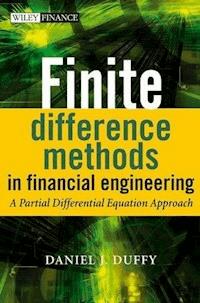
The world of quantitative finance (QF) is one of the fastest growing areas of research and its practical applications to derivatives pricing problem. Since the discovery of the famous Black-Scholes equation in the 1970's we have seen a surge in the number of models for a wide range of products such as plain and exotic options, interest rate derivatives, real options and many others. Gone are the days when it was possible to price these derivatives analytically. For most problems we must resort to some kind of approximate method.
In this book we employ partial differential equations (PDE) to describe a range of one-factor and multi-factor derivatives products such as plain European and American options, multi-asset options, Asian options, interest rate options and real options. PDE techniques allow us to create a framework for modeling complex and interesting derivatives products. Having defined the PDE problem we then approximate it using the Finite Difference Method (FDM). This method has been used for many application areas such as fluid dynamics, heat transfer, semiconductor simulation and astrophysics, to name just a few. In this book we apply the same techniques to pricing real-life derivative products. We use both traditional (or well-known) methods as well as a number of advanced schemes that are making their way into the QF literature:
- Crank-Nicolson, exponentially fitted and higher-order schemes for one-factor and multi-factor options
- Early exercise features and approximation using front-fixing, penalty and variational methods
- Modelling stochastic volatility models using Splitting methods
- Critique of ADI and Crank-Nicolson schemes; when they work and when they don't work
- Modelling jumps using Partial Integro Differential Equations (PIDE)
- Free and moving boundary value problems in QF
Included with the book is a CD containing information on how to set up FDM algorithms, how to map these algorithms to C++ as well as several working programs for one-factor and two-factor models. We also provide source code so that you can customize the applications to suit your own needs.
Sie lesen das E-Book in den Legimi-Apps auf:
Seitenzahl: 575
Veröffentlichungsjahr: 2013
Ähnliche
















Contents
Cover
Half Title page
Title page
Copyright page
Chapter 0: Goals of this Book and Global Overview
0.1 What is this Book?
0.2 Why has this Book been Written?
0.3 For Whom is this Book Intended?
0.4 Why should I Read this Book?
0.5 The Structure of this Book
0.6 What this Book does not Cover
0.7 Contact, Feedback and More Information
Part I: The Continuous Theory of Partial Differential Equations
Chapter 1: An Introduction to Ordinary Differential Equations
1.1 Introduction and Objectives
1.2 Two-Point Boundary Value Problem
1.3 Linear Boundary Value Problems
1.4 Initial Value Problems
1.5 Some Special Cases
1.6 Summary and Conclusions
Chapter 2: An Introduction to Partial Differential Equations
2.1 Introduction and Objectives
2.2 Partial Differential Equations
2.3 Specialisations
2.4 Parabolic Partial Differential Equations
2.5 Hyperbolic Equations
2.6 Systems of Equations
2.7 Equations Containing Integrals
2.8 Summary and Conclusions
Chapter 3: Second-Order Parabolic Differential Equations
3.1 Introduction and Objectives
3.2 Linear Parabolic Equations
3.3 The Continuous Problem
3.4 The Maximum Principle for Parabolic Equations
3.5 A Special Case: One-Factor Generalised Black–Scholes Models
3.6 Fundamental Solution and the Green’s Function
3.7 Integral Representation of the Solution of Parabolic PDEs
3.8 Parabolic Equations in One Space Dimension
3.9 Summary and Conclusions
Chapter 4: An Introduction to the Heat Equation in One Dimension
4.1 Introduction and Objectives
4.2 Motivation and Background
4.3 The Heat Equation and Financial Engineering
4.4 The Separation of Variables Technique
4.5 Transformation Techniques for the Heat Equation
4.6 Summary and Conclusions
Chapter 5: An Introduction to the Method of Characteristics
5.1 Introduction and Objectives
5.2 First-Order Hyperbolic Equations
5.3 Second-Order Hyperbolic Equations
5.4 Applications to Financial Engineering
5.5 Systems of Equations
5.6 Propagation of Discontinuities
5.7 Summary and Conclusions
Part II: Finite Difference Methods: the Fundamentals
Chapter 6: An Introduction to the Finite Difference Method
6.1 Introduction and Objectives
6.2 Fundamentals of Numerical Differentiation
6.3 Caveat: Accuracy and Round-off Errors
6.4 Where are Divided Differences used in Instrument Pricing?
6.5 Initial Value Problems
6.6 Nonlinear Initial Value Problems
6.7 Scalar Initial Value Problems
6.8 Summary and Conclusions
Chapter 7: An Introduction to the Method of Lines
7.1 Introduction and Objectives
7.2 Classifying Semi-Discretisation Methods
7.3 Semi-Discretisation in Space Using FDM
7.4 Numerical Approximation of First-Order Systems
7.5 Summary and Conclusions
Chapter 8: General Theory of the Finite Difference Method
8.1 Introduction and Objectives
8.2 Some Fundamental Concepts
8.3 Stability and the Fourier Transform
8.4 The Discrete Fourier Transform
8.5 Stability for Initial Boundary Value Problems
8.6 Summary and Conclusions
Chapter 9: Finite Difference Schemes for First-Order Partial Differential Equations
9.1 Introduction and Objectives
9.2 Scoping the Problem
9.3 Why First-Order Equations are Different: Essential Difficulties
9.4 A Simple Explicit Scheme
9.5 Some Common Schemes for Initial Value Problems
9.6 Some Common Schemes for Initial Boundary Value Problems
9.7 Monotone and Positive-Type Schemes
9.8 Extensions, Generalisations and Other Applications
9.9 Summary and Conclusions
Chapter 10: FDM for the One-Dimensional Convection—Diffusion Equation
10.1 Introduction and Objectives
10.2 Approximation of Derivatives on the Boundaries
10.3 Time-Dependent Convection-Diffusion Equations
10.4 Fully Discrete Schemes
10.5 Specifying Initial and Boundary Conditions
10.6 Semi-Discretisation in Space
10.7 Semi-Discretisation in Time
10.8 Conclusions and Summary
Chapter 11: Exponentially Fitted Finite Difference Schemes
11.1 Introduction and Objectives
11.2 Motivating Exponential Fitting
11.3 Exponential Fitting and Time-Dependent Convection–Diffusion
11.4 Stability and Convergence Analysis
11.5 Approximating the Derivatives of the Solution
11.6 Special Limiting Cases
11.7 Summary and Conclusions
Part III: Applying FDM to One-Factor Instrument Pricing
Chapter 12: Exact Solutions and Explicit Finite Difference Method for One-Factor Models
12.1 Introduction and Objectives
12.2 Exact Solutions and Benchmark Cases
12.3 Perturbation Analysis and Risk Engines
12.4 The Trinomial Method: Preview
12.5 Using Exponential Fitting with Explicit Time Marching
12.6 Approximating the Greeks
12.7 Summary and Conclusions
12.8 Appendix: The Formula for Vega
Chapter 13: An Introduction to the Trinomial Method
13.1 Introduction and Objectives
13.2 Motivating the Trinomial Method
13.3 Trinomial Method: Comparisons with Other Methods
13.4 The Trinomial Method for Barrier Options
13.5 Summary and Conclusions
Chapter 14: Exponentially Fitted Difference Schemes for Barrier Options
14.1 Introduction and Objectives
14.2 What are Barrier Options?
14.3 Initial Boundary Value Problems for Barrier Options
14.4 Using Exponential Fitting for Barrier Options
14.5 Time-Dependent Volatility
14.6 Some Other Kinds of Exotic Options
14.7 Comparisons with Exact Solutions
14.8 Other Schemes and Approximations
14.9 Extensions to the Model
14.10 Summary and Conclusions
Chapter 15: Advanced Issues in Barrier and Lookback Option Modelling
15.1 Introduction and Objectives
15.2 Kinds of Boundaries and Boundary Conditions
15.3 Discrete and Continuous Monitoring
15.4 Continuity Corrections for Discrete Barrier Options
15.5 Complex Barrier Options
15.6 Summary and Conclusions
Chapter 16: The Meshless (Meshfree) Method in Financial Engineering
16.1 Introduction and Objectives
16.2 Motivating the Meshless Method
16.3 An Introduction to Radial Basis Functions
16.4 Semi-Discretisations and Convection–Diffusion Equations
16.5 Applications of the One-Factor Black–Scholes Equation
16.6 Advantages and Disadvantages of Meshless
16.7 Summary and Conclusions
Chapter 17: Extending the Black–Scholes Model: Jump Processes
17.1 Introduction and Objectives
17.2 Jump-Diffusion Processes
17.3 Partial Integro-Differential Equations and Financial Applications
17.4 Numerical Solution of Pide: Preliminaries
17.5 Techniques for the Numerical Solution of PIDEs
17.6 Implicit and Explicit Methods
17.7 Implicit–Explicit Runge–Kutta Methods
17.8 Using Operator Splitting
17.9 Splitting and Predictor–Corrector Methods
17.10 Summary and Conclusions
Part IV: FDM for Multidimensional Problems
Chapter 18: Finite Difference Schemes for Multidimensional Problems
18.1 Introduction and Objectives
18.2 Elliptic Equations
18.3 Diffusion and Heat Equations
18.4 Advection Equation in Two Dimensions
18.5 Convection–Diffusion Equation
18.6 Summary and Conclusions
Chapter 19: An Introduction to Alternating Direction Implicit and Splitting Methods
19.1 Introduction and Objectives
19.2 What is ADI, Really?
19.3 Improvements on the Basic ADI Scheme
19.4 ADI for First-Order Hyperbolic Equations
19.5 ADI Classico and Three-Dimensional Problems
19.6 The Hopscotch Method
19.7 Boundary Conditions
19.8 Summary and Conclusions
Chapter 20: Advanced Operator Splitting Methods: Fractional Steps
20.1 Introduction and Objectives
20.2 Initial Examples
20.3 Problems with Mixed Derivatives
20.4 Predictor–Corrector Methods (Approximation Correctors)
20.5 Partial Integro-Differential Equations
20.6 More General Results
20.7 Summary and Conclusions
Chapter 21: Modern Splitting Methods
21.1 Introduction and Objectives
21.2 Systems of Equations
21.3 A Different Kind of Splitting: The IMEX Schemes
21.4 Applicability of IMEX Schemes to Asian Option Pricing
21.5 Summary and Conclusions
Part V: Applying FDM to Multi-Factor Instrument Pricing
Chapter 22: Options with Stochastic Volatility: The Heston Model
22.1 Introduction and Objectives
22.2 An Introduction to Ornstein–Uhlenbeck Processes
22.3 Stochastic Differential Equations and the Heston Model
22.4 Boundary Conditions
22.5 Using Finite Difference Schemes: Prologue
22.6 A Detailed Example
22.7 Summary and Conclusions
Chapter 23: Finite Difference Methods for Asian Options and other ‘Mixed’ Problems
23.1 Introduction and Objectives
23.2 An Introduction to Asian Options
23.3 My First PDE Formulation
23.4 Using Operator Splitting Methods
23.5 Cheyette Interest Models
23.6 New Developments
23.7 Summary and Conclusions
Chapter 24: Multi-Asset Options
24.1 Introduction and Objectives
24.2 A Taxonomy of Multi-Asset Options
24.3 Common Framework for Multi-Asset Options
24.4 An Overview of Finite Difference Schemes for Multi-Asset Problems
24.5 Numerical Solution of Elliptic Equations
24.6 Solving Multi-Asset Black–Scholes Equations
24.7 Special Guidelines and Caveats
24.8 Summary and Conclusions
Chapter 25: Finite Difference Methods for Fixed-Income Problems
25.1 Introduction and Objectives
25.2 An Introduction to Interest Rate Modelling
25.3 Single-Factor Models
25.4 Some Specific Stochastic Models
25.5 An Introduction to Multidimensional Models
25.6 The Thorny Issue of Boundary Conditions
25.7 Introduction to Approximate Methods for Interest Rate Models
25.8 Summary and Conclusions
Part VI: Free and Moving Boundary Value Problems
Chapter 26: Background to Free and Moving Boundary Value Problems
26.1 Introduction and Objectives
26.2 Notation and Definitions
26.3 Some Preliminary Examples
26.4 Solutions in Financial Engineering: A Preview
26.5 Summary and Conclusions
Chapter 27: Numerical Methods for Free Boundary Value Problems: Front-Fixing Methods
27.1 Introduction and Objectives
27.2 An Introduction to Front-Fixing Methods
27.3 A Crash Course on Partial Derivatives
27.4 Functions and Implicit Forms
27.5 Front Fixing for the Heat Equation
27.6 Front Fixing for General Problems
27.7 Multidimensional Problems
27.8 Front-Fixing and American Options
27.9 Other Finite Difference Schemes
27.10 Summary and Conclusions
Chapter 28: Viscosity Solutions and Penalty Methods for American Option Problems
28.1 Introduction and Objectives
28.2 Definitions and Main Results for Parabolic Problems
28.3 An Introduction to Semi-Linear Equations and Penalty Method
28.4 Implicit, Explicit and Semi-Implicit Schemes
28.5 Multi-Asset American Options
28.6 Summary and Conclusions
Chapter 29: Variational Formulation of American Option Problems
29.1 Introduction and Objectives
29.2 A Short History of Variational Inequalities
29.3 A First Parabolic Variational Inequality
29.4 Functional Analysis Background
29.5 Kinds of Variational Inequalities
29.6 Variational Inequalities using Rothe’s Method
29.7 American Options and Variational Inequalities
29.8 Summary and Conclusions
Part VII: Design and Implementation in C++
Chapter 30: Finding the Appropriate Finite Difference Schemes for your Financial Engineering Problem
30.1 Introduction and Objectives
30.2 The Financial Model
30.3 The Viewpoints in the Continuous Model
30.4 The Viewpoints in the Discrete Model
30.5 Auxiliary Numerical Methods
30.6 New Developments
30.7 Summary and Conclusions
Chapter 31: Design and Implementation of First-Order Problems
31.1 Introduction and Objectives
31.2 Software Requirements
31.3 Modular Decomposition
31.4 Useful C++ Data Structures
31.5 One-Factor Models
31.6 Multi-Factor Models
31.7 Generalisations and Applications To Quantitative Finance
31.8 Summary and Conclusions
31.9 Appendix: Useful Data Structures in C++
Chapter 32: Moving to Black–Scholes
32.1 Introduction and Objectives
32.2 The PDE Model
32.3 The FDM Model
32.4 Algorithms and Data Structures
32.5 The C++ Model
32.6 Test Case: The Two-Dimensional Heat Equation
32.7 Finite Difference Solution
32.8 Moving to Software and Method Implementation
32.9 Generalisations
32.10 Summary and Conclusions
Chapter 33: C++ Class Hierarchies for One-Factor and Two-Factor Payoffs
33.1 Introduction and Objectives
33.2 Abstract and Concrete Payoff Classes
33.3 Using Payoff Classes
33.4 Lightweight Payoff Classes
33.5 Super-Lightweight Payoff Functions
33.6 Payoff Functions for Multi-Asset Option Problems
33.7 Caveat: Non-Smooth Payoff and Convergence Degradation
33.8 Summary and Conclusions
Appendix 1: An Introduction to Integral and Partial Integro-Differential Equations
A1.1 Introduction and Objectives
A1.2 A Short Introduction to Integration Theory
A1.3 Numerical Integration
A1.4 An Introduction to Integral Equations
A1.5 Numerical Approximation of Integral Equations
A1.6 Summary and Conclusions
Appendix 2: An Introduction to the Finite Element Method
A2.1 Introduction and Objectives
A2.2 An Initial Value Problem
A2.3 The One-Dimensional Heat Equation
A2.4 Convection Equation in one Dimension
A2.5 One-Factor Black–Scholes and FEM
A2.6 Comparing and Contrasting FEM and FDM
A2.7 Summary and Conclusions
Bibliography
Index
Finite Difference Methods inFinancial Engineering
For other titles in the Wiley Finance Series please see www.wiley.com/finance
© 2006 Daniel J Duffy Published by John Wiley & Sons, Ltd
Registered office John Wiley & Sons Ltd, The Atrium, Southern Gate, Chichester, West Sussex, PO19 8SQ, United Kingdom
For details of our global editorial offices, for customer services and for information about how to apply for permission to reuse the copyright material in this book please see our website at www.wiley.com.
All rights reserved. No part of this publication may be reproduced, stored in a retrieval system, or transmitted, in any form or by any means, electronic, mechanical, photocopying, recording or otherwise, except as permitted by the UK Copyright, Designs and Patents Act 1988, without the prior permission of the publisher.
Wiley publishes in a variety of print and electronic formats and by print-on-demand. Some material included with standard print versions of this book may not be included in e-books or in print-on-demand. If this book refers to media such as a CD or DVD that is not included in the version you purchased, you may download this material at http://booksupport.wiley.com. For more information about Wiley products, visit www.wiley.com.
Designations used by companes to distinguish their products are often claimed as trademarks. All brand names and product names used in this book are trade names, service marks, trademarks or registered trademarks of their respective owners. The publisher is not associated with any product or vendor mentioned in this book.
Limit of Liability/Disclaimer of Warranty: While the publisher and author have used their best efforts in preparing this book, they make no representations or warranties with the respect to the accuracy or completeness of the contents of this book and specifically disclaim any implied warranties of merchantability or fitness for a particular purpose. It is sold on the understanding that the publisher is not engaged in rendering professional services and neither the publisher nor the author shall be liable for damages arising herefrom. If professional advice or other expert assistance is required, the services of a competent professional should be sought.
Library of Congress Cataloging-in-Publication Data
Duffy, Daniel J. Finite difference methods in financial engineering : a partial differential equation approach / Daniel J. Duffy. p. cm. ISBN-13: 978-0-470-85882-0 ISBN-10: 0-470-85882-6 1. Financial engineering—Mathematics. 2. Derivative securities—Prices—Mathematical models. 3. Finite differences. 4. Differential equations, Partial—Numerical solutions. I. Title. HG176.7.D84 2006 332.01_51562—dc22
2006001397
A catalogue record for this book is available from the British Library.
ISBN 978-0-470-85882-0 (HB)
Chapter 0
Goals of this Book and Global Overview
0.1 WHAT IS THIS BOOK?
The goal of this book is to develop robust, accurate and efficient numerical methods to price a number of derivative products in quantitative finance. We focus on one-factor and multi-factor models for a wide range of derivative products such as options, fixed income products, interest rate products and ‘real’ options. Due to the complexity of these products it is very difficult to find exact or closed solutions for the pricing functions. Even if a closed solution can be found it may be very difficult to compute. For this and other reasons we need to resort to approximate methods. Our interest in this book lies in the application of the finite difference method (FDM) to these problems.
This book is a thorough introduction to FDM and how to use it to approximate the various kinds of partial differential equations for contingent claims such as:
One-factor European and American options
One-factor and two-factor barrier options with continuous and discrete monitoring
Multi-asset options
Asian options, continuous and discrete monitoring
One-factor and two-factor bond options
Interest rate models
The Heston model and stochastic volatility
Merton jump models and extensions to the Black–Scholes model.
Finite difference theory has a long history and has been applied for more than 200 years to approximate the solutions of partial differential equations in the physical sciences and engineering.
What is the relationship between FDM and financial engineering? To answer this question we note that the behaviour of a stock (or some other underlying) can be described by a stochastic differential equation. Then, a contingent claim that depends on the underlying is modelled by a partial differential equation in combination with some initial and boundary conditions. Solving this problem means that we have found the value for the contingent claim.
Furthermore, we discuss finite difference and variational schemes that model free and moving boundaries. This is the style for exercising American options, and we employ a number of new modelling techniques to locate the position of the free boundary.
Finally, we introduce and elaborate the theory of partial integro-differential equations (PIDEs), their applications to financial engineering and their approximations by FDM. In particular, we show how the basic Black–Scholes partial differential equation is augmented by an integral term in order to model jumps (the Merton model). Finally, we provide worked-out C++ code on the CD that accompanies this book.
0.2 WHY HAS THIS BOOK BEEN WRITTEN?
There are a number of reasons why this book has been written. First, the author wanted to produce a text that showed how to apply numerical methods (in this case, finite difference schemes) to quantitative finance. Furthermore, it is important to justify the applicability of the schemes rather than just rely on numerical recipes that are sometimes difficult to apply to real problems. The second desire was to construct robust finite difference schemes for use in financial engineering, creating algorithms that describe how to solve the discrete set of equations that result from such schemes and then to map them to C++ code.
0.3 FOR WHOM IS THIS BOOK INTENDED?
This book is for quantitative analysts, financial engineers and others who are involved in defining and implementing models for various kinds of derivatives products. No previous knowledge of partial differential equations (PDEs) or of finite difference theory is assumed. It is, however, assumed that you have some knowledge of financial engineering basics, such as stochastic differential equations, Ito calculus, the Black–Scholes equation and derivative pricing in general. This book will be of value to those financial engineers who use the binomial and trinomial methods to price options, as these two methods are special cases of explicit finite difference schemes. This book will also hopefully be employed by those engineers who use simulation methods (for example, the Monte Carlo method) to price derivatives, and it is hoped that the book will help to bridge the gap between the stochastics and PDE approaches.
Finally, this book could be interesting for mathematicians, physicists and engineers who wish to see how a well-known branch of numerical analysis is applied to financial engineering. The information in the book may even improve your job prospects!
0.4 WHY SHOULD I READ THIS BOOK?
In the author’s opinion, this is one of the first self-contained introductions to the finite difference method and its applications to derivatives pricing. The book introduces the theory of PDE and FDM and their applications to quantitative finance, and can be used as a self-contained guide to learning and discovering the most important finite difference schemes for derivative pricing problems.
Some of the advantages of the approach and the resulting added value of the book are:
A defined process starting from the financial models through PDEs, FDM and algorithms
An application of robust, accurate and efficient finite difference schemes for derivatives pricing applications.
This book is more than just a cookbook: it motivates why a method does or does not work and you can learn from this knowledge in a meaningful way. This book is also a good companion to my other book, Financial Instrument Pricing in C++ (Duffy, 2004). The algorithms in the present book can be mapped to C++, the de-facto object-oriented language for financial engineering applications
In short, it is hoped that this book will help you to master all the details needed for a good understanding of FDM in your daily work.
0.5 THE STRUCTURE OF THIS BOOK
The book has been partitioned into seven parts, each of which deals with one specific topic in detail. Furthermore, each part contains material that is required by its successor. In general, we interleave the parts by first discussing the theory (for example, basic finite difference schemes) in a given part and then applying this theory to a problem in financial engineering. This ‘separation of concerns’ approach promotes understandability of the material, and the parts in the book discuss the following topics:
Part I presents an introduction to partial differential equations (PDE). This theory may be new for some readers and for this reason these equations are discussed in some detail. The relevance of PDE to instrument pricing is that a contingent claim or derivative can be modelled as an initial boundary value problem for a second-order parabolic partial differential equation. The partial differential equation has one time variable and one or more space variables. The focus in Part I is to develop enough mathematical theory to provide a basis for work on finite differences.
Part II is an introduction to the finite difference method for a number of partial differential equations that appear in instrument pricing problems. We learn FDM in the following way: (1) We introduce the model PDEs for the heat, convection and convection–diffusion equations and propose several important finite difference schemes to approximate them. In particular, we discuss a number of schemes that are used in the financial engineering literature and we also introduce some special schemes that work under a range of parameter values. In this part, focus is on the practical application of FDM to parabolic partial differential equations in one space variable.
Part III examines the partial differential equations that describe one-factor instrument models and their approximation by the finite difference schemes. In particular, we concentrate on European options, barrier options and options with jumps, and propose several finite difference schemes for such options. An important class of problems discussed in this part is the class of barrier options with continuous or discrete monitoring and robust methods are proposed for each case. Finally, we model the partial integro-differential equations (PIDEs) that describe options with jumps, and we show how to approximate them by finite difference schemes.
Part IV discusses how to define and use finite difference schemes for initial boundary value problems in several space variables. First, we discuss ‘direct’ scheme where we discretise the time and space dimensions simultaneously. This approach works well with problems in two space dimensions but for problems in higher dimensions we may need to solve the problem as a series of simpler problems. There are two main contenders: first, alternating direction implicit (ADI) methods are popular in the financial engineering literature; second, we discuss operator splitting methods (or the method of fractional steps) that have their origins in the former Soviet Union. Finally, we discuss some modern developments in this area.
Part V applies the results and schemes from Part IV to approximating some multi-factor problems. In particular, we examine the Heston PDE with stochastic volatility, Asian options, rainbow options and two-factor bond models and how to apply ADI and operator splitting methods to them.
Part VI deals with instrument pricing problems with the so-called early exercise feature. Mathematically, these problems fall under the umbrella of free and moving boundary value problems. We concentrate on the theory of such problems and the application to one-factor American options. We also discuss ADI method in conjunction with free boundaries.
Part VII contains a number of chapters that support the work in the previous parts of the book. Here we address issues that are relevant to the design and implementation of the FDM algorithms in the book. We provide hints, guidelines and C++ sources to help the reader to make the transition to production code.
0.6 WHAT THIS BOOK DOES NOT COVER
This book is concerned with the application of the finite difference method to instrument pricing. This viewpoint implies that we concentrate on a number of issues while neglecting others. Thus, this book is not:
an introduction to numerical analysis
a guide to the theoretical foundations of the theory of finite differences
an introduction to instrument pricing
a full ‘production’ C++ course.
These problems are considered in detail in other books and will be discussed elsewhere.
0.7 CONTACT, FEEDBACK AND MORE INFORMATION
The author welcomes your feedback, comments and suggestions for improvement. As far as I am aware, all typos and errors have been removed from the text, but some may have slipped past unnoticed. Nevertheless, all errors are my responsibility.
I am a trainer and developer and my main professional interests are in quantitative finance, computational finance and object-oriented programming. In my free time I enjoy judo and studying foreign (natural) languages.
If you have any questions on this book, please do not hesitate to contact me at [email protected].
Part I
The Continuous Theory of Partial Differential Equations
Chapter 1
An Introduction to Ordinary Differential Equations
1.1 INTRODUCTION AND OBJECTIVES
Part I of this book is devoted to an overview of ordinary and partial differential equations. We discuss the mathematical theory of these equations and their relevance to quantitative finance. After having read the chapters in Part I you will have gained an appreciation of one-factor and multi-factor partial differential equations.
In this chapter we introduce a class of second-order ordinary differential equations as they contain derivatives up to order 2 in one independent variable. Furthermore, the (unknown) function appearing in the differential equation is a function of a single variable. A simple example is the linear equation
(1.1)
In general we seek a solution u of (1.1) in conjunction with some auxiliary conditions. The coefficients a, b, c and f are known functions of the variable x. Equation (1.1) is called linear because all coefficients are independent of the unknown variable u. Furthermore, we have used the following shorthand for the first- and second-order derivatives with respect to x:
(1.2)
We examine (1.1) in some detail in this chapter because it is part of the Black–Scholes equation
(1.3)
where the asset price S plays the role of the independent variable x and t plays the role of time. We replace the unknown function u by C (the option price). Furthermore, in this case, the coefficients in (1.1) have the special form
(1.4)
In the following chapters our intention is to solve problems of the form (1.1) and we then apply our results to the specialised equations in quantitative finance.
1.2 TWO-POINT BOUNDARY VALUE PROBLEM
Let us examine a general second-order ordinary differential equation given in the form
(1.5)
where the function f depends on three variables. The reader may like to check that (1.1) is a special case of (1.5). In general, there will be many solutions of (1.5) but our interest is in defining extra conditions to ensure that it will have a unique solution. Intuitively, we might correctly expect that two conditions are sufficient, considering the fact that you could integrate (1.5) twice and this will deliver two constants of integration. To this end, we determine these extra conditions by examining (1.5) on a bounded interval (a, b). In general, we discuss linear combinations of the unknown solution u and its first derivative at these end-points:
(1.6)
We wish to know the conditions under which problem (1.5), (1.6) has a unique solution. The full treatment is given in Keller (1992), but we discuss the main results in this section. First, we need to place some restrictions on the function f that appears on the right-hand side of equation (1.5).
Definition 1.1. The function f(x, u, v) is called uniformly Lipschitz continuous if
(1.7)
where K is some constant, and x, ut, and v are real numbers.
We now state the main result (taken from Keller, 1992).
Theorem 1.1.Consider the function f(x; u, v) in (1.5) and suppose that it is uniformly Lipschitz continuous in the region R, defined by:
(1.8)
Suppose, furthermore, that f has continuous derivatives in R satisfying, for some constant M,
(1.9)
and, that
(1.10)
Then the boundary-value problem(1.5), (1.6)has a unique solution.
This is a general result and we can use it in new problems to assure us that they have a unique solution.
1.2.1 Special kinds of boundary condition
The linear boundary conditions in (1.6) are quite general and they subsume a number of special cases. In particular, we shall encounter these cases when we discuss boundary conditions for the Black–Scholes equation. The main categories are:
Robin boundary conditions
Dirichlet boundary conditions
Neumann boundary conditions.
(1.11)
1.3 LINEAR BOUNDARY VALUE PROBLEMS
We now consider a special case of (1.5), namely (1.1). This is called a linear equation and is important in many kinds of applications. A special case of Theorem 1.1 occurs when the function f(x; u, v) is linear in both u and v. For convenience, we write (1.1) in the canonical form
(1.12)
and the result is:
Theorem 1.2.Let the functions p(x), q(x) and r(x) be continuous in the closed interval [a, b] with
(1.13)
Assume that
then the two-point boundary value problem (BVP)
(1.14)
has a unique solution.
Remark. The condition |a0| + |b0| ≠ 0 excludes boundary value problems with Neumann boundary conditions at both ends.
1.4 INITIAL VALUE PROBLEMS
In the previous section we examined a differential equation on a bounded interval. In this case we assumed that the solution was defined in this interval and that certain boundary conditions were defined at the interval’s end-points. We now consider a different problem where we wish to find the solution on a semi-infinite interval, let’s say (a, ∞). In this case we define the initial value problem (IVP)
(1.15)
(1.16)
It is possible to write (1.15) as a first-order system by a change of variables:
(1.17)
(1.18)
This approach has a number of advantages when we apply finite difference schemes to approximate the solution of problem (1.18). First, we do not need to worry about approximating derivatives at the boundaries and, second, we are able to approximate v with the same accuracy as u itself. This is important in financial engineering applications because the first derivative represents an option’s delta function.
1.5 SOME SPECIAL CASES
There are a number of common specialisations of equation (1.5), and each has its own special name, depending on its form:
(1.19)
Each of these equations is a model for more complex equations in multiple dimensions, and, we shall discuss the time-dependent versions of the equations in (1.19). For example, the convection–diffusion equation has been studied extensively in science and engineering and has applications to fluid dynamics, semiconductor modelling and groundwater flow, to name just a few (Morton, 1996). It is also an essential part of the Black–Scholes equation (1.3).
We can transform equation (1.1) into a more convenient form (the so-called normal form) by a change of variables under the constraint that the coefficient of the second derivative a(x) is always positive. For convenience we assume that the right-hand side term f is zero. To this end, define
(1.20)
(1.21)
This is sometimes known as the self-adjoint form. A further change of variables
(1.22)
allows us to write (1.21) to an even simpler form
(1.23)
Equation (1.23) is simpler to solve than equation (1.1).
1.6 SUMMARY AND CONCLUSIONS
We have given an introduction to second-order ordinary differential equations and the associated two-point boundary value problems. We have discussed various kinds of boundary conditions and a number of sufficient conditions for uniqueness of the solutions of these problems. Finally, we have introduced a number of topics that will be required in later chapters.
Chapter 2
An Introduction to Partial Differential Equations
2.1 INTRODUCTION AND OBJECTIVES
In this chapter we give a gentle introduction to partial differential equations (PDEs). It can be considered to be a panoramic view and is meant to introduce some notation and examples. A PDE is an equation that depends on several independent variables. A well-known example is the Laplace equation:
(2.1)
In this case the dependent variable u satisfies (2.1) in some bounded, infinite or semi-infinite space in two dimensions.
In this book we examine PDEs in one or more space dimensions and a single time dimension. An example of a PDE with a derivative in the time direction is the heat equation in two spatial dimensions:
(2.2)
We classify PDEs into three categories of equation, namely parabolic, hyperbolic and elliptic. Parabolic equations are important for financial engineering applications because the Black–Scholes equation is a specific instance of such a category. Furthermore, generalisations and extensions to the Black–Scholes model may have hyperbolic equations as components. Finally, elliptic equations are useful because they form the time-independent part of the Black–Scholes equations.
2.2 PARTIAL DIFFERENTIAL EQUATIONS
We have attempted to categorise partial differential equations as shown in . At the highest level we have the three major categories already mentioned. At the second level we have classes of equation based on the orders of the derivatives appearing in the PDE, while at level three we have given examples that serve as model problems for more complex equations. The hierarchy is incomplete and somewhat arbitrary (as all taxonomies are). It is not our intention to discuss all PDEs that are in existence but rather to give the reader an overview of some different types. This may be useful for readers who may not have had exposure to such equations in the past.
Lesen Sie weiter in der vollständigen Ausgabe!
Lesen Sie weiter in der vollständigen Ausgabe!
Lesen Sie weiter in der vollständigen Ausgabe!
Lesen Sie weiter in der vollständigen Ausgabe!
Lesen Sie weiter in der vollständigen Ausgabe!
Lesen Sie weiter in der vollständigen Ausgabe!
Lesen Sie weiter in der vollständigen Ausgabe!
Lesen Sie weiter in der vollständigen Ausgabe!
Lesen Sie weiter in der vollständigen Ausgabe!
Lesen Sie weiter in der vollständigen Ausgabe!
Lesen Sie weiter in der vollständigen Ausgabe!
Lesen Sie weiter in der vollständigen Ausgabe!
Lesen Sie weiter in der vollständigen Ausgabe!
Lesen Sie weiter in der vollständigen Ausgabe!
Lesen Sie weiter in der vollständigen Ausgabe!
Lesen Sie weiter in der vollständigen Ausgabe!
Lesen Sie weiter in der vollständigen Ausgabe!
Lesen Sie weiter in der vollständigen Ausgabe!
Lesen Sie weiter in der vollständigen Ausgabe!
Lesen Sie weiter in der vollständigen Ausgabe!
Lesen Sie weiter in der vollständigen Ausgabe!
Lesen Sie weiter in der vollständigen Ausgabe!
Lesen Sie weiter in der vollständigen Ausgabe!
Lesen Sie weiter in der vollständigen Ausgabe!
Lesen Sie weiter in der vollständigen Ausgabe!
Lesen Sie weiter in der vollständigen Ausgabe!
Lesen Sie weiter in der vollständigen Ausgabe!
Lesen Sie weiter in der vollständigen Ausgabe!
Lesen Sie weiter in der vollständigen Ausgabe!
Lesen Sie weiter in der vollständigen Ausgabe!
Lesen Sie weiter in der vollständigen Ausgabe!
Lesen Sie weiter in der vollständigen Ausgabe!
Lesen Sie weiter in der vollständigen Ausgabe!
Lesen Sie weiter in der vollständigen Ausgabe!
Lesen Sie weiter in der vollständigen Ausgabe!
Lesen Sie weiter in der vollständigen Ausgabe!
Lesen Sie weiter in der vollständigen Ausgabe!
Lesen Sie weiter in der vollständigen Ausgabe!
Lesen Sie weiter in der vollständigen Ausgabe!
Lesen Sie weiter in der vollständigen Ausgabe!
Lesen Sie weiter in der vollständigen Ausgabe!
Lesen Sie weiter in der vollständigen Ausgabe!




