


29,99 €
Mehr erfahren.
- Herausgeber: John Wiley & Sons
- Kategorie: Fachliteratur
- Sprache: Englisch
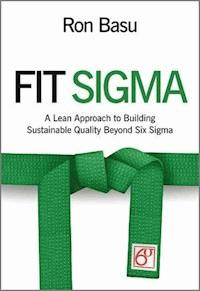
To some, the near perfection of the Six Sigma management system appears to be an impossible ideal, especially for small and medium enterprises. FIT SIGMA TM, a flexible and more sustainable approach, was developed through the integration of the ‘hard' Six Sigma approach with Lean Enterprise philosophy. It consists of three elements; fitness for purpose, fitness for improvement and integration, and fitness for sustainability.
FIT SIGMA: A Lean Approach to Building Sustainable Quality Beyond Six Sigma shows how this tripartite approach can be used to add value to both large and small organisations through improved use of resources, and through the provision of improved customer satisfaction. It shows that a holistic approach to operational excellence underpinned by a data driven methodology can be applied equally to the manufacturing, service or public sectors.
As the Six Sigma philosophy has evolved in recent years to take into account new challenges faced by companies, including climate change, green supply chain, emerging markets and a growing service sector, so FIT SIGMATM has also adapted itself to these new demands.
FIT SIGMA: A Lean Approach to Building Sustainable Quality Beyond Six Sigma covers key developing areas including:
-
Sustainability and Environment
-
Non-profit organizations
-
Service Operations
-
Supply Chain Management
-
Project Management
-
Emerging Markets
-
Small and Medium Enterprises
-
Green Thinking
Each chapter contains practical implementation guide, illustrative examples and case studies, and concludes with a summary of key elements for ease of reference and revision. In addition the book includes a comprehensive glossary of common terms and phrases used in managing quality, along with an appendix which illustrates the applications of basic statistics in Six Sigma and Fit Sigma.
Sie lesen das E-Book in den Legimi-Apps auf:
Seitenzahl: 441
Veröffentlichungsjahr: 2011
Ähnliche

















Contents
Cover
Series
Title Page
Copyright
Dedication
Preface
BACKGROUND
WHY FIT SIGMA?
ABOUT THIS BOOK
WHO SHOULD USE THIS BOOK?
HOW TO USE THIS BOOK
ADDITIONAL FEATURES
Acknowledgements
About the Author
1: The Evolution of Six Sigma, Lean Sigma and FIT SIGMA™
1.1 INTRODUCTION
1.2 FIRST WAVE: AS IS TO TQM
1.3 SECOND WAVE: TQM TO LEAN SIGMA
1.4 THIRD WAVE: LEAN SIGMA TO FIT SIGMA
1.5 MORE ABOUT SIX SIGMA
1.6 WHAT IS SIX SIGMA?
1.7 THE STRUCTURED APPROACH OF SIX SIGMA
1.8 WHAT IS LEAN SIGMA?
1.9 MORE ON LEAN SIGMA
1.10 WHY FIT SIGMA?
1.11 SUMMARY
2: More about FIT SIGMA
2.1 INTRODUCTION
2.2 FITNESS FOR THE PURPOSE
2.3 SIGMA (Σ) FOR IMPROVEMENT AND INTEGRATION
2.4 FITNESS FOR SUSTAINABILITY
2.5 SUMMARY
3: DMAIC Methodology for FIT SIGMA
3.1 INTRODUCTION
3.2 DMAIC FULL
3.3 DMAIC LITE
3.4 KAIZEN EVENT
3.5 SUMMARY
4: FIT SIGMA Tools
4.1 INTRODUCTION
4.2 TOOLS FOR ‘DEFINE’
4.3 TOOLS FOR ‘MEASURE’
4.4 TOOLS FOR ‘ANALYSE’
4.5 TOOLS FOR ‘IMPROVE’
4.6 TOOLS FOR ‘CONTROL’
4.7 SUMMARY
5: FIT SIGMA in Large Manufacturing Operations
5.1 INTRODUCTION
5.2 FITNESS FOR THE PURPOSE
5.3 SIGMA (Σ) FOR IMPROVEMENT AND INTEGRATION
5.4 FITNESS FOR SUSTAINABILITY
5.5 FIT SIGMA IN SUPPLY CHAIN MANAGEMENT
5.6 SUMMARY
6: FIT SIGMA in Service Operations
6.1 INTRODUCTION
6.2 THE DIVIDE BETWEEN SERVICE AND MANUFACTURING
6.3 OBJECTIVES OF A SERVICE ORGANISATION
6.4 ‘FITNESS FOR THE PURPOSE’ FOR SERVICE ORGANISATIONS
6.5 ‘SIGMA (Σ) FOR IMPROVEMENT’ FOR SERVICE ORGANISATIONS
6.7 FITNESS FOR SUSTAINABILITY
6.8 SUMMARY
7: FIT SIGMA in Small and Medium Enterprises
7.1 INTRODUCTION
7.2 ‘FITNESS FOR THE PURPOSE’ FOR SMALL AND MEDIUM ENTERPRISES
7.3 ‘SIGMA (Σ) FOR IMPROVEMENT’ FOR SMALL AND MEDIUM ENTERPRISES
7.4 FITNESS FOR SUSTAINABILITY
7.5 SUMMARY
8: FIT SIGMA in Project Management
8.1 INTRODUCTION
8.2 FIT SIGMA PRINCIPLES IN ADDRESSING PROJECT MANAGEMENT OBJECTIVES
8.3 FIT SIGMA IN A MAJOR PROJECT (HIGH SPEED 1)
8.4 SUMMARY
9: FIT SIGMA in Green Thinking
9.1 INTRODUCTION
9.2 WHAT IS GREEN THINKING?
9.3 WHY FIT SIGMA IS RELEVANT TO GREEN THINKING
9.4 THE ROLES OF STAKEHOLDERS
9.5 HOW FIT SIGMA CAN HELP GREEN THINKING
9.6 GREEN SIGMA
9.7 SUMMARY
10: Implementation of FIT SIGMA: Making it Happen
10.1 INTRODUCTION
10.2 SELECTION OF TOOLS AND TECHNIQUES
10.3 QUALITY PROGRAMMES
10.4 IMPLEMENTATION FOR NEW STARTERS
10.5 FIT SIGMA FOR SUCCESSFUL COMPANIES
10.6 EXTERNAL CONSULTANTS
10.7 SUMMARY
11: More Case Examples
11.1 INTRODUCTION
11.2 CASE EXAMPLES FOR LARGE MANUFACTURING ORGANISATIONS
11.3 CASE EXAMPLES FOR SERVICES, SMES, PROJECTS AND GREEN THINKING
SUMMARY
Appendix I: Questions and Exercises
Appendix II: Introduction to Basic Statistics
STATISTICS
SPSS
Appendix III: Yield Conversion Table
References
Glossary
Index
For other titles in the Wiley Finance series please see www.wiley.com/finance
This edition first published 2011
© 2011 Ron Basu
Registered office
John Wiley & Sons Ltd, The Atrium, Southern Gate, Chichester, West Sussex, PO19 8SQ, United Kingdom
For details of our global editorial offices, for customer services and for information about how to apply for permission to reuse the copyright material in this book please see our website at www.wiley.com.
The right of the author to be identified as the author of this work has been asserted in accordance with the Copyright, Designs and Patents Act 1988.
All rights reserved. No part of this publication may be reproduced, stored in a retrieval system, or transmitted, in any form or by any means, electronic, mechanical, photocopying, recording or otherwise, except as permitted by the UK Copyright, Designs and Patents Act 1988, without the prior permission of the publisher.
Wiley also publishes its books in a variety of electronic formats. Some content that appears in print may not be available in electronic books.
Designations used by companies to distinguish their products are often claimed as trademarks. All brand names and product names used in this book are trade names, service marks, trademarks or registered trademarks of their respective owners. The publisher is not associated with any product or vendor mentioned in this book. This publication is designed to provide accurate and authoritative information in regard to the subject matter covered. It is sold on the understanding that the publisher is not engaged in rendering professional services. If professional advice or other expert assistance is required, the services of a competent professional should be sought.
Library of Congress Cataloging-in-Publication Data
Basu, Ron. Fit Sigma: a lean approach to building sustainable quality beyond Six Sigma / Ron Basu. p. cm. ISBN 978-0-470-66621-0 1. Manufacturing processes – Quality Control. 2. Industrial Management – Quality Control. 3. Six Sigma (Quality Control Standard) I. Title. TS156.B4326 2011 658.4′013–dc22
A catalogue record for this book is available from the British Library.
ISBN 978-0-470-66621-0 (hard back); ISBN 978-1-119-99112-0 (ebk); ISBN 978-1-119-97372-0 (epub); ISBN 978-1-119-97373-7 (emobi)
To Moira, Bonnie and Robi
Preface
BACKGROUND
Whilst passing through Miami Airport en route to Mexico City, I was killing time by perusing the newspaper, and I came across an article on ‘Six Sigma’ in USA Today which caught my eye. Dated 21 July 1998, it had a challenging message relating to the cost benefits of Six Sigma. In the current global economic downturn, this challenge is even more prevalent. At that time I was co-ordinating a global MRP(II) programme between all the manufacturing sites of GlaxoWellcome, including the Xochimilco plant in Mexico. The Global Manufacturing and Supply Division of GlaxoWellcome was considering a ‘Lean Sigma’ initiative which was meant to be a hybrid of Six Sigma and Lean Manufacturing. It struck me that the message in USA Today reflected not just the doubts (or expectations) in the minds of my colleagues but perhaps those of quality practitioners world-wide.
These doubts or expectations addressed many questions. Isn't Six Sigma simply another fad or even just a repackaged form of TQM? It appears to be successful in large organisations like Motorola and General Electric, but can small firms support such a programme? How can we apply the Six Sigma methodology originated from manufacturing operations to the far larger market of the service sector? Like any good product, Six Sigma will have a finite life cycle – so what is next? Surely one big question must be: how can we sustain the benefits in the longer term? It is good to be ‘lean’, but isn't it better to be ‘fit’ in order to stay agile?
The idea of writing a book to address these issues was mentally conceived at Miami Airport and the concept of FIT SIGMA™ was born. The resulting volume was named Quality Beyond Six Sigma and was published by Butterworth-Heinemann in January 2003. In the experience of the author, both in industry and management courses, the details of various tools and techniques had to be acquired from different books, publications and training manuals. It is time now to produce a comprehensive, user-friendly and ‘hands-on’ study. This could act as a single-source reference point for tools and techniques to be used by all practitioners and students of operational excellence. With these thoughts in mind I wrote Implementing Quality (published by Thomson), which was followed by Implementing Six Sigma and Lean (published by Elsevier). The current volume, FIT SIGMA, has been produced with the aim of updating Quality Beyond Six Sigma.
WHY FIT SIGMA?
Six Sigma and Lean Sigma may be viewed by some as ‘old hat’. However, in the current global economic downturn, many organisations, including the public sector, are looking beyond traditional cost-cutting to find longer-term solutions to their financial and organisational challenges.
This near perfection for many may seem to be overkill, while to some it constitutes an impossible ideal to strive towards – especially for a small business. Many businesses are hesitant to dive into an apparently expensive Lean Sigma programme which is known to be successful for large manufacturing organisations like GE, Motorola and Dow Chemicals. There are also new challenges in many areas, including climate change, Green supply chain, emerging markets and the growing service sector. FIT SIGMA, which is an extension of Lean Sigma, is aimed to address these challenges. The methodology of FIT SIGMA – or FIT Σ – has three elements: fitness for the purpose, fitness for improvement and integration, and fitness for sustainability.
ABOUT THIS BOOK
The major new features of this book as compared to Quality Beyond Six Sigma include either new or rewritten chapters as follows:
Chapter 1: The Evolution of Six Sigma, Lean Sigma and FIT SIGMA™
Chapter 2: More about FIT SIGMA
Chapter 3: DMAIC Methodology for FIT SIGMA
Chapter 4: FIT SIGMA Tools
Chapter 5: FIT SIGMA in Large Manufacturing Operations
Chapter 6: FIT SIGMA in Service Operations
Chapter 7: Six Sigma in Small and Medium Enterprises
Chapter 8: FIT SIGMA in Project Management
Chapter 9: FIT SIGMA in Green Thinking
This book is a practical guide to FIT SIGMA which is necessary in the implementation of all kinds of quality programmes at whatever level or under whichever banner these may be pursued, be it continuous improvement, TQM, Six Sigma, Lean Enterprise, Lean Sigma or Lean Six Sigma, to name but a few.
WHO SHOULD USE THIS BOOK?
This volume is aimed at a broad cross-section of readership.
Functional managers, participants and practitioners in TQM, Six Sigma and operational excellence will find that this book will provide them with a comprehensive insight into the tools and techniques of continuous improvement in a single package. A step-by-step guide is included for the application of the appropriate tools to their improvement processes. This volume could be used as an essential handbook for all employees in a Six Sigma programme.Senior executives, both in the manufacturing and service industries (regardless of function), will find that this book will give them a better understanding of basic tools and techniques and help them to support a quality improvement initiative and sustain a strong competitive position.Professional management and training consultants will find the comprehensive approach of tools and techniques forms an essential handbook for Six Sigma-related assignments and seminars.Management schools and academies and research associations will find this book valuable to fill the visible gap in the basics of operational excellence. This text will provide support to both undergraduate and postgraduate courses containing quality and operational excellence and can serve as a main text book for the quality elective component for MBA students.The readership will be global and particularly cover North America, the UK, Continental Europe, Australia and the Asia-Pacific countries.
HOW TO USE THIS BOOK
The book allows maximum flexibility for readers and for practical usage depending on individual requirements and interests. The application areas of the study include the following.
Implementing FIT SIGMA
All organisations, whether service or manufacturing, private or public sector, large, medium or small, should particularly benefit from the specific chapters for large manufacturing organisations, service organisations, small and medium organisations, projects and Green thinking, as well as the section concerning steps of implementation in Chapter 10. The programme members and task groups should acquire a copy of the book and also gain a common understanding of tools as described in Chapter 4.
University and College Courses
It can be used as a textbook or reference tool for advanced programmes on managing quality in universities and business schools. The questions and exercises included in Appendix I should help students by allowing them the chance to practice and assess their level of understanding gained from the relevant chapters. Tutors will have the opportunity of applying these questions and exercises as part of their lecture material and course content.
Enhancing Knowledge
The book contains both the strategic approach of implementing FIT SIGMA and a detailed coverage of tools and DMAIC processes which underpin the programme. The reader, whether a CEO, employee or student, should find the book acts as a self-help method of enhancing his or her knowledge and understanding of quality and operational excellence.
ADDITIONAL FEATURES
Summary
At the end of each chapter the reader will find a summary of the key elements covered in that chapter. This should provide a sound basis for general revision.
Case Studies
Case studies have been included to encourage readers to respond in the context of practical situations. These are concisely written and provide a good learning resource for tutorials.
Statistics
Efforts have been made to minimise the fear of advanced statistics in FIT SIGMA! However, Appendix II illustrates the application of basic statistics in Six Sigma and FIT SIGMA.
Glossary
A comprehensive Glossary of relevant terms has been provided at the end of the book. This gives a ready reckoner for the common terminology and phrases experienced in managing quality.
I have made every effort to furnish you with both simple and more complex concepts which are nonetheless easy to understand. I feel confident that with enough common sense you can apply them readily to make FIT SIGMA a reality in your organisations and programmes. This is intended to offer you ‘more for less’ through the application of FIT SIGMA; that is, more results with less effort in your change programmes. Mahatma Gandhi once said, ‘Be the change you want to be in the world’. I hope this book will in some way help you to bring about that change.
Acknowledgements
I acknowledge the help and support from my colleagues and students at Henley Business School in England and SKEMA Business School in France. As always, it has been my pleasure to work with Dr Nevan Wright, my co-author of Quality Beyond Six Sigma and other books.
I am grateful to the many contributors to the case examples included in the book, with special mentions to Alex Morton, Andy Liddle, Mike Waterhouse and John Barnes.
Every effort has been made to credit the authors, publishers and websites of material used in this book. I apologise if inadvertently any sources remain unacknowledged and if known I shall be pleased to credit them in the next edition.
My sincere thanks go to the staff of my publishers, especially to Jenny McCall and Gemma Valler for getting this project off the ground.
Finally, the project could not have been completed without the encouragement and help of my family, especially my wife Moira and daughter Bonnie.
About the Author
Ron Basu is Director of Performance Excellence Limited and a Visiting Fellow at Henley Business School, England. He is also a Visiting Professor at SKEMA Business School, France. He specialises in Operational Excellence and Supply Chain Management and has research interests in Performance Management and Project Management.
Previously he held senior management roles in blue-chip companies like GSK, Glaxo Wellcome and Unilever, and led global initiatives and projects in Six Sigma, ERP/MRP(II), Supply Chain Re-engineering and Total Productive Maintenance. Prior to this he worked as a Management Consultant with A.T. Kearney.
He is the co-author of Total Manufacturing Solutions, Quality Beyond Six Sigma, Total Operations Solutions and Total Supply Chain Management, and the author of books with titles Measuring e-Business Performance, Implementing Quality and Implementing Six Sigma and Lean. He has authored a number of papers in the operational excellence and performance management fields. He {is} a regular presenter of papers in global seminars on e-Business, Six Sigma and Manufacturing and Supply Chain topics.
After graduating in Manufacturing Engineering from UMIST, Manchester, Ron obtained an MSc in Operational Research from Strathclyde University, Glasgow. He has also been awarded a PhD at Reading University. He is a Fellow of the Institution of Mechanical Engineers, the Institute of Business Consultancy, the Association for Project Management and the Chartered Quality Institute. He is also the winner of an APM Project Management Award.
Ron lives with his wife Moira in Gerrards Cross, England and has two children, Bonnie and Robi.
1
The Evolution of Six Sigma, Lean Sigma and FIT SIGMATM
1.1 INTRODUCTION
Today, depending on whom you listen to, Six Sigma is either a revolution slashing trillions of dollars from Corporate inefficiency, or it's the most maddening management fad yet devised to keep front-line workers too busy collecting data to do their jobs.
USA Today, 21 July 1998
At the time of writing, it has been 12 years since the above statement was made. During this time the ‘Six Sigma revolution’ has created a huge impact in the field of operational excellence, yet conflicting views are still prevalent.
Let us evaluate the arguments for both sides. On a positive note, the success of ‘Six Sigma’ in General Electric (GE) under the leadership of Jack Welch is undisputed. In the GE company report of 2000, their CEO was unstinting in his praise: ‘Six Sigma has galvanised our company with an intensity the likes of which I have never seen in my 40 years at GE.’ Even financial analysts and investment bankers compliment the success of Six Sigma at GE. An analyst at Morgan Stanley Dean Witter recently estimated that GE's gross annual benefit from Six Sigma could reach 5% of sales and that share values might increase by between 10% and 15%.
However, the situation is more complex than such predictions would suggest. In spite of the demonstrated benefits of many improvement techniques such as total quality management (TQM), business process re-engineering and Six Sigma, most attempts by companies to use them have ended in failure (Easton and Jarrell, 1998). Sterman et al. (1997) conclude that companies have found it extremely difficult to sustain even initially successful process improvement initiatives. Yet more puzzling is the fact that successful improvement programmes have sometimes led to declining business performance, causing lay-offs and low employee morale. Motorola, the originator of Six Sigma, announced in 1998 that its second-quarter profit was almost non-existent and that consequently it was cutting 15,000 of its 150,000 jobs.
To counter heavyweight enthusiasts like Jack Welch (GE) and Larry Bossidy (Allied Signal), there are sharp critics of Six Sigma. In fact, Six Sigma may sound new, but critics say that it is really just statistical process control in new clothing. Others dismiss it as another transitory management fad that will soon pass.
Lesen Sie weiter in der vollständigen Ausgabe!
Lesen Sie weiter in der vollständigen Ausgabe!
Lesen Sie weiter in der vollständigen Ausgabe!
Lesen Sie weiter in der vollständigen Ausgabe!
Lesen Sie weiter in der vollständigen Ausgabe!
Lesen Sie weiter in der vollständigen Ausgabe!
Lesen Sie weiter in der vollständigen Ausgabe!
Lesen Sie weiter in der vollständigen Ausgabe!
Lesen Sie weiter in der vollständigen Ausgabe!
Lesen Sie weiter in der vollständigen Ausgabe!
Lesen Sie weiter in der vollständigen Ausgabe!
Lesen Sie weiter in der vollständigen Ausgabe!
Lesen Sie weiter in der vollständigen Ausgabe!
Lesen Sie weiter in der vollständigen Ausgabe!
Lesen Sie weiter in der vollständigen Ausgabe!
Lesen Sie weiter in der vollständigen Ausgabe!




