


9,99 €
Mehr erfahren.
- Herausgeber: The History Press
- Kategorie: Geisteswissenschaft
- Sprache: Englisch
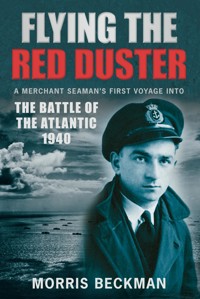
Following the evacuation of the British Expeditionary Force from Dunkirk in 1940, Britain was at her most vulnerable. France had capitulated and the Germans had control of ports from the Arctic to the Mediterranean. Nazi U-boats were at Britain's doorstep, and in that year alone they sunk 204 ships, a gross tonnage of 2,435,667. Britain stood alone against Germany and a vital lifeline was the supplies carried by the civilian Merchant Navy, defended only by the thinly stretched Royal Navy. Winston Churchill conceded that his greatest fear was the slaughter of merchant seaman, who worked in harsh conditions, were often poorly fed, and were always at the mercy of the Kriegsmarine. In Flying the Red Duster, Morris Beckman tells the story of his experiences as a merchant seaman during the Battle of the Atlantic, part of the civilian force which enabled Britain to avoid capitulation to Nazi Germany. Based on his wartime diary - the unique document now held at the Imperial War Museum - this work allows the reader unique access to a time which is fast slipping from living memory.
Das E-Book können Sie in Legimi-Apps oder einer beliebigen App lesen, die das folgende Format unterstützen:
Veröffentlichungsjahr: 2011
Ähnliche


















CONTENTS
Title
Dedication
Foreword by David Cesarani
1The Battle of the Atlantic
2Training and Joining the Venetia
3The Waiting Game
4Going to Sea
5Round the Coast
6U-boat Alley
7Aruba and Bermuda
8Running the Gauntlet
9Ambush
10The Final Leg
Plates
Copyright
David Cesarani is an English historian specialising in Jewish history. His books include Arthur Koestler: The Homeless Mind (1998). In 2005 Professor Cesarani was awarded the OBE for ‘services to Holocaust Education and advising the government with regard to the estabishment of Holocaust Memorial Day’.
FOREWORD BY DAVID CESARANI
When I was a boy growing up in a north London suburb I used to listen keenly to the stories told by a family friend, Eric, who used to visit our home every Monday night for a meal followed by Panorama on the television. He had been a merchant mariner and served on the Arctic convoys during the war. He didn’t talk a lot about his experiences but something he said stuck in my mind. He recalled that if a ship was carrying timber the crew tended to sleep without wearing life jackets because, if hit by a torpedo, the vessel would stay buoyant long enough for them to get to the boat stations in good time. But if it was carrying iron ore they went to sleep ready to race for the lifeboats in seconds, which was all they would have if it was caught by a U-boat or bombed. As I lay in bed at night I tried to imagine what it was like to try to get to sleep on a freighter carrying explosives, inflammable petroleum products or bulk cargo. I shuddered at the thought.
In this gripping memoir of life as a merchant seaman, Morris Beckman repeats what I heard all those years ago – almost word for word. It was the lore of the Merchant Navy. But he has also filled in the silences and the gaps and with extraordinary skill he evokes what it was like to cross the Atlantic at the height of the battle for the sea lanes. This is the story of his first convoy, beginning with his training as a radio operator and his induction into the squalid conditions on a rusty old tanker, the SS Venetia. The crew was full of characters, each of whom is drawn with insight, compassion and humour. Morris writes unsparingly about the unsavoury personalities, poor pay and abysmal conditions. For much of the voyage, the crew’s greatest enemy after the Germans was the crooked steward and the talentless cook.
On the journey to the Americas the convoy lost six ships. Morris, in the claustrophobic confines of the radio room, logged one distress signal after another from torpedoed merchantmen. He realised that to make the Atlantic run was to face ‘sudden death without warning’. On the return leg the Venetia was loaded to the gunnels with high octane fuel; in effect they were sailing on a huge petrol bomb. One ship after another was hit and eleven were sunk before the convoy reached port. Even in British home waters there was a constant danger from mines, the Luftwaffe and E-boats – fast German Navy torpedo boats. No one reading this account will be able to avoid a quickening pulse as Morris brings the narrative to its climax.
Americans have long celebrated the veterans of the Second World War as ‘the greatest generation’. In Britain, perhaps due to a tradition of modesty, for many decades we tended to play down the sacrifice and the achievements of the men and women who kept Britain free, liberated Europe and defeated fascism between 1939 and 1945. The Merchant Navy, which lost more than 34,000 officers and men, is amongst the least recognised of the services that took part in that struggle. Anyone seeking evidence of the horrors those men faced and the courage they displayed, need go no further than this frank and terrifying account.
Morris Beckman was just one member of a crew, on one ship in a succession of convoys, in a battle that lasted the entire war. But his story may stand for the stories of thousands. It is a fitting tribute to the greatest generation that ever sailed under the Red Duster.
Professor David Cesarani OBE
Royal Holloway, University of London
1
THE BATTLE OF THE ATLANTIC
The broad canvas.
The French capitulation in May 1940 enabled the Nazi Kriegsmarine to operate from ports stretching from the Arctic to the Mediterranean. From the newly acquired bases it had access to Britain’s busiest sea routes, and the U-boats could make more sorties as they enjoyed shorter runs home for re-arming, re-servicing and provisioning. Their crews could recuperate for longer periods between forays into the Atlantic and the northern seas. The improvement in the performance of Admiral Dönitz’s ‘grey wolves’ was immediate. In the first five months of 1940 the British lost 108 merchant ships with a gross tonnage of 408,810. In the last seven months of the year, after the Fall of France, they lost 440 with a gross tonnage of 2,026,857.
The British Merchant Navy operated in every theatre of the conflict. It ferried troops and supplies all over the world, took part in every sea-borne evacuation and invasion and suffered appalling losses on the Malta and Russian convoys. Yet all these peripheral activities took second place to the longest sea battle of the war, which covered an area larger than any other battle fought in Europe during the Second World War. It became known as the Battle of the Atlantic, and lasted from 3 September 1939 – when U-30 torpedoed SS Athenia en route from Liverpool to Montreal, with the loss of 117 lives – until 7 May 1945, when SS Avondale Park was sunk by U-2336 an hour before the official German surrender. Often unprotected, a seaman of the merchant vessel convoys could do little as relentless fighting raged about him but do his job, pray, live with his lifejacket, and in the early days keep a condom waterproofing over his torch in case he found himself swimming after dark.
In 1941, with the tide of success running their way, Admirals Raeder and Dönitz pressed Hitler to build another 50 U-boats, but the request was denied. The Führer’s obsession was with war on land, and after Dunkirk he had hopes that Britain would make peace with Germany. Had those 50 been built, Germany could well have won the war. As it was, in 1944 Hitler ordered the Kriegsmarine to commission 120 of the new, faster, long-range electric submarines. It was too late. By February 1945 only two had been built and the war was already lost.
Buoyed by success, the U-boat crews called the period between June 1940 and early 1943 their ‘happy time’. It included that long year when Britain fought alone against the Axis powers and the Royal Navy was too thinly stretched to provide adequate escorts for convoys. Escorts lacked ship-borne radar and the enemy could only be spotted by the naked eye, often by the heart-stopping sight of a torpedo’s wake as it headed for a ship. U-boats had learned to surface at night, rendering the escorts’ underwater asdic detection system ineffective, and they were hard to spot when they sat low in the water under the cover of darkness. Fewer U-boats were being sunk than built; the Germans were ahead on tactics. And they had Admiral Dönitz.
Dönitz had been a successful U-boat commander during the First World War. He went on to make a study of underwater warfare, having never forgotten how the convoy system had frustrated and defeated the U-boats. He knew that if war came then the convoy system would again be employed, and he worked on how to counter it.
He instituted the rudeltaktik whereby his U-boats assembled and attacked convoys in groups of up to a dozen. To facilitate this he organised a communication system using shortwave radio which allowed U-boats at sea to communicate both with his headquarters at St Lorient and with each other. The submarines would operate in groups, each boat having its patrol line, and when one spotted a convoy it would stalk it for many days, giving the rest of the group time to converge and launch a pack attack. Thus, instead of losing the occasional ship to individual U-boat attacks, convoys could be practically wiped out. In October 1940, Convoy SC7 set out from Halifax, Nova-Scotia, heading for home. A 30-ship convoy, it was savaged on the nights of 16, 17 and 18 October. 19 vessels were lost. The ‘wolf packs’ decimated many other convoys, and the frightening losses of merchantmen were causing flutters in Whitehall. Winston Churchill admitted much later that the only thing that really frightened him was the U-boat peril.
The U-boat model doing the damage was the Type VIIC, which had a displacement of 872 tons and a surface speed of 17 knots. It could cruise at 10 knots for 10,000 miles and out-speed any convoy and the majority of lumbering merchant vessels. It carried 14 torpedoes, which could be fired from four tubes in the bows and from one tube aft. In addition it had two 2.20mm guns, one of which could be used as an anti-aircraft weapon. It was arguably the most efficient killing machine of the war.
German engineers and scientists ceaselessly devised new ways of sinking merchant vessels. In 1940 the Luftwaffe seeded the east coast of Britain with mines, from the Thames up to Tyneside. They alone destroyed 70 vessels. Then the Germans produced the magnetic mine which was attracted to ships passing overhead. The British countered this with an effective de-gaussing system which neutralised a ship’s magnetic field. The Germans developed the acoustic mine, nicknamed the ‘gnat’, which was detonated by the vibrations from propellers. Royal Navy minesweepers countered by trailing vibrators across the seas. Then the Kriegsmarine introduced the schnorkel which enabled U-boats to ‘breathe’ underwater, and the huge Type XIVs or Milchkühe (milk cows). These took up station in set positions in the mid-Atlantic, allowing operation U-boats to re-arm and take on provisions without returning to a land base.
Another effective German weapon was the Focke-Wulf Condor, a large plane with a range of nearly 2,500 miles and a bomb load of 4,620lbs. While they did attack Allied merchant vessels, their primary function was reconnaissance, spotting targets for their comrades underwater. They became a familiar sight to merchant seamen, and when the hated ‘Angels of Death’ appeared and circled round a convoy out of range of the ships’ anti-aircraft guns, the seamen knew that their position, course, speed and numbers were being transmitted to the St Lorient headquarters, and that an attack was inevitable.
The British were not idle, and as well as the aforementioned anti-mine devices, they perfected a direction-finding receiver which could pinpoint the underwater position of a U-boat as it transmitted radio messages. The hunter-killer groups of Royal Navy corvettes and destroyers could home onto the submarine, and as a result U-boat losses climbed sharply. In response the Kriegsmarine forbade crews to chatter to each other at sea, but the hunter-killer groups continually devised new tactics to find their prey. The most successful group sank 25 U-boats and was led by Captain Frederick Walker, who won the DSO four times. Support also came from the air. By late 1943 Britain’s coastal command had organised Sunderland and Catalina long-range aircraft into round-the-clock air cover. They were armed with radar and bombs, and patrolled areas round the convoys, forcing the U-boats to keep their heads down.
The most important British breakthrough was the deciphering of the German coding machine, Enigma. U-boat command used it to pass messages to the submarines, never imagining that it could be cracked. But it was, and it enabled the Royal Navy to divert convoys round the U-boat patrol lines and direct hunter-killer groups straight to their prey. This source of information, codenamed ‘Ultra’, was one of the war’s greatest secrets.
The American entry into the war sealed the fate of the U-boat offensive. The US Navy took over the protection of ships along their eastern seaboard and their destroyers began to assist in the protection of Atlantic and Russian convoys. But the greatest American contribution to winning the Battle of the Atlantic was their incredible production of pre-fabricated deep sea cargo carriers. They were turned out by the hundreds and were called Liberty Ships.
It is estimated that the Atlantic and North Sea slogging match alone resulted in the loss of some 2,000 British merchant vessels and 27,000 officers and men. These figures do not include the Allied merchantmen lost, of which there were many thousands. They came from every Nazi-occupied country and were always in our convoys. Over the two-and-a-half years I spent on ship, I saw French, Polish, Greek, Dutch and Norwegian vessels attacked and their surviving crewmen lowering boats, throwing rafts overboard, and on what we called the ‘flamers’, frantically jumping into the freezing seas. The contribution of the merchantmen, both home-grown and foreign, was invaluable, especially at a time when Britain stood alone in Europe against a superior foe.
Before I joined the Venetia, I knew as much about the Merchant Navy as the average Briton – nothing. To me the merchant seaman was just a civilian plying his trade, albeit at sea rather than in a shop or office, but there was a difference between him and other men.
From the moment he boarded his ship until the day he walked ashore if and when his vessel returned home, he was under enemy attack. He was a sitting duck for all that the Luftwaffe and the Kriegsmarine could throw at him. His main pre-occupations were his grievances, low pay, poor food, the long weeks at sea and the very short breaks ashore. It was wartime and he knew that they had to be borne, but some were beyond the pale, such as the fact that if a ship was sunk, then the very same day the pay of the survivors was stopped by the shipping companies. It was a case of no ship, no work to be done, no wages. Protests by the National Union of Seamen and the Merchant Navy Officers Union were in vain. Patriotism was appealed to. It worked.
It was not uncommon for merchant seamen to encounter a particularly discomforting hazard. In seaport pubs seemingly healthy young men in civilian clothes would be taunted by others in uniform. The less they reacted to the taunts, the more outrageous they would become, especially if there were women present. The men subjected to the ridicule and accusations of cowardice – merchant seamen who had been torpedoed, mined, bombed and machine-gunned, suffered the heart-stopping antics of overloaded vessels in fierce gales and lived with the ever-present fear of seeing one of the Nazis’ devastating battleships appear over the horizon – would be goaded into giving the uniformed ‘heroes’ their first battle wounds. I witnessed two such occasions, one in Avonmouth and one in Middlesbrough. Both times Royal Navy ratings joined in the fights alongside the merchant seaman.
To reduce these confrontations the Merchant Navy officers were issued with a lapel badge made from aluminium. It was roughly three-quarters of an inch long and half an inch deep. Inside the frame and stamped out in relief on the plate were the letters ‘MN’. All this was surmounted by a clean anchor crown. By and large it was regarded by its recipients as an affront, a bad joke. Few wore it. It became known as the monkey-nut badge.
During my research I found tucked away inside the SS Venetia’s ‘Agreement and List of the Crew’ a booklet titled Regulations for Maintaining Discipline. After so many years its contents threw new light on the dissatisfactions and grumblings of a crew, who, all in all, did all that was asked of them, and more. At the time it was the practice that the master had it in his power to ‘log’ or fine men. These fines would be deducted from wages, which naturally was to the shipping company’s advantage. Take into account the low wages, and a ‘troublemaker’ who was frequently logged could take home very little money at the end of a voyage. In the booklet the punishments were set out as follows:
1.Striking or assaulting any other crew member
5 shillings
2.Bringing on board intoxicating liquors
5 shillings
3.Drunkenness 1st offence
5 shillings
Drunkenness 2nd offence
10 shillings
4.Taking on board any offensive weapon without concurrence of the Master
5 shillings for every day
5.Insolent language or behaviour to Master or Officers or disobedience to lawful commands
5 shillings
6.Absence without leave
5 shillings for every day.
Generally masters of vessels were reluctant to impose fines unless forced to do so by complete recalcitrants, who were usually drunk out of their minds.
Pay varied, but it was always low. The booklet laid down hard and fast overtime rates; men working in shifts were paid overtime for work done in excess of eight hours Monday to Friday, five hours on Saturday and all work done on Sunday.
Rates for overtime for boys
6 pennies per hour
Rates for overtime for ordinary seamen
6 pennies per hour
Rates for overtime for carpenters
1 shilling/ninepence per hour
Rates for overtime for other ratings
1 shilling/ninepence per hour
It was not much. But then, the men who manned Britain’s forgotten wartime navy never wanted a lot, not even recognition.
2
TRAINING AND JOINING THE VENETIA
Max telephoned me the day after war broke out. We were close friends in and out of school. At Hackney Downs School he had been one of those enviable pupils to whom mathematics was a doddle. He was stubborn, dour and cynical. With two other friends we enjoyed cycling trips, rowed in a gig four on the river on Sundays and enjoyed the long Habonim summer camps. Now, out of character, he sounded ebullient.
‘I’m coming round,’ he said. ‘I can’t study anymore.’
From my home in Amhurst Road, Hackney, we walked to the RAF recruiting office in Kingsway, Holborn, and joined the short queue. The moment we reached the desk the heavily moustached corporal behind it growled lugubriously.
‘Go back to bloody school and don’t waste my time.’
Max bristled. He had a bristle that could change the atmosphere.
‘Maybe you don’t listen to the wireless or read the papers,’ he retorted sarcastically. ‘There’s a war on and we want to fly.’ The corporal waved a dismissive hand and snorted.
‘It takes brains to fly an aeroplane. Just bugger off out of here. Go on! Hop it!’ Studying the corporal as if he were something under a microscope, Max replied with great deliberation,
‘So, it takes brains to fly an aeroplane does it? That must explain why you’re sitting behind that desk!’
We shot out into the street. Max was now obsessed with flying. He dragged me round to other recruiting centres, but in vain. We were too young. It was too early. Things had to be organised. For three months we were lost souls and our studying for university suffered grievously. Then, while reading the Daily Telegraph one day, my eye caught one of the plethora of government notices that filled the newspapers in those days.
Admiralty notice. Radio officers urgently required for the Merchant Navy to maintain a continuous radio watch on all British ships at sea. Good pay. Good prospects. See the world.
I came to a snap decision. It was the invitation to see the world that did it.
Two days later I enrolled at a maritime college in an enormous converted Victorian house off Clapham Common. There I learned to transmit and receive Morse code at speed and across artificial interference, and how to service the heavy-duty marine transmitters and receivers. The very day the Phoney War ended and the Germans attacked France and the Low Countries, I was one of 52 students who took the examination and tests for our special certificates. Forty of us passed, and the next day we went to a famed eatery run by a dear old soul with hennaed hair and rouged cheeks who we called Fanny Bagwash. We celebrated with a slap-up lunch of steak and onion pie, two vegetables and Fanny’s famed apple pie and custard.
The walls of Fanny’s place were covered with hundreds of postcards from ports worldwide, sent by ‘her boys’ who had passed the course before us. The boisterous celebration came to a halt when Fanny burst into tears. The quick thinkers amongst us rushed to comfort her, and gave her the presents we had bought her – a box of Cadbury’s Milk Tray chocolates and 200 John Player cigarettes, for she enjoyed ‘her pulls’, as she called smoking. We then chaired her out into the street, down to nearby traffic lights and back into the café. To puzzled bystanders we announced it was her hundredth birthday. Once back inside she lined us up and kissed each of her boys on the cheeks, a mother bidding us farewell, and then we dispersed to every part of Britain. Over the next few years a name from that group of 40 would appear in the casualty section of the radio officer’s monthly, The Signal as ‘killed or missing’. Missing at sea meant dead.
The next day I took the bus to the Marconi office in East Ham High Street and signed onto their sea-going staff. I signed various forms, giving my next of kin as my father, Joseph Harris Beckman. He was a textile merchant and an immigrant from Poland, a devout Jew who could not come to terms with the youngest of his four sons being the first to leave. Max gave me hell for not having waited, like he did. He had joined the RAF and sported the white flash in his forage cap, denoting pilot training. He brimmed with enthusiasm about flying. Barely a year later Sergeant-pilot Maxwell Addess took off in his Hurricane from an East Anglian airfield. His squadron attacked a swarm of incoming German bombers and fighters. In the ensuing dogfight Max and his plane crashed into the sea. His body was never found.
I reported to the Marconi office day after day at 10am and went home at 5pm. I began to feel like a fraud as the sailor who had never been to sea. Those of us waiting for orders played cards and dominoes, read magazines and chatted about god-knows-what. Now and again a name would be called and the lucky man would cry out exultantly ‘that’s me!’ He had his ship. Others who had completed voyages came into the office to collect pay and further instructions, or the statutory month survivor’s leave. Our questions to them about what it was at sea like evoked dampening replies such as ‘bloody awful’, or a meaningful ‘you’ll soon find out’.
Came the morning my name was called. I was at the counter in a flash. The elderly clerk examined me over his pince-nez and smiled at my eagerness. It was my first ship, but he had sent hundreds of young men to sea. He gave me an advance of £25, which would be deducted from my pay, and then gave me a typed list of the sea-going gear I would need. He advised me to get it all from Gardiners, the famous old store which occupied an entire triangular site where Aldgate meets the East End. It was the specialist shop for all seafarers, British and foreign, and had a worldwide reputation. I went straight there and found it bustling with officers and seaman from several different military and merchant navies. It was all wood, the walls, floors, fitments, counters and shelving, which may have played a part in its eventual demise in the 1970s, when it was gutted by fire.
A telegram arrived the next morning, informing me that I had been appointed the second radio officer on the SS Venetia, anchored in the Thames. I was instructed to report to a Tilbury shipping office on the following day at 11am. Unable to sleep, I rose early, and caught a train from Liverpool Street station, finding myself in the designated office with time to spare. It was a dreary place in a desolate spot. The furniture was cheap, the grey walls dirty, and the notices pinned up were yellowed and curling at the edges. A forlorn-looking woman sat at a cluttered desk sorting through box files.
On the dot of 11am three men appeared. They were middle-aged and tweedy, ruddy and inclined to corpulence. They were the immigration officer, a Board of Trade official and the agent representing the shipping company. The latter smiled at me and said pleasantly:
‘You’re for the Venetia?’
Yessir.’




