


8,49 €
Mehr erfahren.
- Herausgeber: The History Press
- Kategorie: Sachliteratur, Reportagen, Biografien
- Sprache: Englisch
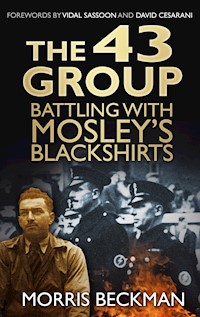
Oswald Mosley decided he could carry on where Hitler and Mussolini had left off. On street corners his fascist speakers would proclaim 'not enough Jews were burned at Belsen'. Enter the 43 Group. In a ferocious, bloody and brilliantly covert five-year campaign, they destroyed the Mosleyites. The membership of the Group was almost entirely made up of British servicemen, the original 43 members quickly swelling to more than 300 and including a Battle of Britain ace, a VC winner – and Vidal Sasson! The Groups philosophy of the '3 D's' - Discuss, Decide and Do it – were quickly manifested on the streets of London, with thousands of fascist meetings and rallies sent packing. The Group was organised in 'wedges' of a dozen or so. These wedges would attend a BUF rally and at a given signal would storm the speaker's platform, attacking BUF stewards and speaker. The members' military background ensured tight discipline and brutally effective actions. This, combined with a number of spies within the fascist ranks, ensured the 43 Group almost always came out on top, closing down two-thirds of all fascist activity in the UK until its simultaneous demise with organised fascism in Britain in 1950. As capitalism falters, fascism is gathering strength in Europe today. This book is a timely reminder of how it gathers that strength - and one way of stopping it.
Das E-Book können Sie in Legimi-Apps oder einer beliebigen App lesen, die das folgende Format unterstützen:
Veröffentlichungsjahr: 2013
Ähnliche
















On the day of the Nuremberg executions the Daily Express observed:
‘The crime of the Nazi leaders had squalid beginnings. Once a handful of policemen could have suppressed it. Instead it grew to its dangerous might through the wickedness of a few and the complicity, the cowardice and the laziness of many.’
This book is dedicated to all the members of the 43 Group and to their many supporters, both Jewish and Gentile.
Acknowledgements
I am indebted to all those who helped me during my work on the book. First and foremost is Bernadette Halpin of Centerprise who, from the start right to the very end, advised, criticised and improved my work. She put tremendous effort into it and made me feel I could not let her down. Also to Dorothea Smartt, the Black Arts Worker at Centerprise, who became as enthusiastic about the book as we were.
I am greatly indebted to Jack Wise, unstinting and generous to the nth degree; to Alan Deane who helped me once, but in an important and unusual way; to Rickie Burman and Helen Jacobus who sparked the whole thing off; to Len Sherman and Gerry Flamberg who vetted the writing as I went along; and to all the other veterans who gave me their recollections. These include: Jeffrey Bernerd, Norman Green, Bernie Newman, Martin Block, Alec Carson, David Spector, the Misses Shapiro and others. Of great help during the early stages was Stanley Marks, a meticulous keeper of records and notes; his generous donation to the London Museum of Jewish Life enabled them to open their collection of 43 Group memorabilia. Finally, I wish to thank my wife, Patricia, for tolerating my ups and downs, my late night typing sessions, and for her support and encouragement.
Contents
Title
Dedication
Acknowledgements
Editor’s Introduction to the First Edition
Foreword to First Edition by Vidal Sassoon CBE
Foreword to Second Edition by David Cesarani OBE
Prologue
Chapter One
Chapter Two
Chapter Three
Chapter Four
Chapter Five
Chapter Six
Chapter Seven
Chapter Eight
Chapter Nine
Chapter Ten
Chapter Eleven
Chapter Twelve
Chapter Thirteen
Chapter Fourteen
Chapter Fifteen
Chapter Sixteen
Chapter Seventeen
Epilogue
Appendix A Post-war fascist leaders
Appendix B Fascist Publications
Appendix C Fascist Organisations
Appendix D Fascist Book Clubs
Plates
About the Author
Copyright
Editor’s Introduction to the First Edition
I first met Morris Beckman in the summer of 1990 after reading a manuscript he’d sent me drawing upon his memories of growing up in the East End Jewish community of the Twenties and Thirties. At Centerprise we receive much autobiographical writing, but his was outstanding. Morris came in later and, as we talked, remarked, ‘l have another book almost finished about the 43 Group’. ‘Who were the 43 Group?’, I responded. Morris looked surprised and disappointed. ‘You live and work in Hackney and you’ve never heard of the 43 Group?’ That afternoon began a conversation that has fulfilled itself finally in this publication.
The 43 Group is a work of social and political history, a record of resistance from a Jewish community perceived at times, perhaps, as a passive one. It is also an inspirational personal testimony and, not least, it is a great read. The exploits of the Group might be taken from an adventure yarn or thriller – though this is a neighbourhood ‘war’ that includes bloody noses and razors, the knuckleduster and lost teeth.
Yet Morris does not make of himself a hero, confessing his own fear, particularly the rising anxiety that almost overwhelms him before each physical assault upon the fascists. This is writing that takes us to a terrifying place: face to face with loathing and violence. While the commandoes in the Group espouse a ‘gung ho’ zest for fighting, Morris’s own attitude is perhaps more typical of those ordinary men and women who joined the Group. Having survived the war, their urgent wish was for peace and normality; driving the fascists from the streets was an ugly but necessary task, undertaken only because of the complacency or inaction of others.
The 43 Group would be an important book at any time; it has a particular relevance and resonance now. The changing map of Europe has witnessed the vicious resurgence of neo-Nazism and anti-Semitism. We have yet to reach the end, or count the appalling cost, of ‘ethnic cleansing’ in the former Yugoslavia. And in this country there has been a revival of the Anti-Nazi League in a climate of renewed violence against ‘foreigners’, ‘aliens’, those who are simply different.
Conscious of these events over the past months, I found, sadly, that there is little in this book that truly dates it. The teahouses and trolley buses call up a different age, almost another city, but Ridley Road is, physically, much as it was, though reflecting now our Afro-Caribbean and Asian communities. And until recently, while the trains on the North London Line still stopped at Dalston Junction, there were visible across the brickwork of the bridge two pale lightning flash insignia. For years I took that route and wondered who had painted them, when and why. I found the answers in The 43 Group.
I’ve been impressed and moved by the support and enthusiasm I’ve received from so many people over the past year. Vidal Sassoon, an ex-member of the Group, provided a Foreword within days; Rickie Burman was generous with her scholarly guidance and the resources of the London Museum of Jewish Life. I feel very privileged to be associated with this book, both for its political/historical importance and for the quality of its writing. Morris Beckman is a gifted author who has ensured that the story of the 43 Group will not be lost.
Bernadette Halpin
Centerprise, October 1992
Foreword to First Edition
by Vidal Sassoon CBE
As a child, I had no concept of hate, its depth and the place it commanded within human feelings and the history of mankind. In the confines of Petticoat Lane, my family lived on the fourth floor of the grey tenement building which housed Mrs Cohen’s baker shop, and it was her bagels that sustained us when we were hungry.
My whole world was Jewish; from the barrow boys with their cockney ‘schpiel’ to my uncle, ‘Kosher Jack’ as he was called, who worked in a butcher shop on Middlesex Street. The salon where I eventually started my apprenticeship was at 101 Whitechapel Road, and ‘Professor’ Adolf Cohen, the hairdresser became my mentor.
How could I forget Petticoat Lane, especially on Sundays? It was a maze of colourful humanity, a kaleidoscope of people wanting to buy and to be amused. Love could be bought with a kind word, and hate was for sale on every street corner.
Fascism was beginning to run rampant. It was impossible to conceive that not more than a borough away, people with hate in their hearts were planning our downfall. Why? We were the stranger in their nest, a bird of a different culture, not indigenous to their mother land. This was enough to stir the angst of the unenlightened in a world where exploration of the other was a frightening experience. We were not only the stranger, we were also the Jew.
I do not know the exact day when we decided to return the hate in kind, but the horror of the images coming from Auschwitz, Dachau, Buchenwald and seemingly so many other places triggered a sense of survival within the remaining Jewish population of Europe. Hearing of the heroics of Mordechai Anielewitz and his few thousand followers in the Warsaw ghetto nurtured our mood. They were young Jews who fought the Nazis with all the passion of Biblical Davids, who died fighting for their dignity.
‘Never again!’ became a command not a slogan, and so the 43 Group was born. Forty three Jewish ex-servicemen and women, many of whom had received the highest awards fighting in the ranks of the British forces, and who did not intend to allow the fascists ever again to rule the streets of London, were joined by many gentile friends who had also seen the horrors of Europe. And so it began. We had turned the other cheek for the last time and, as a 17-year-old recruit, I was proud to be involved.
Vidal Sassoon
Los Angeles, March 1992
British hairdresser, businessman, and philanthropist Vidal Sassoon was born in Hammersmith, London and lived in Shepherd’s Bush. His parents were Sephardi Jews. At the age of 17, although having been too young to serve in the Second World War, he became the youngest member of the 43 Group. In 1948, at the age of 20, he joined the Haganah (which shortly afterwards became the Israeli Defence Forces) and fought in the 1948 Arab-Israeli War.
Foreword to Second Edition
by Professor David Cesarani OBE
When the guns fell silent in Europe on 8 May 1945, followed by the end of fighting in the Far East on 15 August, the Second World War was over. But for millions of people around the world the transition to peace was less a sharp transition and more a blur.
For British ex-servicemen and women, many of whom had been in uniform and under arms for half a decade (or most of their adult life!), it was impossible to adjust to peacetime overnight. Nor were circumstances favourable for a smooth return to civilian life. The millions who had served abroad returned to a country devastated by bombing, bankrupt, and in the grip of austerity. At times, the shortages of food and fuel were even worse than during the wartime blockade by German submarines. Euphoria and relief that the fighting was over gave way to a mood of grim perseverance. It was easily tipped into frustration and anger. Soon there would be a lot to get angry about and, worryingly, a number of cynical, malevolent people willing to manipulate that rage.
At the end of the war in Europe, hordes of refugees, disarmingly labelled ‘displaced persons’ or DPs by the fledgling United Nations, were homeless and distressed. Among them were hundreds of thousands of Jews, survivors of Nazi persecution and genocide. They were clustered together in makeshift centres in the British and American zones of occupation in Germany, usually near the very concentration camps in which they were liberated, like Bergen-Belsen and Dachau. Soon Germany, Austria, and Italy were dotted by DP camps filled with Jews who were desperate to get out of Europe. They wanted nothing more than to leave behind bitter memories and start new lives.
In the Summer of 1945 the majority wanted to go to the Jewish national home in Palestine, then under British administration thanks to a mandate from the League of Nations, the predecessor to the UN. But the newly elected Labour Government led by Clement Attlee, Prime Minister, and Ernest Bevin, Foreign Secretary, reneged on the traditional pro-Zionist policy of their party and enforced the line advocated by the Foreign Office and the British military. This was to hold onto Palestine, which was a geo-strategic asset, and avoid alienating Arab and Muslim opinion by allowing mass Jewish immigration.
When the Jewish population of Palestine learned that the survivors of the Nazi mass murder campaigns would not be allowed to join them in the only place where they could expect a sympathetic welcome and adequate support to rebuild their lives, there was outrage. The Jews launched an insurgency intended to compel the British to allow free immigration or pull out and allow them to establish an independent state. By 1946, the insurrection had developed into a savage pattern of kidnappings, assassinations, ambushes, and bombings. Casualties mounted among the British security forces, while the Jewish population was subjected to ever harsher repression.
Public opinion in Britain swung against the Jews and their supporters in the Zionist movement around the world, especially those in the United States. The outpouring of sympathy that had followed the liberation of the concentration camps, revealing the depth of Jewish suffering at the hands of the Nazis and their allies, turned into resentment. Why were the Jews so ungrateful? One moment British troops are freeing the Jews from slavery under the Nazis and, the next, Jews in Palestine are shooting at these same soldiers. Rage against the Jews was a gift to Sir Oswald Mosley and the far-right movement he led.
Mosley was a renegade politician who had created and led the British Union of Fascists in the 1930s. He was imprisoned by the Government during the war because of his opposition to fighting Nazi Germany. After he was released he set about the revival of his party, re-branded as the British Union. But the ideology was the same: anti-socialist, imperialist, authoritarian, xenophobic, and racist. In 1946, as the conflict in Palestine claimed more lives and sucked in British resources, Mosley and his lieutenants used anti-Jewish feeling as a recruiting tool. His more strident acolytes not only blamed Jews for the mayhem in Palestine. They blamed Jews for the black market that thrived due to rationing and the scarcity of food. They blamed German and Austrian Jewish refugees, who had arrived in the UK in the 1930s, for housing shortages. Mosleyites frequently demanded that the refugees should be ‘sent home’.
This was the turbulent background against which young Jews like Morris Beckman tried to fit back into ‘civvy street’. But they could not ignore the anti-Jewish slogans and graffiti that appeared wherever the fascists were active. They could not turn a deaf ear to anxious Jews, many of them elderly, in the inner-city areas of north and east London where the fascists were holding raucous street corner meetings.
These young Jewish men and women, who Morris writes about with a winning mixture of candour and admiration, were born in Britain and had spent years serving their country in the army, air force, navy, and merchant marine. They bore medals and scars as proof of their devotion to King and Country. They had lost brothers and pals in North Africa, Sicily, Italy, France, in the skies over Europe, in Burma, the jungle battlefields and murderous POW camps of the Far East. They felt totally secure in their identity as British Jews and had nothing to apologise for, to anyone. They were simply not going to sit on their hands while fascists stirred up anti-Jewish feeling, terrified their mums and dads, and smeared the reputation of the entire Jewish community.
So, they squared up to a new enemy in districts across London including Bethnal Green, Stoke Newington, Maida Vale, Kilburn. They wanted, quite literally, to bash up Mosley and his supporters. But they did not just indulge in violence for its own sake. There was nothing mindless about the attack they launched on the resurgent fascists. The men and woman who formed the anti-fascist 43 Group in early 1946, including a fair number of non-Jews, drew on their military training. They used violence, true, but as a means to an end. The calculated, calibrated, targeted use of physical force made their campaign devastatingly effective.
The 43 Group was highly organised and increasingly selective about who it recruited or allowed to join. It developed an effective command and control structure. Most important, it placed a premium on gathering intelligence about the opposition. By monitoring fascist activity and using infiltration techniques it was soon able to anticipate almost every move that Mosley planned. In the pages that follow you will read about extraordinary acts of bravery by men and women who acted as moles inside the fascist headquarters.
As Morris Beckman explains, the 43 Group was the antithesis of a vigilante mob. It was disciplined, principled, restrained, and open. While it was highly secretive concerning operational matters, for obvious reasons, it published a magazine, On Guard, and numerous pamphlets that explained exactly what it was about. No one could be under any illusions regarding its policy of using brute force against the fascists; but, equally, it made clear its willingness to stand down if the forces of law and order protected Jews adequately or the threat of fascism receded.
After three years of conflict, most ferociously in 1946 and 1947, this is exactly what the 43 Group did. Morris Beckman argues that the men and women of the 43 Group made life so intolerable for Mosley’s supporters that they simply lost heart and deserted his cause. There is much truth in this. However, there are some other factors that explain the withering away of the British Union and the evaporation of the fascist menace.
Impatience with austerity reached its peak in 1947. Gradually, living conditions improved. In November 1947, the United Nations voted to partition Palestine into two states, one for the Jews and one for the Palestinian Arabs. British forces began to pull out and by May 1948 they were gone. Mosley and his followers had a shot at winning influence via the ballot box during the May 1947 local elections, but that was almost their only opportunity for using the political process. There was no General Election until 1950, by which time much had changed or improved. Mosley never had luck with the synchronisation of electoral cycles and political cycles.
Yet nothing can or should detract from the courage or sheer tactical brilliance of the 43 Group. They represent an almost unique chapter in the story of anti-fascism and Jewish resistance to persecution. Never before in western Europe had Jews banded together (with the welcome participation of some non-Jews) to wage a successful political and para-military campaign against a racist, anti-semitic, and fascist movement. It is hard to think of any anti-fascist struggle that was so well-conceived and expertly conducted. The 43 Group was also broad-based and inclusive. While left-wing parties had often confronted the far-right in the 1930s, the battles they waged were self-interested - even if they were fought in the name of ‘the workers’ or ‘the people’. None ever took up cudgels to defend the Jews.
Morris Beckman is one of the last survivors of that doughty band. He is a remarkable man and has led a remarkable life. He served as a radio operator in the merchant marine, on vessels plying the most dangerous shipping lanes in the Second World War. He was torpedoed twice. In civilian life he embarked on a successful career as a businessman, got married, and raised a family. At the same time, though, he was a writer. Novels, memoirs, diaries, and history books have flowed from his battered, ancient typewriter. Now aged over ninety he has overseen the publication of a brand new edition of his book on the 43 Group. It is an insider’s account, but it is scrupulously researched and astonishingly balanced. Above all, it is written with verve, passion, warmth and humour. And, sadly, it has burning relevance.
We are currently enduring a form of austerity all over again, with fearful social and political repercussions. All across Europe callous, selfish agitators are harvesting popular dissatisfaction over falling living standards, soaring unemployment, lack of affordable housing, and deteriorating public services. They blame immigrants and ethnic minorities for all these ills. In many countries, homophobia is flourishing as one element of the warped, paranoid credo of populist parties. This combustible atmosphere is further inflamed by extremists who justify hate-filled rhetoric, fanaticism, and violence in the name of religion. Ordinary, decent citizens are caught between ultra-nationalists and ultra-separatists, those who shout ‘My country right or wrong’ and those who cry ‘My religion right or wrong’.
No one reading this book – part history, part memoir, part manifesto – can fail to be stirred by it. While conditions today are nothing like those prevailing seventy years ago, the 43 Group still offers a rational, reasonable model of resistance to extra-parliamentary, intolerant, racist movements that use intimidation as well as scare-mongering to build support. Morris Beckman, and the men and women he stood with shoulder to shoulder against Mosley’s thugs, knew what was enough and when to say ‘Enough’. In that spirit, I hope this powerful book inspires a new generation of anti-fascists in Britain and Europe.
David Cesarani
Research Professor in History
Royal Holloway, University of London
2013
David Cesarani OBE (born 1956) is a historian who specialises in Jewish history, especially the Holocaust. He has also written several biographies, notably Arthur Koestler: The Homeless Mind.
Prologue
This book was written as much by chance as design when, in a West Hampstead library, I came across a book entitled Beyond The Pale.1 It was written by Nicholas Mosley about his father, Sir Oswald Mosley. The title was taken from an article in the New Statesman2 which suggested that Sir Oswald Mosley ‘must be the only living Englishman today who is beyond the pale’. Nicholas Mosley protested that the statement concerned a man of 82 who, when he was active in politics during a period of world-wide violence and crime, had been convicted of no offence and whose policies had come to nothing.
The book revealed that Nicholas Mosley was out of tune with his father’s politics and especially their main plank, anti-Semitism. This must have made it difficult to write completely objectively. But as I read on, the gloss brushed by the son over his father’s ruthless ambition and the gratuitous distress it caused thousands of his fellow citizens dissolved before my eyes. So, Oswald Mosley had his human moments. Really?
There are photographs of Hitler patting the flaxen heads of countless tiny tots. Stalin stroked many a rosy-cheeked baby before doing away with their fathers. Mussolini kissed babies galore and, if they were attractive, their mothers. But the three, whom Mosley strove to emulate, had one thing in common: they were guilty of appalling crimes against humanity, and could be rightly described as serial murderers to the power of millions plus. Nicholas Mosley gave the view from his father’s side of the fence. I, on the other hand, was one of the recipients of what Oswald Mosley once termed ‘a rough game’. That it certainly was.
In the early Thirties, Mosley’s ruthless pursuit of personal power had incurred the distrust of his parliamentary colleagues, and so his chances of leading a British political party, any party, had gone. But this vain, highly intelligent and ambitious man had no intention of being side-lined. He had been watching two men take different and successful routes to power: Hitler in Germany, and Mussolini in Italy. Mosley noticed too that, like Germany and Italy, Britain was suffering widespread discontent due to high unemployment, with its attendant hopelessness and starvation-level poverty. The situation therefore looked very exploitable, and Mosley decided to make the leap.
Mosley visited both Hitler and Mussolini,3 who received him well, and when he returned to England in 1933 he founded the British Union of Fascists (BUF). He modelled his movement on that of Nazi Germany and, like Hitler, selected the scapegoat upon whom the disenchanted and workless could vent their spleen. Thus, anti-Semitism became the main thrust of Mosley’s manifesto. Emulating Goebbels, the successful Nazi propaganda minister, Mosley threw in large visible doses of patriotism by holding mass rallies coloured by seas of Union Jacks and fascist flags.
Mosley built his movement into a sizeable, brutal force whose provocative parades and meetings in Jewish areas created constant disturbances and kept the police at full stretch. He also gathered support from certain wealthy industrialists and sections of the national press. The BUF also established provincial branches and, while they had no chance of achieving success by normal parliamentary process, they were Mosley’s last hope. Besides, the touch of Walter Mitty in the man exhilarated in the limelight and the centrestage his movement gave him.
During the Thirties I was a pupil at Hackney Downs Secondary School, in the heartland of the pre-war activities of the BUF. Their intimidatory violence turned a pleasant enough life into one of apprehensive misery. Jewish people were afraid to venture out after dark and even during the day, when gangs of arrogant Blackshirts roamed the streets abusing and molesting Jews they encountered. It was also unpleasant for non-Jews but they, at least, were not the direct target of abuse and violence. I remember going out at night and keeping a wary watch for Mosley’s gangs. Fortunately, they tended to be noisy, and one could hear the chants of ‘Heil Mosley!’ and ‘Get rid of the Yids!’ in time to dive down a side street or into a front garden thick with bushes. War put an end to all of that.
On October 31st 1939, Sir John Anderson, the then Home Secretary, said in the House of Commons, ‘A certain body known for its anti-Semitic and Nazi propaganda has instructed its members to become rumour-mongers and channels for verbal Nazi propaganda. Measures considered to be necessary for the safety of the civilian population are to be made fun of. For example, parents who evacuated their children to safe areas must be made to think that evacuation was unnecessary. The object here is to get people to bring back their children to London and thus defeat measures taken in their interest. This is the way these people operate’.4
Sir John was referring to Mosley’s British Union of Fascists. Once war was declared, the BUF became not only, officially, enemies of the state, but a potential fifth column should the Nazis invade Britain. While the Allied and German armies faced each other quietly across the Maginot and Siegfried lines during the phoney war, British fascists could only hope for a Nazi victory, it did not seem possible. But, after the fall of France and the retreat from Dunkirk, they began to plan seriously for the coming German conquest. Many fascists were conscripted into the armed forces, many were interned and others, who evaded both conscription and internment, went underground, remaining loyal to their creed and their country’s enemies. Some, however, did pay for their treachery.
Theodore John William Church, taken prisoner at Tobruk, had joined Nazi intelligence. He was found guilty of treachery and hanged 5th January 1946.
Francis John McCordy, taken prisoner in 1940, had applied to join the Waffen SS and helped to found the British Free Corps which fought against the Allies. In January 1946 he was sentenced to penal servitude for life.
Thomas Haller Cooper was in Germany at the outbreak of war. He also enlisted in the Waffen SS and helped raise the British Free Corps. His sentence to death in January 1946 was commuted to penal servitude for life.
Walter Purdy, captured at Narvik, broadcast for the Nazis, wrote anti-Allied propaganda, and betrayed escaping British prisoners. Charged with High Treason, he was sentenced to death, later commuted to a life sentence.
Elise Sarah Orrin, a pre-war BUF member, received five years penal servitude for creating dissatisfaction amongst British servicemen.5
The police confiscated many records belonging to the fascists at the outbreak of war, but they left much in Mosleyite hands. Valuable records, including names and addresses, files and account books were taken to a bomb-proof hideout in a railway arch warehouse bordering Hackney Downs. There they lay under the Liverpool Street to Enfield railway line until recovered by the fascists after the war.
During his internment,6 Mosley could be confident that his supporters would remain loyal to him, intact and active. From scattered cellars and workshops the fascists churned out crude leaflets distributed clandestinely and flyposted on walls, shop windows and trees under cover of the wartime blackout. They were also left on the seats of buses and tube trains. The fascists maintained effective word of mouth communication so that those newly-released from internment knew exactly where to fmd their comrades. (It is a curious fact that the only two fascist regimes in Europe that remained organisationally preserved when the war ended were in Spain and Britain.)
With peace, virtually all the British fascists released from internment emerged unrepentant. The fact that so many of their countrymen and women had died fighting against their murderous belief meant nothing to them, nor that the war had closed upon an estimated 40,000,000 European dead and the devastation of countless cities and towns. Revelations of the conveyor-belt murder of millions in the concentration camps left them unmoved. In fact, they quickly set about propagandising that the camps were a Jewish myth, had never existed. Despite seeing their heroes hanged at Nuremberg, they were still obsessed by a hatred of the Jews and loyalty to their reclusive and time-biding leader, Oswald Mosley.
One would have thought that a rational man, a penitent man – one with even the most fractional vestige of decency – would have surveyed the devastation caused by the ideology he had espoused and suffered remorse. But not Oswald Mosley. A hugely energetic megalomaniac, undeniably charismatic and immensely wealthy, one would have hoped he might have put his efforts into alleviating the hardship of millions of Europeans, including his own countrymen, caused by his vainglorious creed. But no, not Mosley. He never expressed a single word of regret for the holocaust wrought by fascism; his lust for power remained intact, his ability to see only what suited him undiminished. Mosley was still the wilful hyperactive boy dropping stones from a high cliff onto the crowded beach below, intent only upon his own pleasure and heedless of damage to others.
The war could not end soon enough for the fascists to start politicking, but others could not even wait for that. In November 1944, as British and Allied troops were fighting their way into Germany, the League of British Ex-Servicemen and Women, founded by a Mr James Taylor in Birmingham, staged a more or less fascist, but decidedly anti-Semitic meeting at Speakers’ Corner in Hyde Park. The speakers were Victor Burgess,7 released from 18b internment8 and a former Mosley disciple, and Jeffrey Hamm,9 Director of Policy, also an ex-18b detainee and a member of the pre-war BUF. The League was fed by an Aid Fund established to assist ex-18b detainees, and support the underground cells.
The war over, Oswald Mosley cautiously and furtively took up again leadership of a revived fascist movement and within months his ‘rough games’ were provoking trouble on the streets of London. In an interview in 1946, Oswald Mosley told the News Chronicle that experience had not only reaffirmed his views, but had intensified them. During his internment, Mosley had had ample time to plan for the post-war scene, planning facilitated by an early release which was never satisfactorily explained by the then Home Secretary, Herbert Morrison. In the autumn of 1945, he began his bid for power. Mosley realised that the British public would not tolerate a return to the strong-arm methods prevalent before the war; he therefore evolved a low-profile technique aimed at recruiting a new generation of fascists under another name.
Mosley’s first significant move was to circulate a letter signed by Alf Lockhart,10 a one-time BUF member and now one of Mosley’s chief lieutenants, to former Blackshirts all over the country. The letter gave instructions to form local units of ex-fascists and sympathisers, but that the term ‘fascist’ should not appear in the naming of their organisations nor in their literature.11 Many elaborate names were devised, incorporating jingoistic words such as ‘British’, ‘Patriot’, ‘St George’ and ‘Ex-Service’ over and over again. These new units were also ordered to read the mass of literature now beginning to flow out to them from central headquarters. In these early outpourings, the words ‘fascist’ and ‘Jew’ were carefully avoided. ‘Alien’ became the code for Jew. Mosley did not want to scare off those innocents who would otherwise be drawn to joining ‘patriotic’ groups. The units were ordered to push hard for membership, especially for tough young stewards to protect outdoor and indoor meetings, and to create teams for flyposting and to sell literature on the streets. The end of 1945 thus saw the fascists fast expanding, and their creed propagated by new adherents, many too young to know what it was all about.
Throughout the war a secretive fascist-inclined group had existed called the Right Club; its motto was ‘Perish Judah’. Its members numbered some 250, led by Captain Ramsay, MP for Peebles. (It was reputed that Churchill had kept Ramsay down because of his racialism.)12 Other members included the Earl of Galloway and the Duke of Montrose. Mosley hoped that defeat of Atlee’s newly-elected Labour government and the ensuing economic hardships would precipitate dissatisfaction with democracy. He planned also to increase his support by playing the anti-Semitic card, alongside a strong pro-British and pro-Commonwealth stance. Then, backed by the physical strength of his street boys and the anticipated support of right-wing industrialists and landowners, he would seize power. Too simple a plan? It had worked for Hitler, and for Mussolini. A pipe dream? Perhaps. But the intent was there. By Christmas 1945, the fascists were coming out onto the streets and the first contestant of the ensuing four years’ war had now entered the arena. It did not take long for the fascists to realise that they were having an easier passage than they could ever have hoped for; they enjoyed four advantages. Firstly, after a long hard war with its ensuing hardships and shortages, the average person just wanted a quiet life. They tended to hurry past the meetings. Secondly, there was free speech; a cherished freedom allowing anyone to climb onto a soap box and speak his or her mind. There can be no argument against this, but it gave fascists the freedom to provoke at will. Thirdly, there was the Public Order Act. This protected even the most inflammatory speakers; they could taunt and traduce as much as they wished, but if an outraged listener protested, the police could make an arrest for creating a disturbance.
Finally, there was the Palestine factor. There, history had conspired to set Briton and Jew in direct conflict. The British, holding the mandate, strove to maintain a balance between Jew and Arab; this meant curbing Jewish immigration into Palestine. But there were tens of thousands of Jewish survivors of the Holocaust, and other displaced persons, who could never return home and had nowhere to go. They were desperate. Many were sole survivors of large families and no country was keen to take them in, except the Jews in Palestine. Thus began the great exodus of Jews from their squalid misery in Europe to the only land that offered them the chance of a return to normal life. The British strove to stem the incomers by blockade at sea, by capturing them on the beaches and shipping them back to camps in Cyprus, and by diplomatic protest. They also arrested and imprisoned Palestinian Jews who were helping the immigrants.
Inevitably, the strains imposed on both sides raised tempers and the 100,000 British troops slid into what could be termed an undeclared conflict, in particular with the two most extreme Jewish groups, the Irgun Zvi Leumi and the Stern Gang.13 There were military actions on both sides and resultant casualties. When the Irgun hanged two British sergeants in retaliation for the hanging of three of their young men by the British, feelings ran so high in Britain that Jewish men and women dared not leave their homes for several days. The situation in Palestine gave the fascists a rich store of verbal ammunition that they used to the full.
By February 1946, fourteen identifiable fascist groups were operating on the streets and inside schools and halls in London alone.14 And they were concentrating, provocatively, on those same Jewish areas they had seven years earlier. There were more fascist bookshops and debating societies; the most active of these in London were the Hampstead Literary Society, the Kensington Bookshop at Hammersmith Road and the Stoke Newington Bookshop at Lordship Lane. They were also operating in Leeds, Halifax, Coventry, Hull, Bedford, Bristol and Norwich.15 The pre-war fascist speakers now re-appearing on street platforms included Arnold Leese,16 Martin Webster, John Tyndall, John Preen, Victor Burgess, Jeffrey Hamm and Michael Maclean.
Their magazines and papers were now being sold at regular pitches outside selected tube stations including West Hampstead, Finchley Road, Edgware, the Angel, Mile End and Whitechapel. These included many new titles: The Patriot, Tomorrow, Unity, Reality, Vanguard, The People’s Post, League Review, Gothic Ripples, Kingdom Herald, Britain Awake and Britain Defiant.17
Jewish ex-servicemen encountering this felt such a bitter sense of betrayal that they sought out their MPs and the first questions condemning the reappearance of fascism were asked in Parliament. Nothing was done; free speech was hallowed. If one of the ‘Sons of St George’ stood on a chair in Hackney and shouted, ‘The Nazis were right to have gassed the Jews!’, it would be terribly provocative and inexcusably vile, but he had the right to say it. If a Jew in hearing protested he could be arrested for causing a breach of the peace. Such was the law which the Labour government upheld and which the Home Secretary, Chuter Ede, never changed. Frustrated ex-servicemen then turned to their communal leaders, the Jewish Board of Deputies, an elected body loosely equivalent to a Jewish parliament. One of their main committees concerns itself with Jewish Defence. Both before and after the war this committee suffered more opprobrium from the community for its seeming inactivity than any other. In a way, this was unfair. The Jewish Defence Committee (JDC) engaged in many tasks that were invisible and unspectacular: lobbying Parliament, organising protests, writing and sending deputations to challenge the media. But they remained defensive, having no option. Being a part of the establishment, they could not do otherwise than support the laws of the land even if those laws went against the interests of the Jewish community. Furthermore, they could not condone any action which broke those laws.
Outraged ex-servicemen engaged in furious dialogue with the JDC which culminated towards the end of 1945 when they went determinedly to tell them that the fascists had to be stopped. They wanted an end to the racial abuse, and an end to the selling of fascist literature. They expected the Deputies to put pressure on the Home Secretary to illegalise all of these activities. The answer was that while they were sympathetic, it was no time to make waves, that the troubles in Palestine were causing too much bad feeling and therefore Jews in Britain had to tread carefully. The ex-servicemen’s response to this was one that the more cautious members of the Defence Committee least wanted to hear: ‘Damn Palestine – we were born here! We fought for this country and were trained to kill the same type of bastard coming back out of the woodwork. They, too, must be attacked and destroyed. If you can’t do it, we will!’
The only evident ripostes to the fascists that autumn of 1945 were initiated by the Association of Jewish Ex-Servicemen, known as AJEX. Trained by a charismatic character, Lionel Rose, a battery of competent speakers stood on AJEX platforms at Hyde Park Corner, Speakers’ Corner, Bethnal Green, Mile End and Dalston.18 Experienced speakers such as David Cohen, Maurice Goodrich, Bernard Gillis and Cecil Hyams faced vociferous hostility when an incident in Palestine caused British casualties.19 And yet they turned out week after week to plead the Jewish cause, and alert their audiences to the return of the Mosleyites.
Occasionally, there would be clashes. For some time, the fascists had held meetings in Hereford Street in East London. One Sunday morning in November 1945 they arrived to find AJEX in possession of their pitch. The fascists decided to hold their own meeting in Wood Close. Trouble soon began: heckling, abuse, and then fighting. The police closed down both meetings and made two arrests. This was the first physical clash of fascists and anti-fascists since the war’s end. The efforts of AJEX were gallant, but without any great influence. Their audiences mostly comprised the already converted, Jewish supporters – plus those jeering youths who were not to be converted.




