


13,99 €
Mehr erfahren.
- Herausgeber: Spellmount
- Kategorie: Geisteswissenschaft
- Sprache: Englisch
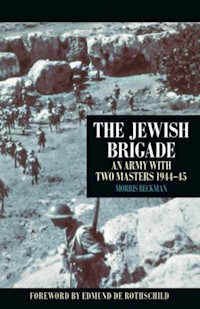
A brigade was formed in 1944 as part of the British Army and fought with distinction in Italy. It was the first all Jewish 'army', and knowledge of its existence and its role in defeating the Nazis gave an immense boost to Jews everywhere. After the war the brigade helped Jewish refugees beat the British blockade of Palestine. Having fought in the War, author Morris Beckman was the founder member of the 43 Group of Jewish ex-servicemen who attacked and destroyed Mosley's emergent Fascist party in a protracted campaign in the late 1940s.
Das E-Book können Sie in Legimi-Apps oder einer beliebigen App lesen, die das folgende Format unterstützen:
Veröffentlichungsjahr: 2010
Ähnliche


















Were these inglorious deeds? Was this the work of bastards?
Contents
Title Page
Dedication
Acknowledgements
Foreword
List of Illustrations
Prologue
Map of Northern Italy
Chapter One
Chapter Two
Chapter Three
Chapter Four
Chapter Five
Chapter Six
Chapter Seven
Chapter Eight
Chapter Nine
Chapter Ten
Chapter Eleven
Chapter Twelve
Chapter Thirteen
Chapter Fourteen
Appendices
Copyright
Acknowledgements
I have come across only three books about the Jewish Brigade. Written just after the end of the war, they are Wheels in the Storm by Major Wellesley Aron MBE, The Brigade by Hanoch Bartov, and With the Jewish Brigade by its Senior Chaplain, Rabbi Bernard Caspar. Later, I read On Parade, the much acclaimed book by Armoury Sergeant-Major Len Sanitt, Warrant Officer 1st Class, who, recovering from wounds, transferred to the Brigade and wrote about his experiences. Other key sources were Promise and Fulfilment, and Scum of the Earth by Arthur Koestler, Forged in Fury by Michael Elkins, The Living Bridge by Shimon Behar, General Secretary of the League of Israeli War Veterans, Soldiersfrom Judea by Rabinowitz, I Shall Live by Henry Ohrenstein, With Zionists at Gallipoli by Colonel James Patterson, and The Jewish Military Effort, 1939–1944 by Michael J. Cohen.
The Public Record Office provided the following War Diaries of the Palestine Regiment: WO/169/10312-10340; WO/169/16311-16313; WO/170/3870-3976; WO/170/4488-4492, and WO/170/5056-5058. It also supplied the Routine Orders issued by the Jewish Brigade HQ staff, which were more revealing still than the War Diaries.
Newspapers: every issue of The Jewish Chronicle from 1940 to 1945, excerpts from the Manchester Guardian, The Times, the Jerusalem Post, the Daily Mail, and the Hebrew Davar.
Reports and magazines, the Zionist Review, fax from Gerald Smith dated 16 July 1995, Israel’s Secret Wars, ‘An Italian Pilgrimage’ by Martin Sugarman, ‘The Jewish Brigade fought for its goals’ by Erita Oyserman, ‘The Jewish Infantry Brigade’ by Sergeant Myer Goldblum, The Canadian Jewish War Contribution, The Forgotten Ally.
I received invaluable support from The Association of Jewish Ex-Servicemen, and was thus able to interview British Jews, such as Eric Nabarro and Cyril Lebor, who had served with the Brigade. Towers of strength along the way were Mark Hyatt and Martin Sugarman – they corrected and advised me unstintingly. Above all I owe most to the late David Spector, who transferred from the Eighth Army to the Jewish Brigade and was appointed Staff Major. During his last months of life he was so keen on a book about the Brigade that, ill as he was, I visited him four times at his nursing home in Brighton. He gave me letters, published articles and first-hand information that was like gold dust.
Morris Beckman
Foreword
I am indeed privileged to write a Foreword to this excellent book that Morris Beckman has written on the Jewish Infantry Brigade Group, formed during World War II, and the difficulties created by those who were very opposed to it. There were many famous names indeed who did prevent a large body of willing men combat Nazi Germany.
Morris Beckman has written a fine account of the help given by the Brigade to those who wished to enter Palestine.
I commend this book as an important record of the events that took place during those years.
Edmund de Rothschild
List of Illustrations
1. Recruiting poster for the British Army, Tel Aviv, November 1941. (Ajex)
2. British Army volunteers parading in the streets of Tel Aviv, 1940 .(Ajex)
3. German soldiers leaving the synagogue in Genoa after cleaning it under the supervision of Jewish Brigade soldiers. (Major David Spector)
4. Brigaders of the Royal Army Service Corps dancing a hora with refugees adopted by the unit, Giovinazzo, Italy, 1944. (Ajex)
5. The front line, Italy, 1945. A Jewish Brigade patrol prepares to go out. (Ajex/Myer Goldblum)
6. Brigade staff, Italy, 1945. Left to right: Captain David Spector G3, Major Jackson G1, Brigadier Benjamin GOC, Captain Goodman IO. (David Spector)
7. Open-air speech given before the attack on the Senio front, April 1945. Captain Norman Cohen RAMC is in the foreground. (David Spector)
8. Commonwealth War Graves Commission cemetery at Ravenna, Italy, containing the graves of Jewish Brigaders of the Palestine Regiment. (Martin Sugarman)
9. ‘A’ Company, 1st Battalion Palestine Regiment’s victory parade, Faenza, Italy, 1945. (Ajex)
10. Guard duty, Tarvisio, Italy, 1945. (Ajex/Myer Goldblum)
11. Announcement of a football game between the Brigade and Belgian Maccabi, Brussels, 14 October 1945. (Ajex)
12. Brigader M. Goldblum with his truck, May 1946. Note the Brigade insignia on the mudguard. (Ajex/Myer Goldblum)
13. Foreign Representative of the Jewish Agency, Moshe Shertok, presenting the Brigade standard at Fiuggi, northern Italy. (Ajex)
14. The Jewish Brigade at Tarvisio after the war. The soldiers are being addressed by the Jewish Agency on the task of finding and rescuing Jewish survivors. (Ajex)
Prologue
By the summer of 1944, 1.3 million Jews were fighting with the Allied forces against the Germans and the Japanese. They included 600,000 Americans, 500,000 Soviets, 70,000 British and Commonwealth servicemen, and 15,000 Polish free forces. There were also several thousand in the free forces of the other European territories under Nazi occupation. Thousands more, who had escaped from concentration camps, death trains and the Nazi search-and-murder Solderkommandos, were fighting alongside the Maquis and partisans in Europe’s marshes, forests and mountains. All of these Jews fought under the flags of their countries of birth. In addition, some 35,000 Palestine Jews fought as volunteers in a variety of units in Europe and the Middle East. They wore British uniforms and fought under the Union flag. Classified as colonial troops, they wore the Palestine shoulder flash. Because Palestine was a mandated territory, the British could not conscript its young men for military duty. This did not matter as, at the outbreak of war, 120,000 young Palestine Jewish men and women rushed to join the British forces.
A high proportion of the volunteers were European escapees from the Nazis. Predominantly Germans, Poles, Austrians and Czechs, they were worried sick about the fate of their families, and their hatred of the Nazis was intense. From day one of the war they wanted only to be combat-trained and to be given a chance to fight against Germany. However, for four years, the pro-Arab bias of the Palestine government and the British Foreign Office, and their fear of upsetting the Arabs by allowing the creation of a Jewish combat force, diverted the volunteers into service, support and guard-duty units. How wrong they were. At that time, the Arabs would not have cared a damn if a Jewish fighting force had come into being as long as it did its fighting against Germany and well away from Palestine. The Arabs had only one objective – an end to British and French colonisation of their lands.
Despite being implacably opposed, the Palestine administration and the Jewish Agency were pragmatic enough to meet when military necessity dictated. These were cagey, adversarial encounters that reflected the mistrust felt between the administration and the Agency. One factor above all others soured relations – something which the British failed to grasp – the Palestine Jews were the only Jews in the world who owned the pockets of land that were theirs alone. Their sense of identification with this Eretz Yisroel (Land of Israel) was so strong that it transcended narrow nationalism. When they flew the Jewish flag over their buildings, no mandatory power on earth could make them lower it. To the Agency the formation of a Jewish combat force, fighting under the Jewish flag, was no more than their entitlement. But it was a thorn in the flesh of the Palestine mandarins and the Foreign Office in London. Upset tens of millions of Arabs, with their oil, the Suez Canal and strategic geographical position to appease a mere half million Jewish settlers? Unthinkable!
War makes demands, especially periods when the appetite for personnel is voracious. After the fall of France in 1940, British servicemen were rushed home from the Middle East and Africa to defend their own country. They left a vacuum which had to be filled. There was a particular need for air force ground staff, and the Palestine Jewish community was an obvious source. With the common aim of defeating the Third Reich, the British and the Jewish Agency met again. And it was at this point that the Agency changed its stance. It realised that every Jewish man and woman recruited into the British forces would receive invaluable military training and experience, and strengthening Britain’s lone stand against the Axis powers was of paramount importance. The Agency continued to press its demand for the creation of a Jewish force, fighting under its own flag, but in a lower key and less frequently. And of course the demand continued to be denied, even ignored altogether.
However, the Agency began to note support in sections of the British press and from several parliamentarians. More than anyone, Winston Churchill gave them hope. In 1940 he angrily declared in the House of Commons that it was nonsense for Britain to reject the offer of a fighting force of 40,000 Jews when the nation was so hard pressed to contain the Axis powers. Churchill continued to press this point and, by the late summer of 1944, he had lost patience with the Foreign Office and the War Office, and demanded action. He got it. By now revelations of the true horrors of the Holocaust were stunning the civilised world, and virtually the whole British press was demanding that Jews should not be denied the opportunity to confront in combat the murderers of their people.
When, in early March 1945, the Jewish Infantry Brigade took its place in the Allied line south of the Senio river in Italy, and faced seasoned German paratroops and a Jaeger Division, the news galvanised Jews throughout the world. The Brigade had 5,500 men. All of its ancillary units had seen active service in the Western Desert and Italian campaigns. Its three infantry battalions, mortar and artillery units had undergone three months of the most gruelling training in bitterly cold weather and icy conditions in the Italian mountains.
The Brigade formed a component part of the British Eighth Army. Every man felt privileged, the large number of academics and intellectuals making all the soldiers aware that they were making history. As he gazed at the German positions, no Brigader would have wanted to be anywhere else. Morale was sky-high. They knew that news of the Brigade’s formation had filtered into those parts of Europe where their co-religionists were in dire straits, and had given them hope. Other Jews in the Allied forces watched and waited to see how the Brigade would acquit itself. In a services club in Rome, a young American Jewish infantryman, said to a Palestine ATS woman, ‘Well, lady, I guess they’ll just have to perform.’
History records that they performed well. Flanked by free Italian and Polish units, they attacked with an elan fuelled by pent-up frustration and an unquenchable thirst for revenge. In an ‘up-and-at-’em’ mood, they fixed bayonets and rushed the German positions. The Germans in their sector melted away in a retreat that developed into a rout of the once mighty Wehrmacht. The war ended and, the Brigade fetched up at Tarvisio, where the borders of Austria, Italy and Yugoslavia met. Here, though still under the command of the Eighth Army, their attention turned to their hidden agenda, laid down by their political masters in Tel Aviv.
The prime remit was to reach out into Europe in small well-armed convoys, to find and rescue as many Jewish survivors as they could, and to take them to shelters being set up by Brigaders in Italy. Here, the emaciated, broken human wrecks would be physically and mentally rehabilitated, then driven south to be put onto boats bound for Palestine, where they would once again live normal lives. The soldiers set about their task with inspired zeal and humanity.
Another priority was retribution, though this was a very hush-hush subject. All the Brigaders I have spoken to admitted that ‘things did happen’, but very few would spell out what these were. A paragraph in the Brigade’s ‘Routine Orders’ stipulated that, during fighting, infantry men should not execute Nazis taken prisoner as they were needed for interrogation. British Jews who served with the Brigade confirmed that when appalling stories were told of the gas chambers and ovens, and the mass slaughter of Jews, emotions often became uncontrollable. The Agency knew that in the postwar confusion, thousands of top SS officers, who were guilty of the most atrocious crimes, would attempt to escape punishment, often in Spain or South America, along the Odessa escape route. The Brigade was chosen to ensure that at least some of these top-ranking SS officers would answer for their crimes against humanity. Armed with intelligence supplied by the Agency and Jewish survivors, revenge squads, with three or four soldiers to each vehicle, went out all over Germany and Austria to exact revenge. There was no shortage of volunteers for the task. In The Times of Thursday 13 July 1995, there appeared an obituary of Meir Zorea who had died on 24 June, aged 72. He had been an Israeli army general and a member of the Knesset. As a second lieutenant in the Jewish Brigade he was awarded the Military Cross for leading his patrol through intense enemy fire, allowing spotters to pinpoint German positions. Zorea had been a member of a revenge squad and he recalled:
We only eliminated those directly involved in the slaughter of Jews. At first we put a bullet through their heads. Then we strangled them. With our bare hands. We never said anything before we killed them. Not why or who we were. We just killed them like you kill a bug.
These were the first postwar executions of selected top Nazis. There were certainly several dozen revenge squads operating; the highest estimate of executions was 1,500. The exact figure will never be known. Those targeted were picked up in their home cities and towns, many plucked from the homes they had come back to before leaving with new identities for safe havens.
Taking precedence over all else was the Brigaders’ awareness that it was now time to prepare for the approaching struggle that would have to be waged to ensure the survival of the Land of Israel. By 1945, unrest in Palestine and the conflict between the British forces and the Haganah, the uncontrollable right-wing Stern Gang, and the Irgun Zvi Leumi groups had escalated to the point where it became certain that Britain would give up the mandate and pull out of Palestine. When this happened, the Jewish community would be attacked by an overwhelming number of Arabs intent on its destruction.
Hitler had achieved one victory – he had rendered Central and Eastern Europe Jew-free. He had murdered six million; the surviving one million were physically and mentally shattered by what they had been through. They were rootless, totally disoriented and without hope as they wandered aimlessly, or rotted in the hastily established displaced persons camps. The suicide rate was alarmingly high. No one wanted to take them in – with one exception, the Jewish community in Palestine. But to get there they would have to run the gauntlet of the British army, navy and air force, engaged in an attempt to satisfy the obsession of the British Foreign Secretary, Ernest Bevin. He had vowed to crush Zionism. With utterances such as, ‘It’s them or us’, he had turned world opinion against Britain. He had also succeeded in turning the British press, as well as parliamentary and public opinion, against his sledgehammer policies in Palestine.
So, when one war was scarcely ended, the Jewish Brigade threw its energy into preparing for the next one. They stepped up the rescue of their suffering co-religionists from the hell of Europe and their passage south to the Palestine-bound boats and salvation. They increased the smuggling of arms to be hidden on farms and kibbutzim throughout Palestine. They picked out the fittest, young, male refugees and took them into the Italian mountains for weapons and fieldcraft training. Brigaders boarding ships in Antwerp and Marseilles to take them home to be demobilised in Palestine gave their uniforms and papers to these now trained refugees, who would take their place.
When the Brigade contingent took part in the impressive postswar victory parade in London, many of its members were still trying to come to terms with the loss of their families. They marched proudly, but unlike those around them, they had their minds focussed on the struggle that lay ahead.
On 29 November 1947 the General Assembly of the United Nations recommended the partition of Palestine. From that day, the British stood aside and watched, until they withdrew their entire military force and their administration on 15 May 1948. On the day following the UN pronouncement, Arabs opened fire on buses, ambushed cars and lorries, set fire to the commercial heart of Jerusalem, went on strike, rioted, attacked and murdered isolated Jewish settlements. The British did not intervene. But the Haganah, aware that it was now the sole protector of the Jewish community, fought back ferociously. On 15 May 1948, David Ben-Gurion proclaimed the birth of the state of Israel.
Only one day later, the armies of five Arab nations, overwhelming in numbers, well armed, and totally confident, attacked with the aim of wiping out the new democracy. No one outside the region expected the Jews to survive. The world held its breath. But with the Holocaust a still fresh memory, and embedded in the souls of the Jews, they fought back with a ferocity that stopped the invading armies in their tracks. The enemy crumbled and scurried back to the safety of their own borders. In a single week the Jews doubled the amount of land that had been awarded to them by the United Nations.
The Jewish Brigade, which subsequently provided thirty-five generals for the Israeli Defence Forces, helped to establish the foundations and the structure on which the state of Israel built the most formidable defensive military machine in the Middle East.
Map of Northern Italy
Northern Italy.
Chapter One
This is the story of the odyssey of a people who never gave up hope. It lasted for nearly 2,000 years. It took them through a seemingly endless dark age when rootlessness and persecution was their everyday lot. It began in AD 135, when the Roman legions under Hadrian crushed the Judean rebellion, and it ended in 1948, when the descendants of those defeated Judeans won their War of Independence in that same land.
When the Romans crushed Bar Kochba’s revolt, they vowed it would be the last by their most troublesome subject people who, rather than worship Roman gods instead of their own One God, Jehovah, preferred to die in battle. The Romans were pitiless. They razed towns and villages, and put the people to the sword. They sacked Jerusalem and destroyed its magnificent temple, leaving only the western (Wailing) wall standing. Then they scattered the surviving Jews to the four points of the compass. The long, fraught journey had begun.
Wherever the remnants of the Jewish community landed up, they clung to four things for comfort: their concept of the One God, their ethical beliefs, their traditional family values, and the Hebrew language. Their strange and reclusive behaviour did not go down well with the indigenous peoples among whom they settled. And they quickly became the focus of blame, lies and grotesque propaganda. They made a ready target for anyone who saw advantage in stirring up and exploiting anti-Jewish prejudice. Over the years, that has not changed.
The aggressive spread of Christianity compounded the isolation of the Jews. Because Judaism was at the time the only other monotheistic religion, Christian leaders saw it as a rival, and even a threat to their power and authority. Attempts to convert Jews to Christ ran into the brick wall of Jewish stubbornness. The next logical step was to demonise these strange people in their midst. It worked. To the unsophisticated masses, the persecution of a Jewish minority became an acceptable, even commendable, activity. The deadliest myth of all, and one that never truly died, was that the Jews had killed Jesus. This enormous lie, accusing the Jews of deicide, was so prevalent across the ages that, even in the twentieth century, Jewish students, taking scripture lessons in enlightened schools, would have to suppress the urge to leap to their feet and protest that it was not their people who were responsible for the death of Christ.
As the centuries passed, there was no let up in the scapegoating of Jews. They were used as catspaws and then discarded, even put to death, when their usefulness ended. They were harried and murdered by Crusaders en route to Palestine to fight the Saracens, and for sport. On the whim of rulers, they were incarcerated in ghettos, and expelled from countries where they had lived for generations. In the Iberian peninsula, they were burnt at the stake for refusing to convert to Catholicism. They were subjected to malicious anti-Jewish laws, pogroms, and physical and verbal abuse. They endured an endless flood of anti-semitic literature in every European language. They suffered so many humiliations, it was not surprising that deep in every Jew’s psyche lay the longing that one day the Jewish people would be able to live a normal life in their own land, free of fear and apprehension.
This yearning was found in every Jewish family throughout the world. At gatherings to celebrate the festival of Passover, the final toast of the Seder night services, commemorating Moses leading the Hebrew slaves out of Egypt, was, ‘And, the next year in Jerusalem’. The toast was proclaimed with the most heartfelt emotion. My father, who fled, from Polish pogroms at the turn of the century, would shake his head and say sadly, ‘It’s a pipe-dream. When? Where? How? Forget it.’
As Jews repeated the toast during the 1930s and ‘40s, the end of the awful odyssey was near. For young Jews, if not for the still cautious and even servile elderly Jews with their appalling memories, the walls of Jericho were within sight. The coming of the Messiah would not take the form of an old, venerably bearded man with a charismatic appeal and the eloquence of a Shakespearean actor, but as young men and women carrying guns, driving tanks and flying warplanes.
Historically, Jews have always taken up arms to defend their countries of birth or adoption. Yet, this has never protected them from anti-semitism, whether intellectual, as in France, brutal, as in Eastern Europe, or psychopathically beyond the pale, as in Nazi Germany.
After the First World War, many Germans, unable to accept that their much-vaunted military machine had been defeated, blamed German Jews for having stabbed the country in the back – a difficult feat for the 22,000 killed fighting for the Fatherland. In Britain, also after the First World War, ugly murmurings needled Rabbi Michael Adler DSO, SCF, BA into compiling The British Jewry Book of Honour, a four-inch thick tome published in 1922 and listing the community’s 9,000 casualties and tally of 1,596 decorations, including five Victoria Crosses.
There were very few instances of Jews in the diaspora forming their own units. The first recorded was in 1794, when Berek Yoselovitch formed a Jewish regiment in Poland as part of General Tadeusz Kosciusko’s army to overthrow the oppressive overlordship of Russia. The regiment fought in Polish uniforms, and under the Polish flag. Most of its officers and men were killed trying to contain successive Russian attacks. The survivors went home to endure the Poles’ endemic hatred of the Jews.
Jewish longing for a National Home has always been a buried seed waiting to germinate. It needed an inspiration to fertilise it. In France, in 1894, that miracle happened. It arrived in the shape of a young Hungarian Jewish journalist, Theodore Herzl, who was covering the Dreyfus trial for a Vienna newspaper.
Although Jews enjoyed full civil rights, France then was a country in which anti-semitism was rife. It broke the surface with a splash when Captain Albert Dreyfus, a Jewish officer on the General Staff, was found guilty of espionage and was sentenced to life imprisonment on the dreaded Devil’s Island. His conviction set off a flurry of anti-semitic articles in the press. Fortunately, however, there were some Frenchmen who thought something about the affair stank. Among these was the famous novelist, Emile Zola. He took up the cudgels on Dreyfus’s behalf and penned his famous piece, ‘J’accuse’. When it was printed in L’Aurore, all hell broke loose as France split into those who damned the Jewish traitor, and those who were convinced of his innocence.
Then, out of the blue, the real traitor, Major Ferdinand Esterhazy, walked into a London newspaper office and confessed his guilt. Even then, the French government was reluctant to reopen the case. Too many prominent people had been involved in the murky business of false accusation. But five years later a new government ordered a new trial. Again the court, part of the establishment, condemned Dreyfus; later, quietly, the court’s findings were set aside. The president pardoned the Jewish officer, and Dreyfus was reinstated into the French army.
The trial of Dreyfus affected Jewish minds as nothing else had. It struck Herzl, the young journalist, like a flash of lightning. Until then, he had considered the assimilation of Jews as a viable solution. Suddenly the ground shifted under his feet. He became completely obsessed with the future of the Jewish people, and he saw that the only real solution was the establishment of a Jewish National Home. From that moment, all of his energy and efforts were concentrated on achieving it. He travelled ceaselessly, seeing anyone and everyone who was prepared to listen. Amazingly, these included presidents, politicians, the pope, the sultan of Turkey, as well as countless Jews, from the influential upper crust to the lowliest worker. He wrote pamplets, the best known of which was ‘The Jewish State’, and a book, Old-New Land. Herzl and his growing band of supporters called themselves ‘Zionists’, and in 1897 he convened the first Zionist Congress in Basle, Switzerland. The Zionist movement was officially founded. It proclaimed a single aim – the establishment of a legally secure homeland for Jews in Palestine.
Herzl worked tirelessly and literally burned himself out in his endeavours to realise his dream. He died at only 44; 7,000 people attended his funeral on 7 July 1904. Among them, following the cortege, was the famous author, Stefan Zweig, who wrote:
This gigantic outpouring of grief from the depths of millions of souls caused me to realise how much passion and hope this lone and lonesome man had borne into the world through the power of a single idea.
It could be argued that Herzl was as great a leader of the Jewish people as Moses who led the Hebrew slaves from Egypt to freedom in the Promised Land. Over 2,000 years later, Herzl established that this same Promised Land had to be the new Jewish National Home, and he founded the movement that united Jews to achieve this goal. Furthermore, he persuaded them that they could and would achieve it.
In 1905 the Tsar’s troops crushed a revolt in Russia and vicious, widespread pogroms followed. Disillusioned Jews, with no bread to eat nor a kopek in their pockets, decided to leave Russia. Herzl’s Zionism now proved its worth. It gave them direction, a sense of where to go. Between 1905 and 1914, some 35,000 made the trek to Palestine. They burned with the zeal of pioneers and planned to create a socialist paradise. They were desperately poor, inured to hardship, and ready to work their fingers to the bone to build new lives for themselves. They settled on land purchased for them by the Jewish Agency. They found the going harsh. From sunrise to sunset and beyond, they drained swamps and cleared desert of stones and scrub. They dropped from heatstroke and malaria. They died of exhaustion and malnutrition. A doctor advised a young Polish student to return to Europe or he would die. That student, David Ben-Gurion, ignored the advice, and forty years later became Israel’s first prime minister.
In 1909 Tel Aviv was founded on the dunes of Jaffa beach. Kibbutz Degania was built. Herzl’s dream was becoming reality. The two vital ingredients needed to make a country are land and the people to work it. Until the First World War, Jewish colonisation in Palestine took place with Arab cooperation. Arab effendi and landowners sold their land to the Jewish Agency, demanding exorbitantly high prices for what they considered barren areas – and to their gratification they were paid.
Inevitably the determined efforts of the settlers meant they began to enjoy a standard of living denied their Arab neighbours. New orchards produced fruit and olives. Well-planned irrigation systems and good husbandry saw grass grow on new soil. There were cattle, chicken runs, and a range of produce. But the settlers were sniped at. Their vehicles were ambushed. Those required to work in the open carried rifles along with their spades and sieves. The Hashomer (watchmen) erected tall observation towers manned round the clock, and encircled the settlements with barbed-wire stockades. Here lay the beginnings of what would one day develop into the powerful Israeli armed forces. In the late 1930s, the British introduced legislation to reduce the sale of land. But still the Arabs sold and the Jewish Agency bought, and European refugees and idealistic Zionists from the western democracies and South Africa continued to trickle in.
In 1914 war broke out. Jews in the countries involved donned their national uniforms and fought alongside their fellow citizens. The Tsar, however, took it into his head to accuse the Jews of disloyalty. Thousands were deported to Siberia. Few returned. Palestine Jews felt an affinity with Britain and the Allies, and offered to form Jewish units to support them. Their offer was turned down. A leading writer and orator, Vladimir Jabotinsky, refused to accept the Allies’ denial of a Jewish regiment to fight the Turks. Later, he swung to the extreme right and founded the Zionist Revisionist Party. An energetic dreamer with a cause, Jabotinsky sat down at a meeting with other Zionist leaders in Egypt in March 1915. Among these was a Russian Jew, Joseph Trumpeldor, who had lost an arm fighting for Russia against Japan in the war of 1905. He had been awarded the Gold Order of St George four times for gallantry, and had been taken prisoner by the Japanese. He was killed in 1920 defending the kibbutz of Tel Hai.
At that meeting in March 1915 Trumpeldor displayed his forceful personality. General Maxwell of Cairo HQ Staff would not accept Palestine Jews as fighting troops because they were foreign and not Empire nationals, though he was prepared to use them as a mule corps, for specific purposes. All the delegates at the meeting turned down this suggestion, declaring that they did not wish to join a donkey battalion. Trumpeldor took a different line. With passion he declared, ‘On which front we start is a matter of tactics. Any and every front leads to Zion. We have to smash the Turks.’ He prevailed and the Zion Mule Corps (ZMC) was formed. With 737 volunteers, mostly Russian Jews who had been expelled to Egypt, it was equipped with twenty horses and 750 pack mules. The men had rifles, bayonets and ammunition. For three weeks before embarking for Gallipoli, they underwent intensive training. Their commander was Lieutenant-Colonel Henry Patterson DSO, a tall and elegant veteran of the Boer War. He was of Irish Protestant origin, and immediately established a sympathetic rapport with his men. He even fought against unfriendly attitudes in high places to secure for them kosher food and matzo (unleavened bread) for Passover.
On 15 April 1915, the ZMC on HMT Dundrennon approached Cape Helles at the extreme southern tip of Gallipoli. Under intense enemy artillery and machine-gun fire they landed and went straight to work. They were officially classified as a line-of-communication unit. Two hundred mules were unloaded at W Beach, and the others at V Beach. Then they were continuously in action under fire supplying the line troops with food, water and ammunition. On one occasion, terrified mules with their chains clanking panicked and careered into Turks creeping forward for a surprise attack. This alerted the British, who halted the attack with intense fire. On 5 May Private M. Groushkowsky exposed himself under fire to prevent his mules stampeding. Although wounded in both arms, he delivered his ammunition to the trenches. General Stopford personally awarded Groushkowsky the Distinguished Conduct Medal.
Three days later the ZMC reached the Inniskilling Fusiliers with supplies as they, depleted in numbers by many casualties, prepared for a counter-attack. The ZMC fixed bayonets to their rifles and, led by Corporal Hildesheim, joined in the charge. On 20 May the ZMC suffered losses – men killed and wounded, horses and mules – under intense Turkish artillery fire. Private Nissel Rosenberg brought his laden mules through to the front line under intense fire and was recommended for a DCM and promoted sergeant. Sergeant-Major Erchkovitz was awarded the DCM.
By the end of July the ZMC was down to half its original strength owing to casualties and sickness. Over a hundred mules had been killed. On 25 July Patterson and Trumpeldor sailed for Egypt, and in the main Cairo synagogue raised 150 volunteers for the Corps. They were referred to as the Cairo troop of the ZMC. By now, news about the ZMC had aroused great interest among Jews everywhere and generated pride that they were performing so well. Patterson recorded that he had received dozens of letters from senior officers testifying to the fearless work of his men. On 29 November Patterson had to be evacuated to Alexandria with an illness that laid him low. Trumpeldor was appointed CO in his place, was wounded by a bullet in the shoulder, but refused to be evacuated and stayed with the ZMC until it was pulled out in January 1916.
In Egypt the ZMC were told that they were to be ordered to Ireland to help to quell a revolt. To a man they refused, declaring they had joined up to fight Turks not Irish patriots. The ZMC was disbanded.




