


17,99 €
Mehr erfahren.
- Herausgeber: John Wiley & Sons
- Kategorie: Geisteswissenschaft
- Serie: Key Contemporary Thinkers
- Sprache: Englisch
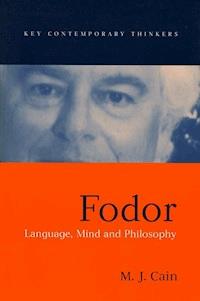
Jerry Fodor is one of the most important philosophers of mind in recent decades. He has done much to set the agenda in this field and has had a significant influence on the development of cognitive science. Fodor's project is that of constructing a physicalist vindication of folk psychology and so paving the way for the development of a scientifically respectable intentional psychology. The centrepiece of his engagement in this project is a theory of the cognitive mind, namely, the computational theory of mind, which postulates the existence of a language of thought. Fodor: Language, Mind and Philosophy is a comprehensive study of Fodor's writings. Individual chapters are devoted to each of the major issues raised by his work and contain extensive discussion of his relationships to key developments in cognitive science and to the views of such philosophical luminaries as Dennett, Davidson and Searle.
This accessible book will appeal to advanced level undergraduate students of philosophy and related disciplines. It will also be of great interest to professional philosophers and cognitive scientists.
Sie lesen das E-Book in den Legimi-Apps auf:
Seitenzahl: 492
Veröffentlichungsjahr: 2013
Ähnliche



















Table of Contents
Cover
Title page
Copyright page
Key Contemporary Thinkers
Acknowledgements
1 The Fodorian Project
Introduction
Folk Psychology
Physicalism
Physicalism and the Mental
Conclusion
2 Philosophical and Scientific Background
Introduction
Psychology and Philosophy
Psychological Behaviourism and the Cognitive Revolution
Philosophical Behaviourism
The Type Identity Theory
Functionalism
Conclusion
3 The Computational Theory of Mind
Introduction
Intentional States
Intentional Processes
Fodor’s Arguments for CTM
Concept Nativism
Fodor’s Attempt to Retreat from Radical Concept Nativism
Conclusion
4 Challenges to the Computational Theory of Mind
Introduction
Davidson and Dennett
Searle
Connectionism
Conclusion
5 Explaining Mental Content
Introduction
Naturalistic Theories of Content
Fodor’s Theory of Content
Atomism and Conceptual Role Semantics
Some Potential Problems for Fodor’s Theory
Some More Telling Objections
Conclusion
6 Individualism and Narrow Content
Introduction
The Nature of the Issue
Individualism and Folk Psychology
Individualism and the Computational Theory of Mind
The Argument from Causal Powers
Narrow Content
Fodor’s Rejection of Narrow Content
Conclusion
7 The Modularity Thesis
Introduction
The Nature of Fodor’s Modularity Thesis
Are Input Systems Modules?
The Central System
Philosophical Implications of the Modularity Thesis
Conclusion
Afterword
References
Index
Copyright © M. J. Cain 2002
The right of M. J. Cain to be identified as author of this work has been asserted in accordance with the Copyright, Designs and Patents Act 1988.
First published in 2002 by Polity Press in association with Blackwell Publishers Ltd
Editorial office:
Polity Press
65 Bridge Street
Cambridge CB2 1UR, UK
Marketing and production:
Blackwell Publishers Ltd
108 Cowley Road
Oxford OX4 1JF, UK
Published in the USA by
Blackwell Publishers Inc.
350 Main Street
Malden, MA 02148, USA
All rights reserved. Except for the quotation of short passages for the purposes of criticism and review, no part of this publication may be reproduced, stored in a retrieval system, or transmitted, in any form or by any means, electronic, mechanical, photocopying, recording or otherwise, without the prior permission of the publisher.
Except in the United States of America, this book is sold subject to the condition that it shall not, by way of trade or otherwise, be lent, re-sold, hired out, or otherwise circulated without the publisher’s prior consent in any form of binding or cover other than that in which it is published and without a similar condition including this condition being imposed on the subsequent purchaser.
ISBN 0-7456-2472-3
ISBN 0-7456-2473-1 (pbk)
ISBN 978-0-7456-6595-5 (epub)
A catalogue record for this book is available from the British Library and has been applied for from the Library of Congress.
Key Contemporary Thinkers
Published
Jeremy Ahearne, Michel de Certeau: Interpretation and its Other
Peter Burke, The French Historical Revolution: The Annales School 1929–1989
Michael Caesar, Umberto Eco: Philosophy, Semiotics and the Work of Fiction
M. J. Cain, Fodor: Language, Mind and Philosophy
Colin Davis, Levinas: An Introduction
Simon Evnine, Donald Davidson
Edward Fullbrook and Kate Fullbrook, Simone de Beauvoir: A Critical Introduction
Andrew Gamble, Hayek: The Iron Cage of Liberty
Graeme Gilloch, Walter Benjamin: Critical Constellations
Karen Green, Dummett: Philosophy of Language
Phillip Hansen, Hannah Arendt: Politics, History and Citizenship
Sean Homer, Fredric Jameson: Marxism, Hermeneutics, Postmodernism
Christopher Hookway, Quine: Language, Experience and Reality
Christina Howells, Derrida: Deconstruction from Phenomenology to Ethics
Fred Inglis, Clifford Geertz: Culture, Custom and Ethics
Simon Jarvis, Adorno: A Critical Introduction
Douglas Kellner, Jean Baudrillard: From Marxism to Post-Modernism and Beyond
Valerie Kennedy, Edward Said: A Critical Introduction
Chandran Kukathas and Philip Pettit, Rawls: A Theory of Justice and its Critics
James McGilvray, Chomsky: Language, Mind, and Politics
Lois McNay, Foucault: A Critical Introduction
Philip Manning, Erving Goffman and Modern Sociology
Michael Moriarty, Roland Barthes
Harold W. Noonan, Frege: A Critical Introduction
William Outhwaite, Habermas: A Critical Introduction
John Preston, Feyerabend: Philosophy, Science and Society
Susan Sellers, Hélène Cixous: Authorship, Autobiography and Love
David Silverman, Harvey Sacks: Social Science and Conversation Analysis
Dennis Smith, Zygmunt Bauman: Prophet of Postmodernity
Nicholas H. Smith, Charles Taylor: Meaning, Morals and Modernity
Geoffrey Stokes, Popper: Philosophy, Politics and Scientific Method
Georgia Warnke, Gadamer: Hermeneutics, Tradition and Reason
James Williams, Lyotard: Towards a Postmodern Philosophy
Jonathan Wolff, Robert Nozick: Property, Justice and the Minimal State
Forthcoming
Maria Baghramian, Hilary Putnam
Sara Beardsworth, Kristeva
James Carey, Innis and McLuhan
Rosemary Cowan, Cornell West: The Politics of Redemption
George Crowder, Isaiah Berlin: Liberty, Pluralism and Liberalism
Thomas D’Andrea, Alasdair MacIntyre
Eric Dunning, Norbert Elias
Jocelyn Dunphy, Paul Ricœur
Matthew Elton, Daniel Dennett
Nigel Gibson, Frantz Fanon
Espen Hammer, Stanley Cavell
Keith Hart, C. L. R. James
Sarah Kay, Žižek: A Critical Introduction
Paul Kelly, Ronald Dworkin
Carl Levy, Antonio Gramsci
Moya Lloyd, Judith Butler
Dermot Moran, Edmund Husserl
Kari Palonen, Quentin Skinner
Steve Redhead, Paul Virilio: Theorist for an Accelerated Culture
Chris Rojek, Stuart Hall and Cultural Studies
Wes Sharrock and Rupert Read, Kuhn
Nicholas Walker, Heidegger
Acknowledgements
This work started life as a PhD thesis submitted to the University of St Andrews in 1997. I benefited from the supervision of Roger Squires and (whilst I was a visiting research student at Birkbeck College, London) that of Sarah Patterson and Barry Smith along with the comments of my examiners, Crispin Wright and Martin Davies. I have received valuable feedback on draft versions of the early chapters from Anna Hindley and members of classes that I taught at Birkbeck College and the University of Nottingham. The comments of two anonymous readers for Polity helped me to improve the clarity and organization of the text. I would like to take this opportunity to express my gratitude to all of these people.
Julie Reid has been a constant source of affection, support and encouragement. Without her companionship, completing this pro-ject would have been a much more stressful experience than it turned out to be. My greatest debt is to my parents, Bernard and Christine Cain. Without their unceasing support, my philosophical career would have ground to a halt several years ago. This book is dedicated to them.
2
Philosophical and Scientific Background
Introduction
In chapter 1 I characterized Fodor’s central ambition as being that of vindicating folk psychology within a physicalist framework. The core of Fodor’s attempted vindication of folk psychology is a theory of intentional states and processes according to which intentional states are computational relations to sentences of a language of thought and intentional processes are computational processes involving the manipulation of such sentences. Call this theory the computational theory of mind (CTM for short). In order to gain a full understanding of CTM and Fodor’s motivations for holding it, it is important to be aware of a series of important developments that took place in scientific psychology and the philosophy of mind in the second half of the twentieth century. In this chapter I will give a detailed account of these historical developments and Fodor’s role in them.
Psychology and Philosophy




