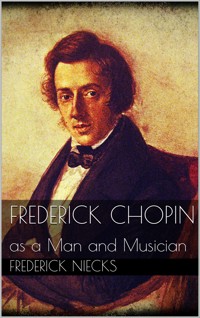
Frederick Niecks
Frederick Chopin
UUID: b54b8808-c111-11e5-b533-0f7870795abd
This ebook was created with StreetLib Write (http://write.streetlib.com)by Simplicissimus Book Farm
Table of contents
VOLUME I.
PREFACE
PROEM.
CHAPTER I.
CHAPTER II
CHAPTER III
CHAPTER IV.
CHAPTER V.
CHAPTER VI
CHAPTER VII
CHAPTER VIII
CHAPTER IX.
CHAPTER X.
CHAPTER XI.
CHAPTER XII
CHAPTER XIII
CHAPTER XIV.
CHAPTER XV.
CHAPTER XVI.
CHAPTER XVII
CHAPTER XVIII
CHAPTER XIX.
VOLUME II.
CHAPTER XX.
CHAPTER XXI.
CHAPTER XXII.
CHAPTER XXIII.
CHAPTER XXIV.
CHAPTER XXV.
CHAPTER XXVI.
CHAPTER XXVII.
CHAPTER XXVIII.
CHAPTER XXIX.
CHAPTER XXX.
CHAPTER XXXI.
CHAPTER XXXII.
EPILOGUE.
VOLUME I.
PREFACE
While
the novelist has absolute freedom to follow his artistic instinct and
intelligence, the biographer is fettered by the subject-matter with
which he proposes to deal. The former may hopefully pursue an ideal,
the latter must rest satisfied with a compromise between the
desirable and the necessary. No doubt, it is possible to thoroughly
digest all the requisite material, and then present it in a perfect,
beautiful form. But this can only be done at a terrible loss, at a
sacrifice of truth and trustworthiness. My guiding principle has been
to place before the reader the facts collected by me as well as the
conclusions at which I arrived. This will enable him to see the
subject in all its bearings, with all its pros and cons, and to draw
his own conclusions, should mine not obtain his approval. Unless an
author proceeds in this way, the reader never knows how far he may
trust him, how far the evidence justifies his judgment. For—not to
speak of cheats and fools—the best informed are apt to make
assertions unsupported or insufficiently supported by facts, and the
wisest cannot help seeing things through the coloured spectacles of
their individuality. The foregoing remarks are intended to explain my
method, not to excuse carelessness of literary workmanship. Whatever
the defects of the present volumes may be—and, no doubt, they are
both great and many—I have laboured to the full extent of my humble
abilities to group and present my material perspicuously, and to
avoid diffuseness and rhapsody, those besetting sins of writers on
music.The
first work of some length having Chopin for its subject was Liszt's
"Frederic Chopin," which, after appearing in 1851 in the
Paris journal "La France musicale," came out in book-form,
still in French, in 1852 (Leipzig: Breitkopf and Hartel.—Translated
into English by M. W. Cook, and published by William Reeves, London,
1877). George Sand describes it as "un peu exuberant de style,
mais rempli de bonnes choses et de tres-belles pages." These
words, however, do in no way justice to the book: for, on the one
hand, the style is excessively, and not merely a little, exuberant;
and, on the other hand, the "good things" and "beautiful
pages" amount to a psychological study of Chopin, and an
aesthetical study of his works, which it is impossible to
over-estimate. Still, the book is no biography. It records few dates
and events, and these few are for the most part incorrect. When, in
1878, the second edition of F. Chopin was passing through the press,
Liszt remarked to me:—"I
have been told that there are wrong dates and other mistakes in my
book, and that the dates and facts are correctly given in
Karasowski's biography of Chopin [which had in the meantime been
published]. But, though I often thought of reading it, I have not yet
done so. I got my information from Paris friends on whom I believed I
might depend. The Princess Wittgenstein [who then lived in Rome, but
in 1850 at Weimar, and is said to have had a share in the production
of the book] wished me to make some alterations in the new edition. I
tried to please her, but, when she was still dissatisfied, I told her
to add and alter whatever she liked."From
this statement it is clear that Liszt had not the stuff of a
biographer in him. And, whatever value we may put on the Princess
Wittgenstein's additions and alterations, they did not touch the
vital faults of the work, which, as a French critic remarked, was a
symphonie funebre rather than a biography. The next book we have to
notice, M. A. Szulc's Polish Fryderyk Chopin i Utwory jego Muzyczne
(Posen, 1873), is little more than a chaotic, unsifted collection of
notices, criticisms, anecdotes, &c., from Polish, German, and
French books and magazines. In 1877 Moritz Karasowski, a native of
Warsaw, and since 1864 a member of the Dresden orchestra, published
his Friedrich Chopin: sein Leben, seine Werke und seine Briefe
(Dresden: F. Ries.—Translated into English by E. Hill, under the
title Frederick Chopin: "His Life, Letters, and Work," and
published by William Reeves, London, in 1879). This was the first
serious attempt at a biography of Chopin. The author reproduced in
the book what had been brought to light in Polish magazines and other
publications regarding Chopin's life by various countrymen of the
composer, among whom he himself was not the least notable. But the
most valuable ingredients are, no doubt, the Chopin letters which the
author obtained from the composer's relatives, with whom he was
acquainted. While gratefully acknowledging his achievements, I must
not omit to indicate his shortcomings—his unchecked partiality for,
and boundless admiration of his hero; his uncritical acceptance and
fanciful embellishments of anecdotes and hearsays; and the extreme
paucity of his information concerning the period of Chopin's life
which begins with his settlement in Paris. In 1878 appeared a second
edition of the work, distinguished from the first by a few additions
and many judicious omissions, the original two volumes being reduced
to one. But of more importance than the second German edition is the
first Polish edition, "Fryderyk Chopin: Zycie, Listy, Dziela,"
two volumes (Warsaw: Gebethner and Wolff, 1882), which contains a
series of, till then, unpublished letters from Chopin to Fontana. Of
Madame A. Audley's short and readable "Frederic Chopin, sa vie
et ses oeuvres" (Paris: E. Plon et Cie., 1880), I need only say
that for the most part it follows Karasowski, and where it does not
is not always correct. Count Wodzinski's "Les trois Romans de
Frederic Chopin" (Paris: Calmann Levy, 1886)—according to the
title treating only of the composer's love for Constantia Gladkowska,
Maria Wodzinska, and George Sand, but in reality having a wider
scope—cannot be altogether ignored, though it is more of the nature
of a novel than of a biography. Mr. Joseph Bennett, who based his
"Frederic Chopin" (one of Novello's Primers of Musical
Biography) on Liszt's and Karasowski's works, had in the parts
dealing with Great Britain the advantage of notes by Mr. A.J.
Hipkins, who inspired also, to some extent at least, Mr. Hueffer in
his essay Chopin ("Fortnightly Review," September, 1877;
and reprinted in "Musical Studies"—Edinburgh: A. & C.
Black, 1880). This ends the list of biographies with any claims to
originality. There are, however, many interesting contributions to a
biography of Chopin to be found in works of various kinds. These
shall be mentioned in the course of my narrative; here I will point
out only the two most important ones—namely, George Sand's
"Histoire de ma Vie," first published in the Paris
newspaper "La Presse" (1854) and subsequently in book-form;
and her six volumes of "Correspondance," 1812-1876 (Paris:
Calmann Levy, 1882-1884).My
researches had for their object the whole life of Chopin, and his
historical, political, artistical, social, and personal surroundings,
but they were chiefly directed to the least known and most
interesting period of his career—his life in France, and his visits
to Germany and Great Britain. My chief sources of information are
divisible into two classes—newspapers, magazines, pamphlets,
correspondences, and books; and conversations I held with, and
letters I received from, Chopin's pupils, friends, and acquaintances.
Of his pupils, my warmest thanks are due to Madame Dubois (nee
Camille O'Meara), Madame Rubio (nee Vera de Kologrivof), Mdlle.
Gavard, Madame Streicher (nee Friederike Muller), Adolph Gutmann, M.
Georges Mathias, Brinley Richards, and Lindsay Sloper; of friends and
acquaintances, to Liszt, Ferdinand Hiller, Franchomme, Charles
Valentin Alkan, Stephen Heller, Edouard Wolff, Mr. Charles Halle, Mr.
G. A. Osborne, T. Kwiatkowski, Prof. A. Chodzko, M. Leonard
Niedzwiecki (gallice, Nedvetsky), Madame Jenny Lind-Goldschmidt, Mr.
A. J. Hipkins, and Dr. and Mrs. Lyschinski. I am likewise greatly
indebted to Messrs. Breitkopf and Hartel, Karl Gurckhaus (the late
proprietor of the firm of Friedrich Kistner), Julius Schuberth,
Friedrich Hofmeister, Edwin Ashdown, Richault & Cie, and others,
for information in connection with the publication of Chopin's works.
It is impossible to enumerate all my obligations—many of my
informants and many furtherers of my labours will be mentioned in the
body of the book; many, however, and by no means the least helpful,
will remain unnamed. To all of them I offer the assurance of my
deep-felt gratitude. Not a few of my kind helpers, alas! are no
longer among the living; more than ten years have gone by since I
began my researches, and during that time Death has been reaping a
rich harvest.The
Chopin letters will, no doubt, be regarded as a special feature of
the present biography. They may, I think, be called numerous, if we
consider the master's dislike to letter-writing. Ferdinand
Hiller—whose almost unique collection of letters addressed to him
by his famous friends in art and literature is now, and will be for
years to come, under lock and key among the municipal archives at
Cologne—allowed me to copy two letters by Chopin, one of them
written conjointly with Liszt. Franchomme, too, granted me the
privilege of copying his friend's epistolary communications. Besides
a number of letters that have here and there been published, I
include, further, a translation of Chopin's letters to Fontana, which
in Karasowski's book (i.e., the Polish edition) lose much of their
value, owing to his inability to assign approximately correct dates
to them.The
space which I give to George Sand is, I think, justified by the part
she plays in the life of Chopin. To meet the objections of those who
may regard my opinion of her as too harsh, I will confess that I
entered upon the study of her character with the impression that she
had suffered much undeserved abuse, and that it would be incumbent
upon a Chopin biographer to defend her against his predecessors and
the friends of the composer. How entirely I changed my mind, the
sequel will show.In
conclusion, a few hints as to the pronunciation of Polish words,
which otherwise might puzzle the reader uninitiated in the mysteries
of that rarely-learned language. Aiming more at simplicity than at
accuracy, one may say that the vowels are pronounced somewhat like
this: a as in "arm," aL like the nasal French "on,"
e as in "tell," e/ with an approach to the French "e/"
(or to the German "u [umlaut]" and "o [umlaut]"),
eL like the nasal French "in," i as in "pick," o
as in "not," o/ with an approach to the French "ou,"
u like the French ou, and y with an approach to the German "i"
and "u." The following consonants are pronounced as in
English: b, d, f, g (always hard), h, k, I, m, n, p, s, t, and z. The
following single and double consonants differ from the English
pronunciation: c like "ts," c/ softer than c, j like "y,"
l/ like "ll" with the tongue pressed against the upper row
of teeth, n/ like "ny" (i.e., n softened by i), r sharper
than in English, w like "v," z/ softer than z, z. and rz
like the French "j," ch like the German guttural "ch"
in "lachen" (similar to "ch" in the Scotch
"loch"), cz like "ch" in "cherry," and
sz like "sh" in "sharp." Mr. W. R. Morfill ("A
Simplified Grammar of the Polish Language") elucidates the
combination szcz, frequently to be met with, by the English
expression "smasht china," where the italicised letters
give the pronunciation. Lastly, family names terminating in take a
instead of i when applied to women.
PROEM.
POLAND
AND THE POLES.THE
works of no composer of equal importance bear so striking a national
impress as those of Chopin. It would, however, be an error to
attribute this simply and solely to the superior force of the Polish
musician's patriotism. The same force of patriotism in an Italian,
Frenchman, German, or Englishman would not have produced a similar
result. Characteristics such as distinguish Chopin's music presuppose
a nation as peculiarly endowed, constituted, situated, and
conditioned, as the Polish—a nation with a history as brilliant and
dark, as fair and hideous, as romantic and tragic. The peculiarities
of the peoples of western Europe have been considerably modified, if
not entirely levelled, by centuries of international intercourse; the
peoples of the eastern part of the Continent, on the other hand,
have, until recent times, kept theirs almost intact, foreign
influences penetrating to no depth, affecting indeed no more than the
aristocratic few, and them only superficially. At any rate, the
Slavonic races have not been moulded by the Germanic and Romanic
races as these latter have moulded each other: east and west remain
still apart—strangers, if not enemies. Seeing how deeply rooted
Chopin's music is in the national soil, and considering how little is
generally known about Poland and the Poles, the necessity of paying
in this case more attention to the land of the artist's birth and the
people to which he belongs than is usually done in biographies of
artists, will be admitted by all who wish to understand fully and
appreciate rightly the poet-musician and his works. But while taking
note of what is of national origin in Chopin's music, we must be
careful not to ascribe to this origin too much. Indeed, the fact that
the personal individuality of Chopin is as markedly differentiated,
as exclusively self-contained, as the national individuality of
Poland, is oftener overlooked than the master's national descent and
its significance with regard to his artistic production. And now,
having made the reader acquainted with the raison d'etre of this
proem, I shall plunge without further preliminaries in medias res.The
palmy days of Poland came to an end soon after the extinction of the
dynasty of the Jagellons in 1572. So early as 1661 King John Casimir
warned the nobles, whose insubordination and want of solidity, whose
love of outside glitter and tumult, he deplored, that, unless they
remedied the existing evils, reformed their pretended free elections,
and renounced their personal privileges, the noble kingdom would
become the prey of other nations. Nor was this the first warning. The
Jesuit Peter Skarga (1536—1612), an indefatigable denunciator of
the vices of the ruling classes, told them in 1605 that their
dissensions would bring them under the yoke of those who hated them,
deprive them of king and country, drive them into exile, and make
them despised by those who formerly feared and respected them. But
these warnings remained unheeded, and the prophecies were fulfilled
to the letter. Elective kingship, pacta conventa, [Footnote: Terms
which a candidate for the throne had to subscribe on his election.
They were of course dictated by the electors—i.e., by the selfish
interest of one class, the szlachta (nobility), or rather the most
powerful of them.] liberum veto, [Footnote: The right of any member
to stop the proceedings of the Diet by pronouncing the words "Nie
pozwalam" (I do not permit), or others of the same import.]
degradation of the burgher class, enslavement of the peasantry, and
other devices of an ever-encroaching nobility, transformed the once
powerful and flourishing commonwealth into one "lying as if
broken-backed on the public highway; a nation anarchic every fibre of
it, and under the feet and hoofs of travelling neighbours."
[Footnote: Thomas Carlyle, Frederick the Great, vol. viii., p. 105.]
In the rottenness of the social organism, venality, unprincipled
ambition, and religious intolerance found a congenial soil; and
favoured by and favouring foreign intrigues and interferences, they
bore deadly fruit—confederations, civil wars, Russian occupation of
the country and dominion over king, council, and diet, and the
beginning of the end, the first partition (1772) by which Poland lost
a third of her territory with five millions of inhabitants. Even
worse, however, was to come. For the partitioning powers—Russia,
Prussia, and Austria—knew how by bribes and threats to induce the
Diet not only to sanction the spoliation, but also so to alter the
constitution as to enable them to have a permanent influence over the
internal affairs of the Republic.The
Pole Francis Grzymala remarks truly that if instead of some thousand
individuals swaying the destinies of Poland, the whole nation had
enjoyed equal rights, and, instead of being plunged in darkness and
ignorance, the people had been free and consequently capable of
feeling and thinking, the national cause, imperilled by the indolence
and perversity of one part of the citizens, would have been saved by
those who now looked on without giving a sign of life. The "some
thousands" here spoken of are of course the nobles, who had
grasped all the political power and almost all the wealth of the
nation, and, imitating the proud language of Louis XIV, could,
without exaggeration, have said: "L'etat c'est nous." As
for the king and the commonalty, the one had been deprived of almost
all his prerogatives, and the other had become a rightless rabble of
wretched peasants, impoverished burghers, and chaffering Jews.
Rousseau, in his Considerations sur le gouvernement de Pologne, says
pithily that the three orders of which the Republic of Poland was
composed were not, as had been so often and illogically stated, the
equestrian order, the senate, and the king, but the nobles who were
everything, the burghers who were nothing, and the peasants who were
less than nothing. The nobility of Poland differed from that of Other
countries not only in its supreme political and social position, but
also in its numerousness, character, and internal constitution.[Footnote:
The statistics concerning old Poland are provokingly contradictory.
One authority calculates that the nobility comprised 120,000
families, or one fourteenth of the population (which, before the
first partition, is variously estimated at from fifteen to twenty
millions); another counts only 100,000 families; and a third states
that between 1788 and 1792 (i.e., after the first partition) there
were 38,314 families of nobles.]All
nobles were equal in rank, and as every French soldier was said to
carry a marshal's staff in his knapsack, so every Polish noble was
born a candidate for the throne. This equality, however, was rather
de jure than de facto; legal decrees could not fill the chasm which
separated families distinguished by wealth and fame—such as the
Sapiehas, Radziwills, Czartoryskis, Zamoyskis, Potockis, and
Branickis—from obscure noblemen whose possessions amount to no more
than "a few acres of land, a sword, and a pair of moustaches
that extend from one ear to the other," or perhaps amounted only
to the last two items. With some insignificant exceptions, the land
not belonging to the state or the church was in the hands of the
nobles, a few of whom had estates of the extent of principalities.
Many of the poorer amongst the nobility attached themselves to their
better-situated brethren, becoming their dependents and willing
tools. The relation of the nobility to the peasantry is well
characterised in a passage of Mickiewicz's epic poem Pan Tadeusz,
where a peasant, on humbly suggesting that the nobility suffered less
from the measures of their foreign rulers than his own class, is told
by one of his betters that this is a silly remark, seeing that
peasants, like eels, are accustomed to being skinned, whereas the
well-born are accustomed to live in liberty.Nothing
illustrates so well the condition of a people as the way in which
justice is administered. In Poland a nobleman was on his estate
prosecutor as well as judge, and could be arrested only after
conviction, or, in the case of high-treason, murder, and robbery, if
taken in the act. And whilst the nobleman enjoyed these high
privileges, the peasant had, as the law terms it, no facultatem
standi in judicio, and his testimony went for nothing in the courts
of justice. More than a hundred laws in the statutes of Poland are
said to have been unfavourable to these poor wretches. In short, the
peasant was quite at the mercy of the privileged class, and his
master could do with him pretty much as he liked, whipping and
selling not excepted, nor did killing cost more than a fine of a few
shillings. The peasants on the state domains and of the clergy were,
however, somewhat better off; and the burghers, too, enjoyed some
shreds of their old privileges with more or less security. If we look
for a true and striking description of the comparative position of
the principal classes of the population of Poland, we find it in
these words of a writer of the eighteenth century: "Polonia
coelum nobilium, paradisus clericorum, infernus rusticorum."The
vast plain of Poland, although in many places boggy and sandy, is on
the whole fertile, especially in the flat river valleys, and in the
east at the sources of the Dnieper; indeed, it is so much so that it
has been called the granary of Europe. But as the pleasure-loving
gentlemen had nobler pursuits to attend to, and the miserable
peasants, with whom it was a saying that only what they spent in
drink was their own, were not very anxious to work more and better
than they could help, agriculture was in a very neglected condition.
With manufacture and commerce it stood not a whit better. What little
there was, was in the hands of the Jews and foreigners, the nobles
not being allowed to meddle with such base matters, and the degraded
descendants of the industrious and enterprising ancient burghers
having neither the means nor the spirit to undertake anything of the
sort. Hence the strong contrast of wealth and poverty, luxury and
distress, that in every part of Poland, in town and country, struck
so forcibly and painfully all foreign travellers. Of the Polish
provinces that in 1773 came under Prussian rule we read that—the
country people hardly knew such a thing as bread, many
had never in their life tasted such a delicacy; few villages
had an oven. A weaving-loom was rare; the spinning-wheel
unknown. The main article of furniture, in this bare scene of
squalor, was the crucifix and vessel of holy-water under
it....It was a desolate land without discipline, without law,
without a master. On 9,000 English square miles lived 500,000
souls: not 55 to the square mile. [Footnote: Carlyle.
Frederick the Great, vol. x., p. 40.]And
this poverty and squalor were not to be found only in one part of
Poland, they seem to have been general. Abbe de Mably when seeing, in
1771, the misery of the country (campagne) and the bad condition of
the roads, imagined himself in Tartary. William Coxe, the English
historian and writer of travels, who visited Poland after the first
partition, relates, in speaking of the district called Podlachia,
that he visited between Bjelsk and Woyszki villages in which there
was nothing but the bare walls, and he was told at the table of the
——— that knives, forks, and spoons were conveniences unknown to
the peasants. He says he never saw—a
road so barren of interesting scenes as that from Cracow to
Warsaw—for the most part level, with little variation of
surface; chiefly overspread with tracts of thick forest;
where open, the distant horizon was always skirted with wood
(chiefly pines and firs, intermixed with beech, birch, and
small oaks). The occasional breaks presented some pasture-
ground, with here and there a few meagre crops of corn. The
natives were poorer, humbler, and more miserable than any
people we had yet observed in the course of our travels:
whenever we stopped they flocked around us in crowds; and,
asking for charity, used the most abject gestures....The
Polish peasants are cringing and servile in their expressions
of respect; they bowed down to the ground; took off their
hats or caps and held them in their hands till we were out of
sight; stopped their carts on the first glimpse of our
carriage; in short, their whole behaviour gave evident
symptoms of the abject servitude under which they groaned.
[FOOTNOTE: William Coxe, Travels in Poland, Russia, Sweden,
and Denmark (1784—90).]The
Jews, to whom I have already more than once alluded, are too
important an element in the population of Poland not to be
particularly noticed. They are a people within a people, differing in
dress as well as in language, which is a jargon of German-Hebrew.
Their number before the first partition has been variously estimated
at from less than two millions to fully two millions and a half in a
population of from fifteen to twenty millions, and in 1860 there were
in Russian Poland 612,098 Jews in a population of 4,867,124.[FOOTNOTE:
According to Charles Forster (in Pologne, a volume of the historical
series entitled L'univers pittoresque, published by Firmin Didot
freres of Paris), who follows Stanislas Plater, the population of
Poland within the boundaries of 1772 amounted to 20,220,000
inhabitants, and was composed of 6,770,000 Poles, 7,520,000 Russians
(i.e., White and Red Russians), 2,110,000 Jews, 1,900,000
Lithuanians, 1,640,000 Germans, 180,000 Muscovites (i.e., Great
Russians), and 100,000 Wallachians.]They
monopolise [says Mr. Coxe] the commerce and trade of the
country, keep inns and taverns, are stewards to the nobility,
and seem to have so much influence that nothing can be bought
or sold without the intervention of a Jew.Our
never-failing informant was particularly struck with the number and
usefulness of the Jews in Lithuania when he visited that part of the
Polish Republic in 1781—If
you ask for an interpreter, they bring you a Jew; if you
want post-horses, a Jew procures them and a Jew drives them;
if you wish to purchase, a Jew is your agent; and this
perhaps is the only country in Europe where Jews cultivate
the ground; in passing through Lithuania, we frequently saw
them engaged in sowing, reaping, mowing, and other works of
husbandry.Having
considered the condition of the lower classes, we will now turn our
attention to that of the nobility. The very unequal distribution of
wealth among them has already been mentioned. Some idea of their mode
of life may be formed from the account of the Starost Krasinski's
court in the diary (year 1759) of his daughter, Frances Krasinska.
[FOOTNOTE: A starost (starosta) is the possessor of a starosty
(starostwo)—i.e., a castle and domains conferred on a nobleman for
life by the crown.] Her description of the household seems to justify
her belief that there were not many houses in Poland that surpassed
theirs in magnificence. In introducing to the reader the various
ornaments and appendages of the magnate's court, I shall mention
first, giving precedence to the fair sex, that there lived under the
supervision of a French governess six young ladies of noble families.
The noblemen attached to the lord of the castle were divided into
three classes. In the first class were to be found sons of wealthy,
or, at least, well-to-do families who served for honour, and came to
the court to acquire good manners and as an introduction to a civil
or military career. The starost provided the keep of their horses,
and also paid weekly wages of two florins to their grooms. Each of
these noble-men had besides a groom another servant who waited on his
master at table, standing behind his chair and dining on what he left
on his plate. Those of the second class were paid for their services
and had fixed duties to perform. Their pay amounted to from 300 to
1,000 florins (a florin being about the value of sixpence), in
addition to which gratuities and presents were often given. Excepting
the chaplain, doctor, and secretary, they did not, like the preceding
class, have the honour of sitting with their master at table. With
regard to this privilege it is, however, worth noticing that those
courtiers who enjoyed it derived materially hardly any advantage from
it, for on week-days wine was served only to the family and their
guests, and the dishes of roast meat were arranged pyramidally, so
that fowl and venison went to those at the head of the table, and
those sitting farther down had to content themselves with the coarser
kinds of meat—with beef, pork, &c. The duties of the third
class of followers, a dozen young men from fifteen to twenty years of
age, consisted in accompanying the family on foot or on horseback,
and doing their messages, such as carrying presents and letters of
invitation. The second and third classes were under the jurisdiction
of the house-steward, who, in the case of the young gentlemen, was
not sparing in the application of the cat. A strict injunction was
laid on all to appear in good clothes. As to the other servants of
the castle, the authoress thought she would find it difficult to
specify them; indeed, did not know even the number of their
musicians, cooks, Heyducs, Cossacks, and serving maids and men. She
knew, however, that every day five tables were served, and that from
morning to night two persons were occupied in distributing the things
necessary for the kitchen. More impressive even than a circumstantial
account like this are briefly-stated facts such as the following:
that the Palatine Stanislas Jablonowski kept a retinue of 2,300
soldiers and 4,000 courtiers, valets, armed attendants, huntsmen,
falconers, fishers, musicians, and actors; and that Janusz, Prince of
Ostrog, left at his death a majorat of eighty towns and boroughs, and
2,760 villages, without counting the towns and villages of his
starosties. The magnates who distinguished themselves during the
reign of Stanislas Augustus (1764—1795) by the brilliance and
magnificence of their courts were the Princes Czartoryski and
Radziwill, Count Potocki, and Bishop Soltyk of Cracovia. Our
often-quoted English traveller informs us that the revenue of Prince
Czartoryski amounted to nearly 100,000 pounds per annum, and that his
style of living corresponded with this income. The Prince kept an
open table at which there rarely sat down less than from twenty to
thirty persons. [FOOTNOTE: Another authority informs us that on great
occasions the Czartoryskis received at their table more than twenty
thousand persons.] The same informant has much to say about the
elegance and luxury of the Polish nobility in their houses and
villas, in the decoration and furniture of which he found the French
and English styles happily blended. He gives a glowing account of the
fetes at which he was present, and says that they were exquisitely
refined and got up regardless of expense.Whatever
changes the national character of the Poles has undergone in the
course of time, certain traits of it have remained unaltered, and
among these stands forth predominantly their chivalry. Polish bravery
is so universally recognised and admired that it is unnecessary to
enlarge upon it. For who has not heard at least of the victorious
battle of Czotzim, of the delivery of Vienna, of the no less glorious
defeats of Maciejowice and Ostrolenka, and of the brilliant deeds of
Napoleon's Polish Legion? And are not the names of Poland's most
popular heroes, Sobieski and Kosciuszko, household words all the
world over? Moreover, the Poles have proved their chivalry not only
by their valour on the battle-field, but also by their devotion to
the fair sex. At banquets in the good olden time it was no uncommon
occurrence to see a Pole kneel down before his lady, take off one of
her shoes, and drink out of it. But the women of Poland seem to be
endowed with a peculiar power. Their beauty, grace, and bewitching
manner inflame the heart and imagination of all that set their eyes
on them. How often have they not conquered the conquerors of their
country? [FOOTNOTE: The Emperor Nicholas is credited with the saying:
"Je pourrais en finir des Polonais si je venais a bout des
Polonaises."] They remind Heine of the tenderest and loveliest
flowers that grow on the banks of the Ganges, and he calls for the
brush of Raphael, the melodies of Mozart, the language of Calderon,
so that he may conjure up before his readers an Aphrodite of the
Vistula. Liszt, bolder than Heine, makes the attempt to portray them,
and writes like an inspired poet. No Pole can speak on this subject
without being transported into a transcendental rapture that
illumines his countenance with a blissful radiance, and inspires him
with a glowing eloquence which, he thinks, is nevertheless beggared
by the matchless reality.The
French of the North—for thus the Poles have been called—are of a
very excitable nature; easily moved to anger, and easily appeased;
soon warmed into boundless enthusiasm, and soon also manifesting lack
of perseverance. They feel happiest in the turmoil of life and in the
bustle of society. Retirement and the study of books are little to
their taste. Yet, knowing how to make the most of their limited stock
of knowledge, they acquit themselves well in conversation. Indeed,
they have a natural aptitude for the social arts which insures their
success in society, where they move with ease and elegance. Their
oriental mellifluousness, hyperbolism, and obsequious politeness of
speech have, as well as the Asiatic appearance of their features and
dress, been noticed by all travellers in Poland. Love of show is
another very striking trait in the character of the Poles. It
struggles to manifest itself among the poor, causes the curious
mixture of splendour and shabbiness among the better-situated people,
and gives rise to the greatest extravagances among the wealthy. If we
may believe the chroniclers and poets, the entertainments of the
Polish magnates must have often vied with the marvellous feasts of
imperial Rome. Of the vastness of the households with which these
grands seigneurs surrounded themselves, enough has already been said.
Perhaps the chief channel through which this love of show vented
itself was the decoration of man and horse. The entrance of Polish
ambassadors with their numerous suites has more than once astonished
the Parisians, who were certainly accustomed to exhibitions of this
kind. The mere description of some of them is enough to dazzle
one—the superb horses with their bridles and stirrups of massive
silver, and their caparisons and saddles embroidered with golden
flowers; and the not less superb men with their rich garments of
satin or gold cloth, adorned with rare furs, their bonnets surmounted
by bright plumes, and their weapons of artistic workmanship, the
silver scabbards inlaid with rubies. We hear also of ambassadors
riding through towns on horses loosely shod with gold or silver, so
that the horse-shoes lost on their passage might testify to their
wealth and grandeur. I shall quote some lines from a Polish poem in
which the author describes in detail the costume of an eminent
nobleman in the early part of this century:—He
was clad in the uniform of the palatinate: a doublet
embroidered with gold, an overcoat of Tours silk ornamented
with fringes, a belt of brocade from which hung a sword with
a hilt of morocco. At his neck glittered a clasp with
diamonds. His square white cap was surmounted by a
magnificent plume, composed of tufts of herons' feathers. It
is only on festive occasions that such a rich bouquet, of
which each feather costs a ducat, is put on.The
belt above mentioned was one of the most essential parts and the
chief ornament of the old Polish national dress, and those
manufactured at Sluck had especially a high reputation. A description
of a belt of Sluck, "with thick fringes like tufts," glows
on another page of the poem from which I took my last quotation:—On
one side it is of gold with purple flowers; on the other
it is of black silk with silver checks. Such a belt can be
worn on either side: the part woven with gold for festive
days; the reverse for days of mourning.A
vivid picture of the Polish character is to be found in Mickiewicz's
epic poem, Pan Tadeusz, from which the above quotations are taken.[FOOTNOTE:
I may mention here another interesting book illustrative of Polish
character and life, especially in the second half of the eighteenth
century, which has been of much use to me—namely, Count Henry
Rzewuski's Memoirs of Pan Severin Soplica, translated into German,
and furnished with an instructive preface by Philipp Lubenstein.]He
handles his pencil lovingly; proclaiming with just pride the virtues
of his countrymen, and revealing with a kindly smile their
weaknesses. In this truest, perhaps, of all the portraits that have
ever been drawn of the Poles, we see the gallantry and devotion, the
generosity and hospitality, the grace and liveliness in social
intercourse, but also the excitability and changefulness, the quickly
inflamed enthusiasm and sudden depression, the restlessness and
turbulence, the love of outward show and of the pleasures of society,
the pompous pride, boastfulness, and other little vanities, in short,
all the qualities, good and bad, that distinguish his countrymen.
Heinrich Heine, not always a trustworthy witness, but in this case so
unusually serious that we will take advantage of his acuteness and
conciseness, characterises the Polish nobleman by the following
precious mosaic of adjectives: "hospitable, proud, courageous,
supple, false (this little yellow stone must not be lacking),
irritable, enthusiastic, given to gambling, pleasure-loving,
generous, and overbearing." Whether Heine was not mistaken as to
the presence of the little yellow stone is a question that may have
to be discussed in another part of this work. The observer who, in
enumerating the most striking qualities of the Polish character,
added "MISTRUSTFULNESS and SUSPICIOUSNESS engendered by many
misfortunes and often-disappointed hopes," came probably nearer
the truth. And this reminds me of a point which ought never to be
left out of sight when contemplating any one of these
portraits—namely, the time at which it was taken. This, of course,
is always an important consideration; but it is so in a higher degree
in the case of a nation whose character, like the Polish, has at
different epochs of its existence assumed such varied aspects. The
first great change came over the national character on the
introduction of elective kingship: it was, at least so far as the
nobility was concerned, a change for the worse—from simplicity,
frugality, and patriotism, to pride, luxury, and selfishness; the
second great change was owing to the disasters that befell the nation
in the latter half of the last century: it was on the whole a change
for the better, purifying and ennobling, calling forth qualities that
till then had lain dormant. At the time the events I have to relate
take us to Poland, the nation is just at this last turning-point, but
it has not yet rounded it. To what an extent the bad qualities had
overgrown the good ones, corrupting and deadening them, may be
gathered from contemporary witnesses. George Forster, who was
appointed professor of natural history at Wilna in 1784, and remained
in that position for several years, says that he found in Poland "a
medley of fanatical and almost New Zealand barbarity and French
super-refinement; a people wholly ignorant and without taste, and
nevertheless given to luxury, gambling, fashion, and outward
glitter."Frederick
II describes the Poles in language still more harsh; in his opinion
they are vain in fortune, cringing in misfortune, capable of anything
for the sake of money, spendthrifts, frivolous, without judgment,
always ready to join or abandon a party without cause. No doubt there
is much exaggeration in these statements; but that there is also much
truth in them, is proved by the accounts of many writers, native and
foreign, who cannot be accused of being prejudiced against Poland.
Rulhiere, and other more or less voluminous authorities, might be
quoted; but, not to try the patience of the reader too much, I shall
confine myself to transcribing a clenching remark of a Polish
nobleman, who told our old friend, the English traveller, that
although the name of Poland still remained, the nation no longer
existed. "An universal corruption and venality pervades all
ranks of the people. Many of the first nobility do not blush to
receive pensions from foreign courts: one professes himself publicly
an Austrian, a second a Prussian, a third a Frenchman, and a fourth a
Russian."
CHAPTER I.
FREDERICK
CHOPIN'S ANCESTORS.—HIS FATHER NICHOLAS CHOPIN'S BIRTH, YOUTH,
ARRIVAL AND EARLY VICISSITUDES IN POLAND, AND MARRIAGE.—BIRTH AND
EARLY INFANCY OF FREDERICK CHOPIN.—HIS PARENTS AND SISTERS.GOETHE
playfully describes himself as indebted to his father for his frame
and steady guidance of life, to his mother for his happy disposition
and love of story-telling, to his grandfather for his devotion to the
fair sex, to his grandmother for his love of finery. Schopenhauer
reduces the law of heredity to the simple formula that man has his
moral nature, his character, his inclinations, and his heart from his
father, and the quality and tendency of his intellect from his
mother. Buckle, on the other hand, questions hereditary transmission
of mental qualities altogether. Though little disposed to doubt with
the English historian, yet we may hesitate to assent to the
proposition of the German philosopher; the adoption of a more
scientific doctrine, one that recognises a process of compensation,
neutralisation, and accentuation, would probably bring us nearer the
truth. But whatever the complicated working of the law of heredity
may be, there can be no doubt that the tracing of a remarkable man's
pedigree is always an interesting and rarely an entirely idle
occupation. Pursuing such an inquiry with regard to Frederick Chopin,
we find ourselves, however, soon at the end of our tether. This is
the more annoying, as there are circumstances that particularly
incite our curiosity. The "Journal de Rouen" of December 1,
1849, contains an article, probably by Amedee de Mereaux, in which it
is stated that Frederick Chopin was descended from the French family
Chopin d'Arnouville, of which one member, a victim of the revocation
of the Edict of Nantes, had taken refuge in Poland. [Footnote: In
scanning the Moniteur of 1835, I came across several prefects and
sous-prefects of the name of Choppin d'Arnouville. (There are two
communes of the name of Arnouville, both are in the departement of
the Seine et Oise—the one in the arrondissement Mantes, the other
in the arrondissement Pontoise. This latter is called
Arnouville-les-Gonesse.) I noticed also a number of intimations
concerning plain Chopins and Choppins who served their country as
maires and army officers. Indeed, the name of Chopin is by no means
uncommon in France, and more than one individual of that name has
illustrated it by his achievements—to wit: The jurist Rene Chopin
or Choppin (1537—1606), the litterateur Chopin (born about 1800),
and the poet Charles-Auguste Chopin (1811—1844).] Although this
confidently-advanced statement is supported by the inscription on the
composer's tombstone in Pere Lachaise, which describes his father as
a French refugee, both the Catholicism of the latter and
contradictory accounts of his extraction caution us not to put too
much faith in its authenticity. M. A. Szulc, the author of a Polish
book on Chopin and his works, has been told that Nicholas Chopin, the
father of Frederick, was the natural son of a Polish nobleman, who,
having come with King Stanislas Leszczynski to Lorraine, adopted
there the name of Chopin. From Karasowski we learn nothing of
Nicholas Chopin's parentage. But as he was a friend of the Chopin
family, and from them got much of his information, this silence might
with equal force be adduced for and against the correctness of
Szulc's story, which in itself is nowise improbable. The only point
that could strike one as strange is the change of name. But would not
the death of the Polish ruler and the consequent lapse of Lorraine to
France afford some inducement for the discarding of an
unpronounceable foreign name? It must, however, not be overlooked
that this story is but a hearsay, relegated to a modest foot-note,
and put forward without mention of the source whence it is derived.
[FOOTNOTE: Count Wodzinski, who leaves Nicholas Chopin's descent an
open question, mentions a variant of Szulc's story, saying that some
biographers pretended that Nicholas Chopin was descended from one of
the name of Szop, a soldier, valet, or heyduc (reitre, valet, ou
heiduque) in the service of Stanislas Leszczinski, whom he followed
to Lorraine.] Indeed, until we get possession of indisputable proofs,
it will be advisable to disregard these more or less fabulous reports
altogether, and begin with the first well-ascertained fact—namely,
Nicholas Chopin's birth, which took place at Nancy, in Lorraine, on
the 17th of August, 1770. Of his youth nothing is known except that,
like other young men of his country, he conceived a desire to visit
Poland. Polish descent would furnish a satisfactory explanation of
Nicholas' sentiments in regard to Poland at this time and
subsequently, but an equally satisfactory explanation can be found
without having recourse to such a hazardous assumption.In
1735 Stanislas Leszczynski, who had been King of Poland from 1704 to
1709, became Duke of Lorraine and Bar, and reigned over the Duchies
till 1766, when an accident—some part of his dress taking fire—put
an end to his existence. As Stanislas was a wise, kind-hearted, and
benevolent prince, his subjects not only loved him as long as he
lived, but also cherished his memory after his death, when their
country had been united to France. The young, we may be sure, would
often hear their elders speak of the good times of Duke Stanislas, of
the Duke (the philosophe bienfaisant) himself, and of the strange
land and people he came from. But Stanislas, besides being an
excellent prince, was also an amiable, generous gentleman, who,
whilst paying due attention to the well-being of his new subjects,
remained to the end of his days a true Pole. From this circumstance
it may be easily inferred that the Court of Stanislas proved a great
attraction to his countrymen, and that Nancy became a chief
halting-place of Polish travellers on their way to and from Paris. Of
course, not all the Poles that had settled in the Duchies during the
Duke's reign left the country after his demise, nor did their friends
from the fatherland altogether cease to visit them in their new home.
Thus a connection between the two countries was kept up, and the
interest taken by the people of the west in the fortunes of the
people in the east was not allowed to die. Moreover, were not the
Academie de Stanislas founded by the Duke, the monument erected to
his memory, and the square named after him, perpetual reminders to
the inhabitants of Nancy and the visitors to that town?Nicholas
Chopin came to Warsaw in or about the year 1787. Karasowski relates
in the first and the second German edition of his biography of
Frederick Chopin that the Staroscina [FOOTNOTE: The wife of a
starosta (vide p. 7.)] Laczynska made the acquaintance of the
latter's father, and engaged him as tutor to her children; but in the
later Polish edition he abandons this account in favour of one given
by Count Frederick Skarbek in his Pamietniki (Memoirs). According to
this most trustworthy of procurable witnesses (why he is the most
trustworthy will be seen presently), Nicholas Chopin's migration to
Poland came about in this way. A Frenchman had established in Warsaw
a manufactory of tobacco, which, as the taking of snuff was then
becoming more and more the fashion, began to flourish in so high a
degree that he felt the need of assistance. He proposed, therefore,
to his countryman, Nicholas Chopin, to come to him and take in hand
the book-keeping, a proposal which was readily accepted.The
first impression of the young Lorrainer on entering the land of his
dreams cannot have been altogether of a pleasant nature. For in the
summer of 1812, when, we are told, the condition of the people had
been infinitely ameliorated by the Prussian and Russian governments,
M. de Pradt, Napoleon's ambassador, found the nation in a state of
semi-barbarity, agriculture in its infancy, the soil parched like a
desert, the animals stunted, the people, although of good stature, in
a state of extreme poverty, the towns built of wood, the houses
filled with vermin, and the food revolting. This picture will not
escape the suspicion of being overdrawn. But J.G. Seume, who was by
no means over-squeamish, and whom experience had taught the meaning
of "to rough it," asserts, in speaking of Poland in 1805,
that, Warsaw and a few other places excepted, the dunghill was in
most houses literally and without exaggeration the cleanest spot, and
the only one where one could stand without loathing. But if the
general aspect of things left much to be desired from a utilitarian
point of view, its strangeness and picturesqueness would not fail to
compensate an imaginative youth for the want of order and comfort.
The strong contrast of wealth and poverty, of luxury and distress,
that gave to the whole country so melancholy an appearance, was, as
it were, focussed in its capital. Mr. Coxe, who visited Warsaw not
long before Nicholas Chopin's arrival there, says:—The
streets are spacious, but ill-paved; the churches and
public buildings large and magnificent, the palaces of the
nobility are numerous and splendid; but the greatest part of
the houses, especially the suburbs, are mean and ill-
constructed wooden hovels.What,
however, struck a stranger most, was the throngs of humanity that
enlivened the streets and squares of Warsaw, the capital of a nation
composed of a medley of Poles, Lithuanians, Red and White Russians,
Germans, Muscovites, Jews, and Wallachians, and the residence of a
numerous temporary and permanent foreign population. How our friend
from quiet Nancy—which long ago had been deserted by royalty and
its train, and where literary luminaries, such as Voltaire, Madame du
Chatelet, Saint Lambert, &c., had ceased to make their fitful
appearances—must have opened his eyes when this varied spectacle
unfolded itself before him.The
streets of stately breadth, formed of palaces in the
finest Italian taste and wooden huts which at every moment
threatened to tumble down on the heads of the inmates; in
these buildings Asiatic pomp and Greenland dirtin strange
union, an ever-bustling population,
forming, like a
masked procession, the most striking contrasts. Long-bearded
Jews, and monks in all kinds of habits; nuns of the strictest
discipline, entirely veiled and wrapped in meditation; and in
the large squares troops of young Polesses in light-coloured
silk mantles engaged in conversation; venerable old Polish
gentlemen with moustaches, caftan, girdle, sword, and yellow
and red boots; and the new generation in the most incroyable
Parisian fashion. Turks, Greeks, Russians, Italians, and
French in an ever-changing throng; moreover, an exceedingly
tolerant police that interfered nowise with the popular
amusements, so that in squares and streets there moved about
incessantly Pulchinella theatres, dancing bears, camels, and
monkeys, before which the most elegant carriages as well as
porters stopped and stood gaping.Thus
pictures J. E. Hitzig, the biographer of E. Th. A. Hoffmann, and
himself a sojourner in Warsaw, the life of the Polish capital in
1807. When Nicholas Chopin saw it first the spectacle in the streets
was even more stirring, varied, and brilliant; for then Warsaw was
still the capital of an independent state, and the pending and
impending political affairs brought to it magnates from all the
principal courts of Europe, who vied with each other in the splendour
of their carriages and horses, and in the number and equipment of
their attendants.In
the introductory part of this work I have spoken of the misfortunes
that befel Poland and culminated in the first partition. But the
buoyancy of the Polish character helped the nation to recover sooner
from this severe blow than could have been expected. Before long
patriots began to hope that the national disaster might be turned
into a blessing. Many circumstances favoured the realisation of these
hopes. Prussia, on discovering that her interests no longer coincided
with those of her partners of 1772, changed sides, and by-and-by even
went the length of concluding a defensive and offensive alliance with
the Polish Republic. She, with England and other governments, backed
Poland against Russia and Austria. Russia, moreover, had to turn her
attention elsewhere. At the time of Nicholas Chopin's arrival, Poland
was dreaming of a renascence of her former greatness, and everyone
was looking forward with impatience to the assembly of the Diet which
was to meet the following year. Predisposed by sympathy, he was soon
drawn into the current of excitement and enthusiasm that was surging
around him. Indeed, what young soul possessed of any nobleness could
look with indifference on a nation struggling for liberty and
independence. As he took a great interest in the debates and
transactions of the Diet, he became more and more acquainted with the
history, character, condition, and needs of the country, and this
stimulated him to apply himself assiduously to the study of the
national language, in order to increase, by means of this faithful
mirror and interpreter of a people's heart and mind, his knowledge of
these things. And now I must ask the reader to bear patiently the
infliction of a brief historical summary, which I would most
willingly spare him, were I not prevented by two strong reasons. In
the first place, the vicissitudes of Nicholas Chopin's early life in
Poland are so closely bound up with, or rather so much influenced by,
the political events, that an intelligible account of the former
cannot be given without referring to the latter; and in the second
place, those same political events are such important factors in the
moulding of the national character, that, if we wish to understand
it, they ought not to be overlooked.The
Diet which assembled at the end of 1788, in order to prevent the use
or rather abuse of the liberum veto, soon formed itself into a
confederation, abolished in 1789 the obnoxious Permanent Council, and
decreed in 1791, after much patriotic oratory and unpatriotic
obstruction, the famous constitution of the 3rd of May, regarded by
the Poles up to this day with loving pride, and admired and praised
at the time by sovereigns and statesmen, Fox and Burke among them.
Although confirming most of the privileges of the nobles, the
constitution nevertheless bore in it seeds of good promise. Thus, for
instance, the crown was to pass after the death of the reigning king
to the Elector of Saxony, and become thenceforth hereditary; greater
power was given to the king and ministers, confederations and the
liberum veto were declared illegal, the administration of justice was
ameliorated, and some attention was paid to the rights and wrongs of
the third estate and peasantry. But the patriots who already rejoiced
in the prospect of a renewal of Polish greatness and prosperity had
counted without the proud selfish aristocrats, without Russia, always
ready to sow and nurture discord. Hence new troubles—the
confederation of Targowica, Russian demands for the repeal of the
constitution and unconditional submission to the Empress Catharine
II, betrayal by Prussia, invasion, war, desertion of the national
cause by their own king and his joining the conspirators of
Targowica, and then the second partition of Poland (October 14,
1793), implying a further loss of territory and population. Now,
indeed, the events were hastening towards the end of the sad drama,
the finis poloniae. After much hypocritical verbiage and cruel
coercion and oppression by Russia and Prussia, more especially by the
former, outraged Poland rose to free itself from the galling yoke,
and fought under the noble Kosciuszko and other gallant generals with
a bravery that will for ever live in the memory of men. But however
glorious the attempt, it was vain. Having three such powers as
Russia, Prussia, and Austria against her, Poland, unsupported by
allies and otherwise hampered, was too weak to hold her own. Without
inquiring into the causes and the faults committed by her commanders,
without dwelling on or even enumerating the vicissitudes of the
struggle, I shall pass on to the terrible closing scene of the
drama—the siege and fall of Praga, the suburb of Warsaw, and the
subsequent massacre. The third partition (October 24, 1795), in which
each of the three powers took her share, followed as a natural
consequence, and Poland ceased to exist as an independent state. Not,
however, for ever; for when in 1807 Napoleon, after crushing Prussia
and defeating Russia, recast at Tilsit to a great extent the
political conformation of Europe, bullying King Frederick William III
and flattering the Emperor Alexander, he created the Grand Duchy of
Warsaw, over which he placed as ruler the then King of Saxony.Now
let us see how Nicholas Chopin fared while these whirlwinds passed
over Poland. The threatening political situation and the consequent
general insecurity made themselves at once felt in trade, indeed soon
paralysed it. What more particularly told on the business in which
the young Lorrainer was engaged was the King's desertion of the
national cause, which induced the great and wealthy to leave Warsaw
and betake themselves for shelter to more retired and safer places.
Indeed, so disastrous was the effect of these occurrences on the
Frenchman's tobacco manufactory that it had to be closed. In these
circumstances Nicholas Chopin naturally thought of returning home,
but sickness detained him. When he had recovered his health, Poland
was rising under Kosciuszko. He then joined the national guard, in
which he was before long promoted to the rank of captain. On the 5th
of November, 1794, he was on duty at Praga, and had not his company
been relieved a few hours before the fall of the suburb, he would
certainly have met there his death. Seeing that all was lost he again
turned his thoughts homewards, when once more sickness prevented him
from executing his intention. For a time he tried to make a living by
teaching French, but ere long accepted an engagement as tutor in the
family—then living in the country—of the Staroscina Laczynska,
who meeting him by chance had been favourably impressed by his
manners and accomplishments. In passing we may note that among his
four pupils (two girls and two boys) was one, Mary, who afterwards
became notorious by her connection with Napoleon I., and by the son
that sprang from this connection, Count Walewski, the minister of
Napoleon III. At the beginning of this century we find Nicholas
Chopin at Zelazowa Wola, near Sochaczew, in the house of the Countess
Skarbek, as tutor to her son Frederick. It was there that he made the
acquaintance of Justina Krzyzanowska, a young lady of noble but poor
family, whom he married in the year 1806, and who became the mother
of four children, three daughters and one son, the latter being no
other than Frederick Chopin, the subject of this biography. The
position of Nicholas Chopin in the house of the Countess must have
been a pleasant one, for ever after there seems to have existed a
friendly relation between the two families. His pupil, Count
Frederick Skarbek, who prosecuted his studies at Warsaw and Paris,
distinguished himself subsequently as a poet, man of science,
professor at the University of Warsaw, state official,
philanthropist, and many-sided author—more especially as a
politico—economical writer. When in his Memoirs the Count looks
back on his youth, he remembers gratefully and with respect his
tutor, speaking of him in highly appreciative terms. In teaching,
Nicholas Chopin's chief aim was to form his pupils into useful,
patriotic citizens; nothing was farther from his mind than the desire
or unconscious tendency to turn them into Frenchmen. And now
approaches the time when the principal personage makes his appearance
on the stage.Frederick
Chopin, the only son and the third of the four children of Nicholas
and Justina Chopin, was born on February 22, 1810,[FOOTNOTE:
See Preface, p. xii. In the earlier editions the date given was March
1,1809, as in the biography by Karasowski, with whom agree the
earlier J. Fontana (Preface to Chopin's posthumous works.—1855), C.
Sowinski (Les musiciens polonais et slaves.—1857), and the writer
of the Chopin article in Mendel's Musikalisches Conversations-Lexikon
(1872). According to M. A. Szulc (Fryderyk Chopin.—1873) and the
inscription on the memorial (erected in 1880) in the Holy Cross
Church at Warsaw, the composer was born on March 2, 1809. The
monument in Pere Lachaise, at Paris, bears the date of Chopin's
death, but not that of his birth. Felis, in his Biographie
universelle des musiciens, differs widely from these authorities. The
first edition (1835—1844) has only the year—1810; the second
edition (1861—1865) adds month and day—February 8.]in
a mean little house at Zelazowa Wola, a village about twenty-eight
English miles from Warsaw belonging to the Countess Skarbek.[FOOTNOTE:
Count Wodzinski, after indicating the general features of Polish
villages—the dwor (manor-house) surrounded by a "bouquet of
trees"; the barns and stables forming a square with a well in
the centre; the roads planted with poplars and bordered with thatched
huts; the rye, wheat, rape, and clover fields, &c.—describes
the birthplace of Frederick Chopin as follows: "I have seen
there the same dwor embosomed in trees, the same outhouses, the same
huts, the same plains where here and there a wild pear-tree throws
its shadow. Some steps from the mansion I stopped before a little cot
with a slated roof, flanked by a little wooden perron. Nothing has
been changed for nearly a hundred years. A dark passage traverses it.
On the left, in a room illuminated by the reddish flame of
slowly-consumed logs, or by the uncertain light of two candles placed
at each extremity of the long table, the maid-servants spin as in
olden times, and relate to each other a thousand marvellous legends.
On the right, in a lodging of three rooms, so low that one can touch
the ceiling, a man of some thirty years, brown, with vivacious eyes,
the face closely shaven." This man was of course Nicholas
Chopin. I need hardly say that Count Wodzinski's description is
novelistically tricked out. His accuracy may be judged by the fact
that a few pages after the above passage he speaks of the discoloured
tiles of the roof which he told his readers before was of slate.]The
son of the latter, Count Frederick Skarbek, Nicholas Chopin's pupil,
a young man of seventeen, stood godfather and gave his name to the
new-born offspring of his tutor. Little Frederick's residence at the
village cannot have been of long duration.The
establishment of the Grand Duchy of Warsaw in 1807 had ushered in a
time big with chances for a capable man, and we may be sure that a
young husband and father, no doubt already on the look-out for some
more lucrative and independent employment, was determined not to miss
them. Few peaceful revolutions, if any, can compare in thoroughness
with the one that then took place in Poland; a new sovereign ascended
the throne, two differently-constituted representative bodies
superseded the old Senate and Diet, the French code of laws was
introduced, the army and civil service underwent a complete
re-organisation, public instruction obtained a long-needed attention,
and so forth. To give an idea of the extent of the improvement
effected in matters of education, it is enough to mention that the
number of schools rose from 140 to 634, and that a commission was
formed for the publication of suitable books of instruction in the
Polish language. Nicholas Chopin's hopes were not frustrated; for on
October 1, 1810, he was appointed professor of the French language at
the newly-founded Lyceum in Warsaw, and a little more than a year
after, on January 1, 1812, to a similar post at the School of
Artillery and Engineering.The
exact date when Nicholas Chopin and his family settled in Warsaw is
not known, nor is it of any consequence. We may, however, safely
assume that about this time little Frederick was an inhabitant of the
Polish metropolis. During the first years of his life the parents may
have lived in somewhat straitened circumstances. The salary of the
professorship, even if regularly paid, would hardly suffice for a
family to live comfortably, and the time was unfavourable for gaining
much by private tuition. M. de Pradt, describing Poland in 1812,
says:—Nothing
could exceed the misery of all classes. The army was
not paid, the officers were in rags, the best houses were in
ruins, the greatest lords were compelled to leave Warsaw from
want of money to provide for their tables. No pleasures, no
society, no invitations as in Paris and in London. I even saw
princesses quit Warsaw from the most extreme distress. The
Princess Radziwill had brought two women from England and
France, she wished to send them back, but had to keep them
because she was unable to pay their salaries and travelling
expenses. I saw in Warsaw two French physicians who informed
me that they could not procure their fees even from the
greatest lords.But
whatever straits the parents may have been put to, the weak, helpless
infant would lack none of the necessaries of life, and enjoy all the
reasonable comforts of his age.