


16,99 €
Mehr erfahren.
- Herausgeber: John Wiley & Sons
- Kategorie: Fachliteratur
- Sprache: Englisch
Master the new realities of work with this step-by-step guide to freelancing In Freelance Your Way to Freedom: How to Free Yourself from the Corporate World and Build the Life of Your Dreams, freelancing phenomenon Alex Fasulo delivers a practical, step-by-step guide to navigating the potential and perils of launching your very own side hustle. In the book, the author draws on her own experience transforming a $36,000/year Fiverr side hustle into a million-dollar enterprise. She explains how to manage those critical moments in business when decisions need to be made quickly and without warning. You'll find concrete tips and hands-on examples to make the gig economy work for you, Freelance Your Way to Freedom also includes: * The good, the bad, and the ugly about the new work economy * Relatable struggles, mindset challenges, and a woman's perspective on solopreneurship * Anecdotes and examples that show you how to apply the advice and guidance contained within A can't-miss handbook for freelancers, solopreneurs, and entrepreneurs, Freelance Your Way to Freedom belongs on the bookshelves of anyone participating or interested in the new world of work.
Sie lesen das E-Book in den Legimi-Apps auf:
Seitenzahl: 295
Veröffentlichungsjahr: 2022
Ähnliche


















Table of Contents
Cover
Title Page
Copyright
Dedication
Foreword
Preface
Acknowledgments
1 You Can Be Financially Free
Defining What Financial Freedom Means for You
Financial Freedom Is an Equal Opportunity Employer
Chapter 1 Key Points
I: Freelancing
2 Why Freelancing First Makes Sense
What Is Freelancing?
The Pros and Cons of Freelancing Marketplaces and Solo Businesses
Which Option Is Better for You?
Never Put All Your Eggs in One Basket
Chapter 2 Key Points
3 Getting on More Than One Freelancing Platform
The Big Three
Where Else Can You Freelance?
Chapter 3 Key Points
4 Why You Should Create a Freelancing Agency
What Is a Freelancing Agency?
When and How Do You Start a Freelancing Agency?
Chapter 4 Key Points
5 Adjusting to a Freelancing Lifestyle
What Is a Freelancing Lifestyle?
Structuring a Productive Freelancing Lifestyle
Chapter 5 Key Points
6 Meeting Customer Expectations
The Top Three Freelancing Customer Expectations
How to Set the Right Freelancing Tone
Little Gestures to Keep Customers Happy
Dealing with Unhappy or Downright Irrational Clients
Chapter 6 Key Points
7 The Upper Echelons of Freelancing Platforms
What Is Fiverr PRO?
Doing the Math
Upwork, Other Platforms, and the Myth of Saturation
Chapter 7 Key Points
II: Side Hustling
8 Breaking Down Your Freelancing Income
What Is a Real Freelancing Profit?
Calculating Leftover Freelancing Income
Reinvesting into Your Expanding Empire
Chapter 8 Key Points
9 Top Ten Side Hustles to Consider
Work as an Online Tutor
Sell Online Courses
Sell ebooks
Start a Blog
Launch a YouTube Channel
Start Affiliate Marketing
Become an Influencer
Become an Airbnb Host
Launch a Podcast
Start a Dropshipping Business
Chapter 9 Key Points
10 Picking the Right Side Hustles for You
Breaking Down the Time You Have
Analyzing Your Stomach for Risk
Identifying What Will Make You Happy
Putting It All Together
Chapter 10 Key Points
11 Time Management Expectations
The Beginning: Months 1–4
The Plateau: Months 5–8
The Automating: Months 9–12
Chapter 11 Key Points
12 Automating Your Side Hustles for Passive Income
How I Automate My Business
Automated Tools That You Should Consider
Automation and Freelancing: An Unlikely Duo
Chapter 12 Key Points
13 Vetting Virtual Assistants
Step 1: Where to Find VAs and Other Talent
Step 2: Portfolio > Resume
Step 3: Testing Candidates in Real Time
Chapter 13 Key Points
14 Building Out Your Virtual Team
How I Structure My Virtual Team
The Hub‐and‐Spoke Model
The Business of One
Chapter 14 Key Points
III: Personal Branding
15 Using Your Freelance and Side Hustle Success to Launch a Personal Brand
We All Love a Good Story
The Monetary Benefits of a Personal Brand
The Personal Benefits of a Personal Brand
Chapter 15 Key Points
16 Identifying Your Core Personal Brand Components
Figure Out Who You Are
What Do You Want to Be Known For?
Who Do You Want to Reach?
Sum Your Brand Up in 15 Seconds or Less
Poll Your Audience Weekly
Remember to Be Flexible
Chapter 16 Key Points
17 Picking the Right Social Media Apps for You
TikTok
Twitch
YouTube
Where to Go from Here
Chapter 17 Key Points
18 Creating and Automating Content
Six Social Media Post Ideas You Can Use Today
Which Kinds of Social Media Posts Do the Best?
Posting and Algorithmic Hacks
Automating Your Content
Chapter 18 Key Points
19 Handling Online Criticism and Hate
Step 1: Anticipating the Hate
Step 2: Filtering the Hate
Step 3: Learning to Love Your Haters
Chapter 19 Key Points
20 TikTok Goes the Clock
Fierce Loyalty and a Forgiving Algorithm
Gen Z's “Come as You Are” Comfort
The Odds Are in Your Favor
Chapter 20 Key Points
21 A Crash Course on Virality
Conducting Viral Research
Creating Viral‐Worthy Content
Maintaining Viral Momentum
Monetizing the Virality
Chapter 21 Key Points
IV: Financial Freedom
22 Key Concepts for Investing Your Money
Investing Is Personal
If You Can Make It, You Can Invest It
The World of Investing Is Gate‐Kept with Intimidation Tactics
Chapter 22 Key Points
23 Seeing Yourself as a Financially Free Person
Step 1: Acknowledging Your Current Wealth Roadblocks
Step 2: Using Manifestation and Affirmations
Step 3: Having Gratitude
Chapter 23 Key Points
24 The Benefits of Systems That Work in Your Place
Believing You Can Make the Switch to Passive Income
The Point of Passive No Return
The Money‐Retention Balancing Act
Chapter 24 Key Points
25 The “Seven Streams of Income” Rule
How Do We Know the Average Millionaire Has Seven Streams of Income?
What Are the Seven Streams of Income?
How to Get Started Chasing the Lucky Seven
Chapter 25 Key Points
26 Building Your Financial Freedom Tribe
It Starts by Envisioning and Attracting Your Ideal Tribe
Where Do You Find These Inspiring People?
Welcoming in Others Down the Line
Chapter 26 Key Points
References
About the Author
Index
End User License Agreement
Guide
Cover Page
Title Page
Copyright
Dedication
Foreword
Preface
Acknowledgments
Table of Contents
Begin Reading
References
About the Author
Index
Wiley End User License Agreement
Pages
iii
iv
v
xi
xii
xiii
xiv
xv
xvi
xvii
xix
xx
xxi
xxiii
1
2
3
4
5
6
7
9
10
11
12
13
14
15
16
17
19
20
21
22
23
24
25
26
27
29
30
31
32
33
34
35
36
37
38
39
40
41
42
43
44
45
46
47
48
49
50
51
52
53
54
55
56
57
59
60
61
62
63
64
65
67
69
70
71
72
73
74
75
76
77
78
79
80
81
82
83
84
85
86
87
88
89
91
92
93
94
95
96
97
98
99
100
101
102
103
104
105
107
108
109
110
111
112
113
114
115
117
118
119
120
121
122
123
124
125
126
127
128
129
131
133
134
135
136
137
138
139
140
141
142
143
144
145
146
147
149
150
151
152
153
154
155
156
157
158
159
160
161
162
163
164
165
167
168
169
170
171
172
173
174
175
176
177
178
179
180
181
182
183
184
185
187
189
190
191
192
193
194
195
196
197
198
199
200
201
202
203
205
206
207
208
209
210
211
212
213
214
215
216
217
219
220
221
222
223
224
225
226
227
228
229
231
232
233
234
235
236
237
238
239
240
241
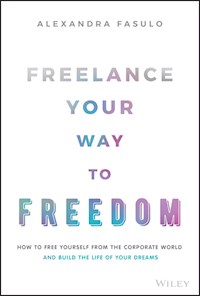
ALEXANDRA FASULO
FREELANCE YOUR WAY TO FREEDOM
HOW TO FREE YOURSELF FROM THE CORPORATE WORLD AND BUILD THE LIFE OF YOUR DREAMS
Copyright © 2023 by Alexandra Fasulo. All rights reserved.
Published by John Wiley & Sons, Inc., Hoboken, New Jersey.
Published simultaneously in Canada.
No part of this publication may be reproduced, stored in a retrieval system, or transmitted in any form or by any means, electronic, mechanical, photocopying, recording, scanning, or otherwise, except as permitted under Section 107 or 108 of the 1976 United States Copyright Act, without either the prior written permission of the Publisher, or authorization through payment of the appropriate per‐copy fee to the Copyright Clearance Center, Inc., 222 Rosewood Drive, Danvers, MA 01923, (978) 750‐8400, fax (978) 646‐8600, or on the Web at www.copyright.com. Requests to the Publisher for permission should be addressed to the Permissions Department, John Wiley & Sons, Inc., 111 River Street, Hoboken, NJ 07030, (201) 748‐6011, fax (201) 748‐6008, or online at http://www.wiley.com/go/permissions.Trademarks: Wiley and the Wiley logo are trademarks or registered trademarks of John Wiley & Sons, Inc. and/or its affiliates in the United States and other countries and may not be used without written permission. All other trademarks are the property of their respective owners. John Wiley & Sons, Inc. is not associated with any product or vendor mentioned in this book.
Limit of Liability/Disclaimer of Warranty: While the publisher and author have used their best efforts in preparing this book, they make no representations or warranties with respect to the accuracy or completeness of the contents of this book and specifically disclaim any implied warranties of merchantability or fitness for a particular purpose. No warranty may be created or extended by sales representatives or written sales materials. The advice and strategies contained herein may not be suitable for your situation. You should consult with a professional where appropriate. Neither the publisher nor author shall be liable for any loss of profit or any other commercial damages, including but not limited to special, incidental, consequential, or other damages.
For general information on our other products and services or for technical support, please contact our Customer Care Department within the United States at (800) 762‐2974, outside the United States at (317) 572‐3993 or fax (317) 572‐4002.
Wiley publishes in a variety of print and electronic formats and by print‐on‐demand. Some material included with standard print versions of this book may not be included in e‐books or in print‐on‐demand. If this book refers to media such as a CD or DVD that is not included in the version you purchased, you may download this material at http://booksupport.wiley.com. For more information about Wiley products, visit www.wiley.com.
Library of Congress Cataloging‐in‐Publication Data
Names: Fasulo, Alexandra, author.
Title: Freelance your way to freedom : how to make 7 figures online, free your mind, and work from anywhere in the world / Alexandra Fasulo.
Description: Hoboken, New Jersey : John Wiley & Sons, Inc., [2023] | Includes bibliographical references and index.
Identifiers: LCCN 2022029593 (print) | LCCN 2022029594 (ebook) | ISBN 9781119893233 (hardback) | ISBN 9781119893257 (adobe pdf) | ISBN 9781119893240 (epub)
Subjects: LCSH: New business enterprises. | Businesswomen. | Entrepreneurship. | Gig economy.
Classification: LCC HD62.5 .F368 2023 (print) | LCC HD62.5 (ebook) | DDC 658.1/1—dc23/eng/20220801
LC record available at https://lccn.loc.gov/2022029593
LC ebook record available at https://lccn.loc.gov/2022029594
Cover Design: Paul McCarthy
To my momager, who has played both mom and dad to my sister and me—thanks for teaching me to rub some dirt on it, get back up, and go out there and crush my dreams.
FOREWORD
I'm currently sitting at the highest café in the Chamonix ski resort, facing Mont Blanc, the second‐tallest mountain in Europe, and drinking hot wine as I write this.
My workload these days is around five hours a week, totally remote.
My computer, camera, sometimes WiFi, and power are literally the only things I require for my work.
I'm 33, a multimillionaire, an entrepreneur running multiple businesses, and an investor in real estate (11 dwellings at present count), precious metals, crypto, fine art, businesses, and more. Technically, I could be completely retired as my passive income from just my properties is enough to cover all my expenses, which is 100 percent hands off. Retirement is not something I seek, however.
Obviously, this isn't a position that I landed into straight away. I had to start at the bottom of the entrepreneurial ladder.
And it started with a simple idea: I will learn to work remotely. There is no plan B.
I knew my life was going to be filled with endless adventures and travel, and I knew a job would get in the way of that. And I wasn't about to allow some silly need for a paycheck get in the way, just so that I could feed myself.
And I meant that. I wasn't going to have a plan B. That was never an option—no matter how long it took, no matter if I had to eat baked beans for years, no matter if I had to sleep on friends’ couches without a place to call my own. All my energy was directed at this goal.
I started working in bars, juggling four waitress/bartender jobs at once while I was studying marketing (one of the most important skills that helped me get to where I am).
Bar jobs covered my living expenses while at the same time freeing up my brain space so I could return home after work and study the necessary skills I needed to make an online business work.
When I tell people that I worked 16‐hour days in my twenties, people often laugh, don't believe it, or romanticize the idea that perhaps I was making little YouTube videos or reading up about how social media works.
Well, those were components of it, but so was cleaning up drunk people's vomit in the bar bathroom at midnight.
The entrepreneur's journey is never pretty. It certainly tests you and makes you truly realize that there is no job beneath you if it's helping you on the journey of becoming eventually free.
And yes, I understand that some will need to work three jobs just to support their household, as there is no spare time or money to try to focus on growing a side business for them.
That is a chapter in the life of that person, who isn't in the incredible position you are in right now, just trying to understand remote work by holding this book.
And that's why we need to pursue our dreams, for us and for them.
For the people who right now cannot make this lifestyle a dream of theirs, perhaps eventually your remote work will be so successful that you'll be able to give back and help to free others from the burden of just having to exist day to day, with no potential of future planning.
That's something I have the opportunity to do these days, thanks to my work that blossomed beyond my wildest dreams.
But then, there's also the crew that will shun any mention of the drastic personal responsibility like the responsibility this book will demand that you have in order to make the entrepreneurial lifestyle work for you, because it's an uncomfortable truth for many, in a far too comfortable world.
If I had a cent for every excuse or comment I read from people trying to explain why they couldn't make their dream come true, I would have been a multimillionaire at a much younger age. That shield keeps these people hidden from the demand to give it everything they've got in order to be great.
And so, don't be that person. Don't complain that you can't have your dream life if you truly realize that you're just lying to yourself. You're literally just hurting yourself by trying to protect your lies.
Okay, now back to the story of how I got here.
Following my vomit‐cleaning, study‐filled years, I ended up getting a job as a marketing coordinator, which progressed into a marketing manager position. This experience lasted two years, and it was one of the greatest jobs I could hold because it taught me even more about what I needed in order to make my own online business work.
My eyes were always on the prize.
My job taught me the value of direct response marketing and the value of selling online education, which is something that people always seek, something they always need, something that you get to price yourself without permission, and you have a global market to sell to, 24 hours a day.
It unlocked my eyes to creating a great product, building a community around that interest, and marketing it over and over, with the sales coming in hour after hour, day after day, including when you sleep.
So what is the core of my business now?
Exactly what I learned during my long, cold, gray office years, which is selling digital products.
Through what I learned during every single job I ever had, including the bar jobs, I have now created and mastered my go‐to formula, launching very successfully five times now, selling upwards of $5 million in revenue, most of that being pure profit.
This has been repeated in a vast range of interest areas as well.
This all might sound very simple to you, or perhaps you're rolling your eyes thinking, “I'm sure it worked for you, but it won't work for me.”
Sure, you can say that to yourself, and it will be true.
I instead chose to see other people living this type of life and seeing it as evidence that this world was meant for me, and that if other people could do it, so could I. All I needed to do now was to skill myself up within the necessary areas to get to my goal of working wherever in the world I wanted to.
I absorbed every drop of information around me to see if it was suitable for my online monetization journey, chose to be very selective with my time, and unfortunately made those sacrifices not to go out and party because there was nothing tastier than freedom, which was in the near(ish) distance.
Pair that with my unshakable confidence that I would succeed, with no backup plan.
And I got there.
This is why this book you're about to read is so significant.
While it took me from the age of 19 until 30 to figure out the formula, which is replicable within my field, category, and interest area and which more or less guarantees results, I know it probably didn't have to take this long.
I never had a manual. I never had a road map.
When I started my journey, the idea of working online and living wherever in the world I wanted to, for as long as I wanted, simply was not a real possibility. It was inconceivable.
In fact, people laughed at it and at anyone trying to pursue this world.
There were hardly any examples of people living this way because, indeed, the internet wasn't as saturated as it is today—a full, wonderful, endless library to help you grow, and accessible at your fingertips.
I used to have to fight with people, saying how outdated the 9‐to‐5 office work model was and that people need to work less and be able to work remotely in order to be happier and more productive.
And then the COVID pandemic hit, and it swiftly shifted most people's perceptions from thinking this world was impossible to realizing it was actually a much better way of working.
But then people were left with the question of how to live this new lifestyle forever, maybe even wanting to become their own boss.
And how to start this journey?
That's why I'm thrilled you're holding this significant book in your hands from a woman who accomplished great success for herself at such a young age, defying all the odds to come out on top—someone who is living a life that almost everyone dreams of.
I personally never thought to create a road map for people interested in escaping the 9‐to‐5 grind and transitioning into their next remote work chapter.
My path wasn't smooth, and I wouldn't know how to put it into a manual.
But Alexandra Fasulo figured out the essential components you need to make this journey so much easier for you.
You're in amazing hands. Take notes and follow her guidance carefully, knowing that sometimes copying a strategy is the perfect thing to do until you work out your own spice in the recipe.
But the most important advice I have and always tell people is to please take action.
You don't need to take giant leaps daily. Small daily action and energy focus will get you there, I promise you.
This world is for everyone, and it is possible for anyone.
It doesn't require anything special of anyone except the dedication to make this goal happen.
Because the beautiful thing about the internet is that there is a market out there for everyone to sell anything.
If you can think it up, you can find it and sell it on the internet, whether it's being your own boss or finding a forward‐thinking company to work for that encourages remote working and that you believe in.
People before you, like Alex and me, have made this reality possible for themselves, and you're not different from us.
The fact that you're holding this book shows you want this for yourself.
So strap in, baby, because your life is about to change significantly, and you can thank yourself for being brave enough to believe you can.
Now go out there and do great work.
—Sorelle AmoreCEO of sorelleamore.com
PREFACE
The remote work economy is a diverse and ever‐expanding place with abounding opportunity, money, and interpersonal freedom. It's a place where you can be your own boss, open as many streams of income as you desire, and do it all from anywhere in the world. No senior manager is watching, waiting to scold you for forgetting punctuation in an email with a client. It seems almost too good to be true; it's like a futuristic workplace utopia.
From my experience over the past decade immersing myself in online marketplaces after quitting my job with no plan or money saved, I have found that the world of remote work is indeed some kind of a utopia, where you can trade hard work and commitment for unlimited freedom. It's a place where working smarter, not harder, is praised; where technology, automation, and virtual assistants can remove the traditionally long working hours while you unplug for the afternoon on some remote digital nomad island in Southeast Asia.
But not even I could fathom that kind of utopia after years of college and two different office jobs that groomed employees for a life of servitude. I slid right into the belief that I had to suffer in the name of responsibility as an adult, as if suffering was a normal exchange everyone had to engage in if they wanted to own a house, a car, and pay off their debt.
Boy, was I wrong, and the remote work economy spared no time in showing me that these beliefs were rooted in an old‐school approach to work that was born out of the Industrial Revolution. This new kind of online, interdependent economy only wants one thing from you: accountability. It wants you to show up, with a laptop and WiFi, as you open your accounts to check in on your teams, clients, and software that does your work in the background. If you can manage to do that—and only that—you're going to be in luck. Suffering is not part of this process, and it's certainly not expected of you if you want to be successful with a few side hustles you only put 30 minutes into managing each day.
This book is not about getting rich quick or hacking hidden systems. It's about laying the foundation in the remote work economy that will help you achieve financial independence in a fraction of the time your corporate employer promised.
We will first look at the remote work economy as a whole and how to navigate it as a beginner, followed by breaking down the ins and outs of freelancing and how to leverage your own agency, which you manage from anywhere in the world. We'll go over the different places you can freelance and how to set yourself apart from the competition.
Next, we'll explore the systems you need to put in place, the discipline and mindset development that's required to be successful, and secret side hustle hacks that can help you scale to six figures during your first year in business. Lastly, we'll talk about money momentum, using your success to build a personal brand that branches off into more revenue streams, and we'll go over a final checklist that will set you up to build your own seven‐figure online empire.
The concepts in this book are not hard to understand—I promise. Although the idea of remote work and all the hundreds of side hustles available to you today can seem overwhelming, this book is intended to make simple the very basics of making money reliably through the remote work economy. I will detail every single decision I made to go from unemployed to sitting at the helm of a seven‐figure freelance writing and social media personality business today, so that you can replicate my remote work blueprint.
Enjoy the adventure as we set out together to help you reclaim your personal freedom.
ACKNOWLEDGMENTS
This book and the inspiration for it would not have been possible without the “squad” of my mom, sister, stepdad, best friend/freelance agency manager Bri, and, of course, my stoic Siamese cat, Wee. This book also would have not been possible if my amazing agent, Jean Sagendorph, hadn't sent me an email one day after finding me on TikTok. I never imagined this many people would want to know what I have to think about things. I still can't believe it some days, but I have to shout out God on that one.
I would lastly like to acknowledge my online haters, whom I have to thank for my fiery, determined, and passionately stubborn work ethic. Without your constant insults and accusations, I wouldn't be half of the force I am today.
To the many, many more books to come.
xoxo, the Freelance Fairy
1You Can Be Financially Free
Man is born free, and everywhere he is in chains.
— Jean‐Jacques Rousseau
If you ask anyone in your life what it means to have a stable job, they will tell you it's working at a 9‐to‐5 with a boss. We have been told this since we were in kindergarten when textbooks started to imply to us that success comes from an office job. We've all seen the illustrations that depict the person in the business suit with the briefcase, wearing the same three monochrome colors as they trudge their way into work. And from that moment on, it's that very concept of success that is pushed on us until we embody it ourselves. If we dare to veer off that path and do something different, we risk being ostracized from the people in our lives who believe that kind of risk is irresponsible.
As social creatures who thrive in communities, we're impacted by our peers. What they say and think about us matters. That's why philosopher Jean‐Jacques Rousseau in The Social Contract explored why natural man who was free and happy living in the forest gave up autonomy for the modern condition of unhappiness, inequality, and dependency. He recognized that some benefits, like amenities and technology, come from leaving the forest, yet this trade‐off makes people unhappier and more unequal than ever.
We are all born free, yet we line up for those invisible chains because we believe we must. That's where your journey into making the most of the remote work economy begins: the belief. The belief that you must work at the job, in the office building, with the boss, or else you are letting yourself and your family down. The belief that being a responsible adult means sacrificing part of yourself along the way. The belief that the only way to build real wealth is through giving up forty years of your life in a work space far away from your family.
These invisible chains are created inside our minds, which means they can be destroyed in the exact same place. You can—and deserve—to be financially free just as much as the next person. You don't need to prove yourself any more than you already have. You were born free, and to freedom you shall return through the basis of your own personal financial freedom.
Defining What Financial Freedom Means for You
Financial freedom is the status of being able to make decisions for the rest of your life without worrying about money. For some people, this can look like having $5 million in their bank account; for other people, it can be having a few hundred thousand dollars saved with no debt and 12 different side hustles that are expected to earn at least $500,000 each between now and that person's death.
Financial freedom can be tailored to everyone on the level of specifics. But one thing remains universal: it's the state in which you can do whatever you want with your life without worrying about money.
You must be thinking to yourself: “Yeah right, sounds too good to be true.” That's because for 95% of people, it is too good to be true. And it's only too good because they continue to allow the invisible chains to keep them in one place, at one job, with one boss who doesn't respect them or their time. They perceive freedom to be too good to be true, so it remains too good. But for you, it's not too good at all—it's merely the bare minimum. Financial freedom is how you unlock the potential for the rest of your life and give yourself the opportunity to see what's out there, waiting for you.
We try to plan for our lives to the best of our ability, but we can't possibly plan for the abounding opportunities that can only come our way when we start to believe we are deserving of them. That's why the Law of Attraction could not be truer—we attract what we believe we deserve. We put out the energy into the world that we want to bounce right back to us. The most successful and wealthy people of our time today were not special or lucky; they were merely masters of their mindset and accepted the reality of financial freedom for themselves early on in their lives. They dropped their chains in pursuit of the unknown. And what they found is exactly what will be detailed in this book: accountability is the only sacrifice that must be made in the achievement of personal and financial independence.
Financial Freedom Is an Equal Opportunity Employer
Rousseau argued that when we left the forest to move into society, we created inequalities that never used to be there. Barriers to entry popped up in the form of status, education, skin color, and sex. In the forest, we could access any resources we needed to and there was no system to stop us. Yet, in society, we accept inequalities in the name of stability.
That's what makes the concept of financial freedom so incredible and surely something Rousseau would be praising if he were alive today. The pursuit of financial freedom is equally available to every single person in the world—hear me out. In the past, societal jobs in offices, government buildings, medical facilities, and law firms required individuals to obtain degrees. In order to obtain these degrees, people needed to receive primary education in a supportive setting that encouraged them to go to college. They would then need financial aid in order to go to higher education, where they were destined to graduate with insurmountable debt that made the idea of venturing into the unknown world of remote work too risky. This kind of system ostracizes individuals from lower socioeconomic communities and favors those with the money needed to access education and study materials.
In the world of financial independence, you don't need a college degree, a resume, or even a forward‐facing photo of yourself. It doesn't matter what you look like or how old you are. Nothing about your past matters. You can get on anonymous freelancing marketplaces and learn skills for free on YouTube or TikTok. You can build a portfolio of free work you offer to do for friends and family when first starting out. You can set up affiliate marketing funnels and ecommerce landing pages that have nothing to do with you and your identity. You are truly, in every sense of the word, free.
Case Study: My Journey to Financial Freedom
I declared myself financially free in 2020 when I earned my millionth dollar on Fiverr. If that was all I had going at the time, I wouldn't have considered one million dollars to be enough to support me (age 27) for the rest of my life. But, with one million earned dollars that I intended to invest in multiple real estate investment properties, as well as six different side hustles at the time, including my online courses that average around $15,000 to $25,000 in passive sales per month, I declared myself financially free to my social media followers. If I were to stop working altogether and do nothing starting today, my freelance writing agency, which is now entirely managed by my best friend and virtual assistants, e‐book sales, course sales, YouTube ads revenue, website ads revenue, investment property revenue, and TikTok/Instagram Reels revenue would comfortably support me for the rest of my life. I do not have to work another day if I do not want to.
The rest of this book is going to show you in detail how I was able to become financially free at 27 years old. We are going to look at the different side hustles, freelancing business structures, personal brands, and business tools that you can use in any combination to achieve financial freedom. And while we look at it, I want you to promise me that you are going to read over these pages believing that you deserve this kind of freedom, too.




