


18,99 €
Mehr erfahren.
- Herausgeber: John Wiley & Sons
- Kategorie: Geisteswissenschaft
- Serie: Key Contemporary Thinkers
- Sprache: Englisch
This new book offers a comprehensive and accessible introduction to Frege's remarkable philosophical work, examining the main areas of his writings and demonstrating the connections between them.
Frege's main contribution to philosophy spans philosophical logic, the theory of meaning, mathematical logic and the philosophy of mathematics. The book clearly explains and assesses Frege's work in these areas, systematically examining his major concepts, and revealing the links between them. The emphasis is on Frege's highly influential work in philosophical logic and the theory of meaning, including the features of his logic, his conceptions of object, concept and function, and his seminal distinction between sense and reference.
Frege will be invaluable for students of the philosophy of language, philosophical logic, and analytic philosophy.
Sie lesen das E-Book in den Legimi-Apps auf:
Seitenzahl: 486
Veröffentlichungsjahr: 2013
Ähnliche




















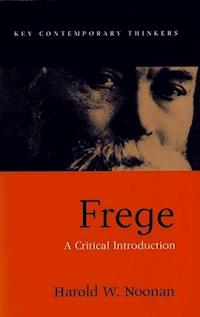
Frege
A Critical Introduction
Harold W. Noonan
Polity
Copyright © Harold W. Noonan 2001
The right of Harold W. Noonan to be identified as author of this work has been asserted in accordance with the Copyright, Designs and Patents Act 1988.
First published in 2001 by Polity Press in association with Blackwell Publishers Ltd
Editorial office:
Polity Press
65 Bridge Street
Cambridge CB2 1UR, UK
Marketing and production:
Blackwell Publishers Ltd
108 Cowley Road
Oxford OX4 1JF, UK
Published in the USA by
Blackwell Publishers Inc.
Commerce Place
350 Main Street
Malden, MA 02148, USA
All rights reserved. Except for the quotation of short passages for the purposes of criticism and review, no part of this publication may be reproduced, stored in a retrieval system, or transmitted, in any form or by any means, electronic, mechanical, photocopying, recording or otherwise, without the prior permission of the publisher.
Except in the United States of America, this book is sold subject to the condition that it shall not, by way of trade or otherwise, be lent, re-sold, hired out, or otherwise circulated without the publisher’s prior consent in any form of binding or cover other than that in which it is published and without a similar condition including this condition being imposed on the subsequent purchaser.
ISBN 0-7456-1672-0
ISBN 0-7456-1673-9 (pbk)
A catalogue record for this book is available from the British Library and has been applied for from the Library of Congress.
Typeset in 10½ on 12 pt Palatino
by Best-set Typesetter Ltd., Hong Kong
Printed in Great Britain by MPG Books Ltd, Bodmin, Cornwall
This book is printed on acid-free paper.
Key Contemporary Thinkers
Published
Jeremy Ahearne, Michel de Certeau: Interpretation and its Other
Peter Burke, The French Historical Revolution: The Annales School 1929–1989
Michael Caesar, Umberto Eco: Philosophy, Semiotics and the Work of Fiction
Colin Davis, Levinas: An Introduction
Simon Evnine, Donald Davidson
Edward Fullbrook and Kate Fullbrook, Simone de Beauvoir: A Critical Introduction
Andrew Gamble, Hayek: The Iron Cage of Liberty
Phillip Hansen, Hannah Arendt: Politics, History and Citizenship
Sean Homer, Fredric Jameson: Marxism, Hermeneutics, Postmodernism
Christopher Hookway, Quine: Language, Experience and Reality
Christina Howells, Derrida: Deconstruction from Phenomenology to Ethics
Fred Inglis, Clifford Geertz: Culture, Custom and Ethics
Simon Jarvis, Adorno: A Critical Introduction
Douglas Kellner, Jean Baudrillard: From Marxism to Post-Modernism and Beyond
Valerie Kennedy, Edward Said: A Critical Introduction
Chandran Kukathas and Philip Pettit, Rawls: A Theory of Justice and its Critics
James McGilvray, Chomsky: Language, Mind, and Politics
Lois McNay, Foucault: A Critical Introduction
Philip Manning, Erving Goffman and Modern Sociology
Michael Moriarty, Roland Barthes
Harold W. Noonan, Frege: A Critical Introduction
William Outhwaite, Habermas: A Critical Introduction
John Preston, Feyerabend: Philosophy, Science and Society
Susan Sellers, Héléne Cixous: Authorship, Autobiography and Love
David Silverman, Harvey Sacks: Social Science and Conversation Analysis
Dennis Smith, Zygmunt Bauman: Prophet of Postmodernity
Geoffrey Stokes, Popper: Philosophy, Politics and Scientific Method
Georgia Warnke, Gadamer: Hermeneutics, Tradition and Reason
James Williams, Lyotard: Towards a Postmodern Philosophy
Jonathan Wolff, Robert Nozick: Property, Justice and the Minimal State
Forthcoming
Maria Baghramian, Hilary Putnam
Sara Beardsworth, Kristeva
Mark Cain, Fodor: Language, Mind and Philosophy
James Carey, Innis and McLuhan
Rosemary Cowan, Cornell West: The Politics of Redemption
George Crowder, Isaiah Berlin: Liberty, Pluralism and Liberalism
Thomas D’Andrea, Alasdair MacIntyre
Eric Dunning, Norbert Elias
Jocelyn Dunphy, Paul Ricoeur
Matthew Elton, Daniel Dennett
Nigel Gibson, Frantz Fanon
Graeme Gilloch, Walter Benjamin
Karen Green, Dummett: Philosophy of Language
Espen Hammer, Stanley Cavell
Keith Hart, C. L. R. James
Sarah Kay, Žižek: A Critical Introduction
Paul Kelly, Ronald Dworkin
Carl Levy, Antonio Gramsci
Moya Lloyd, Judith Butler
Dermot Moran, Edmund Husserl
Steve Redhead, Paul Virilio: Theorist for an Accelerated Culture
Chris Rojek, Stuart Hall and Cultural Studies
Wes Sharrock and Rupert Read, Kuhn
Nick Smith, Charles Taylor
Nicholas Walker, Heidegger
Contents
Preface
Acknowledgements
1 Introduction: Frege’s Life and Work
Biography
The Origin and Development of Frege’s Philosophy
Frege’s Contributions to Philosophy
2 Logic
The Purpose of Conceptual Notation
Logic before Frege
Fregean Logic
3 Number
Aims of The Foundations of Arithmetic
Rebuttal of Earlier Attempts
The Development of Frege’s Own Position
4 Philosophical Logic
‘Function and Concept’
‘On Concept and Object’
5 Theory of Meaning
The Distinction between Sense and Reference
Indirect Reference
The Objectivity of Sense
Challenges to Sense
Appendix
Bibliography
Index
Preface
In this book I present a study of the most important themes in the work of the great German philosopher and logician Gottlob Frege. The exposition follows the order in which these themes appear in Frege’s work. Thus, after an introductory chapter outlining the background to Frege’s thought and setting him in the context of his time, the second chapter explains his fundamental advances in logic, as found in his first book, Conceptual Notation. The third chapter is devoted to his discussion of number in his masterpiece, The Foundations of Arithmetic, and its successor The Basic Laws of Arithmetic, including an account of the inconsistency discovered in his system by Bertrand Russell, ‘Russell’s Paradox’. The remaining two chapters are concerned with the most significant and influential of his writings on philosophical logic and meaning: ‘Function and Concept’, ‘On Concept and Object’, ‘On Sense and Reference’ and ‘Thoughts’.
I am grateful to my colleagues at the University of Birmingham, particularly Joss Walker, for the patience with which they have read and commented on successive redraftings of this material.
H. W. N.
Acknowledgements
The author and publishers are grateful to the following for permission to quote from copyrighted material:
Blackwell Publishers for Translations from the Philosophical Writings of Gottlob Frege, ed. P. Geach and M. Black, Oxford, 1969; Posthumous Writings, trans. P. Long and H. White, Oxford, 1979; and Collected Papers on Mathematics, Logic and Philosophy, ed. B. McGuinness, trans. M. Black et al., Oxford, 1984.
Blackwell Publishers and Northwestern University Press for Gottlob Frege, The Foundations of Arithmetic, trans. J. L. Austin, Oxford and Evanston, Ill., 1968.
Oxford University Press for Gottlob Frege, Conceptual Notation and Related Articles, ed. and trans. T. W. Bynum, Oxford, 1972.
Every effort has been made to contact copyright holders, but if any have been inadvertently overlooked, the publishers will be pleased to make the necessary arrangements at the first opportunity.
1
Introduction: Frege’s Life and Work
Biography
Friedrich Ludwig Gottlob Frege was the founder of modern mathematical logic, which he created in his first book, Conceptual Notation, a Formula Language of Pure Thought Modelled upon the Formula Language of Arithmetic (Begriffsschrift, eine der arithmetischen nachgebildete Formalsprache des reinen Denkens (1879), translated in Frege 1972). This describes a system of symbolic logic which goes far beyond the two thousand year old Aristotelian logic on which, hitherto, there had been little decisive advance. Frege was also one of the main formative influences, together with Bertrand Russell, Ludwig Wittgenstein and G. E. Moore, on the analytical school of philosophy which now dominates the English-speaking philosophical world. Apart from his definitive contribution to logic, his writings on the philosophy of mathematics, philosophical logic and the theory of meaning are such that no philosopher working in any of these areas today could hope to make a contribution without a thorough familiarity with Frege’s philosophy. Yet in his lifetíme the significance of Frege’s work was little acknowledged. Even his work on logic met with general incomprehension and his work in philosophy was mostly unread and unappreciated. He was, however, studied by Edmund Husserl, Bertrand Russell, Ludwig Wittgenstein and Rudolf Carnap and via these great figures he has eventually achieved general recognition.
Frege’s life was not a personally fulfilled one (for more detailed accounts of the following see Bynum’s introduction to Frege 1972 and Beaney’s introduction to Frege 1997). His wife died twenty years before his own death in 1925 (he was survived by an adopted son, Alfred) and, ironically, his life’s work in the philosophy of mathematics, to which he regarded all the rest of his efforts as subordinate, that is, his attempted demonstration that arithmetic was a branch of logic (the ‘logicist thesis’ as it is now called), was dealt a fatal blow by Bertrand Russell, one of his greatest admirers, who showed that it entailed the inconsistency that now bears his name (‘Russell’s Paradox’). Nevertheless, Frege perhaps gained some comfort from the respect accorded to him by Russell and by Wittgenstein, who met Frege several times and revered him above all other philosophers. In retrospect, indeed, many would perhaps say that in philosophy generally, as distinct from the narrower branches of logic and the philosophy of mathematics, Frege’s greatest contribution was the advance in the philosophy of logic and language which made Wittgenstein’s work possible.
Little is known of Frege’s personality and life outside philosophy. Apparently his politics and social views, as recorded in his diaries, reveal him to have been, in his later years, extremely right-wing, strongly opposed to democracy and to civil rights for Catholics and Jews. Frege’s greatest commentator, Michael Dummett, expresses great shock and disappointment (1973: xii) that someone he had revered as an absolutely rational man could have been imbued with such prejudices. But a more generous view is the one expressed by another great Frege scholar, Peter Geach. Geach writes that while Frege was indeed imbued with typical German conservative prejudices, ‘to borrow an epigram from Quine, it doesn’t matter what you believe so long as you’re not sincere. Nobody can really imagine Frege as an active politico devoted to some course like Hitler’s’ (1976c: 437).
We have, however, a presentation of the more attractive side of Frege in an account Wittgenstein gives of his encounters with him:
Lesen Sie weiter in der vollständigen Ausgabe!
Lesen Sie weiter in der vollständigen Ausgabe!
Lesen Sie weiter in der vollständigen Ausgabe!
Lesen Sie weiter in der vollständigen Ausgabe!
Lesen Sie weiter in der vollständigen Ausgabe!
Lesen Sie weiter in der vollständigen Ausgabe!
Lesen Sie weiter in der vollständigen Ausgabe!
Lesen Sie weiter in der vollständigen Ausgabe!




