


Erhalten Sie Zugang zu diesem und mehr als 300000 Büchern ab EUR 5,99 monatlich.
- Herausgeber: Jonathan Ball
- Kategorie: Sachliteratur, Reportagen, Biografien
- Sprache: Englisch
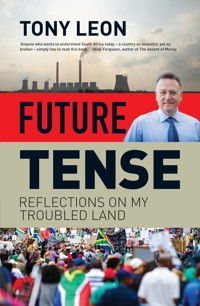
'From the vantage point of years in active politics, Tony Leon provides a lucid analytical balance sheet of SA Ltd 2021. Eschewing political correctness, Leon tells it as he sees it.' – Judge Dennis Davis 'Anyone who wants to understand South Africa today – a country so beautiful, yet so broken – simply has to read this book.' - Niall Ferguson, author of The Ascent of Money In his riveting new book, Future Tense, Tony Leon captures and analyses recent South African history, with a focus on the squandered and corrupted years of the past decade. With unique access and penetrating insight, Leon presents a portrait of today's South Africa and prospects for its future,based on his political involvement over thirty years with the key power players: Cyril Ramaphosa, Jacob Zuma, Thabo Mbeki, Nelson Mandela and FW de Klerk. His close-up and personal view of these presidents and their history-making, and many encounters in the wider world, adds vivid colour of a country and planet in upheaval. Written during the first coronavirus lockdown, Future Tense examines the surge of the disease and the response, both of which have crashed the economy and its future prospects. As the founding leader of the Democratic Alliance, Leon also provides an insider view for the first time of the power struggles within that party, which saw the exit of its first black leader in 2019. There is every reason to fear for the future of South Africa but, as Leon argues, 'the hope for a better country remains an improbable, but not an impossible, dream'.
Sie lesen das E-Book in den Legimi-Apps auf:
Seitenzahl: 418
Veröffentlichungsjahr: 2021
Das E-Book (TTS) können Sie hören im Abo „Legimi Premium” in Legimi-Apps auf:
Ähnliche














FUTURE TENSE
Reflections on my Troubled Land
Tony Leon
Jonathan Ball Publishers
Johannesburg · Cape Town · London
PRAISE FOR FUTURE TENSE
‘Tony Leon is not only an experienced politician but also a talented writer, and this book is the highly readable result of that combination. His analysis of the last two decades in South Africa is honest and penetrating and his views on the handling of the Covid pandemic are persuasive. He demonstrates very clearly that change will be needed for widespread prosperity, freedom from corruption and reliably good governing to be achieved. This will be an important book for South Africans who want to ensure their country succeeds in the 2020s, and for so many in the rest of the world who are urging them on to reach their true potential.’
– Lord William Hague, former British Foreign Secretary and Conservative Party leader
‘From the vantage point of years in active politics, Tony Leon provides a lucid analytical balance sheet of SA Ltd 2021. Eschewing political correctness Leon tells it as he sees it. The consequence is a book that will promote much needed rational debate about the direction that the country needs to take.’
– Judge Dennis Davis
‘Future Tense unflinchingly anatomises what has gone wrong in South Africa since the heady days when Tony Leon entered politics. As the former leader of the country’s main opposition party, he was never going to pull his punches when describing the dismal decline of the African National Congress. But he is just as critical of his own party’s failure to translate popular dissatisfaction into votes and political change. Anyone who wants to understand South Africa today – a country so beautiful, yet so broken – simply has to read this book.’
– Niall Ferguson, Milbank Family Senior Fellow, the Hoover Institution, Stanford, and author ofCivilization: The West and the Rest
‘Tony Leon’s passionate and informed account of South Africa’s decline from the world’s new democratic hope two decades back to its capture by corrupt big men who rode roughshod over its constitutional promises is essential reading. Not just for South Africans, but for people everywhere who need to heed the warning on what happens when the ruling party trumps the state and when populism fuels economic decline. In the midst of many current crises, Leon also points the way for a more hopeful future for a country which needs to succeed to prove that democracy and the rule of law can still flourish in a multi-ethnic, historically conflicted and potentially rich nation.’
– Bill Browder, author ofRed Notice
‘Even his political opponents must confront Tony Leon’s jarring questions about whether South Africa can be rescued from corruption, cronyism and continued economic decline.’
– Peter Hain, former anti-apartheid activist and senior Labour Party cabinet minister
Previous books by Tony Leon
Hope and Fear: Reflections of a Democrat (1998)
On the Contrary: Leading the Opposition in a Democratic South Africa (2008)
The Accidental Ambassador: From Parliament to Patagonia (2013)
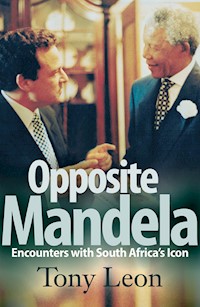
Opposite Mandela: Encounters with South Africa’s Icon (2014)
Table of Contents
To Michal
‘Most of us have only one story to tell. I don’t mean that only one thing happens to us in our lives: there are countless events, which we turn into countless stories. But there’s only one that matters, only one finally worth telling.’
JULIAN BARNES, The Only Story, 2018.
Preface
‘I know how dangerous it is to make personal experience your main basis for authority.’1 So says Yuval Noah Harari, author of bestselling blockbusters Sapiens and Homo Deus.
Danger acknowledged, the book in your hands, Future Tense: Reflections on my Troubled Land, is very much my own singular take on select themes and events, and some of the personalities – some outsize, some obscure – who shaped the core happenings that led South Africa to the place it finds itself in in 2021, and how these may impact our future.
It has been my great good fortune to have been present at key moments when the door to the future swung on the hinges of history, and I encountered some of the more remarkable characters in our national story, and some of the players in the wider world, who shaped us and who offer useful pointers for the future.
I had the privilege of serving the longest period to date as leader of the official opposition in democratic South Africa, from 1999 to 2007. And after leaving Parliament in 2009 I was engaged in international diplomacy as South Africa’s ambassador in South America, to Argentina, Uruguay and Paraguay, and more recently as chairman of a local communications company and advisor to overseas consultancies. These postings provided distance from and lent perspective to the rough and tumble of public life in which I’d been engaged for over twenty-five years.
Dozens of books have appeared on local shelves chronicling what went right in the brave and inspiring new dawn of democracy in South Africa in 1994. Even more volumes have been published on what’s gone wrong since – the vertiginous slide from Nelson Mandela and Desmond Tutu’s Rainbow Nation to the Republic of Resentment and Decline. This book is, I hope, different and also more refreshing than depressing.
Neither of these destinations, utopia or dystopia, was inevitable or even, before their occurrence, likely. Both of them, and the stumbles between the two roads open to South Africa twenty-five years ago, were navigated by men and women of zeal. Some were zealous in a good sense – selfless, committed and singular in purpose – while others were greedy, corrupt and entirely selfish. Among those who ploughed our national path in more recent times were some committed to decent ends – albeit occasionally pursuing irrational and self-defeating means to achieve them – a few who were prisoners of dogma, and yet others who proclaimed high principle and collective purpose to conceal their own predations. Another category muddled along in the middle, hoping for the best without preparing for the worst outcomes.
In the tussle in history there are two threads that determine outcomes, according to Beyond Great Forces: How Individuals Still Shape History by Daniel Byman and Kenneth M Pollack. On the one hand there are the great men and women, ‘individual leaders, both famous and infamous’, who drive events; on the other there’s the ‘structuralist zeitgeist’ where huge sweeping forces trump the power of personality.
Both matter. But consider the United States and the world today had Hillary Clinton prevailed over Donald Trump, as she nearly did in 2016. Or if David Cameron had not chosen to call a referendum on Brexit earlier in the same year …
Here at home, you can play the ‘what if?’ game by asking the likely outcome had nature not intervened in 1989 and felled reluctant reformer and hard-line securocrat President PW Botha, via a ruptured blood vessel in his brain, paving the way for FW de Klerk; and you can take this further by wondering the outcome – given, as Byman and Pollack put it, ‘the ruthless domestic politics in a country roiled by civil war and a regime’s inherent desire to survive’ at the time – had De Klerk not stepped down.
And, more recently, what about if Nkosazana Dlamini-Zuma had prevailed at Nasrec in Johannesburg in December 2017 and become President of South Africa?
This book, informed by my own experiences with the challenges of leading a political party in South Africa for thirteen years, is a reminder of the power, and the flaws, of human agency in determining the fate of nations and the political tribes who live in them.
In Britain when David Cameron’s precipitate decision on Brexit looked certain to lead to his resignation, journalist Janan Ganesh presciently observed that leadership in politics is ‘not quite the only thing that matters but almost. A party with a good front man or woman can afford to get everything else wrong and probably will not. Most other variables – policy, strategy, organisation – flow from the leader.’2
I was to discover the potency of that prophecy in local terms when the unhappy circumstances in which the Democratic Alliance (DA) found itself in 2019 led to my being called in to interrogate its leadership. This book also deals with that story.
There are as many variants of political correctness as there are categories of victims, and South Africa is a world leader in both.
Plenty has been written about the wide variety of groups and the historical events that swept away the ancien regime of apartheid, butlittle is addressed to the concerns of the middle-class tax-paying backbone of the nation. I’m not politically correct and have no claim to victimhood but I recognise the real hurt felt by those who endure the lash and legacy of discrimination, of whatever sort.
I’m categorically middle class by income and liberally minded by inclination. I’m also – and I’m reminded daily of the fact in the cacophony of the local noise that often passes for commentary – white. From this – my – demographic much is demanded and, for some of us, the future is cloudy. Regarded by our political overlords with suspicion, advised daily to ‘check our privilege’, our pockets are pillaged by the fiscus, and we’re often pilloried as unpatriotic or worse. We have, simultaneously, the best and the worst of the new South Africa; some of us have thrown in the towel and departed. This angst gets an airing here since I am of this tribe, even though I’ve always regarded nationality, language and culture as far more essential to my identity than my race.
Perhaps the greatest threat to the future of freedom in this country, and in far more enduring democracies beyond its shores, is the grim realisation of British philosopher Bertrand Russell in 1928, that we have two kinds of morality, side by side: one that we preach but do not practise, and another that we practise but seldom preach. In a country and world being tested by the plague of the coronavirus and its aftermath, tempted by the quick political cures of populism and magic money trees, and slideaways from constitutionalism and sound money principles, these words, written nearly a century ago, now have an urgent relevance.
Writing this book during the covid-19 pandemic was a profound experience. Beyond the intimations of mortality the virus induced in us all, it did at least allow a concentrated focus on the vital issues that have left South Africa so battered by the effects of the lockdown. The flip side was the dilemma of writing about contemporary topics amid such a huge upheaval – but, as this account suggests, the personalities, policies and politics of South Africa predated, sometimes by some decades, the imposition of the national lockdown in March 2020.
I’m deeply grateful to Jonathan Ball and Jeremy Boraine of Jonathan Ball Publishers for suggesting this book and guiding it to completion, our third such happy collaboration; to Tracey Hawthorne, for the very helpful editing and shaping of this book; to Geordin Hill-Lewis, who provided valuable advice on interpreting the data of the National Treasury; to Dr Anthea Jeffery, who offered useful guidance on expropriation without compensation; and to Paul Wise, for proofreading and additional fact-checking.
Much appreciation, too, to the Thursday Zoom Durban cocktail sessions with Steve and Kirsten du Toit and Mike and Phillida Ellis, who sustained my writing effort with encouragement and humour. And, as always, my wife Michal filled the indispensable roles of constant muse, chief critic and best partner in the world. This book is dedicated to her.
Any mistakes in these pages are, irritatingly, mine.
Tony Leon
Cape Town
January 2021
PART I
PRESENT TENSE
CHAPTER 1
________
Long fuses, damp squibs: The false new dawn
A travel tip I heard too late was to never go to New York City during the United Nations General Assembly week in late September. It’s a misery of barricaded streets, impassable roads and overcrowded subways because every world leader, from the good and the great to the despotically awful, descends on the Big Apple. If Madame Kleptomaniac, First Lady of the Republic of Thievery, wishes to go shopping, the city police obligingly close off a main road, with attendant traffic chaos.
However, a US firm for whom I was an advisor correctly viewed the week as an opportunity for endless meetings with the corporate and political types flooding the city. So in September 2018 I was assigned to address them on matters South African, or how the country was faring with Cyril Ramaphosa at the helm in his first year as president.
His nail-biting, against-the-odds victory in the election for the presidency of the African National Congress (ANC) in December 2017 had allowed him to shove the vanquished Jacob Zuma from the state presidency some six months before, and expectations of deliverance from the dread Zuma years were sky high. But Ramaphosa’s defeat of the charismatically challenged Nkosazana Dlamini-Zuma, favourite of her ex-husband and the radical brigade, had been extremely narrow, and purchased at great cost.
His razor-thin winning margin of just 179 votes (out of 4 776 voting delegates) at the ANC Conference meant he was, in the words of one party veteran, ‘in control of just 51% of the entity’. And this was mirrored in the delegates’ choice of the other ‘top six’ positions: alongside Ramaphosa in the high echelon were some very dubious, indeed arguably criminal, characters: new secretary-general Ace Magashule, the Guptas’ Free State enabler, was generally believed to be deeply corrupt; the shadowy deputy president DD Mabuza had been the subject of a detailed New York Times hatchet job which covered allegations ranging from warlord activities in his province of Mpumalanga to embedded graft and larceny;3 and the deputy secretary-general was Zuma holdover and staunch defender Jessie Duarte.
It was Mabuza who’d broken with the so-called ‘Premier League’ of provincial barons aligned with the Zumas to give Ramaphosa his narrow win. And it was reckoned that between the two candidates – Ramaphosa and Dlamini-Zuma – around R1 billion had been spent to win allegiances, suggesting that the ANC conference ‘wasn’t an election but an auction’.4 Ramaphosa had taken money from some of the most compromised and corrupted companies in the land, notably a tender-milking entity, Bosasa.5
HALF A WIN
Midweek, and mid-afternoon, I zigzagged around various obstacles to arrive at the InterContinental Hotel, where Cyril Ramaphosa was the guest speaker at a business conference hosted by the South African Embassy.
The venue, on the mezzanine level, and the event itself, gave an indication of where the country and its new president stood in the world. Bearing in mind that Yankee Stadium was at its 60 000-person capacity in 1990 to welcome Nelson Mandela after his release from prison, and that Mandela’s successor, Thabo Mbeki, would have attracted a belt of heavy-hitting corporate CEOs and chairmen from the major companies, this medium-sized ballroom with its many empty seats told its own story.
The warm-up act was compèred by trade and industry minister Rob Davies, whose fashion choice of a maroon shirt and green tie somewhat deflected attention from his remarks. He had on stage representatives from two big companies, consumer-goods corporation Procter & Gamble and tech company IBM, whose task was to parade South Africa’s business attractiveness. But instead of top-level CEO endorsers, the two speakers were senior-management types.
Still, as we waited for Cyril Ramaphosa to commence speaking that afternoon in New York, a grizzled American lobbyist on Africa sitting near me said, ‘It doesn’t really matter what he says. The whole point of this afternoon is that he is speaking and not Zuma.’
‘Not Zuma’ was indeed Ramaphosa’s only international calling card at the time, as his partial victory had meant he was saddled with policy pledges to implement land expropriation without compensation (EWC) and nationalise the Reserve Bank, among other delights plucked from the 1960s socialist playbook.
But what, in fact, were Ramaphosa’s own views and values on the most important and pressing reforms needed to right-size South Africa and unite it after a decade of division and misrule? Did he have a vision of what the country needed and what to do to achieve it?
THE CHAMELEON
Here the view was deeply occluded. Ramaphosa had both a chameleonic resumé and a paradoxical outlook: ‘a representative of both sets of black South Africans who [had] done well since 1994’6 – the trade unionists and the black economic empowerment (BEE) millionaires – he came from both groups and was hardly likely to upset either. Trade unionist, one-time communist, business billionaire, he had variable and excessively vague views on the most urgent issues. His own alleged pro-business standpoints were often more the imaginings of his millionaire backers than the result of any entrepreneurial flair or grit on his part. His vast pile of cash was the result of BEE receipts and major board appointments and share options: he held great wealth rather than having created any.
Ramaphosa’s most noteworthy accomplishment before national politics was his stewardship of the National Union of Mineworkers (NUM) from 1982 to 1991. In his time there, the industry employed 500 000 people and its gold mines were producing 504 tonnes of the metal from sixty-five mines. By 2017, I was advised by one audience member embedded in the industry, we were down to 110 tonnes from just nine mines, a drop of more than eighty percent in two decades, with plummeting job losses. Eskom power cuts and tariff hikes (a surge in pricing of 500 percent in a decade), populist unions and the cost of very-deep-level mining had extracted a fearsome price.
Around the same time as Ramaphosa’s New York foray, mining veteran Jim Rutherford, a one-time director of mighty Anglo American, spoke for many when he told a local mining conference in Johannesburg, ‘South Africa does not feature on the international investor radar.’ International mining equity investors had ‘largely given up’ on South Africa, and saw better opportunities elsewhere, he said.7 (In early 2020, after a hundred years as the icon of mining in the country, AngloGold Ashanti, the latter-day incarnation of Anglo American’s gold mining, exited the country completely.)
Although immediately following Ramaphosa’s election there’d been a surge of economic optimism, dubbed ‘Ramaphoria’, among suburban matrons and in the ‘chattering classes’ – intellectuals or artists who tend to express liberal opinions – who normally were staunch in opposition to his party, was he really a non-racialist in the mould of Mandela? After all, he’d warned voters in rural Limpopo in 2013 that not voting for the ANC meant ‘the boers will come back to control us’. (He later ‘clarified’ this attack as directed at ‘the apartheid regime’ and said that it was ‘unfortunate’ that his statement had caused offence.)8 And this is by no means an isolated instance of Ramaphosa’s ‘doublethink’, where the speaker simultaneously espouses two contradictory views, à la George Orwell’s Nineteen Eighty-Four.
An old political acquaintance, Dr Mario Oriani-Ambrosini (who died very prematurely in 2014), related in his memoir that during the constitutional negotiations in 1994, Ramaphosa had told him the ANC had a ‘25-year strategy to deal with whites’. ‘It would be like boiling a frog alive, which is done by raising the temperature very slowly. Being cold-blooded, the frog does not notice the slow temperature increase.’ Ambrosini took this to mean that ‘the black majority would pass laws transferring wealth, land, and economic power from white to black slowly and incrementally, until the whites lost all they had gained in South Africa, but without taking too much from them at any given time to cause them to rebel or fight.’9
The facts, from a raft of legislation to proposed constitutional amendments, lent credence to this account. And in late 2018, with the ‘25-year strategy’ nearing its end, Ramaphosa lashed out at what he termed ‘lackadaisical’ whites for their attitude towards transformation, and warned in a radio interview that ‘we need to use a multiplicity of pressure points’.10
LOUSY DIAGNOSIS, GOOD DOCTOR
That September afternoon in New York, Cyril Ramaphosa eventually took the stage but his speech was more word salad than menu of thoughtful ideas and bold actions. Having the day before advised The Wall Street Journal that ‘we were too slow with some reforms [but] now the reforms are coming fast and furious,’11he certainly didn’t announce any in his speech that day (and, indeed, we still await a sign of them two years later). Instead, in a curious note to strike to wary potential American investors, he invited those present to join South Africa on its ‘journey of transformation’.12
Some in the audience had already been on this particular ride: policy uncertainty, stringent BEE codes, rigid labour laws, and soon a highly intrusive and interventionist competition policy aimed at foreign investors. Many had dismounted and disinvested. But Ramaphosa that day did what he did best: he offered emollient reassurance in dulcet tones of trust and confidence, and he doled out the charm.
I’d formed the view, watching him over the years and based on occasional interactions, that he was like an old-style doctor – the diagnosis might be lousy but you trusted the GP.
But what was far less persuasive was another note: he sidestepped any responsibility for the failures of policy and execution of what was by that point two and a half decades of ANC governance. For example, while he correctly acknowledged ‘a lamentable crisis in education and the country’s skills deficit’, instead of manning up to his party’s 24-year failure on this front, he blamed the whole mess on apartheid. Ramaphosa, while far more articulate than Zuma (who famously couldn’t properly read out a set of figures in public), was essentially cut from the same blame-game/avoid-accountability mould.
I left the hotel in New York reminding myself this was the first time I’d seen Ramaphosa in action as president, and thinking that, like most of the addresses I’d heard him make in Parliament years before, it had been fluently delivered but content light.
PROMISES MADE …
The early days of Cyril Ramaphosa’s presidency suggested prevarication and fudging on the critical issues and a retreat into the safe harbour of the past; rhetorical thrusts were never matched by decisive action. And those early-warning signs would, over the next two years, harden into a deadly inertia, with the president’s response to the cascading economic crises confronting the country being not to confront the roadblocks to a reform agenda in his own ranks, from the unionists to the communists, but to call conferences and summits. Balancing factions might have been useful for party-unity purposes, but was fatal when it came to moving forward the country and its economy.
In his 2019 State of the Nation speech in Parliament, the normal high, breathless expectations of dramatic changes were anticipated by media blowhards. Ramaphosa announced none. Rather, he referenced no fewer than nine commissions or committees or summits or panels to deal with the challenges and crises facing the country.
I had, the week before, been in England and tramped around the bucolic estate of Winston Churchill’s Chartwell home in Kent, where his famous ‘Action This Day’ philosophy was everywhere in sight in the ghosts of the rooms where he’d plotted the fight against Hitler’s Germany, and before that his willingness to stand alone against the forces of appeasement in his own party. Ramaphosa was fond of quoting Churchill but he never followed the British leader’s bold examples of moving assertively to restore both confidence and growth, and ignoring, or even sidelining, internal party rivals.
Ramaphosa also invoked the spirit of Nelson Mandela to justify his compromises and consensus-seeking ways. He told Parliament, and his growing band of detractors, ‘Achieving consensus and building social compacts is not a demonstration of weakness. It is the essence of who we are.’13Left unmentioned in all this was that at more important moments in recent history, from starting secret negotiations with the apartheid government to undertaking a U-turn on economic policy, and even retaining the Springbok rugby symbol, Mandela had led first and achieved consensus later.
Ramaphosa’s early-2019 promises of moving South Africa twenty places up the World Bank’s ‘ease of doing business’ index, on which it was then a lowly 82nd, instead saw it slide down to 84th place the following year. His promise of ‘lower debt trajectory’ was observed only in its breach: the country’s debt-to-GDP ratio was forecast to shoot up to 85.6 percent by 2021, rising to 95.3% by 2025 – its highest level ever.14And the ‘million paid internships’ in three years he promised in the touted Youth Employment Service had by 2019 reached just 32 248, leading opposition member of Parliament (MP) Geordin Hill-Lewis to tell Parliament that at that rate it would take eighty-eight years to reach its target.15
Whatever Ramaphosa’s limits, for his ravaged party he was its ‘get out of jail’ card in the 2019 general election. He managed to present himself, notwithstanding sitting atop an atrophying and hugely corrupt machine, as the face and force of welcome change.
When the votes were counted in the May poll, South Africa’s sixth democratic election, the ANC had triumphed by less than before (57 percent of the total) but had held onto its eight (of nine) provincial redoubts, if only by a fingernail in the heavily contested Gauteng province. But the unambiguous below-the-surface numbers were hardly reassuring: more than nine million eligible voters hadn’t bothered to register for the poll, and of those who did, over a third (34 percent) simply stayed away from voting.
For all the ANC’s vaunted self-belief of being a vanguard ‘people’s movement’, it had won the election with the lowest voter haul on the lowest percentage poll against the highest non-registration of eligible voters in twenty-five years. This meant its outsize parliamentary majority (234 of a total 400 seats) masked the fact that in reality only 26.5 percent of all voting-age South Africans had turned out for the governing party.
And even Ramaphosa’s clear ability to deliver electoral salvation for his party remained contested within it: ANC election head Fikile Mbalula said that without Ramaphosa at the helm, the party would have lost badly, polling in the region of only 40 percent, by his estimation; yet his and Ramaphosa’s bête noire, party supremo Ace Magashule, denied this, claiming the party win was due to ‘the collective’.
In the months following the election there was little if any sign that Ramaphosa would ‘do a De Klerk’, shorthand for how, in the last white election of 1989 (which elected me to Parliament), after the mighty National Party (NP) led by FW de Klerk was humbled by its lowest voting percentage in thirty years, De Klerk declared that the general election had placed the country ‘irrevocably on the road of drastic change’.16He then greenlighted the most monumental changes ever witnessed by the white Parliament in one speech on 2 February 1990, including the unbanning of the ANC, the release of political prisoners and the end of the state of emergency.
After the May 2019 election, finance minister Tito Mboweni published a series of suggested – incremental and modest – reforms: independent energy alternatives, local control of ports and harbours, some minor privatisations, and telecommunications liberalisation. He also warned on the need for debt reduction through culling the public-sector wage bill. Ramaphosa appeared to back him but shied away from implementing any of the items. Mboweni became so frustrated about his agenda not being realised that he took to late-night Twitter sessions to complain about the paralysis at the heart of government.
When it came to Ramaphosa’s own suggested minor reforms, from energy independence and breaking up Eskom, to more rational visa regulations, either they were never implemented or they were done in half-baked fashion. Instead, he contented himself with conjuring, to an ever more incredulous nation, fantasies such as ‘smart cities’ (in spite of the fact that most municipalities were bankrupt), bullet trains (the passenger rail service had effectively by then collapsed in Cape Town) and sovereign wealth funds (at the time the country was borrowing R2 billion every trading day, according to former finance minister Trevor Manuel, just to service its soaring debt load). It was almost as if he believed that mere assertion would deliver results.
ONE-WAYS AND U-TURNS
Little wonder, then, that when credit-rating agency Moody’s Investor Services cut the country’s final rating into junk territory (or below investment grade) in late March 2020, it cited missed opportunities for its long-awaited decision: ‘Unreliable electricity supply, persistent weak business confidence and investment as well as long-standing labour market rigidities continue to constrain South Africa’s economic growth,’ the agency noted.17 In the wake of this, and an expected sell-off of local bonds, the currency crashed at one stage to R18 to the US dollar, an extraordinary tumble: when I’d returned from Argentina in late 2012 it was at R8.
Still there was no discernible shift on the real reform front by the president, who maintained his silence at these seismic eruptions on the economic landscape. On the losses to the fiscus, with a hole in revenue collection north of R350 billion, Mboweni noted, ‘[Following majority decisions] sometimes feels like swallowing a rock.’18
Ramaphosa made no attempt to defend his minister, who by then was being referred by the party for disciplinary measures for going against its decisions.
Tito Mboweni was one cabinet member I remembered fondly from the early days of the democratic Parliament. He was then labour minister and I his shadow on the opposition benches. Unlike most of his political brethren, he had enormous doses of self-confidence: sometimes wrong, never in doubt. But he was one of the few ANC ministers who never resorted to racial name calling, and even after a fiery debate (and we had many) would invite me out after the session for dinner or a drink.
But as finance minister in 2020 he stood isolated. All economic measures were, increasingly erratically, being enacted on the hoof by trade and industry minister Ebrahim Patel, a staunch communist and micro-manager of note. He felt empowered enough to dismiss bleak economic forecasts offered by Mboweni’s ministry of the post-covid landscape as ‘a thumb suck’.19
During the government-imposed national coronavirus lockdown, Mboweni lost every round to the faction that Ramaphosa was trying to appease, notably that of Nkosazana Dlamini-Zuma, on whose arrogant command the entire disaster management of government rested. She saw the lockdown as an opportunity to change the economy completely, and even spoke in revolutionary terms of ‘class suicide’ to achieve this.20
The lost revenues from her ban on the sale of cigarettes and alcohol exceeded the R70-billion loan the government was forced to obtain from the International Monetary Fund (IMF) in July 2020. (The IMF promotes international financial stability and monetary cooperation, facilitates international trade and sustainable economic growth, and helps to reduce global poverty, among other things.) Perhaps the lowest moment of Ramaphosa’s entire presidency was when Dlamini-Zuma simply countermanded his announcement that cigarette sales would be allowed in the next (stage four) level of lockdown. He meekly defended her U-turn of his decision, invoking the myth of ‘the collective’.
There was something frankly pusillanimous about Ramaphosa. While he abided over the conversion of millions of law-abiding cigarette smokers and drinkers into overnight criminals (since most sourced their smokes and booze via the flourishing black market), and while an estimated R13 billion in cancelled projects by brewing companies and glass manufacturers rendered laughable his vow to attract new investment, he blinked when challenged by a far more powerful and often violent lobby – the taxi owners.
Covid-19 regulations insisted that the thousands of taxis that clog our roads had to limit the number of commuters per vehicle to interdict the spread of the disease, and prohibited them from crossing provincial boundaries. In exchange, the taxi industry was offered R1.3 billion for lost revenues. In defiance, and as a demand for more cash to be stumped up by an essentially insolvent government, the SA National Taxi Council (Santaco) simply flouted the regulations. No crackdown followed, since the taxi owners were too powerful and the government too weak to respond effectively.
This led commentator William Saunderson-Meyer to observe:
It’s difficult to think of any other country where a mafia will inform the nation on Sunday that it intends on Monday to cause the eventual premature death of hundreds, possibly thousands, of citizens unless it is paid a massive ransom. Where else, except South Africa, would the response to such criminal, homicidal blackmail not be the declaration of martial law, mass police deployment and pre-emptive arrests of the ring leaders?21
Where else indeed?
LIGHTING THE LONG FUSE
Many, including himself, said Ramaphosa was playing ‘the long game’. In one interview, Ramaphosa compared himself to the heroes in the 1978 British-American war movie Force 10 from Navarone. He told The Economist:
British commandos try to blow up a dam so that the water will sweep away a bridge that the Nazis want to use. When the explosives go off, nothing happens. The commandos are furious. ‘It didn’t work!’ they say. But the explosives expert tells them to wait. The dam is structurally damaged and will soon collapse, he says. Once the fuse has been lit, there is no going back.22
The exception, troublingly for those who thought his leadership would point the country in an economically sound direction, became manifest during the coronavirus crisis. He advised a Mayday gathering in Stanger on the north coast of KwaZulu-Natal that ‘the gloves are off’ in terms of constructing a ‘new economy’ and said it ‘is time to stop playing around the edges’ and that ‘radical economic transformation’ (a phrase plucked directly from the Zuma lexicon) was the best route forward.23
This gave encouragement to the economic Talibans in his party. They were determined to use the excuse of a health emergency to perfect their schemes for economic utopia. For example, ANC ‘manager for research, strategy and policy analysis’ Dr Mukovhe Morris Masutha – a Zuma acolyte – argued that the coronavirus crisis had delivered ‘an unprecedented opportunity’ to defeat the ‘tyranny of “investors” and “lenders”’. He warned that a careful study was needed of ‘the past 26 years of democracy’, which he described as ‘our nation’s failed neoliberal experiment’. He urged his party to ‘guard against the tyranny of the markets, defend democratically elected leadership and put the wellbeing of the nation first, even if it means risking everything.’24
You don’t need to be a Nostradamus to suggest that ‘risking everything’ could indicate what was in store for the country post-covid-19.
Incidentally, Masutha, a colourful character who had dated a daughter of Jacob and Nkosazana Dlamini-Zuma, had, variously, led the #FeesMustFall campaign (a protest movement that began in 2015 to stop increases in student fees and increase government funding of universities) at my alma mater, the University of the Witwatersrand (Wits), and, according to a media report, been a spy for the State Security Agency, the government’s intelligence arm, at the time – allegations to which he did not respond.25
Higher up the party food chain, cabinet minister and South African Communist Party (SACP) boss Blade Nzimande (who’d been instrumental in the rise of Zuma but had clung tenaciously to office under his successor) lambasted the Mbeki-led ‘Growth, Employment and Redistribution’, or Gear, economic policies as having ‘left the economy increasingly dependent on volatile and speculative investment’, neatly eliding the fact that the policies had produced the highest growth and job levels in a generation. He also warned that in the aftermath of the pandemic (whenever that might be) ‘we can’t go back to the crisis before the crisis’.26
Licking his ideological lips, too, was Nzimande’s colleague, SACP deputy secretary-general Solly Mapaila, who was even more explicit about who was in the party’s sights post-pandemic: ‘The covid-19 crisis provides an opportunity for the state to be empowered to discipline capital and the private sector,’ he harrumphed, noting that the private sector, an engine of growth and opportunity, was now ‘at its weakest’.27
Ramaphosa himself entered the lists on this debate, telling a very rare press conference on 31 May 2020 that the current economic set up was ‘colonial and racist’.28This was the system that had enabled him to become a billionaire – clearly a case of ‘do as I say, not as I did’.
These were clear signals that fundamental anti-investor, business-hostile, growth-negative economics was in the offing. Mainstream economists by this stage feared that financing this new economic revolution, at a time when the state had raked up huge deficits, would likely only happen by raiding pension funds, imposing swingeing ‘wealth taxes’ and/or reimposing capital controls. The last option – printing money – was, happily, unlikely, given the tenacious independence of the Reserve Bank.
The prospect of the country going to the IMF for a loan was another possibility, but the leftists in control of economic thinking in government loudly foreclosed this option, fearing a ‘threat to national sovereignty’, as the international lender would likely impose ‘structural reforms’ on the country.29The grant of a low-cost loan by the IMF in July 2020, by way of a rapid financing instrument (RFI), was certainly less onerous and conditional than the straitjacket of structural adjustment but could be a harbinger for the future.
(An IMF RFI provides rapid financial assistance for countries with urgent balance-of-payment needs caused by, among other things, natural disasters, and requires repayment at low interest rates within three to five years. By contrast, an IMF stand-by arrangement (SBA) is much more expansive, and may require critical reforms of policy to restore macroeconomic stability and growth.)
An ANC policy document on post-covid economic reconstruction, published in May 2020, codified thinking in the starkest terms: ‘the developmental state and its hegemony’ were front and centre of it all, once again and notwithstanding the appalling track record of the preceding twenty-six years.30This led The Economist to note, ‘There is seemingly no problem for which the ANC does not see the state as the solution.’31
This was yet another paper, one of an endless stream, which, whatever its merits or likely demerits, arrived on a landscape already littered with them. Veritably, the country was, in the words of the Brenthurst Foundation, ‘policy rich but implementation poor’.32
WEAK OPPOSITION
Finally, it remained, certainly for outside observers, a puzzle, given the multiplicity of failures or missteps by government and the wasteland of the Zuma years, why the opposition parties couldn’t better capitalise on the situation to their own advantage.
Award-winning columnist of The Times of London, Jenni Russell, hitherto a hopeful pundit on the country’s prospects, in January 2020 made the funereal observation that ‘lights are being switched off in South Africa’. Her gloomy conclusion was referenced to, in part, the poor performance of the opposition at the polls, which removed from Ramaphosa a potential trump card:
The opposition parties are so weak that the ANC is still guaranteed its majorities. Ramaphosa cannot use that as a lever or a threat. If he cannot persuade, threaten or cajole his party into thinking beyond their own greed and wealth, the future of the country will be bleak.33
CHAPTER 2
________
Opposition blues: What happened in the DA
The ANC’s holy grail, the 1955 Freedom Charter – drafted largely by white communists – commenced with the clarion call that ‘South Africa belongs to all who live in it – black and white’.
This was matched and internationalised a few years later by the declaration of civil-rights warrior Martin Luther King Jr who, with deep eloquence, stated that the US would bend the long arc of its discriminatory history toward justice when people would be judged not by the colour of their skin ‘but by the content of their character’.
A GOOD QUESTION
‘So how can a white man lead a political party in a country that’s eighty percent black?’
This was the question that Tim Sebastian, the rightly feared inquisitor of the BBC World TV news programme HARDTalk, asked me again and again during our half-hour interview recorded in May 2004 and broadcast later across the world. And he was hardly alone in wondering about this.
My BBC interview happened just weeks after the 2004 South African elections, when the DA consolidated itself, for the second time since the 1994 first democratic elections, as the official opposition party – but way behind the ANC of Thabo Mbeki. Once again, the terms of electoral trade had been race determined: the black majority held to the ANC, while the minorities mostly united behind the party I led, the DA.
I’d pondered a lot on the HARDTalk question long before it was posed, and increasingly afterwards as I had to deal with a great din of background noise within the party and the crude barbs of the ANC outside it. This meant that, notwithstanding constitutional niceties about equal citizenship, political reality dictated that to succeed in South Africa the opposition needed to be led and perhaps largely populated by representatives of the majority group.
One contrary view from outside the narrow and ever more stifling debate on race in South Africa came in the form of the Brazilian ambassador to South Africa, a man of easy charm and cynical disposition. He arrived by appointment one day in the early 2000s in my parliamentary office and cheerily advised me, ‘If you were a political leader in Brazil, you’d probably be president.’ He went on to inform me that despite nearly half of Brazil’s huge 211-million population being black, ‘we only have white presidents’.
In 2008 Barack Obama famously, and against the weight of his country’s conflicted history, became the first black president of the United States. But in both that contest and his 2012 re-election, Obama got a huge turnout among the minority cohorts of the electorate – blacks, Latinos, university graduates, etc – but lost the white vote by more than twenty percent to his unsuccessful and white Republican opponents.34
CHANGE AT THE TOP
When I stood down after thirteen years as leader of the DA in May 2007, the party was still grappling with mixed results on how to square the circle, if indeed it was capable of resolution: how to maintain its majority support among minorities, and increase its meagre voter share among the black majority.
My successor as party leader, Helen Zille, commenced with many advantages I’d lacked. She inherited a relatively large and well-functioning party, and her resumé of activism and journalism during the apartheid era suggested that she could reach parts of the electorate beyond my grasp. And, although she’d been alongside me in the party since 1999, and was in fact seven years older than me, she did objectively signal leadership rejuvenation.
But she too grappled with our one essential sameness – the country’s primary opposition party, never mind its diverse membership and caucus composition, was still white led.
She addressed this dilemma in two ways, with decidedly uneven results.
First, in the run-up to the 2014 general election, she spearheaded a ‘Know Your DA’ campaign video and pamphlet. It drew commendably on Helen Suzman’s legacy but omitted entirely my own role as the only other living party leader, and obliterated the leadership of other founding spirits such as Colin Eglin and Zach de Beer. I was irritated by the omission but offered, to those who asked me about it, only the comment, ‘If you get into a contest about the past, the ANC will beat you every time.’
My former chief of staff Gareth van Onselen was less constrained. Drawing attention not only to who’d been omitted from the campaign materials, but also who’d been highlighted in them – a pantheon of ANC heavyweights, from Mandela to Albert Luthuli – he noted:
The video attempted to position the DA’s legitimacy entirely on the ANC’s terms, drawing wholly on ANC endorsements [of Helen Suzman, for example] and recognition, as evidence of the party’s moral worth.35
It was easy to poke holes in the attempt by the DA, awkwardly and selectively, to position itself on the ‘right side’ of history but the electoral results in terms of attracting new black votes were very modest: the party did advance overall in the election, to a total vote of 22.23 percent (compared with 16.6 percent in 2009). However, subsequent research indicated that it received an improved but still disappointing 3.2 percent support from the black electorate.36
SHORT-CIRCUITING HISTORY
The second attempt by Zille to colour the party leadership was on display just before and immediately after the 2014 election, and indicated just how hazardous an attempt to short-circuit the fuses of history can be.
It was a function at the stately Mount Nelson Hotel in February 2014, some three months before polling day, that the grandees of opposition politics gathered for the launch of Robin Renwick’s book on the life of Helen Suzman. The event drew Mangosuthu Buthelezi, FW de Klerk, myself, the mayor of Cape Town Patricia de Lille, and the newish and young leader of the parliamentary opposition Lindiwe Mazibuko. But all eyes that night were on two of the speakers at the launch, Zille and former principal of the University of Cape Town (UCT), Mamphela Ramphele.
The day before the book launch, Zille and Ramphele had announced that Ramphele would be the party’s ‘presidential candidate’ in the election. Although no such post actually existed, it was Zille’s attempt to ensure the campaign was spearheaded by a well-known black female. But within five days of the announcement, Ramphele had reneged on the position by refusing to sign a party membership card.
I found the whole exercise ludicrous. On the one hand, Zille had often and with feeling described to me just how difficult it was to work under Ramphele, as she’d done when employed at UCT. But beyond Ramphele’s lack of empathy, there was the question of achievement: she’d held high but brief office at the World Bank and started various business ventures that had emphasised her connection to the late Steve Biko more than her economic acumen. I once described her as ‘the Zsa Zsa Gabor of politics’ – famous for being famous rather than for noted achievements beyond her medical background.
Indeed, she proved built not to last. And after her split with the DA, she went on to lead her Agang party to a huge defeat in the polls (achieving just 0.28 percent of the vote), then refused to take up one of its two seats in Parliament, leaving her party both in the lurch and saddled with great debt.
On the other hand, I understood Zille’s problem: how do you dramatically indicate to wary voters that the party has really changed its leadership profile and isn’t simply the movement the ANC suggests it is – a home for recalcitrant, even racist, reactionaries?
THE HORNS OF THE DILEMMA
I had experienced Zille’s dilemma: as leader it’s necessary to marry principle, of which you’re chief standard bearer, with a ruthless pragmatism to advance the party – not an easy mix. Indeed, at that Mount Nelson book launch I’d mentioned to Suzman’s daughter, my friend Francie Jowell, that her mother had never sought the party leadership and was an example par excellence of a doughty, conviction-led politician. Her work and legacy were thus relatively uncontaminated by the messy compromises of party management and the need to expand the base of her movement (which for thirteen years held just one seat of 166 in Parliament).
My great colleague of yore, who died very suddenly in 2016, Dene Smuts, suggested the way to expand leadership was ‘to grow your own timber’. But cultivating such trees or saplings inside the party forest proved to be difficult or too long term for a party in a hurry to change the race dynamic.
If Mamphela Ramphele was a brief and misplaced dalliance that did little damage, two other guests at the Mount Nelson Hotel, both promoted by Zille with the same motive, incurred great cost to the party, and to her, when they departed amid much acrimony later. The weapons for advancing the party proved to be boomerangs in the cases of Mazibuko and De Lille.
In 2011 there was a mid-term caucus election to reaffirm the party’s parliamentary leader, Athol Trollip. Zille couldn’t fill the post, as she’d elected to be provincial premier, so Trollip had been chosen in 2009 to replace my close friend Sandra Botha in the role. That first bruising contest pitted two other friends of mine against each other – Trollip and Ryan Coetzee, both with very different skills sets. In the event, Trollip won and Coetzee went on to be Zille’s key advisor in her role as premier of the Western Cape.




