


35,99 €
Mehr erfahren.
- Herausgeber: John Wiley & Sons
- Kategorie: Fachliteratur
- Serie: Lecture Notes
- Sprache: Englisch
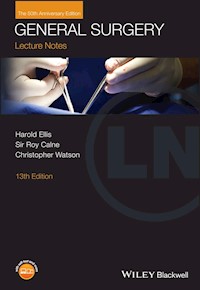
THE 'GOLDEN JUBILEE' EDITION OF A CLASSIC TEXTBOOK, FIRST PUBLISHED IN 1965
Highly Commended at the British Medical Association Book Awards 2016
General Surgery Lecture Notes continues to be an invaluable, appealing and approachable resource for thousands of medical students and surgical trainees throughout the world. This comprehensive guide focuses on the fundamentals of general surgery, and systematically covers all the clinical surgical problems that a student may encounter and about which they need to know.
Fully revised and updated to reflect the rapid changes which are taking place in surgical practice, this 50th anniversary edition:
- Includes principles of treatment written at student level to aid understanding
- Features full colour illustrations throughout
- Includes electronic access to a range of extra material including case studies, images and photographs, and biographies
- Includes free access to the Wiley E-Text
- Is a perfect review text for medical students as well as junior surgeons taking the MRCS examination and other postgraduate surgical examinations
Trusted by generations of medical students, the clinical emphasis of General Surgery Lecture Notes makes this an essential purchase for all those wishing to learn more about general surgery.
Sie lesen das E-Book in den Legimi-Apps auf:
Seitenzahl: 1092
Veröffentlichungsjahr: 2016
Ähnliche
















General Surgery
Lecture Notes
Harold Ellis
CBE DM MCh FRCS Emeritus Professor of Surgery, Guy’s Hospital, London
Sir Roy Calne
MS FRCS FRS Emeritus Professor of Surgery, Addenbrooke’s Hospital, Cambridge
Christopher Watson
MD BChir FRCS Professor of Transplantation and Honorary Consultant, Addenbrooke’s Hospital, Cambridge
Thirteenth Edition
This edition first published 2016 © 2016 by John Wiley & Sons, Ltd© 1965, 1968, 1970, 1972, 1977, 1983, 1987, 1993, 1998, 2002, 2006, 2011 by Harold Ellis,Sir Roy Y. Calne and Christopher J. E. Watson
Registered office: John Wiley & Sons, Ltd, The Atrium, Southern Gate, Chichester, West Sussex, PO19 8SQ, UK
Editorial offices: 9600 Garsington Road, Oxford, OX4 2DQ, UK 1606 Golden Aspen Drive, Suites 103 and 104, Ames, Iowa 50010, USA
For details of our global editorial offices, for customer services and for information about how to apply for permission to reuse the copyright material in this book please see our website at www.wiley.com/wiley-blackwell
The right of the author to be identified as the author of this work has been asserted in accordance with the UK Copyright, Designs and Patents Act 1988.
All rights reserved. No part of this publication may be reproduced, stored in a retrieval system, or transmitted, in any form or by any means, electronic, mechanical, photocopying, recording or otherwise, except as permitted by the UK Copyright, Designs and Patents Act 1988, without the prior permission of the publisher.
Designations used by companies to distinguish their products are often claimed as trademarks. All brand names and product names used in this book are trade names, service marks, trademarks or registered trademarks of their respective owners. The publisher is not associated with any product or vendor mentioned in this book. It is sold on the understanding that the publisher is not engaged in rendering professional services. If professional advice or other expert assistance is required, the services of a competent professional should be sought.
The contents of this work are intended to further general scientific research, understanding, and discussion only and are not intended and should not be relied upon as recommending or promoting a specific method, diagnosis, or treatment by health science practitioners for any particular patient. The publisher and the author make no representations or warranties with respect to the accuracy or completeness of the contents of this work and specifically disclaim all warranties, including without limitation any implied warranties of fitness for a particular purpose. In view of ongoing research, equipment modifications, changes in governmental regulations, and the constant flow of information relating to the use of medicines, equipment, and devices, the reader is urged to review and evaluate the information provided in the package insert or instructions for each medicine, equipment, or device for, among other things, any changes in the instructions or indication of usage and for added warnings and precautions. Readers should consult with a specialist where appropriate. The fact that an organization or website is referred to in this work as a citation and/or a potential source of further information does not mean that the author or the publisher endorses the information the organization or website may provide or recommendations it may make. Further, readers should be aware that internet websites listed in this work may have changed or disappeared between when this work was written and when it is read. No warranty may be created or extended by any promotional statements for this work. Neither the publisher nor the author shall be liable for any damages arising herefrom.
Library of Congress Cataloging-in-Publication DataEllis, Harold, 1926-, author. Lecture notes. General surgery / Harold Ellis, Sir Roy Calne, Christopher Watson. – Thirteenth edition. p. ; cm. General surgery Includes bibliographical references and index. ISBN 978-1-118-74205-1 (pbk.) I. Calne, Roy Yorke, author. II. Watson, Christopher J. E. (Christopher John Edward), author. III. Title.IV. Title: General surgery. [DNLM: 1. Surgical Procedures, Operative. WO 500] RD31 617–dc23
2015024747
A catalogue record for this book is available from the British Library.
Wiley also publishes its books in a variety of electronic formats. Some content that appears in print may not be available in electronic books.
Cover image: © Getty Images/annedde
CONTENTS
Preface
Acknowledgements
Abbreviations
The anytime, anywhere textbook
About the companion website
1: Surgical strategy
History and examination
Writing your notes
Case presentation
2: Fluid and nutrition management
Body fluid compartments
Fluid and electrolyte losses
Normal fluid losses (Table 2.1)
Abnormal fluid losses
Effects of surgery
Prescribing fluids for the surgical patient
Nutrition
Notes
3: Preoperative assessment
Patient assessment
Management of pre-existing medical conditions
4: Postoperative complications
Classification
Wound infection
Antibiotic-associated enterocolitis: Clostridium difficile
Meticillin-resistant Staphylococcus aureus
Other multiresistant organisms of significance
Pulmonary collapse and infection
Deep vein thrombosis in the lower limb
Pulmonary embolus
Burst abdomen
Postoperative fistula
Postoperative pyrexia
Complications of minimally invasive surgery
Additional resources
Notes
5: Acute infections
Cellulitis
Abscess
Boil
Carbuncle
Specific infections
Additional resources
Notes
6: Tumours
Pathology
Clinical features and diagnosis
History
Examination
Special investigations
Tumour markers
Treatment
Notes
7: Shock
Aetiology
Normal regulation of tissue perfusion
Abnormal regulation of tissue perfusion
Special causes of shock
Sequelae of shock
Principles in the management of patients in shock
Notes
8: Burns
Causes
Severity
Clinical features
Treatment
Complications
Prognosis
Additional resources
Notes
9: The skin and its adnexae
Sebaceous cyst
Dermoid cyst
Verruca vulgaris (wart)
Keratoacanthoma (molluscum sebaceum)
Ganglion
Pilonidal sinus
The nails
Tumours of the skin and subcutaneous tissues
Additional resources
Notes
10: The chest and lungs
Injury to the chest
Fractures of the ribs
Lung abscess
Empyema
Lung tumours
Secondary tumours
Additional resources
Notes
11: The heart and thoracic aorta
Cardiopulmonary bypass
Valvular disease
Aortic stenosis
Mitral regurgitation
Mitral stenosis
Ischaemic heart disease
Thoracic aortic disease
Notes
12: Arterial disease
Arterial trauma
Aneurysm
Abdominal aortic aneurysm
Ruptured abdominal aortic aneurysm
Acute aortic expansion
Popliteal aneurysm
Assessing the patient with arterial disease
Atherosclerotic arterial disease
Atherosclerotic occlusive arterial disease
Coronary occlusive disease
Mesenteric occlusive disease
Cerebral occlusive disease
Intermittent claudication
Critical ischaemia
Carotid artery disease (Figure 12.3)
Raynaud’s disease and Raynaud’s phenomenon7
Buerger’s disease
Embolism (Figure 12.4)
Cold injury
Additional resources
Notes
13: Venous disorders of the lower limb
Anatomy of the venous drainage of the lower limb
Pathology of venous disease
Varicose veins
Complications of varicose veins
Deep venous insufficiency
Venous ulceration
Deep vein thrombosis
Additional resources
Notes
14: The brain and meninges
Space-occupying intracranial lesions
Intracranial tumours
Intracranial abscess
Intracranial vascular lesions
Hydrocephalus
Additional resources
Notes
15: Head injury
Types of injury
Brain injuries
Cerebral perfusion
Management of the patient with a head injury
Indications for surgery in head injuries
Traumatic intracranial bleeding
Other complications
Brain death
Additional resources
Notes
16: The spine
Spina bifida (Figure 16.1)
Spinal injuries
Degenerative spinal disorders
Cervical spondylosis
Epidural spinal abscess
Spinal tumours
Additional resources
Notes
17: Peripheral nerve injuries
Classification
Special investigation
Treatment
Brachial plexus injuries
Radial nerve injuries (Figure 17.1a)
Median nerve injuries (Figure 17.1b)
Median nerve compression at the wrist (carpal tunnel syndrome)
Ulnar nerve injuries (Figure 17.2)
Ulnar nerve compression at the elbow (cubital tunnel syndrome)
Differential diagnosis of flexion deformities of the fingers
Sciatic nerve injuries
Common peroneal nerve injuries
Lateral cutaneous nerve of the thigh compression: meralgia paraesthetica
Cervical sympathetic nerve injuries: Horner’s syndrome7
Additional resources
Notes
18: The oral cavity
The lips
Ulcers in the mouth
Other lesions within the mouth
Malignant disease of the mouth and pharynx
Carcinoma of the lip
Carcinoma of the tongue
Carcinoma of the soft palate and fauces
Carcinoma of the hard palate
Carcinoma of the floor of the mouth, alveolus and cheek
Carcinoma of the tonsil
Carcinoma of the nasopharynx
Carcinoma of the oro- and laryngopharynx
Tumours of the jaw
Tumours of the bone
Ameloblastoma (adamantinoma)
Surface tumours
Antral tumours
Additional resources
Notes
19: The salivary glands
Inflammation
Mumps
Acute bacterial parotitis
Chronic recurrent parotid sialadenitis
Mikulicz’s syndrome
Calculi
Salivary tumours
Adenolymphoma
Carcinoma
Additional resources
Notes
20: The oesophagus
Dysphagia
Perforations of the oesophagus
Caustic stricture of the oesophagus
Achalasia of the cardia
Plummer–Vinson syndrome6
Oesophageal diverticula
Pharyngeal pouch
Reflux oesophagitis
Tumours of the oesophagus
Carcinoma
Barrett’s oesophagus8 and adenocarcinoma
Additional resources
Notes
21: The stomach and duodenum
Congenital hypertrophic pyloric stenosis
Duodenal atresia
Peptic ulcer
The acute peptic ulcer
The chronic peptic ulcer
Perforated peptic ulcer
Pyloric stenosis
Gastrointestinal haemorrhage
Tumours of the stomach
Gastrointestinal stromal tumours
Carcinoma
Bariatric surgery
Additional resources
Notes
22: Mechanical intestinal obstruction
Mechanical obstruction
Closed loop obstruction
Adhesive obstruction
Volvulus
Mesenteric vascular occlusions
Neonatal intestinal obstruction
Intussusception
Additional resources
Notes
23: Paralytic ileus
Aetiology
Peritonitis
Pseudo-obstruction
Note
24: The small intestine
Meckel’s diverticulum
Crohn’s disease
Tumours of the small intestine
Carcinoid syndrome
Additional resources
Notes
25: Acute appendicitis
Pathology
Clinical features
Treatment
The appendix mass (Box 25.1)
Appendicitis in pregnancy
Additional resources
Notes
26: The colon
Constipation and diarrhoea
Diverticulosis and diverticulitis
Angiodysplasia
Colitis
Tumours
Colostomy
Additional resources
Notes
27: The rectum and anal canal
Bright red rectal bleeding (Table 27.1)
Haemorrhoids (piles)
Perianal haematoma
Fissure in ano
Anorectal abscesses
Fistula in ano
Stricture of the anal canal
Prolapse of the rectum
Pruritus ani
Tumours
Rectal polyps
Carcinoma of the rectum
Anal cancer
Additional resources
Notes
28: Peritonitis
General characteristics of peritonitis
Peritoneal dialysis peritonitis
Non-specific bacterial peritonitis
Pneumococcal peritonitis
Haemolytic streptococcal peritonitis
Staphylococcal peritonitis
Tuberculous peritonitis
Bile peritonitis
Localized intraperitoneal collections of pus
Subphrenic abscess
Pelvic abscess
Notes
29: Hernia
Definition
Abdominal wall hernias
Inguinal hernia
Femoral hernia
Richter’s hernia
Umbilical hernia
Congenital umbilical hernia
Paraumbilical hernia
Divarication of the recti
Epigastric hernia
Incisional hernia
Unusual hernias
Diaphragmatic hernias
Reflux oesophagitis
Additional resources
Notes
30: The liver
Liver enlargement
Jaundice
Congenital abnormalities
Liver trauma
Acute infections of the liver
Hydatid disease of the liver
Cirrhosis
The effects of liver failure
Liver neoplasms
Liver surgery
Additional resources
Notes
31: The gallbladder and bile ducts
Congenital anomalies
Cholelithiasis (gallstones)
Bile composition and function
Gallbladder physiology
Gallstone types
Clinical manifestations of gallstones
Gallbladder polyps
Carcinoma of the gallbladder
Cholangiocarcinoma
Additional resources
Notes
32: The pancreas
Congenital anomalies
Acute pancreatitis
Severe acute pancreatitis
Chronic pancreatitis
Pancreatic cysts
Lesen Sie weiter in der vollständigen Ausgabe!
Lesen Sie weiter in der vollständigen Ausgabe!
Lesen Sie weiter in der vollständigen Ausgabe!
Lesen Sie weiter in der vollständigen Ausgabe!
Lesen Sie weiter in der vollständigen Ausgabe!
Lesen Sie weiter in der vollständigen Ausgabe!
Lesen Sie weiter in der vollständigen Ausgabe!
Lesen Sie weiter in der vollständigen Ausgabe!
Lesen Sie weiter in der vollständigen Ausgabe!
Lesen Sie weiter in der vollständigen Ausgabe!
Lesen Sie weiter in der vollständigen Ausgabe!
Lesen Sie weiter in der vollständigen Ausgabe!
Lesen Sie weiter in der vollständigen Ausgabe!
Lesen Sie weiter in der vollständigen Ausgabe!
Lesen Sie weiter in der vollständigen Ausgabe!
Lesen Sie weiter in der vollständigen Ausgabe!
Lesen Sie weiter in der vollständigen Ausgabe!
Lesen Sie weiter in der vollständigen Ausgabe!
Lesen Sie weiter in der vollständigen Ausgabe!
Lesen Sie weiter in der vollständigen Ausgabe!
Lesen Sie weiter in der vollständigen Ausgabe!
Lesen Sie weiter in der vollständigen Ausgabe!
Lesen Sie weiter in der vollständigen Ausgabe!
Lesen Sie weiter in der vollständigen Ausgabe!
Lesen Sie weiter in der vollständigen Ausgabe!
Lesen Sie weiter in der vollständigen Ausgabe!
Lesen Sie weiter in der vollständigen Ausgabe!
Lesen Sie weiter in der vollständigen Ausgabe!
Lesen Sie weiter in der vollständigen Ausgabe!
Lesen Sie weiter in der vollständigen Ausgabe!
Lesen Sie weiter in der vollständigen Ausgabe!
Lesen Sie weiter in der vollständigen Ausgabe!
Lesen Sie weiter in der vollständigen Ausgabe!
Lesen Sie weiter in der vollständigen Ausgabe!
Lesen Sie weiter in der vollständigen Ausgabe!
Lesen Sie weiter in der vollständigen Ausgabe!
Lesen Sie weiter in der vollständigen Ausgabe!
Lesen Sie weiter in der vollständigen Ausgabe!
Lesen Sie weiter in der vollständigen Ausgabe!
Lesen Sie weiter in der vollständigen Ausgabe!
Lesen Sie weiter in der vollständigen Ausgabe!
Lesen Sie weiter in der vollständigen Ausgabe!
Lesen Sie weiter in der vollständigen Ausgabe!
Lesen Sie weiter in der vollständigen Ausgabe!
Lesen Sie weiter in der vollständigen Ausgabe!
Lesen Sie weiter in der vollständigen Ausgabe!
Lesen Sie weiter in der vollständigen Ausgabe!
Lesen Sie weiter in der vollständigen Ausgabe!
Lesen Sie weiter in der vollständigen Ausgabe!
Lesen Sie weiter in der vollständigen Ausgabe!
Lesen Sie weiter in der vollständigen Ausgabe!
Lesen Sie weiter in der vollständigen Ausgabe!
Lesen Sie weiter in der vollständigen Ausgabe!
Lesen Sie weiter in der vollständigen Ausgabe!
Lesen Sie weiter in der vollständigen Ausgabe!
Lesen Sie weiter in der vollständigen Ausgabe!
Lesen Sie weiter in der vollständigen Ausgabe!




